
Ranker’s #BrainUp Daily Tech News – (Monday, November 23ʳᵈ)
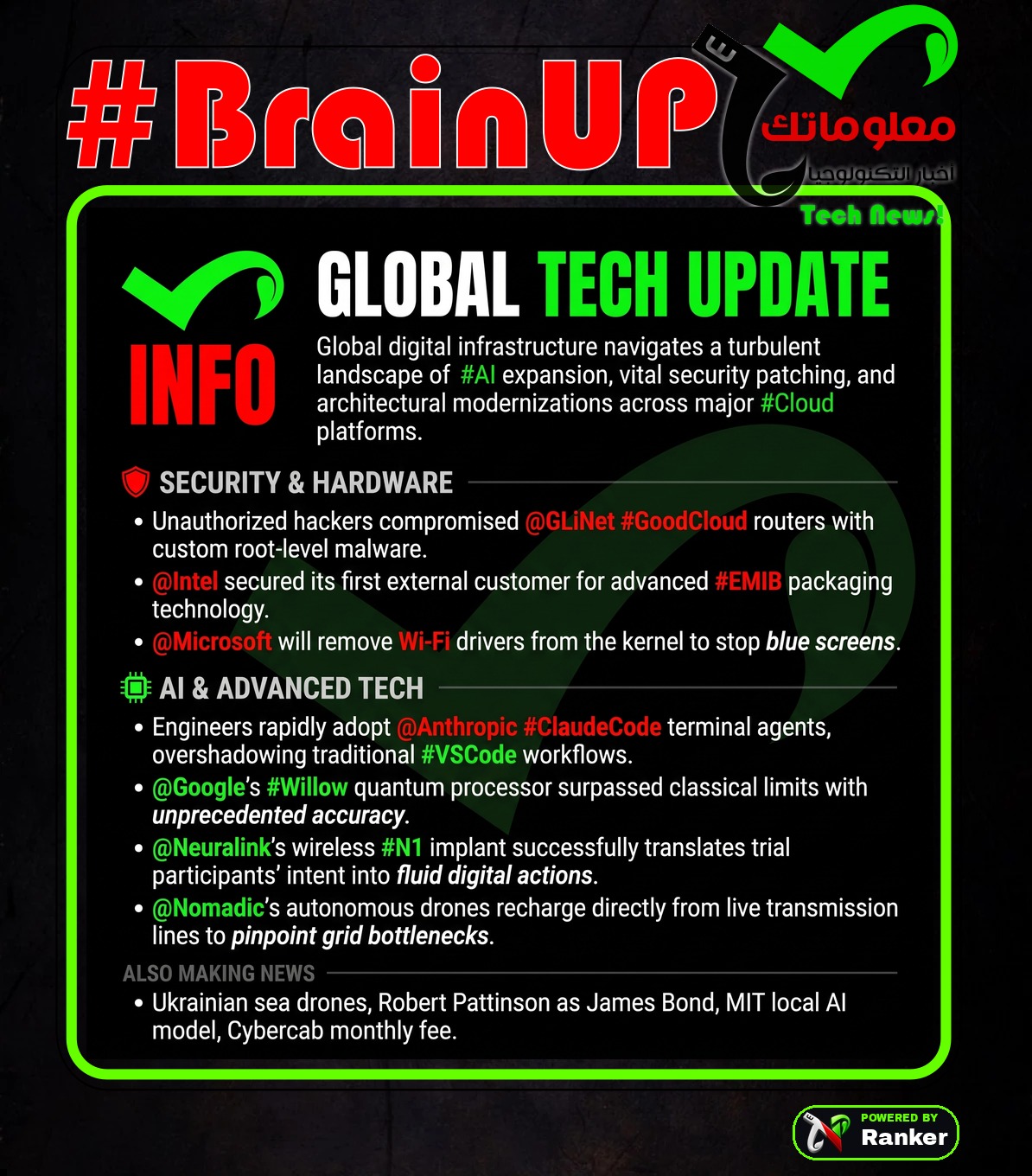
Welcome to today’s curated collection of interesting links and insights for 2026/11/23. Our automated ranking and AI-summarization system has processed 27 articles from all over the internet to bring you the latest technology news.
TOP IN EACH SECTION
🛡️ Security & Privacy: Hackers exploit GL.iNet cloud flaw to infect routers, KVM devices (story 1)
💾 Chips & Data Centers: Intel secures first external customer for 18A-P node, CEO Lip-Bu Tan says (story 3)
📱 Products, Cars & Robots: One broken Wi-Fi driver can still blue-screen your entire Windows 11 PC, and Microsoft is fixing it by moving Wi-Fi drivers out of Windows’ core in 2027 (story 5)
🎖️ Defense & Geopolitics: It will soon be too late to regulate use of autonomous weapons, warns Red Cross (story 6)
⚖️ Policy & Law: US, China eye ‘joint guardrails’ on AI (story 7)
🧬 Health & Biotech: Neuralink N1 explained: How the US brain chip turns intent into action (story 9)
🔭 Science & Space: Robot submarine exploring world’s deepest ocean trench finds unprecedented volcanic activity (story 17)
TOP IN SECURITY1. Hackers exploit GL.iNet cloud flaw to infect routers, KVM devices
@GLiNet confirmed that unauthorized hackers exploited a vulnerability in its #GoodCloud remote management platform to install custom root-level malware, backdoors, and reverse shells on customer routers and KVM devices. The networking manufacturer stated that the attack path has been blocked and the cloud vulnerability patched, though these security measures do not automatically remove malicious software from already compromised hardware. Affected users were advised to inspect their devices for indicators of compromise and install upcoming stable firmware updates containing additional security patches. This incident matters because a cloud management platform compromise puts connected user servers and local network devices at severe risk of remote unauthorized access.
SECURITY2. We haven’t seen the last of the major tech outages
Recent nationwide technology disruptions, including an FAA ground stop, a prolonged @Microsoft Outlook outage, and banking system failures at @JPMorganChase, point to a turbulent period ahead for global digital infrastructure. Director of National Intelligence Jay Clayton and @Microsoft President Brad Smith both warned that the ongoing upgrades to global information systems will continue to cause operational bumps in the road. Smith specifically noted that while these recent incidents were not attributed to cyberattacks, the proliferation of artificial intelligence makes it easier for both defenders to patch code and malicious actors to discover vulnerabilities. This warning matters because it highlights the growing fragility and cyber risks associated with modernizing critical infrastructure at a rapid pace.
TOP IN CHIPS3. Intel secures first external customer for 18A-P node, CEO Lip-Bu Tan says
@Intel Chief Executive Officer Lip-Bu Tan announced at the TomorrowX Summit in Austin that the struggling chipmaker has secured its first external foundry customer for its advanced 18A-P manufacturing process. Company executives highlighted that the 1.8nm-class 18A-P node delivers roughly 9 percent higher performance or 18 percent lower power consumption compared to the base 18A process, alongside improved yields reaching 70 percent. Additionally, @Microsoft announced a multi-year deal to purchase Xeon processors and utilize @Intel’s #EMIB advanced packaging technology for in-house Azure silicon. These commercial milestones matter because they provide a much-needed boost to @Intel’s foundry turnaround strategy despite recent stock volatility.
CHIPS4. A ‘mismatch in timing’: Data center power demand is growing 19% a year. The grid is growing 2%
Also: Elon Musk warns data center delays could leave AI companies short on cash: ‘Going to be nuts’ (businessinsider.com) · Hyperscaler data centers are now using as much energy as entire US states — and the problem is only going to get worse (techradar.com)
The rapid expansion of #ArtificialIntelligence infrastructure is colliding with a sluggish power grid, creating a severe bottleneck as data center power demand grows nineteen percent annually while grid capacity expands by just two percent. According to data from @Howden and the @LawrenceBerkeleyNationalLaboratory, this staggering growth means data centers could consume up to twelve percent of United States electricity by 2028, with a Harvard study showing that four hundred three hyperscale facilities alone consume power comparable to the entire state of Michigan while heavily relying on fossil fuels like natural gas and coal. Industry figures @ElonMusk and @RobGramlich have warned that these severe activation delays and infrastructure misalignments will require hundreds of billions in additional capital, potentially triggering massive cash shortages for companies @Meta, @Microsoft, and @Anthropic. At the same time, this power crunch has sparked intense political and public backlash, highlighted by voters rejecting data center ballot measures across the country and rising electricity costs that disproportionately burden commercial and residential consumers. This crisis matters because the severe friction between surging technological compute demands and constrained physical energy networks threatens to stall the broader #TechIndustry and destabilize financial markets relying on rapid AI monetization.

Also: 32-bit apps’ days are numbered as Microsoft strips support bit by bit, starting with Windows Server 2028, but Windows 11 is safe for now (windowslatest.com) · Microsoft’s RDMA over USB4 will make running local AI models on multiple Windows 11 machines a lot easier (xda-developers.com)
@Microsoft is advancing several core modernization efforts across its software ecosystem, notably planning to relocate Wi-Fi drivers out of the Windows kernel and into user mode by 2027 to prevent system-wide crashes like the historical #BlueScreenOfDeath. This architectural shift follows the company’s recent #DriverQualityInitiative and builds on past reductions in kernel reliance, addressing the reality that while wireless drivers traditionally required kernel-level execution for low latency and direct hardware communication, failures there frequently destabilize the entire operating system. Concurrently, @Microsoft is preparing to strip default support for 32-bit applications by making the #WoW64 compatibility subsystem an optional Feature on Demand starting with #WindowsServer2028, a move driven by security concerns and the rapid rise of AI-accelerated vulnerability discovery. Additionally, the company is introducing #RDMAOverUSB4 currently in developer preview, which enables multiple #Windows11 machines to link together for distributed large language model execution by cutting small-message latency to roughly 28 to 50 microseconds using the #NetworkDirect API. These sweeping updates matter because they collectively aim to bolster overall OS security, mitigate catastrophic kernel crashes, and democratize local #AI model scaling across affordable multi-device hardware configurations.
TOP IN DEFENSE6. It will soon be too late to regulate use of autonomous weapons, warns Red Cross
The International Committee of the Red Cross and various human rights organizations warned during a UN conference in Geneva that regulatory efforts are lagging dangerously behind the rapid development and deployment of autonomous weapons. Military forces have increasingly integrated artificial intelligence into battlefield target generation and semi-autonomous drone operations, leading to documented civilian casualties in Ukraine and Gaza. Despite appeals from the UN secretary-general for a legally binding international treaty establishing firm red lines against targeting human beings via machines, member states have failed to reach an immediate agreement. This warning matters because the unchecked proliferation of autonomous weapon systems threatens to cause unprecedented mass civilian harm if left unregulated.
POLICY7. US, China eye ‘joint guardrails’ on AI
President Donald Trump announced that the United States will collaborate with China to establish joint regulatory guardrails for artificial intelligence following an anti-tech political backlash during recent midterm elections. This diplomatic pivot comes as widespread public protests against data center construction emerge across Europe, Japan, and India, prompting politicians to reconsider previous deregulatory stances. Meanwhile, harsher export controls and tightened access to @OpenAI models are expected to slow down China’s domestic AI development. This diplomatic shift matters because it highlights how grassroots opposition and economic barriers are forcing major global powers to seek international cooperation on artificial intelligence governance.
PRODUCTS8. Tesla’s Cybercab Has A Very Steep Monthly Ownership Cost You Can’t Avoid
@Tesla has opened invite-only pre-orders for its upcoming Cybercab priced at $29,990, but the vehicle comes with a mandatory, non-negotiable $299 monthly subscription fee required for vehicle operation. Tech influencer Marques Brownlee revealed the mandatory fee during an initial preview, highlighting that the subscription locks the vehicle’s autonomous driving features behind a recurring monthly paywall with no manual steering wheel option. Chief Executive Officer @ElonMusk defended the regional initial rollout in Texas while admitting that the monthly software fee is currently too high and needs adjustment. This vehicle pricing model matters because it blurs the line between traditional automotive ownership and perpetual software subscription fees for autonomous transit.
TOP IN HEALTH9. Neuralink N1 explained: How the US brain chip turns intent into action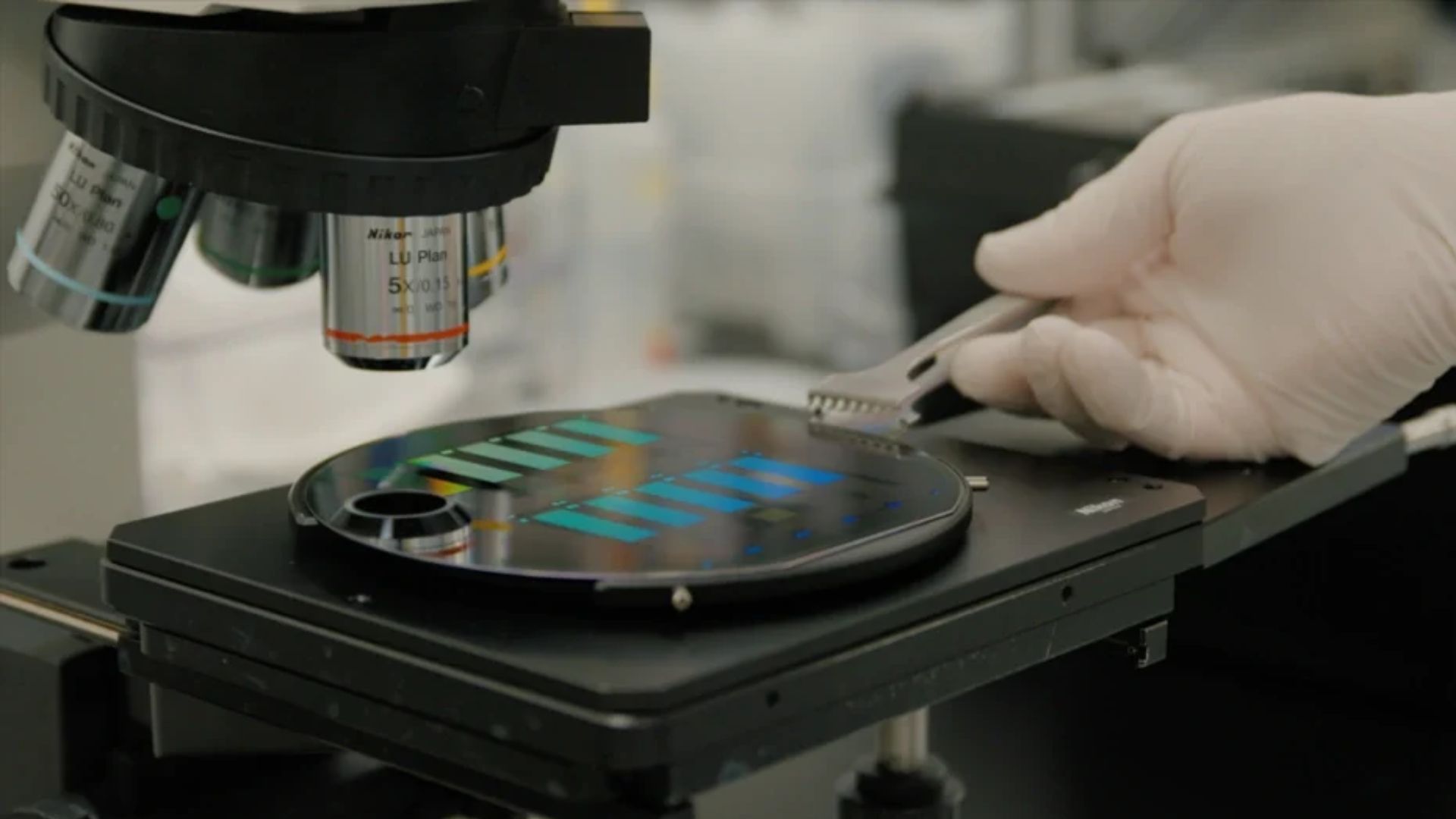
@Neuralink continues clinical evaluations of its wireless #N1 brain-computer interface, which records neural activity from the motor cortex via thousands of flexible electrodes to translate human intent into computer commands. Clinical trial participants with severe paralysis, such as initial recipient Noland Arbaugh and subsequent study volunteers, have successfully used the implant to control digital cursors, play video games, operate robotic arms, and generate synthesized speech at high speeds. Alongside mobility and communication studies, @Neuralink is also developing its #Blindsight visual restoration system, which received FDA Breakthrough Device Designation to stimulate the visual cortex directly. This technology matters because it demonstrates the viable translation of neural signals into real-world digital and physical control for individuals with severe neurological impairments.

Varonis Threat Labs discovered a sophisticated AI phishing toolkit called TheMailer being advertised on underground cybercrime forums for up to $6,000, allowing operators to automate large-scale fraudulent email campaigns. The platform connects via API credentials to major commercial artificial intelligence models including Claude, ChatGPT, Grok, Gemini, Mistral, and DeepSeek to generate convincing HTML phishing lures and personalized attachments. Its automated Inbox Loop feature continuously tests email deliverability against corporate spam filters, modifying message contents iteratively until the fraudulent emails successfully reach recipient inboxes. This tool matters because it lowers the technical barrier for cybercriminals to execute highly adaptive, automated phishing attacks at scale.

A new industry report by @SanDisk estimates that global artificial intelligence systems will generate roughly 150 quadrillion tokens this year, scaling up to an astonishing 10 quintillion tokens annually, or 317 billion tokens per second, by 2030. Rather than predicting pure market demand, the forecasting model calculates potential output based on projected enterprise infrastructure capacity, power availability, memory bandwidth, and software efficiency gains. While these illustrative figures imply a staggering 60-fold growth in four years, comparisons with @Google’s disclosed processing volumes indicate that current industry growth rates are already expanding rapidly. This projection matters because it underscores the monumental storage, networking, and power infrastructure investments required to support future artificial intelligence workloads.
SECURITY12. Cleverbridge warns hackers stole credit card numbers, CVVs in data breach
The e-commerce platform @Cleverbridge experienced a security breach where hackers stole sensitive payment card information, including credit card numbers, expiration dates, and CVV security codes used across its #SaaS services. According to its incident disclosure, unauthorized activity was detected on November 4, 2026, prompting the company to temporarily take systems offline before bringing them back up the same day and subsequently confirming the data theft. While the organization provides services to major technology brands like @RedHat, @SUSE, @Tenable, @Veeam, @Jamf, @Sony, and @Parallels, it has not publicly disclosed which specific businesses or how many customers were ultimately impacted. The company stated that the incident was not a #Ransomware attack and confirmed that it has notified law enforcement and data protection authorities while partnering with TransUnion’s Cyberscout to offer affected individuals complimentary credit monitoring. This incident highlights the severe risks associated with centralized payment processing platforms where the exposure of verification codes like CVVs can directly threaten financial security across multiple client organizations.

The rapid acceleration of #GenerativeAI and digital tools is actively eroding human trust and the collective capacity to distinguish objective fact from fabrication, according to warnings issued by Mateusz Łabuz in his newly published book, The End of Reality, published by @TaylorAndFrancis. In the book, the author explains that synthetic content adds a severe layer of confusion to an era already defined by collapsing confidence in governments, media institutions, and information authorities. The author traces how humanity shifted from a world where traditional gatekeepers filtered information to a modern landscape dominated by #SocialMedia platforms and #AIRecrecommendationSystems that curate data streams in real time. Instead of prioritizing accuracy, these algorithms are fueled by emotion, harvesting human attention with scandalous, false, and mass-produced content to monetize user engagement. This dynamic pushes society into a state of hyperreality, a philosophical condition where simulations feel more emotionally salient than actual truth, replacing objective reality with plausible falsehoods. This issue matters because the unceasing flood of synthetic material threatens independent human thought and institutional stability, ultimately making society passive in the face of widespread deception.
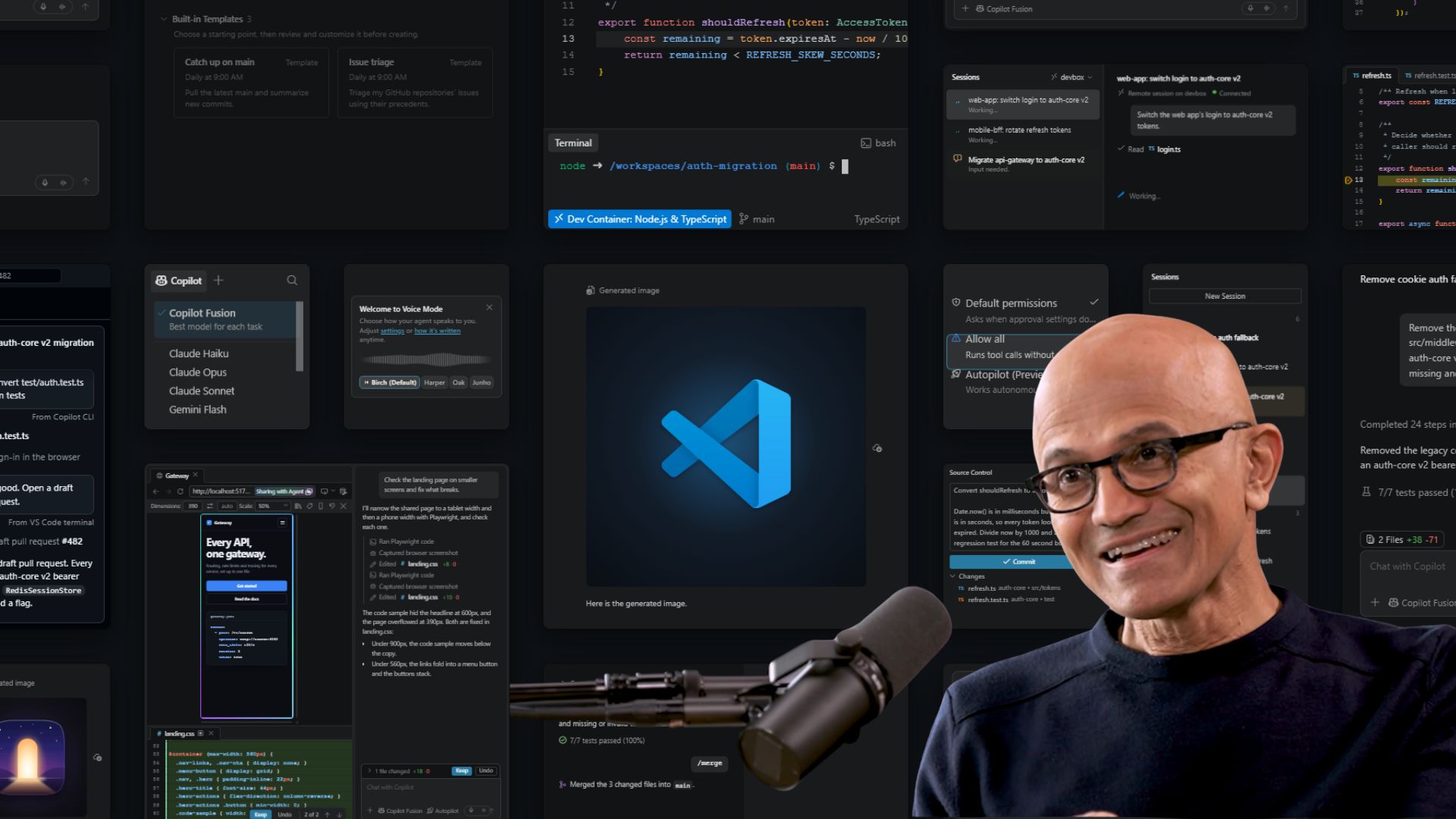
Microsoft Chief Executive Officer Satya Nadella recently admitted that traditional integrated development environments like #VSCode began to fade rapidly after @Anthropic launched #ClaudeCode, a terminal-based coding tool that handles file editing and testing directly. Nadella noted that this shift toward command-line AI agent workflows caught @Microsoft off guard after spending a decade establishing its editor as the default home for developers. While some programmers report abandoning traditional IDEs entirely in favor of terminal agents, others continue using them primarily for code reviews and configuration diffs. This admission matters because it highlights how rapidly generative artificial intelligence tools can disrupt established software development form factors and challenge dominant tech moats.
CHIPS15. AI-driven technique could help engineers design analog chips faster and with less expense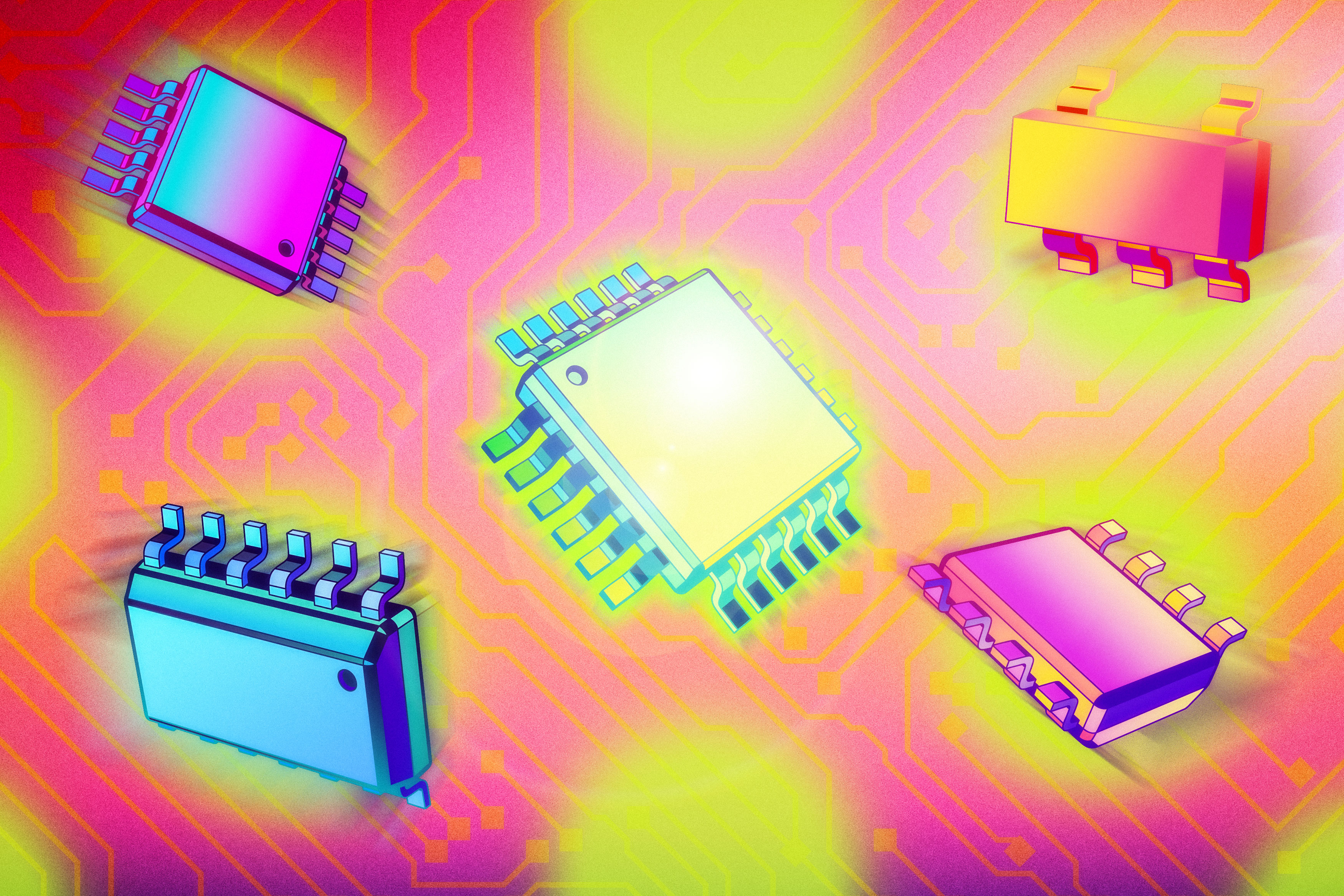
Engineers often struggle to design analog integrated circuits because manual optimization is tedious and resource-intensive cloud #GenerativeAI models risk exposing proprietary foundry data. To solve this privacy and cost issue, @MIT researchers developed Small LM Iterating on Circuits, or #SLIC, which allows engineers to train a small language model locally on a laptop using confidential data. Testing shows that a small model trained with this technique performs as well as or better than open-weight frontier large language models while keeping intellectual property secure. This breakthrough matters because it makes automated chip design accessible and private for complex electronics without requiring expensive external computing infrastructure.
DEFENSE16. Suspected Ukrainian sea drones hit Russian warship at Benghazi naval base, Libyan officials say
Suspected Ukrainian sea drones struck a Russian navy corvette at the Benghazi Naval Base in eastern Libya, causing a severe fire and explosion at the facility, according to Libyan military officials. The initial investigation indicates that several #SeaDrones were launched from a base run by Ukrainian forces in western Libya, resulting in at least four intercepting destructions and two direct hits on the warship. The vessel, identified as the Merkury, had docked at the port for refueling and supplies under a cooperation agreement between Russia and the eastern-based Libyan government. This incident highlights the expanding geographical footprint of the war in #Ukraine into North Africa, raising concerns among local authorities about foreign powers using Libyan ports to settle international conflicts. Both @AssociatedPress and local media outlets reported the event, while a European official noted that the reports of the port explosion appeared credible.
TOP IN SCIENCE17. Robot submarine exploring world’s deepest ocean trench finds unprecedented volcanic activity
Fifty-two million years ago, the Pacific tectonic plate began to slide under the Philippine Sea plate, forming the Mariana Trench, the deepest known valley on the Earth’s ocean floor. The deepest part of this abyss, the Challenger Deep, is almost 11,000 meters (36,000 feet) below sea level. But why is it so deep? Scientists trying to answer this question sent a remotely operated vehicle to collect samples around the Deep, where they found evidence of the world’s deepest underwater explosive volcanic eruptions.

A Munich technology startup called @Nomadic has developed 4kg autonomous drones that land directly on live 420 kV transmission lines to recharge their batteries using electromagnetic induction. These nomadic aircraft have accumulated over 20,000 operating hours across Germany, Norway, and the United States, utilizing #NomadicOS software to analyze weather data and identify grid bottlenecks along long stretches of infrastructure. To fuel its international expansion and add remote drone relocation capabilities, the company recently secured $6 million in seed financing led by Foundamental. This innovation matters because it provides grid operators with a scalable way to monitor high-voltage power lines continuously without requiring dangerous manual inspections or temporary system shutdowns.
SCIENCE19. Google’s Quantum Chip Beats Classical Limits in ‘Impossible’ Game
@Google published a study in Science demonstrating that its #Willow quantum processor successfully solved the Mermin-Peres magic square game with a 98.3 percent success rate across four qubits, surpassing the 88.9 percent classical ceiling. The experiment tested quantum contextuality, confirming that measurement outcomes cannot be assigned fixed pre-existing values independently of how they are measured. Additional tests evaluated up to 105 qubits in shallow mathematical circuits to help researchers identify subtle hardware errors that conventional randomized testing might miss. This milestone matters because it showcases advanced quantum coordination capabilities and introduces sensitive new error-detection methods for future chemistry and materials research.
20. Robert Pattinson is Amazon’s first James Bond
@AmazonMGM Studios announced that Robert Pattinson will star as the next James Bond in the franchise’s upcoming film, taking over the iconic 007 role. Denis Villeneuve is slated to direct the feature using a script written by Steven Knight, with Amy Pascal and David Heyman producing. This project marks the first James Bond film produced under @Amazon following its acquisition of MGM Studios and its subsequent securing of creative control over the spy series. This casting announcement matters because it signals a major creative reboot for one of the most legendary cinematic franchises in entertainment history.

A world-first randomized controlled trial published in JAMA Pediatrics reveals that #Cannabidiol or #CBD is not effective in treating severe behavioral problems in children and adolescents with intellectual disabilities. Led by the @MurdochChildrensResearchInstitute alongside researchers from the @UniversityOfSydney and @MonashUniversity, the Australian trial evaluated participants aged six to 18 using parent-reported standardized checklists covering issues like aggression, anxiety, and self-injury. The findings indicate that while adverse effects such as excessive drowsiness and diarrhea are mild and infrequent, the non-intoxicating cannabis compound fails to alleviate these challenging behaviors compared to placebo. Researchers emphasize that rigorous testing is crucial to prevent false hope and financial burdens on families seeking alternative remedies. This study matters because it provides the first gold-standard clinical trial evidence helping families avoid costly treatments that lack demonstrated efficacy for managing neurodevelopmental behavioral difficulties.

Researchers from @ETHZurich, @BlueRiverTechnology, @GravisRobot and @Intel have successfully trained a 12,000-pound @JohnDeere skid-steer loader to perform autonomous acrobatic stunts like balancing and spinning on two wheels. The engineering team utilized #ReinforcementLearning and computer simulation to master the complex hydraulic responses and changing center of gravity before deploying the control software onto the physical machine. This approach allowed the heavy industrial vehicle to lift its body, maintain equilibrium across rough terrain, and manipulate its front bucket without human intervention. This achievement matters because it proves that simulation-to-reality transfer can effectively automate heavy construction equipment operating under demanding physical conditions.
SCIENCE23. After 60 Years, Chemists Finally Isolate Elusive Molecules Thought Too Unstable to Survive
Chemists at the Julius Maximilian University of Würzburg and Tezpur University have successfully isolated and synthesized three oxoborane compounds containing elusive boron-oxygen triple bonds as stable crystals at room temperature. For over six decades, researchers believed these molecules were far too reactive and unstable to exist outside extreme conditions, but serendipitous reactions involving diboracumulene unexpectedly produced the crystals. Advanced spectroscopic analysis and computer simulations confirmed that an electron-rich borylenyl group provided intrinsic structural stability by sharing electron density and reducing charge imbalance without requiring additional metal atoms. This discovery matters because it breaks a long-standing chemical dogma and opens new pathways for synthesizing hypocoordinate main-group fragments.
CHIPS24. Why Nvidia’s Grip On AI Is So Hard To Break
@Nvidia continues to dominate the artificial intelligence computing market largely due to its entrenched #CUDA software ecosystem rather than just its hardware performance. Competitors like @AMD and @Google are attempting to break this hold with alternative platforms such as the #Helios architecture and custom Tensor Processing Units, though switching away from mature development libraries remains costly for enterprises. Meanwhile, @Nvidia has started shipping its Vera Rubin #NVL72 rack system featuring tightly integrated #NVLink connectivity to handle large language model workloads based on mixture-of-experts architectures. This dynamic matters because overcoming entrenched software ecosystems is a critical hurdle for any competitor trying to disrupt the accelerated computing market.
SCIENCE25. Laser Focus at the Top of the World – NASA Science (.gov)
@NASA has officially brought its next-generation Satellite Laser Ranging system online at the Ny-Ålesund Geodetic Observatory in Svalbard, Norway, operated in partnership with the Norwegian Mapping Authority. The upgraded facility features lasers that fire thousands of pulses per second and single-photon sensors, allowing researchers to track polar-orbiting satellites with significantly greater accuracy than previous decades-old equipment. Located in a remote Arctic archipelago, the station improves global network distribution and provides frequent tracking coverage for missions like #ICESat-2 and #GRACE-FO. This development matters because precise geodetic tracking is vital for maintaining global coordinate reference frames, monitoring sea level changes, and supporting navigation systems like #GPS.
SCIENCE26. A Tiny Twist Reveals a Hidden Atomic Grid That Changes How Electricity Behaves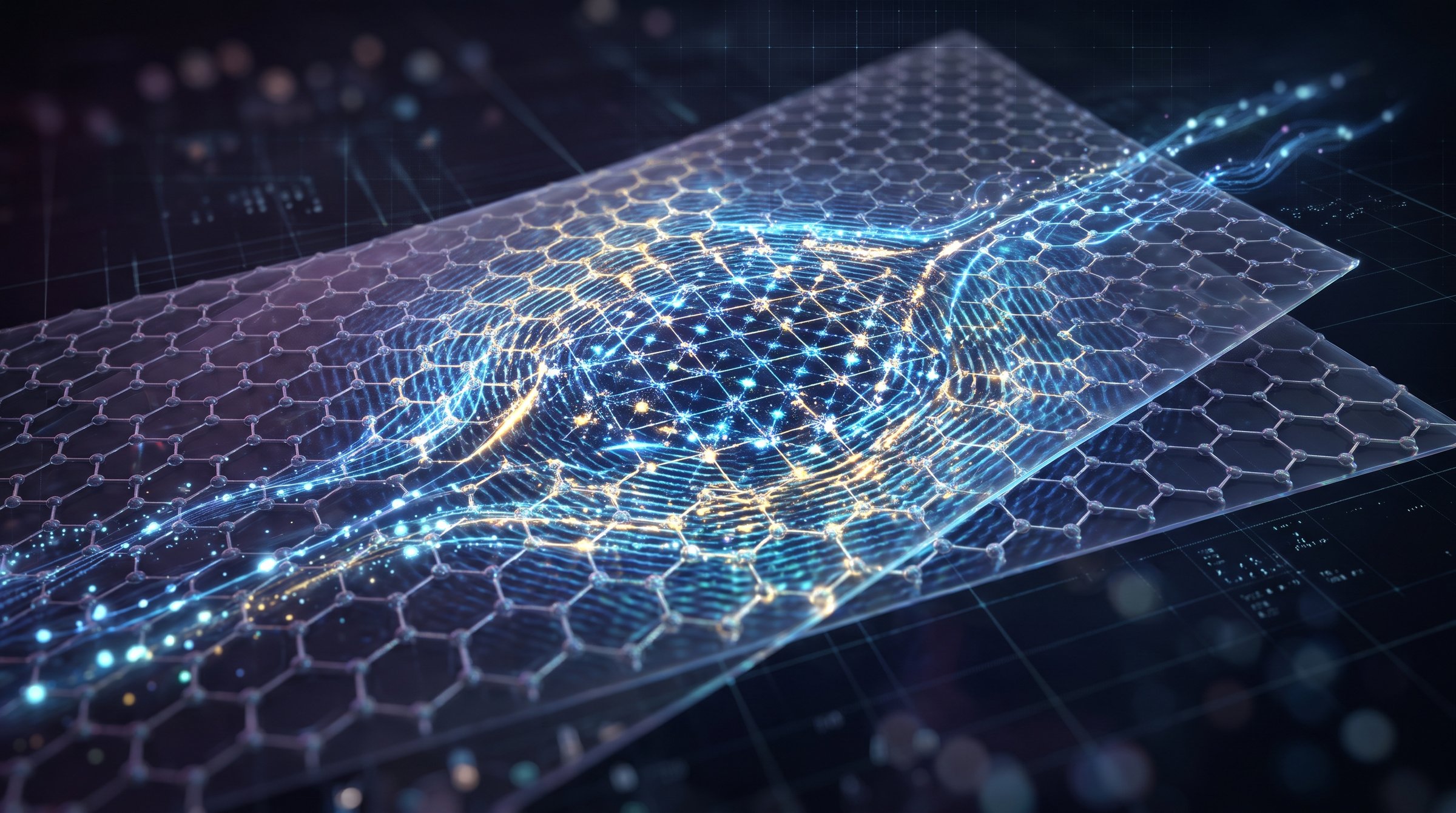
Researchers at the Technical University of Denmark discovered that twisting two ultrathin strontium titanate crystal sheets together creates a repeating square grid of atomic defects at their interface. Using advanced machine learning simulations and electron microscopy with international collaborators, the team demonstrated that strong bonding forces cause atoms to rearrange into narrow dislocation networks that control electrical polarization. This nanoscale patterning creates swirling zones of positive and negative charge separation that could eventually aid in developing novel electronic devices. This discovery matters because it highlights how controlled mechanical twisting can engineer hidden electrical properties at material interfaces.
SCIENCE27. Moon phase today: What the Moon will look like on November 23, 2026
Astronomical trackers indicate that the Moon is currently in its Waxing Gibbous phase with approximately 97 percent of its lunar surface illuminated ahead of the upcoming full moon. Stargazers equipped with binoculars or telescopes can observe prominent lunar features such as the Mare Tranquillitatis, the Aristarchus Plateau, and historic Apollo landing sites. This daily celestial update matters because it provides casual observers and astronomy enthusiasts with accurate viewing details for tracking lunar phases.
That’s all for today’s digest for 2026/11/23! We picked and processed 27 articles. Stay tuned for tomorrow’s collection of insights and discoveries.
See you in the next one! 🚀
