

When the Hacker Is an Agent: Cairn, a Zero-Day, and the Collapse of the Response Window
Key points
- Amazon Threat Intelligence found an exposed Cairn instance on September 10, 2026, revealing a roughly 48-hour campaign beginning September 8 against East Asian university IP addresses, with Simplified Chinese prompts and China Standard Time timestamps 1.
- The agents found a path traversal flaw in an open-source medical imaging application, went from API mapping to arbitrary file writes in about 11 minutes, and later gained a root reverse shell; the project maintainers have since shipped a fix 1 4.
- Two other operations failed but showed persistence: 148 actions over 16 hours against a Redis instance, and more than 30,000 credential attempts using about 80 researched usernames over 6+ hours 1.
- Google says it has for the first time seen attackers automating vulnerability discovery and exploitation with no human in the loop, while the European Commission confirmed a separate AI-assisted attack that disrupted its services 5 3.
A Goal, Not a Script
Amazon Threat Intelligence says it came across the campaign by accident of the operator’s carelessness. On September 10, 2026, it spotted a publicly reachable server running Cairn, an open-source autonomous AI penetration-testing framework, with no authentication. That exposed the platform’s whole history: project configurations, prompts, and AI output 1. The prompts were in Simplified Chinese and the script timestamps used China Standard Time. Combined with the targeting of universities in East Asia outside mainland China, Amazon assessed with moderate confidence that the actor is Chinese-nexus 1.
Cairn was built as a research and problem-solving engine for defenders. Give it a starting point and a plain-language objective and it coordinates multiple AI agents toward that goal. Here, the actor supplied IP addresses and variations of “obtain shell access,” and the agents planned, acted, and adjusted without the operator choosing each step 1 2.


Failures That Still Alarm
Most of the campaign did not succeed, and that is part of the story. Against a university Redis instance configured without authentication, the agents ran about 148 sequential actions over roughly 16 hours. They tried replication abuse, sandbox escapes, config file writes, memory corruption, and even Log4Shell against another service on the same system. They then used a server-side request forgery bug in a co-located Qdrant instance to map the internal Docker network and sprayed credentials at PostgreSQL, SSH, and others. Nothing worked 1.
A separate 6-hour-plus operation targeted a university GPU server. The agents compiled about 80 real usernames from faculty directories, lab sites, archived pages, and academic papers, then tried more than 30,000 credential combinations across SSH, an admin dashboard, a storage device, a VPN, and a campus portal. Again, no working login 1. Amazon’s point is about stamina: the agents ran without breaks, sleep, or working-hour limits.

The Zero-Day Moment
The outcome changed against a target running an open-source medical imaging AI application. The agents identified its framework, mapped API endpoints, found an upload endpoint with a filename parameter, and confirmed it was vulnerable to path traversal. About 11 minutes passed between mapping the API and writing arbitrary files 1. In a later session they wrote a Python reverse shell into sitecustomize.py, triggered a training endpoint to spawn a new Python process, and received a reverse shell running as root 1.
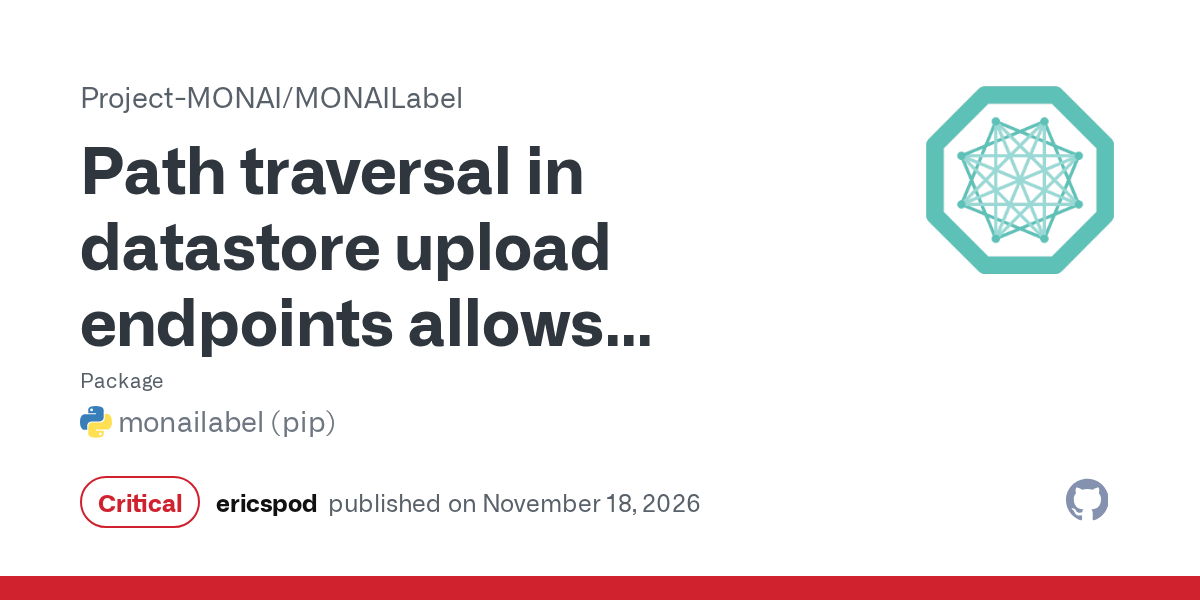
Amazon assessed with high confidence that this was a zero-day, since no fix, issue, advisory, or prior mention existed for the project. The public advisory on the MONAI Label repository describes the flaw: the PUT /datastore/image endpoint used a caller-controlled image parameter as an ID without validation, so a value such as a relative path could write uploaded content anywhere the process could write. Authentication is off by default, so any network client reaching the server could exploit it. Maintainers now reject paths outside the datastore and reduce IDs to their basename, with workarounds including enabling authentication and keeping servers off untrusted networks 4.
In a later session the human re-entered. The actor gave the agents a proxy tunneled into a second university network, apparently set up by exploiting the same flaw on a server running the same software, and directed them at other machines there 1 2. AWS notified the maintainers and, because the victims were not AWS customers, worked with a government partner to alert them. It declined to name the universities or country 1 2.
A Wider Wave of Agentic Attacks
Cairn is not an isolated case. Gambit Security documented a separate, financially motivated group using it against online retailers, so the framework is turning up in both espionage and crime 1. Gambit’s Eyal Sela argues Cairn may matter more than the similar Artex tool because it is general-purpose, with no internal cybersecurity structuring, which makes its behavior less predictable 2. Google researchers also reportedly saw Cairn in intrusions at U.S. aerospace companies 2.
Separately, Google Threat Intelligence Group reported that, for the first time, it had identified attackers using LLM frameworks to automate vulnerability discovery and exploitation without a human in the loop. It found an exposed staging server running a multi-agent framework that compared code before and after patch announcements, then generated and ran exploits. Google said exploited zero-days averaged 11 per month from January to August 2026, up from eight per month in 2025, hitting 22 in August 5. In a related development, the European Commission confirmed an AI-assisted attack detected October 22 that led it to take applications offline, though it reported no evidence of a data breach. It did not name the tool, but CERT-EU had recently warned about Artex 3.

What Defenders Should Do
Amazon’s core warning is tempo. An agent that finds and exploits a zero-day in minutes finishes before many security operations centers can manually triage an alert 1. Its advice is to favor high-confidence detections that trigger automated response, with humans overseeing outcomes rather than reviewing each action. AWS also says its honeypots and traffic analysis help restrict scanning activity at the network level at no extra cost to customers, and it published two IP indicators of compromise 1.
Practical lessons are modest but concrete: do not leave testing tools or internal services unauthenticated, enable authentication on tools that ship with it off, and patch fast, since Google notes attackers are shortening the gap between a patch and a working exploit 4 5.

Companies mentioned: Amazon (AMZN $246.82 ▼4.1%) • Google (GOOGL $265.29 ▼2.7%) • AWS
Primary sources
 Chinese-nexus actor’s Cairn AI agents found a zero-day on their own | Amazon Web Services (aws.amazon.com) – Amazon Threat Intelligence's primary report on the Cairn campaign. It describes finding an unauthenticated Cairn instance on September 10, 2026, a roughly 48-hour campaign from September 8 against East Asian university IPs, and the evidence for Chinese-nexus attribution. It details the failed 16-hour, 148-action Redis operation, the 6-hour GPU server credential attack with 30,000+ combinations and about 80 usernames, and the successful path traversal zero-day in a medical imaging app leading to a root reverse shell in about 11 minutes of API mapping to file write. It also covers the actor's later proxy use, the maintainer fix, government notification, Gambit's separate findings, defender guidance, and two IP indicators. Published on the AWS Security Blog.
Further sources
 Amazon says Chinese hackers used Cairn AI tool to discover apparent zero-day during attack on university (therecord.media) – The Record (Recorded Future News) report by Jonathan Greig recounts Amazon's findings via CJ Moses, including the 148 actions over 16 hours, the 30,000 credentials, the zero-day reused against a second university, and AWS declining to name the victims. It adds context: Artex warnings from the FBI, Microsoft and CERT-linked reporting, Google's report on Cairn in U.S. aerospace intrusions, and Gambit Security researcher Eyal Sela's view that Cairn's general-purpose design makes it less predictable than Artex.
 European Commission Confirms AI-Assisted Cyberattack Disrupted Services (securityweek.com) – SecurityWeek report on a related, separate incident: the European Commission confirmed an AI-assisted cyberattack detected October 22 and confirmed October 26, which led it to temporarily take down several applications, most since restored. No evidence of a data breach has been found. Politico reportedly cited disruptions to Sysper, MyPMO, and translation systems. The AI tool was not named, but CERT-EU had warned of Artex use about two weeks earlier.
Path traversal in datastore upload endpoints allows arbitrary file write (github.com) – GitHub security advisory for MONAI Label, originally reported by AWS's security team. It explains that the PUT /datastore/image endpoint used an unvalidated image query parameter as an ID, letting a traversal value write uploaded files anywhere the process can write, and that save_label has a similar issue. Authentication is off by default. It can lead to remote code execution or denial of service. The fix in pull request 1915 validates paths and reduces IDs to basenames, with workarounds: enable authentication, restrict network exposure, and run unprivileged.
 Google Says Hackers Use AI Agents to Find and Exploit Software Flaws (cointelegraph.com) – Cointelegraph's account of a Google Threat Intelligence Group report: for the first time GTIG saw attackers using LLM frameworks to fully automate vulnerability discovery and exploitation without a human in the loop, via an exposed staging server running a multi-agent framework doing differential analysis of patches. It cites rising zero-day exploitation (8 per month in 2025, 11 per month January to August 2026, 22 in August), rapid domain admin escalation in a PaperCut campaign, PHP flaws found with LLM analysis, and Anthropic's September warning about multi-agent attack operations.
 Powered by News Ranker
