
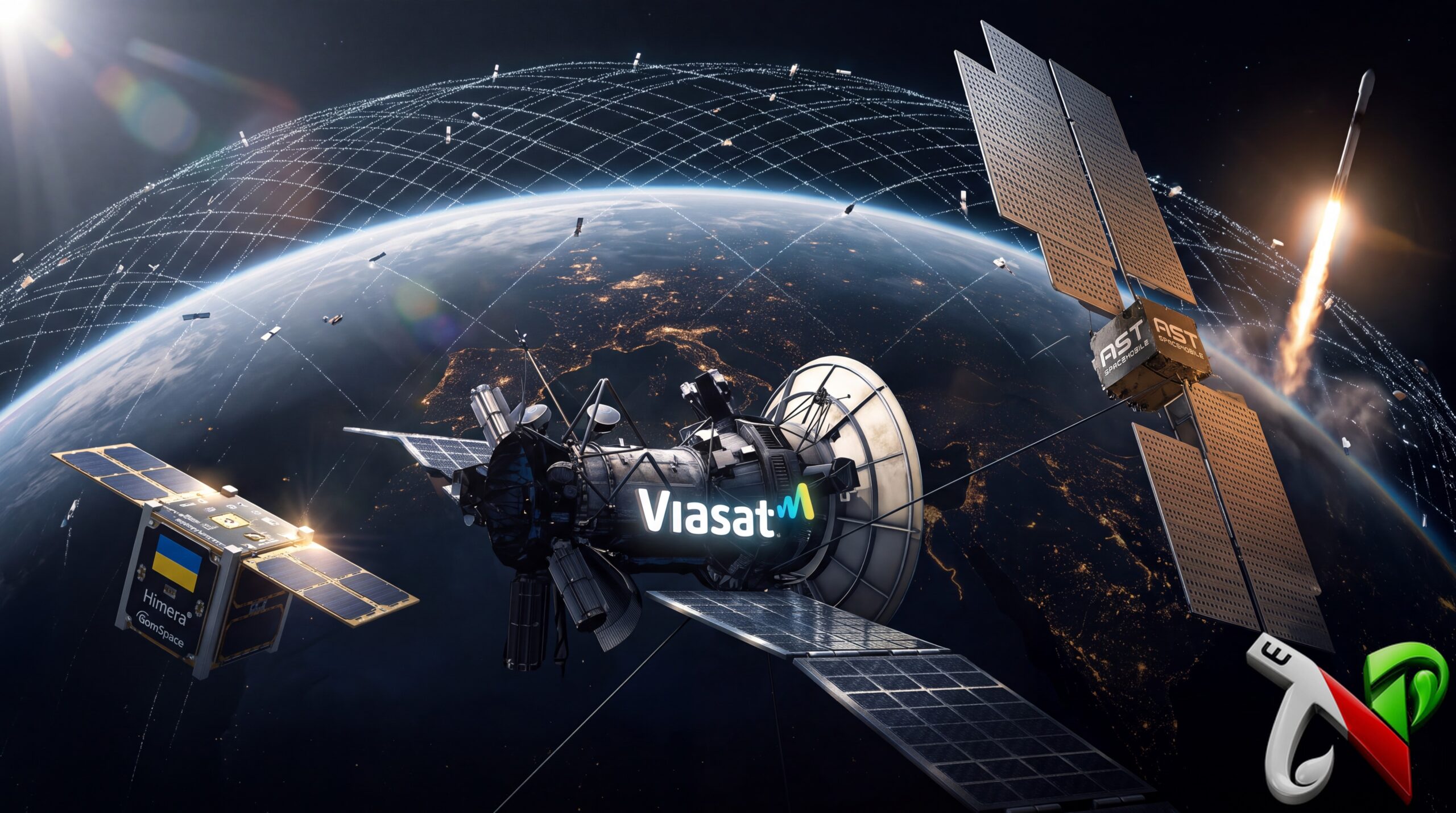
Starlink’s Shadow: Ukraine, Viasat and AST SpaceMobile Each Try to Escape Dependence
Key points
- Ukraine's Himera and Denmark's GomSpace are testing the experimental Obria Nano satellite, launched on October 1 aboard SpaceX's Transporter-18, as a first step toward a Ukrainian-controlled communications constellation 1.
- Viasat ended its latest quarter with about 100,000 US fixed broadband subscribers, down from 603,000 in 2020, a drop of roughly 83% since Starlink's beta launch 2.
- Viasat's new Unleashed Max plan costs $109.99 a month for the first year and then $179.99, versus about $130 for Starlink's Residential Max 2.
- AST SpaceMobile signed a $1.3 billion engine deal with Firefly Aerospace to build its Blacklift rocket, which is not expected to launch until late 2028, while it has only 13 satellites in orbit 3.
- All three stories are separate developments, tied together by the market pull of Starlink.
Ukraine Tests Sovereign Orbit
Since 2022, Starlink has been a key communications channel for Ukrainian forces, supporting battlefield coordination and drone missions where terrestrial networks have been damaged 1. Restrictions in mid-October disrupted connectivity and interfered with drone operations. Ukraine said on October 24 that Starlink and Starshield links were back to normal speeds, but Elon Musk and American officials gave different accounts of who approved the restrictions 1.
That episode pushed Kyiv toward infrastructure it controls. Ukrainian defence firm Himera and Danish manufacturer GomSpace announced on October 27 that they had begun testing Obria Nano, an experimental satellite that reached orbit on October 1 aboard SpaceX’s Transporter-18 rideshare mission 1. The results are meant to guide the design of further satellites. The partners also envisage eventually producing spacecraft and ground terminals inside Ukraine 1.
Much remains undisclosed. No technical specifications, capacity, financing or planned constellation size have been released, and the system is unlikely to replace Starlink. A smaller network could instead provide dedicated links for selected defence needs 1.

Viasat's Subscriber Slide
Separately, Viasat shows what the Starlink era has meant for a legacy satellite provider. It reported about 100,000 US fixed broadband subscribers in its latest quarter, against 603,000 in the third quarter of 2020, a fall of about 83% 2. The company blamed seasonally high summer churn.
Its answer is ViaSat-3 Flight 2, a geostationary satellite that entered service over the Americas in early October and is designed for download speeds above 100Mbps. The CFO said the plan is to use the improved performance to stabilize the business over the next few quarters 2. The new Unleashed Max plan promises unlimited data, top network priority, baseline speeds of 80Mbps and bursts up to 200Mbps 2.
Obstacles remain. Moving to the new service needs new equipment and a professional installation. Latency is still around 645ms for Unleashed Max, compared with about 45ms for Starlink. Pricing starts at $109.99 and rises to $179.99 after a year, while Starlink offers discounts of 30% to 50% in select areas. Deutsche Bank estimated Starlink has 4.1 million US subscribers 2.

AST Bets on Its Own Rockets
In a related move on the mobile side, AST SpaceMobile announced plans to develop reusable rockets after launch delays. It has only 13 satellites in orbit, well short of its goal of 45 by year end, which delays continuous satellite-to-phone service for carriers such as AT&T and Verizon and its competition with the upcoming Starlink Mobile 3.
Its 20-ton Blacklift rocket, able to carry five BlueBird satellites per launch, will not fly until late 2028. A $1.3 billion Firefly Aerospace deal covers 36 engines (27 Miranda and nine Vira), a manufacturing license and three years of engineering support for the first three rockets 3. The move follows a New Glenn explosion during a ground test at Blue Origin in May, which forced a launch pause 3.
Investors are skeptical. Rocket development is hard and costly, and the stock has dropped from as high as $133 in May to about $30 3. AST may share more on its November 12 earnings call.

The Common Thread
These stories are distinct, but they point in the same direction. Starlink’s scale gives it influence over governments, incumbents and challengers alike. Ukraine wants control of its critical links, Viasat is trying to win back customers with new hardware, and AST is vertically integrating to avoid dependence on launch providers. Each approach carries serious execution risk, and none has yet shown it can match Starlink’s coverage, price or performance.

Companies mentioned: SpaceX • AT&T (T $21.63 ▼0.9%) • Verizon (VZ $45.69 ▼0.9%)
Primary sources
 Ukraine takes bold step toward satellite independence following Starlink disruption — partnering with European makers to launch its own sovereign orbital mesh (techradar.com) – TechRadar reports that Ukrainian defence firm Himera and Danish spacecraft maker GomSpace are testing Obria Nano, an experimental satellite launched on October 1 aboard SpaceX's Transporter-18. The effort follows Starlink and Starshield disruptions in mid-October that affected Ukrainian drone operations, with conflicting accounts of who approved the restrictions. The article says the goal is a Ukrainian-controlled constellation, with eventual domestic production of spacecraft and terminals, and notes that technical specifications, financing and constellation size are undisclosed. It includes comments from Himera CEO Misha Rudominski and cites SpaceNews. Published by TechRadar.
 Starlink Rival Viasat Has Lost Over 80% of Its US Satellite Subscribers (pcmag.com) – PCMag reports on Viasat's quarterly earnings, which showed about 100,000 US fixed broadband subscribers, down about 83% from 603,000 in Q3 2020. It covers the ViaSat-3 Flight 2 satellite, the Unleashed Max plan with pricing and speeds, latency comparisons with Starlink, Starlink's discounts and plan prices, and Deutsche Bank's estimate of 4.1 million Starlink US subscribers. Published by PCMag.
Further sources
 AST SpaceMobile to Build Its Own Rockets to Catch Up With Starlink Mobile (pcmag.com) – PCMag reports that AST SpaceMobile plans to build its own reusable Blacklift rocket, with engine technology from Firefly Aerospace under a $1.3 billion deal for 36 engines, a license and engineering support. The article notes AST has only 13 satellites in orbit against a 45-satellite goal, that Blacklift will not launch until late 2028, the background of Blue Origin's New Glenn setback, and investor skepticism as the stock fell from $133 to $30. Published by PCMag.
 Powered by News Ranker
