
AI-RAN Leaves the Lab: First Live Call, Real Gains, and Open Questions
Key points
- T-Mobile, Nokia and Nvidia completed the first AI-RAN call at a commercial cell site in Bellevue, Washington, using Nokia Massive MIMO radio, 5G anyRAN software and Nvidia's Aerial RAN Computer, connected to a commercial 5G core and devices 1 3.
- The call proved the plumbing works, but no throughput, latency or efficiency figures were released, so the AI benefit is still unproven on that site 1.
- Other trials give numbers: Deutsche Telekom saw 10-15% uplink gains in lab tests, and O2 and Nokia claimed about 20% better spectral efficiency at a live London site 2 5.
- Nokia's AI-RAN products enter pilots around the end of this year with commercial availability in 2027, and BT plans first AI-RAN sites in Birmingham in 2027 1 4.
A Call on a Live Network
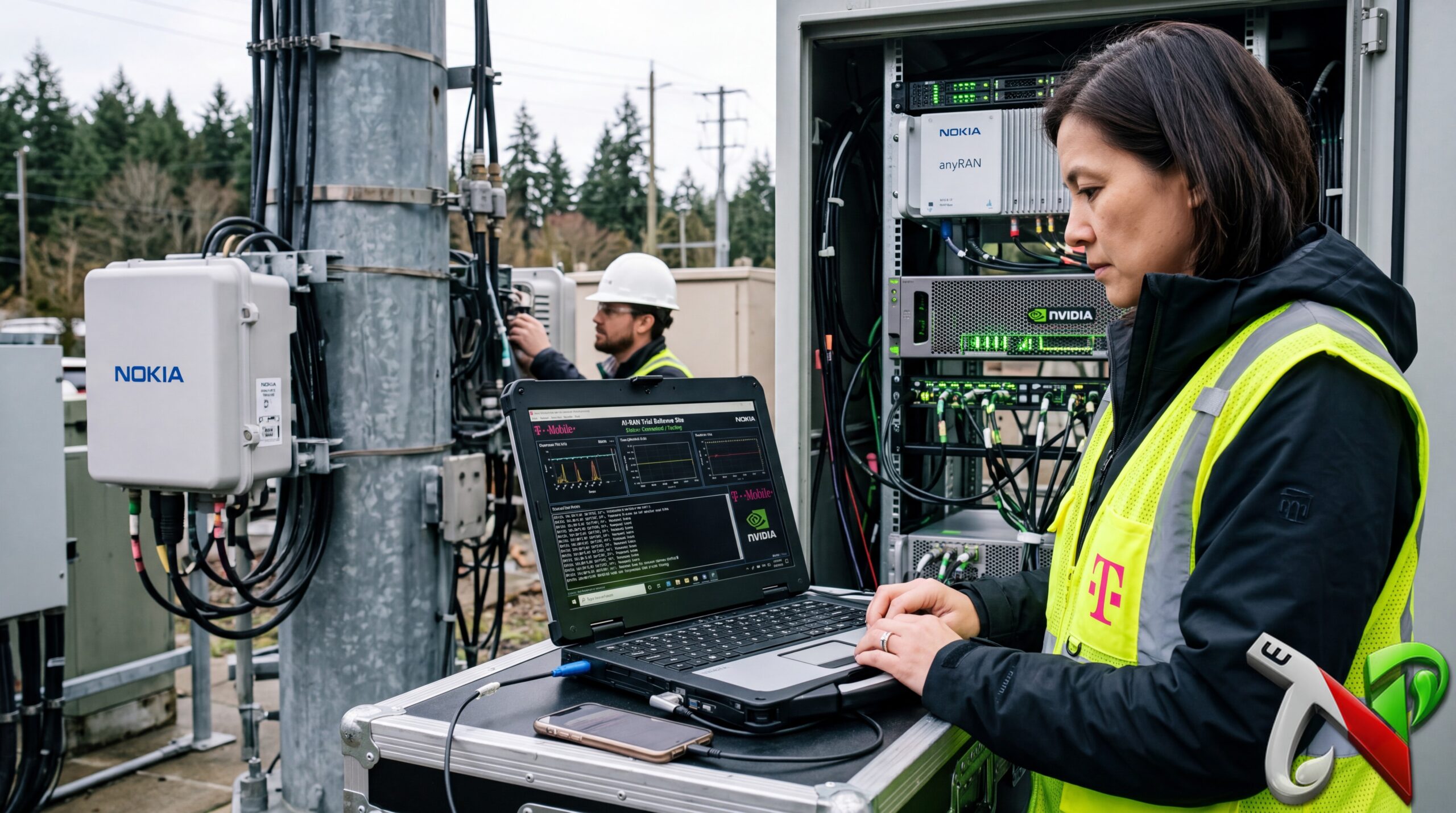
T-Mobile, Nokia and Nvidia say they have completed the world’s first AI-RAN call at a commercial cell site in Bellevue, Washington. It ran on T-Mobile’s live production network, using a Nokia Massive MIMO radio, Nokia’s 5G anyRAN software and servers built on Nvidia’s Aerial RAN Computer platform 3. The site connected to a commercial 5G Standalone core and a commercial smartphone, so this was not a lab rig 1.
Nokia frames it as the first software-defined RAN call using accelerated computing, and traces a path from T-Mobile’s AI-RAN Innovation Center in Bellevue in September 2024, through the Nokia-Nvidia partnership in 2025, to lab tests earlier this year 3. Next come field trials with new AI-for-RAN algorithms, more spectrum bands and AI workloads running beside radio functions on shared hardware 3.

What AI-RAN Actually Promises
The RAN is the antennas, radios and baseband computers your phone talks to, traditionally powered by custom chips. AI-RAN moves that processing to GPUs so the same hardware can run AI models that tune the radio link and, in theory, host other AI jobs with spare capacity 1. Nokia says it is on a path to 2x spectral efficiency, with more than 20% claimed so far, 50% targeted for 2027 and over 100% for 2028 1 3.
Deutsche Telekom, Nokia and Nvidia offer some of the most concrete figures. AI-based uplink channel estimation, running in real time on GPUs alongside the radio workload, delivered typical throughput gains of 10-15% in labs in Bonn and Oulu, with larger gains in more complex radio conditions. A field trial is next 2.

Proof Still Pending
The Bellevue call shows Nokia’s radio stack can run on Nvidia silicon in a live network. It does not yet show the AI improves anything 1. Nvidia-free approaches are also posting results: T-Mobile reported a 16% downlink throughput gain and 12% better spectral efficiency from AI beamforming with Ericsson, though it did not say how many sites were involved 1. T-Mobile is backing both approaches, and its CTO John Saw says the proof will come from field trials and total cost of ownership 1.
Cost is a real concern. Light Reading notes that Nokia has promised its GPU-based successor product at the same price as older custom-silicon gear, which looks risky as AI demand lifts component prices, and shareholders want trials turned into commercial deals 7.

Operators Line Up Worldwide
Interest is spreading. BT plans to bring its first AI-RAN sites online in Birmingham in 2027 on the EE network, with Nvidia and Nokia, to see whether lab gains hold under customer traffic 4. Separately, O2 and Nokia reported about 20% better spectral efficiency from predictive AI at its Paddington Station Giga Site in London, a claim that comes from the companies themselves 5.
At Nvidia GTC in Berlin, Nvidia’s Ronnie Vasishta and Nokia’s Pallavi Mahajan discussed customer trials, deployment timelines and how operators might monetize AI infrastructure and prepare for AI-native 6G 6. Light Reading even floats Starlink as a possible big customer if it builds a terrestrial network 7.
For ordinary users, nothing changes yet. Any benefit would show up as extra capacity in crowded places, with commercial gear due in 2027 and 6G expected around 2030 1.

Companies mentioned: T-Mobile (TMUS $146.83 ▼0.1%) • Nvidia (NVDA $217.94 ▲0.9%)
Primary sources
 'This is a wow moment': T-Mobile has made the world's first AI-RAN call, and it could mean huge changes for the next generation of staying in touch (techradar.com) – TechRadar's report on the Bellevue call explains what AI-RAN is, notes the call ran on a commercial site with a commercial core and phone, and stresses that no throughput, latency or efficiency data was released. It adds context on Nokia's efficiency roadmap, Deutsche Telekom's lab gains, T-Mobile's Ericsson trials, analyst and executive reactions, and the 2027 commercial and 2030 6G timelines. Published on techradar.com.
 Deutsche Telekom and Nokia advance commercial AI-RAN with measurable radio performance gains on NVIDIA AI Aerial (www.telekom.com) – Deutsche Telekom's announcement describes lab validation with Nokia and Nvidia of AI-based uplink channel estimation for the PUSCH, running on Nvidia Aerial RAN Computer with Nokia commercial 5G software. Measurements in Bonn and Oulu showed typical 10-15% throughput gains, rising in complex radio conditions, with a field trial planned. It also mentions a physical AI proof of concept with Agile Robots and Supermicro. Published on telekom.com.
Further sources
 Nokia, T-Mobile, NVIDIA complete world-first AI-RAN call (www.nokia.com) – Nokia's own blog post announces the world-first AI-RAN call in Bellevue with T-Mobile and Nvidia, lists the equipment used, recounts the timeline from 2024 to now, states the 2x spectral efficiency ambition, and outlines next field trials covering more spectrum bands and AI inferencing alongside RAN. Published on nokia.com.
 BT to pioneer live AI-RAN deployment in the UK with NVIDIA and Nokia (www.bt.com) – BT's announcement says it will trial AI-RAN on its live EE network with Nvidia and Nokia, bringing first sites online in Birmingham in 2027 and monitoring capacity, reliability and spectral efficiency. It cites Nokia's reported 20%+ lab gains and includes executive quotes, plus a separate AI Vision effort with TCS for field operations. Published on bt.com.
 O2 and Nokia claim first live deployment of 5G AI-RAN in UK | Computer Weekly (www.computerweekly.com) – Computer Weekly reports that O2 and Nokia claim the UK's first live AI-RAN deployment, at the Paddington Giga Site in London, using predictive AI that reportedly improved spectral efficiency by about 20%. It places the trial within O2's Giga Site rollout and its £700m Mobile Transformation Plan. Published on computerweekly.com.
- Capacity Global at NVIDIA GTC 2026: Nokia and NVIDIA on AI-RAN's Next Phase – Capacity (capacityglobal.com) – A short Capacity interview summary from Nvidia GTC 2026 in Berlin featuring Nvidia's Ronnie Vasishta and Nokia's Pallavi Mahajan on AI-RAN trials, timelines, spectral efficiency, monetization and AI-native 6G. Only the overview was available. Published on capacityglobal.com.
 Nokia badly needs big AI-RAN deals – Musk would be a great start (www.lightreading.com) – A Light Reading analysis arguing Nokia needs big AI-RAN deals and that Starlink could be a natural customer if it builds a terrestrial network. It covers Nokia's shift from custom silicon to Nvidia GPUs after a $1 billion investment, skeptics' cost concerns, the promise to price GPU products like older ones, and Starlink's spectrum limits. This is a distinct, adjacent angle. Published on lightreading.com.
 Powered by News Ranker
