Welcome to today’s curated collection of interesting links and insights from 2025/12/12. Our AI-powered system has processed and summarized 25 URLs to bring you the key takeaways.
As previously aired🔴LIVE on Clubhouse, Chatter Social, and TikTok.
Also available as a #Podcast on Apple 📻, Spotify🛜, Anghami and Amazon🎧 or anywhere else you listen to podcasts.
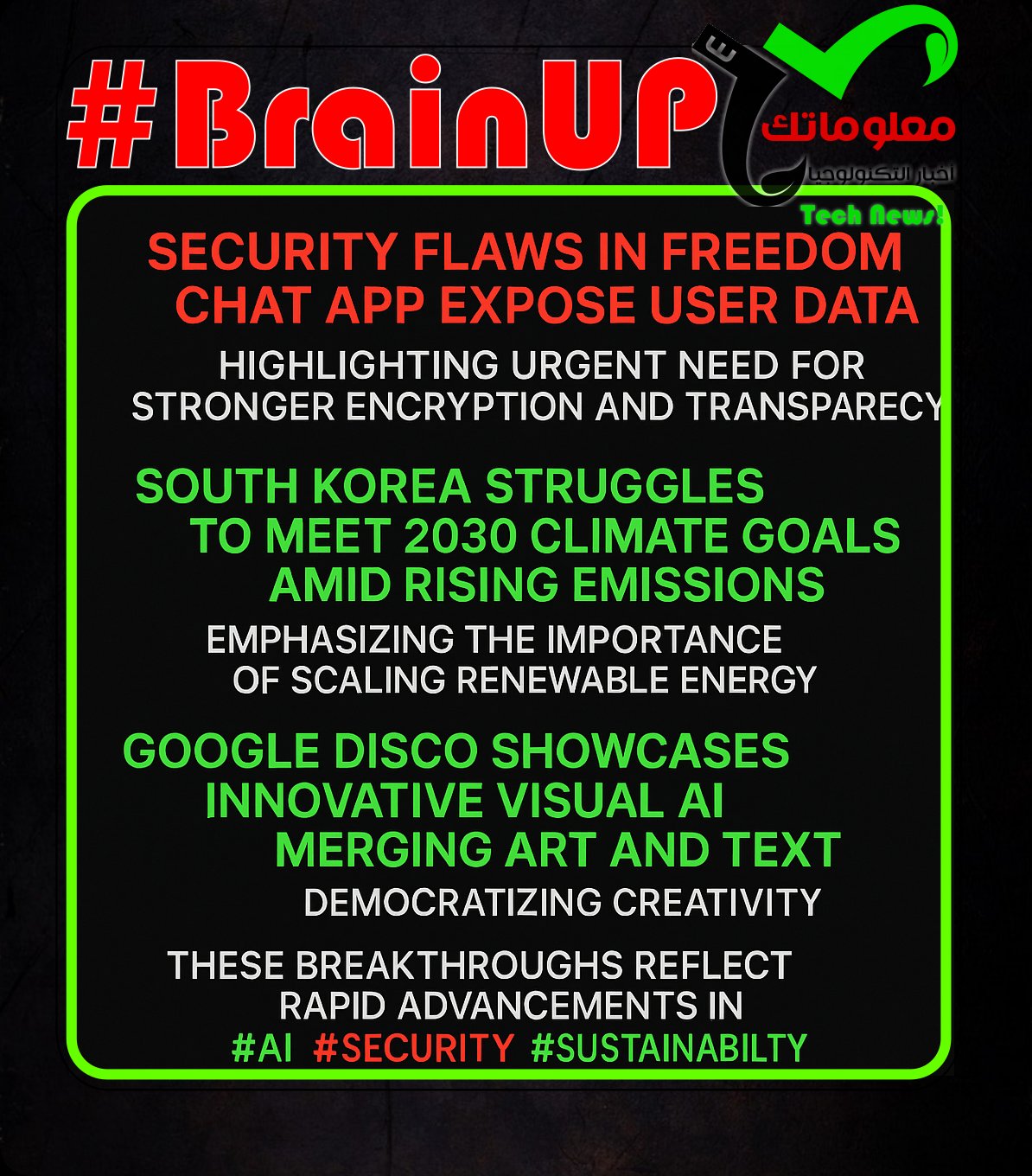
1. Security flaws in Freedom chat app exposed users’ phone numbers and PINs
Significant security vulnerabilities in the #FreedomChat app compromised users’ phone numbers and PINs, raising serious privacy concerns. The exposure highlights the risks posed by insufficient encryption and lax data protection protocols in communication platforms. @TechCrunch reveals that these flaws could have allowed malicious actors to intercept sensitive data, potentially leading to account takeovers and identity theft. The incident emphasizes the need for stringent security audits and compliance with industry standards to safeguard user information in chat applications. Furthermore, this case serves as a cautionary tale about the importance of transparency and prompt mitigation when security breaches occur.
Source: https://techcrunch.com/2025/12/11/security-flaws-in-freedom-chat-app-exposed-users-phone-numbers-and-pins/
2. S. Korean Government Struggles to Meet 2030 Climate Targets Amid Rising Emissions
South Korea faces significant challenges in meeting its 2030 climate goals as emissions have been increasing rather than declining. The government’s plan aimed to cut greenhouse gas emissions by 40% from 2018 levels by 2030, aligning with its commitment under the Paris Agreement. However, recent data shows emissions have instead risen due to economic growth and ongoing reliance on #coal and #fossil fuels. @SouthKorea’s Ministry of Environment acknowledges the need to accelerate green energy transitions and implement stricter regulations on industries. Experts emphasize the importance of scaling up #renewable energy and improving energy efficiency to avoid missing the target, which would jeopardize global efforts to limit temperature rise. This struggle highlights the complex balance between economic development and climate responsibility that countries worldwide are grappling with.
Source: https://en.yna.co.kr/view/AEN20251212004400320
3. Google Disco Is a Browser-Based Generative AI Experiment That Combines Visual Art and Text
Google Disco is a browser-based AI experiment developed by @Google that merges generative #AI technologies to create unique visual art from textual descriptions. The experiment showcases the capabilities of advanced #machinelearning models that understand and interpret user input to produce intricate images, blending creativity with artificial intelligence seamlessly. It offers users an interactive platform to explore how generative AI can expand the possibilities of visual storytelling. Google Disco highlights the potential for integrating AI into everyday digital experiences, especially in enhancing creative workflows. As generative AI continues to evolve rapidly, projects like Google Disco demonstrate the growing importance of accessible, engaging AI tools in democratizing art and innovation.
Source: https://www.theverge.com/tech/842000/google-disco-browser-ai-experiment
4. Online privacy protection for teens
Online privacy protection for teens has become a crucial concern as younger users increasingly engage with digital platforms. @TheHill highlights recent legislative efforts aimed at bolstering safeguards around teen data, emphasizing the need to address vulnerabilities unique to adolescents. The article discusses the complexities of enforcing stricter privacy measures without stifling innovation in #technology and the digital economy. Evidence suggests that teens are particularly susceptible to privacy violations as they may not fully comprehend long-term data implications. The policy debate balances protecting youth against overregulation, suggesting enhanced transparency and parental controls as potential solutions to foster safer online environments for this demographic.
Source: https://thehill.com/policy/technology/5645395-online-privacy-protection-teens/
5. Palantir Sues CEO of Rival AI Firm, Alleges Widespread Effort to Poach Employees
The lawsuit filed by @Palantir Technologies against the CEO of a competing #AI firm highlights the intense rivalry and competitive tensions in the artificial intelligence sector. @Palantir alleges a targeted, systematic campaign to entice its employees away, suggesting deeper strategic conflicts beyond typical industry competition. Such legal action reflects the high stakes in securing top talent and proprietary technology within the rapidly evolving #AI and data analytics market. These disputes underscore the challenges companies face in protecting intellectual property and human capital amid aggressive recruitment. As #AI technologies continue to reshape business landscapes, resolving such conflicts legally could set significant precedents for talent acquisition ethics and corporate conduct.
Source: https://www.wsj.com/business/palantir-sues-ceo-of-rival-ai-firm-alleges-widespread-effort-to-poach-employees-9c297986
6. Architects of AI named TIME magazine’s 2025 Person of the Year
The recognition of the “Architects of AI” as TIME magazine’s 2025 Person of the Year highlights the transformative impact of #ArtificialIntelligence on society and the economy. @TIME underscores how these innovators and pioneers in AI development have reshaped industries, from healthcare to finance, driving advancements that were once considered science fiction. The selection emphasizes the dual nature of AI technologies: while they offer unprecedented benefits such as automation and data analytics, they also raise ethical questions and concerns around privacy and job displacement. The article explores the collaborative efforts of leading AI researchers, engineers, and policy makers who are steering the direction of AI to maximize positive outcomes while mitigating risks. This spotlight on AI architects reflects the growing acknowledgment of their role in shaping the future of humanity amidst rapidly evolving technological landscapes.
Source: https://www.pbs.org/newshour/nation/architects-of-ai-named-time-magazines-2025-person-of-the-year
7. OpenAI intros new AI model GPT-5.2, says better at professional tasks
OpenAI has launched its latest AI model, GPT-5.2, which demonstrates significant improvements in handling complex professional tasks such as legal analysis, technical writing, and data interpretation. @OpenAI emphasizes that GPT-5.2 leverages advancements in #machinelearning and #naturalanguageprocessing to deliver more accurate, contextually aware outputs. The model incorporates enhanced reasoning capabilities, enabling it to understand nuanced queries better than previous versions, making it a valuable tool for corporate and academic applications. Furthermore, GPT-5.2 showcases better multilingual support, addressing a major limitation in earlier models, thus broadening its global usability. This release underscores the ongoing evolution of AI technologies, pushing the boundaries of what can be automated in professional environments.
Source: https://www.cnbc.com/2025/12/11/openai-intros-new-ai-model-gpt-5point2-says-better-at-professional-tasks.html
8. Broadcom reveals its mystery $10 billion customer is Anthropic
Broadcom has disclosed that its previously unidentified $10 billion customer is Anthropic, an AI startup focused on developing large language models. This revelation highlights the growing significance of #artificialintelligence in the semiconductor and infrastructure sectors, with Broadcom playing a crucial role in providing hardware solutions that power advanced AI capabilities. @Anthropic has been at the forefront of AI innovation, competing with industry leaders to create more ethical and interpretable AI systems. Broadcom’s investment and collaboration indicate a strategic alignment to support the expanding demands of AI compute infrastructure. This partnership underscores the increasing integration of cutting-edge #AI technologies within the tech hardware landscape, suggesting substantial future growth and innovation potential.
Source: https://www.cnbc.com/2025/12/11/broadcom-reveals-its-mystery-10-billion-customer-is-anthropic.html
9. Want a digital license plate? The Sony Afeela 1 will be the first car to offer one – and you’ll be able to add your Instagram handle
The Sony Afeela 1 is setting a new trend by incorporating a #digitalLicensePlate that provides more than just vehicle identification; it offers personalization features like displaying an owner’s Instagram handle. This innovation embodies @Sony’s vision of integrating social identity with futuristic automotive technology, creating a unique interface between drivers and their vehicles. The digital license plate transforms traditional static plates into dynamic displays capable of showing customized content, enhancing connectivity and personalization for car owners. Additionally, this feature may have practical implications for communication and safety, as messages or alerts could be shown in real time. As the automotive industry shifts towards more interactive and digital experiences, Sony’s initiative could pave the way for similar advancements in #vehicleTech.
Source: https://www.techradar.com/vehicle-tech/hybrid-electric-vehicles/want-a-digital-license-plate-the-sony-afeela-1-will-be-the-first-car-to-offer-one-and-youll-be-able-to-add-your-instagram-handle
10. Google launched its deepest AI research agent yet on the same day OpenAI dropped GPT-5.2
Google made a significant leap in AI research by launching its most advanced research agent to date on December 11, 2025, paralleling OpenAI’s release of GPT-5.2. This simultaneous rollout signals an intense rivalry between two giants, @Google and @OpenAI, each pushing the boundaries of #ArtificialIntelligence. Google’s new agent dives deeper into multi-modal and reasoning capabilities, emphasizing transparency and adaptability, which marks a critical evolution from their previous models. The release highlights a broader industry trend towards more sophisticated, integrated AI systems capable of complex decision-making and language understanding. As these tools become more powerful, they could dramatically transform sectors like healthcare, education, and research by providing nuanced insights and interactions.
Source: https://techcrunch.com/2025/12/11/google-launched-its-deepest-ai-research-agent-yet-on-the-same-day-openai-dropped-gpt-5-2/
11. DoorDash and Uber Sue NYC Over Tipping Mandate Before Delivery Checkout
The article reports that major food delivery platforms @DoorDash and @Uber have filed a lawsuit against New York City concerning a new tipping mandate requiring customers to add a tip before completing their delivery order checkout. The companies argue that the #NYC mandate infringes on their business model and could mislead consumers about tipping because it forces tipping upfront rather than after service, potentially affecting driver earnings. The mandate aims to ensure that delivery workers receive fair compensation in the form of guaranteed tips. @NYC officials contend that pre-checkout tipping transparency combats low pay and industry opacity that disadvantage gig workers. This legal battle highlights the ongoing tensions over fair labor practices and earnings within the gig economy, reflecting broader debates over #gigwork regulations and platform accountability. Court proceedings are anticipated in early 2026, with significant implications for the future of digital tipping norms in the US food delivery sector.
Source: https://www.bloomberg.com/news/articles/2025-12-11/doordash-uber-sue-nyc-over-tipping-mandate-before-delivery-checkout
12. Airlines Add Facial Scans to Speed Boarding and Security Lines
Airlines and airports are increasingly implementing #facialrecognition technology to streamline boarding and security processes, aiming to enhance both convenience and safety for travelers. This move reflects an industry-wide push toward more automated and contactless operations, as highlighted by recent deployments at the Orlando International Airport. According to industry experts and officials, the use of biometric systems reduces wait times and helps prevent fraud, as identity verification becomes more reliable and efficient. However, privacy advocates like @Electronic Frontier Foundation express concerns regarding surveillance and data security, emphasizing the need for stringent regulations and transparency. Overall, the integration of facial scans exemplifies a broader trend in the travel sector embracing #AI and biometric innovations to revolutionize passenger experiences.
Source: https://www.nytimes.com/2025/12/08/travel/facial-recoginition-flights-airports-orlando.html
13. Warnings Mount in Congress Over Expanded US Wiretap Powers
The expansion of wiretap powers in the United States has sparked increasing concern within Congress, as lawmakers warn about the potential risks to privacy and civil liberties. @Wired highlights that recent legislative proposals aim to broaden the government’s surveillance authorities, particularly enabling law enforcement agencies to access communications more easily under #wiretap technology. These expanded powers raise alarms about overreach and unintended consequences, especially as digital communication platforms become central to everyday life. Critics argue that without proper safeguards, these changes could infringe on constitutional rights. Furthermore, the debate underscores the tension between ensuring national security and preserving individual privacy in an era dominated by rapid technological advances.
Source: https://www.wired.com/story/warnings-mount-in-congress-over-expanded-us-wiretap-powers/
14. Reddit challenges Australian under-16 social media ban in Federal Court
Reddit is confronting Australia’s regulatory attempt to ban social media access for individuals under 16, invoking significant debate around digital rights and youth protection. The legal dispute emerges from Australia’s efforts to impose age restrictions on platforms to curb online harms faced by minors, reflecting increasing governmental scrutiny of #socialmedia’s role in youth wellbeing. @Reddit’s challenge underscores the tension between safeguarding young users and ensuring access to digital communities pivotal for social interaction and information sharing. This case highlights the broader global discourse on age verification technologies and regulatory frameworks, emphasizing the need for balanced policies that protect children without overly restricting their digital freedoms. The outcome could set a precedent affecting how other jurisdictions manage underage access to social media in the future.
Source: https://www.abc.net.au/news/2025-12-12/reddit-social-media-ban-under-16-court-challenge/106134994
15. Disney sends cease-and-desist over Google AI’s use of its images
Disney has issued a cease-and-desist letter to Google, demanding it stop using Disney-owned images in its AI systems. The move highlights the growing tension between major corporations like @Disney and tech giants such as @Google over the use of copyrighted content in artificial intelligence training databases. The dispute centers on how companies collect vast amounts of images to train AI models, raising concerns about copyright infringement and intellectual property rights. This legal confrontation exemplifies a broader debate within the #AI and creative industries about balancing innovation with copyright protections. Disney’s action may set important precedents that influence how #machinelearning companies approach copyrighted content in the future.
Source: https://www.androidauthority.com/disney-google-ai-cease-and-desist-3624592/
16. Disney signs deal with OpenAI to allow Sora to generate AI videos featuring its characters
Disney has entered into a groundbreaking partnership with @OpenAI to enable Sora, an AI-driven creative platform, to produce AI-generated videos featuring Disney’s iconic characters. This collaboration leverages #GenerativeAI technologies, allowing users to create personalized and dynamic content with beloved Disney figures in new, innovative ways. The deal represents a significant shift in how entertainment content can be produced, blending creativity with #ArtificialIntelligence to offer customized storytelling experiences. Disney’s embrace of AI highlights the company’s commitment to pioneering future media formats and expanding its digital presence. By integrating OpenAI’s advanced models, this partnership could redefine user engagement and content creation in the entertainment industry.
Source: https://techcrunch.com/2025/12/11/disney-signs-deal-with-openai-to-allow-sora-to-generate-ai-videos-featuring-its-characters/
17. Taiwan to keep production of most advanced chips at home: Deputy FM
Taiwan has emphasized its commitment to retaining the production of the most advanced semiconductor chips domestically, a statement made by the Deputy Foreign Minister. This strategic decision underscores the island’s pivotal role in the global #chip manufacturing supply chain, especially as demand for #semiconductors surges across tech industries. @Taiwan’s focus on maintaining its technological edge in chip fabrication reflects a broader geopolitical context where control over these critical components has become a matter of national security. Furthermore, safeguarding advanced production capacity at home helps mitigate risks related to geopolitical tensions and international trade uncertainties. The move highlights Taiwan’s determination to stay at the forefront of #technology innovation while supporting global tech companies reliant on its expertise.
Source: https://www.france24.com/en/live-news/20251211-taiwan-to-keep-production-of-most-advanced-chips-at-home-deputy-fm
18. Microsoft Executive Vows to Halt AI Race to Prevent Catastrophic Future
The conversation around artificial intelligence safety has gained urgency as @Microsoft executive Jared Spataro has publicly committed to pausing the aggressive #AI race to avoid catastrophic outcomes. This reflects growing concerns in the tech industry that unchecked AI development could lead to unintended harmful consequences. Experts argue that without proper regulation and ethical frameworks, advancements in #AI might surpass human control, leading to risks that could impact societies globally. Spataro’s stance highlights the importance of balancing innovation with caution, advocating for collaborative efforts among industry leaders, policymakers, and researchers to establish responsible AI governance. This position also resonates with broader discussions on AI ethics under the spotlight of recent breakthroughs, indicating a pivotal moment in shaping the future trajectory of AI technology.
Source: https://finance.yahoo.com/news/microsoft-executive-vows-halt-ai-170000870.html
19. China Launches 34,175-Mile AI Network That Acts Like One Massive Supercomputer
China has taken a remarkable leap in artificial intelligence infrastructure by launching a 34,175-mile network that functions as a unified supercomputer. This vast #AI network connects numerous data centers and computing nodes across the country, enabling unprecedented computational scale and efficiency. According to experts, integrating such an expansive system allows a level of parallel processing power that rivals or exceeds traditional singular supercomputers, significantly accelerating AI research and development. The initiative demonstrates China’s commitment to advancing its technological dominance, following in the footsteps of global leaders like @ElonMusk’s ventures in cutting-edge tech. This project marks a milestone in how distributed computing can be harnessed to push the limits of machine learning and data processing capabilities at scale.
Source: https://gizmodo.com/china-launches-34175-mile-ai-network-that-acts-like-one-massive-supercomputer-2000698474
20. Google Illegally Scraped the Web to Fix Its AI Problems and Catch Up to OpenAI, European Regulators Probe
European regulators have launched an investigation into @Google for allegedly illegally scraping vast amounts of web data without authorization to enhance its artificial intelligence capabilities. This move is seen as part of Google’s effort to rapidly catch up with competitors like @OpenAI, which have been leading in the AI space. The probe centers on whether Google’s data collection practices violated copyright laws and data privacy regulations under EU law. The case highlights the intense competition in the AI sector, where access to large datasets is critical for training advanced #machinelearning models. Additionally, it raises significant questions about the ethical boundaries of data scraping and the future of AI development in compliance with legal frameworks governing data use.
Source: https://fortune.com/2025/12/11/google-illegally-scraped-the-web-to-fix-its-ai-problems-and-catch-up-to-openai-european-regulators-probe/
21. Google Shows Off Photorealistic Android Avatars in XR for the First Time
Google has demonstrated impressive photorealistic avatars in its XR (extended reality) environments, marking a significant step forward in digital human representation. The company showcased these avatars to highlight advancements in #machinelearning and #3Drendering technology, combining realistic visuals with expressive animation. @Google’s work focuses on improving the sense of presence and connection in virtual spaces by creating avatars that closely resemble real-life individuals while maintaining natural movement and facial expressions. This progress not only elevates the immersive quality of #Android XR but may also transform social interactions, remote collaboration, and gaming experiences. Overall, the demonstration underscores how leveraging AI-driven rendering techniques can push the boundaries of avatar realism and enhance XR platforms worldwide.
Source: https://www.roadtovr.com/google-android-xr-likeness-avatars-photorealistic/
22. Doxers Posing as Cops Are Tricking Big Tech Firms Into Sharing People’s Private Data
Social media platforms and major tech companies are increasingly being targeted by doxers who impersonate law enforcement officials to gain access to users’ private information. By exploiting lax verification processes, these bad actors successfully deceive companies into handing over sensitive data, which can then be abused for harassment or other malicious purposes. The problem is exacerbated by the growing complexity of digital identity verification in the age of #remotework and #digitalprivacy. According to @Wired, this kind of impersonation highlights significant weaknesses in the policies designed to protect users from unauthorized data requests. Strengthening authentication protocols and improving transparency measures are critical steps to safeguard personal information against such sophisticated scams.
Source: https://www.wired.com/story/doxers-posing-as-cops-are-tricking-big-tech-firms-into-sharing-peoples-private-data/
23. UK fines LastPass £1.2M over 2022 data breach impacting 1.6 million users
The UK’s Information Commissioner’s Office (ICO) imposed a £1.2 million fine on #LastPass for its insufficient security measures leading to a significant 2022 data breach affecting 1.6 million users. The breach exposed critical user information, underscoring the dangers of lax cybersecurity in the password management sector. @UK ICO’s enforcement highlights the growing regulatory scrutiny around data protection, emphasizing accountability for tech firms safeguarding sensitive data. This penalty serves as a cautionary tale to companies about the need for robust #cybersecurity frameworks and swift incident response strategies. It also draws attention to the challenges of securing cloud-based services that manage vast troves of personal and corporate passwords.
Source: https://cyberinsider.com/uk-fines-lastpass-1-2m-over-2022-data-breach-impacting-1-6-million-users/
24. Rivian Will Add Lidar in 2026, Says Tesla’s Cameras Aren’t Enough
Rivian has announced plans to integrate #Lidar technology into its vehicles starting in 2026, marking a significant shift in the approach to autonomous driving sensors. While @Tesla CEO Elon Musk has long championed a camera-based system for full self-driving capabilities, Rivian argues that cameras alone lack the precision and reliability needed for safe autonomy, especially in complex environments. The move highlights growing industry recognition that combining multiple sensor types, including radar and lidar, is essential to overcome the limitations faced by vision-only systems. Rivian’s commitment to lidar indicates a broader trend toward sensor fusion, aiming to enhance vehicle safety and operational robustness. This development may influence consumer trust and regulatory approval processes as companies contend with the challenges of deploying fully autonomous vehicles.
Source: https://www.thedrive.com/news/rivian-will-add-lidar-in-2026-says-teslas-cameras-arent-enough
25. AI chatbot blamed in wrongful death lawsuit in Greenwich
A wrongful death lawsuit filed in Greenwich, Connecticut alleges that an AI chatbot may have contributed to a tragic fatality. The case centers on the use of an artificial intelligence system generating responses that may have influenced critical decisions leading to the death. This situation underscores the growing legal and ethical challenges associated with #AI technologies like @OpenAI’s #ChatGPT, whose outputs are increasingly used for real-world decision-making but are not always reliable. Experts are raising concerns about the accountability mechanisms needed to govern AI in sensitive contexts such as healthcare or crisis intervention. As AI adoption accelerates, this case could become a precedent for how liability is assigned when AI-generated information results in harm.
Source: https://apnews.com/article/ai-chatgpt-wrongful-death-lawsuit-greenwich-97fd7da31c0fa08f3d3ea9efd6713151
That’s all for today’s digest from 2025/12/12! We found and processed 25 URLs. Stay tuned for tomorrow’s collection of insights and discoveries.
Thanks Patricia Zougheib and Dr Badawi for curating the links
See you in the next one! 🚀