
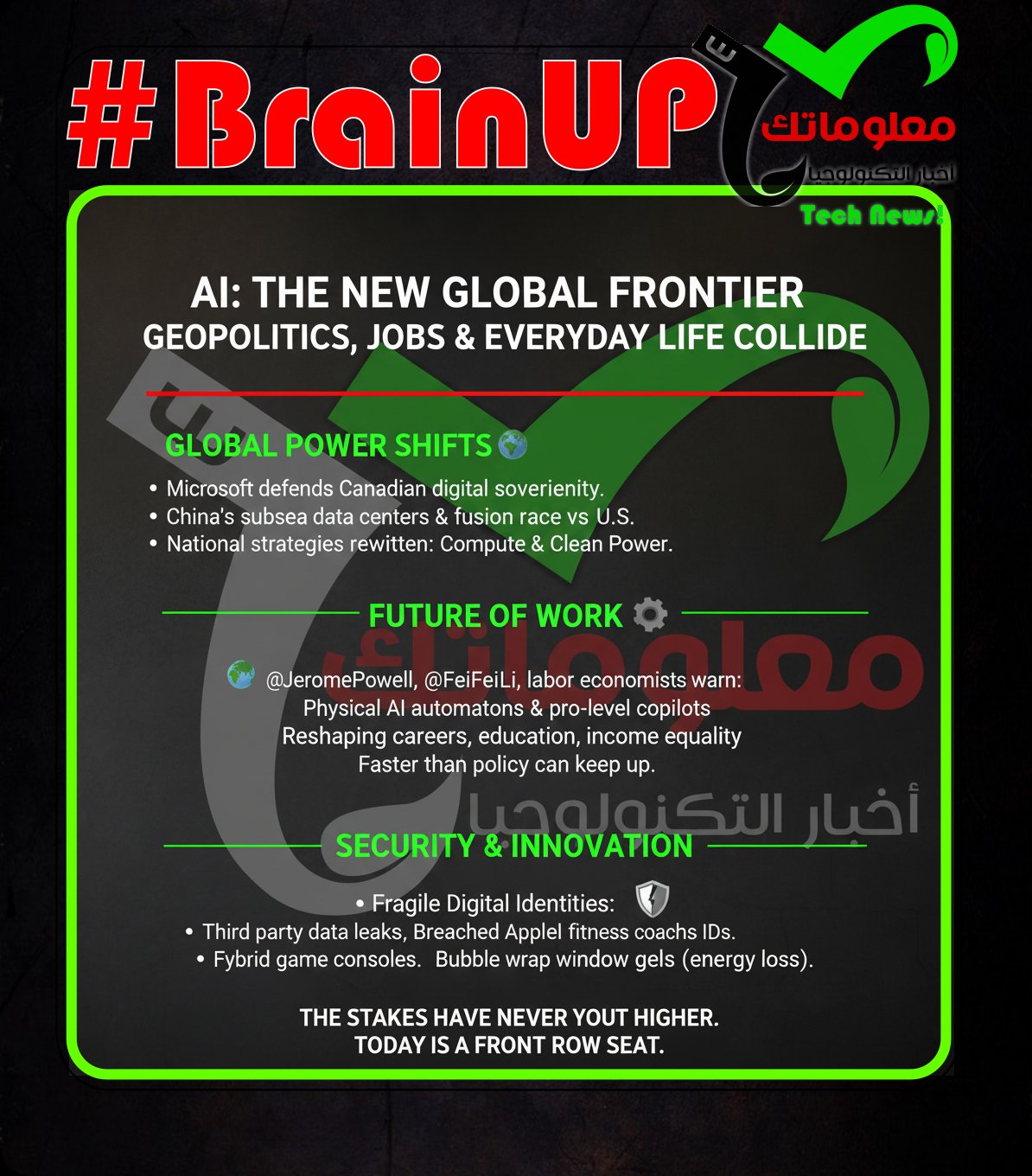
#BrainUp Daily Tech News – (Sunday, December 14ᵗʰ)
Welcome to today’s curated collection of interesting links and insights for 2025/12/14. Our Hand-picked, AI-optimized system has processed and summarized 22 articles from all over the internet to bring you the latest technology news.
As previously aired🔴LIVE on Clubhouse, Chatter Social, Instagram, Twitch, X, YouTube, and TikTok.
Also available as a #Podcast on Apple 📻, Spotify🛜, Anghami, and Amazon🎧 or anywhere else you listen to podcasts.
1. Microsoft president insists company will stand up to defend Canadian digital sovereignty
Microsoft’s president for Canada, Kathryn Fortier, emphasized the company’s commitment to protecting Canadian digital sovereignty amid global pressures on data privacy and control. She highlighted Microsoft’s investments in local data centers and partnerships aimed at ensuring Canadian data remains under Canadian jurisdiction, supporting national security and privacy standards. This stance reflects Microsoft’s response to challenges from foreign governments seeking access to data, reinforcing the importance of sovereignty in the digital age. Fortier’s remarks underline the growing intersection of technology, policy, and national interest as Canada’s digital infrastructure evolves. The company’s proactive measures aim to preserve trust and bolster Canada’s position in the global digital economy.
2. China’s subsea data centre could power 7,000 deep-seek conversations per second: report
China has developed one of the world’s first subsea data centres, which has the capacity to power 7,000 simultaneous deep-seek conversations per second, highlighting its technological advances in #data storage and computing infrastructure. This innovative centre is submerged underwater to take advantage of natural cooling, reducing energy consumption and environmental impact compared to traditional data centres. The project aligns with China’s broader strategic goals to boost digital infrastructure and support the growing demands of AI and cloud services. By pioneering subsea technology, China aims to secure a competitive edge in global technology markets and enhance data processing efficiency. This breakthrough reflects the country’s commitment to integrating cutting-edge #technology with sustainable practices in digital expansion.
The piece argues that most people’s fear is mass layoffs and widening income inequality from AI, not a speculative bubble. In a NY panel, @Daron Acemoglu of @MIT and others warned that AI could eliminate many jobs, citing @DarioAmodei’s claim of potentially wiping out half of entry-level white-collar roles in 1 to 5 years and @BernieSanders’ warning of up to 97 million US jobs displaced over a decade. Acemoglu proposes a #pro-workerAI path that raises workers’ skills and value, reducing layoffs and boosting productivity, while acknowledging it’s less favorable to big tech business models. The article notes that the Biden administration has begun discussions and enacted some pro-worker policies, but more is needed to steer tech firms toward this approach through government action and societal pressure. Without such a shift, AI could deepen inequality as investors and firms accumulate wealth, whereas a deliberate move to pro-worker AI could foster social cohesion and a more resilient economy.
4. Job Market Worsening Is Part Story, Fed Chair Says
Federal Reserve Chair @JeromePowell acknowledges that while the job market appears to be weakening, this trend is only part of the broader economic picture influenced by #AI advancements and other factors. He points out that AI impacts labor dynamics but is not solely responsible for employment challenges. Powell underscores that understanding AI’s effects requires nuanced analysis to avoid oversimplifying the causes behind job market fluctuations. This perspective aligns with the Fed’s cautious approach to balancing technological progress with economic stability. The discussion highlights the complexity of integrating #AI into workforce assessments and monetary policy.
5. How a US Citizen Was Scanned With ICE’s Facial Recognition Tech
An incident in Chicago shows how @ICE used #facialRecognition to confirm a U.S. citizen’s identity when he could not present ID. Jesus Gutiérrez, 23, was questioned and handcuffed by federal agents, placed in a car, and, with no ID, his photo was taken; after the facial scan, the agents said, ‘Oh yeah, he’s right. He’s saying the right thing. He does got papers,’ and released him. The episode illustrates that facial recognition can influence field decisions when traditional ID is unavailable and raises questions about the reliability of such tech in immigration enforcement. It underscores the potential risk of detentions based on incomplete verification and the need for safeguards and transparency in face-scanning practices. This story, part of a Reveal and 404 Media collaboration, shows how facial recognition features in immigration enforcement.
7. Measles outbreaks continue despite claims from Robert F. Kennedy Jr.
Measles outbreaks persist in the United States despite claims made by Robert F. Kennedy Jr. regarding the disease and vaccines. According to health experts and CDC data, recent years have seen a resurgence of measles linked to vaccine hesitancy and misinformation. The spread of #vaccine skepticism, fueled by high-profile figures like Kennedy, undermines public health efforts to achieve herd immunity. Continued outbreaks highlight the importance of vaccination as a proven method to control and prevent the disease. This ongoing situation demonstrates the critical need to counteract misinformation and increase public trust in vaccines to protect communities.
8. Third-party breach exposes ChatGPT account details
The article reports a third-party breach involving analytics platform @Mixpanel that exposed OpenAI API account details linked to ChatGPT, while no chat histories, passwords, or API keys were exposed. Evidence shows the stolen data came from Mixpanel’s environment and included names, email addresses, Organization IDs, coarse location, and technical browser metadata, with OpenAI stressing that its own systems were not breached. The timeline indicates Mixpanel first detected a smishing attack on November 8, attackers accessed internal systems the next day, exported OpenAI data, and OpenAI was notified on November 25, after which Mixpanel was cut off the following day. Analysis suggests the incident highlights how even trusted vendors can create significant risk for hundreds of millions of users and underscores the need for stronger safeguards across the full chain of third-party data processing, given that Organization IDs can enable targeted phishing or impersonation. The breach reinforces regulatory focus on vendor security in modern tech policy and the importance of robust third-party risk management for platforms with broad reach like @OpenAI #vendorSecurity #thirdParty #dataBreach.
9. AI Data Center Boom May Suck Resources Away From Road, Bridge Work
The rapid expansion of AI data centers is creating intense competition for resources such as land, labor, and materials, potentially diverting them from traditional infrastructure projects like roads and bridges. The surge in demand for these specialized facilities is driven by advancements in artificial intelligence and the need for greater computational power. This trend risks slowing progress on public infrastructure maintenance and development, which already faces challenges from budget constraints and aging systems. Industry experts warn municipalities may struggle to balance the booming tech sector’s resource demands with essential infrastructure upkeep. The shift highlights a broader tension between emerging technology industries and public infrastructure priorities within urban development planning.
10. My Apple ID Has Been Breached
The article details the experience of discovering a breach in the author’s Apple ID security, emphasizing the importance of promptly detecting and responding to such incidents. After noticing suspicious activity, the author describes steps taken to secure the account, including changing passwords and enabling two-factor authentication (2FA). This highlights vulnerabilities even within widely trusted platforms like Apple and underscores the need for users to maintain strong security practices. The author also reflects on the emotional and practical challenges posed by security breaches. The account serves as a cautionary narrative encouraging vigilance and proactive security management to protect personal digital identities.
11. US TikTok investors in limbo as deal set to be delayed again
Potential buyers of #TikTok’s US operations say they remain in limbo as the deadline for a mandated sale or ban continues to be postponed, with the latest extension likely to be the fifth time the United States has pushed back enforcement. Investors including billionaire @FrankMcCourt’s consortium say they have raised capital and are prepared to purchase the American division from China-based ByteDance, but delays in China’s approval and diplomatic coordination have left the deal unresolved even as Washington signals it will extend the deadline again. The sale arises from US legislation that would either force a divestment of TikTok’s American assets or block the app entirely over national security concerns about foreign data access, and although the White House and administration officials had previously said a deal was near with backing from @DonaldTrump and Chinese leadership, no formal agreement has been announced. The continued uncertainty has left investors waiting and markets unsettled, underscoring how geopolitical friction, regulatory pressure and bilateral negotiations are slowing what was meant to be a swift transition of ownership.
Definition: TikTok divestment requirement
The TikTok divestment requirement refers to US policy measures stemming from the Protecting Americans from Foreign Adversary Controlled Applications Act, which compels apps owned by companies deemed foreign adversaries, especially those with ties to the Chinese government, to sell their local operations or face a ban in the United States. This mandate aims to prevent foreign influence or unauthorized data access by shifting ownership to US-based entities, but it also creates complex international negotiation and compliance challenges.
12. The CIA’s Lost Nuclear Device in the Himalayas
In the 1960s, the CIA deployed a nuclear-powered surveillance device on #NandaDevi, a high peak in the Himalayas, to monitor Chinese missile tests amid Cold War tensions. The device was lost during a storm, prompting fears of radioactive contamination in the region. Efforts to recover the device faced serious challenges due to harsh terrain and political sensitivities between India and the United States. The incident highlights the complexities and risks of covert operations in geopolitically sensitive areas. This case exemplifies the intricate balance of intelligence gathering, environmental concerns, and international relations during the Cold War era.
13. Nex Playground’s Game Console Blends Toys and Video Games for Holiday Shoppers
Nex Playground has introduced a new game console that merges physical toys with digital gaming experiences, targeting children and holiday shoppers seeking innovative entertainment options. The console allows users to interact with physical toys that activate game content, creating an engaging hybrid play experience. This concept reflects a growing trend in the toy and gaming industry where traditional play is enhanced by technology, appealing to both kids’ tactile interests and digital engagement. The product aims to carve out a niche in a market dominated by pure video games by offering a unique blend of hands-on and screen-based fun. By integrating physical and digital play, Nex Playground seeks to attract parents and gift buyers looking for creative, interactive holiday gifts.
14. China and U.S. Race to Lead Fusion Energy Breakthrough
The article explores the intense competition between China and the U.S. to develop practical #fusionenergy, a promising solution to the global energy crisis and climate change. China’s state-backed efforts have advanced rapidly, illustrated by its recent progress in achieving higher plasma temperatures and longer containment times in fusion reactors, while American initiatives, often driven by private companies and national labs, focus on innovation and commercial scalability. This rivalry accelerates technological breakthroughs in plasma physics and reactor design, pushing the boundaries of what could become a limitless, clean energy source. The competition reflects deeper geopolitical tensions and impacts international collaboration in science, with each country seeking to secure energy independence and technological dominance. Understanding this race underscores fusion’s transformative potential and the strategic challenges in bringing it to a viable, widespread energy solution.
15. Inside Meta’s Pivot From Open Source to Money-Making AI Model
Meta has shifted its strategy from promoting open-source AI models to focusing on monetizing proprietary AI technologies. This change reflects a broader industry trend prioritizing commercial benefits over open collaboration. The company is investing in advanced AI systems designed to integrate with its platforms and drive revenue generation. This pivot aligns with Meta’s ambitions to leverage #AI as a core business driver rather than a shared research tool. By emphasizing monetization, Meta aims to maintain competitive advantage while fostering innovation within a controlled ecosystem.
16. How Chinese entities are already using Nvidia’s powerful H200 AI chips
Chinese entities have begun utilizing Nvidia’s H200 AI chips despite U.S. export restrictions intended to limit China’s access to advanced technology. Reports reveal that several Chinese companies and research institutions have integrated these powerful AI processors for applications in fields such as autonomous driving, chip design, and scientific research. The adoption highlights the challenges in enforcing export controls and indicates China’s strong demand for cutting-edge AI hardware to advance its technological capabilities. This situation underscores the complex dynamics of global tech competition and the barriers in fully restricting state-of-the-art AI hardware dissemination. Nvidia’s H200 chips thus continue to impact China’s AI development despite regulatory efforts.
17. Robot Fires at YouTuber, Sparking Safety Fears
A chilling incident occurred when a robot unexpectedly fired at a YouTuber during a demonstration, raising serious safety concerns about autonomous machines. The video showed the robot, equipped with a gun, activating without warning, highlighting the potential dangers of inadequate safeguards in robotic technology. This event underscores the urgency for stricter safety protocols and regulatory oversight in the development and deployment of AI-powered robots to prevent accidental harm. The episode serves as a cautionary tale about the rapid integration of AI into robotics without fully addressing risk management, urging stakeholders to prioritize human safety. As AI and robotics increasingly intersect in practical applications, this case emphasizes the critical balance needed between innovation and precaution.
18. Physical AI-enabled automaton could soon replace factory workers
The advancement of physical AI-enabled automatons is poised to transform manufacturing by replacing human factory workers. These robots integrate #artificialintelligence with physical capabilities, enabling them to perform complex tasks traditionally requiring human dexterity and decision-making. Evidence shows progress in both hardware and AI algorithms, allowing for adaptable, efficient automation in various industrial settings. This shift is expected to enhance productivity and reduce labor costs, while also raising questions about workforce displacement and the need for new labor policies. The development signifies a major leap in industrial automation, promising to redefine manufacturing processes and labor dynamics.
19. How fitness AI coaching plans can make you quit running
Fitness AI coaching plans promise personalization and optimization of workouts using data from wearables like #Peloton, #Fitbit, and #Runna. However, many users find these AI-driven plans overwhelming and rigid, leading to frustration and, paradoxically, quitting running rather than improving. The AI suggests precise schedules and goals that may not account for personal motivation or changing lifestyles, which can reduce the enjoyment of exercise and cause burnout. This case highlights a tension between technological optimization and human adaptability, suggesting that effective fitness coaching requires balancing data insights with personal preferences. Therefore, while AI can enhance training, it must be delivered flexibly to maintain user engagement and avoid discouraging activity.
20. Fei-Fei Li on AI, College Degrees, and Building Talent
Fei-Fei Li, a Stanford professor often called the ‘godmother of AI,’ discusses the evolving landscape of artificial intelligence and its impact on education and the workforce. She highlights how traditional college degrees are becoming less central as new skills and talent acquirement methods emerge in the AI-driven era. Li emphasizes the importance of integrating practical skills with theoretical knowledge to cultivate relevant expertise for future job markets. Drawing from her experience as a researcher and CEO, she advocates for innovative approaches in education that prepare students for rapid technological changes. This vision aligns with broader trends reshaping higher education and workforce development in a tech-centric society.
21. SpaceX quietly removes its $40 Starlink plan in the US
SpaceX has removed its $40 per month Starlink plan option from its US offerings, leaving the $110 monthly subscription as the lowest price. The $40 plan, launched in 2022 as a lower-cost option with certain limitations, was quietly discontinued without formal announcement. This move may reflect SpaceX’s adjustment to market demand, operational costs, and pricing strategy to sustain the Starlink satellite internet service. Removing the cheaper plan streamlines the pricing structure, focusing users on higher-tier services with better performance and support. This change underscores SpaceX’s evolving approach to balancing accessibility and profitability for its #Starlink network under @ElonMusk’s leadership.
With iOS 26.2, @Apple lets users roll back Liquid Glass again on the Lock Screen by adding a clock transparency slider. The update follows iOS 26.1’s move toward a frosted look rather than a global change, giving per-element control over transparency for the #LiquidGlass design. Beyond the clock slider, iOS 26.2 adds features like #AirDrop codes for non-contacts for 30 days, #Reminders alarms, a Following tab in #AppleNews, offline lyrics in #AppleMusic, AI generated chapters for #Podcasts and a Podcast Mention feature, plus a Sleep Score in #AppleWatch and essential #securityupdates across devices. The timing comes as @AlanDye leaves Apple for Meta and @StephenLemay steps in to lead interface work, underscoring another pivot in how Apple handles Liquid Glass and related design choices.
23. US lab creates clear window gel that traps heat to cut energy loss
A team at @CU Boulder has developed a clear window gel that traps heat to cut energy loss in buildings. The material is described as a novel insulating window gel intended to improve energy efficiency on a global scale. If implemented widely, it could reduce heat transfer through glazing, lowering the energy needed for heating and cooling. The advance showcases ongoing research in #energy #efficiency and window technologies to curb energy losses in the built environment.
That’s all for today’s digest for 2025/12/14! We picked, and processed 22 Articles. Stay tuned for tomorrow’s collection of insights and discoveries.
Thanks, Patricia Zougheib and Dr Badawi, for curating the links
See you in the next one! 🚀
