
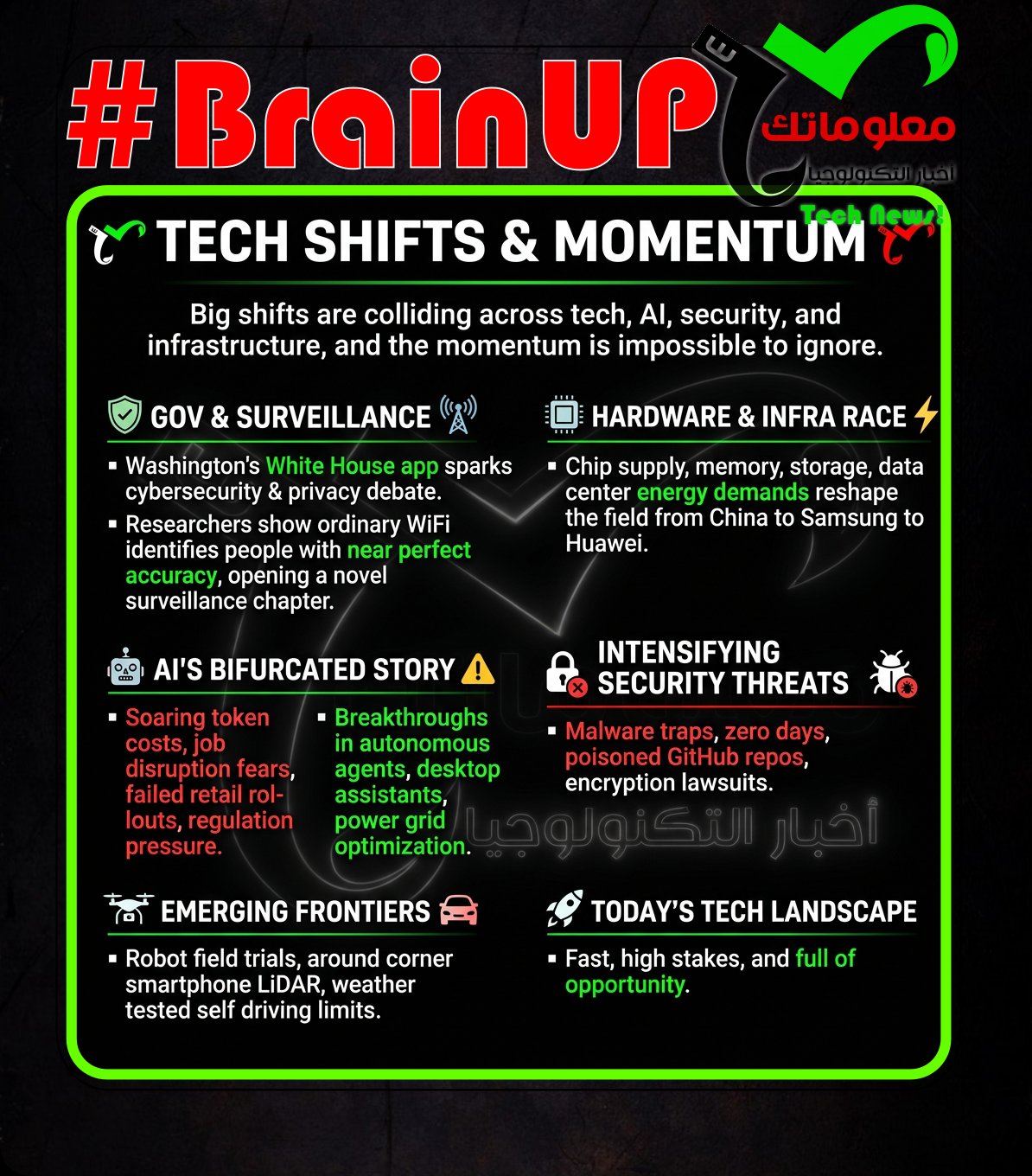
#BrainUp Daily Tech News – (Sunday, May 24ᵗʰ)
Welcome to today’s curated collection of interesting links and insights for 2026/05/24. Our Hand-picked, AI-optimized system has processed and summarized 32 articles from all over the internet to bring you the latest technology news.
As previously aired🔴LIVE on Clubhouse, Chatter Social, Instagram, Twitch, X, YouTube, and TikTok.
Also available as a #Podcast on Apple 📻, Spotify🛜, Anghami, and Amazon🎧 or anywhere else you listen to podcasts.
1. The White House is ordering agencies to place its new app on all employees’ government phones
The #WhiteHouse is directing federal agencies to install its newly launched #WhiteHouseApp on government furnished mobile phones across the executive branch, a move current and former officials described as highly unusual and potentially dangerous. Internal communications show federal CIO @Greg Barbaccia asked agency CIOs to help determine how to deploy the app broadly, and the #FAA told employees its IT team will automatically install the app on all FAA-issued iPhones and iPads as mandated by the White House. A White House spokesperson, Olivia Wales, said the app provides Americans direct access to live streams, breaking news alerts, policy initiatives, and social media posts, arguing government devices typically include pre-installed apps that support employees’ work. Former government IT executive Sonny Hashmi warned that mandatory installation should be cause for alarm because any app on government devices can create potential backdoor access to networks, and researchers had flagged issues after launch such as sharing users’ IP addresses, time zones, and other data with third parties, while an earlier GPS tracking concern was addressed when the White House removed that functionality. Overall, the rollout pushes the administration into new territory by blending an overtly political communications tool with government device ecosystems, raising #cybersecurity and data exposure concerns.
2. Ordinary WiFi can now identify people with near perfect accuracy
Researchers at Karlsruher Institut für Technologie (KIT) demonstrate that ordinary #WiFi routers combined with #artificial intelligence can identify people with near perfect accuracy by analyzing how radio waves propagate and reflect off bodies, effectively forming a camera like image using radio waves instead of light. The system can recognize individuals even without a carried device, and turning off a smartphone is not sufficient because other nearby connected devices still generate enough wireless activity for detection. The team warns this could turn ubiquitous routers into invisible surveillance tools, enabling identification in places like cafés and later recognition by public authorities or companies, while remaining hard to notice. Unlike earlier work requiring specialized sensors or channel state information, the approach can use normal router device communication, including beamforming feedback information, which increases practicality and potential reach. As wireless networks are widespread in homes and public spaces, the method could scale into a largely invisible, comprehensive surveillance infrastructure unless addressed.
3. California AI advancements raise concerns about job losses
The rapid advancement of #artificialintelligence in California has sparked concerns about potential widespread job losses. Reports indicate that as AI technology like #ChatGPT becomes more integrated into various industries, many workers, especially in sectors like customer service and administrative roles, could face displacement. Experts argue that without proactive policies and retraining programs, the economic impact on affected workers could be severe. Some policymakers are pushing for regulations and educational initiatives to help bridge the skills gap created by AI automation. This situation underscores the need for balancing technological progress with social and economic safeguards to protect the workforce.
Companies are pushing employees to maximize #AI usage for productivity gains, but rising #token based bills are forcing some to scale back. Microsoft has reportedly started canceling most direct @Anthropic Claude Code licenses and steering engineers to #GitHub Copilot CLI after rapid internal adoption made costs difficult to sustain, while keeping its Foundry arrangement and related investments intact, according to The Verge. Uber’s CTO Praveen Neppalli Naga said the company burned through its entire 2026 #AI coding tools budget in four months after incentivizing usage with internal leaderboards, and similar usage tracking has appeared at #Meta and #Amazon with calls to “toxenmaxx.” The pattern highlights an economic paradox: even if per token costs fall, broader adoption and #agentic AI can drive much higher total token consumption, with Goldman Sachs projecting a 24-fold increase to 120 quadrillion tokens per month by 2030 and Gartner warning cheaper inference will not necessarily lower enterprise spend. These reports reinforce concerns that replacing or augmenting human labor with AI can be constrained by compute economics, echoed by @Nvidia’s Bryan Catanzaro saying compute costs can exceed employee costs.
5. US scrambles to stop Internet users re-creating dead pilots’ voices
Internet users used software and #AI tools to reconstruct approximations of dead pilots’ voices from public materials in @NTSB crash-investigation dockets, prompting the agency to suspend public access to its online accident database. The @NTSB said advances in image recognition and computational methods let people rebuild cockpit voice recorder audio from sound spectrum imagery, citing the ongoing investigation of the November 4, 2025 crash of UPS Flight 2976 in Louisville, Kentucky, after it released transcripts and a PDF spectrogram of the last 30 seconds of cockpit audio. The crash involved a structural failure and an engine detaching after takeoff, killing three pilots and also killing 12 people on the ground and injuring 23. A 1990 federal law bars public release of cockpit voice or video recordings to protect crew privacy, and former officials and investigators described strict access controls and nondisclosure practices around the recordings. By sharing spectrogram imagery that can be reverse engineered into audio, the @NTSB’s transparency practices collided with the privacy purpose of the law, leading it to review what materials it can safely publish.
6. How far can AI improve China’s power grid?
China is accelerating the use of #AI in its power system to improve forecasting, grid optimisation and reliability, but experts caution that inflexible electricity markets and rising demand could cap the benefits for the clean-energy transition. The National Development and Reform Commission says that by 2027 at least five specialised large language models will be deeply embedded in the power grid, power generation and other fields, and pilots in places like Shanghai, Xinjiang and Beijing use AI to predict renewable output and enhance grid security. The #IEA estimates AI-powered algorithms could optimise operations, improve wind and solar integration, cut unexpected outages by up to 50 per cent, and if scaled, deliver about 300 terawatt-hours of global electricity savings, while companies like China Southern Power Grid report AI-based forecasting that supports trading and improves security and cost efficiency. Yet AI is also energy intensive, data centres are projected to consume 3 to 5 per cent of China’s electricity by 2030, and generative AI can create short-term demand spikes that have already affected grid security. Experts such as @Gao Hongchao note that AI integration into #VirtualPowerPlants is still early and, in a system prioritising reliability, AI mainly assists decision-making rather than fully controlling dispatch, meaning structural limits may undercut efficiency gains.
7. Grok schlock panned by fed flock
A Reuters review suggests @Elon Musk’s xAI chatbot Grok has seen little uptake in US federal #AI use and is perceived as weaker than leading rivals. Across more than 400 federal AI-use examples that named vendors, Grok or xAI appeared only three times and only for basic tasks like document drafting or social media management, while @OpenAI models appeared in more than 230 examples and @Google and @Anthropic showed up dozens of times. In a separate database of more ambitious government AI projects, Grok again appeared only three times, including routine Election Assistance Commission work and a Department of Energy pilot at Lawrence Livermore for document summaries and general research, compared with 140 entries involving Microsoft and OpenAI. The article argues the patchy data has gaps and excludes intelligence agencies and the Pentagon, yet the pattern still indicates Grok is far less adopted than competitors and not delivering the frontier performance Musk markets, echoing a Pentagon source saying staff prefer Gemini or Claude and noting public leaderboards where Grok rarely ranks in the top 10. This weak adoption is portrayed as problematic as SpaceX, which absorbed xAI, centers Grok and enterprise #AI in its IPO pitch and as Reuters reports Musk has pushed banks to buy Grok subscriptions tied to IPO participation, raising doubts about whether such deals can sustain real workplace demand.
8. Kash Patel’s Apparel Site Is Trying To Trick Visitors Into Installing Malware
An apparel site tied to @Kash Patel, BasedApparel.com, was spotted serving a #ClickFix attack aimed at tricking macOS users into installing malware by running a command in Terminal. Visitors may be shown a fake #Cloudflare “Verify you are human” page warning of “Unusual Web Traffic Detected,” which instructs them to click a Copy button and then paste and run the copied text in macOS Terminal. Although the page claims it copies a harmless verification string, it actually copies an obfuscated hidden command that decodes and fetches a shell script from a hacker-controlled domain. A user who flagged the incident retrieved the payload and found it was detected by 27 antivirus engines on VirusTotal as a Trojan infostealer, with commands that can steal credentials from Chromium-based browsers and data from cryptocurrency wallets, bundle it into a zip, and exfiltrate it. The incident suggests the site was compromised and reinforces warnings to distrust scareware pop-ups and copied-and-pasted Terminal commands, as Apple added protections in macOS Tahoe 26.4 to warn against such pastes.
9. Why Is Fusion Energy Always ’10 Years Away’?
Fusion power keeps being framed as perpetually years away because, despite major recent progress, turning lab success into reliable, efficient, continuous electricity generation remains extremely difficult. The article notes that fusion “x years away” quips date back at least to the 1960s and a 1986 panel, and contrasts those old timelines with real advances such as increased outputs, improved hardware, and laboratory fusion ignition. @Tammy Ma explains that @Lawrence Livermore National Laboratory’s #National Ignition Facility has achieved fusion ignition multiple times, but it was built for national security data rather than the high, efficient energy gains needed for commercial power, and no other approach has matched NIF on key metrics like energy gain and burning plasma. Both Ma and @Arianna Gleason emphasize that the core obstacles are formidable engineering and #materials science problems, namely building components that can survive star-like heat and radiation for long periods, including tritium breeding blankets, plasma-facing tokamak walls, and ultra-precise inertial fusion targets. The piece concludes that progress is real but the timeline depends heavily on solving these technical hurdles and scaling effort, with Ma arguing that more government and investor funding would accelerate the path to commercial #fusion energy.
10. China behind in LLM race but it can still win in AI, ex-Tencent AI lead says
@Liu Wei, former head of Tencent’s Hunyuan foundational model team, argues China is behind in the #LLM race because it lacks “fanshi,” paradigm-defining breakthroughs like @OpenAI’s #ChatGPT and @Anthropic’s #Claude Code. He says many Chinese companies are copying #DeepSeek or US firms at the core technical level, and warns that being a technological follower in the AI era risks having progress undermined when the frontier shifts. Liu adds that narrowing benchmark scores can be misleading because they do not capture gaps in real-world usefulness. He points to US leaders continuing to advance the technical frontier, citing @Anthropic’s Mythos model launch in April, while China’s leading player #DeepSeek did not match its earlier impact with its V4 model. The message is that catching up on paper is not enough, China needs original paradigm innovations to compete and still has room to win in broader #AI.
Chinese memory manufacturer CXMT is breaking into the mainstream consumer memory market by partnering with Corsair for a Vengeance DDR5 kit. This move positions CXMT as a notable player amid global DRAM shortages, offering an alternative to traditional suppliers. The collaboration highlights the growing presence and reliability of Chinese-made DRAM in high-performance consumer products. By providing competitive memory solutions, CXMT aims to alleviate supply constraints and foster more diverse sourcing options within the industry. This development signals a shift towards broader acceptance of Chinese memory technology in global markets.
12. 12. Apple Blocked $2.2 Billion in Fraudulent App Store Transactions in 2025
@Apple revealed that it stopped more than $2.2 billion worth of fraudulent #AppStore transactions during 2025 as the company continues tightening its ecosystem security and anti-fraud infrastructure. The report highlights how Apple removed tens of thousands of malicious developer accounts, rejected large numbers of risky app submissions, and blocked compromised accounts attempting to exploit payment systems, fake reviews, phishing operations, and subscription scams. The company says its layered defense strategy now relies heavily on #AI-driven fraud detection, behavioral analytics, human review teams, and automated account verification systems to identify suspicious activity before apps reach users. Apple also emphasized that many attacks increasingly involve organized fraud networks attempting to manipulate rankings, steal financial information, or distribute malware through deceptive applications. The announcement reflects the growing scale of digital marketplace abuse as major tech companies face mounting pressure from regulators and consumers to prove that closed ecosystems can provide stronger privacy and security protections while handling billions of transactions annually.
13. Elon Musk has given up on solar power (on Earth) | TechCrunch
@Elon Musk’s recent moves suggest a shift away from the “solar-electric economy” promoted in @Tesla’s Master Plans toward fossil-powered AI infrastructure and space-based energy. The article points to @xAI running data centers on dozens of unregulated natural gas turbines, planning to buy $2.8 billion more, while still purchasing $697 million in #Tesla Megapacks and lacking any materially significant purchases of #solar panels from Tesla. A new @SpaceX IPO filing instead emphasizes #space-based solar and orbital data centers, claiming space arrays can produce more than five times the energy of terrestrial solar due to 24/7 illumination, but it also highlights difficult economics like satellite power costs being multiples higher than on Earth and the challenges of hardening chips for space. The piece argues Musk may view today’s gas-turbine data centers as temporary until gigawatts of servers can be lofted into orbit to avoid Earth-side opposition, yet the risk is that this bet fails and entrenches fossil use in the meantime. The filing frames this strategy around expectations of “terawatt-scale annual AI compute growth,” a scale that dwarfs today’s roughly 40 gigawatts of global data center power use and drives Musk’s rationale for looking beyond terrestrial #solar.
A tentative profit sharing deal that narrowly averted a strike at @Samsung has triggered internal backlash that is now disrupting operations and threatening on-time shipments of #HBM for #AI customers. The Seoul Economic Daily reports widespread meeting cancellations and work negligence spreading into the foundry and TSP test and package units, with a source saying decision making on major projects has come to a complete halt, and warnings that negligence on production and verification lines could harm customer relationships and delivery commitments. The conflict centers on a stark payout gap: memory division workers could receive about 600 million won (around $400,000) while DX division workers would get about 6 million won (around $4,000), under a plan allocating 10.5% of semiconductor operating profit as stock bonuses plus 1.5% cash. Opposition is escalating via a DX-linked union seeking a court injunction to block the larger union from bargaining, and a shareholder group arguing the profit-linked bonus structure needs shareholder approval, as union ratification voting runs through May 27 and non-memory members could sway the result. With TSP essential to back-end packaging and testing, any slowdown could directly constrain #HBM output, including efforts to ramp #HBM4 for @Nvidia Rubin accelerators, despite CEO Jun Young-hyun urging employees to move past the dispute.
15. Tech layoffs pass 100,000 as 2026 tracker points to AI and Web3 shifts
Tech industry layoffs have surpassed 100,000 in 2023, indicating significant shifts toward #AI and Web3 technologies. Major companies including Microsoft, Google, and Amazon have announced substantial job cuts as they restructure to focus on AI-driven innovation and cloud services. The layoffs reflect broader market corrections following the rapid growth during the pandemic and signal changing priorities in tech investments and talent. Analysts suggest these moves will shape the industry’s future dynamics by reallocating resources toward emerging technologies like #generativeAI. This trend highlights the evolving landscape of the tech workforce and emphasizes the need for adaptability amid ongoing digital transformation.
In the AI industry’s shift into the #agent era, Alibaba’s Qwen team introduced #Qwen3.7-Max as a proprietary “versatile agent foundation” built for #long-horizon reasoning and reported about 35 hours of continuous autonomous execution. In one highlighted autonomous engineering run, the model worked on an isolated server with an unfamiliar T-Head ZW-M890 PPU to optimize an attention kernel, making 1,158 tool calls and 432 kernel evaluations over 35 hours, handling compilation failures and iterating to a 10.0x geometric mean speedup, outperforming open source competitors z.ai’s GLM-5.1 at 7.3x and @Moonshot’s Kimi K2.6 at 5.0x which often ended sessions early. Alibaba frames the endurance as “environment scaling,” training across many dynamic agentic environments, and notes evaluations such as simulating a one-year startup lifecycle in “YC-Bench.” The article argues the proprietary shift aligns Alibaba with @OpenAI and @Google’s paid-access strategy and may help recoup high training costs, while Chinese-only endpoints could limit adoption among U.S. and European enterprises focused on compliance and data sovereignty.
17. Canada to impose 15% tax on global streaming services in support of local productions
Canada is introducing a 15% tax on global streaming services like Netflix, Disney+, Apple TV+, and Amazon Prime Video to fund local content production. The government aims to level the playing field between Canadian and international streaming platforms, ensuring local creators receive adequate support despite the dominance of foreign companies. This move responds to the declining revenues for domestic media in the face of global competitors and aligns with Canadian regulations targeting cultural preservation. The tax revenue will help promote Canadian culture and create more opportunities for domestic talent within the entertainment industry, reinforcing the country’s commitment to vibrant local media. This policy mirrors similar efforts globally to balance the influence of large multinational streaming services.
18. CEO Walks Back Comment About Replacing ‘Lower-Value’ Human Capital With AI
A CEO recently clarified remarks regarding the role of #AI in workforce management after suggesting that AI might replace ‘lower-value’ human capital. The initial comment sparked significant backlash, prompting the CEO to emphasize the company’s commitment to human employees and the complementary role of AI rather than outright replacement. This incident highlights the ongoing tensions and misunderstandings surrounding AI’s integration into business operations and labor markets. It reflects broader concerns about #automation and its social impacts, suggesting that corporate leaders must carefully communicate about AI’s role to maintain trust. Ultimately, the episode underscores the need for balanced adoption of AI technologies that respect both innovation and workforce value.
19. MPs demand AI kill switch to protect British lives
UK MPs have called for the introduction of a legal AI kill switch to safeguard lives and prevent AI systems from causing harm. The demand arises amid growing concerns about uncontrolled developments in artificial intelligence, especially with technologies capable of making autonomous decisions. The MPs emphasize the necessity of regulatory frameworks to impose strict controls on AI, including mandatory failsafe mechanisms that allow human intervention to shut down AI systems during emergencies. This approach aims to balance technological advancement with public safety, ensuring AI benefits society without escalating risks. The proposal aligns with broader global efforts to implement robust AI governance as the technology becomes increasingly integrated into critical sectors.
A new study argues the rapid expansion of #data centers, alongside cryptocurrency mining, is poised to push U.S. electricity prices higher and could intensify public backlash tied to rising utility bills. It finds data centers’ share of total U.S. electricity use grew from 1.9% in 2018 to 4.4% in 2023, and models project national average wholesale power costs could rise 6% to 29% by 2030, with places like Virginia seeing generation-cost spikes up to 57%. Meeting this demand may rely heavily on natural gas, with potential use of underutilized coal plants, and the study estimates electricity-sector CO2 emissions could increase as much as 28% by 2030, partially reversing coal-retirement progress. The modeling also compares scenarios with and without #InflationReductionAct-like clean-energy incentives that were largely repealed: without them, natural gas supplies about 70% of incremental generation, but restoring incentives drops gas to about 41% while boosting wind and solar, affecting both emissions and costs. Overall, lead author @Jeremiah Johnson says the scale of added demand is unusually large, and where renewables are constrained, legacy fossil generation and imported power could keep wholesale costs elevated across the grid.
21. Palantir’s access to identifiable NHS England patient data is ‘dangerous’, MPs say
MPs and patient advocates warn that #NHS England’s decision to let @Palantir access identifiable patient information to help build the #Federated Data Platform is “dangerous” and could undermine public confidence in #data privacy. The Financial Times reported that Palantir staff and other contractors have been allowed to access data before it is pseudonymised, with an internal NHS briefing describing “unlimited access to non-NHSE staff” for part of the platform, despite acknowledged risks of “loss of public confidence.” Campaigners and MPs cite the £330m contract and Palantir’s other government work as amplifying concerns, while the Patients Association says patients were not consulted and want transparency and clear boundaries. NHS England says external consultants must have security clearance and that strict access policies apply, including logging any instances of identifiable data seen, and Palantir says it is only a data processor with granular controls that prevent misuse. The dispute highlights the tension between deploying #AI to integrate datasets for efficiency and maintaining assurances that personal data remains protected within the NHS.
22. Starbucks Abandons Borked AI Inventory Tool That Couldn’t Count: Report
Starbucks has retired an #AI-powered #inventory tool after about nine months because it repeatedly made basic counting mistakes, according to @Reuters. An internal newsletter said “Automated Counting” would be discontinued and that beverage components and milk would return to being counted the same way as other inventory categories. The system, supplied by NomadGo and promoted as combining on-device 3D spatial intelligence, #computerVision, and #augmentedReality with high accuracy, was reported to frequently miscount and mislabel items despite marketing claims of 99% accuracy. The tool was part of an effort under CEO @BrianNiccol to address inventory shortages affecting sales, and Starbucks said it tests ideas in stores and adjusts based on partner feedback to improve consistency across North American locations. The change fits within Starbucks’ broader experimentation with #AI, including Green Dot Assist, Smart Queue, and a customer-facing #ChatGPT-powered recommendation feature, while NomadGo said it is continuously learning from user feedback.
@Riot Games says its #Vanguard anti-cheat update does not “brick” PCs, PC components, or PC software, and clarifies that images shared alongside the claims show “cheat hardware devices” made for cheating in #Valorant. The controversy resurfaced after users alleged the kernel-level system had become more aggressive, with one claim describing an in-game IOMMU restart warning that left #DMA firmware unusable even after uninstalling Vanguard, supposedly requiring a full OS reinstall. Riot responds that the update instead makes those cheat devices worthless for Valorant, noting that disabling #IOMMU can let the device function again, but IOMMU will still be required to play Riot games. It reiterates that Vanguard cannot impact a PC’s functionality beyond blocking such cheating methods and says it will continue investing in anti-cheat while being transparent about how the systems work.
@Huawei introduced high capacity data center SSDs for AI inference, including 61.44TB and 122.88TB models with a 245TB version expected, by using #Die-on-Board packaging to overcome limits imposed by U.S. sanctions on advanced #3D NAND. Because the U.S. Department of Commerce put @Huawei on the #Entity List in 2019, it cannot access U.S.-origin technology and therefore cannot buy cutting-edge high layer NAND, even from non-U.S. makers like @Samsung or @SK hynix whose products rely on American tech. With local supplier @YMTC limited to 232 layer #Xtacking 4.0 NAND, Huawei mounts more NAND dies directly on the SSD PCB rather than relying on traditional BGA or TSOP packages, increasing density without stacking and reducing manufacturing steps and costs. The approach required solving thermal management and signal integrity issues, which the company claims it addressed in its OceanDisk 1800 launch. The article frames this SSD as part of Huawei’s broader pattern of innovating around restrictions as China blocks certain @Nvidia products and pushes domestic alternatives, potentially increasing revenue and R&D investment for Chinese chipmakers.
25. Iran Accuses Binance of Helping the Military Evade Sanctions
Iran has accused the cryptocurrency platform Binance of facilitating transactions for its military to evade international sanctions. According to the Iranian officials, Binance’s services have been used to bypass restrictions imposed due to Iran’s controversial activities. This development raises concerns about the effectiveness of global financial sanctions and the role of cryptocurrency in undermining them. The case highlights the growing intersection between digital currencies and geopolitical strategies, emphasizing the challenges regulators face. Binance’s involvement illustrates the complexities of monitoring and controlling crypto flows linked to sanctioned entities.
26. Trend Micro warns of Apex One zero-day exploited in attacks
Trend Micro has identified a zero-day vulnerability in #ApexOne, a security product used by enterprises, which is actively being exploited in attacks. The vulnerability allows attackers to bypass security and execute arbitrary code, posing significant risk to affected systems. Researchers warn that this zero-day is leveraged in targeted attacks, emphasizing the urgent need for organizations to apply mitigations and updates provided by Trend Micro. The discovery highlights ongoing challenges in securing enterprise environments against sophisticated threat actors exploiting unknown bugs. Users of Apex One are advised to remain vigilant and implement protective measures to minimize potential impact.
27. China puts humanoid robots through tea harvesting field trials
The article says China is testing humanoid robots in tea production through tea harvesting field trials as part of preparations for the 2026 World Humanoid Robot Games. It describes these tests as involving humanoid robots operating in tea farms and being evaluated in real production conditions ahead of the event. Beyond noting the connection to the 2026 games, no additional details are provided about the specific robots, results, locations, or performance metrics. Overall, it frames the field trials as a practical readiness step linking agricultural use cases to the upcoming competition.
28. Megalodon chums the waters in 5.5K+ GitHub repo poisonings
An automated campaign dubbed #Megalodon pushed malicious commits into more than 5,500 #GitHub repositories, planting CI/CD credential-stealing malware that runs if a repo owner merges the commit and then propagates through their pipeline. SafeDep reports 5,561 repos were affected, and @Moshe Siman Tov Bustan of Ox Security says the malware steals AWS secret keys and Google Cloud access tokens, queries AWS, Google Cloud Platform, and Azure metadata for role credentials, and searches for SSH keys, Docker and #Kubernetes configs, Vault tokens, Terraform credentials, and dozens of secret patterns before exfiltrating GitHub and Bitbucket tokens. Researchers found it embedded in the open source Tiledesk package, with versions 2.18.6 through 2.18.12 backdoored after the attacker compromised the GitHub repo, leading the maintainer to unknowingly publish poisoned releases even though the npm account was not directly taken over. Bustan warns this signals an accelerating #software-supply-chain era and argues that platform-level defenses from services like #npm and GitHub are needed because malicious code is still reaching servers even after steps like invalidating certain npm tokens. While the activity resembles prior TeamPCP-style repo poisonings, Ox and SafeDep say there is no solid threat-intel or code-analysis link to TeamPCP, and indications suggest it is not part of TeamPCP’s announced contest.
29. Texas AG sues Meta over claims that WhatsApp doesn’t provide end-to-end encryption
The Texas Attorney General sued @Meta alleging that #WhatsApp’s long-standing claims of providing #end-to-end-encryption are false and that the company can read users’ unencrypted messages. The complaint points to statements dating back to 2016 and sworn 2018 testimony by @Mark Zuckerberg asserting that WhatsApp is “fully encrypted” and that Facebook systems do not see message content, while the state argues Texans were deceived into believing even Meta could not access their communications. As factual support, the lawsuit largely relies on a Bloomberg report describing an abruptly closed US Commerce Department Bureau of Industry and Security probe and quoting an internal email claiming “there is no limit” to WhatsApp messages Meta can view, without indicating the AG’s office obtained that email or independent investigative material. It also cites that Meta can receive plaintext messages users report, though the article notes those are decrypted on the reporting user’s device using that user’s keys, and technologists argue a bypass of the #SignalProtocol would likely be exposed by reverse engineering. Meta called the allegations baseless and said it will fight in court, as experts also point to a 2023 technical analysis that gave WhatsApp a generally clean bill of health while identifying at least one design flaw.
Waymo temporarily suspended its driverless ride-hailing service in Atlanta and multiple Texas cities, including Houston, ahead of forecast severe storms and potential flash flooding over the Memorial Day weekend. The move followed an incident in Atlanta where an unoccupied Waymo vehicle became stranded in floodwater during heavy rain, and at least one other Waymo vehicle was also delayed during the storm. The article notes two earlier San Antonio incidents in which Waymo vehicles got caught in floodwaters, prompting a #software recall affecting nearly 3,800 vehicles. With the National Weather Service warning of severe thunderstorms, hail, gusty winds, and possible Gulf Coast flash flooding, Waymo said it paused Texas operations out of caution for the expected dangerous weather. The suspension reflects how extreme weather, especially flooding, can disrupt #autonomous ride-hailing and has led Waymo to limit service when conditions pose heightened risk.
31. Gemini app for Mac adding ‘Spark’ agent and voice control this summer
@Google previewed two major additions to the Gemini app for macOS coming this summer: the ‘Spark’ personal AI agent and a new voice experience with desktop context. #GeminiSpark is described as a 24/7 agent that can take actions for you, integrate with Gmail, Docs, other #Workspace apps, and third party services, and on Mac it is expected to work with local files and automate desktop workflows, alongside Gemini’s existing ability to use open windows as prompt context. Spark will first be available to Google AI Ultra ($100 per month) subscribers in beta next week on Android, iOS, and the web, before arriving on macOS later in the summer. The voice feature is triggered by long-pressing the function key to open a floating pill, then Gemini uses on-screen context to turn free-form speech into precise drafts and reformat text at the cursor, with a demo showing Finder file selection followed by dictating an email inserted into a Gmail compose window. Together, these updates position the Mac app as a more hands-on, system-aware #AI assistant for creating text and automating tasks across the desktop.
32. Your Smartphone’s LiDAR Can Now See Around Corners
Researchers led by Siddharth Somasundaram at the MIT Media Lab demonstrated that smartphone-grade #LiDAR can sense around blind corners by reconstructing sparse 3D shapes of hidden objects and tracking their motion, and it can even help localize a camera using objects outside direct view. The approach relies on #non-line-of-sight imaging, where laser pulses scatter off a wall or floor, bounce off a hidden object, and return via indirect paths, producing extremely weak signals that still encode timing information at picosecond #time-of-flight precision. Unlike a true photograph of a hidden room, the system yields rough, low-resolution reconstructions and depends on combining many noisy frames from a portable sensor with roughly 100 pixels. The work suggests that capabilities previously requiring specialized, expensive lab setups can be made accessible on consumer devices, with potential implications mentioned for detecting pedestrians in self-driving contexts, robot navigation in clutter, and maintaining hand tracking in #AR/#VR outside a headset’s field of view. Overall, it shows how reprocessing faint, indirect reflections can extend consumer LiDAR beyond line-of-sight mapping to practical around-corner sensing.
That’s all for today’s digest for 2026/05/24! We picked, and processed 32 Articles. Stay tuned for tomorrow’s collection of insights and discoveries.
Thanks, Patricia Zougheib and Dr Badawi, for curating the links
See you in the next one! 🚀
