
Algae Protein Gene Therapy Gives Some Blind Patients Partial Vision Back
Key points
- In the PIONEER trial, 10 legally blind patients aged 40 to 73 with retinitis pigmentosa received a gene therapy carrying the algae-derived light sensor ChrimsonR in one eye, at one of three escalating doses 1.
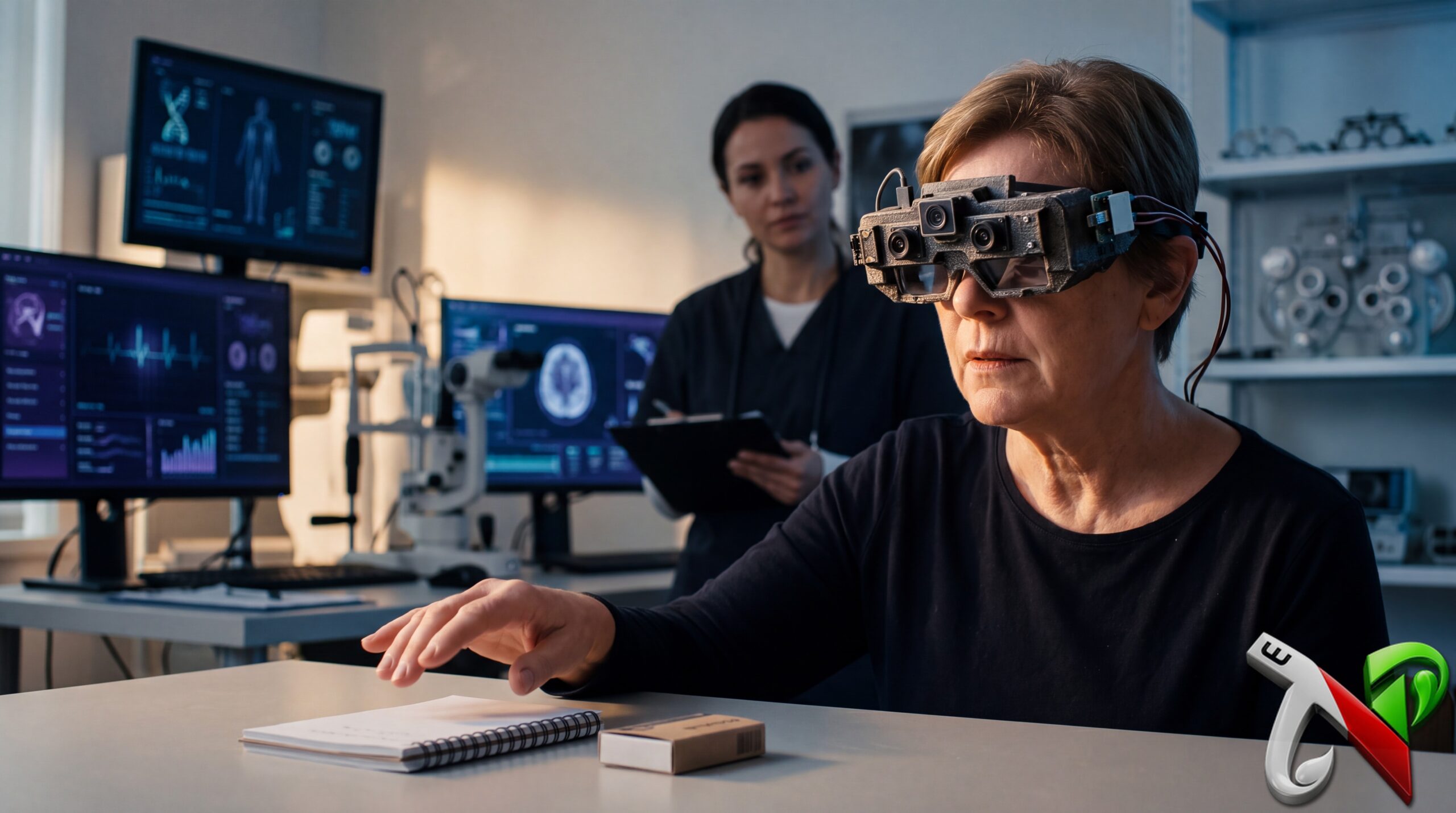
- With the goggles on, 6 of 10 participants showed a clinically meaningful gain in light sensitivity of more than fourfold, and one improved over 62-fold.
- Of eight patients who took further vision tests, roughly half could touch a notebook, grab a small staple box, or detect a change in a rotating bar.
- Safety was acceptable: most patients had temporary inflammation or raised eye pressure, and one severe blockage of a major eye artery cleared within minutes after an FDA-approved eye drop.
Alien Proteins, Real Sight
The idea once sounded like science fiction: install a light-sensing protein from algae in the human eye and let the brain learn to read the signals. A new clinical trial called PIONEER suggests it can work, with clear caveats 1.
The study treated people with retinitis pigmentosa, a genetic disease that gradually destroys the light-sensing cells of the retina. Seven of ten patients showed improved light sensitivity. When they wore goggles that pulse light to activate the algae protein, about half could reach for and touch objects or identify the orientation of a black bar. One participant, whose case made headlines in 2021, can now recognize and count objects, and white crosswalk stripes stand out to them.
This is still far from normal vision. What patients see is blurry, the field of view is narrow, and object edges look squiggly. They cannot yet read or recognize faces.
From Lab Tool to Therapy
The protein, channelrhodopsin, helped launch optogenetics about two decades ago, when Karl Deisseroth’s team used it to switch rodent neurons on and off with light. The technique transformed neuroscience and has been honored by the Nobel Committee. Until now it has mostly been a research tool.
Later searches of other algae strains turned up variants such as ChrimsonR, which responds to amber light. Amber penetrates tissue better and is less damaging than the blue light that activates the classic version. Researchers are also using generative AI to redesign such proteins for greater light sensitivity.
The appeal for retinitis pigmentosa is its breadth. More than 100 genetic variations are linked to the disease, so fixing a single gene would help few patients. Adding a light sensor to surviving cells could work regardless of the underlying mutation.
Turning Ganglion Cells Into Sensors
Earlier work put channelrhodopsin into cones, a type of light-sensing retinal cell. But in advanced disease, cones may be too far gone to save. This trial instead targeted retinal ganglion cells, which pass visual signals to the brain but normally do not detect light. They are hardier than cones, so they can serve as substitute sensors.
The team packaged the ChrimsonR instructions in a harmless viral vector and injected it into the worse-seeing eye of each patient. The goggles, which resemble a consumer headset, then do the translation. A camera watches the scene thousands of times per second and, when a pixel changes, pulses amber light from that spot into the eye. Because eyes constantly dart around, this change-driven approach may better mimic natural vision.
Gains lasted for years among those who responded, improving over roughly five years. Brain recordings also hinted at adaptation: visual-related electrical signals were more coherent with eyes open than closed, suggesting perception depended on the new input.
Safety and the Road Ahead
The trial’s first goal was safety, and it was met. Most participants had a short bout of inflammation or a temporary rise in eye pressure, with no detectable effects elsewhere in the body, and the retina’s structure stayed intact. The one severe event was an artery blockage that cleared within minutes with an approved eye drop.
The next gains will have to come from sharper tools. The therapy reaches only a fraction of ganglion cells, which limits resolution, and more light-sensitive protein versions may help. On the hardware side, the team is working on goggles with more accurate and timely stimulation, with possible additions including eye tracking, scene preprocessing software, and even holographic displays. As Deisseroth wrote, methods built for basic discovery are now heading toward diverse therapeutic uses.
Primary sources
 Blind Patients Recover Partial Vision in Gene Therapy Trial (singularityhub.com) – A SingularityHub feature on the PIONEER clinical trial, which combined gene therapy with optogenetics in 10 legally blind patients with retinitis pigmentosa. It explains how channelrhodopsin from algae launched optogenetics, why the team used the amber-light variant ChrimsonR, and why it targeted ganglion cells rather than cones. It reports that 6 of 10 participants gained clinically meaningful light sensitivity, that about half of those who did further tests could touch objects or detect bar movement, that benefits lasted for years, and that the safety profile was acceptable. It also covers current limits (no reading or face recognition) and planned improvements to proteins and goggles. Published by singularityhub.com; the text is truncated at the end.
 Powered by News Ranker
