
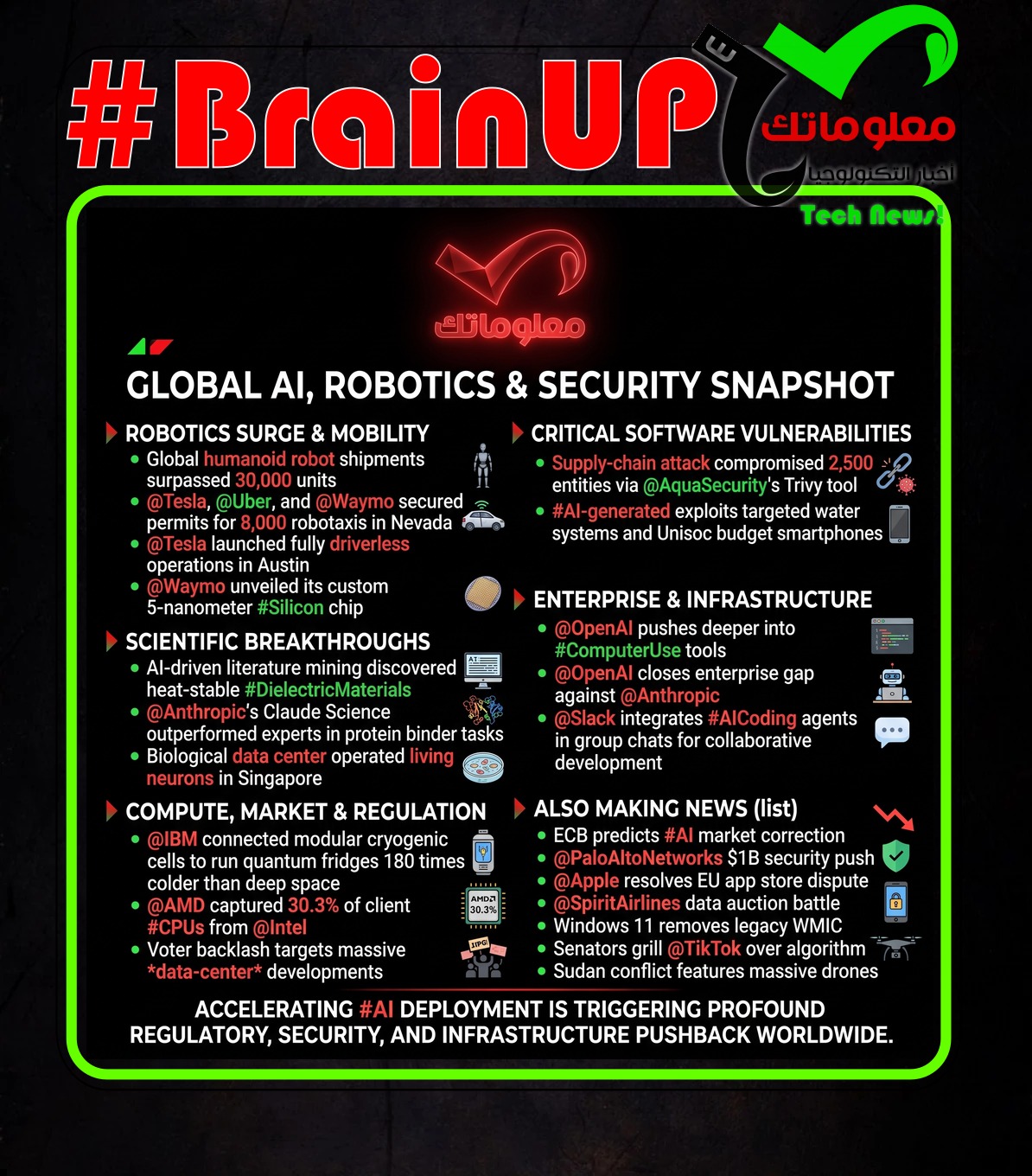
Ranker’s #BrainUp Daily Tech News – (Friday, August 21ˢᵗ)
Welcome to today’s curated collection of interesting links and insights for 2026/08/21. Our automated ranking and AI-summarization system has processed 27 articles from all over the internet to bring you the latest technology news.
1. AI-driven literature mining speeds discovery of heat-stable lead-free dielectric materials
Artificial intelligence has successfully mined data scattered across hundreds of research papers to discover new #LeadFree #DielectricMaterials that maintain stable performance even at elevated temperatures. The published study details an innovative approach designed to transform traditional materials discovery from a tedious trial-and-error procedure into a streamlined, data-driven workflow. By automating the extraction and analysis of complex chemical literature, the methodology enables researchers to identify promising compositions far more rapidly than conventional experimental methods allow. This capability addresses a long-standing bottleneck in physical sciences where synthesizing and testing candidate compounds physically is both time-consuming and expensive. Consequently, the breakthrough matters because it accelerates the development of next-generation electronic components capable of operating reliably under extreme thermal stress.
2. Waymo built its own robotaxi chip and published its supplier list
@Waymo has published detailed architectural specifications of its onboard robotaxi computer, introducing a custom 5-nanometer application-specific integrated circuit alongside its primary supplier list. The proprietary custom chip acts as a powerful front-end processor delivering over 1,000 TOPS of machine learning performance dedicated to extracting raw data from lidar, radar, and camera streams before it reaches the core decision-making neural network. Operating within a balanced and heterogeneous hardware ecosystem, @Waymo paired its custom silicon with merchant CPUs and accelerators sourced from seven key partners, including @AMD, @Micron, @Samsung, @SanDisk, @Socionext, @TSMC, and @Nvidia. The ruggedized computing hardware is engineered with dual-engine hardware redundancy and liquid cooling to withstand extreme thermal swings across multiple U.S. cities where the company operates thousands of vehicles completing roughly 500,000 weekly paid trips. This hardware disclosure matters because it provides rare transparency into the specialized custom semiconductor infrastructure required to scale safe, high-throughput autonomous driving systems.

A massive supply-chain attack has compromised more than 2,500 organizations and 434,000 CI/CD pipelines after hackers infiltrated an open-source security scanner. Security firms @CloudSEK and @HudsonRock revealed that the financially motivated group @TeamPCP exploited a known vulnerability in @AquaSecurity’s Trivy tool to poison a build consumed by @LiteLLM. Because the automated pipeline trusted the component without checking its identity, the poisoned package installed a stealer that harvested critical credentials including cloud keys, SSH tokens, and AI provider keys. Independent researcher @KevinBeaumont confirmed that nearly five months after the March 2026 breach, several of the exfiltrated keys remained active despite organizations claiming to have rotated them. This incident matters because it highlights a severe systemic risk where automated tool chains can silently surrender master access to enterprise infrastructure without requiring a direct exploit of the target software.
4. Humanoid Robot Shipments Up 300%: Up To 30,000 So Far In 2026
Global shipments of humanoid robots surged significantly in the first half of 2026, with estimates ranging from over 22,000 units reported by @CounterpointResearch to more than 30,000 units claimed by the @HumanoidRobotSceneApplicationAlliance. According to market trackers, leading vendors such as @Agibot and @Unitree dominate approximately three-quarters of worldwide shipments, with @Agibot capturing the top market share. While a large portion of these deployments initially target research and educational applications, industrial and commercial adoption is expanding, supported in part by state-backed training centers in China where operators teleoperate robots to generate valuable training data. Meanwhile, @Unitree achieved a major financial milestone by debuting on Shanghai’s STAR Market and soaring nearly 500% to reach a valuation near $50 billion. This rapid scaling matters because it signals that humanoid robotics is transitioning from experimental lab demonstrations into a heavily commercialized hardware market backed by substantial capital.
5. AI market correction is coming, ECB blog predicts | Reuters
A recent @EuropeanCentralBank blog post warns that a market correction targeting technology stock exuberance in the United States is increasingly likely and could trigger far-reaching economic consequences. Investors have heavily piled into shares of major tech entities like @Alphabet, @Amazon, and @Apple based on expectations that artificial intelligence will fundamentally reshape the global economy, pushing valuations well above historical averages. However, the @EuropeanCentralBank cautions that existing fiscal and monetary policy buffers may prove insufficient to blunt the potential economic fallout if speculative asset prices suddenly collapse. This warning matters because an abrupt valuation adjustment in the dominant technology sector could destabilize broader financial markets that currently rely on sustained high returns from artificial intelligence investments.
6. What Happens When the World is Run on Code No One Understands?
The rapid proliferation of generative artificial intelligence is accelerating automated discoveries in mathematics and software development, but it is simultaneously creating a critical verification bottleneck because human review cannot keep pace with machine output. Recent high-profile security disclosures revealed that @Anthropic’s Mythos model and tools evaluated by @Microsoft engineers have uncovered massive numbers of deep vulnerabilities in critical operating systems and enterprise codebases. To prevent catastrophic system failures arising from complex code that no human fully understands, computer scientists are increasingly turning to formal methods and formal verification to mathematically prove software correctness. By pairing generative AI with automated proof-checking systems, developers can systematically validate code logic and eliminate entire classes of systemic errors before deployment. This infrastructural shift matters because modern global society increasingly relies on digital code running hospitals, financial systems, and power grids that must remain secure and verifiable.
Security researchers have demonstrated a critical vulnerability in budget smartphones powered by Unisoc system-on-chip devices that allows attackers to gain full root access via a malicious video call. The exploit targets improper isolation of shared resources in the modem firmware of Unisoc chips – specifically models T612, T616, T606, and T7250 – which are widely used in affordable mobile handsets manufactured by brands such as @Xiaomi, @Motorola, and @Realme. Disclosed by a researcher using the alias @0x50594d, the proof-of-concept attack uses malicious code injected into call setup messages over a closed VoLTE network to compromise rooted test devices running older security patches. Despite the highly specific laboratory conditions required for successful execution, the vulnerability allows arbitrary code execution with kernel privileges from the modem context. This discovery matters because Unisoc supplies essential mobile hardware to major vendors globally, posing a severe latent risk to millions of budget device users if manufacturers fail to patch the underlying firmware.
8. IBM’s Quantum Fridges Run 180× Colder Than Deep Space
@IBM has successfully connected two modular cryogenic cells into a single environment and cooled them below 15 millikelvin, marking the first time multi-module quantum gate operations have been executed across separate refrigeration units. Operating at roughly 180 times colder than deep space, this extreme temperature is a physical requirement to prevent superconducting qubits from collapsing under thermal noise. Each 8-foot-tall aluminum module provides about 9 cubic feet of cold interior space and uses 1-meter aluminum superconducting cables called L-couplers to link modules and enable two-qubit gates between separate cells. While @IBM advances toward its 2029 fault-tolerance target named Starling – aiming for roughly 10,000 physical qubits producing around 200 logical qubits – rival companies are pursuing alternative fault-tolerant architectures using trapped ions, photons, and spin-qubits. This hardware engineering milestone matters because achieving modular cryogenic scalability is essential for transitioning quantum computing from isolated laboratory physics experiments into practical enterprise data center infrastructure.
9. Slack wants to drag AI coding out of the terminal and into the group chat
@Slack has announced a new product called Slack Code that embeds #AICoding agents directly into dedicated messaging channels to enable collaborative software development across entire teams. Supported integrations at launch include @Anthropic’s Claude Code, @Cognition’s Devin, @GitHub Copilot, and an agent from @Vercel, allowing users to invoke coding assistants from any conversation to generate live previews, code diffs, and running project plans. When an agent is tagged, it spins up a dedicated code channel and operates in a cloud-based environment complete with browser testing tools, leaving behind a searchable audit trail before archiving itself. During demonstrations, engineering agents successfully investigated bugs, opened pull requests, and dynamically incorporated design assets from @Figma provided by human teammates. This product launch matters because it shifts AI-assisted programming away from isolated individual terminal windows and into a shared enterprise collaboration layer where non-technical stakeholders can directly participate in software creation.
10. Palo Alto Networks and NTT DATA team up on a $1 billion AI security push
@PaloAltoNetworks and @NTTDATA are expanding their partnership through a $1 billion initiative aimed at automating security operations and integrating advanced identity tools deeper into large enterprise environments. Modern autonomous artificial intelligence agents deployed within organizational networks constantly query databases, transfer files, and execute software routines independently, creating a massive proliferation of machine credentials. According to @PaloAltoNetworks, typical enterprises maintain over 80 non-human machine accounts for every human employee, leaving most security teams unable to inventory or audit which systems hold sensitive access permissions. This strategic collaboration matters because unchecked machine identities represent a critical blind spot that can easily be exploited by threat actors to compromise vital corporate, medical, or financial infrastructure.
11. Tesla, Uber, and Waymo all get the OK to operate thousands of robotaxis in Nevada
The Nevada Transportation Authority has unanimously approved commercial robotaxi permits for @Tesla, @Uber, and @Waymo to operate up to 8,000 autonomous vehicles across Clark County over the next twelve months. Specifically, @Tesla received approval for up to 5,000 vehicles, while @Waymo and @Uber were authorized for 1,000 vehicles each, with @Uber deploying its fleet through partnerships with @Motional and @Zoox. Despite the large authorized caps, representatives from @Tesla testified that reaching the maximum ceiling within a year is unlikely, projecting a more conservative deployment target closer to 2,500 vehicles due to operational scaling. The rapid approvals have sparked sharp pushback from local taxi companies and the Livery Operators Association, who argued that flooding the local roadways with autonomous fleets risks severe traffic congestion and economic displacement for human gig drivers. This regulatory decision matters because it establishes Las Vegas as a major battleground for commercial robotaxi deployment and tests how municipal infrastructure will absorb large-scale autonomous transportation.
12. Apple’s long-running app store battle with the EU appears to finally be over
Apple’s long-running antitrust dispute with the European Union regarding iOS app distribution and developer fees appears to be resolved after the European Commission welcomed revised business terms introduced by the company. Under the updated framework within the European Union bloc, developers will face commissions ranging from 5% to 26% depending on their chosen sales channels and program enrollments. Specifically, apps using Apple’s in-app purchase system will incur a standard 26% commission, which drops to 15% for participants in programs like the App Store Small Business Program, while alternative payment processing and web link-outs feature reduced rates. Additionally, apps distributed through alternative app marketplaces or web channels will be subject to a flat 5% Core Technology Commission. While this agreement successfully closes the regulatory chapter in Europe, legal conflicts persist in the United States, where settlement talks between @Apple and @EpicGames remain stalled and pending judicial resolution. This outcome matters because it sets a major precedent for how dominant technology platforms must structure app store fees and alternative marketplace access to comply with international antitrust regulations.
13. Inside OpenAI’s plan to make ChatGPT the way you use your computer
@OpenAI is advancing its #ComputerUse initiative by rolling out new tools that allow ChatGPT to independently operate web browsers and external desktop applications with human-like dexterity. To achieve this capability, @OpenAI trained its models using extensive datasets that incorporated frame-by-frame screenshots, ideal mouse and keyboard input demonstrations, and reinforcement learning loops designed to reward successful task completion. Unlike earlier iterations that relied solely on analyzing static pixel screenshots, the updated models can directly parse webpage memory structures, accessibility trees, and link connections to accelerate interactions across multiple software environments. Executives note that this technology represents a fundamental shift in user interaction, moving away from specialized coding interfaces toward general-purpose automation capable of handling everyday digital workflows. This development matters because it positions @OpenAI to compete directly with @Anthropic in embedding autonomous agents deeply into consumer and enterprise operating systems.
14. AMD Crosses a 30% Client CPU Market Share Against Intel
@AMD has crossed a major industry milestone by capturing 30.3% of the x86 client CPU market in the second quarter against @Intel’s 69.7%, according to tracking data from @MercuryResearch. This figure represents a substantial jump from a 21.1% market share two years prior, driven primarily by strong shipment growth in notebook processors that complemented @AMD’s existing strength in desktop CPUs. Despite @AMD’s gains in traditional x86 hardware, the broader PC industry is experiencing a severe downturn in desktop shipments, falling by more than 20% year-over-year due to a persistent memory crunch that has dramatically inflated the cost of RAM, storage, and graphics cards. Meanwhile, alternative Arm-based processors from competitors like @Apple, @Qualcomm, and @MediaTek reached a record-high 15.3% share of overall PC client CPU shipments. This market shift matters because it highlights shifting competitive dynamics in silicon manufacturing alongside macroeconomic component shortages that continue to constrain consumer hardware demand.
15. A data centre rack running on living neurons is now operating in Singapore
Researchers from @NUSMedicine, data center operator @DayOne, and Melbourne-based @CorticalLabs have unveiled a biological data centre prototype in Singapore utilizing a 20-unit rack of neuron-powered CL1 computers. The living neurons integrated into these servers are grown from stem cells and cultured at the @NUS Life Sciences Institute to explore biological computing as an alternative to silicon infrastructure for scaling artificial intelligence workloads with reduced electrical power consumption. However, independent analysis indicates that a single CL1 unit consumes between 850 and 1,000 watts, meaning the entire rack draws up to 20 kilowatts of power, which is comparable to conventional silicon data center racks. This energy consumption stems primarily from the intensive life-support systems, incubators, and temperature controls required to keep the biological cells alive rather than the computation itself, while also imposing a strict six-month maintenance lifespan on the neural tissue. This prototype matters because it shifts biological computing from theoretical academic research into early commercial exploration, though critical questions regarding its net energy efficiency per computational task remain unanswered.
16. Claude Science outperforms experts in protein binder task
@Anthropic’s Claude Science model, operating with Mythos Preview and Opus 4.8 versions, has outperformed human experts in a rigorous protein binder design challenge and significantly accelerated chemical analysis workflows. Working in collaboration with @AdaptyvBio and @TwistBioscience to validate the results experimentally, the AI achieved hit rates between 22.6% and 26.7% across 15 challenging targets, rising to 35.1% when tackled individually, substantially exceeding the typical 10% to 15% success rate of human-led design campaigns. Additionally, the AI demonstrated the ability to process raw nuclear magnetic resonance spectroscopy and liquid chromatography-mass spectrometry data within minutes without relying on vendor-specific operator software, yielding purity and hydrogen count metrics that closely matched laboratory benchmarks. This breakthrough matters because it demonstrates that advanced artificial intelligence can autonomously execute complex end-to-end biochemical design and quality-control tasks, potentially revolutionizing pharmaceutical research and drug development timelines.
17. Voters Aren’t Waiting for Election Day to Fire Officials Who Approved Data Centers
Local voter backlash against massive artificial intelligence data center developments has triggered a surge in municipal political activism and recall elections across the United States. In Independence, Missouri, resident outrage over a $6.2 billion tax abatement package granted to @Nebius for a massive 1.2-gigawatt data center complex led to a successful petition drive forcing a special recall election against a local councilman. Similar grassroots opposition has erupted in locations like Festus, Missouri, and Yukon, Oklahoma, where residents have attempted to recall local officials over proposed multibillion-dollar computing facilities that threaten to strain municipal water resources and drive up electricity prices. State-level political races have also absorbed voter anger, with public service commissioners and delegates losing seats after supporting infrastructure projects linked to soaring energy costs. This widespread political friction matters because it illustrates a growing grassroots rebellion where communities are refusing to absorb the heavy local resource costs of the AI infrastructure boom without adequate public input or accountability.
18. OpenAI is gaining on Anthropic with business users, new data indicates
New corporate spending data from expense management company @Ramp indicates that @OpenAI has steadily gained market share against @Anthropic among paying business users in the United States. Following a shift in May where @Anthropic captured 41% of @Ramp’s corporate user base compared to @OpenAI’s 39%, the gap has widened further, with @Anthropic holding nearly 44% and @OpenAI commanding nearly 40% as of July. Despite @Anthropic’s current lead, @OpenAI has exhibited faster quarter-to-date growth driven by strong developer adoption of newer models like GPT-5.6 Sol, whereas @Anthropic faced customer friction following the high pricing and strict 30-day data retention requirements associated with its Fable model tier. Meanwhile, overall enterprise adoption of paid artificial intelligence tools among @Ramp customers has climbed steadily, crossing 56% by July. This shifting market share matters because it demonstrates that enterprise AI customers are highly volatile and willing to switch providers dynamically as competing labs release new products, underscoring the lack of permanent brand loyalty in the sector.
Artificial intelligence training startup @Micro1 has submitted a late $12.5 million acquisition bid for bankrupt airline @SpiritAirlines’ corporate data assets, challenging @Google’s winning $10 million bid from an earlier bankruptcy auction. @SpiritAirlines has been auctioning off its data assets as part of bankruptcy proceedings following its collapse last year, sparking a competitive bidding war that previously involved another AI startup, @Mercor, which had placed a $7.5 million offer. @Micro1 Chief Executive Officer Ali Ansari argued that @Google’s winning bid undervalues decades of valuable real-world operational data that can train AI models to navigate messy, practical environments. While bankruptcy law professors note that courts typically protect the integrity of completed auctions, judges retain discretion to entertain late bids if they significantly increase recovery for creditors and shareholders. This legal contest matters because it highlights how aggressive artificial intelligence startups are willing to disrupt traditional bankruptcy proceedings to secure large-scale proprietary training datasets.
20. Intense light bent out of shape—ultrafast lenses made from gas
Researchers from the @MPIK in Heidelberg have successfully utilized an atomic gas as a time-dependent optical element to shape and spectrally manipulate intense, high-frequency laser pulses. This gas-based lens offers a novel method for controlling extreme ultraviolet and X-ray pulse dynamics without relying on traditional solid-state optics that often degrade under high-intensity radiation fields. The ability to precisely manipulate ultrafast high-frequency laser radiation holds significant potential for advancing scientific applications such as chemical reaction steering, quantum computing architectures, and high-resolution spectroscopy. This fundamental optics breakthrough matters because it provides researchers with robust new tools to control extreme laser energies required for cutting-edge physical and chemical research.

A critical vulnerability discovered in @NASA’s open-source ground control software could have allowed unauthenticated third-party attackers to issue commands directly to spacecraft and execute server-side scripts. Security researcher Yuval Elbar from the @Cycode Agentic Development Security Platform identified the flaw in the browser-based interface of the AMMOS Instrument Toolkit (AIT-GUI) up to version 2.5.1, which has since been patched in version 2.5.2. The security failure stemmed from the AIT-GUI web server listening on all external network interfaces with zero authentication or authorization protection, combined with a total absence of cross-site request forgery defenses on critical endpoints like `/cmd` and `/script/run`. This configuration meant that any external attacker could potentially gain full control of spacecraft simply by tricking an operator into visiting a malicious webpage or accessing an exposed network port. This security flaw matters because operational space infrastructure inherits standard web vulnerabilities that, if exploited, carry catastrophic operational costs and safety risks.
@Microsoft has permanently removed the legacy Windows Management Instrumentation Command-line (WMIC) tool in upcoming builds of the Windows 11 September 2026 Update. Originally deprecated years ago, WMIC was traditionally utilized by enterprise IT administrators to run administrative scripts, but it was frequently abused by cybercriminals as a living-off-the-land binary to deploy malware and ransomware without bringing external executables. In early preview builds of the upcoming update, the tool is entirely absent from the system partition, cannot be enabled via optional features, and returns an unrecoverable command-not-recognized error when executed. @Microsoft confirmed that completely purging the legacy component is designed to improve overall operating system security and reliability. This change matters because eliminating heavily exploited administrative binaries helps block sophisticated threat actors from leveraging trusted system tools to compromise consumer and enterprise machines.

An independent internal investigation conducted by @Supermicro’s board of directors has cleared its current senior management and CEO Charles Liang of knowing about an alleged $2.5 billion smuggling scheme involving restricted hardware packed with @Nvidia chips destined for China. The probe was initiated following the March indictment of co-founder and board member Yih-Shyan “Wally” Liaw, who allegedly spearheaded the illegal export operation and whose criminal trial has been postponed to March 2027. While @Supermicro’s internal review found no evidence that executives were aware of the illicit sales – though the company did terminate several sales and technical support employees for violating corporate policies – external legal pressures continue to mount. Federal authorities in New York have issued a grand jury subpoena, the @SEC has requested customer documents, and overseas authorities in Taiwan recently detained four employees for questioning regarding separate corporate sales. This investigative conclusion matters because it attempts to reassure investors about executive integrity, even as ongoing federal and international criminal probes threaten to expose deeper compliance failures at the server manufacturing firm.
24. Senators demand answers from TikTok About ‘depraved’ experiment
United States Senators Marsha Blackburn and Richard Blumenthal have sent a sharply critical letter to @TikTok executives @ShouChew and US spinoff CEO Adam Presser, demanding answers regarding an internal algorithmic experiment that withheld a safety feature from millions of teenage users. Disclosed via confidential 2023 legal documents reported by Bloomberg Businessweek, the test intentionally disabled filter-bubble prevention safeguards for 10% of US users to measure impacts on daily active users and financial metrics. The control group included 16-year-old Chase Nasca, whose account was inundated with dark content concerning hopelessness and suicide shortly before he died by suicide in 2022. The senators condemned the company’s decision as depraved and demanded a complete unredacted version of the document alongside details of all similar algorithmic tests where safety features were reduced or delayed. This congressional inquiry matters because it escalates legal and political scrutiny over how major social media platforms prioritize engagement and profit metrics over the mental health and safety of young users.
25. Tesla’s Austin robotaxis are now fully driverless, tracking shows
Crowdsourced tracking data indicates that @Tesla’s robotaxi service in Austin, Texas, has transitioned to operating entirely without human safety monitors behind the wheel. Independent monitoring project @RobotaxiTracker logged 170 unsupervised rides across 54 distinct vehicles over a two-week period, supported by corroborating user reports on social media platforms. However, the expansion faced scrutiny after a passenger filmed an unsupervised @Tesla vehicle repeatedly striking and driving through a line of fixed plastic bollards that had obstructed a street corner since 2024. While @Tesla does not publicly disclose fleet telemetry or remote operator intervention rates, the incident raised questions about the vehicle’s onboard spatial mapping capabilities, particularly given @Tesla’s decision to forgo lidar and high-definition mapping systems. This deployment milestone matters because it highlights the rapid scaling of driverless commercial rides while underscoring the ongoing technical challenges autonomous vehicles face when navigating complex urban infrastructure.

An intensifying drone conflict in Sudan’s ongoing civil war has highlighted a high-stakes aerial contest between large Turkish-built military aircraft and Chinese-made reconnaissance unmanned aerial vehicles. The Sudanese Armed Forces have deployed heavy 66-foot @Baykar Akıncı drones – costing roughly $25 million each – to successfully intercept and destroy at least six Chinese-made CH-95 drones operated by the rival paramilitary Rapid Support Forces since June 2026. While the CH-95 is a smaller, lower-cost medium-altitude aircraft used primarily for reconnaissance and strike missions, the heavier Akıncı is equipped with advanced radar and air-combat missiles capable of engaging aerial targets directly. United Nations officials have warned that the proliferation of armed drone warfare across the region has become the leading cause of civilian casualties, accounting for over 80% of conflict-related deaths between January and April 2026. This military escalation matters because it illustrates how advanced, asymmetric drone warfare between competing foreign-supplied systems is escalating the human toll in prolonged regional conflicts.
27. US says hackers are targeting vulnerable water systems with the help of AI
U.S. cybersecurity agencies including @CISA, the @FBI, and the @NSA have issued a joint warning that hackers are actively exploiting critical vulnerabilities in industrial automation equipment used across the nation’s water and wastewater systems. The coordinated alerts highlight that threat actors are targeting Siemens S7 programmable logic controllers – devices responsible for managing automated physical processes in energy, manufacturing, and agricultural sectors – by leveraging artificial intelligence to rapidly generate exploit scripts from publicly available vulnerability data. According to @CISA, these intrusions can cause severe operational downtime, equipment damage, and public safety hazards, particularly affecting vulnerable rural communities with expansive geographic infrastructure. This warning follows a series of escalating cyberattacks against water facilities across multiple states, heavily attributed by officials to suspected Iranian threat actors. This cybersecurity threat matters because the integration of artificial intelligence into hacker tooling accelerates the automated exploitation of vital public utility infrastructure that remains inadequately secured.
That’s all for today’s digest for 2026/08/21! We picked and processed 27 articles. Stay tuned for tomorrow’s collection of insights and discoveries.
See you in the next one! 🚀
