
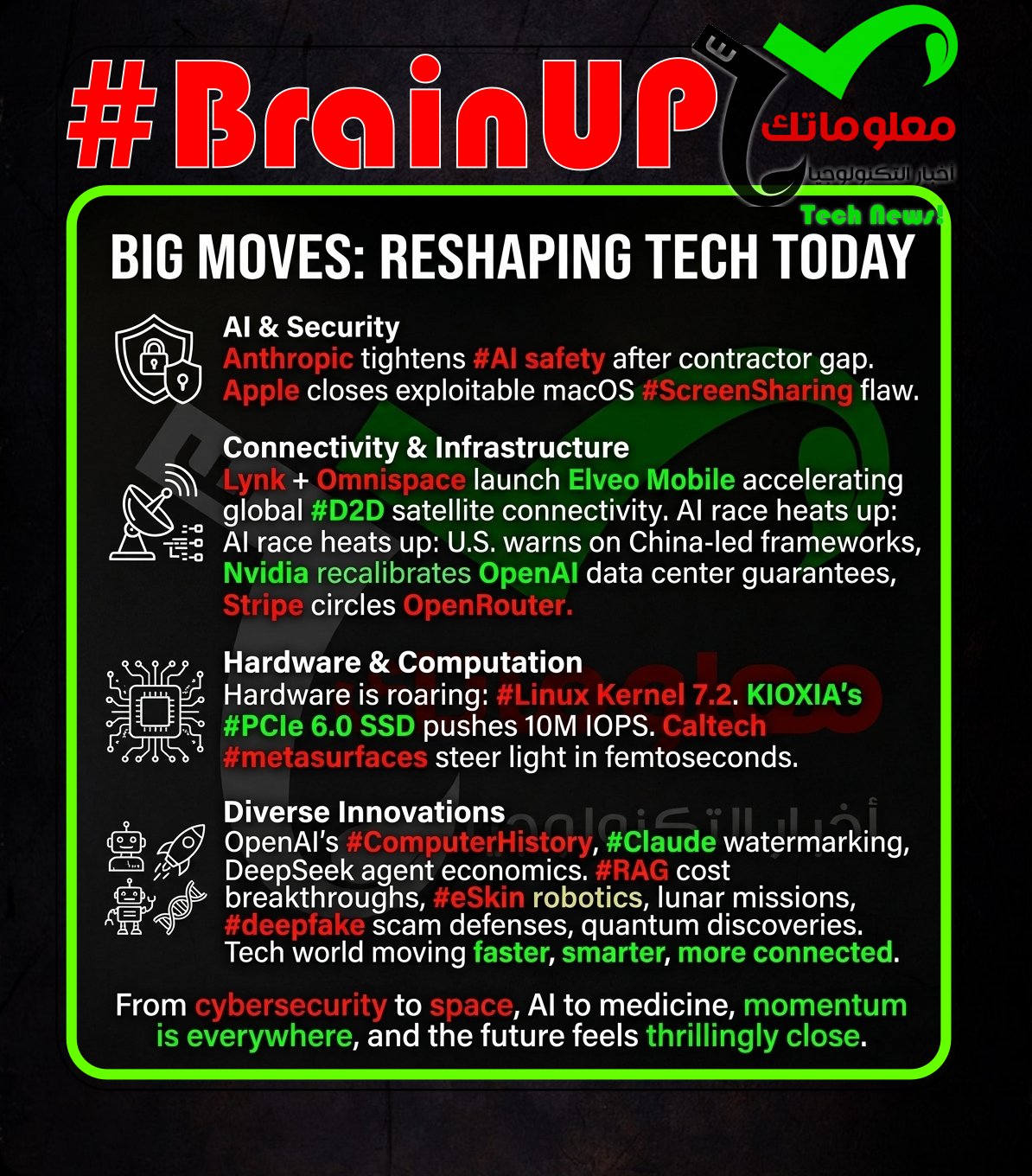
#BrainUp Daily Tech News – (Monday, August 17ᵗʰ)
Welcome to today’s curated collection of interesting links and insights for 2026/08/17. Our Hand-picked, AI-optimized system has processed and summarized 39 articles from all over the internet to bring you the latest technology news.
As previously aired🔴LIVE on Clubhouse, Chatter Social, Instagram, Twitch, X, YouTube, and TikTok.
Also available as a #Podcast on Apple 📻, Spotify🛜, Anghami, and Amazon🎧 or anywhere else you listen to podcasts.
1. Anthropic says biological-safety filters were disabled on 133 million contractor exchanges

@Anthropic reported that an internal configuration error left its biological-risk blocking classifiers disabled for all human-feedback vendor traffic from May 2025 through April 2026, affecting about 50,000 contractors and roughly 133 million exchanges. The same flag also disabled logging and alert signals that would have routed risky content for monitoring and review, and contractors had mostly open-ended access to evaluate models, including some early or unreleased systems, via outside data-collection platforms. The classifiers are designed to enforce #CB-1 safeguards, filtering assistance that could significantly help people with basic technical backgrounds create, obtain, or deploy chemical or biological weapons. After investigating, Anthropic said it found no evidence of concerning misuse that provided meaningful uplift to a biological-weapons threat actor, while noting the discovery reduced its confidence that similar gaps do not exist elsewhere. In response, it strengthened vendor screening and access controls, including stronger identity and background checks and phishing-resistant MFA, and raised its #CB-1 risk assessment from “very low” to “low.”
2. Apple patches actively exploited macOS Screen Sharing authentication flaw
@Apple patched CVE-2026-65400, an improper authentication flaw in macOS #ScreenSharing that could let a network attacker authenticate without valid credentials, after Dutch authorities reported active exploitation of internet exposed Macs. The fixes shipped on August 6, 2026 in macOS Tahoe 26.6.1, Sequoia 15.7.9, and Sonoma 14.8.9, and Apple said it improved state management so Screen Sharing accepts only valid credentials, crediting Alfredo Pesoli via Bynario Atlas for reporting the issue. NCSC-NL said it observed attacks against multiple systems with TCP port 5900 reachable from the internet, where attackers gained root access and installed #Monero cryptocurrency miners, and it noted public proof of concept code was available. The advisory assigns a CVSS v3 score of 7.1 and the article cautions against overstating scope beyond publicly reachable Screen Sharing setups, and against conflating a reported CISA record score change with confirmed inclusion in CISA’s #KEV catalog. Administrators should install the relevant macOS updates and confirm systems are on at least the patched versions to mitigate the observed exploitation.
3. Lynk and Omnispace form Elveo Mobile to advance D2D services

Lynk Global completed its merger with Omnispace and rebranded as Elveo Mobile to broaden #direct-to-device (#D2D) satellite services beyond intermittent messaging by adding globally coordinated #S-band spectrum. The deal, announced in October on undisclosed terms, closed after the companies said Aug. 17 they cleared all U.S. and foreign regulatory approvals, and it combines Omnispace’s 60 megahertz of S-band spectrum with Lynk’s D2D platform that has delivered messaging and alerts in a small group of island nations using seven small satellites. Omnispace’s earlier plan to use the spectrum for a 600-plus satellite D2D system had stalled after it reported interference from @SpaceX D2D operations in the United States, while dedicated satellite spectrum is positioned as a way to support more bandwidth-heavy data applications, similar to moves by @SpaceX and rival @AST SpaceMobile. Elveo CEO @Ramu Potarazu said the company has contractual agreements with more than 50 mobile network operators in over 60 countries and plans to announce strategic partnerships, investments, and manufacturing and launch updates later this year as it prepares a next-generation service. Investor @SES remains a leading shareholder, and prior Lynk plans involved using SES geostationary and #MEO satellites for continuous global D2D by 2027, with two SES MEO pathfinders, including an in-orbit relay capability compatible with Elveo’s network, still in testing.
4. U.S. draft letter would bar AI coalition access for countries joining China-led framework
A reported U.S. draft letter would warn countries that signing on to China’s World Artificial Intelligence Cooperation Organization (#WAICO) could cost them access to the U.S.-led #PaxSilica technology and supply-chain coalition. Reuters says the draft is aimed at signatories of the Joint Statement on AI Opportunity, and frames the choice as participating in a U.S.-aligned ecosystem versus a China-designed competing vision for AI. The consequence described is political and commercial exclusion from Pax Silica and related shared AI investment opportunities, not a treaty-based penalty, and the reporting does not identify fines, criminal sanctions, or an automatic ban on U.S. technology. Publicly, the State Department has described the #AIOpportunityStatement and Pax Silica’s goals and lists separate signatory groupings, but it has not released the draft letter, and no public confirmation from the White House or Commerce Department is identified. China launched #WAICO in July with 29 founding members and an emphasis on open-source AI, capacity building, and global participation, sharpening the geopolitical contest over #AIgovernance and #AIinfrastructure access.
5. Nvidia scales back funding guarantee for Ohio OpenAI data center, WSJ reports

@Nvidia has scaled back its planned financial support for a proposed @OpenAI #data-center project in Ohio, with an initial guarantee now expected to be under $120 billion instead of the $250 billion previously discussed, according to the Wall Street Journal. The report says the companies are nearing an agreement in which @Nvidia would provide a financial backstop only for the first phase, and a deal could be signed as soon as this weekend. The change followed investor concerns about @Nvidia’s risk exposure from large financing commitments, coming shortly after the company partnered with six major financial institutions on compute financing platforms intended to raise more than $500 billion in third-party capital for #AI infrastructure. @OpenAI is still in talks over a binding lease for the full 10-gigawatt project, which is being developed by SB Energy, a @SoftBank subsidiary, and would be the largest announced data center project to date if completed. The project would advance @OpenAI’s move toward owning #AI infrastructure, though its ability to fund large commitments remains under scrutiny because it is unprofitable despite an $852 billion valuation.
6. Linux Kernel 7.2 Officially Released, This Is What’s New
Linux Kernel 7.2 has been officially released, introducing numerous updates and improvements across hardware support and driver enhancements. Significant additions include better support for AMD and Intel GPUs, expanded compatibility for new processors, and enhancements in file system performance, particularly for Btrfs and EXT4. The kernel also brings improvements to power management for laptops and servers, enhancing efficiency and battery life. These changes aim to enhance overall system stability and performance while enabling broader hardware compatibility. This release solidifies Linux Kernel 7.2 as a critical update for users and developers seeking improved functionality and support.
7. Kioxia’s new PCIe 6.0 SSD brings 10M IOPS and massive endurance

@KIOXIA Europe GmbH has unveiled the GP1 Series, a #PCIe 6.0 #NVMe SSD designed for direct GPU access in AI infrastructure, positioned as the first product in the GP Series expected in early 2026. Using #XL-FLASH generation 2 (SLC NAND) and a new in-house controller, it claims up to 10 million random read IOPS at 512-byte blocks, and it targets AI storage architectures that extend high-bandwidth memory with a flash-based capacity tier. The drive meets PCIe 6.0 and NVMe 2.2 specs and is rated up to 50 #DWPD, which the article estimates could equal about 109.5 PB written over two years for a hypothetical 3TB model, and it contrasts this with Gigabyte’s AI TOP 100E claiming 219 PB using TLC NAND. It will ship in E3.S and E1.S form factors (9.5 mm and 15 mm), support both air cooling and certain cold-plate liquid cooling options, and provide evaluation samples to select customers by the end of 2026 ahead of a showcase at the FMS conference in California. Kioxia frames the GP1 as a way to reduce latency and CPU overhead while improving GPU utilization, and it says the architecture is intended to scale toward 100 million IOPS, a performance target the article notes @Nvidia has reportedly been pushing for AI deployments.
8. Scientists Reprogram How Light Travels in Just 74 Femtoseconds
Researchers at Caltech demonstrated an ultrathin silicon #metasurface that can steer and reshape a light beam in 74 femtoseconds, pointing to optical control hardware that can operate on the same timescale as light itself. The device uses nanoscale silicon resonators to briefly trap and concentrate light, so a short control pulse can trigger the #opticalKerrEffect, a rapid refractive index change that alters how another pulse propagates. By engineering a high quality factor design, the team amplified an interaction that is normally too weak, enabling one light pulse to control another without mechanical motion or slower carrier-based material changes. In lab tests, they redirected a beam up to 13 degrees to either side and changed the output beam shape by varying the spatial illumination pattern, making the optical response reconfigurable rather than fixed at fabrication. The results, reported in Nature Nanotechnology by @ClaudioHail with @HarryAtwater and @LiorMichaeli, suggest a route to ultrafast programmable beam steering and shaping for cameras, sensors, communications, scientific instruments, and photonic computing.
9. ChatGPT’s Computer History tracks your clicks and keystrokes

@OpenAI added a new opt-in feature to the macOS #ChatGPT desktop app called #ComputerHistory that turns your on-device actions into training data to learn your workflows, suggest automations, and resume tasks you left unfinished. It builds a timeline of your activity that #ChatGPT and #Codex can reference when you make requests, and a demo showed it finding the last document edited, checking whether it was shared via #Slack, and summarizing how the user spent the morning. For control and privacy, users can exclude specific apps and websites, delete individual entries, and the system ignores content from incognito or private browser tabs, according to Ari Weinstein on X. The feature is compared to Microsoft’s #WindowsRecall, but @OpenAI says it does not capture images, video, or audio, instead relying on “events.” Overall, it aims to make the assistant more helpful by remembering work context, while still raising some creepiness concerns given the scope of activity tracking.
10. America’s Minuteman III missiles could reach 80 years
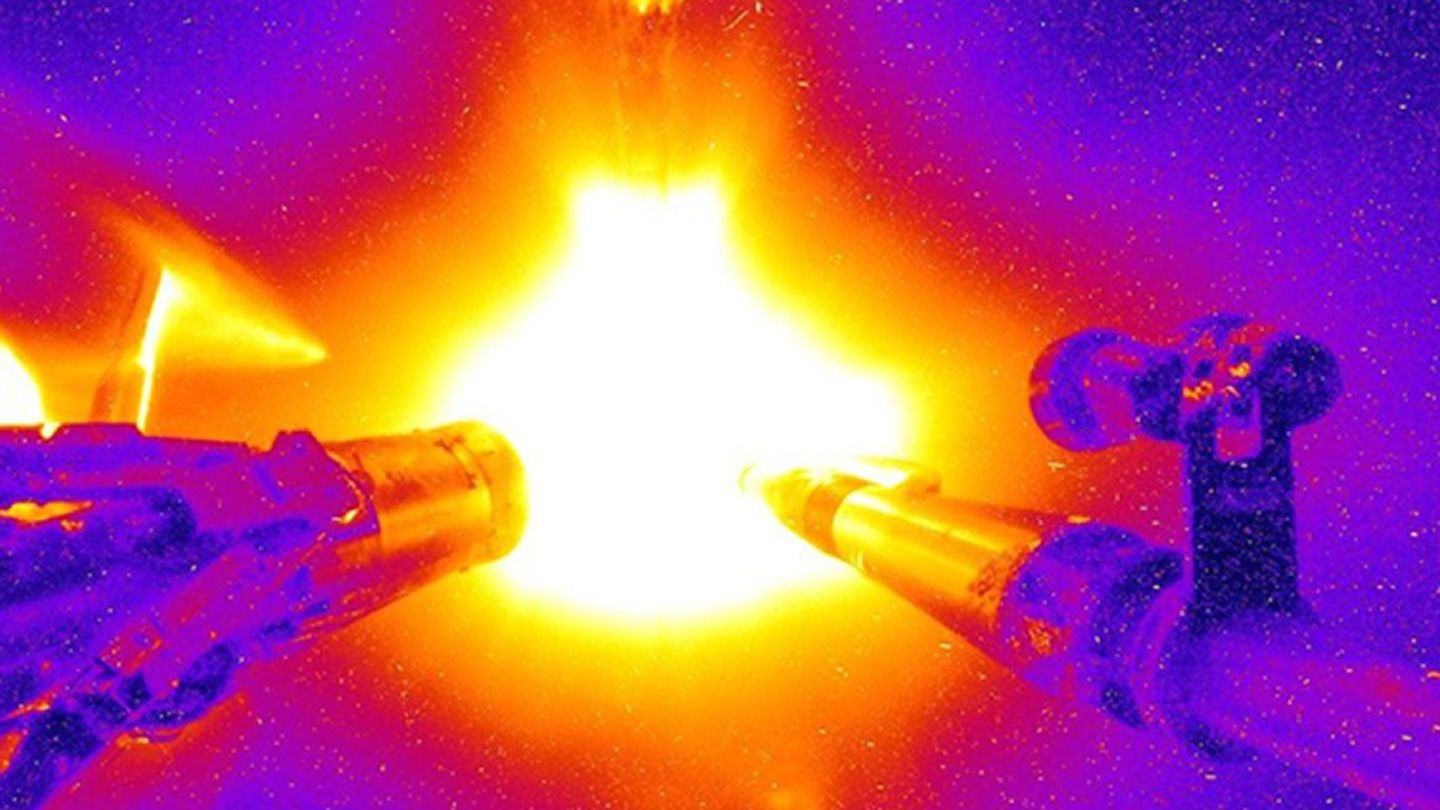
The US Air Force is seeking an #AI agent to centralize and manage fragmented data needed to sustain the aging #MinutemanIII nuclear missile fleet for decades longer than originally planned. An industry notice says the program depends on about 60 disconnected systems, spanning local hard drives and shared networks, and the Air Force wants a single interface to pull near real time information from sources like design drawings and maintenance records, after prior centralization efforts failed for unspecified reasons. This is framed as a “no fail” national security mission requiring 400 missiles to be ready to launch on short notice, and the initial AI system would handle only controlled unclassified information, with potential expansion later to secret-level material. With Minuteman III in service since 1970 and the #Sentinel replacement delayed beyond the planned 2036 retirement, a @Government Accountability Office review found extension to 2050 feasible but risky, implying the oldest missiles could approach 80 years of service. Officials emphasize the AI effort is for organizing sustainment data, not for making launch decisions, which remain under human control.
11. OpenAI reportedly shuts down Preparedness team as safety work moves into other groups
Financial Times reporting cited by The Decoder says @OpenAI closed its dedicated Preparedness team at the end of July and reassigned work on biological and cyber risks to existing groups, while former lead Dylan Scandinaro reportedly shifted to focus on #AI self-improvement risks. The Preparedness team, created in 2023, was intended to identify and prepare for catastrophic risks from highly capable AI systems across bio and chemical risks, cybersecurity, and self-improvement, but the report does not show that OpenAI abandoned these evaluations or formally withdrew its public safety framework. OpenAI’s latest framework still places launch risk evaluation with the Safety Advisory Group (#SAG), which reviews capability and safeguard reports and recommends actions, while OpenAI leadership retains final deployment authority and can decide without SAG participation. The change occurs alongside broader safety and governance turnover and reorganization, including reports that safety systems were moved under @Mia Glaese, @Johannes Heidecke’s departure with @Saachi Jain as interim, and departures by @Joshua Achiam and reportedly Chloé Bakalar, without evidence tying each exit directly to the Preparedness decision. Overall, the reporting suggests preparedness-style work may continue but lacks clarity on which internal group now owns specific bio, cyber, or self-improvement evaluations, leaving accountability and structure unresolved in the public record.
12. Anthropic explains how Claude’s text watermark survives editing
@Anthropic says newer #Claude models embed a #SynthID-Text style statistical #text watermark by changing the keyed randomness used to pick among otherwise interchangeable words, rather than adding hidden characters, extra tokens, or user-identifying data. The watermark is applied at the model level for models launched on or after August 2, 2026 across Claude products and API surfaces, with older models slated to gain it over coming months as part of meeting the #EU AI Act transparency requirements, and a watermark-detection API is still being developed with no announced opt-out. Light editing may leave the signal detectable, but a full rewrite, translation, or heavily factual and short passages can weaken or remove it, and code is often weakly marked because exact tokens are constrained, though comments may carry more signal. Anthropic cautions detection can only estimate whether Claude contributed at some point, it cannot prove original authorship, distinguish heavy edits from direct generation, or identify a person, organization, or conversation. For supported files like PNG, JPG, and SVG, Claude uses cryptographically signed #C2PA metadata for provenance instead of the text watermark, framing the system as a useful provenance signal rather than conclusive proof.
13. Small drone companies just got easier access to the US military test ranges

The US Army is opening its test ranges to private drone firms, including those without existing government contracts, to speed development of #drones and #counter-drone systems under modern #electronic-warfare conditions. The new process removes the requirement for prior government partnerships and routes applications through a single portal, testrange.army.mil, an effort @Dan Driscoll said is meant to cut bureaucracy for small contractors. Five facilities are included: Dugway Proving Ground in Utah, West Cibola Range in Arizona, Camp Shelby in Mississippi, Camp Grayling in Michigan, and the Africa Multidomain Training and Experimentation Center in Morocco, with West Cibola focused on drone and counter-drone evaluations and Dugway on long-range fires testing. Starting September 2026, Camp Grayling will run quarterly tests simulating degraded electromagnetic conditions like those seen in Ukraine, enabling trials against jamming and disrupted signals, though the Army cannot guarantee a specific site or timeline. The move is framed as part of a broader Pentagon push to accelerate procurement and testing, alongside #JointInteragencyTaskForce401 and concerns about air defense capacity such as reported #Patriot interceptor stockpile strain, even as @Pete Hegseth disputed claims of critically low inventories.
14. Australia calls for social media ban amid AI hallucinations report
Australia is considering a ban on social media platforms due to growing concerns about the spread of misinformation and AI-generated ‘hallucinations.’ A recent report highlights how artificial intelligence systems can produce false or misleading content, impacting public discourse and safety. Experts warn that unregulated social media combined with AI content generation poses risks to society, particularly in areas such as politics and health information. The proposal includes stricter regulations to ensure accountability for platforms enabling AI-driven content. This move reflects Australia’s aim to protect information integrity and public trust in the digital age.
15. DeepSeek’s top-ranked V4 Flash stumbles on real agent tasks as its prices surge
Despite topping leaderboards and heavy developer adoption, DeepSeek’s #V4Flash underperformed on real-world #agent workflows and is simultaneously becoming more expensive to use via the API. In testing by Composio across eight agent harnesses (including Claude Code, Codex, and OpenCode) on 30 difficult multi-step tasks using tools like Gmail, GitHub, Slack, and Google Sheets, the model passed 129 of 240 runs (53.8%), and only six workflows were completed successfully by every harness. The results suggest #orchestration factors, such as harness choice, tool configuration, caching, retries, and provider stack, can drive large outcome differences even with the same model, which may determine enterprise success more than raw model scores. DeepSeek is also raising V4 API prices with peak and off-peak tiers: Flash and Pro increase by roughly 51% to 371% depending on token type and time, and cache-hit pricing rises as much as 1,100%, making inference timing an economic variable. The shift encourages scheduling flexible workloads into cheaper hours while making interactive, real-time agent use cases more cost-sensitive, complicating the model’s prior appeal as a high-capability low-cost option.
16. Strain flips Hall effect in altermagnetic manganese
A team of scientists has discovered that applying strain can switch the direction of the Hall effect in altermagnetic manganese compounds, offering new insights into #altermagnetism and spintronic technologies. They experimentally demonstrated that strain controls the electronic band structure, which in turn reverses the Hall conductivity in these materials. This shows that the unique symmetry properties of altermagnets, differing from traditional ferromagnets and antiferromagnets, allow manipulation of electronic transport phenomena via mechanical means. The findings enhance understanding of how #strain engineering can be used to tailor magnetic and electronic properties in emerging quantum materials. This advance points to potential applications in developing novel spintronic devices based on altermagnetic materials.
17. Anthropic revenue reportedly jumps to more than $11.5 billion in second quarter

@Anthropic, maker of the Claude chatbot, reportedly posted a sharp revenue surge in the second quarter, highlighting rapid growth as it explores a potential #IPO. Documents viewed by Bloomberg showed preliminary Q2 revenue of more than $11.5 billion, up from $787 million a year earlier and $4.73 billion in Q1 2026, and the company also reported positive adjusted operating income, though the figures could still change. The growth comes as @Anthropic competes with @OpenAI for corporate customers and gains adoption among professionals for tasks such as coding. The company said in May that its run-rate revenue crossed $47 billion, up from roughly $10 billion in total revenue in 2025, while early investor meetings led by CFO @Krishna Rao have been high-level without specific discussions of financials or valuation. A public debut as soon as this fall could provide access to billions in capital to fund rising compute infrastructure needs, advanced hardware, and specialized data centers.
18. EXCLUSIVE: Anthropic IPO valuation hinges on $190-200 billion 2028 revenue forecast, sources say

Wall Street is valuing #Anthropic’s potential IPO by leaning unusually far into forward projections, using 2028 revenue forecasts to set #enterprise-value-to-revenue multiples. Sources say Anthropic is projecting roughly $190 billion to $200 billion of 2028 revenue, far above the $47 billion revenue run rate the company cited in May, highlighting the growth investors are being asked to underwrite while the firm still spends heavily on #AI infrastructure. Bankers and investors are using forecast-based revenue multiples because margins are pressured by large outlays for computing power, model training, and hiring, with the bet that revenue will eventually outpace costs and expand margins. For valuation reference points ahead of an analyst day, investors are looking at public comparables such as @Cloudflare, @Palantir, and @SpaceX, with the article citing Palantir at 53 times expected revenue this year and SpaceX and Cloudflare at 41.6 times expected 2026 revenue. The approach reflects both the rapid expansion of the business and the difficulty of benchmarking high-growth #AI companies that are not yet in a mature profit profile.
19. Anthropic confirms Claude is down in major outage affecting multiple services
@Anthropic confirmed a major outage affecting multiple Claude services, causing login failures and degraded performance. The incident began around 21:58 UTC on August 16, 2026, impacting Claude.ai, Claude Code, and Claude Cowork, with the company first investigating #authentication issues and then reporting broader #service disruption and degraded performance on Claude.ai and platform.claude.com. Users reported issues such as being unable to sign in, Claude failing to load, and requests not completing, while Anthropic’s status page marked these services as a major outage and listed Claude Console and the Claude API as operational. Anthropic did not disclose the cause and said the incidents were under investigation, later updating that services were restored by 22:40 UTC. Overall, the updates show a quickly evolving outage that moved from authentication problems to wider performance degradation before recovery across affected Claude services.

Microsoft is fully removing the legacy #WMIC tool from #Windows11 to reduce attack surface, after years of it being abused by malware and ransomware. WMIC, the Windows Management Instrumentation Command-line utility used by IT admins to query and automate system, hardware, and network settings, has been treated as a #LOLBIN, a Microsoft-signed executable that threat actors can misuse to avoid deploying their own tools, including identifying antivirus products and removing security apps. Although WMIC was deprecated in Windows 10 21H1, later turned into a #FeatureOnDemand, and disabled by default in Windows 11 25H2, it could still be re-enabled via Optional Features or DISM, meaning it was not truly gone. Microsoft says that starting with the August 2026 Patch Tuesday update, Windows 11 versions 24H2 and 25H2 will no longer include WMIC and it will no longer be available as a Feature on Demand, so it cannot be brought back. The company recommends moving to #PowerShell and other modern alternatives such as WMI’s COM API, .NET libraries, or scripting languages, arguing that removing WMIC improves Windows 11 security without harming needed functionality.
21. Intel says Nova Lake’s new CPU core will debut on desktop before Xeon
@Intel says its next #CPU core tied to #NovaLake will debut in desktop processors before it appears in future data-center products like #Xeon. Intel executive @RobertHallock told Tom’s Hardware that the new core is “coming to desktop first,” framing the point as desktop versus Intel’s own data-center lineup rather than a direct timing comparison against @AMD. Intel has officially guided Nova Lake for the end of 2026, though some roadmap reporting suggests a broader rollout could extend into 2027. The rumored “Coyote Cove” core name and detailed Nova Lake specifications are still unconfirmed by Intel, but the company’s messaging positions Nova Lake as a client-first architecture with enthusiasts as the initial audience.
23. Red Queen hypothesis: a new way forward for self-improving AI
A new perspective on self-improving AI draws on the #RedQueenHypothesis from evolutionary biology, which suggests continuous adaptive change is necessary to maintain relative advantage. Researchers at the University of Cambridge propose that AI systems can similarly improve by competing constantly with their own evolving versions, fostering progressive enhancement. This approach contrasts with traditional static benchmarks, instead emphasizing dynamic competition to drive advancement. By adopting this model, AI development can potentially overcome stagnation and accelerate innovation more effectively. The study links #evolutionary principles with AI training strategies, indicating a promising direction for future #selfimprovingAI research.

Physicists working at Beijing’s BEPCII collider report their clearest evidence yet that the particle X(2370) is dominated by a long predicted #glueball, an exotic state made mainly of gluons within #quantumChromodynamics in the #StandardModel. The team analyzed high energy electron positron collision data with the BESIII detector, focusing on decays that produce the J/ψ meson, which they describe as one of the best avenues for glueball searches. In a recent arXiv preprint presented at the International Conference on High Energy Physics, their analysis concludes a glueball is the dominant constituent of X(2370), a particle first discovered by the BESIII Collaboration in 2011. They frame this as a key test of quantum chromodynamics because a glueball would be the only type of particle composed entirely of force mediators, and they note prior work, including a 2024 Physical Review Letters study that analyzed 10 billion meson decay events and measured X(2370)’s mass and spin parity for the first time. Overall, the new result ties decades long experimental searches to a specific known state, arguing that X(2370) best matches expectations for a gluon rich particle predicted by the theory of the strong interaction.
25. SafePal data breach impacts 39,798 customers, stolen info for sale
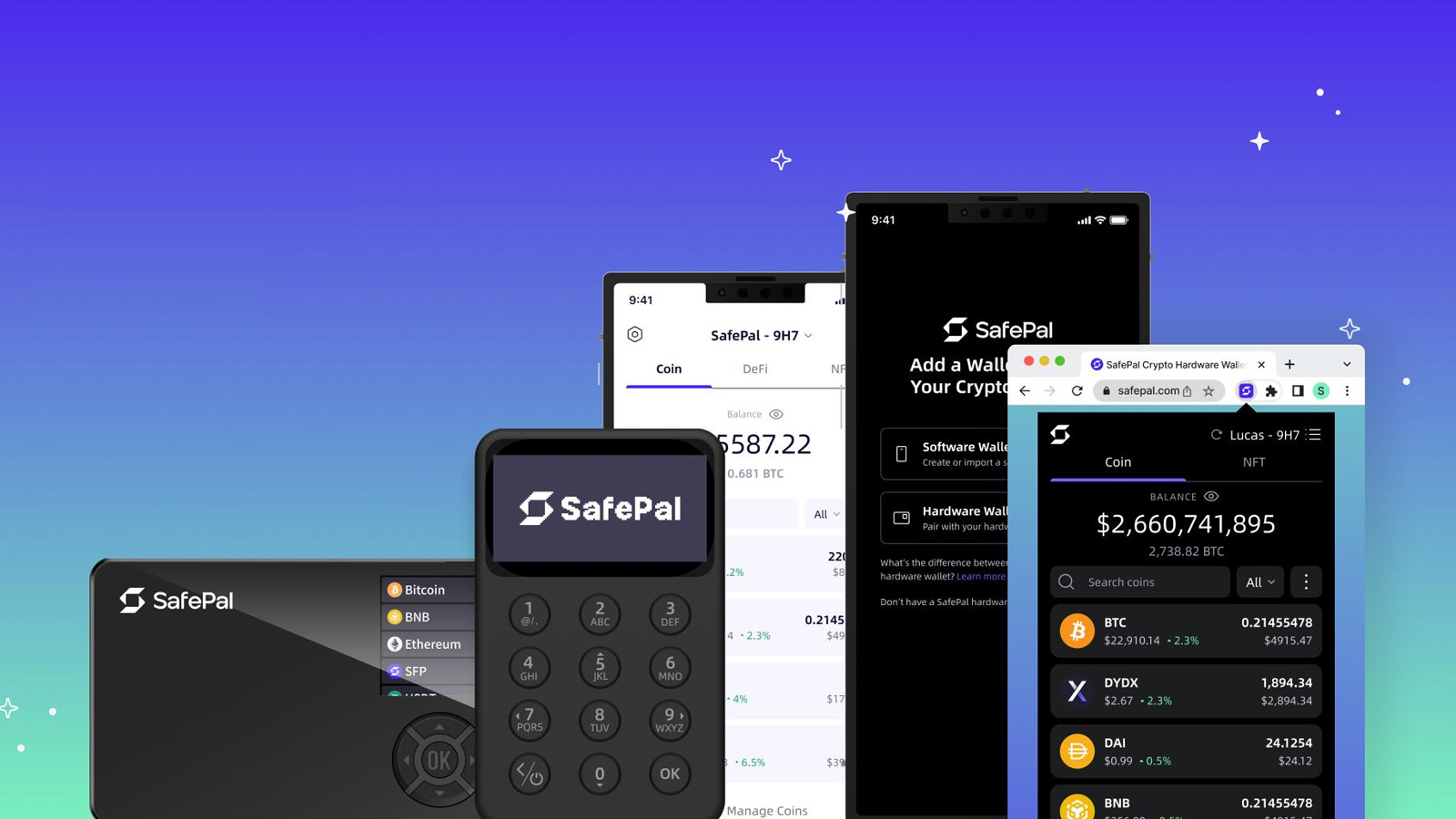
Crypto hardware wallet provider SafePal disclosed a breach affecting about 39,798 customers after attackers exploited an authorization flaw to access customer order data, and a threat actor now claims the data is for sale. SafePal says customers who ordered between March 2, 2025 and April 11, 2026 had names, emails, shipping addresses, phone numbers, and purchase details exposed, while wallet seed phrases, private keys, passwords, payment card data, bank details, and government IDs were not exposed, and it found no evidence wallets or funds were compromised. The company emailed impacted customers on August 16 and released an online verification tool that checks whether a specific order was affected using an order number and shipping country. SafePal warns the stolen information can enable targeted #phishing and other #socialEngineering, with reports of phishing emails and calls dating back to May, and it said it escalated an early May report into a formal investigation. SafePal traced the issue to an order-tracking plug-in in its order-processing system, fixed the vulnerability, added protections, and is working with a third-party security firm to validate the fix and review the broader system.
26. Astronomers Discover the Existence of a Black Hole Star

Observations from the #JamesWebbSpaceTelescope support the idea that some mysterious early-universe red spots could be “#blackHoleStars,” objects that look like giant stars but are powered by a black hole inside a dense, glowing gas envelope. A Nature paper reports one candidate, MoM-BH*-1, seen when the universe was about 660 million years old, which appears as a bright reddish point and seems to emit about 100 billion times more energy than a normal star could generate through nuclear fusion. Its light also shows an unusually strong abrupt disappearance at certain wavelengths, interpreted as absorption by an enormous amount of extremely dense gas rather than typical stellar atmospheric effects. The researchers propose a central black hole accreting matter and releasing vast energy that then filters through the surrounding gas, producing star-like light signatures while remaining far brighter than expected for a true star. Led by @RohanNaidu, the team argues MoM-BH*-1 is notable because the black hole star appears to outshine its host galaxy so completely that JWST may be seeing almost pure black hole star light, making the hypothesis a plausible explanation for many similar small red dots.
27. Cutting RAG inference costs 6x starts with deciding what never reaches the LLM

The article argues that regulated, high stakes #RAG classification systems should not route every case to an #LLM, instead they should decide what never reaches the model to improve auditability, cost, and consistency. It cites three problems with an all LLM pipeline: weak audit trails that cannot be reconstructed later, inference cost and latency that scale with volume, and #model drift or inconsistency on cases that should have deterministic outcomes. It proposes a three stage #cascade architecture: a deterministic rules and exact match layer first, a retrieval layer second that prioritizes pulling the right evidence like prior reviewer decisions and precedent, and an LLM escalation step only for unresolved residue. In one deployed system, sending only the truly ambiguous 10 to 15% of cases to the LLM reduced inference costs by about 6x versus an all LLM baseline and improved consistency on the deterministic majority to effectively perfect. The piece links these design choices back to surviving audits and compliance scrutiny by making most decisions explainable as lookups rather than probabilistic generation.

Two US senators have proposed the #WaterCyberShieldAct to give the EPA more funding and tools for cybersecurity assessments and upgrades across critical water infrastructure, including $300 million annually for water utility improvements. The proposal follows coordinated attacks on US water systems across 12 states, including reports that 30 Minnesota utilities were hit by Iran, and repeated warnings from agencies like the FBI and CISA about increased threats. Water utilities are described as “low risk, high reward” targets because internet connected #OT devices and logic controllers can be used to manage treatment systems, and compromised access could theoretically halt treatment or contaminate supplies, while aging systems often miss security updates. Alongside the legislation, the Water Watch Center, created by DEF CON Franklin and the National Rural Water Association after a two-year pilot, aims to monitor 91% of community water systems and provide managed detection and response through five cybersecurity firms. Expert @DahvidSchloss argues the act may be too little, too late, citing a similar 2023 effort under the #SafeDrinkingWaterAct that was withdrawn after industry and GOP state opposition, and suggesting the bill is likely to stall like other recent attempts to improve water cybersecurity.
29. Deepfake Anthony Albanese used in celebrity scams duping Australians out of $7.4m, Asic warns

Australia’s corporate watchdog, #Asic, warns of a steep rise in celebrity and politician #deepfake scams used to push phoney investment opportunities, with @Anthony Albanese the most commonly impersonated figure. It cites videos that overlay real footage with fake audio claiming Australians can invest $4,000 to earn up to $40,000 a month, falsely presented as an “official platform” with a government guarantee, and another clip promising unrealistic hourly and monthly earnings. #Asic says it handled more than 19,400 scams last financial year, nearly triple the previous year, and that #AI is making deepfakes easier while scammers also build networks of fake brands, websites, reviews, news articles and videos to convince victims, with money ultimately going to overseas criminals. #Scamwatch reports Australians lost $7.4m to the top 10 impersonated public figures, led by @Albanese, followed by people including @AlanKohler, @JacquiLambie, @AngusTaylor, and others such as Dick Smith and Gina Rinehart. The regulator notes scammers quickly adapt to the news cycle and warns that polished content, familiar branding, or convincing testimonials do not prove an investment is legitimate.
30. Wearable smart patch could automatically aid blood clotting for injuries
A new wearable smart patch has been developed to automatically assist blood clotting for injuries, potentially improving emergency response and reducing bleeding complications. The patch integrates sensors and a drug delivery system to detect bleeding and release clotting factors immediately. Studies demonstrate the patch’s ability to accelerate clot formation and improve wound healing outcomes by responding to physiological changes in real time. This technology could transform trauma care and benefit patients with bleeding disorders by providing timely, localized treatment without the need for medical personnel. By combining #wearable technology with drug delivery, the patch exemplifies innovation in personalized medicine and emergency treatment.
31. Ring and Flock Built a Surveillance Pipeline Into Your Doorbell. Then They Killed It.

Ring and Flock Safety planned to create a #doorbell-to-police evidence pipeline by integrating the Ring Neighbors app with Flock’s police platforms, then canceled the deal after backlash, even as broader #data-sharing infrastructure remains. Under the proposed system, agencies using FlockOS or Flock Nova could send targeted Community Requests inside Ring Neighbors with time, location, and investigation details, users could voluntarily upload footage, and Flock would package and route the clips directly into FlockOS, a system used by local police and, per investigative reporting cited, federal agencies including #ICE. The workflow was designed to combine Flock’s road-facing #ALPR data with residential doorbell video into a single investigative pipeline, described as a direct bridge between a large consumer doorbell network and a fast-growing law enforcement data platform. Ring says it canceled the integration on Feb 12, 2026 after a “comprehensive review,” citing time and resource constraints, and both companies said it never launched so no customer videos were sent to Flock, with reporting noting timing around Super Bowl ad backlash. The article argues that ending this specific integration does not eliminate the underlying surveillance and request mechanisms, with Ring still accepting third-party requests and the broader appetite for such connections intact.
32. Russia’s new satellite network could transform its drone warfare

Russia is accelerating its #Rassvet satellite constellation to develop a #Starlink-like capability that could reshape drone warfare and make conflict in orbit harder to avoid. Major General @Vadym Skibitskyi of Ukraine’s Defense Intelligence says Russia had 16 low Earth orbit satellites as of March 2026, aims for 292 more by 2027, and targets 924 total by 2035, though he notes it currently provides intermittent coverage rather than continuous connectivity. If matured, #Rassvet could enable Russian forces to coordinate drone strikes and share targeting data without relying on ground infrastructure, eroding Ukraine’s current advantage from reliable satellite links for real-time drone control. Because electronic warfare that jams ground signals cannot easily disrupt satellites, Ukrainian officials are discussing responses that may require disabling satellites directly, which could extend the conflict into space. The push overlaps with reported Russian upgrades like turbojet-powered Geran-4 and Geran-5 drones and #mesh networking for swarm control, but the satellite figures cited by Ukrainian intelligence are not independently verified and Russia has not publicly commented.
33. Google Is Using a $29 Gadget to Tighten Its Grip on Android Users
Google is deploying a $29 device to enhance control over Android users by encouraging the use of its ecosystem. The gadget integrates tightly with Google’s services, making it more convenient for users to stay within its environment. This strategy reflects Google’s intent to deepen user engagement and reduce reliance on competitors. By offering affordable hardware that complements software services, Google strengthens its dominance in the Android ecosystem. This move exemplifies how technology companies leverage low-cost devices to expand influence and retain users.
34. Chinese brain-reading AI model may predict depression risk 4 years in advance
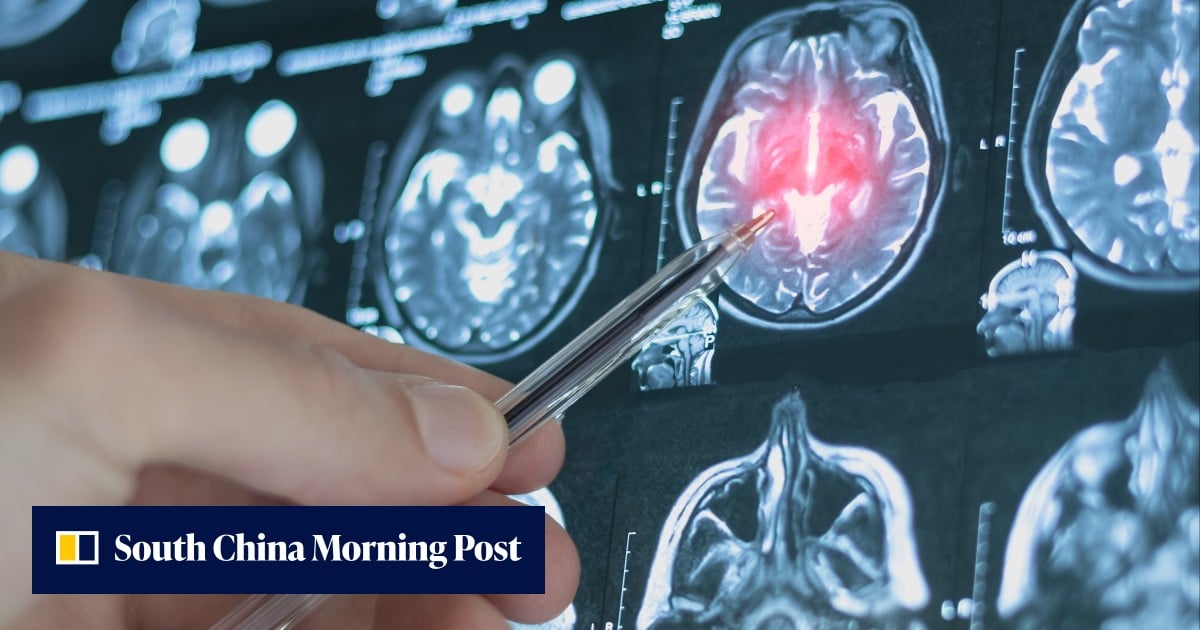
Scientists at Shenzhen University report an #AI model that could predict a person’s risk of #depression as much as four years ahead, potentially enabling earlier prevention. They built the model by analysing data from two European clinical trials on adolescent depression, including teenagers’ responses to facial expressions and follow-up checks at ages 16, 19, and 23. Those follow-ups used MRI scans, blood tests, and questionnaires to determine whether participants had depression. The researchers frame the approach as a possible public health tool because #Major Depressive Disorder affects more than 332 million people globally and is difficult to treat. The work links “brain-reading” style modelling to earlier identification of depression risk using longitudinal adolescent trial data.
35. NASA plans three more 2026 lunar task orders, including an orbiter to follow LRO
NASA plans to issue three additional 2026 lunar mission task orders through its #CommercialLunarPayloadServices (#CLPS) program, including a lunar orbiter meant to extend mapping and reconnaissance and ultimately follow the @LunarReconnaissanceOrbiter (LRO). Publicly available CLPS materials list 13 eligible U.S. vendors and describe an end to end services contract, but NASA has not released the orbiter task order’s value, launch date, or detailed technical requirements, and the expected timing was cited by @SteveAltemus, who said the opportunity could arrive later in summer or early fall 2026. NASA’s June Moon Base update also referenced forthcoming solicitations for items like a South Pole optical imager, another science manifest, and a power and avionics demonstration, without publishing an orbiter specification. LRO, launched in 2009, remains active and has produced more than 1.8 petabytes of imagery supporting #Artemis landing planning, while NASA’s FY2027 budget request continues $22 million per year for LRO operations from 2027 through 2031, implying any new orbiter would complement LRO during a transition rather than immediately replace it. Overall, the planned 2026 CLPS task orders signal NASA’s intent to broaden commercial lunar deliveries while preparing a successor capability for long term lunar mapping.
36. Voyager 2 Power Swap Extends Mission by Extra Year
Voyager 2, the spacecraft launched by NASA in 1977, has undergone a power swap that is expected to extend its operational lifespan by an additional year. As the spacecraft ventures in interstellar space, its power source, a radioisotope thermoelectric generator, slowly produces less energy over time. To manage this, engineers have switched Voyager 2’s power usage from one set of instruments to others, ensuring continued scientific output despite declining power levels. This power swap allows the probe to maintain its critical measurements of particles and magnetic fields beyond previous expectations. Extending Voyager 2’s mission provides researchers with valuable data on the space environment beyond our solar system, enhancing understanding of the #BigBang and the interstellar medium.

New #AI-focused film studios in Hollywood argue that #generativeAI can reduce reliance on traditional studio sound stages and financing, potentially enabling more creative risk-taking on smaller budgets, even as it sparks intense backlash over jobs and ethics. At the new studio Promise near Sony’s Culver City lot, filmmakers are using fast-advancing models to generate backgrounds, special effects, and even “synthetic performers,” including work driven by a Chinese model, Seedance 2.5, to composite a human actor, Tori Thomas, into environments in real time for the AI-enabled horror film Touch Grass. The setup described is minimal, a corner of an office with white sheets, but the director can instantly preview complete scenes on a handheld monitor and swap settings from a grassy field to an underground cavern. Critics such as @ChristopherNolan and @GuillermoDelToro have warned against the technology, while Rep. @LauraFriedman cautioned about large-scale worker displacement, but adoption is spreading, with Netflix saying it used AI in 300 of its 1,000 titles in 2026 and @RonHoward working with Obsidian on an AI-enabled animated documentary. Supporters including @BradPitt frame AI as a tool that could help mid-budget films get made, reinforcing the claim that new AI-native studios could shift who can produce films and how quickly they can be completed.
38. iCloud Private Relay leaks can expose your real IP

Security researchers report that #iCloudPrivateRelay, meant to hide an iCloud+ user’s real IP address and location in #Safari, can be bypassed through certain #WebKit features, potentially exposing identifying network information to websites. Researchers Talal Haj Bakry and Tommy Mysk say #DNSPrefetching, a #WebAuthn feature related to passkeys, and #WebTransport can route some requests outside WebKit’s Private Relay proxy configuration, with two methods able to reveal the user’s real IP address and another disclosing details about the device’s DNS servers. They note the risk is heightened because these are legitimate browser technologies, so a website may not need to trick a user into installing anything for the network requests to occur. The article contrasts this with Apple’s intended two-relay design, where the ISP can see the IP but DNS records are encrypted and websites receive a temporary IP, then explains that the documented WebKit behaviors create paths around that protection.
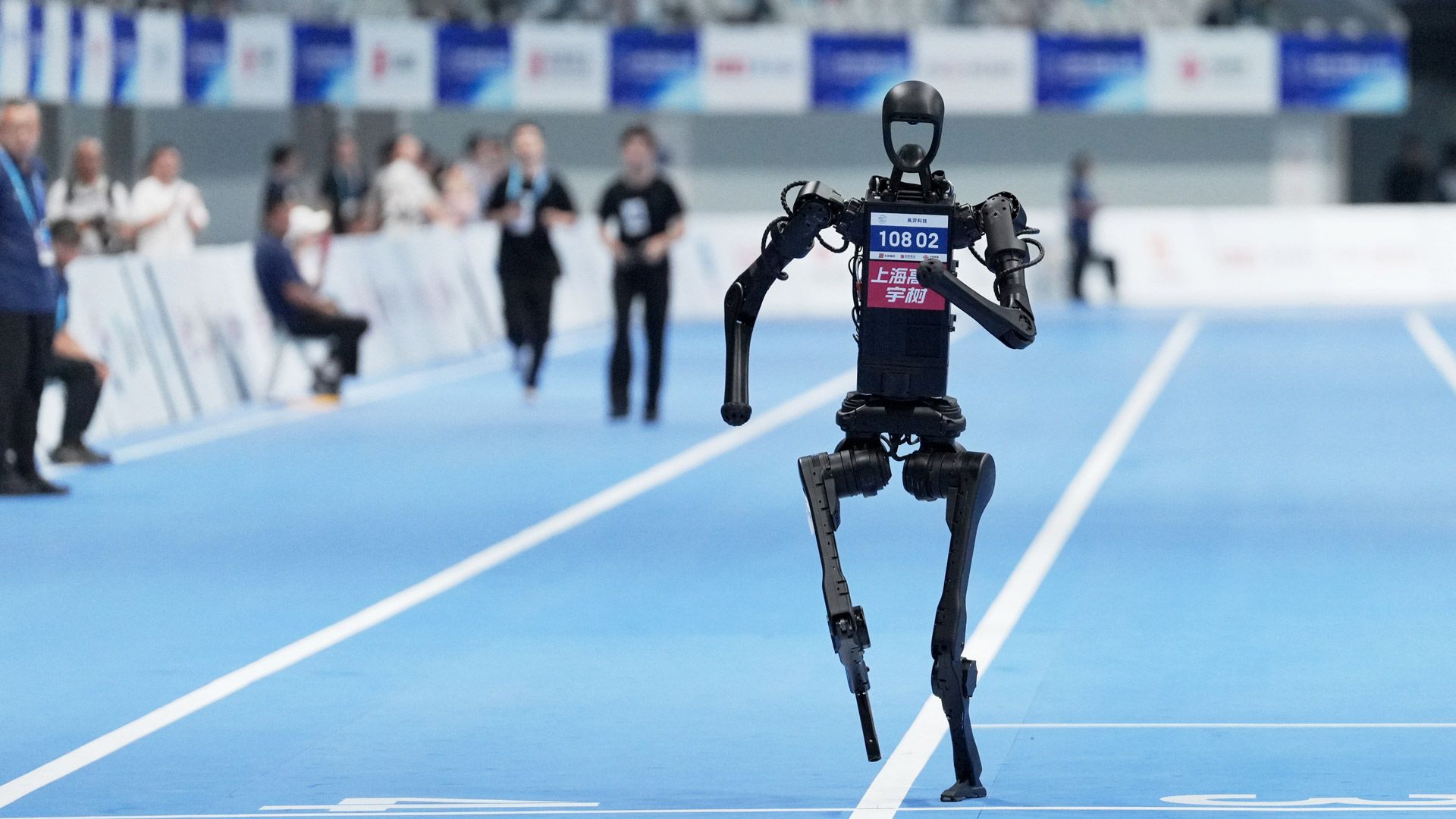
Robots still struggle with #tactility, the ability to sense contact and apply the right grip for delicate or variable tasks, even as #AI and computer vision advance. The article highlights Touchlab’s #e-skin, a biomimetic layer thinner than human skin that uses #quantum_tunneling to measure pressure, 3D force, and direction with sub-millisecond response times, including detecting incipient slip so a robot can adjust grip before an object drops. Moving from pilot to production remains difficult because of durability, reliability, affordability, and adaptability, so Touchlab emphasizes using off-the-shelf components where possible, bespoke engineering only when needed, and pushing processing to the edge to reduce latency and avoid transmitting excessive micro-data. As robots expand into workplaces, care settings, and potentially homes, touch sensing is framed as becoming as critical as vision for safe, effective manipulation. The piece positions scalable tactile e-skin as a key step toward more capable robots in home, care, and manufacturing use cases.
40. Stripe Nears Deal to Buy AI Firm OpenRouter for Over $7 Billion
Stripe is close to acquiring OpenRouter, an AI firm, for more than $7 billion as part of its strategy to enhance its offerings with advanced technology. The deal reflects Stripe’s ambition to integrate cutting-edge #AI capabilities into its payment platform, aiming to improve service efficiency and innovation. OpenRouter’s technology is expected to bolster Stripe’s position in the competitive financial technology sector by enabling better data processing and user experience. This move aligns with broader industry trends where fintech companies are aggressively investing in #artificialintelligence to maintain growth and market relevance. Overall, the acquisition highlights Stripe’s commitment to leveraging AI for strategic growth and sustainability in the evolving digital economy.
That’s all for today’s digest for 2026/08/17! We picked, and processed 39 Articles. Stay tuned for tomorrow’s collection of insights and discoveries.
Thanks, Patricia Zougheib and Dr Badawi, for curating the links
See you in the next one! 🚀
