
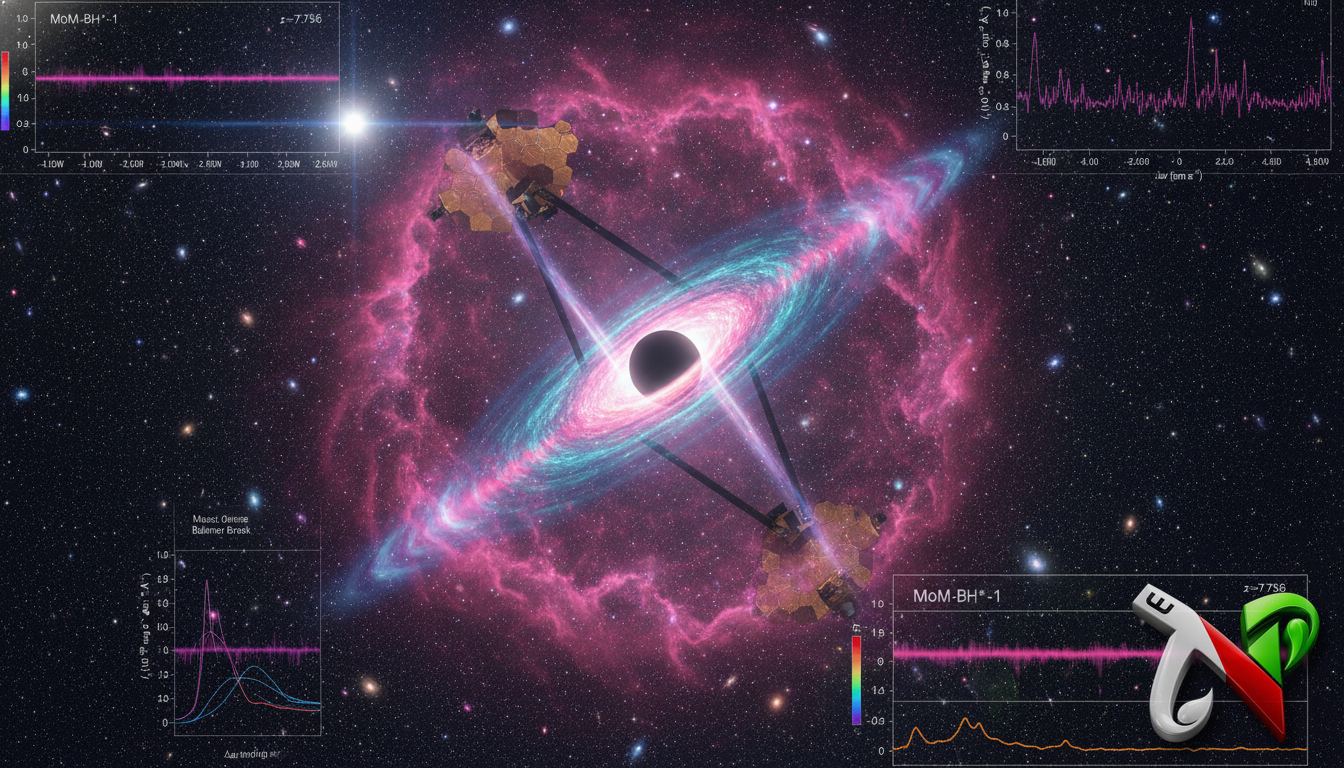
Cosmic Dawn Mystery Solved: JWST Spots Supermassive Black Hole Swaddled in Dense Gas
Key points
- Researchers using JWST observed a cosmic-dawn source designated MoM-BH*-1 at a redshift of roughly 7.756, existing just 660 million years after the Big Bang 1.
- The object exhibits one of the largest hydrogen Balmer breaks ever recorded at 7.7, far exceeding the theoretical limit of 3 for a normal stellar population 1.
- Scientists modeled the source as a supermassive black hole embedded within an extremely dense, turbulent, and dust-free gas envelope rather than a conventional galaxy 1.
- This enshrouded configuration supports the theoretical mechanism of super-Eddington accretion, helping explain how supermassive black holes formed so quickly in the early universe 1.
Unraveling Cosmic Dawn
How billion-solar-mass black holes managed to assemble within the first 700 million years of cosmic history remains one of modern astrophysics’ most enduring puzzles 1. Spotting the seeds and rapid growth mechanisms of these early giants has proven extraordinarily difficult 1. Now, observations from the James Webb Space Telescope (JWST) have brought researchers closer to an answer by capturing a singular source from the universe’s infancy, shining just 660 million years after the Big Bang 1.
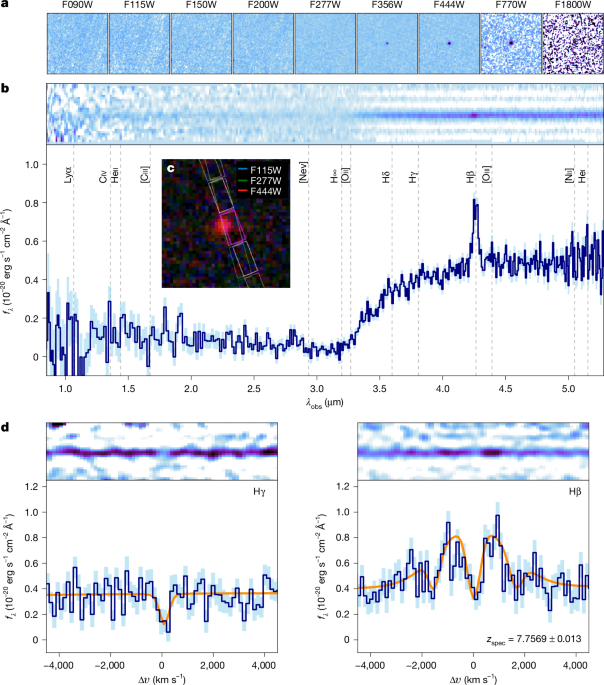
Identified as MoM-BH*-1 through the ‘Mirage or Miracle’ JWST program, the target first caught scientists’ attention due to its extreme redness and compact, unresolved appearance in deep-field imaging 1. Follow-up spectroscopy revealed a suite of remarkable features, including a broad H beta emission line and a massive drop in flux between 3 and 4 micrometers 1.
Defying Stellar Limits
The defining characteristic of MoM-BH*-1 is its extraordinary Balmer break, which reaches a strength of 7.7 1. In standard astrophysics, a dust-free stellar population cannot produce a break strength greater than 3, even when modeled with an extreme population of short-lived A-type stars capped at a limit of 5 1. This massive anomaly firmly rules out a conventional stellar population as the origin of the spectrum 1.
Alongside the unprecedented break, the object displays simultaneous absorption and emission in non-resonant hydrogen lines like H beta and H gamma 1. Such deep absorption features demand exceptionally high gas densities and turbulent velocities, pointing directly toward a powerful central engine rather than starlight 1.
The Black Hole Star Model
To make sense of these contradictory traits, researchers constructed advanced spectral synthesis models featuring a classical active galactic nucleus accretion disk wrapped inside a cocoon of dense, turbulent gas 1. This setup successfully reproduces the observed continuum shape, deep Balmer break, and ultraviolet weakness without relying on heavy dust attenuation 1.
Often described conceptually as a primordial ‘black hole star’ – a rapidly growing black hole swaddled in gas – this configuration provides empirical support for super-Eddington accretion models 1. It suggests that early black holes could feed at ferocious rates while remaining shrouded behind thick veils of gas rather than dust 1.
Broader Astronomical Context
The discovery helps demystify the growing family of ‘little red dots’ uncovered by JWST, which share perplexing spectral energy distributions and broad Balmer features 1. While previous interpretations struggled to separate the contributions of stars versus active galactic nuclei, this heavily enshrouded source indicates that radiation from the black hole dominates nearly all observed light 1.
In related solar system research, scientists using JWST data have also recently uncovered an unidentified absorption feature near 5.11 micrometers shared by both Saturn’s moon Titan and the distant dwarf planet Pluto, pointing to overlapping organic chemistry across otherwise vastly different worlds 7. Meanwhile, separate stellar observations show that black holes in our local universe can continue expelling powerful winds and jets long after their primary feeding outbursts fade 8.
Primary sources
 A gas-enshrouded and gas-reddened black hole at cosmic dawn – Nature (nature.com) – The primary research paper detailing the JWST discovery and modeling of MoM-BH*-1 as a gas-enshrouded supermassive black hole at cosmic dawn.
 Mirage or miracle? JWST finds earliest known 'black hole star' at cosmic dawn (phys.org) – An institutional news release summarizing the Nature study on the early 'black hole star' candidate discovered by ISTA and international collaborators.
Further sources
 Astronomers find a new object from the early universe using Webb data (phys.org) – A related news brief highlighting broader early-universe findings made possible by the James Webb Space Telescope.
 JWST study suggests a handful of 'leaky' galaxies reionized the early universe (phys.org) – A related reporting piece discussing a JWST study on how a small group of leaky galaxies drove cosmic reionization.
- Pluto has a heart. Scientists discovered that its bleeding. (mashable.com) – An adjacent science report detailing evidence that Pluto's Sputnik Planitia glacier may be slowly leaking liquid nitrogen from beneath its ice.
- JWST Revealed the Early Universe — The Roman Space Telescope Will Help Us Understand How It Evolved (discovermagazine.com) – An article previewing how NASA's upcoming Roman Space Telescope will complement JWST in studying cosmic evolution.
- The James Webb Space Telescope just found the same unidentified molecule on both Titan and Pluto — two worlds with almost nothing in common — and scientists say they cannot yet match it to any known substance in any existing database (spacedaily.com) – A separate study reporting that JWST detected an identical unidentified infrared absorption feature on both Titan and Pluto.
- Black Holes May Not Be the Bottomless Pits We Imagined (scitechdaily.com) – A related astrophysics report showing that black holes continue ejecting matter long after their main feeding outbursts conclude.
 Powered by News Ranker