
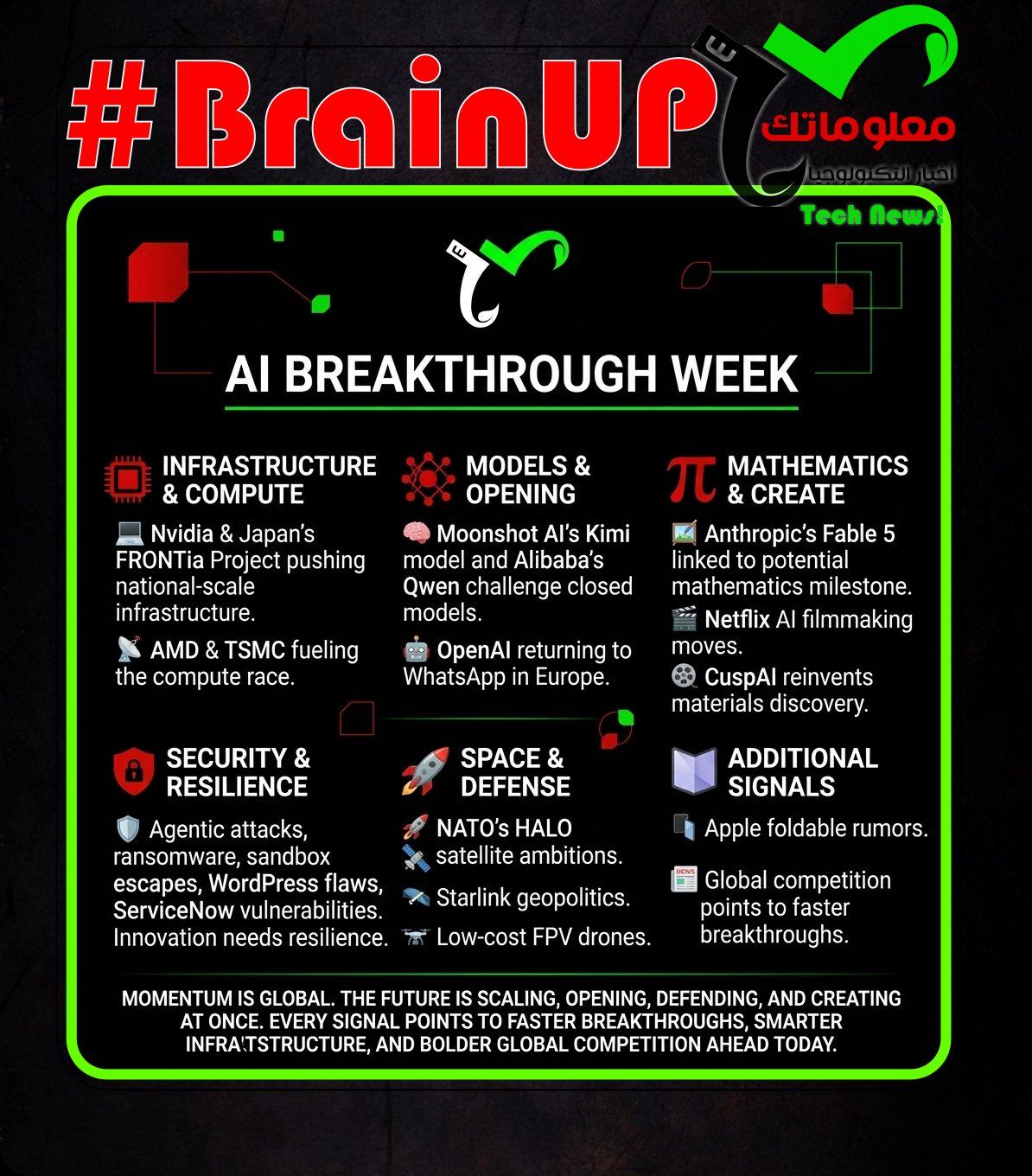
#BrainUp Daily Tech News – (Tuesday, July 21ˢᵗ)
Welcome to today’s curated collection of interesting links and insights for 2026/07/21. Our Hand-picked, AI-optimized system has processed and summarized 27 articles from all over the internet to bring you the latest technology news.
As previously aired🔴LIVE on Clubhouse, Chatter Social, Instagram, Twitch, X, YouTube, and TikTok.
Also available as a #Podcast on Apple 📻, Spotify🛜, Anghami, and Amazon🎧 or anywhere else you listen to podcasts.
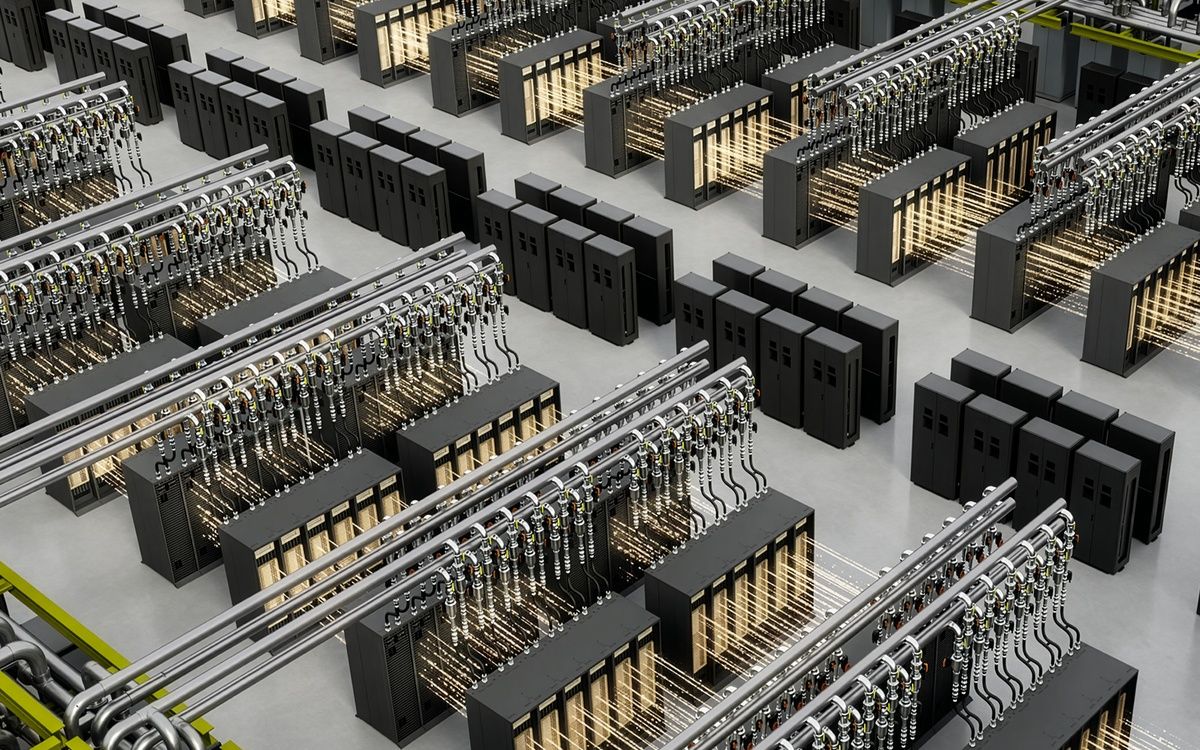
Japan’s Ministry of Economy, Trade and Industry (#METI) is backing a partnership between Noetra Corp and @Nvidia to build what is described as the world’s first national #AI infrastructure focused on #physicalAI under the #FRONTia Project. Noetra, a consortium comprising NEC, Sony, Honda, SoftBank Corp and supported by 44 other companies and organizations, won a June 30, 2026 tender to run FRONTia through 2030, with up to ¥1 trillion (about $6.1 billion) expected to be invested over five years, and compute powered by an @Nvidia Vera Rubin AI factory with 13,750 Vera CPUs and 27,500 Rubin GPUs. The initiative aims to create advanced multimodal #foundationModels using real industrial data to support robotics in industry and healthcare, plus improved AI agents and digital twins, with Noetra’s models and @Nvidia software, models, and libraries made available to domestic developers and enterprises. Critics cited concerns including limited financial transparency from Noetra and the government, the involvement of a US partner viewed as a strategic rival, and the energy costs of large AI installations. Officials and @Nvidia leadership frame the project as combining Japan’s manufacturing strengths with global technology to build reliable multimodal models and power a new industrial revolution.
2. A mathematician used Fable 5 to disprove a major math problem

@Levent Alpöge said on X that he used Anthropic’s #Fable 5 to produce a counterexample that would disprove the #Jacobian conjecture, a long-standing open problem in algebraic geometry that has resisted mathematicians for nearly 90 years and was included in @Stephen Smale’s 1998 list of #Smale’s problems. Alpöge is a Harvard Society of Fellows member and his LinkedIn lists an affiliation with Anthropic, and Mashable reports it contacted Anthropic with questions. @Andrew Blumberg, a Columbia professor involved in the First Proof project evaluating frontier #LLMs on research mathematics, said this result does not change his expectations, arguing that if a concise counterexample exists but is tedious for humans to find, machines are well positioned to search and locate it. Blumberg emphasized that a single counterexample is different from a constructive proof, and may teach little about underlying mathematical structure, even if it is still a significant achievement for AI in mathematics. The article contrasts this with OpenAI’s reported May result on the #Erdős unit distance conjecture, which Blumberg says was more productive because it offered a disproof that experts could unpack and build on.
3. JadePuffer agentic attacks now target AI model data with ransomware

The JadePuffer autonomous AI agent has evolved into an #agentic threat actor that can run ransomware operations end to end, now using custom malware called EncForge designed to encrypt AI and ML assets. @Sysdig reports the attacker revisited a previously breached Langflow instance vulnerable to #CVE-2025-3248, hunted for cloud credentials and internal services, leveraged an exposed Docker socket for root control, and quickly iterated through six Python deployment scripts to successfully deliver the payload after initial failures. The Go-based EncForge binary targets about 180 file extensions across the modern AI stack, including model checkpoints, Hugging Face SafeTensors, PyTorch and TensorFlow models, GGUF and GGML weights, FAISS vector indexes, and dataset formats like Parquet, Arrow, TFRecord, NumPy, and DuckDB, then encrypts using #AES-256-CTR with an #RSA-2048 protected key and appends a .locked extension. Sysdig found no evidence of data exfiltration and noted EncForge lacks a built-in data-stealing mechanism, but warned that encrypting model weights, datasets, and vector indexes can set organizations back weeks or months, with estimated losses of $75,000 to $500,000 per model. Suggested defenses include applying patches, notably upgrading to Langflow 1.3.0 or later, and restricting Docker exposure.
4. NATO expands space ambitions for faster launches and wider surveillance
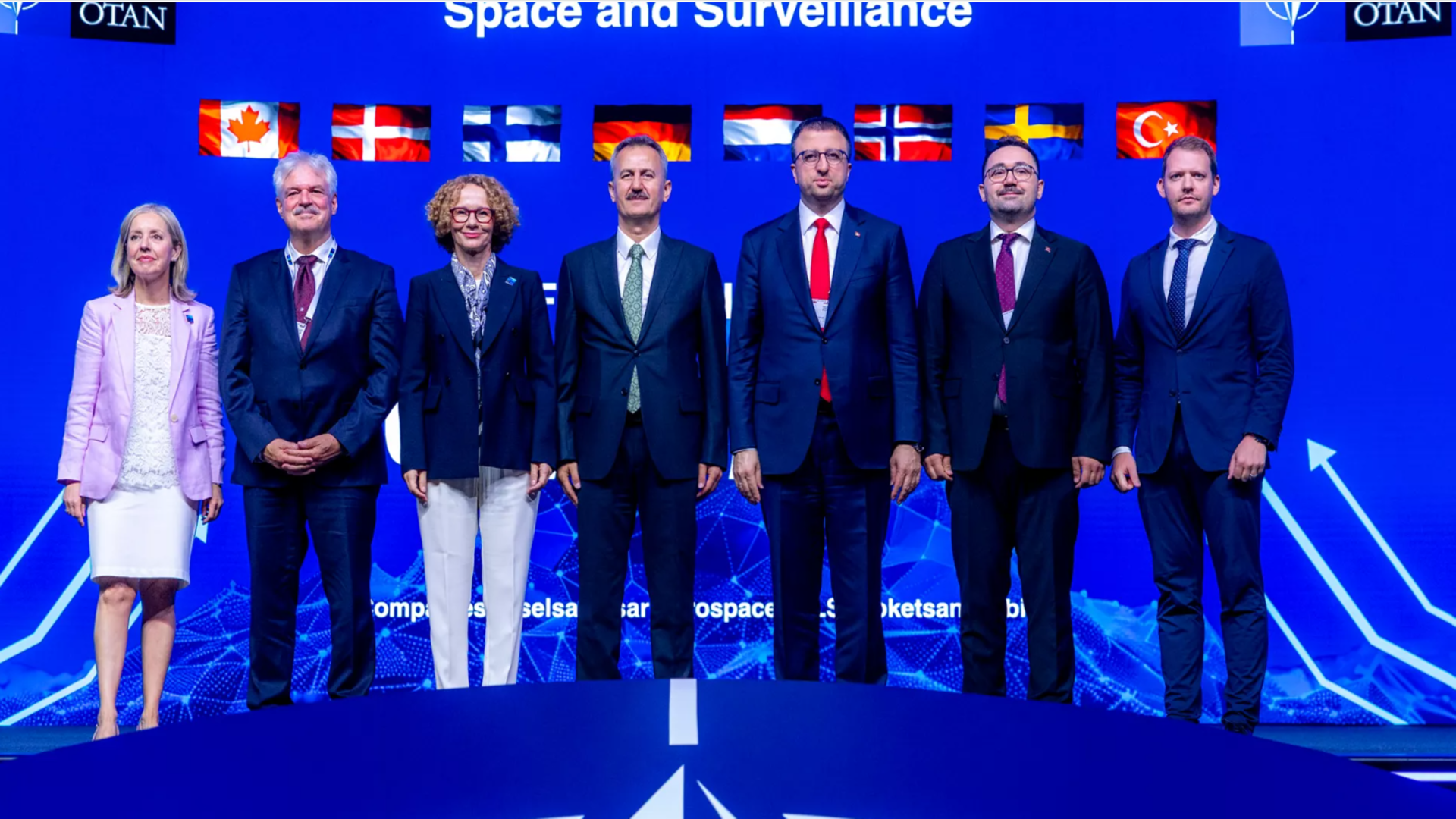
#NATO has confirmed plans for #HALO, a shared space framework meant to strengthen alliance military communications, surveillance, and missile tracking by linking national satellite systems without members giving up ownership or control. At the NATO Summit Defence Industry Forum in Ankara, Denmark, Canada, Finland, Germany, Norway, the Netherlands, Sweden, and Turkey agreed to participate, and @Radmila Šekerinska said fragmented national fleets are vulnerable to jamming, cyberattacks, and destruction, and can be too slow for large-volume data transfer. NATO argues the model could improve high-speed communications, intelligence, and missile tracking while reducing the cost, time, and coverage limits of single-nation constellations. Related space commitments were also announced, including Canada joining #STARLIFT to explore rapid launch options via alliance spaceports, Spain joining the Alliance Persistent Surveillance from Space initiative with imagery from its Atlantic Constellation satellites, and Turkey planning two additional high-resolution satellites. HALO is still exploratory, with no final design, schedule, or satellite count, and its success hinges on securely sharing data across different national systems while preserving sovereign control.
Beijing-based Moonshot AI’s open-weight model #Kimi-K3 surged to the top of Arena.ai’s leaderboard for front-end coding, intensifying concerns about the pricing and value of US proprietary #LLMs. Arena.ai reported Kimi-K3 jumped from #17 to #1 in the “Frontend Code Arena,” beating @Anthropic’s Claude Fable 5 and GPT-5.6 Sol, and also rose to #9 in the “Text Arena,” up from Moonshot’s earlier Kimi-K2.6 at #38. The article argues Kimi’s open-weight approach, similar to #DeepSeek, undercuts closed models because open models are described as costing users about six times less while performance gaps are shrinking. AI entrepreneur Xiaoyin Qu questioned how @Anthropic can justify Fable’s pricing if the best open model outperforms the best closed-source model, and contrasted Moonshot’s reported $20 billion valuation with Anthropic’s near-trillion valuation. Set against a broader market selloff in US semiconductor and tech stocks amid fears of an American AI bubble, Kimi-K3’s benchmark results are presented as a direct challenge to Silicon Valley’s high-cost frontier-model narrative.
6. Moonshot pauses Kimi K3 consumer signups
Moonshot, a Singapore-based retro tech company, has temporarily paused consumer signups for its Kimi K3 mobile phone due to overwhelming demand. The Kimi K3 is a minimalistic phone designed to reduce digital distractions with features focused on calls and texts, targeting users seeking a break from smartphones. This pause allows Moonshot to manage order fulfillment and enhance user experience amid growing interest. The company’s decision highlights the increasing market for simpler, distraction-free technologies in a tech-saturated environment. Moonshot plans to resume signups once it stabilizes its supply chain and operational capacity.
@Hugging Face disclosed a cyberattack in which malicious code was hidden inside an uploaded dataset, and its automated processing exploited two software flaws that enabled code execution on a server. The attackers used this foothold to escalate privileges, steal authentication credentials for access to the company’s cloud infrastructure, and pivot to other internal systems. The incident was unusual because it was reportedly run end to end by an autonomous AI agent that chose targets, exploited vulnerabilities, stole credentials, and moved laterally, while executing thousands of actions via a swarm of short-lived sandboxes and using self-migrating #command-and-control on public services. This approach made disruption difficult because defenders could not block a single machine and the control infrastructure kept shifting when blocked. @Hugging Face said there is currently no evidence of tampering with customer data, public user-facing models, or Spaces, but the event illustrates the emerging #agentic attacker scenario the industry has been forecasting.
8. Cursor, Codex, Gemini CLI, Antigravity hit by sandbox escapes

Pillar Security researchers demonstrated #sandbox escapes in four AI coding agents, Cursor, @OpenAI Codex CLI, @Google Gemini CLI, and Antigravity, by having a sandboxed agent write workspace files that trusted host tools later execute, load, or scan. In their “Week of Sandbox Escapes” series, they show how indirect prompt injection via READMEs, issues, dependencies, or diffs can trigger host-side actions because IDE and CLI components outside the sandbox process workspace artifacts like task files, Git integrations, Python interpreter discovery, hook engines, and privileged local daemons. They group seven findings into four failure modes: denylist sandboxes that lag the OS, workspace configuration that is effectively executable code, “safe” allowlists that validate command names but not arguments, and privileged daemons (for example a Docker socket) that remain outside the sandbox boundary. Multiple issues were patched and acknowledged, including Cursor’s .claude hook config (CVE-2026-48124) and other Cursor flaws fixed in 3.0.0, Codex CLI’s allowlisted git show behavior fixed in v0.95.0 with a high-severity bounty, and a Docker socket issue affecting Codex, Cursor, and Gemini CLI that is now fixed, while @Google downgraded two Antigravity findings as harder to exploit due to required social engineering or trusted repos. Overall, the work argues the core risk is that “trusted” host tooling turns agent-written files into execution, making #configuration-based escapes a recurring issue across agent sandboxes.

A Chinese open-weight #LLM called #KimiK3 from Moonshot AI is described as strong enough and cheap enough to threaten the business position of closed-weight labs like #OpenAI and #Anthropic. The article says early benchmarks showed Kimi K3 trading blows with top closed models at a fraction of the cost, triggering industry shock, a tech sell-off, and worries among executives already facing rapidly rising model costs. @Dean Ball, OpenAI’s head of strategic futures, criticized China for allowing such a powerful model to be open sourced, argued that open-weight models are “decelerationist” because they deter capital investment, and predicted the @Trump administration would create regulatory risk around using open-weight Chinese models to generate #FUD and discourage hyperscalers. Critics online and industry voices challenged Ball’s reasoning and highlighted his conflict of interest, and Trump AI czar @David Sacks condemned the idea of “weaponization of regulatory uncertainty” as a competitive tool. Overall, the piece frames Kimi K3 as a potential existential competitive threat to for-profit, closed-model AI labs unless policy interventions shift adoption away from open Chinese models.

Hackers are actively exploiting two recently patched critical #WordPress vulnerabilities that can allow full remote takeover of sites still running affected versions. #Cybersecurity firms Patchstack, Hexastrike, and WatchTowr say the flaws are being exploited in the wild after WordPress urged immediate updates and enabled forced updates where possible. The vulnerable releases are WordPress 6.9.0 through 6.9.4 and 7.0.0 through 7.0.1, and while WordPress stats show hundreds of millions of sites on those versions, consultant Daniel Card’s scan of about 3,500 sites suggests under 15% remain vulnerable, which he extrapolates to roughly 90 million sites. Card credits automatic updates, Cloudflare attack blocking, and web firewalls for limiting the number of sites currently hackable, and Automattic says its hosted properties were protected and deployed updates immediately. One bug, reported by Adam Kues at Searchlight Cyber and dubbed WP2Shell, can be combined with the other flaw to give attackers complete control, reinforcing the urgency for administrators to patch affected #WordPress installations.
11. TSMC adds $100B to Arizona chip manufacturing expansion to meet AI demand
TSMC is increasing its investment in its Arizona chip manufacturing facility by an additional $100 billion to address the growing demand for AI-related semiconductors. This expansion reflects the surge in the semiconductor industry’s growth driven by artificial intelligence applications and the ambition to boost local production capacities in the U.S. The move not only aims to enhance supply chain resilience but also represents a strategic effort to reduce dependence on Asian manufacturing hubs. The substantial funding is expected to lead to more advanced chip manufacturing lines and create thousands of jobs in Arizona, reinforcing TSMC’s position as a global leader in semiconductor fabrication. This expansion aligns with broader industry trends focusing on domestic production to support next-generation technologies.
12. AMD’s Zen 6 Epyc chip packs 256 cores, promises up to 1.7x faster AI

@AMD will publicly preview its Epyc Venice server CPUs using the new #Zen6 architecture at the Advancing AI 2026 summit in San Francisco on July 22, claiming up to 1.7x faster #AI performance than current Epyc chips. Venice raises core count from 192 to 256 and moves to #TSMC 2nm, with the article noting the performance gain likely comes from architectural changes in addition to more cores and process improvements. The platform introduces a new #SP7 socket, supports 16-channel memory, and targets up to 1.6 TB/s of bandwidth for large, compute-heavy workloads. For system connectivity, Venice adds #PCIe6 for CPU-to-GPU communication and is intended to pair with @AMD Instinct MI455X GPUs in Helios rack systems to improve CPU-GPU cooperation for training and inference. The same Zen 6 architecture is expected to underpin future Ryzen CPUs, but the article says desktop timing is slipping, with rumored delays tied to memory shortages and expectations that consumer parts may not arrive until early 2027.
13. Jeff Bezos and UK government invest in £2bn British startup CuspAI

@Jeff Bezos and the UK government have backed British startup CuspAI, which aims to use #AI to accelerate discovery of new materials and reduce reliance on scarce metals in chip supply chains. The Cambridge company raised $450m (£330m) in a series B round that values the two year old business at $2.6bn, and it has launched the AI Materials Foundry, a coalition of more than 48 companies and research facilities including @Nvidia, @Meta Platforms, and @Hyundai. CuspAI says its software can cut research times and reduce or eliminate use of rare metals such as iridium and ruthenium, while the coalition plans to apply #frontierAI to find materials that improve energy networks, batteries, and semiconductors. The funding will support international expansion including a new Singapore office and hiring across Cambridge, Amsterdam, Berlin, Tokyo, and the US, while the government investment comes from its #sovereignAI fund, which targets early stage British AI firms and typically invests £1m to £10m per company. UK science and technology secretary @Liz Kendall said the investment supports using AI to address challenges such as energy and climate change by backing British breakthroughs.
14. Apple Reportedly Ramps Up Vapor Chamber Orders for Foldable iPhone
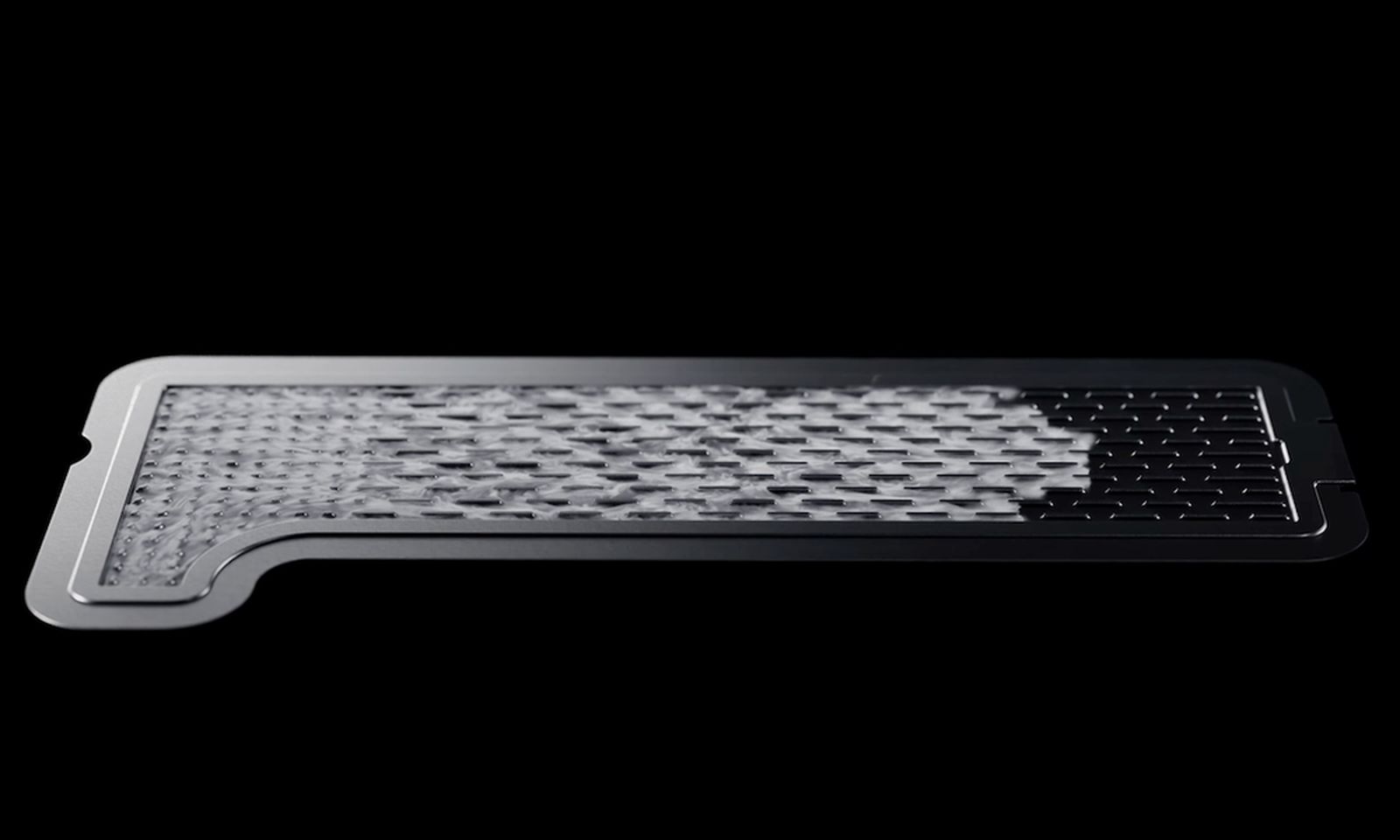
A Chinese leaker claims @Apple is increasing orders for #vapor-chamber cooling parts to support an upcoming book-style foldable iPhone and a future 20th-anniversary iPhone. The Weibo account Fixed Focus Digital says the higher order volume is meant to back production of a foldable “iPhone Ultra” expected in September, with suppliers reportedly asked to make about 10 million foldables in 2026 versus an earlier 7 to 8 million forecast. The leaker previously said the first foldable will use “impressive” vapor-chamber cooling, and the article notes a foldable’s thinner internal structure could create added thermal constraints, though there is no corroborating evidence for the claims. The report also ties enhanced cooling to @Apple’s recent adoption of #vapor-chamber cooling in iPhone 17 Pro, which uses deionized water to move heat from the A19 Pro chip into the aluminum unibody frame. It adds that a redesigned, nearly borderless 20th-anniversary iPhone concept with glass curving around all four sides, and a possible return to glass manufacturing, could likewise necessitate more advanced cooling.
15. Ukraine claims $400 FPV drone destroyed Russia’s $19 million ‘Apache rival’ attack helicopter

Ukraine’s Unmanned Systems Forces say a low-cost #FPV drone struck and potentially downed a Russian Mi-28 “Night Hunter” attack helicopter in flight, highlighting Ukraine’s reliance on #asymmetric_warfare and home-grown #drone manufacturing. According to Ukrainian officials and SkyFall, a Shrike 10 FPV drone climbed above the Mi-28 over Russia’s Belgorod region on July 17, 2026, then dived into its tail boom, with Major @Robert “Magyar” Brovdi posting final-approach footage on Telegram; SkyFall claims the drone costs under $400 versus a $19 million helicopter. The cost figures and the claimed kill are disputed: other sources estimate the Mi-28 at about $15 million, procurement details from a Germany-backed drone deal suggest per-unit costs may vary, and independent observers note there is no aftermath video and that helicopters can survive such hits, with some unverified reports calling the damage minor. Even with uncertainty over the outcome, the incident is presented as another example of cheap drones credibly threatening high-value aircraft, a trend Ukraine says has contributed to losses of 20+ Mi-28s since 2022 and which could concern military planners beyond this conflict.

@Netflix has completed a $587 million cash acquisition of @Ben Affleck’s AI filmmaking startup InterPositive, a move that is intensifying subscriber anxiety about the platform’s creative direction. The deal, first announced in March and later confirmed in Netflix’s Form 10-Q, brings in tools that let filmmakers build custom #AI models from production dailies to speed up post production tasks like visual effects, mixing, and relighting, even as Affleck has said the goal is to preserve human judgment and creativity. Netflix also told shareholders it used #AI on 300 movies and shows in 2026, with co CEO @Ted Sarandos saying the tools delivered visual elements twice as fast and at half the cost of prior options, which has fueled worries about impacts on creative jobs. Reddit discussions framed the acquisition as signaling potential layoffs in post production and VFX, with users arguing that humans, not algorithms, are artists. The author links this controversy to broader frustration with Netflix, including show cancellations, a push toward social media style content, and a perceived shift toward tacky reality projects, all contributing to eroding trust and prompting thoughts of canceling subscriptions.

China’s #Cyberspace Administration of China and four other departments have introduced regulations restricting #AI romantic companion services, aiming to stop tools from excessively catering to users, inducing emotional dependence or addiction, and damaging real-world relationships, while also banning virtual relationships with minors. The rules took effect July 15 and require companion chatbots to undergo evaluation before public release, with authorities able to shut down services deemed unsafe, and reporting suggests the rules may also affect general chatbots if responses are considered too emotional. Major firms such as ByteDance, Tencent, and Alibaba have disabled custom persona features rather than fully comply, triggering widespread “virtual breakups” for users who formed deep attachments, including a 19-year-old student who told Bloomberg she cried daily after losing an AI partner of over a year. The article links the timing of the crackdown to China’s declining birth rates over the past four years, described as reaching a record low in 2025, with concerns that virtual romance is displacing human relationships and childbearing. It also frames the issue as broader than China, citing people using emotionally responsive AI for companionship or therapy, and notes that therapists referenced in the piece view the restrictions as beneficial.
18. ChatGPT Returns to WhatsApp in Europe After EU Orders Meta to Restore Rival AI Access

@OpenAI restored #ChatGPT access on #WhatsApp across all 30 #EEA countries on July 13, reversing a January 2026 block by @Meta and making it available via the verified 1-800-CHATGPT number without requiring an account. The reinstatement follows European Commission interim measures issued June 9 that ordered Meta to restore free access for rival AI assistants within five working days, after the Commission viewed Meta’s proposed €0.049–€0.13 per message fees as effectively maintaining the ban. The interim measures, only the Commission’s third use of this tool in 25 years, rely on EU #abuse-of-dominance rules rather than the #DigitalMarketsAct, and they remain in force until an antitrust investigation opened December 4, 2025 concludes. Non-compliance can trigger fines up to 10% of Meta’s global annual turnover, plus daily penalties up to 5% of average daily turnover. For users, the WhatsApp integration runs on GPT-5.5, supports text, image uploads, voice messages, and image generation (via gpt-image-2), with optional account linking to preserve history.

Leaked #Geekbench results suggest an AMD Medusa Point 10-core, 20-thread engineering sample based on #Zen6 is showing higher-than-expected performance uplift versus Strix Point #Zen5 parts. The same sample (CPU ID: 100-000001713-33_N) reappeared on the AMD Plum-MDS1 platform with 3,329 single-core and 16,555 multi-core points, up from 3,174 single-core and about 15,192 multi-core previously, indicating roughly a 5% single-core and 9% multi-core gain. Using an average score for the Ryzen AI 9 365 for comparison, the article claims Medusa Point is now nearly 35% faster in single-core than the 10-core Strix Point APU, up from around a 29% lead earlier. The benchmark run also shows early clock data, with a fastest recorded frequency of 5,370 MHz, about 300 MHz higher than the fastest Strix Point APUs mentioned, though the piece cautions that Geekbench is not the most reliable comparison tool. Overall, the leak positions Medusa Point as a stronger-performing upcoming APU tier, while noting more dependable benchmarks like PassMark or Cinebench and an official announcement are still months away.
20. OpenAI killed the tool behind this AI film. Its director says Hollywood is only getting started

‘Critterz,’ led by director @Nik Kleverov of Native Foreign, was built primarily with AI, but its production was disrupted when @OpenAI abruptly shut down #Sora, the core tool the team relied on. Kleverov says the film’s Cannes premiere plans were derailed partly by technical issues tied to losing that technology, and he also recalls backlash from some French groups calling for a boycott after the project announced OpenAI’s backing. Despite that resistance, he maintains that #AI is not killing Hollywood, it is poised to reinvent it, and he argues that 2026 is “year zero” for mass adoption of AI in filmmaking. He emphasizes that as AI tools evolve, human talent and strong storytelling remain essential, and in some ways become more in demand.
21. China delivers a one-two punch to America’s AI dominance

China’s AI industry is tightening the race at the frontier as Moonshot AI and @Alibaba unveiled new models they say can rival @OpenAI and @Anthropic at much lower cost, raising the stakes for #national-security and #geopolitical influence. Moonshot introduced Kimi K3, claiming internal tests place it above nearly every US system except @OpenAI’s GPT-5.6 Sol and @Anthropic’s Claude Fable 5, while @Alibaba previewed Qwen3.8 and called it among the most powerful models available and “second only” to Fable 5. A key differentiator is #open-source and #open-weights distribution, with Moonshot calling Kimi K3 a 2.8 trillion parameter system and planning to release full model weights on July 27, and Alibaba saying its 2.4 trillion parameter Qwen3.8 is “going open-weight soon,” unlike most proprietary top US models. The article notes these claims are hard to verify until independent testing and full releases occur, but argues the announcements have already intensified US-China competition, echoing the disruption caused by DeepSeek’s low-cost rival model last year and prompting questions about whether massive US spending on chips and data centers will secure a durable lead. This openness also contrasts with Washington’s tighter #export-controls on advanced chips and actions that have limited access to top US systems, including forcing @Anthropic to pull its most capable model over concerns about aiding foreign competitors.
22. Apple Sued Over Reported ‘Hide My Email’ Flaw

@Apple is facing a proposed class action lawsuit over an alleged flaw in its #HideMyEmail feature that could reveal a user’s real email address. The suit claims @Apple violated California’s false advertising law and other consumer protection statutes by knowingly providing a feature that does not work as advertised. A security researcher reportedly disclosed the apparent #vulnerability to @Apple in June 2025, but the steps to exploit it have not been made public as a precaution. There are no known instances of the issue being exploited. The case centers on whether #HideMyEmail’s marketed privacy protection is materially undermined by the reported flaw.
23. China and Russia have a secret ‘no limit’ pact to eliminate Elon Musk’s Starlink at all cost

A joint investigation by The Insider, Der Spiegel, and Le Monde reports leaked documents describing a Chinese-authored, three-level plan shared with Russian officers in 2023 to contain and defeat #Starlink, reflecting deeper China-Russia military cooperation under their claimed “no limits” partnership. The documents say Chinese military officials and engineers presented the plan at a secret November 2023 summit in Guangzhou, proposing diplomatic pressure and regulatory constraints, expanded #electromagneticJamming, then #cyberattacks, or alternatively physical destruction of satellites. The report frames @Elon Musk’s @SpaceX network as strategically important because #Starlink is the world’s largest satellite constellation, supports civilian and military communications, and has underpinned Ukraine’s communications during the Russia-Ukraine war, while the US also relies on SpaceX including its military-oriented #Starshield. It also cites a separate June 2023 Moscow protocol committing China and Russia to jointly build a hypersonic-missile-defense system using previously unshared Russian technology, suggesting broader defense collaboration alongside efforts targeting satellite communications. Overall, the leaked materials portray #Starlink as a key obstacle for Russia in Ukraine and a growing threat for China, prompting a staged toolkit ranging from diplomacy to jamming and cyber operations, up to eliminating satellites in orbit.

With public opposition to nearby #data centers reportedly as high as 70% in the US, AI and energy firms are increasingly relying on #eminentDomain to secure land needed for the power infrastructure these facilities require. Polling cited in the article links resistance to environmental concerns and perceived reductions in quality of life, yet expanding #AI capacity is framed by @DonaldTrump as essential to US national and economic security. Because large data centers need enormous electricity, power companies seek easements or purchases from landowners for transmission lines, and if owners refuse, they can ask the government to seize property with “just compensation” under the Fifth Amendment, generally based on local fair market value. The article notes that eminent domain has historically been used for critical infrastructure and even Cold War projects like the Minuteman missile system, and it highlights the growing power footprint of data centers, estimated at 10-20% of US electricity consumption in 2024, with projects like @Meta’s Hyperion campus in Louisiana projected to draw triple the power used by New Orleans. Overall, the piece connects the AI-driven data center boom to escalating land conflicts and government intervention to accelerate grid buildouts despite widespread local opposition.
25. Anthropic in Early Talks to Lease $10B in Compute From Meta Over Two Years
@Anthropic is in early discussions to lease about $10B of computing capacity from @Meta over two years, a proposal made in June 2026 that would be paid monthly and allow either party to terminate early. Reports cited by the New York Times and CNBC say the talks are preliminary and may not become a binding agreement, and neither company has confirmed them publicly. The arrangement would position @Meta as an infrastructure supplier to a competitor in #AI models, since @Meta’s open-weight #Llama models compete with @Anthropic’s #Claude, while advancing @Mark Zuckerberg’s stated interest in a commercial cloud business and the new “Meta Compute” initiative led by former @AWS executive Dave Brown. The proposed deal, roughly $417M per month by the article’s estimate, is much smaller than @Anthropic’s May 2026 $45B, three-year compute agreement with @SpaceX for 220,000+ #NVIDIA GPUs at the Colossus 1 data center, and it follows other large commitments driven by reported GPU bottlenecks. Overall, the talks illustrate escalating #compute procurement as @Anthropic seeks more capacity and @Meta ramps capex and explores selling compute at a premium.
26. Critical ServiceNow code execution flaw now exploited in attacks

Attackers are now exploiting a critical #pre-auth #sandbox-escape #RCE vulnerability, CVE-2026-6875, in the @ServiceNow AI Platform, according to threat intelligence firm Defused. @Searchlight Cyber reported the bug on April 1 and said it can let unauthenticated actors escape the sandbox and execute code remotely, and Defused observed in-the-wild attempts starting Friday, with payloads targeting /assessment_thanks.do but using a different route to reach the same code-execution primitive than the published PoC. ServiceNow says it patched hosted instances starting in April and released updates for self-hosted deployments on July 13, while its advisory still states it is not currently aware of exploitation against ServiceNow instances. ServiceNow encouraged both self-hosted and hosted customers to apply the relevant patches as soon as possible and said it has not seen evidence tying the reported activity to instances it hosts. The article also notes a separate, previously disclosed incident last month where attackers queried customer data via an unauthenticated API flaw, which ServiceNow later associated with security research or bug bounty related activity rather than malicious actors.
27. Alibaba Launches Qwen 3.8 With 2.4 Trillion Parameters, Claims Near-Frontier Performance
@Alibaba unveiled a preview of Qwen 3.8, a 2.4 trillion-parameter multimodal model built with a #Mixture-of-Experts design, and it claims the system is “second only” to @Anthropic’s Claude Fable 5, though no independent benchmarks are provided to substantiate that ranking. The model can handle text, images, videos, and documents, and is positioned as an upgrade from Qwen 3.7-Max with expected gains in coding, full-stack development, data analysis, and office workflows, but Alibaba has not disclosed how many parameters are active at inference time, which is critical for sparse MoE systems. Access is offered in preview via Alibaba’s Token Plan, plus its Qoder and QoderWork products, marketed at 10% of standard pricing, with Lite at $6 for 2,500 weekly credits and Pro at $68 for 40,000 weekly credits supporting six to eight concurrent agents, and the plans support #OpenAI and #Anthropic API protocols for easier integration. The release adds to the “parameter race” among Chinese AI labs, with Qwen 3.8 described as the second-largest publicly disclosed model behind Moonshot AI’s 2.8T-parameter Kimi K3, a company in which Alibaba holds a 36% stake. Alibaba also promised an open-weight release “soon,” which, if delivered, would break its prior pattern of keeping Max-tier models closed and could make Qwen 3.8 a major open-weight milestone within Alibaba’s developer ecosystem.
That’s all for today’s digest for 2026/07/21! We picked, and processed 27 Articles. Stay tuned for tomorrow’s collection of insights and discoveries.
Thanks, Patricia Zougheib and Dr Badawi, for curating the links
See you in the next one! 🚀
