
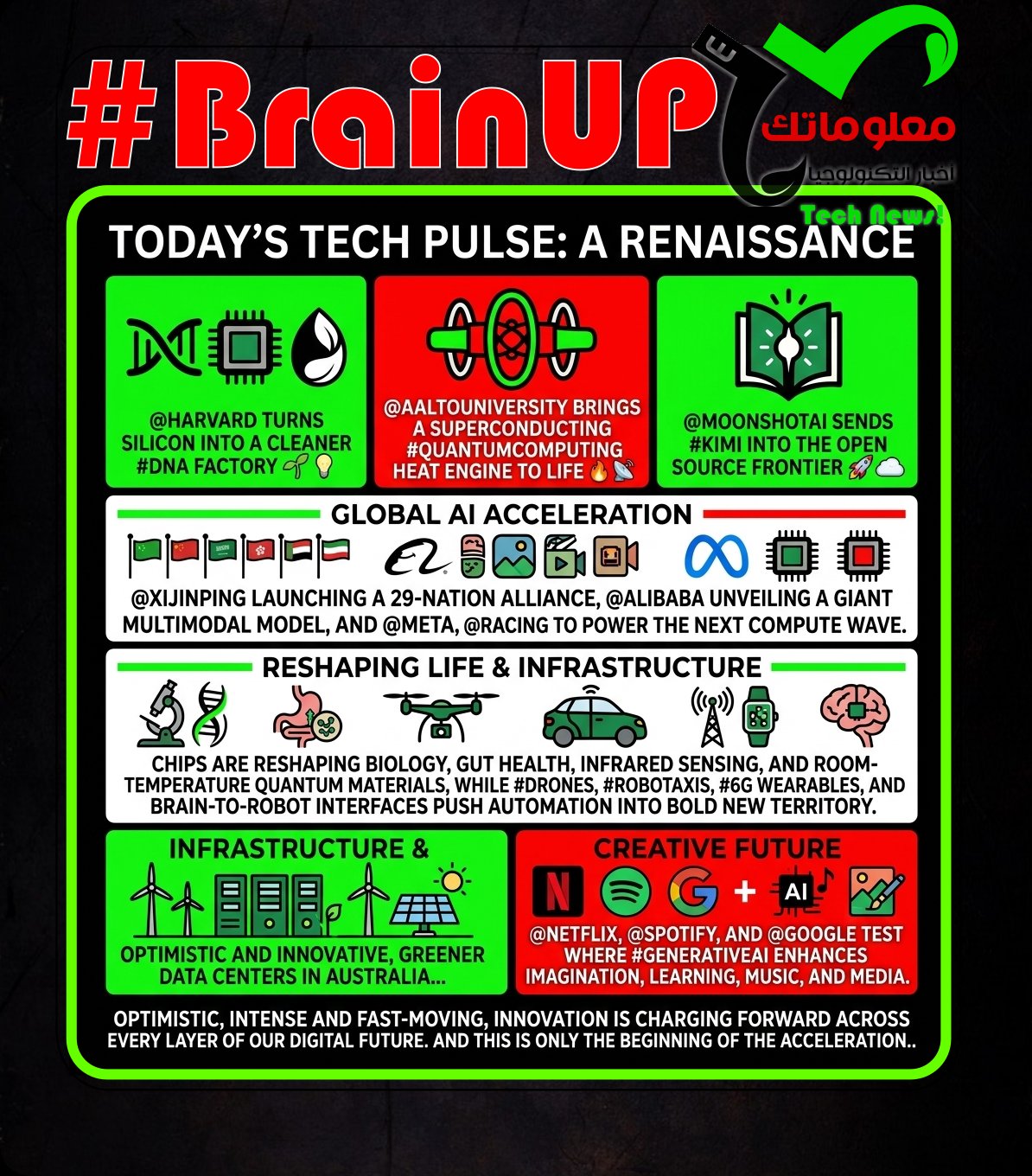
#BrainUp Daily Tech News – (Monday, July 20ᵗʰ)
Welcome to today’s curated collection of interesting links and insights for 2026/07/20. Our Hand-picked, AI-optimized system has processed and summarized 31 articles from all over the internet to bring you the latest technology news.
As previously aired🔴LIVE on Clubhouse, Chatter Social, Instagram, Twitch, X, YouTube, and TikTok.
Also available as a #Podcast on Apple 📻, Spotify🛜, Anghami, and Amazon🎧 or anywhere else you listen to podcasts.
1. Harvard Scientists Turned a Silicon Chip Into a DNA Factory

A @Harvard-led team built a silicon chip that can synthesize many DNA strands in parallel using electricity to control a water-based #enzymatic DNA synthesis process, offering a cleaner alternative to conventional manufacturing. Reported in Nature Electronics, the chip produces 64 distinct DNA sequences at once, each up to 39 nucleotides long, exceeding prior enzymatic platforms that made only about a dozen sequences simultaneously. The device replaces solvent-heavy #phosphoramidite chemistry, which can scale to millions of sequences but depends on hazardous organic solvents and centralized facilities, with a gentler approach that more closely resembles cellular DNA assembly. It achieves precise parallel control by using tiny electric currents at each of 64 sites with concentric ring electrodes to locally generate protons and lower pH for #deprotection, enabling nucleotide-by-nucleotide growth only where needed while counter-currents help confine the acidity. This demonstrates a path toward smaller, safer, potentially portable DNA-writing systems that could support applications such as diagnostics, genome engineering, and cancer research.
2. Kimi: Threat or menace? | TechCrunch

Chinese company Moonshot AI released a new open source version of its #Kimi model, Kimi K3, triggering renewed debate about China and open source AI. Moonshot said Kimi K3 still trails proprietary leaders like Claude Fable 5 and GPT 5.6 Sol but showed “frontier-level performance,” and independent analyses from Arena.ai and Vals AI also suggested it is competitive with flagship frontier models. The timing alongside @Xi Jinping’s World AI Conference speech and a roughly 1% Nasdaq drop, with chip stocks like Nvidia sold off, amplified U.S. political and market anxiety similar to reactions to DeepSeek’s open source R1 in 2025, now intensified by U.S.-China tariffs and national security disputes. Figures including @David Sacks and @Travis Kalanick argued U.S. regulation and alleged Chinese #distillation from American models risk losing the AI race, while OpenAI’s Dean Ball praised Kimi’s quality and warned an open weight dominated world could lead to “full AI communism,” with the state providing AI as digital public infrastructure. Ball suggested the U.S. could deter adoption of open weight Chinese models by increasing regulatory risk via agency guidance rather than banning open source.
3. World’s First Superconducting Quantum Heat Engine Could Transform Quantum Computing

Researchers at Aalto University built the first cyclic #quantum heat engine implemented in #superconducting circuits, using a transmon qubit as the working substance and operating near absolute zero. The device centers on a flux tunable transmon coupled to a resonator and a #quantum circuit refrigerator that can be tuned to either heat or cool the qubit, enabling the four stages of a #quantum Otto cycle within a single controllable element instead of separate hot and cold reservoirs. Using single shot measurements over up to three consecutive cycles, the team tracked the qubit’s state to compute absorbed heat, produced work, and efficiency, finding positive work output and agreement between observed performance and simulations. Reported in Nature Communications and led by @Mikko Möttönen, the experiment extends the familiar heat engine principle into the quantum regime on a microscopic scale and demonstrates a simpler, more versatile approach to cyclic quantum heat engines in a platform already central to #quantum computing, communication, and sensing.
4. Xi Jinping Launches 29-Nation AI Alliance to Counter US Tech Dominance

@Xi Jinping used the 2026 World AI Conference in Shanghai to unveil the World Artificial Intelligence Cooperation Organization, #WAICO, a 29-nation intergovernmental body positioned as China’s most direct challenge to US-led global #AI governance. The founding agreement was signed in Shanghai on July 16 by countries including Russia, Brazil, Indonesia, South Africa, Pakistan, Malaysia, Senegal, and Kazakhstan, with no Western nation joining, and notable absences including G7 members, the EU, Australia, South Korea, and India. @Xi pledged 5,000 AI training opportunities for developing countries over five years, promised to deploy China’s AI-powered meteorological early warning system #MAZU in 30 countries, and said China would open six international AI cooperation centers with ASEAN, the Arab League, the African Union, CELAC, the Shanghai Cooperation Organization, and BRICS. The launch came amid tightening US export controls on advanced semiconductors, and Xi criticized countries that “overstretch the concept of national security” in AI policy, a remark framed as a response to US chip restrictions. The initiative is described as promoting international AI cooperation and cross-border AI regulation, and is presented as a counterweight to the US-linked #PaxSilica framework connecting allies on AI supply chains.

A study in #NatureBiomedicalEngineering reports a human #ColonChip model that recreates multiple key features of #InflammatoryBowelDisease using patient-donated cells from #CrohnsDisease and #UlcerativeColitis, aiming to overcome limits of standard cell cultures and animal models. Led by first author @AlicanÖzkan at Harvard, the chip combines matched epithelial cells, stromal fibroblasts, circulating immune cells, and physiologically relevant mechanical forces, and it can reproduce disease exacerbations reported in pregnant women with IBD and support study of early cancer formation in an organ-relevant in vitro context. The experiments highlighted fibroblasts as active drivers, pairing IBD-derived fibroblasts with otherwise healthy intestinal cells from the same people was sufficient to induce disease-like behavior including a leakier barrier and stronger inflammatory responses. Recreating gentle stretching from normal bowel movements further intensified inflammatory and fibrotic responses in chips built from IBD tissue. Overall, the work suggests fibroblasts and mechanical forces may be underappreciated contributors to IBD progression and variability, and the chip provides a platform to isolate how each component contributes to gut inflammation and damage.
6. Australia Mandates AI Data Centers Be Net Power Generators, Sets Water Efficiency Rules
@Anthony Albanese announced a mandatory national framework, the #Australian Standards for AI, that would legally require large-scale AI data centers to be net power contributors, putting at least as much energy into the grid as they consume. The proposal obliges hyperscale operators to underwrite new electricity generation, specifically new renewable generation and firming capacity, pay full grid-connection costs, and reduce power use during periods of grid strain, while also aiming to ensure they do not raise power prices for Australian consumers. It also sets #water-efficiency rules requiring operators to minimize water consumption and fund any additional water infrastructure their facilities need, alongside siting expectations that new data centers be built in “the most appropriate locations” to reduce the current concentration of capacity in Sydney and Melbourne. The plan is positioned as a single national structure consolidating energy, water, location, and intellectual property rules, and it arrives amid heightened industry interest, including #Anthropic evaluating a campus exceeding 1.4GW and sending RFPs to multiple operators. Governance and rollout include creating an Office of AI within the Department of the Prime Minister and Cabinet, seeking National Cabinet backing in August 2026, and targeting draft legislation for early 2027.

The U.S. #AI data center boom is intensifying disputes over whether utilities can use #eminent_domain to take private land for transmission lines that primarily serve private data centers, reviving long-running fights about the meaning of “public use.” A Pew Research Center analysis cited in the article says the U.S. has more than 3,000 data centers and another 1,500 in development, while polling finds about 7 in 10 Americans oppose AI data centers in their communities due to concerns like higher utility bills, pollution, noise, and loss of green space, and the centers also require large amounts of water and electricity. The article argues expansion is being driven by grid reliability and surging electricity demand, noting that in 2024 data centers used more than 4% of the nation’s total electricity, which pushes power companies to build new transmission lines and acquire easements, sometimes through government-backed takings with “just compensation” under the Fifth Amendment. Legally, the key question is whether building lines for a private facility satisfies the #public_use standard, which the U.S. Supreme Court has interpreted broadly, including in @Kelo_v._City_of_New_London (2005), a decision that spurred backlash and led 45 states to enact eminent domain reform laws and prompted some state courts to apply stricter limits under their own constitutions. These clashes place local resistance to AI infrastructure alongside evolving state and federal rules about when delegated condemnation powers for utilities can be used to benefit private development.
8. Ukraine wants to dominate drone manufacturing after battlefield successes

Ukraine says it has expanded #drone manufacturing to 10 million units a year and is preparing to reach 20 million, framing the surge as a key part of its long-term defense strategy. @Volodymyr Zelensky said Ukraine has already surpassed its earlier goal of 1 million drones annually, and tied further scale-up to ongoing cooperation with international partners. The announcement aligns with a $1.1 billion EU defense-industrial arrangement dubbed the #DroneDeal, confirmed by @Ursula von der Leyen, with Ukraine’s officials saying multiple agreements are already completed and more than 20 countries may join. Ukrainian leaders point to extensive battlefield reliance on unmanned systems for surveillance and precision strikes, citing claims of over 800,000 verified targets struck and heavy Russian casualties in 2026, while acknowledging such figures are hard to independently verify during active conflict. Officials argue the same wartime experience and external financing could underpin ambitions to become the world’s largest producer of drones and robotic systems, though success depends on funding, production capacity, component access, and sustained international support.
9. Physicists Just Turned a Black Hole Energy Theory Into Reality

@Sir Roger Penrose’s idea of extracting energy from a spinning black hole, later extended by @Yakov Zel’dovich to predict wave amplification from fast rotation, has been recreated experimentally using a stationary device that mimics extreme rotation. Researchers at CUNY ASRC built a ring-shaped network of electronic resonators whose properties were rapidly modulated in a timed sequence to create a traveling pattern that makes the system appear to rotate ultrafast without moving parts, with results published in Nature. Electromagnetic waves with suitable rotational characteristics interacted with this synthetic time-engineered rotation, extracted energy from it, and emerged amplified, reproducing the core #Penrose–Zel’dovich process described as broadband selective amplification. By replacing mechanically impossible spin rates with #synthetic ultrafast rotation, the platform enables controlled studies of wave behavior under extreme rotational dynamics. The work connects black hole inspired theory to a practical experimental method with stated implications for fundamental research and for communications, optics, and photonics.
10. TSMC is accelerating Arizona factory buildout to capitalize on AI ‘megatrend,’ CFO says

TSMC is accelerating capacity buildout at its Arizona factory to capture what CFO @Wendell Huang described as a multi-year demand megatrend tied to #AI, doubling down on its U.S. expansion. The company committed an additional $100 billion, bringing its Arizona investment pipeline to $265 billion, and raised full-year capital expenditure guidance to $60 billion to $64 billion, citing robust U.S. customer demand and strong government support. To meet surging demand, TSMC is optimizing leading-edge capacity, including quickly converting #5nm capacity to #3nm, while phase one of the Arizona site using #4nm technology is already operating and #2nm is positioned as the newest revenue driver entering the third quarter after initial revenue in the second quarter. Huang noted U.S. fab construction costs are four to five times higher than in Taiwan and said initial profit dilution may widen as overseas scale increases, but argued the expansion will ultimately strengthen the U.S. semiconductor ecosystem through both front-end wafer fabs and back-end advanced packaging fabs. He added TSMC cannot control market swings and will focus on business fundamentals, while expecting minimal impact from component price increases.
11. The First Room-Temperature Quantum Material of Its Kind Is Spun From Atoms of Gold

Researchers at Louisiana State University report a room-temperature #quantum material that manipulates quantum states of light without cryogenic cooling. The device is a thin film of gold on a glass chip etched with microscopic slit patterns, forming a #plasmonic metacrystal where light on the surface generates plasmons and the slits act as artificial atoms, or meta-atoms, that filter which quantum statistics pass through. By changing the size, shape, and spacing of these slits, the team can select and transport certain quantum states of photons more robustly, reducing the disruption that heat typically causes for electron and atom based quantum systems. @Riley Dawkins describes the crystal as a statistical filter for quantum states, and @Omar Magaña-Loaiza says this robust transport can move information-carrying states from one point to another at room temperature. Published in Nature, the work is presented as an early proof of concept and a blueprint other teams can adapt to engineer related light-sorting chips for practical #quantum technologies.
12. Tiny infrared chip could improve detection of gases and heat – Technology Org

MIT researchers report a chip-based optical device that can dynamically control incoming mid-infrared light, acting as a tunable lens that could make infrared cameras more capable without bulky, expensive optics. The lens is built from an active #metasurface in which each microscopic pixel can be controlled independently, allowing the device to change focus and help cameras detect different signals without moving parts, and the work is described in Nature Communications. The team demonstrated a lab-scale version made mostly with conventional semiconductor chip-factory processes, suggesting it could scale to industrial manufacturing. By enabling compact, programmable mid-infrared optics, the approach could improve #thermalImaging, chemical sensing, pollution monitoring, and potentially new kinds of optical computing, including detecting organic molecules that absorb in the mid-infrared such as methane and propane. Building on earlier phase-change metasurface lenses from @JuejunHu’s group that tuned focus uniformly, this work targets per-pixel tuning to avoid the wiring complexity that has limited prior active metasurface designs.
13. Alibaba Launches Qwen 3.8 With 2.4 Trillion Parameters, Claims Near-Frontier Performance
@Alibaba unveiled Qwen 3.8, a 2.4 trillion-parameter #multimodal #Mixture-of-Experts model, and claims it is “second only to” @Anthropic’s Claude Fable 5, although it has not released independent benchmarks to support that ranking. The preview model can handle text, images, videos, and documents, and is available via Alibaba’s Token Plan, Qoder, and QoderWork at about 10% of standard pricing, with Lite at $6 for 2,500 weekly credits and Pro at $68 for 40,000 weekly credits plus 6 to 8 concurrent agents, and compatibility with @OpenAI and @Anthropic API protocols. The release positions Qwen 3.8 as the second-largest publicly disclosed model behind Moonshot AI’s 2.8 trillion-parameter Kimi K3, highlighting the ongoing parameter race among Chinese labs, with Alibaba noting it has not disclosed how many parameters are active at inference time, a key detail for sparse MoE systems. Alibaba says Qwen 3.8 should outperform Qwen 3.7-Max in coding, full-stack development, data analysis, and office workflows, but detailed performance numbers for Qwen 3.8 are not provided. Alibaba also promised an open-weight release “soon,” which would break its pattern of keeping Max-tier models closed, but it did not give a date or standalone per-token pricing.
14. Apple and Google navigate new EU regulations shaping AI technology
Apple and Google are adjusting their AI developments to comply with the European Union’s new regulatory framework aimed at ensuring ethical and transparent #ArtificialIntelligence. The EU regulations require tech giants to implement stringent safety checks and transparency measures for their AI systems, prompting @Apple and @Google to enhance their AI oversight processes. This shift reflects the growing global effort to balance innovation with responsible AI governance, addressing concerns about privacy, bias, and accountability. Both companies are investing in compliance infrastructures to meet these legal obligations, illustrating the increasing influence of regional policies on global technological trends. The move demonstrates the impact of regulatory environments on shaping the development priorities and strategies of leading AI developers.
15. The next innovation in AI: robots that can be controlled by your thoughts

Chinese company BrainCo unveiled a #brain-to-robot interface that lets human operators control robots using thoughts, without physical input or verbal instruction. The platform uses non-invasive #EEG headsets to translate neural activity into robot commands, relying on training data that links imagined actions to specific neuron patterns, with #AI algorithms matching thoughts to actions. BrainCo says the system can also connect to robotic arms and other devices, for example instructing an arm to pick up a cup through thoughts alone, and it was presented at the World Artificial Intelligence Conference in Shanghai. As the Brain-Controlled Robot AI Platform is adopted, it is intended to generate high-quality real-world training data to refine its algorithms, addressing a major industry bottleneck. BrainCo executive Nyx He said the next frontier for embodied AI is improving how robots understand the humans they work with, aligning the approach with broader advances in AI that can enhance robotics flexibility and dexterity.
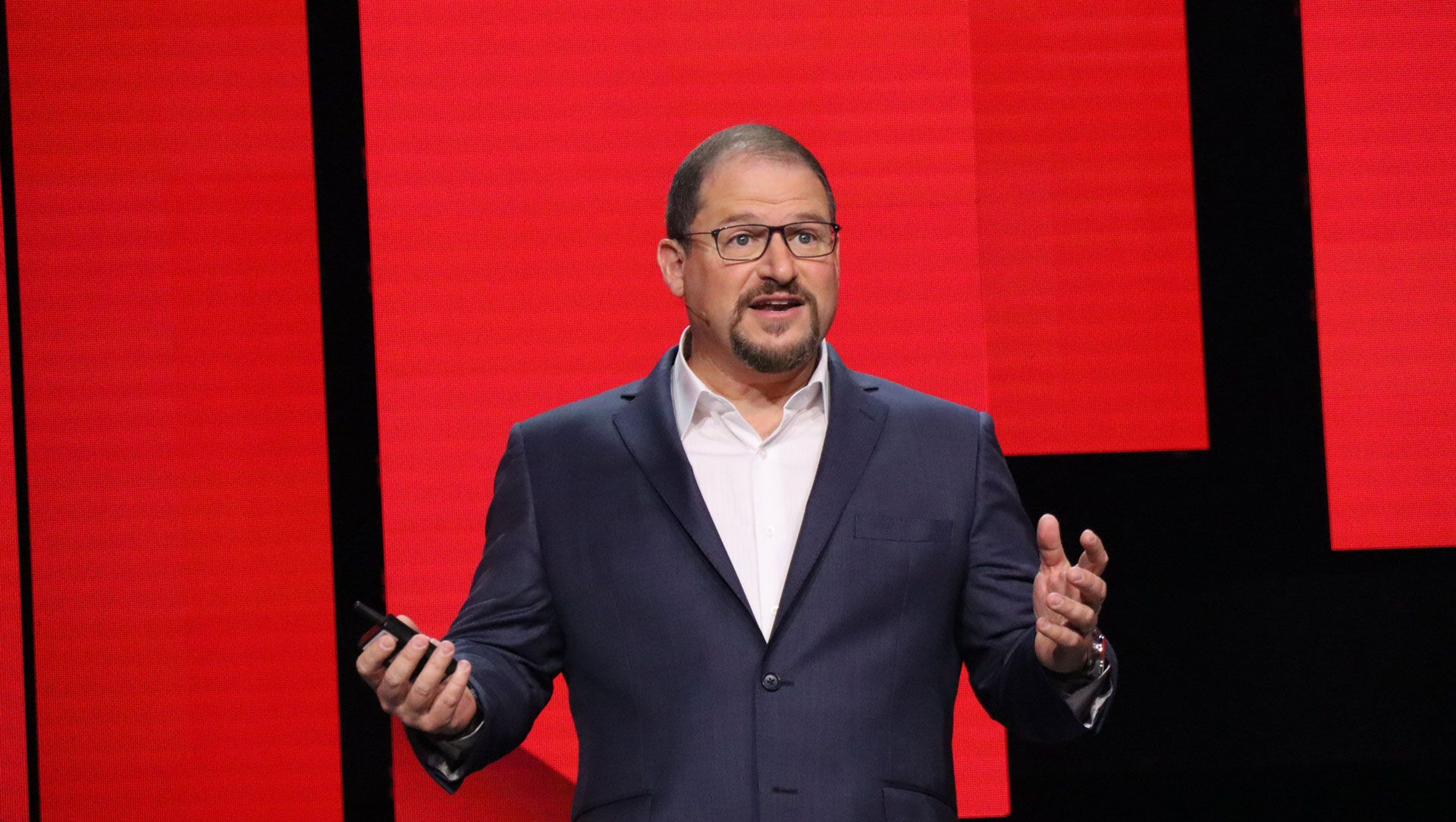
@Qualcomm CEO @Cristiano Amon argues that #6G could enable a mainstream boom in smart glasses by turning people into “walking cameras” that continuously capture what they see and send it to #AI models for instant, interactive intelligence. In a Fox Business interview, he describes glasses with built-in cameras streaming real-time video and even audio to a user’s personal AI, framed as an “exciting new device category.” The article links this vision to proposed #6G capabilities such as much faster peak speeds than #5G, potentially up to 1Tbps using sub-terahertz spectrum, alongside very low latency. It notes that smart glasses have historically struggled, citing the backlash after Google Glass and ongoing privacy concerns around Meta and Ray-Ban glasses, suggesting that social acceptance remains a key obstacle even if network technology improves. Overall, the piece presents #6G as a potential catalyst for wearable adoption while emphasizing that technical progress alone may not overcome public discomfort with always-on cameras.
17. Anthropic in Early Talks to Lease $10B in Compute From Meta Over Two Years
@Anthropic is in early-stage talks to lease about $10B of computing capacity from @Meta over two years, a proposed deal that would make @Meta an infrastructure supplier to a direct competitor in the AI model market. Reports cited (The New York Times and CNBC) say @Anthropic floated the idea in June 2026, with payments in monthly increments and bilateral early-termination rights, though terms could change and neither company has confirmed it. The talks align with @Mark Zuckerberg’s statement that a @Meta cloud business is “definitely on the table,” and with Meta’s “#Meta Compute” initiative led by former @AWS SVP @Dave Brown, alongside massive 2026 capex guidance of $125B to $145B and procurement of more than 1.3 million GPUs. Context in the article frames the proposal as smaller than @Anthropic’s earlier compute commitments, including a $45B, three-year agreement with @SpaceX for 220,000+ @NVIDIA GPUs at the Colossus 1 data center, and a long-term $100B+ commitment to @AWS centered on #Trainium capacity. If completed, the lease would represent a concrete step toward Meta commercializing #compute as Anthropic continues seeking relief from #GPU bottlenecks that limit access to premium @Claude models.
18. 60% of agentic AI costs go to response refinement, and most enterprises are already over budget

93% of enterprise AI teams are exceeding budgets because the real cost driver in #agenticAI is not token price but how systems are built and used at scale. In a July 2026 @McKinsey (QuantumBlack) report, its Enterprise AI FinOps Survey of 75 respondents across five industries found that response refinement, the iterative loop where an #AIAgent checks and regenerates outputs, consumes 60% of total agentic AI costs, while Menlo Ventures data cited in the report showed enterprise #LLM spend tripled over 12 months by end of 2025 despite Stanford HAI’s 2025 AI Index showing inference costs for GPT-3.5-level capability fell more than 99%. The report argues the gap between falling unit costs and rising total bills reflects volume growth and architectural choices, amplified by a shift to consumption-based pricing and by deploying expensive frontier models for routine tasks that smaller models could handle. As deployments move from pilot to production, the focus shifts from technical feasibility to whether agent outputs justify their operating costs, with budget constraints already emerging in organizations per @McKinsey’s forthcoming 2026 State of AI survey.
19. Climate Activists Pelt Microsoft Data Center With Balloons Full of Acid

Climate activists linked to Extinction Rebellion targeted a future #Microsoft data center construction site in Amsterdam, escalating protests against the environmental impacts of #AI data centers. They said they threw water balloons containing hydrogen peroxide, acetic acid, salt, and acrylic paint, claiming the mixture can attack concrete and accelerate steel rust, though the actual damage is unknown. The group framed the action as direct, nonviolent civil disobedience, citing past stunts such as using butyric acid and barricading access to Lloyd’s in London. They argue data centers drive carbon emissions through heavy electricity use, strain local water supplies, and that this project exploits a loophole to circumvent rules banning so-called #hyperscalers while consuming large amounts of power in an area with shortages. Extinction Rebellion also tied the protest to broader political claims about Microsoft’s role in Israel’s destruction of Gaza, urging resistance to what they describe as the anti-democratic power of large corporations.
20. Amazon’s Robotaxi Company Recalls Its Fleet After One of its Cars Got Confused by Heavy Smoke
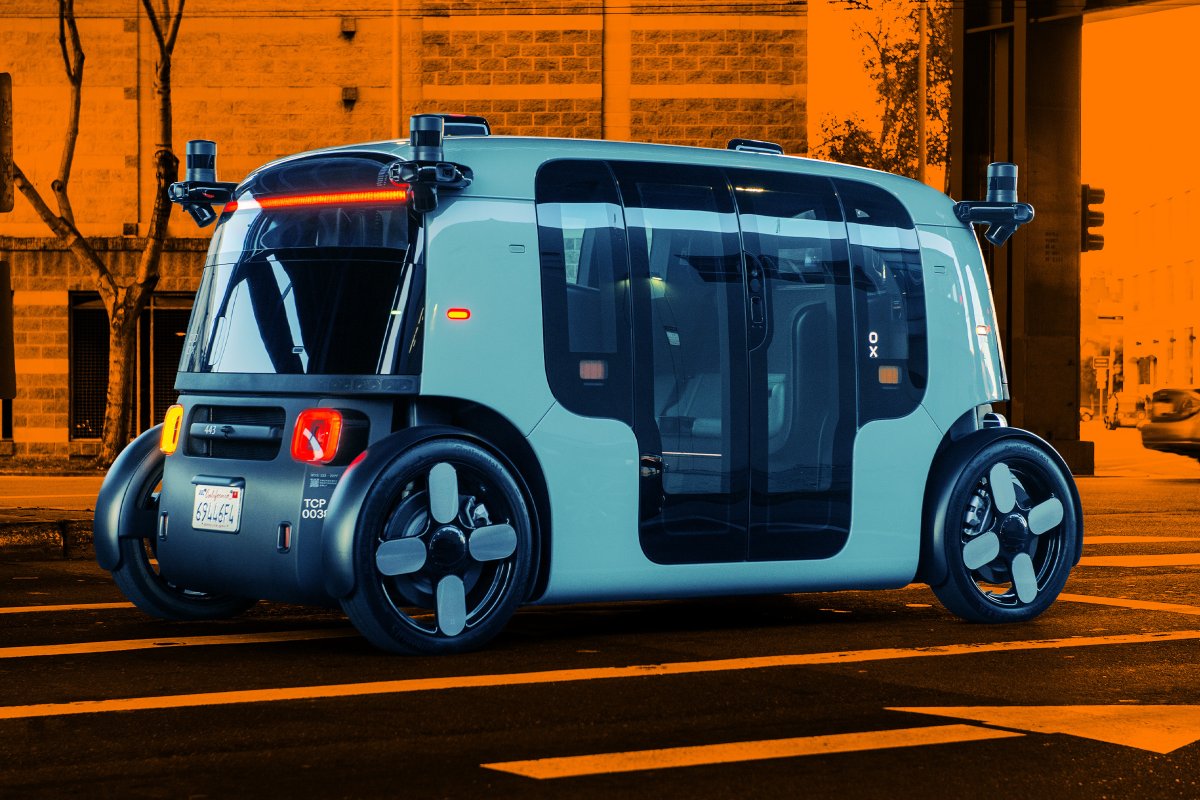
Amazon-owned @Zoox is recalling its entire fleet of 105 #autonomous #robotaxis via a software update after one vehicle became confused by heavy smoke near an active fire scene. According to a filing with the National Highway Traffic Safety Administration, on June 20 a Zoox robotaxi without passengers encountered smoke that obscured an emergency scene that was not cordoned off with cones, braked hard while trying to steer away, and stopped until a teleoperator manually reversed it so first responders could place traffic cones. Zoox told @TechCrunch the patch improves its ability to detect active emergency scenes by adding detection and response to heavy smoke in certain situations. The incident, reported by @CNBC as occurring in Las Vegas where Zoox offers free rides, underscores ongoing difficulties #self-driving cars have with unpredictable emergency conditions. The article situates the recall within broader scrutiny of robotaxis impeding responders, citing incidents involving @Waymo and a warning from NHTSA administrator @Jonathan Morrison that failure to safely interact with first responders is unacceptable and a public danger.
21. France orders Polymarket blocked over illegal gambling promotion

France’s National Gaming Authority, the ANJ, has ordered internet service providers to block access to Polymarket, saying the crypto-based prediction market illegally promotes gambling and games of chance to French users. The July 16 order targets all Polymarket sites run by ADVENTURE ONE QSS INC, after the regulator said it had monitored the service since November 2024, found an earlier geoblocking of French financial transactions was being circumvented, and reiterated that #predictionMarkets are not authorized under French law, with risks including addiction and market manipulation. The ANJ also cited a May investigation by the Paris prosecutor’s cybercrime unit into alleged manipulation of weather-related bets using compromised sensors, and said Polymarket lacks a #KYC identification system for French and European users. The move places France alongside Belgium, Germany, Italy, the Netherlands, Spain, and Switzerland in restricting such platforms, and the ANJ said it blocked 1,290 URLs in 2025 under its administrative powers. It also comes amid broader scrutiny of Polymarket, including reporting that it paid influencers to promote fabricated wins on TikTok and attempted to block VPN access under U.S. legal pressure.
22. AI advice made people three times less accurate but twice as confident, researchers found

A study by @Valerio Capraro, @Chiara Marcoccia, and @Walter Quattrociocchi found that merely having access to #AI advice can suppress people’s willingness to admit uncertainty, while making them less accurate and more confident. When participants could consult an AI model, “I don’t know” responses fell from 44% to 3%, accuracy dropped from 27% to 9%, and confidence rose from 30% to 76%, with some people switching from correct answers to wrong ones after asking the AI. The researchers intentionally used questions where the model (Step 3.5 Flash) typically fails, so the effect could not be explained as rational delegation to a reliable tool; monetary incentives improved results only modestly, to 8% “I don’t know” and 16% accuracy, still below no-AI baselines. The findings align with the #cognitiveSurrender pattern described by @Wharton researchers, and suggest the availability of AI reduces the habit of recognizing one’s knowledge limits. The article links this concern to products that are designed to always answer, including #Google’s AI search changes that replace links with confident AI summaries, which #CommonSenseMedia called an “unacceptable risk” for students.
23. Microsoft admits it can’t fix Windows 11 Secure Boot problems, and older PCs are hit hardest

A July 15 OEM “Secure Boot Office Hours” session showed that parts of the Windows 11 #SecureBoot 2023 certificate rollout still fail on real hardware, and @Microsoft plus major OEMs could not fully explain or resolve some admin-reported errors. IT admins described issues like persistent #BitLocker recovery loops, Secure Boot certificate errors, and #KEK updates that would not apply even when following official guidance or forcing installation via the AvailableUpdates registry key. Prior reporting cited industry-wide firmware inconsistency: some boards required temporarily disabling Secure Boot to apply revocations, others ignored updates while still showing Secure Boot enabled, and some systems needed manual key resets and re-enrollment with little documentation, with one case ending in a motherboard replacement after repeated false CPU-change warnings. A prominent unresolved example involved fleets of HP EliteBooks and ZBooks where both forced certificate installation and HP-documented BIOS setting changes triggered BitLocker recovery in testing, tied to BIOS updates that could affect PCR7 measurements that BitLocker relies on. Overall, the discussion implies that the remaining failures are often rooted in OEM firmware behavior and uneven deployment rather than a single Windows-side fix, leaving admins to determine whether their case matches known unresolved patterns or is a new, unreported problem.
24. Thinking Machines is coming for Anthropic’s intellectual vibe

Thinking Machines, founded by former OpenAI leader @Mira Murati, is positioning itself to rival @Anthropic’s intellectual, creativity-oriented brand by emphasizing AI that augments human thinking. The company has released its first model, Inkling, and says it can be fine-tuned through its Tinker platform, with Inkling described as having 975 billion parameters, including 41 billion active parameters, and being an #open-weights model. Unlike Anthropic’s messaging around “Keep thinking with Claude” and AI enhancing cognition, Thinking Machines acknowledges Inkling is not the most powerful model available. Instead, it is betting that #customization and user fine-tuning will be a more compelling differentiator. The strategy mirrors the broader “AI should enhance human intelligence rather than replace it” ethos, while competing on controllability rather than raw capability.
https://www.sciencedaily.com/releases/2026/07/260716023603.htm N/A
26. Methods to break down chemicals in the environment
Innovative methods to decompose harmful chemicals in the environment are crucial for reducing pollution and enhancing ecological health. Researchers are developing advanced techniques that utilize chemical reactions and biological processes to break down persistent pollutants more efficiently. These methods include the use of catalysts and microorganisms that transform toxic substances into less harmful or inert compounds. The effectiveness of these approaches could lead to improved strategies for environmental cleanup and pollution management. Such advancements support sustainable development by mitigating the long-term impacts of chemical contaminants on ecosystems.
27. Netflix paid $587M for Ben Affleck’s AI filmmaking startup | TechCrunch

Netflix disclosed in a regulatory filing that it paid $587 million in cash to acquire InterPositive, an AI filmmaking startup co-founded by @Ben Affleck. Netflix announced the deal in March without financial terms, saying the entire InterPositive team would join Netflix and that @Ben Affleck would become a senior advisor, and he said he wanted to protect the power of human creativity. Affleck said InterPositive’s #AI tools support filmmakers in post-production by helping address real-world production challenges like missing shots, background replacements, or incorrect lighting. A prior Bloomberg report suggested the acquisition could be worth up to $600 million, and Netflix also reported that about 300 of its titles have already used #generativeAI. The acquisition links Netflix’s expanding use of #generativeAI with tools positioned as aiding, rather than replacing, human creative work.
28. Spotify Doubles Down on AI Slop As It’s Being Flooded With It
Spotify is trying to combat a flood of low-quality #AI-generated content on its platform while also expanding #AI features that can mislead listeners and frustrate artists. Spotify executive Sam Duboff said the company removed over 75 million spammy tracks in the last year, as AI-made music has entered algorithmic playlists, charted, and enabled impersonation of artists, including deceased musicians, yet Spotify continues rolling out tools like #AI playlists, an #AI DJ, and the beta #AboutTheSong summary feature. @Lorde criticized #AboutTheSong after it inaccurately described a specific onstage performance for one of her songs, an error that appears to have originated from a mistaken tour review that the feature cited as a source, and she argued that AI-generated meanings at the source can limit free interpretation and should include an opt-out for artists. Spotify told Rolling Stone the feature exists because fans want backstories, that it pulls from third-party internet articles, and that it moved quickly to fix the incorrect information. The incident highlights the difficulty Spotify faces in drawing a line between fighting #AI slop and embedding #AI deeper into the listening experience.
29. Fix AI Mode or get Google out of classrooms, advocates say

Child safety and education advocates argue that Google’s #AI-powered Search, especially #AI Mode, creates an unacceptable risk for students and should be disabled for education users or schools should reconsider relying on Google in classrooms. A report from Common Sense Media says students should stop using the generative AI search experience until educators can turn the AI off, noting that #AI Mode was made broadly available, including to education accounts, even though it is powered by #Gemini models that are age-gated in other Google products. Experts also point to issues with Google’s #AI Overviews repeating misinformation and presenting answers with an authoritative tone that can mislead children, while Common Sense Media found Google’s AI tools could readily complete homework for minor users. They warn this mix of misinformation risk, persuasive chatbot behavior, and easy answer generation can confuse learners and enable unintentional cheating, potentially making learning harder. Because Google is deeply embedded in schools through #Chromebooks and #Google Workspace for Education, advocates say the company’s push to make generative AI fundamental to Search erodes trust and raises urgent classroom safety and learning concerns.
30. Claude’s AI assistant could be manipulated through browser extensions

Security researchers at Manifold Security say #Anthropic’s Claude for Chrome extension (v1.0.80, released July 7, 2026) still contains two unpatched issues that could let another browser extension push Claude into executing sensitive predefined workflows. The first flaw is that the extension does not check Event.isTrusted, allowing synthetic clicks on claude.ai to trigger nine hardcoded tasks such as reading #Gmail, opening #GoogleDocs, checking #GoogleCalendar, and modifying #Salesforce leads, with risk rising from CVSS 7.7 to 9.6 when auto execution is enabled. Manifold says it reported the issues via the bug bounty program on May 21, 2026 and confirmed on July 7, 2026 they still worked, and notes eight releases from 1.0.73 to 1.0.80 did not change the flagged handlers, which it says remained byte identical. A second weakness involves a side panel URL parameter, skipPermissions=true, that can enable a privileged mode that skips permission checks and consent prompts, even though #Anthropic argues it is only constructed by internal scheduled task features. Manifold warns the bypass remains a few lines of #JavaScript and reports the behavior reproduces across Claude’s Opus, Sonnet, and Fable side panel model selections.
31. Kimi.ai (@Kimi_Moonshot) on X

Kimi.ai says Kimi K3 demand has surged unexpectedly, pushing its GPU capacity near the limit over the past 48 hours. To maintain service quality for existing subscribers, it is temporarily pausing new subscriptions and prioritizing compute for current members, while noting that subscribed users are not affected. The company says it is adding capacity as quickly as possible and will reopen new subscription slots in batches. It also plans to split membership into two plans, Kimi Membership for web, app, and work use, and Kimi Code Membership for coding workflows, to better match compute needs and keep the experience stable. The post thanks users for their patience and understanding.
That’s all for today’s digest for 2026/07/20! We picked, and processed 31 Articles. Stay tuned for tomorrow’s collection of insights and discoveries.
Thanks, Patricia Zougheib and Dr Badawi, for curating the links
See you in the next one! 🚀
