
#BrainUp Daily Tech News – (Sunday, July 12ᵗʰ)
Welcome to today’s curated collection of interesting links and insights for 2026/07/12. Our Hand-picked, AI-optimized system has processed and summarized 28 articles from all over the internet to bring you the latest technology news.
As previously aired🔴LIVE on Clubhouse, Chatter Social, Instagram, Twitch, X, YouTube, and TikTok.
Also available as a #Podcast on Apple 📻, Spotify🛜, Anghami, and Amazon🎧 or anywhere else you listen to podcasts.
The Doge project has ceased operations, marking the end of its involvement in the crypto market. This decision was driven by multiple challenges, including regulatory pressures and financial difficulties, which made continued activity unsustainable. The closure reflects the broader issues faced by similar crypto endeavors in navigating complex legal environments and maintaining viability. For stakeholders, this shutdown signals caution in the volatile digital currency space and the importance of regulatory compliance. The Doge case exemplifies the dynamic and uncertain nature of the cryptocurrency industry.
2. Apple Is Suing OpenAI for Allegedly Stealing Hardware Secrets
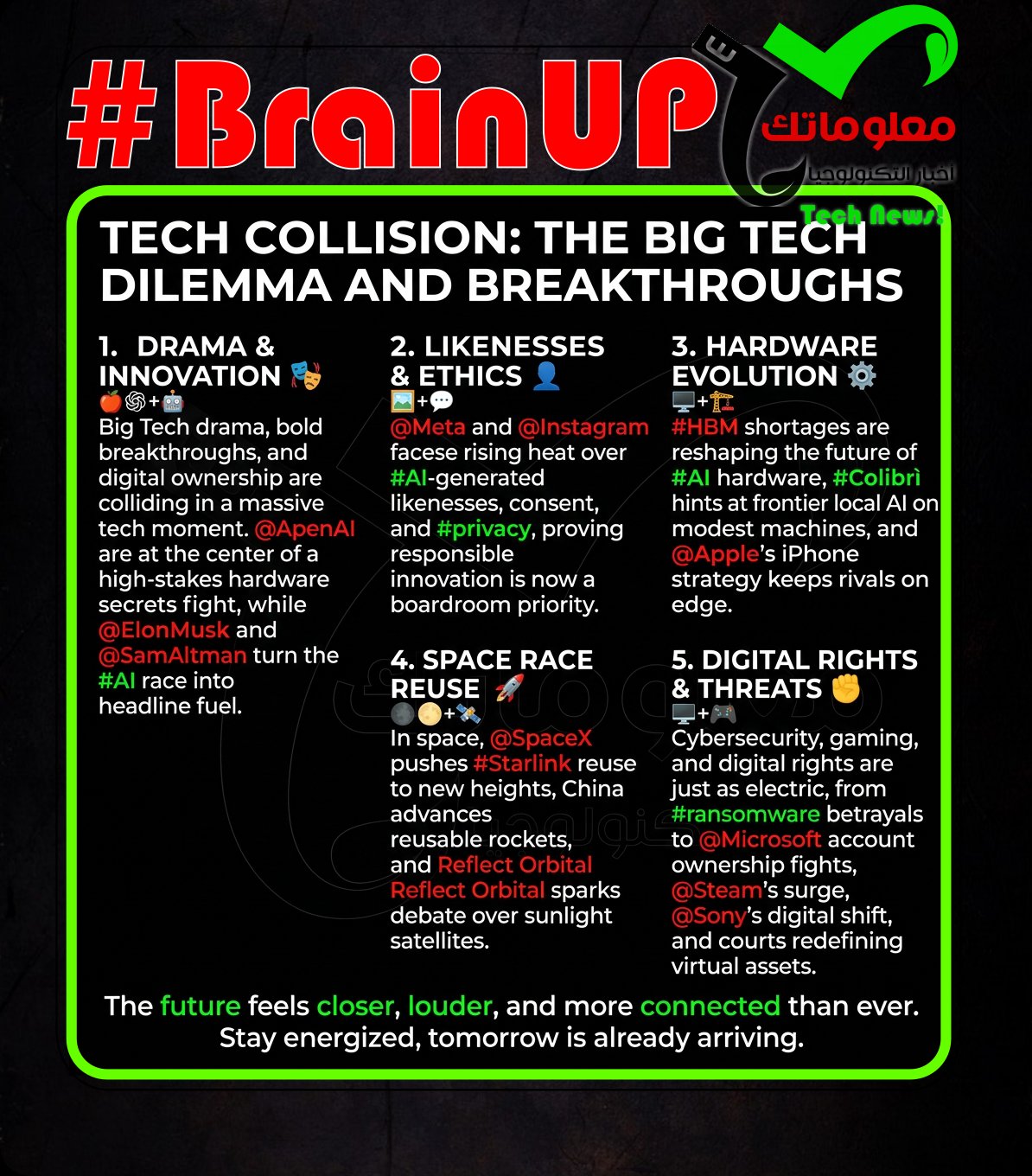
@Apple has sued @OpenAI, its chief hardware officer @Tang Tan, and others, alleging they misappropriated Apple #trade_secrets related to unreleased parts and prototypes, confidential designs, and documents tied to stealth hardware projects. The complaint says Tan and colleagues encouraged departing or prospective Apple employees to bring proprietary presentations, supplier details, and even confidential parts to interviews, and allegedly coached recruits on evading Apple’s security protocols. Apple also alleges an @OpenAI engineer, Chang Liu, kept a company laptop, retained access to Apple’s internal file-sharing system via a bug, downloaded dozens of confidential hardware files including manufacturing and testing materials for complex circuit boards, and advised a recruit on how to avoid detection when copying files. @OpenAI denies seeking competitors’ secrets, while Apple says it is defending its teams’ work, framing the case as a major Silicon Valley IP dispute that comes despite the companies’ 2024 partnership to distribute #ChatGPT on Apple devices and amid growing competition in #AI-powered consumer devices.
@Elon Musk used the publicity around #Apple’s lawsuit against @OpenAI to attack @Sam Altman while claiming #SpaceX will begin deploying its #AI1 satellites next year. The article says #Apple alleges @OpenAI stole proprietary technology, including circuit designs and component architecture for upcoming AI devices, and notes Apple claims more than 400 former employees joined OpenAI, with ex-design VP Tang Tan allegedly urging recruits to bring Apple hardware components for “show and tell.” Musk responded online by accusing Altman of having “st[e]al[en] an open source AI charity” and “all of Apple’s phone technology,” adding that the satellites would fly next year and implying Altman would be in jail by then, after Altman mocked Musk for “sellling public market investors on short-term space datacenters.” It also outlines SpaceX’s #AI1 satellite design, described as supporting up to 150kW of peak compute payload with liquid radiators, meteoroid shielding, a centralized compute module, deployable solar arrays, and manufacturing at the Gigasat facility in Texas, tying the feud back to their long-running conflict over OpenAI’s shift from nonprofit roots and earlier litigation.
4. Privacy concerns rise as Instagram tests AI tools
Instagram has begun testing AI-driven features that are raising significant privacy concerns among users and experts. The platform’s new AI tools, designed to enhance user experience and content discovery, collect extensive personal data, prompting fears about data security and misuse. Critics warn that without strict regulatory oversight, these AI implementations could compromise user privacy and facilitate intrusive profiling. The controversy highlights the broader tension between technological innovation and protecting individual rights on social media platforms like Instagram. This situation underscores the need for transparent policies ensuring AI advancements do not come at the expense of user privacy.
5. Meta Removes AI-Generated Images From Instagram Amid Criticism
Meta recently removed AI-generated images created by its #Muse model from Instagram after facing significant criticism. These images, which depicted celebrities in stylized forms, sparked debates on ethical concerns and potential misuses of AI-generated content. Critics argued that such images could blur the lines of authenticity and impact public trust on social platforms. Meta’s decision reflects a cautious approach towards AI-generated content as the company navigates regulatory and societal expectations. This move highlights the evolving challenges tech firms face in balancing innovation with responsible content management.
6. LinkedIn Is Quietly Becoming a Dating App as Professionals Look for Love Beyond Swipe Culture
A growing number of professionals are turning LinkedIn into an unexpected dating platform, with a new survey finding that one in eight U.S. workers have started a romantic relationship through the site and one in five have used it to vet potential partners. The shift is driven by declining trust in traditional dating apps, as many users view employment history, education, and mutual connections as stronger indicators of authenticity than dating profiles. While most respondents still believe LinkedIn should remain a professional space, younger generations are increasingly blurring the lines between career networking and personal relationships, reflecting a broader trend where verified professional identities are becoming a new form of digital trust in an era of online deception and “ghosting.”
7. Ransomware negotiator hired to represent victims was working for the attackers
A former ransomware negotiator at DigitalMint, Angelo Martino, was sentenced to 70 months in prison for secretly collaborating with the #BlackCat (ALPHV) ransomware group to increase ransoms from the very clients he was hired to help. US prosecutors said Martino shared confidential negotiation information with the attackers to maximize ransom demands, receiving a cut of the payments, and five affected clients paid more than $75 million to ransomware affiliates, with ransoms from $213,000 to $26.8 million during April to September 2023. Martino pleaded guilty to conspiracy to interfere with interstate commerce by extortion, gained millions in cryptocurrency, and used proceeds to buy two Florida houses, a boat, and vehicles, with the FBI seizing some cryptocurrency. He must forfeit property and pay 10 percent of post-release salary to compensate victims, while co-defendants Kevin Martin and Ryan Goldberg previously received four-year sentences. The case highlights how #ransomware negotiation roles can be abused to worsen extortion outcomes, even as BlackCat has been targeted by law enforcement actions like an FBI decryption tool and website seizures.
#Meta has integrated its #MuseImage model into @Instagram so that public-account photos and posts can be used to generate #AI images unless users opt out, prompting @SAG-AFTRA to urge members and all users to change settings to protect their likeness. According to Wired, someone can tag a public profile in a prompt and use #MetaAI to generate an image using that person’s likeness, and Meta’s help center says users will not be notified about content created with these AI features. @SAG-AFTRA provided step-by-step instructions to find the “Sharing and reuse” settings and toggle off permissions for Posts and Reels, warning that leaving the new default settings enables use without consent. The union and @CAA condemned the opt-out approach, with CAA arguing that names, images, likenesses, voices, and creative work should not be used by third parties, including AI models, without clear documented consent, and the article notes similar backlash to @OpenAI’s short-lived #Sora model. The dispute centers on whether platforms should default to allowing AI reuse of user content or require affirmative consent that gives creators real control.
@SK Hynix CEO Kwak Noh-jung said the memory shortage will worsen, calling 2027 the industry’s “worst year” from a supply perspective and projecting demand to exceed supply capacity even beyond 2030. He made the comments to Reuters on the same day SK Hynix marked the largest-ever IPO for a foreign company on the U.S. stock market, raising $26.5 billion, echoing earlier statements from SK Group chairman @Chey Tae-won that shortages could persist until 2030. The article links the crunch primarily to #HBM demand for #AI accelerators, because HBM requires more complex manufacturing and packaging than consumer #DDR5 and uses more wafer capacity, prompting vendors to reallocate output and tightening supply. It also notes incentives to talk up scarcity given strong revenues and rising competitor valuations, but points to concrete market behavior like multiple long-term supply agreements that lock in multi-year DRAM supply with price floors and ceilings. While prices are expected to stay elevated near term, the piece cites TrendForce data showing Q3 2026 DRAM contract prices rising 15% to 18% QoQ, suggesting the market may be stabilizing, albeit at much higher price levels, consistent with the article’s theme that the shortage outlook remains uncertain but pressured by AI-driven demand.
Italian engineer Vincenzo (aka JustVugg) created #Colibrì, a proof-of-concept that can run the 744-billion-parameter, 1.5-TB #GLM-5.2 #Mixture-of-Experts model on a modest CPU with 25 GB of RAM and a 1 GB/s virtual #NVMe drive, aiming to make frontier-scale local AI more accessible amid subscription costs and privacy concerns. On this setup it achieves only about 0.05 to 0.1 tokens per second, far below the roughly 20 to 30 tokens per second needed for real-time conversation, though Vincenzo reports impressive results in limited testing due to the model’s high capability. The approach exploits #MoE structure by loading and unloading only the expert sub-models needed per token, with simple expert-selection code in a single C file and a quantized version of the model to reduce size. The design trades memory footprint for heavy I/O and bandwidth demands, with NVMe speed typically the first bottleneck, followed by RAM limits and then CPU cores as storage improves. Colibrì does not yet run on GPUs and would still face major data-shuffling constraints, but early interest is high and benchmark data is being collected as the project develops.
11. iPhone 18 Pro Max: New Battery May Make It Apple’s Heaviest in Years
The iPhone 18 Pro Max may get thicker and heavier because @Apple is reportedly planning a much larger battery and an upgraded cooling system. Leaker Ice Universe claims the phone could be about 9mm thick and around 240 grams, roughly 0.25mm thicker and 7 grams heavier than the iPhone 17 Pro Max, while regulatory filings cited by MacRumors list 5,391mAh for China and 5,567mAh for the U.S., nearly 500mAh more than the current model. Ice Universe also points to a stainless-steel #vapor-chamber cooling system as an added contributor to weight, though other reports disagree on whether the body thickens or only the rear camera bump grows. If the 240-gram figure is accurate, it would match the iPhone 14 Pro Max as one of Apple’s heaviest, despite prior material shifts from stainless steel to titanium and then to aluminum on later Pro models. The article frames the likely buyer trade-off as comfort versus #battery endurance, with final details expected around Apple’s September iPhone 18 unveiling, potentially alongside a foldable iPhone.
12. iPhone 18 Pro Release Date: Apple’s Strategic Choice Can Defeat Rivals
@Apple’s early September launch timing for the iPhone 18 Pro lineup is positioned as a deliberate strategy to outmaneuver Android rivals by letting them launch first and absorb the market risks. @Samsung and @Google are expected to ship Galaxy and Pixel flagships in late July or early August, but that gives them only a short full-price window, about six weeks for Samsung and four for Google, before iPhone-driven carrier renewals and marketing in September and October compress sales and force aggressive trade-in deals. Apple also benefits from learning from those earlier launches, including higher premium price points set by rivals amid rising component costs, which can reduce potential iPhone “sticker shock” by making the elevated pricing baseline feel established. On software, the article contrasts a unified, day-one #iOS 27 rollout across supported iPhones, strengthened by extensive public betas, with fragmented #Android 17 adoption across manufacturers, regions, and skins like #OneUI 9, which can create consumer anxiety and less consistent early experiences. Overall, the later iPhone release date is framed as a way for Apple to gather market intelligence, deliver a more stable out-of-the-box experience, and dominate the holiday-selling period after rivals have already shown their hand.
13. Latest Galaxy Z Fold 8 leak offers your clearest look yet at Samsung’s new foldables
New, official-looking marketing renders of Samsung’s upcoming Galaxy Z Fold 8 and Galaxy Z Flip 8 have leaked, offering a clearer look at the devices ahead of launch. Serial leaker @Roland Quandt posted watermark-free images on Bluesky showing the Z Fold 8 in lavender and the Z Flip 8 in pink, and the designs match prior leaks including similar Z Fold 8 renders shared earlier in the week. While the images do not reveal major new design changes, their apparent authenticity and lack of watermarks make them a notable leak. The report also reiterates claims that Samsung may ship three foldables this year: the wider Z Fold 8, a Z Fold 8 Ultra with a narrower form factor plus rumored upgrades like a telephoto camera and larger internal display, and the Z Flip 8. Samsung has confirmed its next #GalaxyUnpacked event will be held in London on July 22, where the new foldables and new Galaxy Watch hardware are expected to be announced.
14. FCC approves first Reflect Orbital satellite
The #FCC authorized Reflect Orbital to launch and operate Eärendil-1, a low Earth orbit satellite designed to test reflecting sunlight into nighttime regions for brief, targeted illumination. The 142-kilogram spacecraft is slated to launch later this year to about 600 to 650 kilometers altitude and deploy an 18-meter-square thin-film reflector to direct reflected sunlight for several minutes at a time, with the company citing interest for lighting construction sites, supporting search-and-rescue, and boosting output at terrestrial solar farms. Astronomers and environmentalists criticized the concept, warning that large numbers of such satellites could disrupt plant and animal diurnal cycles and degrade astronomy, with @Tony Tyson of the Vera C. Rubin Observatory arguing the reflector may scatter light broadly and the @European Southern Observatory stating a proposed 50,000-satellite constellation could raise background sky brightness at its Chilean facilities by a factor of three to four. Reflect Orbital’s filing drew nearly 1,900 mostly critical comments, while ESO called such systems an existential threat to optical astronomy and urged regulators to act. In its order, the FCC largely said concerns about impacts on optical astronomy and the environment fall outside its jurisdiction for this authorization, while noting the company’s commitment to collaborate with NASA and the National Science Foundation to protect optical astronomy.
15. SpaceX Falcon 9 rocket launches for 35th time, hauls Starlink satellites to orbit (video)
A @SpaceX Falcon 9 launched a batch of #Starlink satellites on July 10, 2026, pushing a heavily reused booster close to the company’s reuse record. The rocket lifted off from Vandenberg Space Force Base in California at 11:01 p.m. EDT carrying 29 Starlink broadband satellites toward #lowEarthOrbit, marking the 35th flight of first stage booster B1071, one shy of the 36-flight record set days earlier by B1067. B1071 successfully returned to land on the droneship “Of Course I Still Love You” in the Pacific about 8.5 minutes after liftoff, while the upper stage was set to deploy the satellites about 62 minutes after launch. The mission adds to a Starlink network with more than 10,700 active satellites, and @SpaceX has applied to operate up to 100,000 spacecraft in LEO. The launch was the 81st Falcon 9 mission of 2026, with roughly 80% of the year’s flights dedicated to Starlink, underscoring how booster #reusability is enabling rapid constellation growth.
16. Scientists Used AI to Find Hidden Earthquake Signals Along the San Andreas Fault
Scientists applied #AI and machine-learning to long-term strain data along California’s San Andreas Fault and identified previously unknown #slow-slip events that may affect the timing and occurrence of low-frequency earthquakes (#LFEs), a potential step toward recognizing earlier warning signals for major quakes. Using about eight years of continuous borehole strainmeter measurements from four instruments near Parkfield (2009 to 2016), the team captured subtle rock deformations spanning seconds to weeks, filling a gap between what seismometers and GPS typically observe. The analysis found many slow-slip events coincided in time with nearby LFEs, defined as within 10 kilometers and shallower than 20 kilometers depth, suggesting these “earthquakes in slow motion” are linked to local seismic processes rather than isolated anomalies. The findings support the idea that aseismic sliding can shape stress conditions on active faults and, as lead author Zahra Zali noted, #artificial_intelligence can reveal patterns that conventional methods miss because signals are small and buried in complex background noise. The researchers aim to extend similar AI-based analyses to other fault systems to test and corroborate the slow-slip to seismic-activity connection.
17. New flapping robot swims and flies like a diving bird
Engineers at MIT and EPFL designed a lightweight flapping robot that can swim underwater and then transition directly into flight, mimicking diving birds such as loons and puffins. The #flapping-wing aerial-aquatic vehicle (FAAV) weighs under 300 grams and uses a fuselage, two flexible flapping wings, and a steerable tail, with interchangeable wings and tail sizes to test different configurations. In water tank and lake experiments, the team identified combinations of wing size, flapping frequency, and tail angle that let the robot move smoothly from swimming to breaking the surface and flying. Reported in Science, the work is intended to help researchers study how diving birds adapt their mechanics across air and water while also pointing toward a new class of #aerial-aquatic drones. @Raphael Zufferey says the long-term vision is for oceanographers and coastal communities to launch such robots to fly to hard-to-reach areas, dive to collect measurements or samples, and return data at lower cost than traditional methods.
Automated #ALPR-style camera systems marketed for stolen-car recovery and serious investigations are being used to generate mailed phone-use citations, including a $1,251 “public safety” ticket based on a single image with no traffic stop. The article describes a case where a woman had both hands on the wheel while a face-down phone sat on her lap, yet weeks later she received the fine, and cites another incident where Georgia State Patrol issued a citation noting “CAPTURED ON FLOCK CAMERA” for holding a phone. It highlights legal and policy conflicts: Georgia law (OCGA 17-4-23) generally requires traffic offenses to occur in an officer’s presence for a valid citation, while Washington State caps automated camera fines at $145 under RCW 46.63.220, far below $1,251. It also points to misuse and error concerns, including criminal charges against Albany, Georgia officers for personal use of Flock data and a Florida case where a woman was cited for holding a phone in a hand she was born without, later dismissed. The #privacy and constitutional stakes are framed as growing “mission creep,” with the @Electronic Frontier Foundation warning that mass data collection and repurposing of plate-reader tools for minor violations could invite future @Supreme Court scrutiny.
19. Digital warfare reaches fuel maps as Ukrainian users create confusion across Russia
A coordinated online campaign reportedly urges Ukrainian supporters to manipulate Russian fuel station information on digital maps to create confusion for drivers. Participants use the “GdeBenz” website, which has drawn more than one million visitors, and are encouraged to use #VPNs, including free services, to edit map data while masking their locations. The edits include falsely marking stations with fuel as empty or showing closed stations as open, with instructions spreading via social media, and supporters framing it as disruption aimed at uncertainty rather than damage to physical infrastructure. The article notes the scale and impact are not independently verified, and longer term disruption depends on how quickly mapping platforms detect and correct inaccurate updates. Overall, it illustrates how #digital platforms and everyday information services can become contested space in geopolitical conflict, where data accuracy can shape travel decisions and potentially cause wasted trips, longer queues, and frustration.
#Steam is portrayed as increasingly eclipsing #PlayStation in scale and momentum, raising pressure on Sony as more players weigh switching to PC. Analyst Simon Carless estimates Steam has surpassed 200 million monthly active users versus PlayStation’s officially stated 125 million MAUs as of March 2026, using @Valve’s EU #DigitalServicesAct MAU disclosure (31.1 million in H2 2025) plus global bandwidth distribution to extrapolate worldwide totals. The piece argues Steam’s larger audience and growing ecosystem, including hardware efforts, make it a more attractive market for publishers, while PC gaming also offers alternatives like GOG outside a walled garden. It adds that Sony decisions such as stopping physical discs for some future releases could backfire because physical PlayStation games can be much cheaper than digital, and a future console may be unusually expensive due to a memory chip shortage. Alinea Analytics also reports Steam generated about $11.1B in gross revenue in H1 2026, up 14.5% year over year, suggesting that further migration from PlayStation could amplify Steam’s lead.
A Brazilian small-claims court ordered @Microsoft to restore an Xbox user’s suspended Microsoft account and its attached digital library after the user was told by support to repurchase his games. The Reddit user Ordo_Liberal said the account had #two-factor authentication enabled, yet Microsoft permanently suspended it after detecting unauthorized access and concluding the account’s security information had been changed, and none of the company’s recovery options restored access before he sued. The ruling gives Microsoft 15 days to reinstate access or face fines, and awards about $400 (R$2,000) in damages, with an added 10% penalty if the payment deadline is missed. The case highlights how a permanent Microsoft account suspension can lock a user out of not only Xbox purchases but also Windows licenses, store apps, Microsoft 365, and OneDrive data, and it clashes with the common platform stance that digital games are licensed rather than owned. The article notes the decision is a first-instance judgment limited to one account in one jurisdiction, with other countries’ courts treating game accounts and digital ownership differently, and Microsoft has not publicly commented.
22. Tech Bros Puzzled by Why AI Hasn’t “Massively Disrupted” Books Yet
The piece argues that despite heavy hype, #AI and #LLMs have not “massively disrupted” books because their strengths in short-form text do not translate into sustained, coherent long-form writing. It cites a since-deleted r/singularity thread where an enthusiast asked why people still read human-made books and suggested prompting an LLM to write a sequel to @Harry Potter, followed by commenters pointing to the limitation known as #contextRot, where coherence degrades as outputs get longer. The article extends the same hype-versus-reality theme to education, noting an X post by @OpenAI staffer Ryan Brewer lamenting that AI did not spark an “educational renaissance,” and arguing that AI systems often output confident blends of fact and fiction that do not support effective learning. Reactions quoted in the article mock the idea of outsourcing learning to a chatbot, including a screenshot prompt that reads “learn for me.” Overall, it links the lack of disruption in publishing and education to practical shortcomings in current #LLM capabilities rather than a lack of technical enthusiasm.
23. AI is blowing up Microsoft’s emissions, causing a 25% spike in its latest report
Microsoft’s latest Environmental Sustainability Report shows a 25% year over year rise in reported greenhouse gas emissions, which the article attributes to rapid #AI datacenter expansion and Microsoft’s decision to stop buying unbundled renewable energy certificates, described as controversial #greenwashing credits. The piece also pushes back on claims that Microsoft reported 34 million metric tons of carbon emissions in a single year, stating that figure was not reported by the company and that social media coverage has misunderstood the data. As evidence, it cites a chart comparing Microsoft’s actual reported emissions, using a market-based approach under the #GHG Protocol across Scopes 1, 2, and 3, versus an illustrative estimate of emissions without select interventions. Those interventions include energy efficiency improvements for Xbox consoles, renewable energy purchases, sustainable aviation and marine fuel certificates, and supply chain decarbonization for Surface devices, with Microsoft noting the avoided-emissions estimate is directional. Overall, the article argues the report reflects both rising emissions tied to #AI infrastructure growth and ongoing efforts to reduce emissions through specific initiatives, making the situation more complex than a simple claim of unchecked pollution.
Chinese courts have repeatedly treated game accounts and #microtransactions as inheritable property with monetary value, allowing heirs to claim digital game-related assets despite non-transferability clauses in platform agreements. Reddit user u/Slawrfp summarized rulings including the 2009 “Golden Blade case,” where a Zhengtu item valued around RMB 50,000 was deemed property that could pass to the deceased gamer’s legal wife, while an “in-game marriage” was found to have no legal effect and the helper player was still awarded 50% due to shared effort. A 2024 case also addressed #Bitcoin, a gaming account worth about RMB 200,000, and a social media account, with the court finding virtual assets and commercial rights related to social media operations can be part of an estate and transferred to heirs. The court distinguished inheritable virtual property from purely personal interests like chat records, which cannot be transferred and are instead archived by platforms. Overall, the decisions support a broader Chinese legal view that virtual property meeting scarcity, disposability, and value criteria is inheritable, and that contractual inheritance prohibitions in standard license terms are invalid when they conflict with statutory rights.
25. AI Fiction Is Easy to Detect Because It’s Stupid and Bad, Research Finds
A preprint study from researchers at the University of Maryland, College Park and #GoogleDeepMind argues that #AI-written fiction is relatively easy to detect because it relies on formulaic narrative construction, not just surface-level stylistic tics. Analyzing more than 50,000 AI-generated short stories, the authors report that AI stories over-explain themes, prefer tidy single-track plots, and show less moral ambiguity and temporal complexity than human stories; they also identify model-specific patterns like Claude’s flatter escalation, #GPT’s frequent dream sequences, and #Gemini’s default to external character description. To target these deeper signals, they built StoryScope, a detector based on “narrative features” from the 2025 #NarraBench taxonomy, measuring plot development, character and setting description, and temporal structure, which the authors say provides more interpretable detection. For evaluation, they took 10,272 human stories, used #Gemini 2.5 to reverse-engineer them into prompts, generated new stories with multiple LLMs, and released prompts and outputs on #HuggingFace. The study’s broader claim is that AI-generated stories cluster in a shared narrative space while human-authored fiction is more diverse, suggesting structural narrative differences can help separate human originals from AI fiction.
26. Microsoft Responds To Right-Wing Conspiracies About Layoffs
@Microsoft responded to right-wing and racially tinged conspiracy theories claiming recent #Xbox layoffs were intended to replace U.S. employees with foreign workers via #H1B visas. Communications lead @Frank Shaw said the cuts were made to restructure the Xbox business because it is not healthy, and emphasized that the visa sponsorship numbers being cited are Microsoft-wide, not Xbox-specific. He also noted that the layoffs affected employees globally, citing impacts on Canada’s Compulsion Games, France-protected staff connected to Arkane, and losses at id Software in Germany, and added that CEO @Asha Sharma was born in Wisconsin amid Fox News references to her Indian background. The article situates the controversy within broader U.S. political attacks on immigration programs and “Great Replacement” rhetoric, while acknowledging that legitimate critiques exist about labor rights and potential exploitation of migrant workers. It argues that framing the Xbox layoffs as an immigration replacement plot is ill faith, inconsistent with the global scope of the cuts, and tied to exclusionary politics rather than substantive labor advocacy.
27. China recovered its first reusable rocket and showed a new way to do it
China’s state-owned rocket maker CASC said it recovered an orbital-class booster for the first time, advancing its push toward #reusable launch capabilities. On the maiden flight of the two-stage Long March 10B from Wenchang, the first stage separated and about 10 minutes after liftoff guided itself into a four-legged frame on an offshore vessel, where tensioned cables in a grid captured it as its landing engines shut down, while the upper stage reached orbit and deployed a payload identified only as CX-26. Chinese officials called the mission a complete success, and the feat makes CASC and its CALT subsidiary the third organization to achieve controlled recovery after @SpaceX and @Blue Origin. Unlike the propulsive landings used by Falcon 9 and New Glenn, the Long March 10B combines a downrange ship with a #catch technique similar in concept to @SpaceX’s Starship approach, which CASC said validated technologies including multiple engine restarts, high-altitude ignition, precision guidance, and a net-based sea-platform capture system. The method aims to reduce reuse penalties on performance by avoiding landing-leg mass and limiting descent fuel, as the medium-lift Long March 10B is designed to place about 16 metric tons into low-Earth orbit using seven kerosene/LOX YF-100K engines on the booster and a methane-fueled YF-219 engine on the second stage.
#PlayStation’s plan to exit the #physical games market has prompted backlash from gamers and drew attention after several @Sony executives sold company shares soon after the announcement. Sony said that starting in January 2028, no new PlayStation games will receive a physical release, raising player concerns about game ownership and preservation. Two days after the announcement, @Hiroki Totoki sold 225,000 shares worth about $4.73 million, and other reported sales included @Toshimoto Mitomo selling 25,000 shares (about $525,500), @Ravi Ahuja selling 36,826 shares (about $776,300), and @Jon Platt selling 16,512 shares (about $348,900). While Totoki’s transaction was the largest, the cluster of sales around the same period has increased scrutiny from investors and fans. The article notes that despite hopes for a reversal, reports suggest Sony is unlikely to change course because it has been planning an all-digital transition for some time.
That’s all for today’s digest for 2026/07/12! We picked, and processed 28 Articles. Stay tuned for tomorrow’s collection of insights and discoveries.
Thanks, Patricia Zougheib and Dr Badawi, for curating the links
See you in the next one! 🚀
