
#BrainUp Daily Tech News – (Thursday, July 9ᵗʰ)
Welcome to today’s curated collection of interesting links and insights for 2026/07/09. Our Hand-picked, AI-optimized system has processed and summarized 30 articles from all over the internet to bring you the latest technology news.
As previously aired🔴LIVE on Clubhouse, Chatter Social, Instagram, Twitch, X, YouTube, and TikTok.
Also available as a #Podcast on Apple 📻, Spotify🛜, Anghami, and Amazon🎧 or anywhere else you listen to podcasts.
1. DuckDuckGo brags that its free web browser blocks YouTube ads – Dexerto
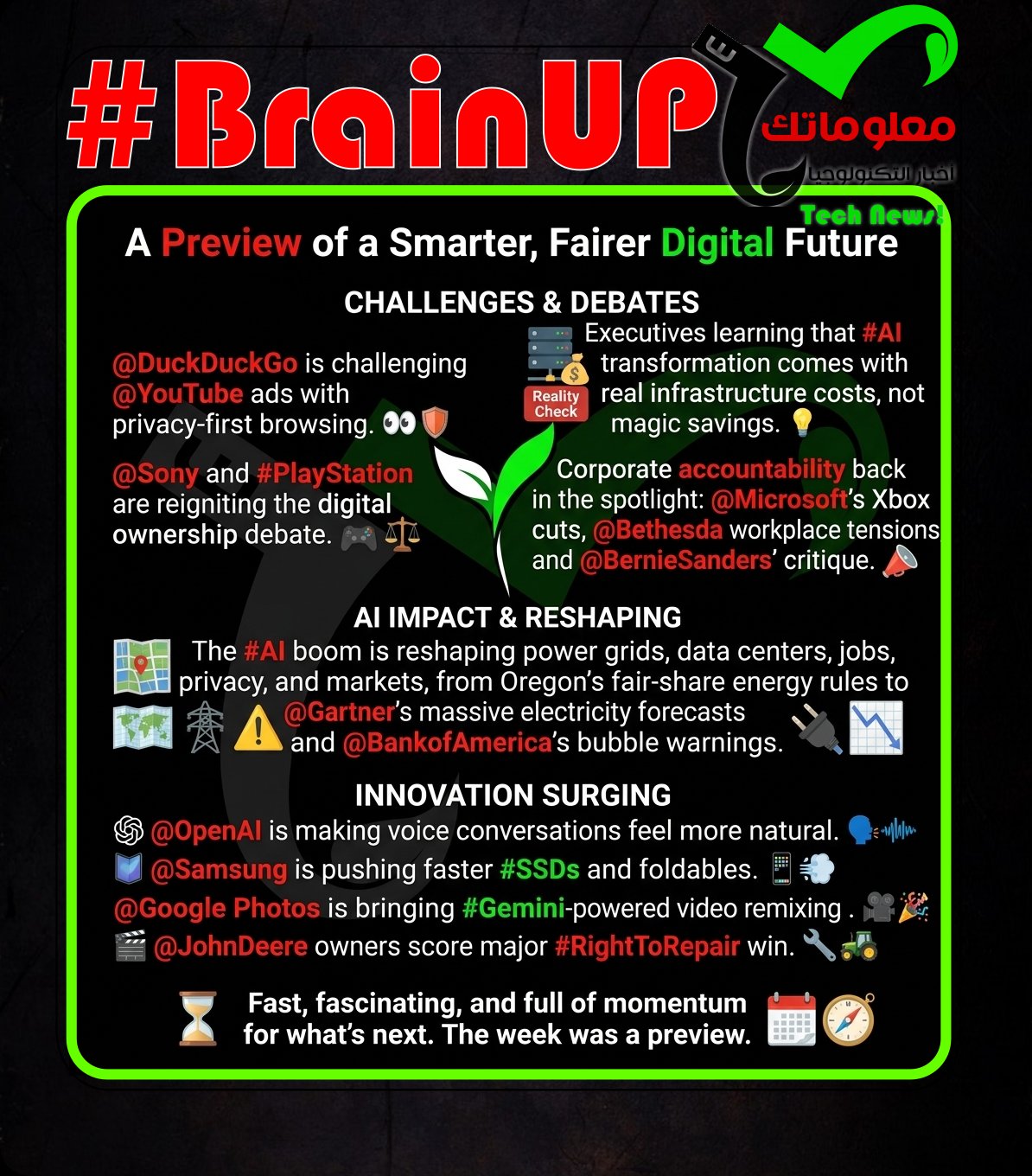
@DuckDuckGo says its free browser now blocks most #YouTube video ads, pitching an uninterrupted viewing experience without paying for Premium. In a July 8 post, the company claimed users can get the full YouTube experience minus the ads, with a new feature called #YouTubeAdBlocking that targets ads before and during videos and is enabled by default for most iPhone, Windows, and Mac users, with Android rolling out automatic enablement soon. The company notes a key limitation on mobile: if links open in the official YouTube app, the blocking will not work, so users must watch on the YouTube website inside the DuckDuckGo browser; it also distinguishes this from #DuckPlayer, which focuses on reduced tracking and a distraction free mode rather than the normal site. DuckDuckGo says the tool relies on community driven filter lists sourced from #uBlockOrigin plus its own rules, and it warns that ad blocking can cause extra buffering even if ads do not interrupt once playback starts. The move lands amid @YouTube’s broader crackdown on ad blockers, with YouTube stating ad blocking violates its Terms of Service and may lead to prompts to allow ads, subscribe to Premium, or blocked playback, while it also offers Premium and a cheaper Premium Lite tier.
2. PlayStation can delete all your digital games after 3 years of inactivity
#PlayStation is drawing backlash as it moves toward all-digital distribution and its European #terms of service allow closing inactive accounts, which would cut off access to purchased #digital games. The article cites Sony’s European terms stating that if an account has not been used for 36 months, PlayStation may initiate closure, notify the user by email, and give 6 months to log in or request the account remain open, after which closure is irreversible and removes access to PlayStation Online Services and digital products bought on that account. It notes enforcement is unclear, but anyone who has bought through the PlayStation Store has accepted these terms, raising concerns about digital ownership unless future EU legislation strengthens consumer rights. The piece contrasts this with physical discs, which are also licensed but are harder to revoke in practice if the full game is on the disc and does not require online activation. It also argues this policy is not simply tied to #GDPR, pointing to reporting that similar account deletion language dates back to at least 2009 and has evolved from 18 to 24 to 36 months, and adds that @Microsoft has similar account terms but says it will not delete accounts containing digital purchases.
A growing number of corporate executives are facing sticker shock as #AI costs rise under new usage-based pricing, undermining the belief that #LLMs could be rolled out cheaply to replace workers. A @KPMG survey of 2,145 senior executives across 20 countries found that 29% did not know where their AI-related cost increases were coming from, and about a third said their lack of understanding of AI economics hindered successful workplace deployment. The report notes that as usage-based models spread, many organizations still lack the capabilities to forecast, monitor, and manage AI spending, especially as higher computational costs push the sector away from subsidized, flat-rate contracts. The article argues this reveals widespread executive “plug-and-play” thinking about AI, while emphasizing that AI hype is also being used to discipline labor through surveillance, weakened bargaining power, and layoffs even if the tools remain error-prone. Overall, the piece frames escalating AI bills and unclear returns as making an “AI takeover” less likely at the current pace, even as companies may still pursue short-term overhead reductions that shift costs onto workers.
@Bernie Sanders criticized Microsoft’s Xbox layoffs and upcoming console price increases as evidence that #corporateTaxBreaks do not create jobs. He pointed to Microsoft’s profits, the tax break it received, and CEO @SatyaNadella’s pay, citing that the company made about $101 billion in profits, received a $12.5 billion tax break, then raised Xbox prices and cut 3,200 jobs. Microsoft said 3,200 Xbox staff will be eliminated this financial year, with 1,600 leaving immediately and more later, alongside the closure of four studios and another potentially being sold or shut down. The company also announced console price hikes effective August 1, attributing them to a “components crisis,” raising 512GB models by $100 and 1TB models by $150 while discontinuing the 2TB model. Microsoft’s own explanation framed the cuts as a reset for a struggling Xbox business with low margins and slower-than-expected growth for #GamePass and multi-platform efforts, linking Sanders’ critique to the tension between record corporate profits and cost-cutting in the gaming division.
@Bryan Johnson, the tech millionaire known for extreme #biohacking and featured in the Netflix documentary Don’t Die: The Man Who Wants to Live Forever, says he has been diagnosed with #autoimmune gastritis, an incurable condition he described as his stomach “eating itself.” He disclosed the diagnosis on Instagram, noted estimates that 2-5% of people have the disease, and said he plans to try to “solve” it and share what he learns. Johnson cited 11 years of low ferritin levels that did not improve even with iron tablets on a vegan diet, and said a colonoscopy, an upper endoscopy, and five stomach biopsies confirmed early autoimmune gastritis. He also linked his autoimmune issues to childhood diet and later stress, and mentioned he was diagnosed with autoimmune hypothyroidism at 21, while the article notes causes are not fully known and genetics and environmental triggers are believed to be major factors. Johnson argued that in an era of #AI, multiomics, and custom-built DNA, proteins, and cells, no condition should be presumed incurable, alongside describing his costly health regimen and past anti-aging experiments.
6. Sony CEO Sells Over Half His Stock Following PlayStation Disc Announcement
An SEC filing shows @Hiroki Totoki sold more than half of his #Sony stock shortly after PlayStation announced it would stop producing physical game discs in January 2028. On July 3, two days after the July 1 announcement, Totoki sold 225,000 shares at $21.02 each for about $4.7 million, reducing his stake by 56% to 173,250 shares, while Sony chief strategy officer @Toshimoto Mitomo also sold 25,000 shares at the same price for $525,500, about 18% of his holdings. The sales occurred as the stock saw a slight bump after the news, and as of publication shares were about $21.20, with the stock up 6% over eight days since the announcement. The decision to end disc production sparked industry backlash and a Change.org “Don’t Kill the Disc” petition that had over 216,000 signatures, but Sony had not addressed fan concerns at the time of writing.
7. Bethesda HR Forced Staff To Remove Small Memorial To Laid-Off Colleagues
After a new wave of #Xbox and @Microsoft layoffs hit multiple studios, staff at Bethesda Game Studios tried to honor colleagues who were let go by creating a small “Celebration of Service” memorial. The Bethesda Game Studios Union said a similar tribute was set up in Austin with photos of laid-off workers, and employees in Rockville, Maryland created their own display in a common area. The union claims Bethesda HR quickly required the Rockville memorial to be taken down, saying it could not remain in a common area, even though those spaces have been used for other team displays like fan works. Kotaku reports it contacted the union and #Xbox about the removal and the status of the Austin memorial. The article also notes that while #Xbox previously pledged not to oppose unionization, union members have complained the company has been slow-walking negotiations as teams seek contract protections such as safeguards around layoffs.
8. If You Thought SpaceX Stock Was Doing Badly Before, Now It’s Really Tanking
Shares of @Elon Musk’s SpaceX fell sharply a day after joining the Nasdaq-100, sliding to a record low a little above $145, below its $150 IPO opening price, and remaining down about 13% over five days and roughly 35% from its mid-June peak. The drop underscores investor concern about the gap between SpaceX’s nearly $2 trillion valuation and its lack of profits, with the company reportedly losing nearly $5 billion last year on more than $18.5 billion in revenue, and its merger with Musk’s xAI adding to worries about cash burn. The selloff occurred amid broader market pressure tied to renewed US-Iran tensions and oil sanctions that pushed crude prices higher, while rival @Jeff Bezos’ Blue Origin announced a $10 billion raise at a $130 billion valuation, though any direct impact on SpaceX’s shares was unclear. Despite the slide, some analysts stayed optimistic, including #MorganStanley initiating coverage with an Overweight rating and a $300 target and #DeutscheBank setting a $255 target, citing a potential advantage in deploying #AI infrastructure in space. Overall, the article frames SpaceX’s post-index-inclusion decline as driven by valuation and profitability doubts, compounded by macro headwinds even as bullish price targets persist.
Oregon regulators approved a new pricing structure that shifts more grid related costs onto very large electricity users such as data centers, reducing what households pay. Oregon’s Public Utility Commission unanimously approved @Portland General Electric raising rates for the large power consumer class by 29.7% while residential rates drop about 1.3%, applying the higher class to developments using more than 20 MW under the #POWER Act (#HB3546). Officials including PUC Chair @Letha Tawney and Governor @Tina Kotek said the goal is to ensure costs created by data centers are reflected in their bills, so upgrades needed to serve them do not raise prices for other customers. The article notes that public opposition to data centers is rising due to massive power use and utility investments to expand capacity, and contrasts Oregon’s enforceable law with @Donald Trump’s nonbinding calls for AI firms to “pay their own way.” By making large users cover the true costs of service, Oregon aims to protect working families and small businesses now and potentially ease backlash, though it remains unclear if other states will adopt similar policies.
10. Cheyenne suspends datacenter wastewater after rare bacterium traced to Meta’s AI site
Cheyenne, Wyoming suspended data center wastewater discharges after a rare bacterium, Cupriavidus gilardii, was traced to wastewater released during commissioning work at @Meta’s planned AI data center site. Cheyenne’s Board of Public Utilities says the organism was detected in late February during routine sampling, confirmed by the Wyoming Public Health Laboratory, and ultimately linked to wastewater from Goat Systems during a fill-and-flush operation that runs water through cooling pipes before sealing a #closed-loop cooling system. Officials said the bacterium did not enter the city’s drinking water, but it contaminated the reclaimed reuse-water network used for irrigation and may pose risks to elderly and immunocompromised people through direct exposure. In response, the city permanently terminated the industrial user’s discharge privileges, paused all data center fill-and-flush and closed-loop cooling wastewater discharges tied to city services, took the reuse system offline, and spent about two months draining and disinfecting the network and Prairie View Pond while temporarily switching irrigation to potable water. The incident is presented as an example of how even water-saving cooling approaches can still generate wastewater during commissioning, contributing to broader public concern about data center impacts.
11. Lawsuit: Man used Grok to make 7K sex images of stepdaughter, then shot himself
An amended proposed class action lawsuit alleges #Grok and its makers, #X and #xAI, enabled creation of #CSAM through “nudify” capabilities and then shielded child predators by obstructing law enforcement investigations. The complaint says a stepfather used Grok to generate about 7,000 sexually explicit images and videos of his stepdaughter from a single photo taken when she was 11, with xAI’s safety systems intervening only after a “gang rape” prompt triggered a CyberTip to @NCMEC. Even after that tip, the suit alleges xAI repeatedly refused to provide critical identifying data such as a user’s IP address, and that its report included only the original non-CSAM photo while omitting the AI-generated CSAM, stalling investigators for weeks until police obtained a warrant and seized devices. The plaintiffs’ lawyers cite an early-2026 @NCMEC finding that 90 percent of xAI CyberTipline reports were not actionable because xAI declined to include user information needed to locate perpetrators, framing this as a pattern that prioritizes profits over child safety. The lawsuit further alleges the stepfather trafficked the images online, later was arrested, and after release on bail shot himself, leaving the child plaintiff, identified as Jane Doe 4, with severe psychological harm including anxiety, depression, and suicidal thoughts.
12. Bank of America Warns That AI Investors Are in for a Nasty Reality Check
Bank of America warns that the stock rally driven by #AI-linked, high-multiple tech names is becoming dangerously speculative and could face a sharp valuation snapback. The note argues valuations have surged even as earnings remain subdued and heavy #data center spending for #AI has not yet translated, and may never translate, into sizable profits, widening the gap between market value and cash generation. As cited by Fortune, the S&P 500 is up about 9% this year and just had its best quarter since 2020, while @Russ Mould highlights the Shiller CAPE at roughly 41 versus 32.5 on Black Tuesday, suggesting historically stretched pricing. Recent late-June turbulence, including a major S&P sell-off that erased hundreds of billions in value and a sharp drop in @Elon Musk’s SpaceX shares, is presented by Capital Economics as evidence of excessive froth and doubts about rally sustainability. The article ties these signals to a potential #AI bubble dynamic, noting that despite volatility, bullish broker targets from @Morgan Stanley and @Goldman Sachs show investor optimism remains high.
13. A Michigan Couple Says a Nearby AI Data Center’s Constant Hum Is Ruining Their Home
Billy and Marjorie Finn in Dowagiac, Michigan say a nearby #AI data center’s constant, high pitched mechanical hum is degrading their quality of life at home. They live across from Hyperscale Data’s 30 megawatt facility, and Billy Finn says his own measurements show the noise rising from about 52 decibels in 2022 to over 60 today, with occasional higher spikes, while Marjorie says the sound follows her even at bedtime and has diminished simple routines like sitting on the porch and hosting family. Two neighbors are suing Hyperscale Data, alleging the noise invades their homes and that the company failed to install adequate sound barriers, and although the Finns did not join, they share similar concerns; an audiologist cited by MLive said sustained noise at these levels likely will not damage hearing but can increase stress and contribute to health problems. The problem may intensify because the facility is planning to expand from 30 megawatts to many hundreds more. VICE frames the Finns’ experience as part of a broader pattern as #data centers proliferate nationwide, prompting complaints and lawsuits in places like New Jersey and Massachusetts because local noise rules and neighborhoods were not designed for round the clock industrial sound.
14. North America Drove Nearly Half Of Global Emissions Growth In 2025
North America has driven nearly half of the global growth in carbon emissions in 2025, highlighting its significant role in climate change. Data reveals that increased fossil fuel consumption in the region, particularly in the United States, contributed substantially to rising emissions despite global efforts to curb them. This growth is attributed to factors such as higher energy demand and slower adoption of clean energy technologies compared to other regions. The trend undermines international commitments to emissions reduction and underscores the need for stronger climate policies in North America. Addressing this issue is critical for achieving global climate targets and advancing sustainable energy transitions worldwide.
15. John Deere owners will get the right to repair their own equipment under a new FTC settlement
The @Federal Trade Commission and several state attorneys general reached a #right to repair settlement with Deere & Co., known as @John Deere, aimed at letting equipment owners fix their own machines. The article says John Deere owners should soon feel free to repair their equipment under this agreement. The settlement is presented as a legal and regulatory action led by the FTC and states to secure repair rights for customers. It links the outcome directly to the broader #right to repair push in agriculture equipment, indicating a shift toward owner-performed repairs. As a result, the piece frames the settlement as expanding practical repair freedom for John Deere owners.
16. Victims of 23andMe data breach to get $47m payout, judge rules
Victims of 23andMe’s 2023 #dataBreach are set to receive $46.75m (£35m) after a California bankruptcy court judge ruled that Chrome Holding, which took control of the company following its bankruptcy, must fund the settlement. The hack exposed highly personal #geneticData, after attackers accessed about 14,000 user accounts and then used those connections to view relatives’ profiles, contributing to an overall breach affecting up to 6.9 million people. The order directs the money to be paid first to Kroll Restructuring, which represents victims in the bankruptcy process, then distributed to affected individuals, though the number of recipients was not specified. The incident triggered regulatory action, including a £2.31m fine from the UK ICO for inadequate security measures, and a lawsuit by @Rob Bonta alleging the company failed to take basic protective steps and misled consumers about the breach’s severity. The ruling ties compensation to 23andMe’s bankruptcy-era restructuring and ownership changes, including the sale of assets to TTAM Research Institute linked to co-founder Anne Wojcicki, while the company continues selling DNA testing kits.
17. Judge rejects Kalshi attempt to override New York state gambling laws
A federal judge ruled that New York can enforce its state gambling laws against prediction market operator Kalshi, rejecting Kalshi’s bid to block enforcement while the case proceeds. US District Judge @Analisa Torres held that Kalshi’s registration with the #CFTC as a designated contract market under the #Commodity Exchange Act does not broadly preempt state regulation, and that New York’s gaming rules can “complement rather than conflict” with federal law even though the CFTC has not moved to restrict Kalshi’s sports-event contracts. The dispute stems from an October 2025 cease-and-desist order from the New York State Gaming Commission directing Kalshi to stop offering what the state described as an unlicensed mobile sports wagering platform tied to sports events, after Kalshi began listing such contracts in January 2025. New York officials, including @Kathy Hochul and @Letitia James, argued the laws protect consumers and prevent harms from unsupervised sports gambling, including impacts on younger adults and prohibitions involving New York-based college teams. The decision denies a preliminary injunction, allowing New York to continue enforcement while litigation continues, and Kalshi has appealed to the US Court of Appeals for the 2nd Circuit.
18. Samsung starts mass production of world’s fastest 8TB and 16TB SSDs ever
Samsung has announced the start of mass production for its new 8TB and 16TB SSDs, which are touted as the fastest in the world. These #SSDs leverage the PCIe 5.0 interface, offering a sequential read speed of up to 13,000 MB/s, significantly surpassing previous generation drives. The products target data centers and high-performance computing markets, addressing the growing demand for faster storage solutions. By integrating advanced technology and higher capacity, Samsung aims to boost efficiency and performance for enterprise storage needs. This development highlights Samsung’s commitment to innovation in #storage technology and paves the way for more rapid data management.
Valve has published a Steam Hardware, Windows Resources page to make it easier for users to install Windows 11 on Steam Deck LCD, Steam Deck OLED, and Steam Machine hardware, while explicitly refusing to provide #Windows support on those devices. The page offers device-specific Windows drivers for components like the APU, graphics, SD card reader, Wi-Fi, Bluetooth, and audio, and @Valve says the resources are provided “as is,” directing users to SteamOS recovery instructions if they need to revert. The move helps users who feel constrained by #SteamOS, especially because some anti-cheat software is still not compatible with Linux-based SteamOS, making Windows the practical option for certain games. The article notes Valve is working to broaden SteamOS compatibility for more general hardware, including Intel and Nvidia systems, and is also working on #dual-boot but has not provided a timeline. Overall, Valve is enabling Windows installation through official drivers and notes, but keeps responsibility on users rather than offering official Windows-on-Steam-Hardware support.
20. Gartner: Data center electricity consumption to grow 26% in 2026
According to @Gartner, global data center electricity use is projected to rise sharply in 2026, driven largely by #GenAI and the rapid adoption of #AI-optimized servers. Consumption is forecast to reach 565 TWh in 2026, up 26% from 447 TWh in 2025, while worldwide data center power demand is expected to climb to 133 GW in 2026 from 105 GW in 2025 and potentially reach 291 GW by 2030, with estimates factoring in supply shortages, project delays, and geopolitical disruptions. @Linglan Wang says AI-optimized servers will account for 31% of data center power consumption in 2026 and surpass conventional servers in 2027, contrasting with conventional server power growth of about 1% to 3% versus AI-optimized server power jumping from 95 TWh in 2025 to 175 TWh in 2026 and 258 TWh in 2027. In the US, data centers are projected to consume 204 TWh in 2026, with dedicated AI data centers using 68 TWh, about one-third, highlighting how power availability is becoming a limiting factor and a competitive battleground. With total data center electricity use estimated to exceed 1,200 TWh by 2030 and grid supply expected to be insufficient, the article links the outlook to a call for efficiency upgrades, secured grid access, high-efficiency cooling, and #edge-computing to sustain scalable growth.
21. EU requires all new cars to have cameras facing the driver’s face to monitor their behavior
Starting July 7, 2026, all new cars sold in the EU must include a driver-facing infrared camera as part of the EU’s #GeneralSafetyRegulation, requiring #AdvancedDriverDistractionWarning (#ADDW) systems to detect distraction or fatigue and issue alerts when a driver looks away too long. EU authorities say the cameras will not collect biometric data and that information will be stored in the car, but reporting notes a lack of clarity on enforcement and what happens if rules are broken. Critics and users argue the measure risks expanding surveillance, could enable data collection and sale, and cite past instances of car manufacturers violating consumer privacy. The European Commission also promoted other mandated safety features such as advanced emergency braking, improved forward visibility, tire wear testing, and expanded safety glass areas, but the announcement sparked debate about whether the technology improves safety versus undermines privacy. The controversy reflects a broader tension between #roadSafety technology and concerns over privacy and surveillance in connected vehicles.
22. AI Could Be Pushing Older Employees Out of Their Jobs, New Brief Finds
A new brief from the Center for Retirement Research at Boston College suggests #AI may be accelerating workforce exits for older workers in jobs most exposed to it after #ChatGPT launched. Using Census employment data for workers 55 and older and estimates of each occupation’s AI exposure, @Geoffrey Sanzenbacher found older workers in high exposure roles were about 25% more likely to be out of work after ChatGPT’s launch than before, with computer programmers showing the biggest increase, while low exposure jobs like painting saw almost no change. The brief argues this pattern differs from earlier automation because the impact may be largest in higher paying roles. Even so, it notes that AI exposed jobs such as data scientists and web developers still tend to be associated with longer careers overall because they are better paid and less physically demanding. The findings link rising post ChatGPT exits to AI exposure while emphasizing that these jobs may persist and continue to have lower overall transitions out of work than less exposed occupations.
China’s National Vulnerability Database (#NVDB) alleges that #ClaudeCode, @Anthropic’s AI coding tool, contains “security backdoor vulnerabilities” and urged users to uninstall it or update to the latest version. Citing the @WallStreetJournal, the notice claims versions released between April and June 2026 could send sensitive information such as user location and identity to remote servers without consent via a built-in monitoring mechanism, even though the tool is not approved for public use in China and @Anthropic restricts its tools there. The alert follows developer Troye Sivan’s report that Claude Code was covertly sending data like time zone and domains, particularly affecting Chinese users, and Anthropic engineer Thariq Shihipar said on X it was a June experiment to curb unauthorized reseller abuse and prevent distillation, slated to be rolled back in the next release. The article links the monitoring to Anthropic’s claims that Chinese AI labs have distilled Claude and to reports of grey-market reselling of Claude API access through proxy networks. It adds that the tracking may become visible and integrated rather than hidden, which could explain the update recommendation, while Beijing’s guidance implicitly acknowledges that Chinese developers are still accessing the tool despite regulatory review requirements.
24. This factory was severely short on workers. Then it offered flexible work
A GE Appliances owned plant in LaFayette, Georgia, eased severe labor shortages by introducing a flexible, app-based system that lets some blue-collar workers choose when and what kind of shifts they work. During the COVID-19 pandemic the factory was flooded with appliance orders but was sometimes hundreds of workers short as employees stayed home or quit, forcing salaried staff to fill in on priority lines. The plant partnered with staffing firm #MyWorkChoice, which recruits and vets a pool of workers who are trained for multiple roles and use an app to sign up for four-hour shifts, with workers remaining employees of the firm. One participant, 68-year-old Ruth Ransom, says the ability to work part time and select less physically demanding tasks like quality control made the job attractive. The arrangement reflects a broader shift as U.S. manufacturers, including Stanley Black & Decker and Georgia-Pacific, experiment with flexible schedules to attract people who do not want a traditional 40-hour manufacturing job.
25. Former GitHub CEO launches competitor designed for the age of vibe coding
Former @GitHub CEO @Thomas Dohmke has launched Entire, a new Git hosting network positioned to serve #AI coding agents and relieve infrastructure strain that centralized platforms like #GitHub are experiencing as agent traffic grows. Entire.io currently lets approved users in the US, EU, and Australia mirror public or private GitHub repositories into a parallel hosting environment so agents can work there without consuming resources needed for deployment, and it also supports Entire native branches. The offering pairs with the Entire CLI, a Git integrated tool that records agent sessions with prompts, responses, file changes, and context to support agent auditing, explaining not just what changed but why. Entire argues the underlying #Git decentralization has always existed but was overridden in practice by centralized hosting, and it markets its network as scalable, low latency, regionally controllable, and better at handling high concurrency from agents. Positioning itself against agent friendly challengers like SpaceX’s @Cursor Origin, Entire cites throughput claims of 2.1 million pushes per hour and 570,000 clones per hour, hinting at a business model spanning hosting, auditing, and eventual monetization of agent related data exhaust.
26. OpenAI releases new voice models for more natural live conversations | TechCrunch
@OpenAI released new conversational voice models, GPT-Live-1 and GPT-Live-1 mini, to make #ChatGPT voice interactions sound more natural and handle turn-taking better through full-duplex speech that can talk and listen simultaneously. The company is replacing its Advanced Voice Mode with GPT-Live-1 mini by default, while paid users can access the larger GPT-Live-1, and the system can route queries to newer text models like #GPT-5.5 for search, reasoning, and agentic capabilities while continuing the conversation, including staying silent to absorb context and sometimes presenting information visually. OpenAI says the redesign addresses past issues such as interrupting users and limited ability to answer questions, and it is aimed at enabling longer, hands-free conversations, with its voice product lead @AttyEleti describing 30 to 40 minute sessions and positioning voice as a future primary interface for complex work. The company reported over 150 million people use Voice and Dictation, noted competition from @Apple, @Amazon, and startups like Sesame, and emphasized it is not trying to build an AI companion while adding safeguards for teens and self-harm related topics. In a demo, live translation to Hindi showed limitations, including a heavy American accent and unnatural, bookish Hindi, and OpenAI said the mode is optimized for most spoken languages without specifying which.
27. Samsung Galaxy Z Fold8, Fold8 Ultra, Flip8, Watch9, and Watch Ultra2 renders leak
Ahead of Samsung’s July 22 Unpacked event in London, a leak claims to reveal official-looking renders and key rumored specs for the Galaxy Z Fold8, Z Fold8 Ultra, Z Flip8, Galaxy Watch9, and Galaxy Watch Ultra2. The Galaxy Z Fold8 is said to come in Cream, Graphite, and Lavender plus a Samsung online store exclusive Pistachio, with a 5.5-inch cover screen, 7.6-inch 4:3 main display, about 200g weight, 4.5mm unfolded and 9.7mm folded thickness, #Snapdragon 8 Elite Gen 5, 12GB RAM, up to 1TB storage, and a 4,800 mAh battery. The Z Fold8 Ultra, positioned as a successor to the Z Fold7, is rumored to have a similar design, the same chipset and memory tiers, a 5,000 mAh battery with 45W wired charging, and cameras listed as 200MP main, 10MP 3x telephoto, and 50MP ultrawide, with colors including white, black, purple, and an online-only green. The Z Flip8 reportedly resembles the Flip7, offers Cream, Graphite, and Pink plus a possibly online-only Mint, uses the Exynos 2600 in some markets, weighs about 180g, has a 4,300 mAh battery, and may keep the same cameras and displays as its predecessor. The Watch Ultra2 is said to come only in 47mm, while the Watch9 is listed in 40mm and 44mm with Cream, Graphite, and Green, and the latest leaks also claim all these devices will cost more than their predecessors.
28. New Study Says Parents’ Phone Use Might Be Giving Kids Attachment Issues Later On
A study suggests that when teens perceive their parents as frequently distracted by phones, they report more signs of #insecure attachment that may persist into adolescence. Researchers surveyed 600 youths ages 12 to 17 recruited via Qualtrics and found a correlation between higher scores on their Device Attachment Interference Scale (DAIS), measuring perceptions that a caregiver’s device use harms attentional availability and the relationship, and higher scores on a standard teen attachment measure. Teens who described parents as phone-distracted scored higher on both avoidant and anxious attachment patterns described in #attachment theory. The authors emphasize the results are correlational and cannot show that parental phone use causes insecurity, since it is also plausible that insecure teens are more likely to notice or resent parents’ device use. One author, media psychologist @Don Grant, framed the finding in the context of concerns about social media’s psychological pull, noting parents may also be vulnerable to these manipulations.
29. Apple’s iPhone Ultra will be double the price of the iPhone 17 Pro Max, report claims
Analyst @Ming-Chi Kuo claims @Apple’s first foldable iPhone, widely expected to be called the iPhone Ultra, will be expensive, slightly delayed after announcement, and still face strong demand. He predicts a price of roughly $2,300 to $2,500, about twice the cost of the iPhone 17 Pro Max, and says it will be unveiled in September alongside the iPhone 18 Pro and Pro Max but begin shipping around a month later, similar to the iPhone X rollout. Kuo expects sales to remain strong at least through the end of 2026, with the device potentially selling out immediately after preorders and delivery lead times stretching to 4 to 6 weeks or longer through December. The article notes conflicting reports about whether the Ultra will be late, but says most now agree on a September unveiling, and adds that @Apple recently raised prices on some products due to a memory chip supply crunch while leaving iPhone pricing unchanged. Overall, the report frames the iPhone Ultra as a high-priced #foldable iPhone that could be hard to get quickly despite its cost.
30. Google Photos adds a new AI ‘Video Remix’ tool | TechCrunch
#Google Photos is adding an AI-powered “Video Remix” feature that can edit and transform videos in seconds, expanding Google’s generative video tools inside its consumer apps. Powered by #Gemini Omni, the tool lives in the app’s “Create” tab and can apply cinematic relighting, replace backgrounds, and add artistic styles like watercolor, raw sketchbook, and oil painting, with examples including making footage look like it was shot in a greenhouse or relit with a morning glow. Google positions it as a way to create share-worthy clips in a few taps without professional editing skills, reducing reliance on dedicated software and helping keep users within Google’s ecosystem amid competition from @Apple, @OpenAI, and @Adobe. Video Remix begins rolling out to eligible Google AI Plus, Pro, and Ultra subscribers across multiple countries including the U.S., India, Japan, and others, and it follows recent AI updates to Photos such as touch-up tools and a digital closet feature for outfit ideas and virtual try-on.
That’s all for today’s digest for 2026/07/09! We picked, and processed 30 Articles. Stay tuned for tomorrow’s collection of insights and discoveries.
Thanks, Patricia Zougheib and Dr Badawi, for curating the links
See you in the next one! 🚀
