
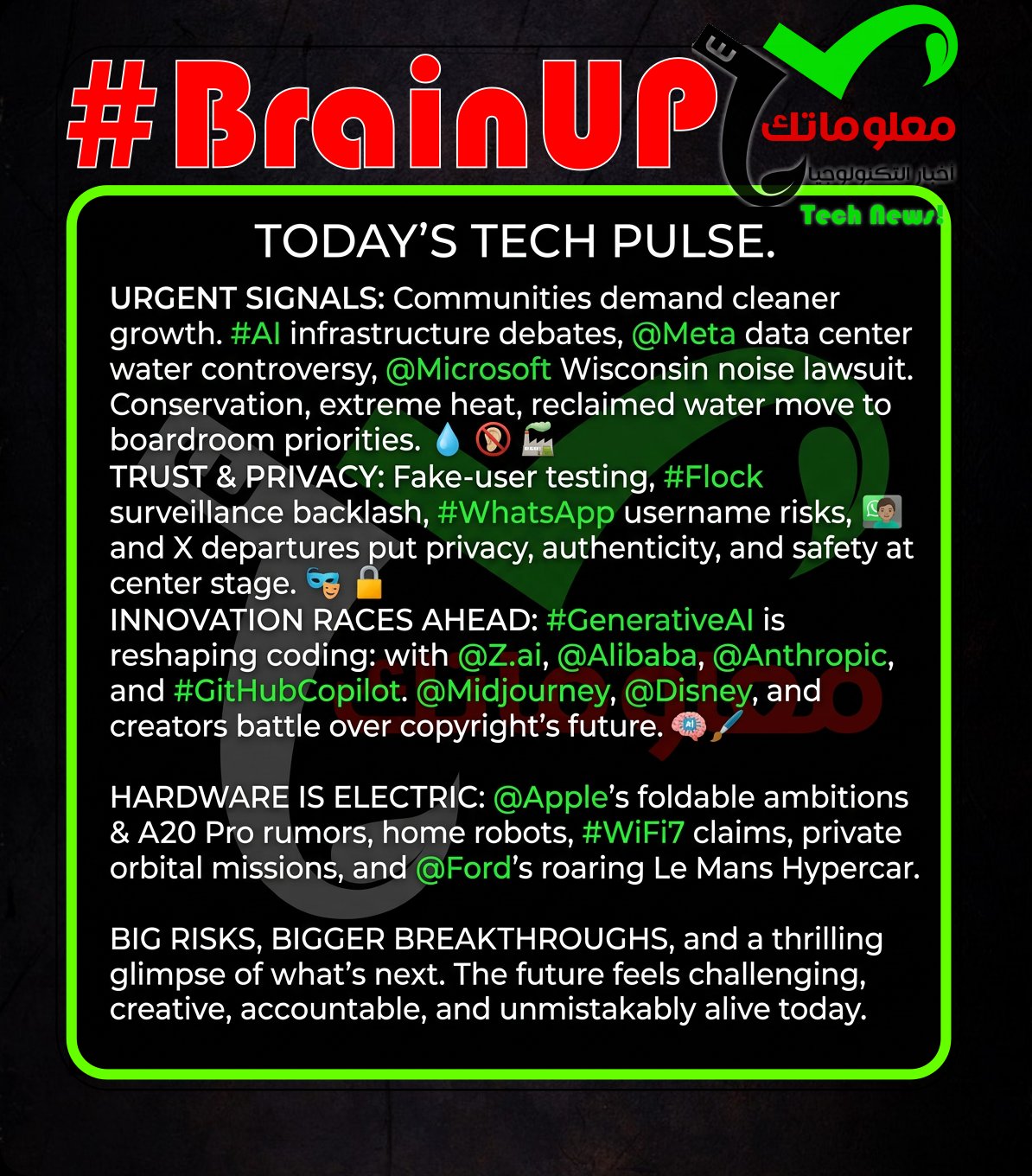
#BrainUp Daily Tech News – (Sunday, July 5ᵗʰ)
Welcome to today’s curated collection of interesting links and insights for 2026/07/05. Our Hand-picked, AI-optimized system has processed and summarized 26 articles from all over the internet to bring you the latest technology news.
As previously aired🔴LIVE on Clubhouse, Chatter Social, Instagram, Twitch, X, YouTube, and TikTok.
Also available as a #Podcast on Apple 📻, Spotify🛜, Anghami, and Amazon🎧 or anywhere else you listen to podcasts.
Cheyenne’s Board of Public Utilities suspended acceptance of industrial wastewater from data center #fill-and-flush and #closed-loop cooling discharges after tracing contamination in the city’s reclaimed water system to Goat Systems LLC, a contractor building @Meta’s Cheyenne campus. The Board said Goat Systems was in significant noncompliance for sending flush water containing Cupriavidus gilardii, a metal-resistant bacterium, into the sanitary sewer, which disrupted two reclamation plants and forced the reuse system offline for months of cleanup; the contractor’s fill-and-flush discharge privileges were revoked March 24 and the suspension was expanded to cover every data center connected to city services. Officials noted the bacterium is not normally tested for and is not a regulated contaminant, but the event triggered pass-through and interference findings under city code and federal pretreatment rules, and the Board also raised concerns that closed-loop systems can carry glycol and other chemicals municipal plants are not designed to treat. The city uses reclaimed water for irrigating parks and golf courses, and the Board worried the bacterium could pose an aerosol risk during irrigation, underscoring that “near-zero-water” closed-loop cooling still produces a discharge during initial filling and flushing. @Meta said it is supporting its general contractor Fortis, which stopped discharging and began hauling wastewater offsite, independent testing found no trace of the substance, and after facilities tested clear in late June the reuse system returned online, while impacts on other Cheyenne data centers under construction remain unspecified.
2. White House deletes thousands of web pages about energy conservation as heatwave slams US
The US Department of Energy reportedly deleted about 6,000 web pages related to #energyConservation during a historic #heatwave, shortly after Republicans attacked @Zohran Mamdani for urging New Yorkers to set air conditioners to 78 degrees to reduce strain on the grid. The article notes that setting thermostats between 75 and 78 degrees had been official DOE guidance, and similar advice has been issued by Republican governors in states like Texas, including @GregAbbott, while figures like @TedCruz, @NikkiHaley, and @NancyMace framed Mamdani’s request as socialism and other inflammatory claims. The deletions were described as broad, removing not only thermostat guidance but also information on #waterConservation, insulation types, and the DOE’s solar decathlon challenge, though the #InternetArchive preserved the lost pages. With New York City seeing four straight days above 95 degrees, including two above 100, the piece argues that conservation guidance can help prevent blackouts that would leave people without air conditioning, and it cites CDC and NOAA data that extreme heat kills more Americans on average than floods, tornadoes, and hurricanes combined.
3. Meta Paid Hundreds of Contractors to Pretend to Be Real Users
Meta hired hundreds of contractors to impersonate real users on its platform to test and improve its services. This strategy involved creating fake profiles and interacting as genuine users to simulate authentic user experiences. The contractors’ activities helped Meta identify issues and optimize features before launching them broadly. However, this approach raised ethical questions about transparency and the authenticity of user engagement on social media. Meta’s use of such tactics highlights the tech giant’s efforts to maintain competitive advantage through #userexperience simulations.
A Virginia-based US Air Force engineer, Jeffrey Sovern, is facing criminal charges after allegedly destroying #Flock license plate surveillance cameras, while drawing substantial public financial support for his legal defense. Local reporting cited in the article says he faces 13 counts of destruction of property, plus six counts each of petit larceny and possession of burglary tools tied to the damage of the #ALPR network. The article situates the case within a broader backlash against AI-powered camera systems that are promoted as crime-fighting tools but criticized for #privacy and social policy harms as they expand across the country. In his GoFundMe statements, Sovern frames his actions as defending rights under the Fourth Amendment and urges supporters to pressure local governments to remove the systems, saying the publicity has hurt his mental health but generated encouragement. His fundraiser, launched in late December 2025 with an $8,500 goal, had reached $15,440 from more than 400 donors at the time of writing, reflecting growing organized and direct-action opposition to these surveillance poles.
5. Wisconsin residents sue Microsoft over noise caused by new data center
Residents near #Microsoft’s Fairwater #dataCenter in Mount Pleasant, Wisconsin, have filed a class-action lawsuit alleging the facility creates unreasonable, excessive noise that constitutes private nuisance and negligence. The suit, brought by three Sturtevant residents in federal court, cites complaints submitted to the Wisconsin Department of Natural Resources and claims the noise comes from diesel generators and #HVAC equipment such as chillers, cooling towers, and fans, and that it is consistent and pervasive. Plaintiffs argue #Microsoft failed to install adequate acoustic barriers or shielding to prevent offsite noise and are seeking unspecified damages, while also noting broader community concerns tied to the national expansion of data centers for #AI, including air pollution, water use, and energy costs. #Microsoft said it is aware of the lawsuit and aims to be a good neighbor, and local officials said they have not received noise complaints since mid-April changes addressing a humming sound traced to cooling fans, which the company said it later fixed. The dispute highlights escalating friction between rapid #dataCenter buildouts and nearby communities over operational impacts.
6. 71% of gamers still want physical games
A Windows Central poll and comment discussion show strong resistance to @PlayStation moving away from physical game discs as the industry trends toward a #digital-only future. Out of 1,577 votes, 71% said they will miss buying physical games, while 13% said they are happy to embrace fully digital, and commenters repeatedly raised worries about ownership, game preservation, rising costs in digital storefronts, and the desire for optional disc drives. Several readers argued that removing disc drives does not clearly solve a consumer problem and instead signals corporations prioritizing themselves, and others suggested business incentives like steering purchases to the PlayStation Store where Sony takes a reported 30% cut. The discussion also reflected distrust of digital licensing, with commenters warning that access rights can be revoked, and it referenced @Xbox efforts such as Project Helix dropping disc drives and a disc-to-digital approach as possible ways to preserve existing libraries. Overall, readers frame physical media as a safeguard for ownership and long-term access, and view an all-digital shift as risky unless platforms offer meaningful preservation options.
7. TrumpCoin Crypto Faces Backlash as Investors Report Significant Losses
TrumpCoin, a #cryptocurrency linked to former President @DonaldTrump, has caused substantial financial losses for many investors. Despite aggressive marketing and high-profile endorsements, the coin’s value plummeted unexpectedly, leading to widespread dissatisfaction. This downturn highlights the volatility and risks associated with politically branded cryptocurrencies, which often lack sufficient regulatory oversight. The incident raises concerns about the intersection of #politics and digital currencies, urging potential investors to exercise caution. This case underscores the importance of due diligence before engaging with politically motivated financial products.
8. Number of billionaires globally soars by 13% amid AI shares boom
The global number of billionaires rose 13% to a record 3,302 as their wealth accelerated, helped by a stock market boom linked to #AI. UBS found billionaires’ wealth grew 25% on average in the year to April, versus a 10.8% rise in average personal wealth worldwide, and counted 18 people worth $50bn to $100bn and 19 worth more than $100bn, including 15 based in the US. UBS economist James Mazeau said most billionaire wealth is tied to listed companies, so rising equity markets, fueled by the #AI boom, lifted fortunes, while the global millionaire population also grew to more than 57.5 million, aided by stock gains and a weaker US dollar. The widening gap between rich and poor is highlighted by the World Inequality Report’s finding that fewer than 60,000 people control three times as much wealth as the bottom half of humanity, prompting calls to raise taxes on the super-rich over concerns about political influence. The article also notes @Elon Musk is listed by Forbes as the richest person with a net worth of $1tn, and discusses UK-specific trends including a fall in UK-based billionaires and debate over whether wealthy people are leaving after the end of the #non-dom tax regime.
9. Wicklow hotel cancels ‘secretive’ Peter Thiel group conference
The Powerscourt Hotel Resort and Spa in Co Wicklow has cancelled bookings for an August, invitation-only “retreat” hosted by Dialog, a group cofounded by @Peter Thiel and @Auren Hoffman. The event was reported to be attended by a senior Nato commander and Trump administration officials, and a leaked schedule listed topics such as preparations for a third world war, battlefield technologies, nuclear energy and cult-building. The cancellation followed criticism from Opposition parties and a campaign by pro-Palestine groups citing Palantir’s links to the Israel Defense Forces, with Powerscourt Estate saying it was “relieved and pleased” the event had been cancelled. Campaigners including Drop Dialogue and the Ireland Palestine Solidarity Campaign framed the decision as a result of public mobilisation and said protests would resume if the conference is moved to another Irish venue. The episode underscores growing scrutiny of hosting #invite-only conferences linked to controversial defence and surveillance interests in Ireland.
10. UK culture minister quits X over ‘abuse and misinformation’
@Lisa Nandy, the UK culture secretary, quit X and said the Department for Culture, Media and Sport will also stop using the platform, arguing it prioritises “abuse and misinformation” over meaningful debate and is unhealthy for democracy and communities. She said she will remain active on Facebook, Instagram and LinkedIn, while X offered no immediate comment. The DCMS becomes the second UK government department to leave X after the Attorney General’s Office, which cited racism and misogyny as reasons for stopping posts. Critics have accused @Elon Musk of weakening safeguards since buying Twitter in 2022 and rebranding it as X, contributing to extremist content and a toxic, divisive culture that has prompted withdrawals by outlets and organisations. The move comes amid heightened UK scrutiny of X, including an #Ofcom investigation into whether its #Grok AI chatbot was used to create and share illegal nonconsensual intimate images, and broader debate over UK regulation such as the #OnlineSafetyAct and proposed under-16 social media restrictions.
Australian musicians urge @Anthony Albanese not to accept any deal that weakens #copyright protections to benefit #AI companies. The article describes a proposal in which international tech firms would invest more than $50bn in datacentres and create a $350m compensation fund in exchange for looser rules allowing them to scrape Australian creative output for #AI model training, which @David Pocock calls the “ultimate dirty deal”. Although the Albanese government says it has no plans to weaken protections and previously ruled out a text and data mining exemption, artists say their work is already being scraped and warn the policy would disadvantage creators. @Bernard Fanning of @Powderfinger says scraping feels like a violation, argues humans should tell Australia’s stories rather than “data aggregations”, and calls for at least a secure legal right to opt out. Framing the plea around Albanese’s well known love of Australian music, the musicians ask him to back artists and national cultural identity by resisting any dilution of copyright rights.
12. Excel on Web is Booming, But Google Sheets is Still Popular After Years of Microsoft’s Dominance
Microsoft Excel on the web has experienced significant growth recently, overcoming years of Google’s dominance in the online spreadsheet market. Data shows increasing adoption of Excel for the web, driven by enhanced features and seamless integration with Microsoft 365 services, positioning it as a competitive alternative to #GoogleSheets. Despite this surge, Google Sheets retains substantial popularity due to its accessibility and widespread use in collaborative environments. This dynamic reflects a shifting landscape where Microsoft’s continued investment in cloud and web versions improves Excel’s appeal, challenging Google’s stronghold. The trend indicates growing user preference for powerful, cloud-based spreadsheet solutions from both @Microsoft and Google, emphasizing competition and innovation in productivity tools.
13. Tesla caps employee AI spending at $200/week except for Grok
@Tesla will impose a $200 per week cap on employee #AI spending starting July 6, after internal efforts to boost usage led some engineers to burn thousands of dollars in tokens each week. An internal memo reported by The Information says employees will need approval to exceed the limit, but the tally excludes beta versions of #xAI products, effectively carving out an exception for #Grok and related tools. The shift follows months in which Tesla centralized AI use with approved models, formal security policies, and even dashboards ranking token consumption, and it mirrors similar corporate cost controls at @Uber, @Meta, @Amazon, and @Walmart as token billing makes prompt costs explicit. The article argues the exemption steers heavy usage toward @ElonMusk’s other company even as Grok is reportedly unpopular inside Tesla compared with Anthropic’s Claude, and despite prior issues like a limited in-car integration and Musk’s admission that xAI was “not built right” after a $2B Tesla investment. The policy arrives as Tesla frames AI as central to its future, including Robotaxi and Optimus plans, and rolls out internal tools like Nova to standardize and support operations.
14. Midjourney wants Hollywood studios to reveal the details of their AI usage | TechCrunch
@Midjourney is asking a court to force @Disney, @Universal, and @WarnerBros to disclose more details about their own #generativeAI practices as part of ongoing copyright lawsuits against the startup. The studios allege #copyrightinfringement, arguing Midjourney’s image models can generate studio-owned characters like Bart Simpson and Darth Vader, while Midjourney says training on copyrighted images is allowed under #fairuse. The fight now centers on #discovery: a judge required disclosure of the studios’ generative AI use only when it produced consumer-facing videos or images, and Midjourney is seeking to remove that limitation. Midjourney argues broader records could show the studios themselves train or develop image-generating AI for internal uses like storyboarding or ideation, and it also wants all prompts and outputs the studios generated in Midjourney, not only those tied to alleged infringement. The studios’ attorney @DavidSinger has characterized the request as a fishing expedition and said the goal is not to stop AI or shut down Midjourney, but to stop unauthorized copying and distribution of the studios’ famous characters.
15. A $7,999 home robot joins the race to automate household chores
Y Combinator-backed Weave Robotics has unveiled Isaac 1, a home robot positioned as an affordable entrant in the push to automate #household_chores. The company says Isaac 1 can fold laundry, make beds, and tidy homes, operating autonomously by default with remote human #teleoperation available if it gets stuck, and it is offered for preorder at $7,999 upfront or $449 per month, with first shipments planned for fall 2026. Online buzz has been strong, with Weave’s launch post on X drawing millions of views, while commenters compared the device to a “Roomba with arms” and criticized it as slow and clunky. The pricing undercuts rivals like 1X’s $20,000 Neo, as the market remains early with no humanoid home robot deployed at scale and @Elon_Musk indicating Tesla’s Optimus production could start in late July or August for chores and other tasks. Weave notes it uses personal information to improve services, but it is unclear whether in-home data is used to train the robot, highlighting broader difficulty in training robots for the physical world compared with internet-trained chatbots.
16. Alibaba reportedly bans employees from using Claude Code | TechCrunch
China’s @Alibaba will reportedly ban employees from using @Anthropic’s #Claude Code starting July 10, after classifying it as high-risk software. The move comes as @Anthropic already prohibits Chinese companies and their foreign-owned entities from using its models and has been trying to close access loopholes, including a reported Claude Code version that could secretly identify Chinese users. @Anthropic’s Thariq Shihipar said on X that this identification was an experiment launched in March to prevent account abuse by unauthorized resellers and protect against #distillation, and that stronger mitigations have since been implemented and the team intended to remove it. In response, Alibaba is reportedly directing staff to use its own #Qoder tool instead, reflecting rising scrutiny and restrictions around AI developer tools and cross-border model access.
17. Private space pilots are flying orbital missions for the US Space Force | TechCrunch
The @U.S. Space Force is turning to private companies to scale up #rendezvous and proximity operations for rapid, close inspection of satellites amid growing concern about novel space weapons from the U.S., Russia, and China. In the exercise Victus Haze, #RocketLab launched its Puma spacecraft just 16 hours and 42 minutes after notice, while True Anomaly’s Jackal used onboard sensors to detect and identify Puma from 2,000 kilometers away, then flew to a classified-close distance to orbit it and capture imagery before returning to its original orbit. True Anomaly CEO @Even Rogers said current collection capabilities have gaps, and described the demo as among the most complex modern spacecraft proximity operations, contrasting it with slower-timeframe private missions like Northrop Grumman servicing and Astroscale debris work. The companies plan additional exercises in coming weeks with increasing difficulty, potentially including evasive maneuvers and mutual inspections. The milestone supports True Anomaly’s push to win future Space Force work, including task orders under the $6.2 billion #Andromeda program, as the company, founded in 2022, has raised just over $1 billion and argues that demonstrated flight heritage is decisive.
@WhatsApp is rolling out optional #usernames so people can add contacts without sharing phone numbers, but early reservations have raised concerns about impersonation and scams. Testing reported by TechCrunch found usernames resembling Indian public figures and institutions available, such as variants linked to @Narendra Modi and @Shah Rukh Khan, prompting India to ask for a pause because usernames could increase cybercrimes like online fraud and #phishing. The concern is that scammers could operate without exposing numbers that might be blacklisted, and impersonation could make scams more convincing. @WhatsApp and @Meta say well-known public-figure names are reserved and that only legitimate owners can reserve them, though it is unclear how many name variations are blocked. Because WhatsApp interactions can feel more direct than on other social platforms, unresolved impersonation risks could affect the feature’s broader rollout.
19. Router brands could be misleading you with that Wi-Fi 7 label
Wi-Fi 7 promises significantly faster speeds and lower latency, but many routers labeled as Wi-Fi 7 do not support the complete standard, potentially misleading consumers. Brands use the Wi-Fi 7 label early, even when relying on draft specifications or incomplete features, such as a 2.4GHz band or lacking key improvements like multi-link operation. This marketing approach complicates consumer understanding and may lead to confusion over what capabilities a router truly offers. The Wi-Fi Alliance has not finalized certification for Wi-Fi 7 devices, emphasizing caution for buyers looking for genuine next-generation performance. Consumers should carefully check detailed specifications rather than solely trusting the Wi-Fi 7 branding to ensure they get the expected advancements.
20. LLMs and Math Combine to Map Human Decision-Making – Neuroscience News
A study presents an automated #cognitive mapping framework that combines #LargeLanguageModels with behavioral choice mathematics to analyze how people explain decisions. In a simulated gambling task with shifting risk parameters, participants had to write free-text justifications after every round, and a fine-tuned #LLM categorized each entry using an algorithmic codebook grounded in established decision-making and behavioral finance theories, including strategies like “maximax” optimization and “minimax” loss avoidance. The researchers then validated the LLM’s text-based classifications by cross-referencing them with mathematical models of participants’ actual choices, finding close alignment between what people said and what they did. Results indicate decision strategies are adaptive rather than fixed traits, with reasoning profiles shifting systematically as the problem’s framing changes. Lead author Dr. Kamil Fuławka argues this toolkit can scale analysis of large volumes of public free-text feedback to support better understanding of community trade-offs in areas such as public health, economic planning, and technological adaptation.
21. Z.ai launches ZCode to challenge Cursor, Claude Code and GitHub Copilot in AI coding
@Z.ai, the Beijing-based lab formerly known as Zhipu AI, launched #ZCode, a free desktop “Agentic Development Environment” built for its #GLM-5.2 model to compete with tools like Cursor, Claude Code, #GitHubCopilot, and Google’s Antigravity. The app runs on macOS, Windows, and Linux, supports #BYOK for third-party models, and centers development around a long-horizon agent workflow where the user specifies an outcome and the agent plans, edits files, runs checks, and iterates until completion, with confirmations required for sensitive actions. ZCode also supports continuing the same workspace task across devices, including remote control via mobile and messaging bots such as Feishu, WeChat, and Telegram, positioning this as a differentiator for Chinese developer workflows. Monetization comes through the #GLMCodingPlan, priced from $16.20 per month (Lite) to $144 per month (Max), with a promotional 1.5x quota bonus through July 31 and discounted off-peak token charging, and it can also use multiple models and agents including Claude Code, Codex, Gemini, and OpenCode. The launch is framed as part of broader enterprise trends, including aggressive pricing competition in frontier models, geopolitical fragmentation of the AI stack, and the maturation of agentic coding tools into a market that Gartner estimates at about $10 billion.
22. iPhone 18 With 9GB RAM Still Won’t Support Two New iOS 27 Features
According to supply chain analyst @Ming-Chi Kuo, the lower-end iPhone 18 and iPhone 18e will get 9GB of RAM, up from 8GB in the iPhone 17 and 17e, to keep #AppleIntelligence running smoothly, while iPhone 18 Pro, iPhone 18 Pro Max, and a foldable “iPhone Ultra” are expected to stay at 12GB. Even with 9GB, iPhone 18 and 18e will not support two new #iOS27 Apple Intelligence features: customizing the expressiveness and pace of #Siri’s voice, and a major accuracy boost for speech-to-text dictation. The article says these features rely on a newer advanced on-device Apple Intelligence model that requires at least 12GB of RAM, making them limited to higher-RAM devices. It also outlines expected release timing, with Pro models and Ultra anticipated in September, and iPhone 18, 18e, and a second-generation iPhone Air reportedly around March 2027, with the iPhone Air presumed to have 12GB. Finally, it notes RAM and NAND shortages have driven chip costs up and analysts estimate iPhone 18 and 18e could be priced $100 to $200 higher than their iPhone 17 counterparts.
23. Apple has reportedly suspended the development of the AirPods Ultra
A tipster on X claims @Apple has suspended development of rumored “AirPods Ultra,” earbuds said to include cameras intended to support #Siri. The most recent rumor had placed these camera-equipped AirPods in a late 2027 launch window, and the article notes that even with a suspension they could still potentially meet that timeframe if development is later reinstated and finalized quickly. For now, the product is described as being in limbo, with no confirmation of whether or when it will return to release plans. The article speculates the pause could be connected to whether #Siri can reliably answer questions about what is in front of the user using the cameras, but emphasizes this is unknown. Overall, it frames the status as a rumor-driven halt rather than a confirmed cancellation, leaving the reported AirPods Ultra uncertain.
24. What We Know About Apple’s Highly Anticipated Foldable iPhone
@Apple is rumored to debut its first foldable iPhone, tentatively called the “iPhone Fold,” at an Apple September event speculated for September 8, 2026, signaling its entry into the competitive #foldable smartphone market. The device is described as featuring a #foldable display that can shift between compact phone use and a tablet-like experience, plus a cleaner, notchless look that replaces the traditional notch with discreet camera dots for a more immersive screen. It is also expected to emphasize #multitasking with split-screen and floating-window modes, enabling scenarios like editing a presentation while joining a video conference. Positioned as a premium product, its rumored $2,000 to $2,500 price would place it against rivals like #Samsung’s Galaxy Z Fold series, while also creating hurdles due to cost and established competitors such as Samsung and Huawei. Overall, the article frames the iPhone Fold as a high-end, design-focused productivity device that could set new expectations in multitasking if Apple delivers its rumored features at the September launch.
25. Ford Hypercar: V8 Roars to Life for the First Time Ahead of the 2027 24 Hours of Le Mans
Ford Racing has offered the first public hint of its forthcoming #Hypercar project for the 2027 24 Hours of Le Mans by revealing the sound of its engine in a short social media video released on July 4, 2026, tied to the 250th anniversary of U.S. independence. The clip shows a prototype largely hidden under a black cover, but includes the deep idle of an all-new naturally aspirated 5.4-litre V8, plus glimpses of a low nose, blue-and-white camouflage, and pronounced rear wheel arches indicating significant aerodynamic development. The V8 is described as based on the architecture used in Ford’s Dark Horse R, GT4, and GT3 programmes, positioning a proven foundation for the new top-class effort in the #FIAWorldEnduranceChampionship. Ford also confirmed that track testing will begin in August at several European circuits, focusing on overall performance, powertrain reliability, #hybrid system integration, and aerodynamic validation ahead of Le Mans’ demands. In 2027, Ford expects to enter a Hypercar field that includes @AstonMartin, @BMW, @Cadillac, @Ferrari, @Genesis, @McLaren, @Peugeot, and @Toyota, with this first “heartbeat” framed as an early milestone toward its return to Le Mans’ top class.
The article claims Apple’s A20 Pro for the iPhone 18 Pro and Pro Max is expected to break a long-running 64-bit memory-bus convention by moving to a 96-bit design to boost memory bandwidth and better support on-device AI workloads. Tipsters citing Reptalica and INIYSA say the chip may use a 96-bit configuration, with one claim describing 96-bit 8533 LPDDR5X delivering about 102GB/s, while another argues #LPDDR6 can provide 96-bit bandwidth in the same physical footprint as a 64-bit LPDDR5X package, aligning with leaked schematics that do not show meaningfully larger DRAM. The piece links this shift to Apple’s renewed focus on a revamped Siri and the Apple Intelligence framework, where improved memory bandwidth would help memory-bound local LLM performance. It also frames rumored storage choices as cost balancing: 256GB and 512GB models reportedly use TLC NAND, while 1TB and 2TB models use slower QLC NAND to save money. With DRAM costs projected to rise sharply to $145 per iPhone 18 Pro/Pro Max versus $39 for the iPhone 17 Pro duo, the article argues pricier #LPDDR6 would further pressure costs, making the NAND cost-cutting more plausible.
That’s all for today’s digest for 2026/07/05! We picked, and processed 26 Articles. Stay tuned for tomorrow’s collection of insights and discoveries.
Thanks, Patricia Zougheib and Dr Badawi, for curating the links
See you in the next one! 🚀
