
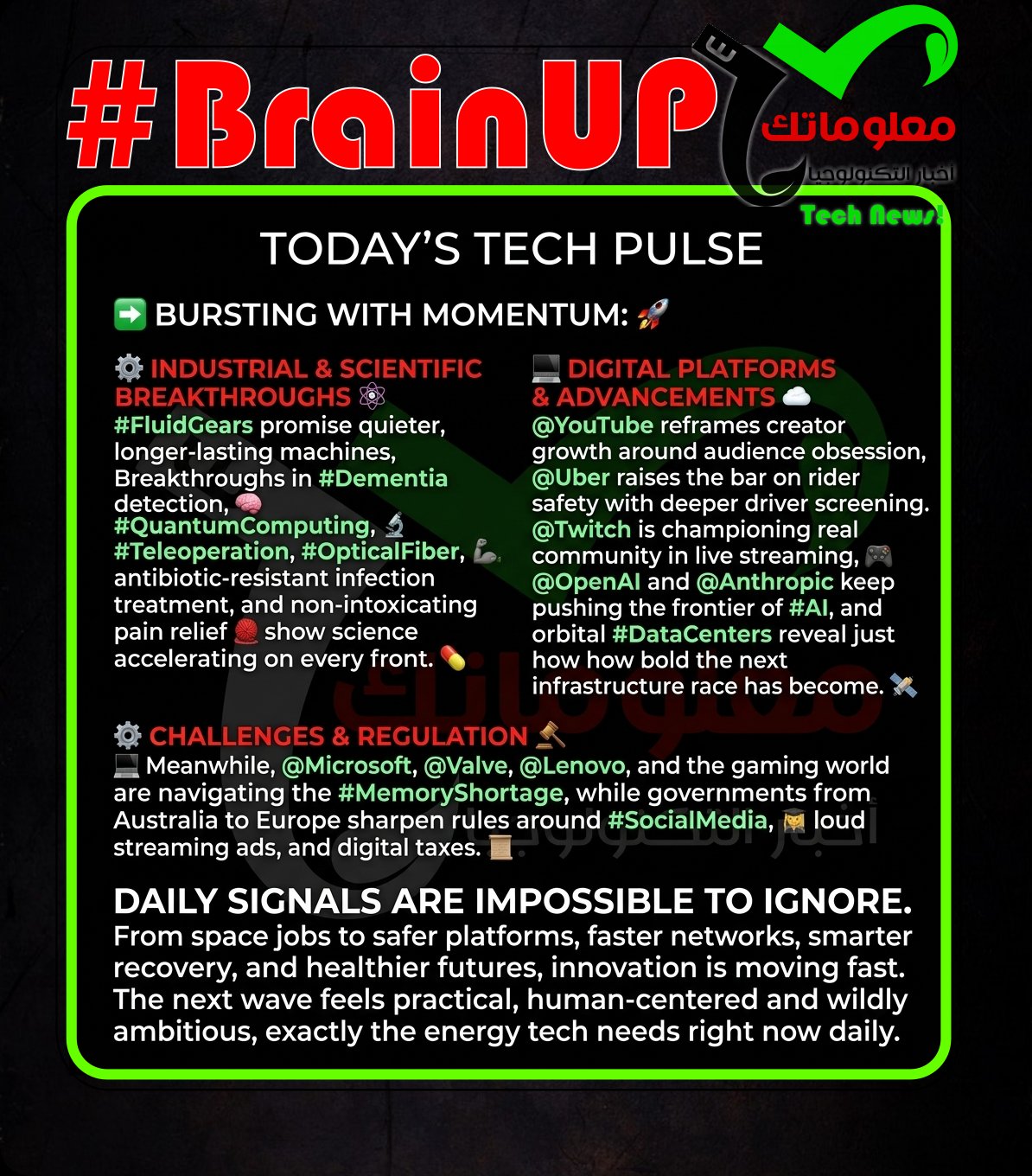
#BrainUp Daily Tech News – (Sunday, June 28ᵗʰ)
Welcome to today’s curated collection of interesting links and insights for 2026/06/28. Our Hand-picked, AI-optimized system has processed and summarized 27 articles from all over the internet to bring you the latest technology news.
As previously aired🔴LIVE on Clubhouse, Chatter Social, Instagram, Twitch, X, YouTube, and TikTok.
Also available as a #Podcast on Apple 📻, Spotify🛜, Anghami, and Amazon🎧 or anywhere else you listen to podcasts.
1. Fluid gears have no teeth, and science explains why this makes them so useful
Fluid gears operate without traditional teeth by using a fluid, typically oil, to transfer torque between components, which reduces wear and enables smoother motion. This technology allows for quieter and more efficient gear systems compared to conventional toothed gears. The fluid friction generates the necessary torque transmission while accommodating differences in rotational speed, making it ideal for applications requiring precision and durability. Such gears are particularly useful in contexts where noise reduction and long service life are critical. Understanding the science behind these #fluidgears highlights their growing importance in modern machinery designs.
2. YouTube says the secret to success is not their algorithm, it’s your audience
At VidCon 2026, YouTube representatives argued that creators should think less about the #algorithm and more about what their #audience wants, even suggesting you replace the word “algorithm” with “audience” when forming questions about performance. On the panel “Decoding the Algorithm: What Your Audience Actually Wants on YouTube,” YouTube’s Todd Beaupré said creators are not punished for infrequent posting or for experimenting with new formats, citing a study of millions of channels that found virtually no relationship between time between uploads and view changes, and noting that longer breaks could correlate with more views on return. He also said low engagement from subscribers is normal, claiming most channels see under 10% click through from subscribers and that even in the first hours after upload, about 90% of subscribers who see a video will not watch it. The takeaway was that early subscriber response does not determine whether a video will succeed, and creators should focus on making something genuinely interesting to viewers rather than trying to “game” YouTube’s systems.
3. Uber expands background check requirements for drivers
@Uber announced stricter driver #background-check requirements, expanding lifetime screening and broadening which convictions trigger permanent disqualification, as it faces lawsuits and scrutiny over rider safety and sexual assault prevention. The company says it will permanently ban drivers with convictions that may be sexual in nature, and will also disqualify those with misdemeanor or felony stalking and strangulation-related offenses, which it says can predict future violence, based on input from domestic violence prevention experts and civil rights groups. It is also moving to 99-year background checks, replacing prior third-party checks that generally traced #SSN histories for only the previous seven years. Uber says the updated rules will not retroactively affect existing accounts with no serious interpersonal safety complaints, and where a conviction is more than 15 years old and not sexual in nature, with the changes still rolling out nationwide. The move follows reporting and a court case highlighting violent incidents in ride-sharing and allegations that Uber’s prior protocols approved some drivers with violent felony convictions, including a case where Uber was found partially liable and ordered to pay $8.5 million.
4. Twitch’s CEO says passive scrolling can’t beat the community of live streaming
At VidCon 2026, Twitch CEO @Dan Clancy argued that passive #social media scrolling has become “anti-social” and that #live streaming wins because it creates real connection and community. He said Twitch keeps viewers with a streamer longer than short-form platforms like #TikTok, makes absences noticeable, and enables shared real-time reactions in chat, which helps viewers form bonds not just with the streamer but also with each other. Clancy compared Twitch communities to sports fandoms, where the value is shared identity more than the “best athletes,” and said similar horizontal bonds form around a streamer. On creator growth, he encouraged using multiple platforms, using short form for discovery and long form to build emotional connection and income, while noting Twitch has intentionally avoided heavy algorithmic recommendations because “solving” discovery could distract viewers away from creators. He said Twitch is exploring short-form on-platform via a feature called #Recaps, an evolution of its story feature that surfaces streamer-selected clips from recent streams, and the article begins to note he addressed generative #AI concerns but does not include details of that plan.
5. Trump threatens 100% tariffs over tax on American tech companies
@Donald Trump threatened to impose 100 percent tariffs on European goods if countries move forward with a #DigitalServicesTax targeting American tech companies operating abroad. In a Truth Social post, he said any country implementing such a tax would face an immediate 100 percent tariff on all goods sent to the U.S., and that the tariff would supersede any existing trade deals. Earlier this month he made a similar threat tied to France’s existing 3 percent levy on local revenue from companies like @Apple and @Google, reportedly raising it directly with @EmmanuelMacron ahead of the G7 summit. The article notes that only Canada has dropped its levy in response to this tactic, and adds that experts say the administration’s leverage has been weakened after a U.S. Supreme Court decision limiting Trump’s power to issue reciprocal tariffs. The episode reflects the administration’s continued use of tariffs as pressure against foreign digital taxes on U.S. tech firms.
6. Claude Mythos 5 is back, but only for a select group of US institutions
The US government has partially lifted its restrictions on @Anthropic, allowing limited access to its most powerful model, Claude Mythos 5, but only for a vetted set of US partners. According to Semafor, the White House has approved access for more than 100 American companies and government agencies after Commerce Secretary @Howard Lutnick said in a letter that adequate safeguards were in place for a defined list of trusted partners, and that Anthropic committed to collaborate on future model protocols and releases. This rollback follows #export controls issued about two weeks earlier that ordered Anthropic to suspend all access to Mythos 5 and its public counterpart Claude Fable 5 for any foreign nationals, including Anthropic employees, citing unspecified #national security concerns. Anthropic has said officials were shown a method to jailbreak Fable 5, but described the vulnerabilities as relatively minor and not unique to its models. Fable 5 remains offline, though people close to the talks say a path to restoring it is forming with no confirmed timeline.
7. I tried ChatGPT after OpenAI’s quiet GPT-5.5 update — and I noticed one change almost immediately
@OpenAI has quietly updated #GPT-5.5 in #ChatGPT to make it less literal and more conversational, aiming to infer user intent, adapt when users change their mind, and maintain conversational context with fewer reminders. After a day of testing in text and #Voice Mode, the author found mixed results: text chats often felt quicker to adjust after clarifications, more likely to carry feedback through the rest of the conversation, and more inclined to suggest alternative angles rather than simply agree. However, the author still had to correct misunderstandings, and the improvements were subtle enough to be hard to quantify. In Voice Mode, the author noticed little change and a sarcasm test, replying “No way!”, was taken literally as a desire to end the conversation, making vocal interaction still feel unnatural. Overall, the update seems like a small step toward smoother conversations in text, while natural human-like voice interaction still feels some way off.
8. Orbital Data Centers Are Seductive on Paper, but They Face Daunting Challenges in Reality
Orbital data centers are being promoted as a way to meet soaring #AI-driven computing demand by moving #data-centers off Earth, where solar energy is abundant and land, water, and grid constraints and community backlash can be avoided, but operating industrial-scale computing infrastructure in orbit is far harder than launching satellites. The article explains that on Earth, data centers depend on three pillars: large and growing electric power, robust #cooling that removes heat produced by servers, and extensive physical infrastructure such as buildings, backup power, water systems, communications links, and maintenance access, plus proximity to users and network backbones for low-latency services. In space, these same needs run into harsh realities: radiation can damage electronics, waste heat is difficult to reject, repairs are extraordinarily expensive, and every pound launched still has significant cost. The authors, engineering professors studying data-center design and space systems engineering, argue that the business case looks seductive in concept but must confront these fundamental engineering and operational constraints. The gap between the promise of an orbital ecosystem, including efforts associated with @SpaceX, and the practical demands of power, thermal management, and maintainability is the central reason orbital data centers face daunting challenges in reality.
9. One Specific Blood Protein Can Identify Dementia Risk Decades Before Diagnosis
An international research team reports that the blood plasma protein #GDF15, measured in middle age, can predict higher #dementia risk decades before diagnosis. Across six large cohort studies from the US, UK, Iceland, and Japan, with follow-up periods of about 15 to 25 years, people aged 55 or younger with higher GDF15 levels were more likely to develop dementia later, with the strongest association seen for vascular dementia. Using #MendelianRandomization on genetic datasets involving hundreds of thousands of people, variants associated with higher GDF15 also tracked with higher dementia risk, supporting the idea that GDF15 may be more than a passive early marker and could contribute to disease pathways. Smaller analyses linked higher plasma GDF15 to higher cerebrospinal fluid GDF15 and to brain shrinkage, but not to amyloid beta clumps tied to #AlzheimersDisease, consistent with a mechanism involving metabolic pathways and the neuroimmune axis. Together, the results position GDF15 as an early, measurable signal of later dementia risk and a potential biological target for understanding why that risk increases.
10. How to design a robust quantum computer
Building a large-scale quantum computer requires overcoming significant challenges in error correction and hardware design. The article discusses recent progress in quantum error-correcting codes and the development of scalable qubit architectures such as superconducting circuits and trapped ions. Advances in these areas improve fault tolerance and operational stability, which are crucial for practical quantum computation. Researchers underscore the importance of integrating theoretical insights with experimental efforts to optimize performance. This synergy accelerates progress toward constructing reliable, robust quantum computers capable of complex problem solving.
11. Companies Could Soon Staff ‘Stubbornly Local’ Jobs With Workers 4,000 Miles Away
Packaging potassium sulfate in China’s Xinjiang region highlights how #teleoperation can shift dangerous, location-bound work into remote, networked labor. BuilderX Robotics uses dust-penetrating, night-vision-like cameras and videogame-style control stations so operators can run excavators, loaders, and other heavy machines from a distant office over #5G or satellite, keeping people out of hazardous warehouses and worksites. Similar remote-control models are emerging elsewhere: robots restocking hundreds of convenience stores in Japan are monitored and sometimes controlled by workers in the Philippines, Düsseldorf airport planned to test remotely driven shuttles, an Atlanta startup offers robot security guards operated by remote staff, and a surgeon in France performed a teleoperated procedure on a patient in India. @Mark Graham argues the significance is not remote labor itself, but that teleoperation pulls “stubbornly local” tasks into a planetary labor market, likely bringing familiar pressures of labor arbitrage, control, and fragmentation. BuilderX founder Shaolong Sui says he pursued teleoperation, rather than full autonomy, as a practical response to construction labor shortages and to move operators from dusty, dangerous sites to safer working conditions across 14 machine types.
12. Streaming services’ obnoxiously loud ads become illegal on July 1 in California
Starting July 1, California will ban video streaming services from playing commercial audio louder than the accompanying program, under SB 576 signed by @Gavin Newsom in October 2025. The law aligns streaming with broadcast, cable, and satellite rules under the #CALM Act, which requires ads to run at the same average volume as the programs, and it comes as Illinois has also passed a similar requirement taking effect July 1, 2027. Industry groups including the Motion Picture Association and the Streaming Innovation Alliance opposed SB 576, arguing that ad loudness varies with #server-side ad insertion, differing encoding pipelines, and the wide range of output devices used for streaming. Trade publication TV Tech reported that compliance will likely require integrating file-based and sometimes real-time loudness control into server-side ad insertion workflows. Persistent complaints about loud ads show the problem is hard to eliminate even in traditional TV, with the FCC reporting at least 1,700 complaints in 2024 after roughly 825 in 2023 and about 750 in 2022, and the new state laws aim to push streaming toward similar volume consistency.
A Manhattan congressional primary became a high-profile proxy fight between rival AI factions, and the winner, @Micah Lasher, said he would not take cues from either side and would still pursue #AI regulation. Pro-safety super PACs including Public First Action backed by @Anthropic spent about $19 million supporting state assemblyman Alex Bores, while pro-innovation group Leading the Future tied to @OpenAI president @Greg Brockman and Andreessen Horowitz spent about $8 million opposing him, yet Lasher won with 39% and Jack Schlossberg finished a distant third. Lasher then pledged to advance the same regulatory agenda as Bores, leaving both camps without the outcome they sought, according to Adam Kovacevich of Chamber of Progress. The race was described as the only U.S. contest so far where pro-regulation and pro-leeway AI groups directly fought over the same seat, reflecting a broader pattern that across 35 elections and millions in spending, AI companies are getting little in return. The article notes AI-related super PACs have spent more than $50 million in 2026 elections, tracing the escalation to debates over California’s #SB1047 and to the 2025 launch of Leading the Future as a response to @Anthropic’s increased involvement in AI legislation.
14. Scientists found a cannabis compound that relieves pain without the high
Researchers at the University of Arizona Health Sciences report that cannabis-derived #terpenes, aroma compounds found in Cannabis sativa and many plants, can relieve chronic and pathological pain without the psychoactive effects associated with #THC. In a paper in Pharmacological Reports, they tested four terpenes, geraniol, linalool, beta-caryophyllene, and alpha-humulene, and found all four substantially reduced pain in mouse models of fibromyalgia and post-surgical pain, with geraniol producing the strongest effect. The work builds on prior findings from @John Streicher’s lab showing terpenes reduce pain in models of inflammation and chemotherapy-related nerve damage, while being less suitable for acute injury pain. Together, the results suggest terpene-based approaches could expand non-intoxicating options for treating difficult chronic pain conditions such as fibromyalgia and post-operative pain.
15. Mark Zuckerberg Is Selflessly Building Yet Another Horrible Product Nobody Asked For
Amid the rapid rise of #predictionMarkets like Polymarket and Kalshi and warnings about increased #gamblingAddiction, @Mark Zuckerberg has reportedly directed Meta to build a similar app called “Arena.” According to two employees cited by the New York Times, Arena would initially use a video game like points system rather than real money, though Meta did not rule out real money betting in the future, and sources said the project could still be canceled. The piece frames the effort as another attempt by Meta to stay relevant as its social apps struggle with user growth, pointing to past misfires such as a failed cryptocurrency initiative, paid celebrity AI chatbots, and its cartoonish #metaverse experiences. It also reports Meta is working on an #AI photo generation app and notes the company previously launched a crowdsourced COVID era prediction tool, Forecast, which never gained traction. The author argues Arena may have little appeal without the get rich incentive that drives many prediction markets, suggesting it could fail if launched.
16. Lenovo Warns PC RAM Prices Will “Never” Go Back to Normal
Lenovo says the #RAM price surge driven by a global memory shortage will not return to pre-2025 levels, predicting a “new normal” of higher prices from 2030 onward even if supply catches up. Speaking at ISC 2026, the company argued that today’s inflated baseline will persist, feeding into pricier PCs and consoles, and slowing next-gen plans while pushing developers toward #optimization as fewer players upgrade. The article attributes the shortage and pricing power to a tight #DRAM oligopoly dominated by @Samsung, @SK_Hynix, and @Micron, which shifted production toward more profitable #AI data center memory, limiting availability for consumer tech. A @Valve engineer, Pierre-Loup Griffais, describes month-to-month take-it-or-leave-it pricing, while @Microsoft forecasting warns console storage and memory costs have already risen over 2.5x and could double again by fall 2027. The piece links this market dynamic and the rapid expansion of data centers, including their heavy water, power, and land demands, to sustained higher costs across gaming and consumer computing.
AI companies that need fresh, high-quality training data for #LLMs are increasingly finding that paid contractors are using other chatbots to generate the very data meant to improve AI systems. The article cites a study that training data usage has doubled every nine months since 2010 and describes companies hiring workers on low-quality, short-term contracts for highly specific tasks, alongside reports to New Scientist that “AI cannibalism” is widespread despite explicit rules against it. A contractor identified as Alice says passing AI-generated work as human is often easy if obvious @ChatGPT-like tics are scrubbed, and other contractors say they rely on multiple LLMs to avoid mistakes and protect their income. The dynamic is framed as an ironic feedback loop: after building products on others’ content and precarious labor, companies are now being fed low-quality AI output in return, which experts warn can destabilize models and undermine the broader AI race.
18. China researchers transmit a whooping 51.3Tb/s through an optical fiber channel
Researchers in China have achieved a breakthrough by transmitting data at an unprecedented speed of 51.3 terabits per second (Tb/s) through a single optical fiber channel. This record-setting feat demonstrates significant advancements in #opticalfiber technology and data transmission capabilities. The achievement shows the potential for dramatically increasing internet bandwidth and improving global communication infrastructure. By pushing the limits of data transfer speeds, this innovation could support future demands for high-capacity networks and enhanced digital experiences. Such progress reflects the ongoing efforts in #fiberoptics research to meet the evolving needs of data-driven industries worldwide.
Using ADP payroll data, @Erik Brynjolfsson argues that #generativeAI is increasingly weakening the employment on-ramp for young workers, even if overall job totals look stable. The updated #CanariesDashboard, built with ADP Research and drawing on 4.6 million workers across 730+ occupations, shows highly #AI-exposed occupations are nearly flat overall as of April 2026, but for ages 22 to 25 those roles are shrinking about 3.8% year over year, worsening from roughly 2.8% through April 2024 to more than 4% per year since, while least-exposed jobs for the same age group grow about 2% annually. Mid-career ages 31 to 34 also contract 1.7% year over year, while ages 35 to 40 grow 2%, suggesting the impact is concentrated by career stage rather than a broad collapse. Brynjolfsson presents the continuously updated dashboard as a response to critics who blamed other shocks like interest rates or post-pandemic distortions, saying the pattern persists and “it’s not going away.” The article links the divergence to a task-based mechanism: AI absorbs routine early-career tasks first, which narrows entry-level opportunities before it eliminates whole jobs.
20. SpaceX stock has cooled. Hiring for jobs in the space economy hasn’t
Despite the post-IPO cooling in SpaceX shares, hiring across the #space economy continues to expand faster than the broader U.S. labor market. The World Economic Forum estimates the global space economy is growing about 9% annually, while U.S. space-economy gross output rose nearly $51.5 billion from 2012 to 2023 and the sector’s total value hit $613 billion in Q2 2025, according to the Space Foundation, alongside roughly 373,000 private-sector space jobs per Department of Commerce BEA estimates. Space-sector employment grew 27% in the decade through 2024 versus 14% for total private-sector employment, and from 2019 to 2024 it rose 18%, with younger workers benefiting as nearly half of new space-economy jobs went to people under 35 and their workforce share increased by 3 percentage points from 2014 to 2024, bucking declines seen in other sectors. @Dean Boerner of Revelio Labs reports active job postings at space-economy companies are up more than 40% year over year while overall U.S. postings are down about 5%, and the sector also offers relatively high pay with median salaries typically around $100,000 to $135,000. The article links this sustained demand to ongoing growth in the space economy and highlights a continuing labor supply-demand imbalance, particularly for skilled manufacturing roles such as machinists and welders.
21. The third Xbox price hike in 15 months raises all models by at least $100
Microsoft is implementing its third Xbox console price hike in just over a year, with increases of at least $100 and up to $150 across current models, shortly after reports of layoffs at Microsoft-owned studios. The Xbox Series S 512GB rises from $399 to $499, the Series S 1TB from $449 to $599, the digital-only Series X 1TB from $599 to $749, and the disc-drive Series X from $649 to $799, while the 2TB Series X variant is being discontinued. After citing tariffs and inflation for earlier 2025 increases, Microsoft now points to #memory costs, saying it is paying 2.5x more for memory and expects costs to double again by late 2027 as DRAM capacity shifts toward #AI GPU demand. To soften the impact, Microsoft is expanding interest-free installment options and working with Amazon on 0% APR financing up to 12 months, while pushing refurbished units that are up to $100 cheaper. The article ties these hikes to broader industry price rises, noting Sony’s PS5 increases, a small Nintendo Switch 2 hike, Valve citing memory costs for a higher Steam Machine price, and Apple raising tablet and PC prices amid a “RAMpocalypse.”
22. Australia to double penalties for platforms in breach of social media ban
Australia will double the maximum penalty for breaches of its #social media minimum age law to $99m, and expand the powers of the eSafety Commissioner to compel platforms to provide evidence of their compliance efforts. Although under-16s have been barred from 10 major platforms since 10 December 2025, the government and regulator say many children still access banned apps, with the eSafety Commission reporting seven in 10 under-16s who had accounts before the ban retain some access, and the BBC finding many Sydney students still able to use social media. Investigations have been opened into alleged non-compliance by Facebook, Instagram, Snapchat, TikTok and YouTube, highlighting enforcement difficulties. @Anthony Albanese and communications minister @Anika Wells said big tech is not doing enough and is doing the bare minimum, framing tougher penalties and stronger investigatory powers as a way to intensify enforcement and reduce under-16 use.
23. Clever chemistry turns antibiotic-resistant bacteria’s own defences against them
Researchers in China report a selective way to kill antibiotic-resistant bacteria by exploiting #beta-lactamase, an enzyme many bacteria use to resist #beta-lactam antibiotics, to activate a near-infrared photosensitiser that enables #photodynamic therapy. @Hexin Xie and colleagues built a molecule with a beta-lactamase recognition unit, an iodine near-infrared photosensitiser, and hydrophilic substituents that initially prevent cell entry and photoactivity, but in beta-lactamase expressing bacteria the hydrophilic groups are cleaved, making the compound lipophilic, cell-permeable, and able to generate reactive oxygen species under infrared light, with reported intracellular accumulation ratios over 2000-fold versus medium. In vitro and in vivo, the approach nearly eliminated some MRSA strains on light exposure and, for MRSA where resistance is mediated by beta-lactamase, was reported to sterilise infected wounds more effectively than vancomycin, while showing weaker activity against the gram-negative Enterobacter cloacae. The authors attribute reduced gram-negative performance to more complex multilayer cell walls and say their next challenge is improving killing in gram-negative bacteria, while @Adam Thomas calls the concept of turning bacterial defences against themselves compelling but notes that achieving therapeutically relevant accumulation in gram-negative bacteria remains a persistent challenge. By linking activation and uptake to a common resistance mechanism, the work suggests a targeted route to treat resistant wound infections by making resistant cells vulnerable to light-triggered oxidative damage.
24. Microsoft warns Windows 11 recovery feature uses up to 50GB of storage, but for a good cause
Windows 11’s #Point-in-time restore is a new full-system recovery feature that can roll your OS volume back to an earlier snapshot to quickly recover from issues like boot loops, and it is shipping in the June 2026 optional update KB5095093 with broader rollout in the July 2026 Patch Tuesday update. It creates local snapshots on a schedule using #VolumeShadowCopyService (VSS), and you restore by booting into the Windows Recovery Environment and selecting a snapshot from before the problem started. @Microsoft says storage use defaults to 2% of disk size with a 2GB minimum and 50GB maximum, but the space is not pre-reserved, VSS only consumes available free space up to the configured cap, and it is integrated with Windows reserved storage to reduce perceived impact. By default, snapshots are created every 24 hours and retained for 72 hours, with Home and unmanaged Pro unable to change frequency or retention (Enterprise can manage these via Intune and CSP), while all editions can adjust the max-usage ceiling. Windows also prunes restore points when they age out, when the storage limit is reached, or when free space on the OS volume drops to 20GB or below, deleting oldest snapshots first to protect critical system operations.
25. Tech-funded Project Intercept Aims to Strike Down Cold and Flu
Project Intercept is a roughly $500 million philanthropic initiative backed by tech companies such as Stripe, Anthropic, and the OpenAI Foundation to reduce or eliminate the burden of respiratory infections by funding broad countermeasures and #air-cleaning technologies. Citing Intercept data that respiratory viruses kill about 1 million people annually and cost the global economy $600 billion each year, the effort targets the market gap created by the common cold’s more than 200 viral causes, which makes single-pathogen vaccines less commercially attractive. The fund plans to support research into #RNA drugs, antibodies, and #computational protein design, including engineered virus-grabbing proteins intended for nasal use, and to #de-risk development by paying for Phase I and Phase II trials, aiming to advance at least two therapies so pharmaceutical companies are more likely to fund Phase III studies for #FDA approval. It also backs large-scale air filtration and ultraviolet light systems, working with a “network of future buyers” including Mastercard and JP Morgan to run office pilots and provide feedback, since retrofits can be costly and complex despite strong evidence these approaches reduce infection. Advised by experts including @Moncef Slaoui and Peter Marks and inspired by rapid #COVID-19-era development, organizers say the investment is substantial but may need to grow to match the scale of the problem.
26. Social media bans go global: big tech faces a reckoning after Australia’s crackdown
After Australia introduced a ban on #social media access for children under 16 in December, other governments began moving toward similar restrictions, with Indonesia blocking under-16s in March, Malaysia following, and Britain announcing a ban planned for early 2027. @Justin Hendrix of Tech Policy Press, which has tracked efforts in more than 40 countries, describes Australia as a “bellwether” that sparked regulator curiosity, even as the real-world impact of bans remains unclear and the science on harms and addictiveness is still not fully settled. Countries are adopting varied age thresholds and approaches: Austria targets under-14s, France 15, and Norway is considering expanding from under-13 to under-16, while some pair restrictions with #smartphone bans in schools and others choose one policy over the other, such as Brazil banning phones in schools but allowing under-16 accounts linked to a parent or guardian. The article links these moves to a broader, fast-evolving debate about how much technology belongs in children’s lives at home and school, alongside growing concern about a laissez-faire approach and mounting lawsuits highlighting potential harms. Together, these developments suggest a widening global reckoning over #technology’s impact on children, with Australia’s crackdown functioning as a catalyst rather than a settled solution.
27. Scalpers are already selling the Steam Machine for over $3000 on eBay despite Valve’s efforts
Scalpers are listing and selling #SteamMachine reservation spots on eBay for huge markups even before the hardware ships, undercutting @Valve’s anti-bot lottery approach. The article cites multiple listings for confirmed invitation emails, including $3,200 for the 512GB bundle with the new #SteamController, other listings at $2,800 and $2,999, and up to $3,500 for a 2TB model, with one reservation reportedly sold for $2,800. It notes the risk that such purchases may be scams because delivery cannot be verified until units ship, while emphasizing that someone still paid the inflated price. The scalping is amplified by already high retail pricing, with the 512GB model starting at $1,049 and the controller bundle at $1,128, which @Valve attributes in part to component costs amid a global memory shortage driven by AI demand. Despite eligibility rules like account requirements, one reservation per household, and cross-checking payment and shipping details, the article argues the system was not enough and advises gamers to avoid secondary-market reservation listings.
That’s all for today’s digest for 2026/06/28! We picked, and processed 27 Articles. Stay tuned for tomorrow’s collection of insights and discoveries.
Thanks, Patricia Zougheib and Dr Badawi, for curating the links
See you in the next one! 🚀
