
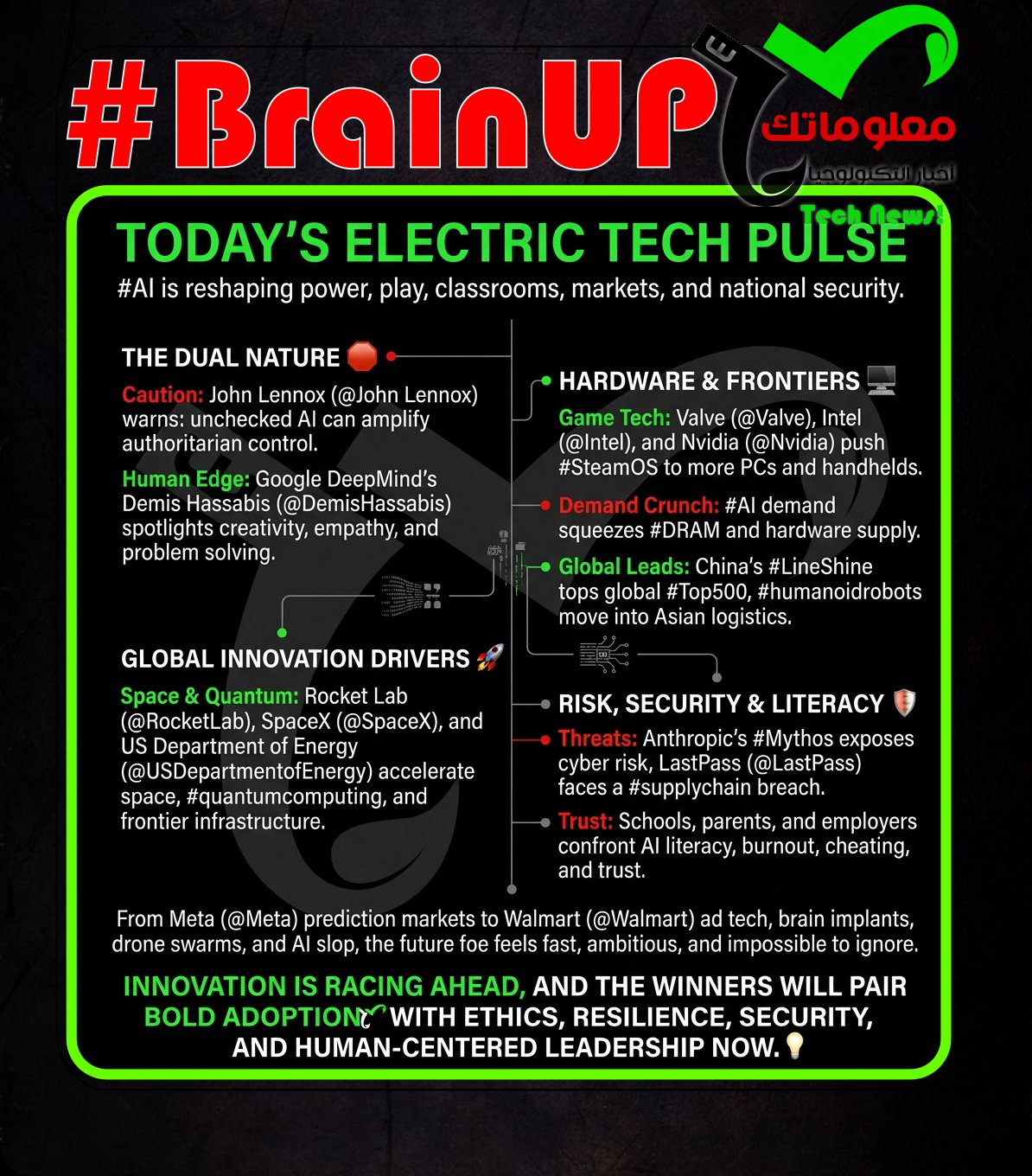
#BrainUp Daily Tech News – (Wednesday, June 24ᵗʰ)
Welcome to today’s curated collection of interesting links and insights for 2026/06/24. Our Hand-picked, AI-optimized system has processed and summarized 29 articles from all over the internet to bring you the latest technology news.
As previously aired🔴LIVE on Clubhouse, Chatter Social, Instagram, Twitch, X, YouTube, and TikTok.
Also available as a #Podcast on Apple 📻, Spotify🛜, Anghami, and Amazon🎧 or anywhere else you listen to podcasts.
1. Oxford’s top maths professor: ‘The devil could use AI to destroy the world’
Emeritus Oxford mathematician @John Lennox argues that rapid advances in #AI, combined with inadequate government regulation, risk enabling #totalitarianism, while insisting a future where machines replace humans is not inevitable. In his book God, AI and the End of History, he warns that #AI is dangerous in the hands of “bad actors” because it can support authoritarian control, framing this in both scientific and Christian terms by saying “the number one bad actor is the devil,” though he also claims AI can be used for good. He links these concerns to a wider crisis in education and free inquiry, condemning the cancellation of @Michael Foran’s gender identity lectures at Oxford as part of a “totalitarianism of the mind” and criticising “safe spaces” that shield students from dissenting views. Lennox, who has publicly debated @Richard Dawkins and presents himself as a cheerful advocate of open debate, contends that universities and schools must return to teaching people how to think, not what to think. His overall message is a call to resist intellectual conformity and to confront AI’s political and ethical risks before it entrenches coercive power.
2. GameStop CEO Foregoes Performance Award
GameStop CEO Matt Furlong has decided to forgo his performance award as the company continues its turnaround efforts. The decision comes amid ongoing strategic changes aimed at repositioning the retailer in a competitive market. Furlong’s choice reflects a commitment to corporate responsibility and aligns leadership incentives with long-term shareholder value. This move signals confidence in the company’s direction and a focus on sustainable growth. By foregoing the award, the CEO underscores GameStop’s dedication to accountability during its transformation.
3. Valve, Intel, and Nvidia will bring SteamOS to more PCs, including handhelds
@Valve is working with @Intel and @Nvidia to expand #SteamOS support beyond the current AMD-only limitation, potentially enabling more PCs and gaming handhelds to run the Linux-based platform. Evidence includes #SteamOS 3.8 adding initial firmware for upcoming @Intel handhelds and controller support for Intel-powered MSI Claw systems, plus reports that SteamOS can run on an Intel Arc B580 GPU only with major workarounds. Today, official installs on non-Valve hardware effectively require AMD CPUs and GPUs, which constrains custom SteamOS builds and largely rules out non-AMD handheld designs. Broader Intel and Nvidia support would open the door to Steam Machine alternatives and is important for future handhelds built around Intel’s Arc G3 chips, though early Arc G3 devices like the MSI Claw EX AI+ and Acer Predator Atlas 8 currently ship with Windows. The article notes that reliable official support may take time because vendors still need firmware, drivers, and compatibility checks, so full do-it-yourself flexibility is likely not imminent.
4. China’s humanoid robots moving in as Asia’s workforce ages out – Asia Times
A quiet “tech truce” is emerging in Asian logistics as aging societies prioritize physical constraints over #de-risking, exemplified by Tokyo Haneda Airport turning to Chinese-made #humanoid_robots for baggage handling. The article cites Japan’s acute labor shortage alongside surging travel demand, including 42.7 million inbound tourists in 2025 and 7 million more in the first two months of 2026, plus official estimates that Japan will need 6.5 million foreign workers by 2040 even as political pressure rises to rein in immigration. It contrasts staged demonstrations like the January Changi Terminal 5 exhibition with the April 2026 viral video of an overwhelmed Singapore ground handler throwing suitcases, arguing that the “universal agony of the human spine” is becoming neutral ground where Chinese algorithms protect Japanese and Singaporean backs. The narrative also notes a shift from robot spectacle to endurance in April 2026, including a Beijing half-marathon headline and @Unitree’s “Drunken Fist” balance work reframed as calibration for real-world labor. Despite Japan’s push for #economic_security and reduced dependence on China, Haneda’s 130cm @Unitree models shown pushing cargo in April are slated for full trials in May, underscoring how demographic pressure is overriding geopolitical friction at the conveyor belt.
5. China’s coal chemicals boom risks repeating past industrial mistakes
China is rapidly expanding its coal-to-chemicals industry, converting abundant domestic coal into fuels, plastics, fertilizers, and petrochemical feedstocks as part of a broader push for energy security and reduced dependence on imported oil and gas. While the strategy strengthens industrial self-sufficiency and supports economic growth, climate experts warn it could undermine the country’s emissions-reduction goals because coal-based chemical production generates substantially more CO₂ than conventional oil- or gas-based alternatives. Analysts note that coal-to-chemicals is one of the few major sectors in China where emissions are still rising, even as renewable energy deployment accelerates and overall emissions growth slows. The expansion echoes earlier periods when heavy industrial investment delivered short-term economic benefits but later created environmental and financial burdens, raising concerns that China may be locking itself into another generation of carbon-intensive infrastructure just as the world moves toward cleaner energy systems.
6. Google DeepMind CEO says these are the skills that will set humans apart from AI
Demis Hassabis, CEO of Google DeepMind, asserts that human skills like creativity, empathy, and emotional understanding will distinguish people from increasingly capable AI systems. As AI advances rapidly, these uniquely human traits are essential for adding value beyond machine capabilities. Hassabis highlights that cultivating a growth mindset and complex problem-solving are critical for future collaboration with AI. These skills underpin how humans can complement AI tools rather than compete with them. His perspective emphasizes the need to focus on developing human-centered qualities as AI integration deepens across industries.
7. 47% of Harvard seniors admit to cheating, and the problem existed long before ChatGPT | Fortune
The article argues that student cheating and broader #academic_integrity problems predate #AI, and that many students arrive at college already accustomed to misconduct. It cites research showing widespread cheating in American high schools, including a 2018 summary by @Eric_Anderman reporting 51% admitting to test cheating, a 2020 study of 70,000 students finding 64% cheated on a test and 58% plagiarized, and reports that about 95% participated in some form of cheating, with one Pennsylvania high school survey showing 90 of 100 respondents cheated at least once. Students rationalize misconduct for reasons like pressure to succeed, feeling unprepared, believing “everyone cheats,” dissatisfaction with teaching, or confusion about what counts as cheating, described via @Gresham_Sykes and @David_Matza’s “techniques of neutralization.” At the college level, a 2020 study of 840 undergraduates found 32% cheated on an exam, while faculty may avoid reporting cases or shift assessment methods, and The Wall Street Journal reported in 2025 that some instructors are abandoning writing assignments in favor of in-class exams due to AI-generated work. The piece links these patterns to institutional rules like Harvard’s policy against plagiarism and misrepresentation, noting that consequences can range from failing a class to expulsion, but suggests enforcement and instructor reporting do not always match the prevalence of cheating.
8. Rocket Lab Victus Haze sets new record for largest satellite constellation mission
Rocket Lab’s Victus Haze mission has set a new record by launching the largest satellite constellation to date, consisting of 30 satellites. This milestone highlights Rocket Lab’s growing role in the space industry and its capability to deploy complex satellite constellations efficiently. The mission’s success demonstrates advances in #smallsat deployment technology and Rocket Lab’s dedication to meeting high launch demands. This achievement positions Rocket Lab competitively among #space launch providers and contributes significantly to satellite network expansion. It underscores the importance of innovative launch solutions in supporting the rapid growth of satellite constellations worldwide.
9. Chinese supercomputer leapfrogs best US machines to be ranked world’s fastest
China’s LineShine has taken the top spot in the #Top500 ranking, overtaking the US system El Capitan and marking the first time since 2017 that a Chinese machine has led the list. According to the Top500 project, LineShine at China’s National Supercomputing Center in Shenzhen reached 2.198 exaflops, runs entirely on conventional #CPUs rather than #GPUs used for AI, and draws about 42.2 megawatts of power. El Capitan at the US government’s @Lawrence Livermore National Laboratory is now second, with other US national-lab machines close behind, while Germany’s Jupiter fell to fifth, and these five systems are the only publicly verified exascale computers. The article notes supercomputers’ uses in medical research, climate modelling, and weapons-related simulations, and highlights wider competition as Europe pursues a €20bn plan for AI “gigafactories” that could exceed 100,000 AI processors but raise energy, water, and climate concerns. The reshuffle underscores how the Top500 is often treated as a proxy for national technological prowess, amid intensifying global investment in high-performance computing and #AI infrastructure.
10. Is AI ‘one big bubble’? Behind the tech sell-off
A wave of selling in #AI-related tech stocks is reflecting growing doubts about whether massive #AI spending will deliver sufficient returns or prove to be a bubble. The tech-heavy Nasdaq fell more than 2% as shares of Nvidia and Google-parent Alphabet declined for a second day, while Micron Technology dropped over 13%, and Intel and Advanced Micro Devices fell around 6%. Micron is cited as emblematic of the swing in sentiment because its stock had surged close to 800% in the past year on demand for memory chips tied to the #AI build-out, yet investors turned nervous ahead of its earnings report. Analysts point to enormous investment totals, including more than $580 billion in corporate investment in the past year and over $1 trillion in the prior four years per Stanford University’s AI Index Report, while questioning when meaningful returns will appear as long-term profitability of #generativeAI remains uncertain. The jitters spread internationally, hitting South Korean chipmakers Samsung and SK Hynix, and come as @OpenAI and @Anthropic consider major IPOs, keeping market focus on whether the current #AI investment cycle is still accelerating.
11. AI in the classroom prompts tide of concern from US parents and experts
US parents and child development experts are increasingly concerned that #generativeAI in schools is being adopted faster than evidence supports, potentially shifting learning decisions from educators to ed tech companies. The article cites Kelly Clancy, whose sixth-grade son was asked to get feedback from @Google #Gemini on a science experiment, prompting her to argue that such tools teach children to let machines do the thinking and to found Parents for AI Caution in Educational Spaces, which seeks a two-year moratorium in New York City public schools. Similar efforts include a February petition signed by more than 1,100 parents in Bend, Oregon, and a call from the advocacy group Fairplay for a five-year moratorium on student-facing #generativeAI products for preschool through 12th grade. At the same time, the Trump administration and major tech firms are promoting classroom AI, including a White House ed tech summit led by @MelaniaTrump, reported funding from @Microsoft, @OpenAI, and @Anthropic for AI training via the American Federation of Teachers, survey data that 40% of K-12 teachers say students use AI weekly, and district contracts for platforms like #MagicSchool. The debate centers on whether these tools truly improve learning and skills, or instead risk harm to cognitive development and reduce teachers to tech support rather than decision-makers about what is best for students.
12. LastPass confirms data breach in Klue supply chain attack
LastPass confirmed a data breach after attackers used stolen #OAuth tokens from third-party vendor Klue to access customer information in LastPass’s #Salesforce environment, while LastPass says its products, services, infrastructure, and customer vaults were not affected. LastPass reports Klue, a market intelligence platform integrated with its Salesforce and Gong systems, was compromised, and an unauthorized actor obtained OAuth tokens Klue held for many customers, then used them to access LastPass customer data in Salesforce, with no evidence found of access to Gong-related data. The potentially exposed data includes customer names, phone numbers, email and physical addresses, support case information, and sales/CRM-related data, which could be used for phishing and social engineering, and LastPass advises caution with unsolicited communications and never sharing the master password. The broader #supply-chain attack was claimed by the Icarus extortion group, which allegedly entered Klue using compromised legacy integration credentials, stole OAuth tokens connecting customers’ Salesforce environments, exfiltrated CRM data, and targeted multiple organizations. LastPass disabled employee access to Klue, rotated exposed API/OAuth tokens, notified law enforcement, and warned customers to trust only official support channels, noting suspicious sender domains including baccarat.com[.]au, robinskitchen.com[.]au, and house[.]com.au.
A U.S. official told @The Associated Press that an @Anthropic AI model, #Mythos, identified vulnerabilities in highly sensitive, classified U.S. government computer systems during a joint testing exercise with U.S. intelligence agencies. The official said the model found certain weaknesses within hours, while cautioning that rapid identification does not mean it could exploit them in that same time frame, and the work was conducted under #Project Glasswing to reduce the risk of severe public safety, national security, and economic fallout. Democratic Sen. @Mark Warner cited similar results in a June 11 Senate hearing, saying the tool broke into almost all classified systems in hours and attributing the account to @Gen. Joshua Rudd, though the #NSA and Anthropic declined to comment. The report comes amid growing friction between Anthropic and the @Trump administration over military use and restrictions on its models, including a directive requiring Anthropic to block foreign nationals from using #Fable5 and #Mythos5 and an executive order creating a voluntary federal review framework for advanced AI releases. Anthropic said it disabled the models to comply while disputing the government’s rationale, and a letter from more than 100 cybersecurity leaders, including from @Adobe and @Nvidia, argued Mythos is strong for finding and weaponizing software flaws but not uniquely so, warning restrictions could aid adversaries.
14. SpaceX raises $25 billion in debt sale less than two weeks after IPO
@Elon Musk-led SpaceX raised $25 billion through a senior unsecured #bond sale less than two weeks after its record #IPO, after receiving nearly $90 billion of investor orders, according to sources. The company priced five tranches of notes maturing from 2031 to 2056, with rates ranging from 5.35% to 6.65%, and the deal was managed by Bank of America, Citigroup, Goldman Sachs, JPMorgan Chase, and Morgan Stanley. SpaceX said it will use proceeds primarily to repay its $20 billion bridge loan facility in full, cover related fees and expenses, and use any remainder for general corporate purposes, while disclosing it has just over $100 billion in cash following an IPO that raised nearly $86 billion. The fundraising reflects SpaceX’s heavy capital needs to develop #Starship, expand #Starlink, and pursue artificial intelligence initiatives, even as its prospectus says Starlink is its only profitable segment and the company has accumulated $41.3 billion in total losses since 2002. The deal is framed as one of the largest bond offerings of the #AI era, placing SpaceX’s financing push alongside other mega-issuers cited in the article.
15. Uber investor’s suit alleges rider safety took a back seat to the gig-work model
A minority investor lawsuit alleges Uber’s top leadership, including @Dara Khosrowshahi and the board, prioritized growth and cost cutting over rider safety, mishandling sexual assault risks and related claims. Filed by Detroit’s Police and Fire Retirement System in California federal court, the complaint says Uber cut compliance corners despite knowing sexual assault and misconduct were persistent problems, leaving the company facing thousands of claims, significant liability, regulatory scrutiny, and reputational damage. The suit alleges Uber delayed or rejected measures employees believed could reduce harm, such as in-car cameras, stronger background checks, and improved matching for women riders and drivers. It claims Uber found in-car cameras feasible and likely to reduce misconduct around 2017 but declined to add them because greater control over drivers could weaken its position that drivers are independent contractors under the #gig-work model. Uber denies the allegations, calling the suit misleading and meritless, and says safety incidents are exceptionally rare and it is continually working to make trips safer.
A national survey from Common Sense Media finds that kids ages 9 to 17 widely use #AI, and many turn to chatbots for homework help, health and body questions, and personal advice before asking adults, raising concerns about dependency, literacy, and safety. Among 1,204 children surveyed, nearly 9 in 10 reported using or interacting with AI, about 1 in 4 used it daily, and nearly a quarter said they would seek AI help with schoolwork before a teacher, counselor, or parent, especially those who struggle with math, essay writing, or challenging tasks. The report also flags emotional reliance: 20% of child AI users said it would be hard to stop for a month, rising to 42% among daily users, and about 1 in 10 said AI sometimes understands them better than most people, with lonelier kids more likely to use chatbots for social and emotional support. At the same time, AI safety and #AI literacy appear limited, nearly half had not discussed AI safety with parents or teachers, only about a third knew AI cannot reliably tell true from false, and when 1 in 6 saw inappropriate chatbot content, most did not tell a trusted adult. The findings suggest children are adopting AI quickly for learning and support while families and schools lag in guidance and safeguards, leaving risks that heavy use may be linked to loneliness and reduced happiness, or may displace healthier coping skills.
17. Valve Says It Can’t Negotiate With RAM Makers At All On Price
@Valve says it effectively cannot negotiate #DRAM prices for its upcoming #SteamMachine, and must accept a take it or leave it monthly offer from a small set of major memory manufacturers or risk being cut off. In an interview with @GamersNexus, a Valve employee claimed there are no contracts, DRAM makers quote a price and quantity each month, and declining could mean they “never talk to us again.” Valve links this supply and pricing pressure to the Steam Machine’s $1,050 base price, and says it also forces inconsistent RAM configurations, either one 16GB stick or two 8GB sticks, though Valve reports no noticeable performance difference in testing. The article argues DRAM producers are prioritizing more profitable sales to #AI hyperscalers and datacenters that buy huge volumes in advance, leaving consumer-focused buyers with less leverage and less predictable supply, and notes even consumer RAM brand @Gskill is struggling to source parts. With DRAM makers increasingly focused on AI and some exiting consumer memory, the piece suggests higher prices for computers and consoles may persist, while also recalling that some DRAM makers were implicated in a major U.S.-prosecuted cartel case more than 25 years ago.
18. OpenAI Codex bombards SSDs with needless write operations, costing millions
@OpenAI is trying to fix a flawed local diagnostic logging implementation in its #Codex coding agent that can generate excessive SSD writes and potentially shorten drive lifespan. A GitHub bug report claims Codex SQLite feedback logs can write about 640 TB per year, and one developer reported 37 TB written after 21 days of uptime, enough to approach the warranted endurance of some consumer SSDs within a year. Users have begun estimating the financial impact as lost SSD value, including one report of $38.64 on a 2 TB Samsung NVMe, and a Codex-generated estimate suggesting low single digit millions of dollars of SSD endurance may have been consumed across users between March and June, using a cost model based on SSD price and TBW ratings. The article links the issue to default-on local logging introduced around the app’s debut, not the later plan to add default telemetry, and notes that logs remain on-device unless users include them in feedback reports. An @OpenAI spokesperson said engineers are aware, have active pull requests to address it, and attributed the problem to high volume data being stored in a way that caused more disk activity than expected.
19. Mythos discovers ‘Squidbleed,’ a memory leak that’s gone undetected since Clinton era
A 29-year-old #Heartbleed-style bug in #Squid, dubbed #Squidbleed, could silently leak plaintext HTTP requests and other sensitive data from proxy memory, and it was found by researcher Lam Jun Rong with help from Mythos Preview and reported to maintainers. Tracked as CVE-2026-47729, it affects every Squid version in default configuration when the proxy can inspect cleartext HTTP traffic (or runs in TLS-terminating setups) and can reach an attacker-controlled #FTP server on TCP port 21. The root cause is in Squid’s FTP directory listing parser, introduced by a 1997 commit to handle legacy #NetWare FTP servers that used extra whitespace: a loop using strchr can become infinite when no filename follows the timestamp, walking past the end of a buffer so xstrdup returns adjacent heap memory back to the attacker. Rong demonstrated the issue with a proof of concept and noted the fix is straightforward, and the Squid project shipped a patch in Squid v7.6 released June 8. The incident shows how long-lived legacy protocol handling in widely deployed infrastructure can create durable #memory-leak risk in real-world proxy deployments.
20. Mark Zuckerberg wants Meta to launch its own prediction market
Mark Zuckerberg is pushing for Meta to develop its own prediction market platform, which would enable users to bet on future events using virtual currencies. This initiative aims to leverage Meta’s extensive social network to crowdsource forecasts and insights on various real-world outcomes. The move reflects Meta’s strategy to integrate more interactive, participatory features into its ecosystem, enhancing user engagement while experimenting with monetization models tied to decentralized finance concepts. By launching a proprietary prediction market, Meta seeks to capitalize on growing interest in #blockchain and virtual asset technologies, strengthening its position in emerging digital markets. Ultimately, this development highlights Meta’s ambition to innovate in social and financial technology spaces simultaneously.
21. The hidden cost of your AI rollout: burning out the high performers running it | Fortune
Companies rolling out #AI often rely on their top performers to lead adoption, implementation, and oversight, but that approach can accelerate #burnout and threaten retention. A Wellhub survey found 88% of people leaders say retaining top talent is their biggest priority, and 85% report using wellness programs to achieve it, while @Carolee Gearhart says AI can either amplify performance or amplify burnout. HR leaders focus on top talent because these employees are asked to do more, including supporting coworkers in building new skills, which raises their burnout risk and makes departures especially costly. To counter this, leaders are emphasizing well-being and clear communication that employees are supported as whole people, with Gearhart warning that staying silent about wellness is a major mistake. She adds that retention improves when HR identifies and meets individual wellness needs, such as sleep and nutrition, to build resilience for workers being taxed in new ways by AI-driven change.
22. Gas stations accused of using AI to inflate fuel prices in class-action lawsuit
A California class-action lawsuit alleges major gas-station operators used #AI-driven pricing to coordinate higher fuel prices, inflating costs by up to 30 cents per gallon in some areas. The suit names BP, Circle K, Marathon Petroleum, 7-Eleven, Walmart, Albertsons, and Kalibrate, claiming Kalibrate’s #AI price-optimizing tools used competitors’ data to help push prices as high as $7 per gallon and violated California’s Cartwright Act, as well as Assembly Bill 325, a law aimed at algorithmic price fixing that took effect at the start of 2026. Plaintiffs say the defendants operate over 1,700 California stations and that each extra penny per gallon costs state drivers about $134 million per year, seeking unspecified damages for alleged overpayment. The filing comes amid broader controversy over algorithmic pricing and concerns about “surveillance pricing,” while noting California’s average gas price of $5.56 per gallon versus a $3.92 national average. The case frames the alleged conduct as an #AI-powered trust that reduces competition and keeps pump prices artificially high for drivers statewide.
23. Dialog Claims It Was Hacked. A Misconfigured Website Left Its Members Exposed
Dialog, an invite-only events group cofounded by @Peter Thiel, told members that a database containing personal information was breached by a “criminal” hacker, but WIRED reports the data appeared to be exposed through a basic website #misconfiguration that made files readable to any visitor. According to an email from managing director Juliette Levine, forensic investigators identified exposure of names of 113 past participants and access to information for some people registered for a summer retreat, and Dialog temporarily shut down many systems. WIRED says a landing page meant to distribute the group’s app let anyone sign up with any email address without a password, then loaded internal files on roughly 200 people into the browser, viewable by inspecting the page with standard browser tools. The accessible records included extensive personal and operational details such as private contact information, active login tokens, participant lists, schedules, and links to questionnaires collected via Fillout and stored in #Airtable, including dates of birth, emergency contacts, internal political leanings and rankings, and digital login keys. The reporting argues that the exposure did not require a break-in, contradicting Dialog’s framing of the incident as a hack, and shows how the group’s web setup effectively made sensitive member data publicly accessible.
The U.S. Department of Energy announced the Quantum Genesis initiative to develop and deploy the world’s first #fault-tolerant, scientifically relevant #quantum computing capability for R&D by 2028 as a foundational element of the broader #Genesis Mission to accelerate U.S. scientific discovery and innovation. The initiative is framed as a step toward goals in President @Trump’s Executive Order, “Ushering the Next Frontier of Quantum Innovation,” which reaffirms U.S. leadership in quantum information science and references the #QC-ADDS effort, and DOE also sought community input via an RFI on scientifically relevant fault-tolerant quantum systems. @Michael Kratsios, Secretary of Energy @Chris Wright, and DOE Under Secretary for Science @Darío Gil said the effort is intended to strengthen U.S. competitiveness, enable breakthroughs beyond classical systems, and leverage DOE national labs, universities, private-sector partnerships, and user facilities, with links to advances in #AI through the Genesis Mission. The article notes Quantum Genesis will have three major priorities, and describes one of them, the DOE Q Competition, which aims to demonstrate fault-tolerant systems in 2028 with logical qubits in the low hundreds targeting critical scientific applications. Overall, DOE presents Quantum Genesis as a national, partnership-driven push to deliver a practical fault-tolerant quantum capability on a defined timeline to support scientific research leadership.
25. Anthropic’s Claude Tag is learning your company, one Slack message at a time | TechCrunch
@Anthropic is launching Claude Tag, an always on AI teammate inside Slack designed not just for productivity but to accumulate #organizational context and #institutional knowledge through ongoing channel participation. Available in beta for Claude Enterprise and Claude Team customers, it expands on existing Slack integrations by adding persistent memory and the ability, with permission, to pull facts from other channels, while giving each channel a shared Claude identity so teammates can see its work and continue prior threads. Admins control what tools, information, and channels each Claude identity can access, keeping memories scoped so, for example, a legal Claude cannot seed context into engineering. Claude Tag can execute assigned tasks by breaking them into stages and reporting progress in threads, and it also has an ambient mode that proactively posts updates, flags items across the organization, and follows up on forgotten threads or tasks. TechCrunch frames this as part of a broader enterprise push toward context layers, noting parallels with @Microsoft Graph via Copilot and Work IQ, plus platforms from @Snowflake, @Databricks, and @Glean aimed at making company knowledge accessible to agents.
During the U.S. Army’s May Ivy Mass exercises, @Palladyne AI demonstrated #SwarmOS enabling a single operator to control a mixed swarm of different drone types while #AI handled a significant share of coordination. The swarm combined reconnaissance drones and Gremlin-X mini-bomber drones and was connected to the #NGC2 next-generation command-and-control network to support real-time data exchange across the broader command network. Palladyne AI said SwarmOS was integrated on size, weight, and power-constrained hardware, and co-founder Denis Gagarich stated the demo crossed a fundamental technical threshold for autonomous control. The article argues such capabilities can shorten the time from target detection to engagement and allow target information to be passed beyond the swarm to other units when stronger strike assets are needed. It notes Gremlin-X is a small FPV-style bomber drone with a munition suspended beneath, still in development, emphasizing AI-enabled operation without GPS and low-cost precision strike, and adds that swarm approaches are also being pursued in other U.S. efforts, including potential use with low-cost cruise missiles and #ShieldAI #Hivemind.
27. They aren’t colleges. But they promise fast, cheap college credits.
An increasingly popular way to earn college credit bypasses traditional colleges by using unaccredited, unregulated online learning platforms that sell fast, low cost courses meant to transfer into undergraduate programs. A @Washington Post analysis found these platforms offer a wide range of courses that are typically cheaper and faster than standard college classes, giving students a head start toward a degree. The article notes that some courses can be finished in a matter of hours while others usually take weeks, and that pricing can be as low as about $100 per month for unlimited transferable courses. This shift highlights how #online learning platforms are positioning themselves as an alternative pathway into college credit despite not being schools. The result is a growing credit earning route that promises speed and affordability while relying on #transfer credits to count toward traditional degrees.
28. 3 People Have Gotten Cancer-Detecting Implants in Their Brains
Coherence Neuro, a San Francisco startup with ties to @Elon Musk’s Neuralink, has begun early human testing of a #brain-computer interface implant intended to detect tumor-specific electrical activity and deliver mild #electrical stimulation that could help prevent brain tumor growth. The company temporarily placed its coin-sized device in the brains of three consenting patients during tumor-removal surgery at Royal Melbourne Hospital for about 30 minutes, then removed it, using the procedure as a short performance check and safety step before longer-term implantation. The approach builds on research suggesting tumors have distinctive electrical properties, including findings that high-grade gliomas can form synapses with neurons and that interrupting electrical signaling or applying low-intensity electricity can slow tumor growth or disrupt cell division. Coherence argues an implant could be more convenient than the wearable #Optune system, which can extend survival by months when worn most of the day but requires shaving the head and carrying a battery. Coherence plans initially to target glioblastoma, a highly recurrent cancer monitored by MRI every two to three months, aiming for continuous monitoring and customized stimulation to address changes between scans.
29. 60% of TikTok videos are AI slop; 21% of YouTube ones – 9to5Mac
A study from video editing platform @Kapwing reports that #AI slop is pervasive on @TikTok, especially for new users and kids content, and earlier work found a smaller but still significant share on @YouTube. Analyzed data included 10,742 TikTok videos across 20 categories plus the first 500 videos served on the For You page to a fresh account, where 59% were identified as AI-generated junk, compared with 21% in an earlier YouTube-focused study. The issue was most extreme in children’s categories: #CartoonKids had 97% AI-generated videos, while #cartoons and #babysong were 83% and #forkids was 79%. Kapwing notes the true rate may be higher because it only counted videos with clearly AI-generated scripts and voiceovers, and argues that platform incentives rewarding quantity over quality encourage uploads of AI-created content. While watch history can train both platforms to show less AI slop than what a new account sees, the findings suggest the problem is already severe and likely to worsen as these incentives persist.
30. Walmart to Acquire Vibe.co in Bid to Win More Advertising to Its Platforms
Walmart says it plans to acquire Vibe.co to expand #WalmartConnect and make it easier for more advertisers, especially small and medium sized businesses, to buy streaming TV and digital ads across Walmart and its Vizio-related video inventory. The company says Vibe.co’s platform helps advertisers buy and create digital ads and is designed to simplify streaming TV advertising while enabling campaign measurement through Walmart’s commerce capabilities. The deal, with terms undisclosed, is subject to a waiting period and customary closing conditions, and is expected to close by the end of fiscal year 2027, with Vibe.co co-founders Arthur Querou and Frank Tetzlaff joining Walmart Connect after closing. Walmart frames the move as part of a broader push by major ad sellers to attract local and regional marketers and as an extension of its recent partnerships with #Magnite, #YahooDSP, and #GoogleDV360. Walmart also previewed plans to roll out new video series for Vizio users featuring celebrity hosts and influencers tied to shopping occasions, and said the transaction will not affect its existing sales and operating income projections.
That’s all for today’s digest for 2026/06/24! We picked, and processed 29 Articles. Stay tuned for tomorrow’s collection of insights and discoveries.
Thanks, Patricia Zougheib and Dr Badawi, for curating the links
See you in the next one! 🚀
