
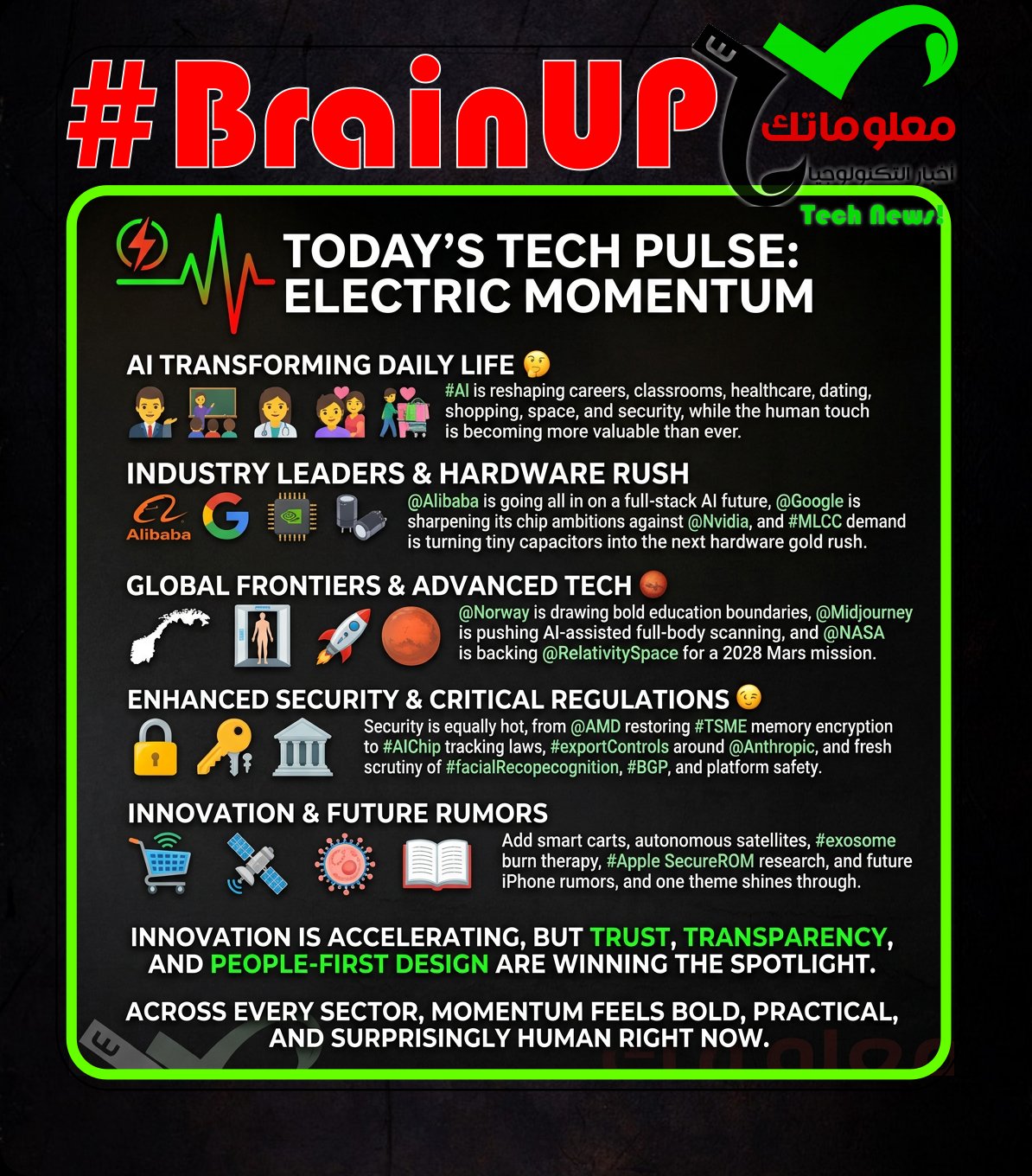
#BrainUp Daily Tech News – (Saturday, June 20ᵗʰ)
Welcome to today’s curated collection of interesting links and insights for 2026/06/20. Our Hand-picked, AI-optimized system has processed and summarized 29 articles from all over the internet to bring you the latest technology news.
As previously aired🔴LIVE on Clubhouse, Chatter Social, Instagram, Twitch, X, YouTube, and TikTok.
Also available as a #Podcast on Apple 📻, Spotify🛜, Anghami, and Amazon🎧 or anywhere else you listen to podcasts.
1. Even professional CV writers are warning not to use AI to write a resume
Professional CV writers are cautioning applicants not to rely on #AI to write resumes because it can produce polished but impersonal and sometimes misleading content that fails to reflect a person’s character. A Kickresume report found 56% of CV writers often or always receive resumes containing at least some AI-generated text, and 67% have noticed an increase in such content, with generic, boilerplate wording cited by 63% as the most common issue. The research also notes AI-linked patterns like longer two-page CVs (32%) and fewer obvious errors, with only 8% flagging typos and spelling as a noticeable problem, while exaggeration of skills and inaccuracies are also reported. Kickresume CEO Peter Duris says #AI can be “leaned on,” but standout CVs depend on personal specifics that only individuals can provide about their skills, experience, and achievements. At the same time, the report acknowledges benefits: 24% of writers have seen more personal branding and storytelling, and 18% have seen more creative, infographic-style CVs, suggesting #generativeAI can support expression when guided by genuine personal input.
2. Forget memory chips: MLCCs are Shenzhen’s newest gold rush
Shenzhen’s Huaqiangbei electronics market has shifted from last year’s memory chip rush to a new hot item, #MLCCs, as the global #AI boom drives a sharp price surge. Traders say these tiny multilayer ceramic capacitors are essential for regulating electric currents, and manufacturers are scrambling to meet demand from AI server clusters and electric vehicles, creating a supply crunch. A distributor in Huaqiangbei reported spot prices for high-capacitance MLCCs, including parts from Japanese leader @Murata Manufacturing, have risen two- to fourfold since Chinese New Year, with some models jumping from 10 yuan per 1,000 units to 40 yuan. Despite heavy inquiry traffic, actual deals are described as sluggish because buyers resist the higher prices. Overall, the article portrays MLCCs as the current “gold rush” component in Huaqiangbei, fueled by AI-driven demand and constrained supply that has pushed prices higher across the spot market.
3. Norway Imposes Near-Ban on AI in Elementary Schools Starting 2026
Norway will effectively ban the use of artificial intelligence tools in elementary schools from 2026, aiming to protect children’s learning and development. The Norwegian government argues that early exposure to AI, such as ChatGPT, could hinder critical thinking and social skills among young students. The policy includes strict regulations to prevent AI from being integrated into teaching materials or school activities for children up to the sixth grade. This move reflects growing concerns worldwide about the impact of AI on education and highlights Norway’s precautionary approach to emerging #technology in learning environments. By limiting AI use in early education, Norway seeks to ensure foundational skills are established without overreliance on automated tools.
Midjourney is launching Midjourney Medical and promoting a full body ultrasound scanning system via a San Francisco “spa” experience where people are immersed in a shallow pool and lowered into a tank of “golden light” to be scanned, with #AI assembling the data into MRI-like images. The company describes a prototype with a ring of 40 scanners containing 358,000 ultrasonic elements firing up to a thousand times per second in water, aiming for roughly one minute per scan and claiming tissue detail around half a millimeter, comparable to standard clinical MRIs. Midjourney also lays out an aggressive deployment ambition, 50,000+ units by 2031 with “a billion scans a month,” positioning it as a preventative health tool and asserting early imaging could avoid 30% of deaths and 50% of healthcare costs. The article notes the core approach is not unprecedented, citing #Fullbody Ultrasound Computational Tomography (#USCT) work at @Caltech and pointing out Midjourney’s announcement downplayed outside contributions. Ultrasound company @Butterfly Network issued its own statement confirming it supplied components for Midjourney’s scanner, undercutting Midjourney’s implication that the system was wholly novel and internally developed.
5. Telegram founder accuses Meta of sabotaging access in India with BGP hijacks
@Pavel Durov claims Indian telco Reliance Jio is intentionally disrupting access to Telegram for users outside India via #BGP hijacking, and suggests this could be tied to @Meta’s investment in Reliance and competition with @WhatsApp. He described #BGP hijacking as publishing incorrect routing announcements that can rapidly spread through the internet and make services hard to reach, and said Reliance has ignored multiple reports, but provided no proof for the accusation. Jio denied any routing misconfiguration and said it follows global routing best practices with high reliability, security, and transparency. Durov also implied Reliance or WhatsApp could be behind lobbying to ban Telegram in India, referencing a six-day block ordered by India’s IT ministry at the National Testing Agency’s request to curb scams and misconduct during a major medical entrance exam. The article notes there are multiple India-specific reasons entities have sought bans or tighter regulation of Telegram, including law enforcement cooperation issues, piracy suspicions, and anonymity, and that telcos object to messaging apps offering voice services under different rules, making Durov’s claim that Telegram was singled out hard to sustain.
6. ‘We’re all in’: Alibaba’s Joe Tsai makes biggest AI push yet at VivaTech
At VivaTech in Paris, @Joe Tsai said #Alibaba is “all in” on #AI because it could become a US$50 trillion total addressable market tied to human productivity and intelligence. He said the company will pursue a #full-stack strategy, investing across the entire value chain, including chips, cloud infrastructure, foundation models, and consumer applications, rather than betting on a single winner. Tsai argued it is still too early to know where the biggest AI profits will emerge, even as tech firms pour billions into data centres, large language models, and computing infrastructure. He also cautioned that today’s leaders, including “pure model companies” that currently appear to capture much of the value, may not remain the biggest beneficiaries over time, which reinforces Alibaba’s decision to spread investment across the stack.
@AMD says it will restore the BIOS option for #TransparentSecureMemoryEncryption, also called #TSME or Memory Guard, on certain non-PRO Ryzen 9000 desktop CPUs via a BIOS release planned for July, citing valuable community feedback. The company had quietly removed that option in a recent firmware update, specifically AGESA 1.2.7.0, which was noticed after a security audit on a Ryzen 7 9700X and confirmed with MSI that the feature had previously been supported. #TSME is a firmware level memory encryption capability where the processor generates a key to encrypt data in RAM, helping protect against cold boot attacks that require physical access. AMD emphasized that Memory Guard is a foundational security feature on Ryzen PRO processors and said it has no plans to remove support from the PRO lineup now or in the future. The change means consumer Ryzen 9000 owners who want the extra physical attack protection can expect the enable option to return through an upcoming BIOS update.
8. The Korean Telecom Giant at the Center of Anthropic’s Mythos Controversy
The Trump administration moved toward export controls on Anthropic’s most powerful AI after a dispute over South Korea’s SK Telecom receiving access to Claude Mythos and broader worries about safeguarding the model’s capabilities. People familiar with the matter say US officials alleged SK Telecom had ties to China, prompting the White House to ask Anthropic to revoke SK Telecom’s access, which Anthropic did, while @Amazon later reported vulnerabilities in Fable 5 that could let users bypass guardrails and reach Mythos’ cybercapabilities. A person close to the administration says these events led the White House to conclude it could not trust Anthropic to protect its most advanced technology, and it ordered Anthropic to revoke access to Mythos and Fable 5 for all foreign nationals, including immigrants inside the US. Anthropic chose to take the models offline entirely rather than implement nationality based gating, and it remains in negotiations with the White House about restoring access. The article links this clash to #export_controls, Anthropic’s #Project_Glasswing controlled access program, and contested claims about security risks and alleged China connections that SK Telecom denies.
9. Putin’s plan to live forever
Russia’s president @Vladimir Putin is portrayed as deeply invested in #longevity, tied to a reported $26 billion state program aimed at extending life through techniques such as #organReplacement. In an excerpted conversation, journalist @BojanPancevski describes two main approaches: #3DPrinting of biological tissue to create lab-grown organs for implantation, and genetically modified mini pigs used to grow organs for eventual transplant into humans, a method also pursued in places like China. The article notes that pig-grown organ transplants face major hurdles, including rejection and limited survival, but frames the work as a serious, non-fantastical research path rather than mere sci-fi. It also highlights Putin’s personal interest in extreme wellness practices like a cryo chamber, a “reverse sauna” reportedly around minus 170°F, which he discussed at length with former Austrian chancellor @SebastianKurz during a political visit. Set against a broader trend of billionaires and celebrities funding or promoting anti-aging efforts, the piece links Putin’s health obsession to a longer tradition of Russian leaders seeking forms of immortality.
At @Unreal Fest, @Epic Games presented a 12-month roadmap for Epic Games Launcher V2, an internal rebuild intended to make the launcher faster and more competitive with @Valve’s Steam. The plan includes a redesigned, personalized storefront with game recommendations based on user taste and playstyle, richer game pages, and additions like in-store patch notes, player reviews, and universal controller support, with the rollout tied in conjunction with #Fortnite. Epic claims the launcher will open about 5x faster on cold boot and restore from the system tray about 6.5x faster, but the company’s figures come from a high-end test system (32-core AMD Threadripper, RTX A6000, 128GB RAM) that is not representative of typical consumer PCs. The emphasis is not just on visuals, but on speed and stronger curation to reach feature parity and a better overall experience. Overall, the roadmap frames Launcher V2 as a broad #EpicGamesStore overhaul aimed at closing gaps with Steam over the next year.
11. Almost half of US singles feel negatively about AI in dating, Match says | TechCrunch
A Match Group survey finds U.S. singles are wary of #AI in romantic contexts, but many still want limited, practical help from AI features inside dating apps. In a poll of 1,000 people ages 18 to 39, 47% reported a negative view of AI’s use in dating, and about 40% said they would refuse to date someone who uses an AI companion app, rising to 51% among women ages 18 to 24. Actual companion app usage was relatively low among 18 to 24 year olds in the prior three months at 12%, and only about a third of those users said they were seeking genuine connections with chatbots, while Match describes disapproval of actually dating an AI as near universal. At the same time, 64% of respondents said they could see how AI might help their dating journey, especially for profile improvements, photo selection, and conversation starters. The takeaway Match emphasizes is “help with the hard parts, hands off for the human parts,” reflecting demand for assistance without replacing authentic connection, even as competitors roll out tools like Bumble’s Bee and broader AI investments across apps like Tinder.
12. From PGP to Mythos: a brief history of export controls that didn’t stop anyone | TechCrunch
The article argues that U.S. #exportControls have repeatedly struggled to stop the spread of cybersecurity software, and it is unclear why they would successfully contain Anthropic’s models Fable and #Mythos now. It recounts how the White House ordered Anthropic to restrict exports of Fable and Mythos to anyone outside the U.S. and even to foreign nationals inside the country, prompting the company to disable access, after concerns tied to a South Korean telecom’s access and a report from @AndyJassy that Amazon researchers found a way around Fable 5’s safeguards, which Anthropic says was a narrow, patched issue. As context, it notes Anthropic had limited Mythos to about 150 vetted organizations and marketed it as a highly dangerous cyber capability meant to help defenders preempt attackers. The piece links this moment to past efforts, including the 1990s case where the U.S. treated #PGP as an arms export, investigated its creator @PhilZimmermann, and still failed to stop distribution after he published the source code in a book, a fight that helped set the stage for widespread end-to-end encryption like #Signal and #WhatsApp. By framing Mythos as the latest test in a long pattern, it suggests the outcome could shape not only Anthropic’s foreign market access but also the compliance rulebook other AI labs will need to follow.
13. The terrifying world of the TikTok farlands
The article explores the eerie and surreal environments known as #TikTokFarlands, virtual spaces created within TikTok’s algorithmically generated content that blend reality and fantasy in unsettling ways. These farlands generate bizarre, often disjointed videos featuring obscure or distorted cultural references that captivate and confuse users, highlighting the complex interaction between technology and human perception. This phenomenon exemplifies how algorithmic curation can unexpectedly create new digital frontiers that challenge our sense of normality and understanding. Such spaces raise questions about digital identity and the psychological effects of consuming content detached from traditional context. The TikTok farlands thus represent a broader commentary on the evolving nature of social media, mediated experience, and the boundaries of virtual exploration.
14. Bill that would mandate AI chip location tracking gains industry support
Six companies specializing in tracking sensitive international shipments are backing the #ChipSecurityAct, which would require stronger security, including location verification, for America’s most advanced #AI chips to prevent diversion to China and other adversaries. In a letter to congressional leadership, they argue the bill would close loopholes in U.S. #exportcontrols and boost competitiveness by increasing customer and manufacturer confidence, leading to more sales, faster export approvals, and expanded market access. The companies say current rules have allowed billions of dollars’ worth of U.S. chips to be sold to entities in third countries that can forward them to China, and cite a March Justice Department case alleging a $2.5 billion scheme. The bill would mandate exporters track where advanced chips are sent using dedicated hardware or software, aiming to enable sales to places like Malaysia or Indonesia without fear of onward transfer to China, amid pushback from some semiconductor lobbying groups that warn the requirements could constrain the industry. The House Foreign Affairs Committee approved the measure 42-0 in late March and it is under review in the House, while a Senate companion bill is in early stages, as policymakers frame chip diversion as a major national security risk because chips underpin frontier AI capabilities.
15. Study shows jumping genes can transfer between different species
A recent study reveals that transposable elements, or jumping genes, can move between different species, challenging previous assumptions about genetic isolation. Researchers observed evidence of horizontal gene transfer, where these mobile DNA sequences transfer across species boundaries, influencing evolution and adaptation. This discovery highlights the role of transposable elements in genetic diversity and genome innovation beyond traditional inheritance patterns. Understanding this mechanism provides insights into evolutionary biology and the dynamic nature of genomes. The study underscores the importance of recognizing horizontal gene transfer in the genomic landscape.
16. NASA selects Eric Schmidt’s rocket company for a 2028 mission to Mars
NASA has selected @Eric Schmidt-led Relativity Space to launch the agency’s Aeolus payload to Mars in 2028, giving the company its first NASA mission. Under a new #public-private partnership, Relativity Space will provide the spacecraft, rocket, and cruise operations to deliver Aeolus, which NASA says will produce the first integrated, daily, global view of Martian winds, temperatures, dust, and clouds. The payload will carry four instruments to study the Martian atmosphere, with results intended to directly inform #entry-descent-landing systems and support safer, more predictable astronaut mission planning. The choice ties NASA’s Mars science and human-exploration needs to a commercial provider that is still ramping up, after Relativity’s 3D-printed Terran 1 failed shortly after launch and its larger Terran R is not scheduled to debut until later this year. The award positions Relativity Space’s upcoming launch capabilities as a key element in delivering Aeolus and advancing Mars atmospheric data collection ahead of future missions.
17. Amazon Workers Describe Retaliation After Complaints at Data Centers
Amazon workers at data centers have reported retaliation after raising concerns about safety, workload, and workplace conditions. Employees described being disciplined, demoted, or fired soon after filing formal complaints or speaking out about issues. These actions appear to discourage workers from coming forward, according to labor advocates and former employees. The pattern sheds light on tensions within Amazon’s vast network of data centers, where critical infrastructure is managed under intense pressure. This situation raises questions about the balance between worker protections and corporate priorities in the tech industry.
18. Meta wants a child safety bill rewritten to shield it from lawsuits over harm to kids
@Meta is lobbying to add language to the #KidsOnlineSafetyAct (#KOSA) that would limit platforms’ exposure to child safety and privacy lawsuits, as lawmakers scrutinize engagement features used by minors. The proposed provision would make companies immune from many state law claims tied to harms involving users under 18 and could override certain state child online protection laws, potentially affecting thousands of already filed cases. #KOSA targets platform design choices like infinite scrolling, activity notifications, and appearance altering photo filters by requiring reasonable steps to reduce risks to minors, focusing on systems that keep kids online as well as content. Meta says the change is meant to create uniform national standards and is not blanket immunity or an attempt to extinguish existing suits, but plaintiff advocates argue the text amounts to broad immunity for AI and social media companies. The push comes amid ongoing litigation against Meta and @Google’s @YouTube, including a first trial loss resulting in $6 million in damages, and during negotiations to revive KOSA after it passed the Senate in 2024 but stalled in the House.
19. Some local police have access to an ICE facial recognition app
A newly revealed @Department of Homeland Security Privacy Threshold Analysis describes plans to expand #facial-recognition surveillance by giving local police a mobile app used to help @ICE identify immigrants during encounters in communities. The app, called the ICE Task Force Module, lets officers scan a person’s face and compare it against more than 250 million government records, including @State Department visa data and the TSA’s Traveler Verification Service, then tells officers to either not detain or arrest, or provides a reference code to seek more information from ICE. The document says photos captured by the app are stored in an internal DHS system for 15 years, and DHS declined to provide NPR more detail while stating ICE wants partner agencies to have tools for its mass deportation mission. The local users appear to be non-federal officers tied to the #287g program’s Task Force Model, which authorizes participating agencies, about 1,300 nationwide, to arrest immigrants on ICE’s behalf during routine policing, while experts like @Clare Garvie raise unanswered questions about whether the app is already in use, how it relates to ICE’s Mobile Fortify, and what limits exist on when scans can occur. These uncertainties echo reports of federal officers photographing faces and license plates in places like Minnesota and Maine, suggesting the technology could broaden identification practices beyond federal operations and into local policing.
20. This month’s Windows 11 update broke the Recycle Bin, OneDrive, and possibly your PC’s stability
Microsoft has confirmed a #Windows11 Recycle Bin bug introduced by the June 2026 Patch Tuesday update KB5095051, alongside user reports of other reliability problems. In certain cases, when permanently deleting a single item from the Recycle Bin, the confirmation prompt shows an internal filename like $Rxxxxx.ext instead of the original name, while the Recycle Bin view still displays the correct filename and restores correctly. Microsoft says the file is still deleted normally, so the issue is mostly cosmetic, and a workaround exists only for commercial customers via Microsoft Support for Business, with a permanent fix planned for a future update. Separately, posts on Microsoft forums describe issues such as trouble accessing OneDrive and Dropbox, sluggish #FileExplorer performance across many PCs, random BSODs on some HP systems, freezes on Lenovo machines, and reports of #BitLocker Recovery being triggered on locally configured devices. Overall, the update is portrayed as another example of Windows updates shipping with bugs despite Microsoft’s stated focus on improving the user experience.
@Microsoft held talks to lease @Oracle Cloud Infrastructure capacity, potentially worth more than $3 billion, but the discussions collapsed over #security and #compliance concerns, according to people familiar with the matter. The plan involved moving some Microsoft workloads to OCI, but Oracle’s public cloud did not have #FedRAMP, a standardized security framework for handling US government data, and Oracle was reportedly unwilling to add it. The breakdown underscores a broader #AI boom constraint where even major tech companies are running short on #compute capacity, spurring unusual partnerships and capacity sharing. Microsoft has projected $190 billion in 2026 calendar-year capital expenditures largely for data center expansion, has used @Amazon to add capacity for @GitHub after outages, and is exploring other leasing options while seeking to prioritize its own #Azure resources. Oracle disputed the article as inaccurate without detailing what was wrong, and an Oracle executive said adding FedRAMP to its public cloud would be a massive engineering lift, while noting Oracle’s government cloud already meets the standard.
22. Google Is Using Nvidia’s Playbook to Build a Rival AI Chip Business
Google is adopting strategies similar to @Nvidia to develop its own #AI chips, aiming to compete in the growing market for artificial-intelligence hardware. The company is investing in custom silicon to enhance performance and lower costs for running AI models, reflecting a shift toward specialized processors beyond traditional CPUs and GPUs. Evidence includes Google’s recent announcements about its AI chip designs and plans to scale up manufacturing, paralleling Nvidia’s approach of combining software and hardware innovation. This move could reshape the competitive landscape by challenging Nvidia’s dominance and advancing Google’s AI capabilities. Ultimately, Google’s efforts illustrate the increasing importance of integrated AI hardware solutions in driving technological leadership and efficiency.
Instacart is expanding deployment of its #AI “Caper Carts” in US grocery stores, including a rollout across select Weis Markets locations in Pennsylvania, bringing camera-laden, location-tracking carts into everyday shopping. The carts include multiple camera sensors, digital weight scales, a touchscreen, and #location-tracking systems, and are positioned as part of Instacart’s “Physical AI for grocery,” using edge computing plus cloud AI trained on more than 1.6 billion online grocery orders. According to the joint press release, the carts track purchases in real time and deliver location-aware ads and eCoupons on the screen, with prompts like “Got everything you need?” claimed to drive nearly a one percentage point average increase in basket size, while also nudging shoppers to join Weis Rewards and use “Buy It Again” suggestions. The article argues this is a dystopian-feeling shift that is becoming more common as Instacart says it has tripled deployments and other retailers like Kroger have explored similar smart carts. It suggests that, as with earlier no-checkout experiments, the system may still rely on unseen human labor monitoring what the cart cameras capture.
Burn specialists at Hamilton Health Sciences used a world first #biological treatment to help a Western University student avoid facial skin grafting after a serious frat house fire. The Dec. 2, 2025 fire at Pi Kappa Alpha near Richmond and Cheapside in London, Ont., started after rubbing alcohol was thrown onto a lit torch, sending five people to hospital, including 18-year-old Kaitlin Jeffrey whose face and hair caught fire. @Dr. Marc Jeschke sought compassionate access from Health Canada and, after receiving no objection, treated Jeffrey with two rounds of #exosome therapy, injecting tiny cell-signaling particles to speed tissue repair and reduce inflammation, using one trillion exosomes sourced from the United States. HHS says Jeffrey healed faster and with better results than another student with serious burns who was not eligible because their injuries did not require grafting, and Jeschke emphasized grafts can leave scarring and a patch-like appearance, especially devastating on the face and neck. Jeffrey called the outcome “a miracle,” noted the mental health impact of the injury, and said the results are helping her move forward as her family hopes further research makes #exosome therapy a new standard of care.
25. A satellite just learned to find things on its own, here’s what that means | TechCrunch
In April, an Earth observation satellite performed its first reported on-orbit use of a #vision-language model to find “areas of interest” from natural-language prompts without human analysts on the ground. Loft Orbital’s YAM-9, running NASA JPL’s NAVI-Orbital software and @Google DeepMind’s #Gemma 3 on a #Nvidia Jetson Orin AGX GPU, classified sensor imagery such as boundaries where natural environments meet human development and infrastructure near railway hubs. The immediate value is on-orbit data triage that reduces how much raw imagery must be downlinked and manually reviewed, potentially making space sensors more useful and valuable. Longer term, Loft argues it enables “always-on” patrol-style monitoring logic in space, such as watching a border and flagging suspicious changes through interactive queries. Loft positions this as part of an infrastructure-as-a-service model and says real-time global coverage would require roughly 50 to 100 YAM-9-like satellites, while other operators like Planet Labs and Kepler Communications indicate related AI work or undisclosed on-orbit compute uses.
26. Nothing cancels this year’s CMF phone due to RAM prices
Nothing has decided not to launch a new CMF budget phone this year because rising #RAM and memory costs make it impossible to deliver a meaningful upgrade at an affordable CMF price. Co-founder @Akis Evangelidis said a successor to the CMF Phone 2 Pro was in development, but current memory prices prevent building a phone that feels like a genuine step forward “at a price that makes sense.” CEO @Carl Pei added that memory costs for the company’s mid-range Phone 4A doubled between planning and launch, then doubled again afterward, calling memory the most expensive smartphone component, and the article notes other companies are also being affected, including @Tim Cook saying Apple will raise prices because the situation is “unsustainable.” Even without a CMF phone this year, Evangelidis said CMF will launch several new products, expand into new categories, and hinted that Nothing’s smartphone launch season is not over, while the budget CMF phone lineup is effectively pushed back, with the description indicating it may not return until at least 2027.
27. Unpatchable ‘usbliter8’ Exploit Breaks Apple A12 and A13 SecureROM Boot Chain
Paradigm Shift released an exploit called #usbliter8 that targets @Apple A12 and A13 #SecureROM through #USB #DFU mode, breaking the early boot chain. The article describes the issue as an unpatchable, hardware-level risk because it affects SecureROM, which cannot be updated after devices ship. This means impacted devices may remain permanently vulnerable at the boot stage if an attacker can leverage DFU access. The report links the impact to the Apple A12 and A13 boot process and highlights the security implications of a persistent SecureROM weakness. Source: https://thehackernews.com/2026/06/unpatchable-usbliter8-exploit-breaks.html
The iPhone 18 Pro and Pro Max are rumored to launch in September with notable upgrades and potentially significantly higher prices. Leaks suggest a familiar rear design with the camera plateau from the iPhone 17 Pro, new colors led by Dark Cherry plus light blue, dark blue, and silver, and improved durability via a new aluminum manufacturing process aimed at better corrosion resistance and less discoloration. The front #DynamicIsland is expected to shrink by about 50 percent, reportedly to around 13.49 mm wide, while keeping the same functionality. Performance and connectivity upgrades are rumored to include a 2nm #A20Pro chip, Apple’s #C2 modem with possible satellite 5G, and an #N2 wireless chip bringing #WiFi7 and Bluetooth 6, improving AirDrop, Personal Hotspot, and speeds. Camera and software changes may include a variable-aperture 48 MP main camera for better light control and depth of field, and new #AppleIntelligence features with Siri AI arriving in iOS 27, including the ability to see what’s on your screen and process natural language.
29. Will the Sun engulf the Earth? Scientists reveal an unexpected fate for our planet
The Sun will not engulf the Earth when it expands into a red giant in about 7.5 billion years, contrary to previous assumptions. Scientists determined this by modeling the Sun’s evolution and the orbital changes of the Earth, considering tidal and mass loss effects. They found that the Earth’s orbit will actually widen during the Sun’s giant phase, preventing the planet from being swallowed. This unexpected outcome challenges earlier views that predicted the Earth being consumed by the swollen Sun. Understanding the Sun’s future impact on Earth informs long-term planetary evolution and solar system dynamics.
That’s all for today’s digest for 2026/06/20! We picked, and processed 29 Articles. Stay tuned for tomorrow’s collection of insights and discoveries.
Thanks, Patricia Zougheib and Dr Badawi, for curating the links
See you in the next one! 🚀
