
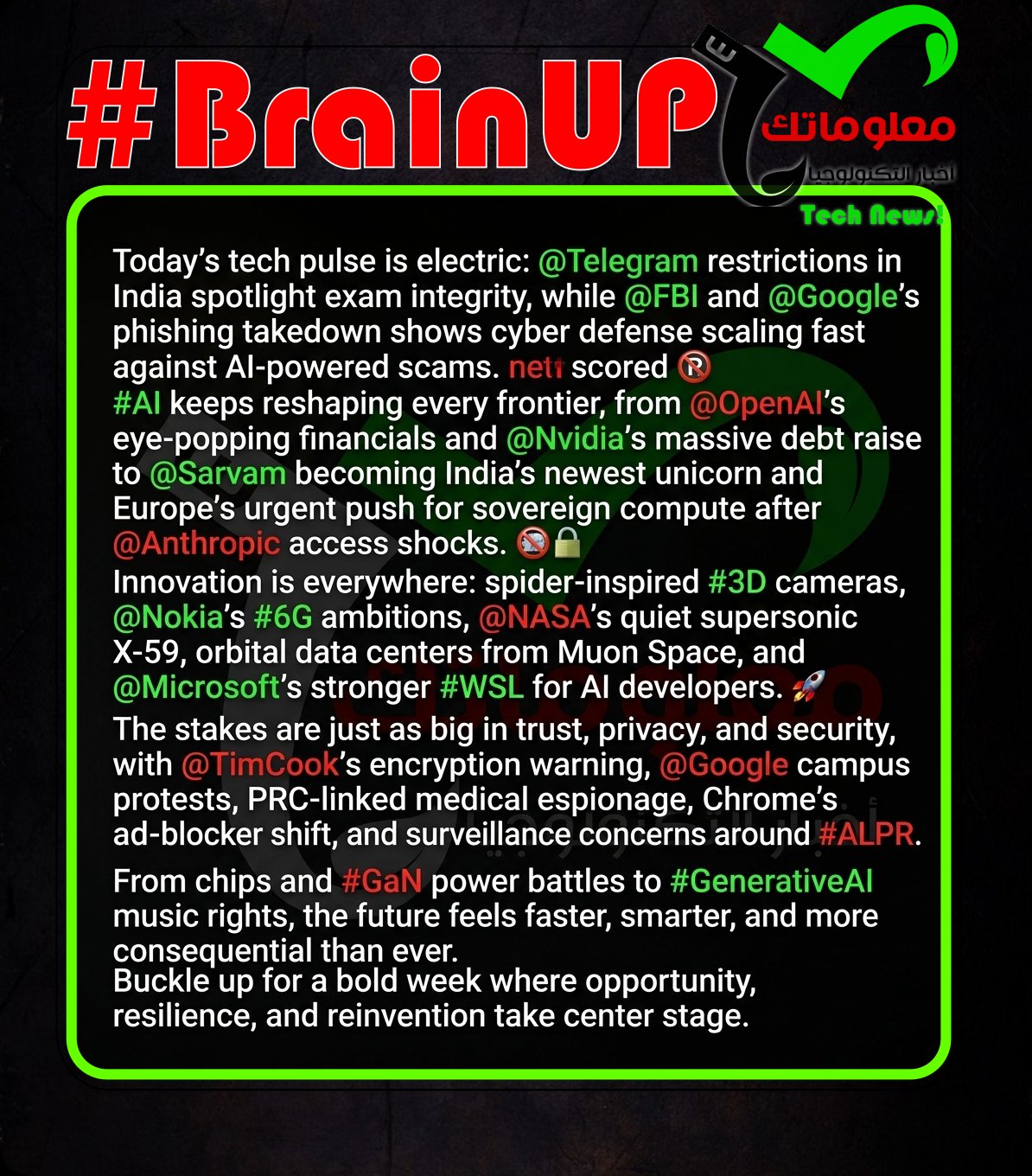
#BrainUp Daily Tech News – (Tuesday, June 16ᵗʰ)
Welcome to today’s curated collection of interesting links and insights for 2026/06/16. Our Hand-picked, AI-optimized system has processed and summarized 34 articles from all over the internet to bring you the latest technology news.
As previously aired🔴LIVE on Clubhouse, Chatter Social, Instagram, Twitch, X, YouTube, and TikTok.
Also available as a #Podcast on Apple 📻, Spotify🛜, Anghami, and Amazon🎧 or anywhere else you listen to podcasts.
1. Telegram temporarily restricted in India ahead of NEET re-exam; NTA welcomes Centre’s move
Telegram has been temporarily restricted in India until June 22, 2026, as the government targets fake NEET (UG) 2026 re-examination papers and exam fraud ahead of the June 21 re-test, with the #NTA calling it a calibrated step to protect exam integrity. Acting on NTA recommendations, @MeitY issued directions under Section 69A of the #InformationTechnologyAct 2000 to limit access for a defined period covering the exam window and immediate aftermath, and also directed Telegram to disable in India its message-editing feature for already-posted content until June 30. The NTA said message editing was misused to fabricate after-the-event “paper leak” evidence by altering older messages after an exam ended, and alleged organised cheating rackets used Telegram to defraud candidates and spread misinformation. It said @I4C under the Ministry of Home Affairs coordinated monitoring and removals of many Telegram accounts, but platform-level restriction was chosen after intermediate steps like takedowns did not sufficiently curb misinformation. The NTA pointed to channels claiming leaked papers and demanding payments from students, reiterating that no paper is available outside the secured examination chain and that such offers are fraud, framing the temporary curbs as narrowly tailored to address public concerns while minimising disruption.
@FBI, @Google, and @Lumen Technologies say they dismantled a China-based #phishing-as-a-service operation called Outsider Enterprise, seizing servers and payment wallets and triggering a civil lawsuit. Sold via a Telegram bot for $88 per week or $200 per month, the kit let subscribers with no technical skill deploy scam pages from 290-plus templates impersonating banks, carriers, government agencies, #USPS, and toll systems like New York’s E-ZPass, while capturing data in real time and requesting SMS codes, PINs, and other approvals to defeat #two-factor authentication. Google’s complaint alleges the operators provided tutorials showing buyers how to prompt #Gemini to generate phishing-page HTML disguised as a “gift redemption page” with inline CSS and no JavaScript, then import that shell back into the kit to create more variants. The FBI ties the platform to about 3.87 million stolen credit cards and an estimated $1.9 billion in losses since July 2023, while Google separately reports hundreds of thousands of victims and 2.5 million scam texts sent to Android users over two weeks in May. The takedown, dubbed Operation Ghost Hook under Operation Riptide, included seizure of admin domains, a Shopify storefront, and about $100,000 in USDT, with Google pursuing #RICO and trademark claims even as it notes extradition from China is unlikely.
3. Jumping spiders inspire wildly efficient 3D camera
Researchers at Northwestern University created SpiderCam, a highly energy-efficient #3D camera inspired by how jumping spiders judge distance with poppy-seed-sized brains. Jumping spiders have multiple retinal layers that capture the same scene at different focus levels, letting their brains compare sharpness and blur to infer depth, a principle @Emma Alexander’s team mimics by capturing two images with subtly different focus. A custom algorithm compares blurriness between the image pair and converts it into real-time depth measurements, running on a customizable chip designed for energy-efficient processing. The prototype produces depth maps at 32.5 frames per second while consuming 624 milliwatts, under one watt total, which is less power than a standard nightlight. The approach could reduce the computational and hardware demands typical of depth sensing, enabling battery-powered applications like assistive devices, wearables, robots, drones, and augmented reality, with plans to further improve and integrate it into small robots and wearable devices.
4. Exclusive: OpenAI Losses Increased Nearly 8X in 2025, With Spending Hitting $34 Billion
Audited financial documents viewed by the publication and independently verified by the Financial Times indicate #OpenAI’s losses surged in 2025 as spending rose sharply and accounting changes related to its shift from nonprofit to for profit amplified reported net losses. In 2024, OpenAI reported $3.7 billion in revenue, $12.48 billion in total costs and expenses, and a net loss attributable to the company of $5.09 billion, after an overall net loss of $8.84 billion was reduced by $3.74 billion categorized as “net loss attributable to noncontrolling members capital.” In 2025, revenue increased to $13.07 billion but total costs and expenses reached $34 billion and operating loss was $20.92 billion, then a $41.55 billion loss tied to fair value changes of convertible interests and warrant liability contributed to a $60.35 billion net loss that was reduced to a $38.53 billion net loss attributable to the company via $17.87 billion and $3.95 billion attributed to noncontrolling and redeemable noncontrolling interests. The documents also show payments to OpenAI of $867 million from @SoftBank and $303 million from @Microsoft in 2025, while OpenAI paid @Microsoft $17.2 billion across categories including $10.59 billion in research and development, and ended 2025 with just over $50 billion in assets, nearly half in cash. Overall, the figures portray a company with rapidly rising revenue but far faster growth in costs and large accounting-driven losses during its corporate conversion, alongside significant financial flows with @Microsoft.
5. Why Nokia thinks it can win the 6G race
@Nokia is trying to shape the next era of connectivity by betting on #AI-powered networks, #6G, and a more #software-centric telecom future. The piece says #AI is transforming how networks are built and managed, positioning AI-driven infrastructure as central to Nokia’s strategy. It notes Nokia faces fierce competition from rivals including @Huawei and @Ericsson, with more than $200 billion in market value described as being at stake. The video frames this shift as Nokia’s most ambitious reinvention yet and explores whether it can stay ahead in building future global connectivity. It is presented as the third installment of CNBC’s “Built for Billions” series on Nokia, following earlier parts on how Nokia makes money and why it missed the smartphone shift.
Sarvam raised $234 million at a $1.5 billion valuation, becoming India’s newest AI unicorn as governments and companies push for greater control over #AI technologies and computing infrastructure. The Series B round is led strategically by HCLTech with a $150 million investment, with participation from Bessemer Venture Partners and existing backers Khosla Ventures and Peak XV Partners, and Sarvam aims to raise $300 million total. After launching open source 30B and 105B parameter models earlier this year, Sarvam says it is building a full-stack #AI business across model development, inference infrastructure, and enterprise applications tailored to Indian languages and use cases in sectors such as banking, insurance, government services, and defense. The funding is positioned to accelerate #sovereignAI efforts amid access constraints highlighted by Anthropic disabling access to its latest models after a U.S. government order, and Sarvam plans to invest in next-generation models for agentic, coding, and cybersecurity applications while expanding compute for deployments. Sarvam reports scale across its products, including more than 2 million daily conversational interactions, about 10 million daily API calls on its inference platform, 500,000+ hours of monthly speech transcription, 35 million+ pages digitized via document AI, and multilingual voice agents used to collect data from 17 million farmers for India’s Ministry of Agriculture and Farmers Welfare.
7. DOJ Lawyers Argue xAI Is ‘Vital’ for National Security in NAACP Lawsuit
The Department of Justice intervened in the NAACP’s lawsuit over xAI’s unpermitted natural gas turbines, arguing that efforts to halt them would threaten US national, economic, and energy security because the power supports #AI innovation used in the Department of Defense’s military operations. The DOJ, xAI, and the state of Mississippi asked a court to dismiss the case, which alleges xAI is violating the #CleanAirAct and endangering public health at its Southaven, Mississippi data center, Colossus 2, including claims of increased risks of asthma attacks and heart disease. DOJ filings say only four AI models, including Grok, support mission-critical operations on Secret and Top-Secret networks, and a declaration from DoD official Cameron Stanley states the military relies on Grok’s Gov model for vital missions, including recent strikes against Iran, asserting that shutting off turbine-powered operations would directly threaten ongoing national security interests. The dispute also centers on state agencies’ assertions that xAI can operate turbines for a year without permits, which the NAACP argues conflicts with #EPA regulations, and on evidence from Southern Environmental Law Center emails indicating the number of unpermitted turbines at Colossus 2 grew from 27 to 57 by mid-May. SELC estimates that increase corresponds to a 111% rise in nitrogen oxide emissions, an 83% rise in PM2.5 emissions, and an 88% rise in formaldehyde emissions since April, intensifying the clash between claimed security needs and local pollution impacts.
8. Exclusive: OpenAI Losses Increased Nearly 8X in 2025, With Spending Hitting $34 Billion
Audited financial documents viewed by the publication and independently verified by the Financial Times indicate that @OpenAI’s losses rose sharply in 2025, with total spending reaching $34 billion and a net loss attributable to the company of about $38.5 billion. In 2024, @OpenAI reported $3.7 billion in revenue against $12.48 billion in total costs and expenses, resulting in a net loss attributable to the company of $5.09 billion after $3.74 billion was recorded as “net loss attributable to noncontrolling members capital,” with the article noting it is unclear how that removal was reconciled. In 2025, revenue increased to $13.07 billion, but costs and expenses rose to $34 billion and operating loss was $20.92 billion; the year also included a $41.55 billion loss tied to conversion from non-profit to for-profit due to fair value changes in convertible interests and warrant liability, contributing to a stated net loss of $60.35 billion that was reduced to $38.53 billion by attributing $17.87 billion to noncontrolling members capital and $3.95 billion to redeemable noncontrolling interests. The documents also show 2025 payments to @OpenAI of $867 million from @SoftBank and $303 million from @Microsoft, while @OpenAI paid @Microsoft about $17.2 billion for services across R&D, cost of revenue, sales and marketing, and G&A, and ended 2025 with just over $50 billion in assets, nearly half in cash. Overall, the figures depict rapid revenue growth alongside even faster growth in #costs and large accounting-driven losses associated with the organizational conversion and substantial spending with @Microsoft.
9. The pitch for a European AI ‘Plan B’ | Euractiv
After the @Trump administration ordered @Anthropic to stop providing its latest AI models to non-US nationals, a group behind the “Europe 2031” scenario argues Europe should pursue tech sovereignty via a different route: rapidly expanding domestic #AI compute and partnering with American tech giants rather than primarily funding European model builders. They warn that simply pouring public money into firms like @Mistral could waste resources given the scale of US investment in data centres, model training, and talent, and they question whether @ASML is a reliable strategic choke point for leverage in the #AI supply chain. Their proposed “Plan B” is a massive buildout of European data centre capacity to attract US companies and create leverage over their future choices, combined with alliances beyond Washington and Beijing. The approach would require mobilising public and private capital on an exceptional scale, establishing special build zones akin to the Commission’s planned “data centre acceleration zones” under the #Cloud and AI Development Act, plus targeted energy expansion and streamlined permitting. The proposal rests on the assumption that US frontier models will keep consolidating dominance, leaving Europe vulnerable without compute capacity and bargaining power.
10. Europe’s AI Sovereignty Problem Runs Far Deeper Than Frontier Access
A recent US order requiring #Anthropic to cut off foreign access to two advanced models is framed in Europe as a warning that dependency can abruptly limit access, but the article argues Europe’s #AI sovereignty challenge is deeper because its AI market is tightly entangled with dominant US ecosystems. As demand-side evidence, it cites Swedish “vibe coding” startup Lovable, a celebrated European success valued at $6.6 billion after raising $540 million, whose product routes prompts to US models from #Anthropic and @Google and runs within hyperscaler infrastructure, including an expanded partnership with #Google Cloud and integration into #Google Workspace. This application-layer strategy can deliver fast execution and strong UX, yet it creates strategic risk when upstream model providers can become competitors, illustrated by images suggesting #Anthropic built an in-chat app builder similar to Lovable’s core product and by the launch of Claude for Legal, which pressured legal AI startups like Harvey, Legora, and Robin AI that rely on Claude. The article links this to the industry pattern of being “sherlocked,” where an incumbent absorbs features built by smaller firms on top of its platform, implying that sovereignty interventions focused only on boosting supply and demand may inadvertently deepen dependence. It concludes by noting not all European startups rely on proprietary US foundation models, but uses application-layer dependence to show why frontier access alone does not define Europe’s sovereignty problem.
@Tim Cook argues that governments should not force #encryption backdoors because any special access created for law enforcement will also be found and abused by criminals. At the 2015 EPIC Champions of Freedom event, he criticized Silicon Valley rivals for monetizing personal data and warned that undermining privacy on services like #iMessage and #FaceTime would invite exploitation, comparing a backdoor to a key left under a mat. The article links this view to the ongoing #security versus #privacy debate and notes that end-to-end encryption remains under pressure from governments, including concerns about the UK’s #OnlineSafetyAct enabling scanning of encrypted messages. It adds that modern cybersecurity thinking treats exploitation as a matter of when, not if, and that #AI-enabled cybercrime increases the risk that attackers will pursue and leverage any hidden access. Overall, the piece presents Cook’s quote as a continuing caution that weakening encryption to improve national security can directly erode user privacy and system safety.
12. Dozens walk out as Google boss addresses Stanford graduates
Dozens of @Stanford University graduates walked out as @Google CEO @Sundar Pichai began a commencement keynote, protesting #Google’s work with the US government on #artificial intelligence. BBC video showed students leaving and holding signs such as “ICE spies with Google AI”, while reports including SFGate estimated up to about 200 participants, with some also waving Palestinian flags amid earlier calls to protest Google’s ties to Israel. Pichai largely avoided discussing AI and joked about the expected demonstrations, and Google did not respond to the BBC’s request for comment. The incident fits a wider pattern at US graduations this year, where speakers who mention AI have faced boos and jeers, including former Google CEO @Eric Schmidt and other commencement speakers. Together these reactions reflect campus unease about AI’s role in society, including concerns about jobs and tech companies’ government and international ties.
13. Anthropic Sued Over Limits on Its $200-a-Month AI Plans
Anthropic is facing a proposed class-action lawsuit accusing the company of misleading customers about the actual value of its premium Claude subscriptions. The complaint, filed by Washington, D.C.-based user Karl Kahn, alleges that Anthropic marketed its $100 “Max 5x” and $200 “Max 20x” plans as offering five and twenty times the usage of Claude Pro, while imposing opaque and significantly lower real-world limits that many users only discovered after subscribing. Kahn, who upgraded to the $200 tier for intensive coding work, claims he exhausted 15% of his weekly allowance during a single five-hour session and was forced to either stop working, ration his usage, or pay for additional access. The lawsuit seeks class-action status for customers who purchased the plans since April of last year, reimbursement for affected subscribers, and a finding that Anthropic engaged in fraudulent marketing practices. The case highlights a growing tension at the heart of the #GenerativeAI economy: users increasingly depend on AI tools for professional work, yet companies face soaring compute costs and often rely on vague “fair use” policies and dynamic rate limits that may not align with marketing promises. Anthropic declined to comment on the allegations, but the lawsuit could become an early test of how courts define transparency, consumer expectations, and accountability in the rapidly expanding market for premium AI subscriptions.
14. Scientists shut down cancer DNA repair to overcome drug resistance
Researchers report that the small molecule UNI418 can undermine cancer drug resistance by shutting down key parts of the #DNA repair machinery that tumors use to survive therapy. In cell-based screening for replication stress regulators, UNI418 caused major declines in homologous recombination proteins RAD51 and CHK1, leaving cells less able to repair treatment-induced DNA damage, and in combination with a #PARP inhibitor it helped resistant cancer cells respond again. Mechanistically, UNI418 activated the Cul4A #ubiquitin ligase complex, which tags these repair proteins for degradation, effectively dismantling the repair network. The team traced this activation to interference with inositol phosphate metabolism that lowers IP6, a molecule that normally restrains Cul4A activity. By promoting targeted degradation of DNA repair factors rather than relying on specific mutations, the work outlines a potential strategy to re-sensitize tumors that have regained DNA repair capacity and become resistant to PARP inhibitors.
15. Nvidia plans to raise at least $20 billion in its first debt sale since start of AI boom
@Nvidia plans its first investment grade bond sale since 2021, aiming to raise at least $20 billion as it taps capital markets during the #AI boom. An SEC filing disclosed the offering without an amount, but sources said the deal could be closer to $25 billion, following the company’s earlier statement that it could issue up to $25 billion in unsecured commercial paper. The company said proceeds will support general corporate purposes, including repayment and refinancing of existing debt, as it currently carries about $7.5 billion in long term debt and $1 billion in short term debt. The move comes as AI driven growth has dramatically expanded Nvidia’s scale, with fiscal 2026 sales of $216 billion versus about $27 billion in fiscal 2022, and as it simultaneously pursues aggressive shareholder returns, including a dividend increase and an $80 billion buyback plan while targeting roughly 50% of free cash flow to shareholders. The planned issuance also aligns Nvidia with other AI linked tech firms raising large sums in debt and equity markets to fund operations and capital needs.
16. China scolds e-commerce giants
Chinese regulators publicly scolded major e-commerce platforms for misleading marketing ahead of the 618 shopping festival, adding pressure on the sector’s tactics and competition. Authorities accused leading platforms and specifically cited @Alibaba’s Taobao and @JD.com, a move that dented both companies’ shares and followed earlier instructions to avoid an aggressive #price war that has squeezed profits and complicated the government’s efforts against #deflation. Officials have sought to curb so-called #involution in e-commerce since 2024, but a strategist said the notable shift is regulators’ increased willingness to publicize enforcement actions. The episode also coincides with platforms rolling out #AI features, which a China tech newsletter said have sometimes provided misleading product information, reinforcing regulators’ concerns about consumer-facing practices.
17. White House’s Anthropic block set to dominate G7
The @White House decision to block foreigners’ access to @Anthropic’s cutting-edge AI model is expected to dominate the #G7 summit opening in France. The move sparked alarm among Western allies, with the EU saying it underscored the need for “#technological sovereignty,” and Canada’s leader warning about dependence on a small cluster of powerful US tech firms. The episode highlights how “middle powers” have largely lagged in the #AI race behind the US and China, and how American efforts dwarf transatlantic rivals. As a point of comparison, France’s leading AI firm @Mistral is reportedly seeking funding at about a $23 billion valuation, around 40 times smaller than @Anthropic’s estimated valuation, intensifying the debate over access, capability gaps, and reliance on US companies at the summit.
@Mark Cuban argues that job seekers should focus on small businesses because they create roughly 60% of new jobs each year and he expects their share of job creation to grow, with #AI skills providing a major advantage. He says #AI helps mom-and-pop operations compete with larger corporations by making work easier and faster, and he pushed back on claims that small firms use AI mainly to cut headcount, saying it lets them do tasks they previously lacked time to handle. Cuban also notes that only about 14% of businesses have embedded AI across their organizations, leaving much of the economy underusing AI and creating opportunities for candidates, especially recent graduates, to help implement it. He advises learning not just AI basics but how to deploy it for competitive advantage, and he suggests small companies may be easier to join and can accelerate skill development. He sums up the stakes by telling young people there will be companies that are great at AI and companies that used to be in business, making AI implementation know-how a practical edge for landing jobs at smaller firms.
19. Anthropic’s model restrictions are a win for Europe’s top AI startup
New US export controls restricting access to @Anthropic’s cybersecurity models have reinforced @Mistral’s long running pitch that Europe needs #AI sovereignty and independent #AI infrastructure. US officials imposed controls on Anthropic’s Mythos 5 and Fable 5 on national security grounds, barring any foreign national from accessing them, after concerns that safeguards against misuse could be bypassed, and Anthropic then suspended access entirely. @Arthur Mensch has warned that relying on US model providers leaves Europeans without the ability to turn systems on or off, and Mistral has responded by promoting open weight models that customers can run on their own infrastructure and customize with their own data. European governments and enterprise buyers have echoed this focus on knowing where data is and what happens to it, and Mensch has argued Europe has limited time to build its own capability before dependence becomes permanent. Although Mistral trails Anthropic on valuation, capabilities, and users, the episode makes clearer that control over frontier AI often rests with the provider and its government, strengthening Mistral’s sovereignty message.
20. Muon Space announces Condor-Ultra orbital platform for up to 100kW compute
Muon Space announced Condor-Ultra, a new “Starship-Class Spacecraft Platform” designed to support #orbital data centers with higher power, thermal, and networking capabilities, with a pathfinder mission targeted for 2028. The company says the platform can provide 20kW power, 25Gbps connectivity via #Starlink, 18 sqm of nadir payload area, and support 400kg payloads, with higher-powered variants reaching up to 100kW, and it is optimized for stackable mass deployment from @SpaceX’s #Starship. Muon also highlights integration of @Nvidia’s Space-1 Vera Rubin module for in-space AI inferencing and cites feasibility studies with companies exploring large-scale AI infrastructure in orbit. The article frames the strategy as a “picks and shovels” approach, selling the satellite bus for space compute while noting that technical details, such as how 20kW power and the claimed thermal architecture will be delivered, are not disclosed. It situates Condor-Ultra alongside Muon’s prior work, including a $60 million customer-backed role in the SDA #HALO program and the 2025 MuSat XL platform (planned for 2027), while reporting company leadership says Condor-Ultra is three times heavier than MuSat.
21. NASA’s Quiet Supersonic Jet Just Hit Another Major Milestone
@NASA’s X-59 #quiet-supersonic jet hit a key milestone by flying at mission conditions, reaching Mach 1.4 so the agency can prepare for future flights over U.S. communities to study public perception of its intended “sonic thump” instead of a traditional sonic boom. After first breaking the sound barrier on June 5 at about Mach 1.1 over California’s Mojave Desert, the aircraft flew again on June 12 at about 925 mph and roughly 55,000 feet, matching the speed and altitude planned for upcoming community data collection. These early supersonic flights used a @NASA F-15 chase plane to monitor the X-59 and its louder sonic boom also masked any X-59 noise, while future sorties will add a shock-sensing probe to measure the X-59’s shock wave signature and performance. The program now moves through months of #envelope-expansion testing and an acoustic validation phase to confirm the aircraft produces a thump rather than a boom, supporting @NASA’s goal of using the results to inform new noise standards and potentially lift the long-standing ban on nonmilitary supersonic overland flight, work that began nearly a decade ago with a $247.5 million @LockheedMartin contract.
@China’s Supreme People’s Court upheld an injunction barring @Infineon from selling specified #GaN power products in mainland China after a lawsuit by rival @Innoscience, marking a major win for Innoscience in a multi-jurisdiction patent fight. The decision affirms a May 27 ruling from the Suzhou Intermediate People’s Court that found Infineon infringed two Innoscience invention patents, ordering it to stop selling, offering, and importing the products and to pay 10 million yuan in damages. The dispute is playing out across multiple regions, with the U.S. #InternationalTradeCommission affirming an order against Innoscience for infringing an Infineon patent, while Innoscience says its redesigned products were cleared and U.S. shipments continue, and a German court also found infringement by Innoscience with more trials scheduled. The stakes are heightened because both companies are approved suppliers for @Nvidia’s shift to #800V DC rack power delivery, where #GaN enables faster switching and smaller power stages as rack power scales beyond 200kW. Market context underscores the impact: TrendForce lists Innoscience as 2024’s leading GaN power-device vendor at 29.9% share versus Infineon at 10.3%, and the China-related revenue exposure and stock moves show the ruling’s immediate business significance.
@The Atlantic published searchable databases indicating that many millions of copyrighted songs have been used to train #AI music models. The databases reportedly include one with 12 million tracks, another with 9 million, and two more with about 100,000 songs each, and the accompanying reporting cites hit tracks from @Taylor Swift and @Bad Bunny as examples. The article links these findings to ongoing legal fights involving #generative AI music platforms such as @Suno and @Udio, which have argued #fair use in response to claims that they scraped copyrighted content. It notes that in a related book-publishing dispute, copyright-infringement claims stalled while piracy allegations gained more traction, with outcomes still pending despite an initial $1.5 billion settlement. By making the underlying training lists searchable, the databases could support future music-industry lawsuits, even as streaming services struggle to reliably prevent, label, or curb scams and AI impersonations.
24. Cybersecurity experts don’t think Anthropic’s Fable 5 presents a unique threat
The Trump administration imposed #export-controls on @Anthropic’s frontier AI model #Fable-5 after reports from Amazon and a researcher claimed it was jailbroken quickly, prompting Anthropic to shut off access while seeking a policy reversal. Cybersecurity and AI experts argued the cited research does not show access to uniquely dangerous hacking capabilities, and that demonstrated behavior reflects normal defensive uses rather than a true #guardrail-bypass. @Katie Moussouris said third-party testing showed Fable 5 initially refused requests to analyze vulnerable open source code, but was later prompted through a multistep manual process to produce scripts that test patches, and she emphasized this supports the routine “find, fix, and test” loop defenders need. She called broad restrictions on foreign sales heavy handed and misguided, noting later research has not found ways to bypass safeguards around hacking. Even proponents of stronger AI oversight such as Sen. @Mark-Warner criticized the move as lacking a transparent, risk-based process, and urged a statutory framework with clear and consistent standards for testing and approving frontier models.
25. The US government’s Anthropic models ban was never about an AI jailbreak | TechCrunch
A U.S. Commerce Department enforcement letter forced @Anthropic to take its latest cybersecurity-focused AI models, Fable 5 and Mythos 5, offline, signaling that the #AI industry is vulnerable to swift U.S. government intervention. The letter invoked an obscure #export control directive that barred non-Americans, including some Anthropic employees, from accessing the models, citing an unspecified national security concern, and Anthropic shut the models down for all customers to comply, without any apparent court approval. Reporting from Axios suggested the directive may have stemmed from tensions and “personality differences” with the @Trump administration rather than a technical issue, while cybersecurity expert @Katie Moussouris argued an alleged guardrail bypass described by researchers, reported by The Wall Street Journal to be from @Amazon, should not have triggered export controls and cannot be meaningfully fixed without weakening defensive utility. Moussouris and other security experts urged revoking the order, warning that pulling advanced cybersecurity capabilities from defenders is dangerous, and the episode echoes how overly broad past export rules nearly hindered legitimate security research. Overall, the incident frames the ban as less about an #AI jailbreak and more about heavy-handed, possibly retaliatory policy that can abruptly constrain U.S. tech products.
26. DARPA seeks swappable satellites to help with future star wars
DARPA has issued a request for information for its Rapid Reconstitution of Space Capabilities initiative, seeking ways to quickly restore U.S. space functions if satellites or related infrastructure are disrupted by attacks. It cites space as an increasingly contested domain and points to threats including #anti-satellite weapons, jamming and spoofing, and cyberattacks, noting reports of Russia and China demonstrating or developing counterspace capabilities and U.S. observations of apparent Chinese orbital maneuver experiments. As a benchmark, DARPA references the 2023 @US Space Force Victus Nox exercise that launched a vehicle into orbit 27 hours after notification, and asks for concepts that could reconstitute degraded operations in hours to weeks, including for surges in demand. Suggested approaches include #reconfigurable and #software-defined, multifunction, multi-mission payloads, proliferated or mesh architectures, and rapid on-orbit deployment concepts. For now, DARPA is collecting ideas from U.S. labs and private organizations to inform potential future efforts to make rapid, responsive, and cost-effective satellite replacement and capability restoration feasible.
Google says a PRC-linked espionage group it tracks as #UNC6508 stayed inside multiple North American medical and military research organizations for more than a year, using custom malware to snoop through Gmail inboxes and steal sensitive information. @Google Threat Intelligence Group’s Luke McNamara described the intruders’ data-hunting as focused heavily on defense-related terms, including searches for emails involving major defense names, specific individuals at niche defense companies, and topics like drone technology, alongside medical targets such as the pathogen Chikungunya tied to a July 2025 outbreak in China’s Guangdong province. Google did not disclose how many organizations were compromised, but said the operation targeted several national, state, and private medical entities spanning clinical providers, academic centers, military health institutions, advocacy groups, regulators, and research from drug trials to public health policy and military readiness. Incident responders detected the campaign in early 2025 but assess it dates back to at least 2023, with attacks beginning by exploiting externally facing #REDCap servers used to manage and store sensitive clinical research data. The earliest known intrusion occurred in September 2023, followed by deployment of custom malware called #InfiniteRed to capture legitimate REDCap login credentials and support ongoing access.
28. Feds freaked over Fable 5 after simple ‘fix this code’ prompt, not jailbreak, says researcher
@Katie Moussouris of Luta Security says the “#jailbreak” that led the Trump administration to restrict Anthropic’s advanced models was actually a straightforward prompt, “Fix this code,” not a true guardrail bypass. She reports that third-party researchers gave Anthropic’s Fable 5, Mythos 5, and Claude Opus models vulnerable code, including known #CVEs and intentionally flawed samples, asked for security review, then after refusals got the models to propose fixes and, with extra prompting and manual steps, generate test scripts. The US government then issued an #export-controls directive suspending foreign-national access to Fable 5 and Mythos 5, and Anthropic disabled the models for all customers to comply, prompting an open letter from more than 100 cybersecurity leaders urging reversal. Moussouris argues this removes useful defensive capability, the routine “find, fix, and test” loop, making AI worse for defenders while not preventing similar capabilities in open-weight or foreign models, especially as rivals advance and US firms allege #distillation-attacks by China-based competitors like DeepSeek. The episode, she suggests, misapplies controls meant for dual-use tech and risks harming cybersecurity defense more than it deters attackers.
29. Anthropic Accused of Misleading Users Amid Soaring AI Costs in New Lawsuit
@Anthropic faces a proposed class action alleging it misled subscribers about how much usage they would get under its Claude Max 5x and Max 20x plans amid rising #frontier AI costs. The suit, filed in the Northern District of California by Washington, D.C. user Karl Kahn and reported by the Wall Street Journal, claims the $100 and $200 per month plans did not deliver the advertised five and twenty times the tokens versus Claude Pro, and that the company’s pricing and token accounting make it hard to understand where usage is being consumed. The filing cites July emails to Max subscribers describing weekly token allowances that were allegedly far below the advertised usage, and @Anthropic declined to comment. The dispute highlights broader customer frustration with opaque #tokens and usage windows as models become more #agentic and computationally expensive, with some users reporting faster burn rates after the debut of Anthropic’s agentic model Fable 5. As competitors move to capitalize on cost complaints, @Microsoft introduced MAI-Thinking-1 and said it performs comparably to Claude Opus 4.6 at lower cost, arguing many users are urgently seeking alternatives.
30. This Cop Scanned A Woman’s License Plate 179 Times And Somehow That Was Allowed
A Milwaukee police officer resigned after investigators found he repeatedly used #automated_license_plate_readers to track a woman he was dating, illustrating how vehicle surveillance tools can be misused. The woman discovered the monitoring by checking “Have I Been Flocked,” which showed her car had been scanned 179 times in about two months, with each search reportedly logged as part of an investigation despite allegedly lacking any real criminal basis. While #license_plate_readers were promoted as a way to recover stolen cars, find dangerous suspects, and solve serious crimes, documented incidents show officers using the systems to monitor ex-partners, romantic interests, and private citizens. The article cites the @Institute_for_Justice as having documented at least 14 cases of officers accused of abusing plate-reader databases for personal stalking or monitoring, noting such abuse can be difficult to detect. The Milwaukee case underscores concerns that expanding #ALPR surveillance with limited oversight can turn public-safety infrastructure into a private surveillance device.
Microsoft’s latest #WindowsSubsystemForLinux update, positioned as #WSL3, aims to make running Linux workloads on #Windows11 significantly more capable, especially for developers using #AI, containers, and other Linux-based dev workflows. At Microsoft Build 2026 in San Francisco, Microsoft announced a preview of #WSLcontainers that will roll out over time as a free component updated independently of Windows through existing WSL distribution channels, while keeping the familiar wsl shell experience. Unlike #WSL1’s syscall translation and #WSL2’s lightweight managed #VM, #WSL3 is described as an architectural pivot focused on reducing layers between Linux user space and Windows devices, using a new paravirtualized VM approach to deliver “GPU and NPU without the performance tax” and allow Linux containers to run directly on Windows with no extra configuration. Microsoft says this redesigned execution path should make frameworks like #PyTorch and #TensorFlow in WSL perform much closer to native Linux, and could be the fastest way to run Linux-based AI workloads on a Windows PC short of running Linux bare metal, with expected gains on Copilot+ PCs and Qualcomm Snapdragon X Elite, Intel Meteor Lake, and Lunar Lake systems, while AMD support will not be available at first. Even with these improvements, the article notes that a pure Linux desktop remains best for AI developers.
32. Google Chrome’s next update will mark the end of popular ad blockers
@Google is finalizing its shift to #ManifestV3 in #Chrome by removing the last practical workaround that kept many #ManifestV2-based ad blockers working, which is expected to end support for tools like uBlock Origin. A Chromium commit removes the “kExtensionManifestV2Disabled” flag, described as dead code now that supported versions of Chrome no longer allow MV2 extensions, and a Google engineer cites complexity, tech debt, and security risks as reasons for dropping the associated functionality. The change lands in Chrome 150, expected June 30, 2026, while Chrome 151 is expected to remove remaining MV2-related flags such as ExtensionManifestV2Unsupported, ExtensionManifestV2Availability, and AllowLegacyMV2Extensions. Reporting and documentation from CyberNews, the W3C WebExtensions Community Group, AllAboutCookies, PiunikaWeb, and PCWorld align on the timeline, and the move may also affect other #Chromium-based browsers, with Neowin suggesting Microsoft Edge and Opera are likely to follow. Together, these removals close the remaining loopholes and complete Chrome’s MV2 deprecation, materially reducing the viability of legacy ad blockers on Chrome going forward.
33. Xbox Project Helix Could Be Sold Through Klarna and PayPal Payment Plans Due to Rising Costs
A leak suggests @Microsoft may add #buy-now-pay-later options to the Xbox website, prompting speculation that future Xbox hardware like #XboxProjectHelix could be sold via payment plans as console costs rise. The rumor comes from user Redphx, who found backend strings referencing “Buy now, Pay later” with @PayPal and @Klarna, including options such as “Pay in 4 interest-free” installments or spreading payments up to 24 months. The article links this to comments from Xbox CEO @AshaSharma, who told Fortune that the industry may need “new models” because mass audiences may not afford consoles costing thousands of dollars. It notes that while such plans exist elsewhere, they are not common on gaming platforms, and a payment plan could hypothetically make a $1.5k console more manageable. However, the piece stresses this is unconfirmed: the code may relate to the Xbox store rather than #ProjectHelix, and @Microsoft has not officially announced the feature.
34. Tech Firm Kali365 Issues Security Warning for Teams, Outlook, and OneDrive
Tech company Kali365 has issued a security warning concerning potential vulnerabilities in Microsoft Teams, Outlook, and OneDrive. The firm highlights that these platforms, crucial for remote work and communication, may face risks from cyberattacks targeting their data and user access. Kali365 emphasizes the importance of robust security measures such as multi-factor authentication and regular software updates to mitigate these threats. This alert encourages organizations to reassess their cybersecurity protocols to protect sensitive information effectively. The warning underscores the need for vigilance as dependence on cloud-based tools continues to grow in the digital workspace.
35. Samsung Galaxy Book 6 Edge with Snapdragon X2 Elite is $2,100, only 16GB of RAM
Samsung introduced the Galaxy Book 6 Edge, its first Galaxy Book using @Qualcomm’s #Snapdragon X2 Elite, but the single available configuration draws criticism for its high price and modest memory. The 16-inch “Gray Blue” laptop comes only with 1TB storage and 16GB RAM, and Samsung emphasizes the chip’s #AI performance, an anti-reflective #AMOLED display, and up to 22 hours of battery life, plus ports including two USB-C, HDMI, microSD, USB-A, and a headphone jack. It also leans on Galaxy ecosystem features like Storage Share, Multi Control, Second Screen, and Nearby Devices for cross-device workflow with Galaxy phones and tablets. At $2,099.99, the article argues the value looks weak versus Windows alternatives like the Lenovo Yoga Slim 7x with the same chipset and 32GB RAM for $1,899, and even comparisons to Apple’s MacBook Pro pricing, especially given the Galaxy Book 4 Edge started at $1,349 about two years earlier. Samsung sells it only through its website with immediate shipping and up to $390 trade-in credit that mainly applies to Galaxy Book 5 laptops.
That’s all for today’s digest for 2026/06/16! We picked, and processed 34 Articles. Stay tuned for tomorrow’s collection of insights and discoveries.
Thanks, Patricia Zougheib and Dr Badawi, for curating the links
See you in the next one! 🚀
