
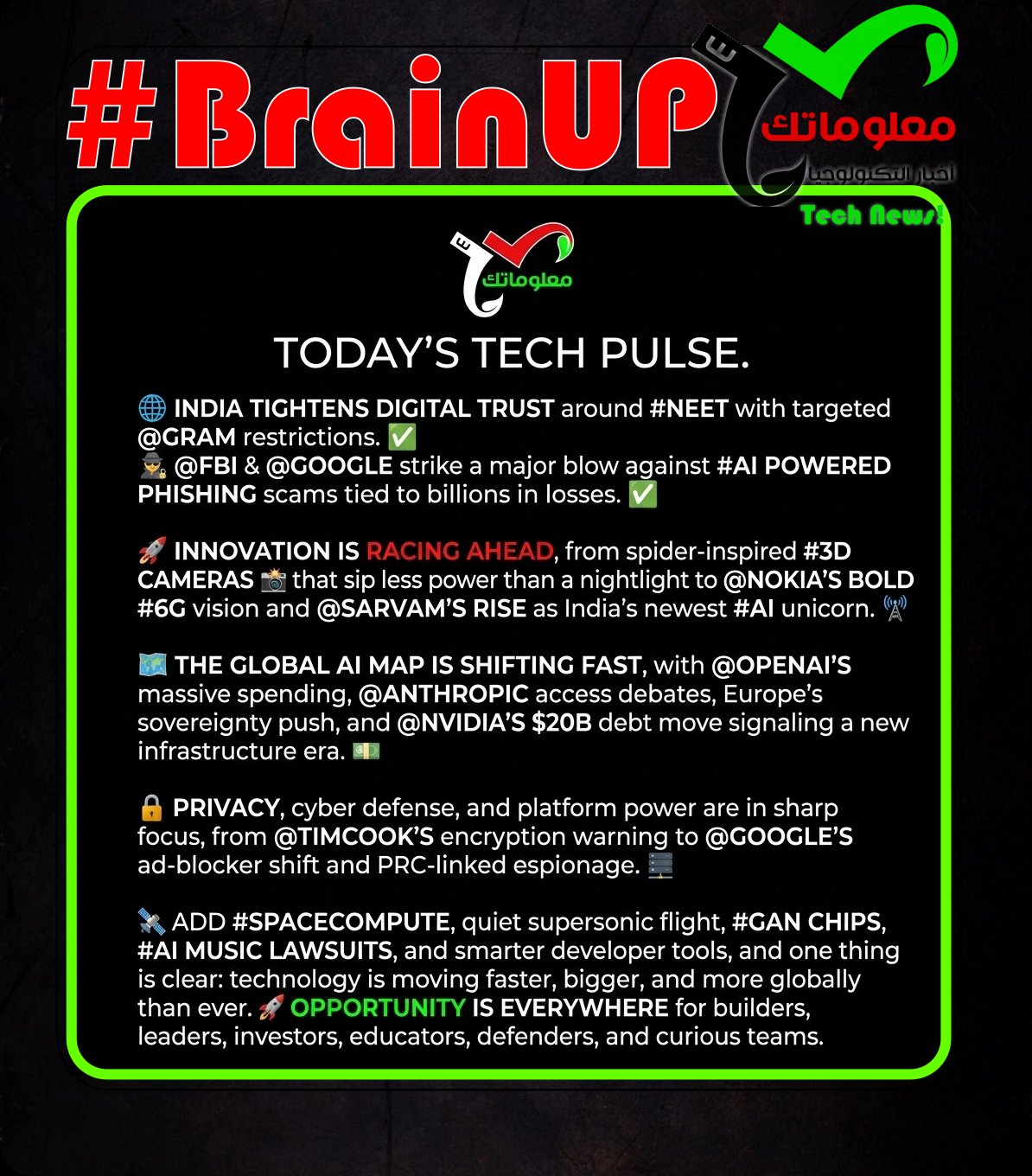
#BrainUp Daily Tech News – (Tuesday, June 16ᵗʰ)
Welcome to today’s curated collection of interesting links and insights for 2026/06/16. Our Hand-picked, AI-optimized system has processed and summarized 35 articles from all over the internet to bring you the latest technology news.
As previously aired🔴LIVE on Clubhouse, Chatter Social, Instagram, Twitch, X, YouTube, and TikTok.
Also available as a #Podcast on Apple 📻, Spotify🛜, Anghami, and Amazon🎧 or anywhere else you listen to podcasts.
1. Telegram temporarily restricted in India ahead of NEET re-exam; NTA welcomes Centre’s move
Telegram has been temporarily restricted in India until June 22, 2026, ahead of the June 21 #NEET (UG) 2026 re-examination, as the government moves to curb fake paper circulation and exam fraud. The #NTA said @MeitY, acting on its recommendations, issued directions under Section 69A of the #InformationTechnologyAct, 2000, and also directed Telegram to disable in India its message-editing feature for already posted content until June 30, citing misuse of editing older messages after exams to fabricate “paper leak” evidence. The agency said the restrictions were a calibrated, narrowly tailored step for the exam window, taken after coordinated takedowns and other intermediate measures failed to adequately stop misinformation and cheating rackets. It added that @I4C under the Ministry of Home Affairs has coordinated monitoring and removals of many Telegram accounts advertising fraudulent services, and flagged channels demanding payments from students by falsely promising access to the re-exam paper, reiterating that no paper exists outside the secured examination chain. Overall, the measures are presented as targeted actions to protect exam integrity, public order, and candidate safety while minimizing broader disruption.
@FBI, @Google, and @Lumen Technologies say they dismantled a China-based phishing-as-a-service operation called Outsider Enterprise by seizing servers and payment wallets and triggering a civil lawsuit. Sold through a Telegram bot for as little as $88 per week, the kit required no technical skill and let subscribers deploy scam pages from 290-plus templates impersonating banks, delivery services, government agencies, DMVs, the U.S. Postal Service, and toll systems like E-ZPass, while capturing data in real time and prompting victims for SMS codes, PINs, and other #2FA approvals. Google alleges the operators coached customers to prompt #Gemini to generate phishing page HTML by framing requests as a harmless “gift redemption page,” then importing that code back into the Outsider tooling to expand template variations. The @FBI links the platform to about 3.87 million stolen credit cards and an estimated $1.9 billion in losses since July 2023, while Google cites hundreds of thousands of victims and 2.5 million scam texts sent to Android users over two weeks in May. Under Operation Ghost Hook, part of Operation Riptide, authorities seized admin domains, a Shopify storefront, and roughly $100,000 in USDT, and Google is pursuing claims including #RICO and trademark infringement despite noting extradition from China is unlikely.
3. Jumping spiders inspire wildly efficient 3D camera
Researchers at Northwestern University created #SpiderCam, a highly energy-efficient #3D camera inspired by how jumping spiders judge distance with multiple retinal layers that capture simultaneous images at different focus levels. Like the spiders’ vision, the camera takes two versions of the same scene with subtly different focus, then a custom algorithm converts differences in blur into real-time depth measurements. Presented June 7 at the Computer Vision Foundation’s Conference on Computer Vision and Pattern Recognition, the prototype generates depth maps at 32.5 frames per second while using 624 milliwatts, under one watt total, less than a standard nightlight. By shifting depth sensing from computationally heavy, hardware-intensive methods to blur-based processing on an energy-efficient customizable chip, it targets resource-constrained uses. The approach could enable battery-powered gadgets like assistive devices, wearables, robots, drones, and #augmentedReality systems, and the team plans to improve it and integrate it into small robots and wearable devices.
4. Exclusive: OpenAI Losses Increased Nearly 8X in 2025, With Spending Hitting $34 Billion
Audited financial documents viewed by the publication and independently verified by the Financial Times indicate that OpenAI’s losses surged in 2025, with total costs and expenses reaching $34 billion and a net loss attributable to the company of about $38.53 billion. In 2024, OpenAI reported $3.7 billion in revenue against $12.48 billion in total costs and expenses, resulting in a net loss attributable to the company of $5.09 billion, after a $3.74 billion amount categorized as “net loss attributable to noncontrolling members capital.” In 2025, revenue rose to $13.07 billion but expenses expanded sharply, including $7.5 billion cost of revenue, $19.18 billion #ResearchAndDevelopment, $5.73 billion sales and marketing, and $1.57 billion general and administrative, producing a $20.92 billion operating loss; the year also included a $41.55 billion loss tied to fair value changes in convertible interests and warrant liability associated with converting from nonprofit to for profit. The statements show OpenAI reduced a stated net loss of $60.35 billion down to $38.53 billion via allocations to “noncontrolling members capital” ($17.87 billion) and “redeemable noncontrolling interests” ($3.95 billion), and ended 2025 with just over $50 billion in assets, nearly half in cash. The documents also report 2025 payments to OpenAI of $867 million from @SoftBank and $303 million from @Microsoft, while OpenAI paid @Microsoft $17.2 billion in total expenses, including $10.59 billion booked under #ResearchAndDevelopment and additional charges across cost of revenue, sales and marketing, and general and administrative items.
5. Why Nokia thinks it can win the 6G race
Nokia is betting it can stay competitive in the next era of connectivity by shifting toward #AI driven network infrastructure, #6G, and a more software centric future. The piece notes that as #AI transforms how networks are built and managed, the Finnish telecom giant aims to help shape what comes next after helping define the mobile era. It also highlights intense competition from rivals including Huawei and @Ericsson, with more than $200 billion in market value described as being at stake. CNBC frames this push as Nokia’s most ambitious reinvention yet and points viewers to a video explaining the company’s strategy and prospects in the race for future global connectivity. The segment is presented as the third installment in CNBC’s “Built for Billions” series on Nokia, following earlier parts on how the company makes money today and why it missed the smartphone shift.
Sarvam has become India’s newest AI unicorn after raising $234 million at a $1.5 billion valuation, reflecting a growing push for #AI sovereignty and greater control over critical #AI technologies and computing infrastructure. The Series B round is led by HCLTech, contributing $150 million, with participation from Bessemer Venture Partners and existing backers Khosla Ventures and Peak XV Partners, and Sarvam aims to raise $300 million total. The Bengaluru startup is building a full stack business across model development, inference infrastructure, and enterprise applications, including open source 30B and 105B parameter models designed for Indian languages, and deployments in banking, insurance, government services, and defense. Sarvam plans to pair its models with HCLTech’s enterprise relationships and engineering capabilities, while using the new capital to research next generation models for agentic, coding, and cybersecurity uses and to expand compute access, amid concerns highlighted by @Anthropic restricting foreign access to some of its latest models under U.S. government orders. Sarvam says its platform is already operating at scale, including over 2 million daily conversational interactions, about 10 million daily API calls, 500,000 hours of monthly speech transcription, document AI digitization of more than 35 million pages, and multilingual voice agents that collected data from 17 million farmers for India’s Ministry of Agriculture and Farmers Welfare.
7. DOJ Lawyers Argue xAI Is ‘Vital’ for National Security in NAACP Lawsuit
The US #DepartmentOfJustice intervened to help dismiss an #NAACP lawsuit seeking to halt xAI’s use of unpermitted natural gas turbines at its Colossus 2 data center in Southaven, Mississippi, arguing that shutting them down would threaten American national, economic, and energy security by cutting power for #AI supporting US military operations. The NAACP says xAI is violating the #CleanAirAct and endangering public health, citing increased risks of asthma attacks and heart disease in communities already burdened by pollution, and it asked for a preliminary injunction to stop the turbines. DOJ filings claim only four AI models, including xAI’s Grok, support mission critical work on Secret and Top Secret networks, and a declaration from @CameronStanley of the #DepartmentOfDefense says the military relies on Grok’s Gov model for vital missions, including recent strikes against Iran, making continued turbine power essential. The dispute also centers on whether state agencies can allow a year of turbine operation without permits, which the NAACP argues conflicts with #EPA regulations, and documents obtained by the Southern Environmental Law Center indicate the Colossus 2 site expanded from 27 to 57 unpermitted turbines by mid May. SELC estimates this expansion raised emissions since April by 111% for nitrogen oxides, 83% for PM2.5, and 88% for formaldehyde, intensifying the clash between national security claims and alleged environmental and health harms.
8. Exclusive: OpenAI Losses Increased Nearly 8X in 2025, With Spending Hitting $34 Billion
Audited financial documents reviewed by the publication and independently verified by the Financial Times indicate @OpenAI’s losses surged in 2025 as spending rose sharply. In 2024, it reported $3.7B revenue and $12.48B total costs and expenses, producing an operating loss of $8.78B and a net loss attributable to the company of $5.09B after $3.74B was recorded as “net loss attributable to noncontrolling members capital.” In 2025, it reported $13.07B revenue and $34B total costs and expenses, an operating loss of $20.92B, plus a $41.55B loss tied to conversion from non-profit to for-profit due to fair value changes in convertible interests and warrant liability, resulting in a $60.35B net loss that was reduced to a $38.53B net loss attributable to the company by allocating $17.87B to “noncontrolling members capital” and $3.95B to “redeemable noncontrolling interests.” The documents also show payments to @OpenAI from @SoftBank ($867M) and @Microsoft ($303M) in 2025, while @OpenAI paid @Microsoft $17.2B for services across #researchAndDevelopment, cost of revenue, sales and marketing, and general and administrative categories, and ended the year with just over $50B in assets, nearly half in cash.
9. The pitch for a European AI ‘Plan B’ | Euractiv
A coalition of European AI experts argues that Europe’s “#Plan B” for #tech sovereignty should prioritize a massive buildout of #AI compute and data centers in Europe, even in partnership with American tech giants, rather than mainly funding European frontier model efforts. The push follows a Trump administration order that led @Anthropic to block access to its latest models for non US nationals, including Europe, shortly after launching a more secure version of its Mythos model, which European politicians cited as a wake up call to back domestic models like #Mistral. In the “Europe 2031” scenario report, the authors warn the US and China could dominate the global economy within five years via leading #AI models, and they caution that public sector attempts to bankroll European AI model development would likely waste money and political capital given the billions American firms are investing in data centers, training, and talent. They also downplay Europe’s leverage via @ASML, with one author arguing export restrictions would not quickly affect the US, and instead propose attracting US giants by building sufficient European compute to gain leverage over their future moves. Delivering this would require mobilizing public and private capital at a scale “not attempted in peacetime,” creating special build zones akin to the Commission’s planned “data centre acceleration zones” under the #Cloud and AI Development Act, plus targeted energy expansion and radically streamlined permitting to ensure Europe has technological capacity and bargaining power as AI geopolitics intensify.
10. Europe’s AI Sovereignty Problem Runs Far Deeper Than Frontier Access
Europe’s #AI sovereignty challenge goes beyond access to frontier models because much of Europe’s AI market is structurally entangled with dominant US ecosystems, so simply boosting supply and demand may deepen dependence rather than reduce it. The article points to the US administration ordering @Anthropic to cut off foreign access to two advanced models as a wake-up call for Europe about how quickly access can be restricted, then examines “application-layer” success stories that rely on US stacks. It uses Swedish startup Lovable as an example: despite rapid growth and a multi-billion valuation, it routes prompts to @Anthropic and @Google models and expands within hyperscaler environments, including a deepened #GoogleCloud partnership and integration into #GoogleWorkspace. The piece argues this creates strategic risk because platform suppliers can become direct competitors, illustrated by screenshots suggesting @Anthropic built an in-chat app builder similar to Lovable’s core offering and by the launch of Claude for Legal affecting startups built on Claude, a dynamic known as “sherlocking” after @Apple. The takeaway is that European AI success at the application layer can still translate into fragile sovereignty if core capabilities, distribution, and competitive control remain anchored in US foundation models and cloud ecosystems.
@Tim Cook argues that forcing #encryption backdoors into consumer communications is dangerous because any special access created for law enforcement can also be found and abused by criminals. Citing his 2015 remarks at the EPIC Champions of Freedom event, he criticized Silicon Valley rivals for collecting and monetizing user data, while warning that undermining privacy in services like #iMessage and #FaceTime would expose users to exploitation. His analogy is that a key hidden for the cops is still a key that burglars will search for, and in cybersecurity terms it becomes a matter of when, not if, attackers can take advantage of such weaknesses. The piece links this view to ongoing policy pressures, including concerns about the UK’s #OnlineSafetyAct enabling scanning of encrypted messages, alongside mixed US signals such as 2024 guidance encouraging encrypted communications after a major cyberattack. Overall, the article frames Cook’s position as a continued defense of #end-to-endEncryption against government demands that could erode privacy and security, especially as AI-enabled cybercrime grows.
12. Dozens walk out as Google boss addresses Stanford graduates
Dozens of students walked out of Stanford University’s graduation ceremony as @Sundar Pichai, @Google’s CEO and a Stanford alumnus, began his keynote, highlighting campus backlash tied to the company’s government-related #AI work and other political concerns. BBC video showed protesters holding signs such as “ICE spies with Google AI,” and while the exact number is unclear, SFGate estimated as many as 200; some attendees also waved Palestinian flags and student groups had previously urged protests over Google’s ties to Israel. Pichai largely avoided discussing #AI and joked about anticipated protests, while Google did not respond to the BBC’s request for comment. The incident fits a broader pattern of US commencement disruptions where speakers mentioning #AI face boos and jeers, including @Eric Schmidt at the University of Arizona, and speakers at the University of Central Florida and Middle Tennessee State University. Together, these episodes reflect growing student unease about #AI, including fears about jobs and the role of major tech firms in government and geopolitical conflicts.
13. Anthropic Sued Over Limits on Its $200-a-Month AI Plans
Anthropic, an AI startup, faces a lawsuit for allegedly restricting user access in its $200-a-month AI service plans, frustrating customers who pay for higher usage. The lawsuit claims that Anthropic imposed arbitrary limitations that contradict their advertised terms, causing concern among subscribers about service reliability. This dispute highlights challenges in the emerging AI service market, where companies balance resource costs and user demands amid rapid growth. The outcome may influence how AI firms structure subscription models and handle usage caps. Overall, the case underscores tensions in #AI monetization strategies as user expectations rise.
14. Scientists shut down cancer DNA repair to overcome drug resistance
Researchers report that the small molecule #UNI418 can undermine cancer drug resistance by shutting down key #DNA repair capacity used to survive therapy-induced damage. In cell-based screening for replication stress regulators, UNI418 caused significant drops in homologous recombination proteins #RAD51 and #CHK1 by activating the #Cul4A ubiquitin ligase complex, which marks these repair factors for destruction. Mechanistically, UNI418 interfered with signaling in inositol phosphate metabolism, reducing #IP6, which normally helps restrain Cul4A activity, thereby promoting degradation of DNA repair machinery. When combined with a #PARP inhibitor, UNI418 helped previously resistant cancer cells respond to treatment again, suggesting a strategy that tackles resistance by destabilizing repair proteins rather than targeting mutations. The work links restoring sensitivity to PARP inhibition with pharmacologically induced loss of homologous recombination components.
15. Nvidia plans to raise at least $20 billion in its first debt sale since start of AI boom
@Nvidia plans its first investment grade bond sale since 2021, aiming to raise at least $20 billion as it continues to benefit from the #AI boom. An SEC filing disclosed the offering without an amount, but sources said it could be closer to $25 billion, following the company’s earlier note that it could issue up to $25 billion of unsecured commercial paper. The company said proceeds will be used for general corporate purposes, including repaying and refinancing existing debt, as it carries about $7.5 billion in long term debt and $1 billion in short term debt. The move comes as other AI linked tech firms also tap capital markets, while Nvidia’s growth since #ChatGPT has been fueled by surging demand for its #GPUs, alongside an expanded shareholder return program that includes a higher dividend and an $80 billion buyback plan. The planned debt raise reflects Nvidia’s much larger scale and cash generation than in 2021, with fiscal 2026 sales of $216 billion and quarterly free cash flow of $49 billion, supporting its stated goal of returning roughly 50% of free cash flow to shareholders.
16. China scolds e-commerce giants
Chinese regulators publicly rebuked major e-commerce platforms for misleading marketing tactics ahead of 618, intensifying scrutiny of the sector’s competitive behavior. The action hit shares of @Alibaba and @JD.com and followed earlier regulatory instructions to avoid an aggressive price war that has squeezed profits and complicated Beijing’s fight against #deflation. Officials have aimed since 2024 to curb #involution among e-commerce players, and a strategist said the notable shift is regulators’ increased willingness to publicize enforcement. The criticism also comes as Alibaba’s Taobao and JD.com roll out #AI features, with a tech newsletter noting some AI agents provided misleading product information. Overall, the warning signals a tougher, more visible regulatory posture as platforms ramp up promotions and new tools for a key shopping event.
17. White House’s Anthropic block set to dominate G7
The @White House decision to block foreigners’ access to @Anthropic’s cutting-edge #AI model is expected to dominate the #G7 summit opening in France. The move sparked concern among Western allies: the EU said it reinforced the need for “technological sovereignty,” and Canada’s leader warned it highlighted the risks of dependence on a small cluster of powerful US tech firms. The episode underscores how “middle powers” have fallen behind in the AI race as the US and China pull ahead, with US efforts in particular far outscaling transatlantic rivals. As an illustration of the gap, France’s leading AI firm, @Mistral, is reportedly seeking funding at about a $23 billion valuation, roughly 40 times smaller than @Anthropic’s estimated valuation. This imbalance and the new access restrictions are likely to shape G7 discussions about AI capability concentration and national or regional control over critical technology.
@Mark Cuban argues that job seekers should focus on small businesses because they create roughly 60% of new jobs each year and he expects that share to grow. He says #AI skills can be a practical entry point since they make it easier and faster for mom-and-pop firms to compete with larger corporations, and he contends that small companies use #AI to do tasks they previously lacked time for rather than simply cutting headcount. Cuban also notes that only about 14% of businesses have embedded #AI across their organizations and many lack dedicated AI budgets, leaving much of the economy underusing AI and creating opportunity for candidates who can implement it. He advises learning not just AI concepts but how to deploy them in companies to gain competitive advantage, adding that small firms often lack AI depth and need help from newer graduates. He also suggests small-business roles can accelerate skill development and repeats his view that it can be easier to get hired by a small company than a large one.
19. Anthropic’s model restrictions are a win for Europe’s top AI startup
US export controls restricting access to @Anthropic’s cybersecurity-focused models are portrayed as an opening for France’s @Mistral, which has been arguing that Europe needs #AI sovereignty and independent infrastructure. US officials imposed controls on Mythos 5 and Fable 5 over national security concerns, and the rules block foreign nationals from accessing the models, prompting @Anthropic to suspend access altogether and raising questions about who controls frontier AI. @Arthur Mensch has warned that relying on US providers leaves Europe without the ability to “turn it off or turn it on,” and @Mistral has pushed open-weight models that customers can run on their own infrastructure and customize with their data. The article notes European officials and enterprise customers echo concerns about data location and dependence, even as @Mistral trails @Anthropic in valuation and other metrics. The restrictions, it argues, make #AI sovereignty more tangible by highlighting that control often sits with the provider and its government.
20. Muon Space announces Condor-Ultra orbital platform for up to 100kW compute
Muon Space announced Condor-Ultra, a “Starship-Class Spacecraft Platform” intended to serve #orbital data centers with upgraded thermal and networking architecture and a pathfinder mission targeted for 2028. The company says the platform can provide 20kW of power, 25Gbps connectivity via #Starlink, 18sqm of nadir payload area, and support a 400kg payload for constellations of hundreds to thousands of satellites, with higher-powered variants reaching up to 100kW, and it is optimized for stackable mass-deployment from #SpaceX Starship. @Jonny Dyer said the next decade’s infrastructure missions, including distributed orbital compute, need a managed, integrated platform that is powerful, stackable, and cost-effective to scale, while the company highlights integration of #Nvidia Space-1 Vera Rubin for in-space AI inferencing and feasibility studies with firms pursuing large-scale AI infrastructure in orbit. The article frames Muon’s strategy as a “picks and shovels” play, selling the satellite bus and its large solar power capability rather than addressing how space compute will be monetized, and notes that key engineering details such as how 20kW power and the thermal system will be achieved are not provided. It also situates Condor-Ultra alongside Muon’s prior SDA #HALO work, including $60 million in customer funding, and its 2025 MuSat XL platform planned for 2027, which Condor-Ultra appears to surpass in scope with limited feasibility information.
21. NASA’s Quiet Supersonic Jet Just Hit Another Major Milestone
@NASA’s X-59 #quiet supersonic jet reached Mach 1.4 in a mission-conditions flight meant to match the speed and altitude it will use to collect public feedback on its expected “sonic thump,” a quieter alternative to a traditional sonic boom. After first breaking the sound barrier on June 5 at about Mach 1.1 over California’s Mojave Desert, the aircraft flew on June 12 at roughly 925 mph and about 55,000 feet, conditions planned for future flights over selected U.S. communities. During early supersonic flights, a @NASA F-15 chase plane monitored the X-59 and also masked its noise, and upcoming flights will add a shock-sensing probe on the F-15 to measure the X-59’s shock wave signature and gather early performance data. The program still faces months of #envelope expansion testing and an #acoustic validation phase to confirm the aircraft produces a thump rather than a boom, before community overflights begin. Backed by a near-decade effort and a $247.5 million @Lockheed Martin contract, NASA aims to use these data to support new, data-driven noise standards that could eventually allow commercial supersonic flights over land.
China’s Supreme People’s Court upheld an injunction that bars @Infineon from selling certain disputed #GaN power products in mainland China, delivering a key win to rival @Innoscience in a multi-region patent fight. The ruling affirmed a May 27 decision from the Suzhou Intermediate People’s Court finding Infineon infringed two Innoscience invention patents, ordering it to stop selling, offering, and importing the products and to pay 10 million yuan in damages. The dispute is mirrored abroad: the U.S. International Trade Commission affirmed a finding that Innoscience infringed an Infineon patent and ordered import and sales bans, while a Munich court found infringement by Innoscience in 2025 with additional trials scheduled. This legal tug of war matters because both firms are on @Nvidia’s approved supplier list for #800V AI-rack power delivery, where #GaN helps enable higher-voltage rack architectures by reducing current and shrinking power stages. The decision also underscores the market stakes, with TrendForce citing Innoscience as 2024’s GaN power-device share leader and the China ruling coinciding with notable share price moves among related semiconductor companies.
@The Atlantic published four searchable databases showing that many millions of copyrighted songs have been used to train #AI music models. The databases include one with 12 million tracks, another with 9 million, and two more with about 100,000 songs each, and the accompanying reporting cites hit songs from @Taylor Swift and @Bad Bunny as examples. The article highlights ongoing legal fights against #generative AI music platforms like @Suno and @Udio, where companies have leaned on #fair use arguments for large-scale scraping, while a related publishing case struggled on copyright claims but found piracy allegations more persuasive, with outcomes still pending after an initial $1.5 billion settlement. These databases could give the music industry stronger evidence to pursue similar lawsuits, even as streaming services try with mixed success to block, detect, or label AI-generated tracks and scammers continue to post AI imitations of existing artists.
24. Cybersecurity experts don’t think Anthropic’s Fable 5 presents a unique threat
The Trump administration imposed #export controls on @Anthropic’s AI model #Fable 5 after reports from @Amazon and another researcher claimed it was jailbroken quickly, prompting Anthropic to shut off access while seeking a policy reversal. Multiple cybersecurity and AI experts dispute that the available research shows any meaningful circumvention of safeguards or any uniquely dangerous new #hacking capability. @Katie Moussouris said third party testing showed Fable 5 initially refused requests to analyze known vulnerable open source code, and that researchers used a multistep manual process to have it generate scripts to test vulnerability patches, which she argues reflects normal defensive workflows rather than a true guardrail bypass, and she noted later research has not found ways to bypass its hacking safeguards. She called broad restrictions on foreign sales heavy handed and misguided, citing her experience advising the #Wassenaar Agreement on dual use export controls. Even lawmakers supportive of stronger AI national security oversight, such as @Mark Warner, criticized the decision as lacking a transparent, risk based process and urged Congress to create a statutory framework for testing and approving frontier AI models with clear, consistent standards.
25. The US government’s Anthropic models ban was never about an AI jailbreak | TechCrunch
The article argues the U.S. government action that forced Anthropic to take its latest cybersecurity models offline looks less like a response to an #AI jailbreak and more like unilateral #government interference that could be reactionary, retaliatory, or both. The U.S. Commerce Department sent Anthropic a letter invoking an obscure #export_controls directive barring non-Americans, including some Anthropic employees, from accessing Fable 5 and Mythos 5 over an unspecified #national_security concern, prompting Anthropic to shut down both models for all customers to comply, without apparent court approval. Reporting cited by Axios suggests the order stemmed from “personality differences” between Anthropic and the @Trump administration rather than a technical defect, and researcher @Katie Moussouris said a described guardrail bypass in Fable 5, involving prompts like “review code” versus “fix this code,” should never have triggered export control and is not meaningfully fixable without weakening defensive utility. Moussouris and other security experts urged the administration to revoke the order, warning that removing advanced cybersecurity capabilities from network defenders is “dangerous,” and the piece frames the episode as a broader warning that U.S. tech companies can be swiftly shut down by government action. The incident is compared to past overly broad U.S. export policy in the 2010s that nearly outlawed legitimate security research, while the current directive is portrayed as especially heavy-handed and potentially retaliatory.
26. DARPA seeks swappable satellites to help with future star wars
DARPA has issued a request for information for its Rapid Reconstitution of Space Capabilities initiative, seeking ideas to restore US space functions quickly if satellites or supporting systems are disrupted by attacks. The agency cites space as an increasingly contested environment, pointing to threats such as anti-satellite weapons, jamming and spoofing, and cyberattacks, alongside reports of #ASAT demonstrations by Russia and China and observations by the US Space Force of apparent Chinese orbital maneuver experiments. As a benchmark, DARPA references the 2023 US Space Force tactically responsive space exercise #VictusNox, which launched a vehicle within 27 hours, and says it wants approaches that can reconstitute degraded operations in hours to weeks, including when demand surges. It is soliciting concepts like reconfigurable, #software-defined, multifunctional and multi-mission payloads, proliferated or mesh architectures, and rapid on-orbit deployment, and is open to proposals from US labs and private organizations. The effort is currently an ideas-gathering stage, framed as a strategic need to replace or augment orbital capabilities quickly in the face of potential future conflict in space.
According to @Google, a PRC-linked espionage group it tracks as #UNC6508 hid for more than a year inside multiple North American medical and military research networks, using custom malware to access data and search through Gmail inboxes. Google says the attackers hunted for defense and technology information, including drone-related topics and emails tied to major defense names, as well as medical research targets and the specific pathogen Chikungunya, a mosquito-borne virus linked in the article to an outbreak in China’s Guangdong province in July 2025. The company would not disclose the number of organizations compromised, but reported targeting across national, state, and private medical entities spanning clinical providers, academic centers, military health institutions, advocacy groups, and regulators. Incident responders detected the activity in early 2025, believe it dates back to at least 2023, and said victims they identified were notified while suspecting additional unseen compromises. Google links the intrusions to exploitation of externally facing #REDCap servers, with the earliest described case in September 2023, followed after about three months by deployment of custom malware called #InfiniteRed designed to capture legitimate REDCap login credentials and maintain persistent access.
28. Feds freaked over Fable 5 after simple ‘fix this code’ prompt, not jailbreak, says researcher
@Katie Moussouris of Luta Security says the “jailbreak” cited in the Trump administration’s decision to restrict Anthropic’s advanced models was not a true #guardrail bypass, it was a basic prompt that asked the model to “Fix this code.” She says she was the only outside expert to read the third party report, which described researchers supplying Fable 5, Mythos, and Claude Opus with vulnerable open source code (including known #CVE issues and intentionally flawed code), first asking for a security review (which Fable 5 refused), then requesting a fix, after which the model produced patches and, with additional prompts and manual steps, scripts to test those patches. The US government issued an #export control directive suspending access to Fable 5 and Mythos 5 for any foreign national, and Anthropic disabled both models for all customers to comply, prompting Moussouris and over 100 cybersecurity leaders to urge reversal in an open letter. Moussouris argues these models were performing normal defensive “find, fix, and test” workflows and that restricting them harms defenders more than attackers, especially since the US cannot meaningfully control access to open weight or foreign alternatives that are rapidly improving. She also notes the broader context of US firms, including Anthropic and @Google, accusing China based rivals like DeepSeek of #distillation attacks, and warns that pulling top capabilities from defenders is dangerous as adversaries advance.
29. Anthropic Accused of Misleading Users Amid Soaring AI Costs in New Lawsuit
@Anthropic faces a proposed class action alleging it misled customers about the value of its Claude Max 5x and Max 20x plans as #frontierAI costs surge. The complaint, filed in the Northern District of California by Washington, D.C. user Karl Kahn, says the $100 and $200 per month subscriptions advertised as providing 5x and 20x the token allowance of Claude Pro appear to have much lower real limits, and that the company’s pricing makes it hard to tell how tokens are being consumed. It cites emails sent to Max subscribers in July outlining weekly token expectations that were allegedly far below the advertised usage, and @Anthropic declined to comment. The dispute highlights how unclear #tokens and usage windows can be for translating AI usage into predictable spending, especially as more #agentic models and long running tasks can rapidly burn allowances, prompting broader enterprise cutbacks and interest in lower cost or #open-source alternatives. Competitors are positioning cheaper options against Claude, including @Microsoft’s MAI-Thinking-1, which its AI lead @MustafaSuleyman said performs comparably to Claude Opus 4.6 at a lower cost, reflecting the market pressure created by affordability complaints.
30. This Cop Scanned A Woman’s License Plate 179 Times And Somehow That Was Allowed
A Milwaukee police officer resigned after investigators found he used #automated license plate readers (#ALPRs) to track a woman he was dating, scanning her license plate 179 times in about two months, a case that highlights broader risks of vehicle-surveillance misuse. The searches were uncovered after the woman used the public transparency site #HaveIBeenFlocked to see whether her car had been scanned, and investigators concluded the repeated lookups were logged as investigations despite allegedly lacking any legitimate criminal purpose. The article argues this is not just one instance of misconduct but evidence that systems designed to find stolen cars and dangerous suspects can be repurposed into personal monitoring tools with limited oversight. It notes #ALPRs have rapidly expanded nationwide, collecting plate numbers with time and location data from cameras mounted on cruisers and infrastructure, and critics warn the resulting surveillance power is hard to police. Citing the @Institute for Justice, the piece says at least 14 documented cases involve officers accused of abusing plate-reader databases to stalk or monitor people for personal reasons, suggesting known cases may understate the scale because such abuse is difficult to detect.
The latest update to #WindowsSubsystemForLinux, positioned as WSL 3, is an architectural pivot that makes Linux on Windows more capable, especially for developers running Linux-based #AI, containers, and dev workloads. At Microsoft Build 2026, @Microsoft introduced preview #WSLContainers and emphasized that WSL remains a free Windows 11 component updated independently through existing WSL channels, while shifting how Linux processes reach hardware to reduce layers between Linux user space and Windows devices. Microsoft says WSL 3 delivers “GPU and NPU without the performance tax” by moving from WSL 2’s lightweight VM overhead to a new paravirtualized VM approach that provides VM isolation while giving more direct access to native hardware, enabling Linux containers to run directly on Windows without extra configuration. This redesigned execution path is intended to bring #PyTorch and #TensorFlow performance in WSL closer to native Linux, with notable gains on #CopilotPlus PCs and systems based on Qualcomm Snapdragon X Elite, Intel Meteor Lake, and Lunar Lake, while AMD support is not available initially. Even so, the article notes a pure Linux desktop remains best for AI developers, but WSL 3 is another step that makes staying on Windows more practical for Linux-centric work.
32. Google Chrome’s next update will mark the end of popular ad blockers
Google Chrome is completing its shift to #ManifestV3 by removing the last practical workaround that let users keep #ManifestV2 extensions running, which is expected to end support for popular ad blockers like uBlock Origin in Chrome. CyberNews highlighted a Chromium commit that removes the “kExtensionManifestV2Disabled” flag, described as dead code now that Chrome no longer supports MV2, and a Google engineer said MV2 functionality is being removed due to complexity, tech debt, and security risks, including MV2 specific bugs. The timeline reported across sources in the article says Chrome 150 (expected June 30, 2026) will remove the primary workaround, with only an impractical DevTools method remaining, and Chrome 151 (expected July 2026) will remove remaining MV2 related flags such as ExtensionManifestV2Unsupported and AllowLegacyMV2Extensions. The change is framed as the final closure of MV2 in Chrome after earlier impacts in 2024 tied to MV3’s new permissions structure and privacy focus. Because these flags live in Chromium, other #Chromium based browsers may be affected, with Neowin suggesting @Microsoft Edge and Opera are likely to follow, though the Google comment notes other browsers can choose to continue supporting MV2.
33. Xbox Project Helix Could Be Sold Through Klarna and PayPal Payment Plans Due to Rising Costs
A leak suggests @Microsoft may add a #BuyNowPayLater checkout option to the Xbox website, potentially using @Klarna and @PayPal, which has fueled speculation about how Xbox could handle rising costs for future hardware like Xbox Project Helix. Leaker Redphx said backend website code references “Buy now, Pay later” and shows language offering “Pay in 4” interest free bi weekly payments or financing spread up to 24 months. The rumor gained traction after Xbox CEO @AshaSharma told Fortune that the industry may need “new models” because mass audiences may not be able to afford consoles that could cost thousands of dollars, making payment plans a plausible approach. The article notes this remains unconfirmed, and while the payment plan code appears real, it currently seems tied to the Xbox store rather than specifically to Project Helix.
34. Kali365 Security Warning Highlights Risks in Teams, Outlook, and OneDrive
Kali365 has issued a significant security warning concerning vulnerabilities in Microsoft Teams, Outlook, and OneDrive, which could expose users to potential cyberattacks. The alert details how attackers exploit these platforms through phishing and malware to gain unauthorized access to sensitive data, emphasizing the growing threat landscape in cloud-based collaboration tools. The vulnerabilities raise concerns about data privacy and organizational security, urging immediate attention to patch updates and enhanced cybersecurity measures. This warning underscores the critical need for users and businesses to stay vigilant and proactive in securing their digital environments against evolving threats. The Kali365 warning highlights the importance of continuous monitoring and adaptive security strategies in the age of remote work and cloud services.
35. Samsung Galaxy Book 6 Edge with Snapdragon X2 Elite is $2,100, only 16GB of RAM
Samsung introduced the Galaxy Book 6 Edge as its first Galaxy Book with #Qualcomm #Snapdragon X2 Elite, but the $2,099.99 price is positioned as hard to justify given the single, limited configuration. The laptop is offered only as a 16-inch “Gray Blue” model with 1TB storage and 16GB RAM, alongside an anti-reflective #AMOLED display, claimed 22-hour battery life, and ports including two USB-C, HDMI, microSD, USB-A, and a headphone jack. Samsung emphasizes #AI performance and Galaxy device integrations such as Storage Share, Multi Control, Second Screen, and Nearby Devices, even though the RAM spec is not highlighted in the announcement. The article argues the pricing looks especially steep versus Windows alternatives like the Lenovo Yoga Slim 7x with the same chipset and 32GB RAM for $1,899, and compared with @Apple’s MacBook Pro options that offer more RAM at higher or similar tiers, particularly recalling the Galaxy Book 4 Edge started at $1,349 two years prior. Samsung sells the Galaxy Book 6 Edge only through its website with immediate shipping and trade-in offers up to $390 that mainly apply to Galaxy Book 5 laptops.
That’s all for today’s digest for 2026/06/16! We picked, and processed 35 Articles. Stay tuned for tomorrow’s collection of insights and discoveries.
Thanks, Patricia Zougheib and Dr Badawi, for curating the links
See you in the next one! 🚀
