
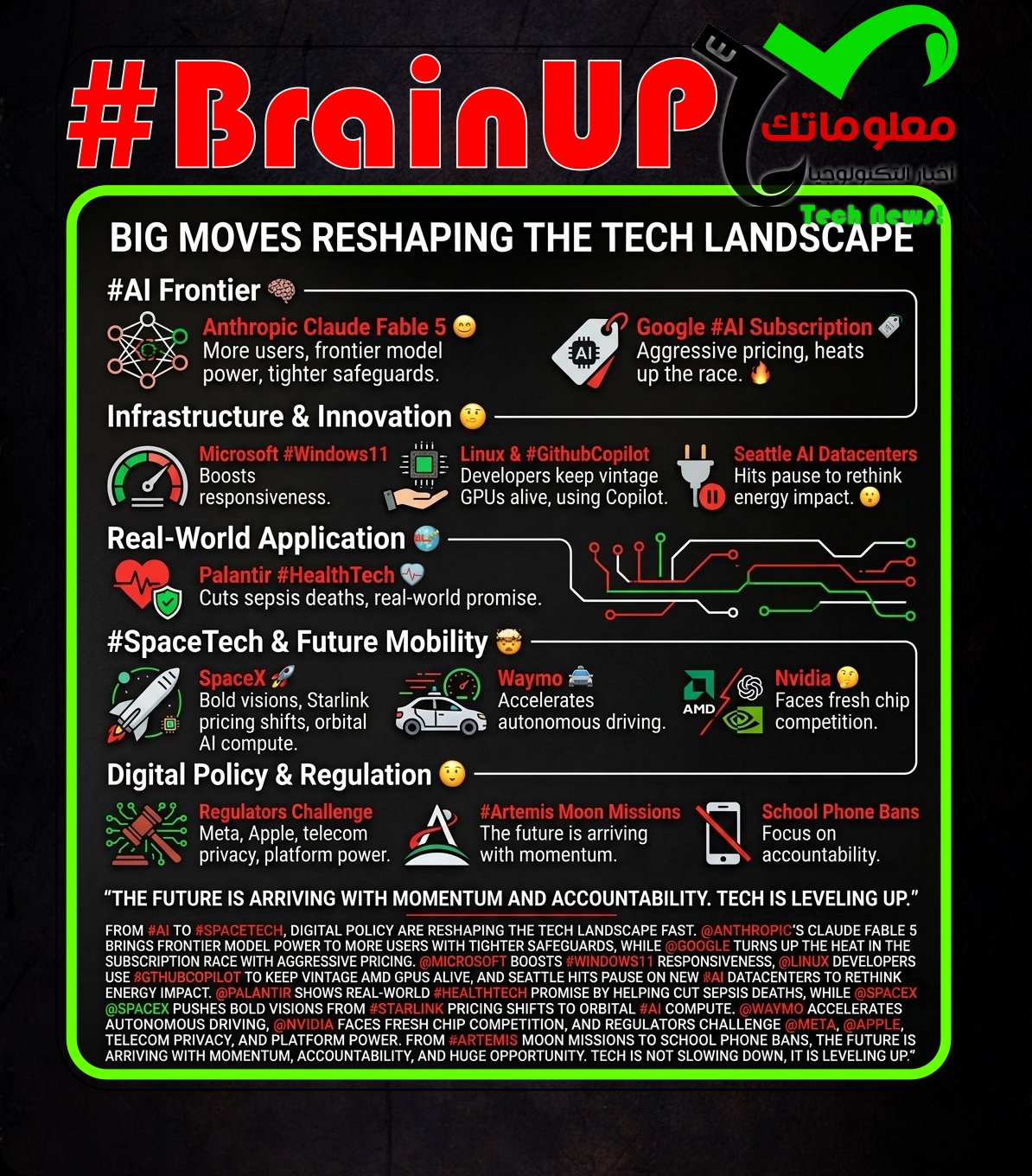
#BrainUp Daily Tech News – (Wednesday, June 10ᵗʰ)
Welcome to today’s curated collection of interesting links and insights for 2026/06/10. Our Hand-picked, AI-optimized system has processed and summarized 25 articles from all over the internet to bring you the latest technology news.
As previously aired🔴LIVE on Clubhouse, Chatter Social, Instagram, Twitch, X, YouTube, and TikTok.
Also available as a #Podcast on Apple 📻, Spotify🛜, Anghami, and Amazon🎧 or anywhere else you listen to podcasts.
1. Anthropic rolls out Claude Fable 5, but it’s available for a limited time
@Anthropic is rolling out Claude Fable 5, a new model in the same underlying class as its most powerful @Mythos models, after previously restricting Mythos due to concerns it could help attackers find and exploit software vulnerabilities. The company says it built stronger #guardrails so Fable 5 includes strict safeguards that block or divert sensitive queries, including offensive cybersecurity, biology, or chemistry, to its older model, Opus 4.8, while the unrestricted Claude Mythos 5 remains limited to a highly vetted group such as government cyberdefenders and certain life sciences researchers. Fable 5 is free for a limited time but is described as compute intensive and token hungry, with BleepingComputer observing around 1 million tokens consumed in 8 minutes and a $100 Max plan’s daily usage exhausted in about 9 minutes when using the new #Workflow system with high effort settings. Anthropic says it cannot offer Fable 5 as broadly as Opus 4.8 due to cost, but it is available to Pro, Max, and Enterprise customers until June 22 before switching to usage based pricing. The rollout reflects Anthropic’s attempt to balance broader access to frontier capability with risk controls and operational cost limits.
Linux graphics driver maintenance is starting to use #AI-assisted coding to keep older hardware supported, with work reported on the AMD #R600 driver stack for #Mesa. According to Phoronix, @Gert Wollny made 59 commits to the R600 #Gallium3D driver to clean up shader compiler code, and the refactoring notes cite @GitHub Copilot in auto mode as assistance for building the code. The article argues this approach helps address the reality that older drivers may be maintained by only a handful of people, while also noting the R600 driver targets AMD/ATI HD 2000 through HD 6000 GPUs from 2007 to 2010. It adds that @Linus Torvalds is allowing AI use when appropriate and that a policy requires proper tagging of AI-assisted contributions, with responsibility for bugs remaining on the human submitting changes. Separately, developers are discussing moving R600 into a legacy branch called “Amber2” to reduce risk of breakage in the main Mesa codebase as new features are added.
3. Seattle enacts year-long ban on new AI datacenters
Seattle’s city council unanimously approved a one-year moratorium on new datacenter construction as backlash grows against electricity-hungry #AI infrastructure in a major tech hub home to @Amazon and @Microsoft. Lawmakers said the pause will give the city time to draft regulations aimed at limiting environmental risks and potential increases in residents’ electricity bills, and to assess whether datacenters are an appropriate use of urban land, possibly adding requirements like investments in local transit and housing. The move accelerated after reporting that five proposed facilities could use up to a third of Seattle’s current electricity demand, alongside organizing by local tech workers and groups such as Amazon Employees for Climate Justice that generated nearly 100,000 emails to officials. A unanimously passed amendment still allows existing datacenters to seek expansions needing up to 20 megawatts of additional power, which activists warn could undermine the moratorium, while lawmakers argue it distinguishes civic-serving facilities from large-scale #AI-focused projects. Activists are now supporting similar campaigns in other Washington communities, and Mayor Katie Wilson said her administration will pursue state-level datacenter regulation in the next legislative session.
4. Windows 11’s CPU performance boost released today, enable it using these steps
Microsoft’s June 2026 Patch Tuesday update, KB5094126 (OS Builds 26200.8655 and 26100.8655), introduces the #LowLatencyProfile to accelerate core Windows 11 shell experiences like Start, Search, and Action Center, but it may not be enabled automatically even after installation. The feature works by having the CPU jump to maximum frequency immediately when Windows detects an interactive trigger, holding the boost briefly for about one to three seconds to render the UI, then dropping back to idle. This bypasses the usual scheduler ramp-up delay that can cause hesitation, especially on budget PCs and older hardware, while having minimal battery and thermal impact due to the short burst, aligning with the #RaceToSleep technique used by other operating systems. @Scott Hanselman is cited defending the approach as a standard responsiveness tactic rather than a lazy fix, with the biggest visible gains expected on mid-range and older devices and subtler changes on high-end systems. The article frames the update as a practical way to make everyday shell interactions feel faster, and notes that the first requirement is installing KB5094126 before checking whether the feature is enabled or force-enabling it.
5. Google just fired a warning shot in the AI subscription price wars | TechCrunch
Google intensified the U.S. #AI subscription price fight by cutting its entry-level Google AI Plus plan from $7.99 to $4.99 per month and doubling included storage from 200GB to 400GB, with the storage change rolling out over the next several days, according to Gemini subscriptions product lead @Vikas Kansal. Launched in January for individuals and students, AI Plus includes features such as video generation via Omni Flash, the Google Flow creative studio, and NotebookLM, while heavier users can pay more for AI Pro and AI Ultra. Goodwater Capital’s @Chi-Hua Chien framed the move as a signal that #AI infrastructure is entering a faster-than-expected commoditization era, arguing Google’s vertical integration, distribution, and bundling advantage can pressure margins for more pure-play providers. He compared the dynamic to prior tech shifts where infrastructure vendors were aggressively commoditized as customers prioritized cheaper delivery over the underlying plumbing. The article notes this price pressure has already been building in markets like India, where @OpenAI introduced ChatGPT Go at about $4.60 per month and Google later offered a sub-$5 AI Plus plan, and it suggests similar undercut-and-bundle logic is now being applied to U.S. consumers as companies like #OpenAI and #Anthropic consider public markets.
6. Palantir Software Halves Sepsis Deaths at Hospital in Tampa
The application of Palantir’s data integration software at Tampa General Hospital has resulted in a 50% reduction in sepsis-related deaths. By integrating disparate health data, the software enables earlier diagnosis and intervention for sepsis patients, which is crucial given the condition’s rapid progression. This success demonstrates how advanced technology can significantly improve patient outcomes in critical care settings. The case underscores the potential for innovative #healthtech solutions to transform hospital protocols and reduce mortality rates. Palantir’s approach illustrates the growing impact of data-driven tools in enhancing healthcare delivery.
7. Starlink charges $10 monthly hardware fee in move away from one-time purchases
#Starlink is shifting Residential customers from buying equipment up front to renting it for $10 per month, while also raising monthly service prices by $5 to $10. Ordering pages now show $0 upfront hardware cost plus a $10 monthly kit fee for the terminal and router, alongside service tiers priced at $55 for 100Mbps, $85 for 200Mbps, and $130 for the “Max” plan up to 400Mbps, with optional professional installation for $199 or included with Max. A support article says rentals are available “in select countries,” limited to Residential plans, renters cannot pause service, and customers can switch to ownership by filing a support ticket, while PCMag reports the rental fee is appearing for new customers in countries including the US, Canada, the UK, France, Australia, and Mexico. The move follows years of changing hardware pricing and promotions, from a $499 fee at launch in 2020 to $599 in 2022 and later regional pricing and “free hardware” offers tied to higher monthly charges, suggesting @SpaceX’s broadband unit is continuing to experiment with pricing as it seeks revenue growth. For customers, the rental may cost more over time, PCMag estimates $360 over three years versus retail purchase prices like $349, and Starlink notes users with an existing kit can avoid the fee by entering a device identifier at checkout.
8. Claude Fable 5 vs Opus 4.8: Real Differences Tested
Claude Fable 5, released June 9, 2026, is the first publicly available Mythos-class model from @Anthropic, offering higher coding and analysis performance than Claude Opus 4.8 but with higher cost and a built-in safety routing system. In a same-prompt test to generate a browser ping pong game, both models produced working HTML, but Fable 5 output a more polished, design-forward interface, while Opus 4.8 was functionally complete with a more classic, neutral arcade layout. Benchmarks and pricing reflect the tradeoff: Fable 5 scores 80.3% on SWE-Bench Pro vs 69.2% for Opus 4.8, exceeds 90% on Hex’s analytical benchmark, and is priced at $10 per million input tokens and $50 per million output tokens, double Opus 4.8’s $5 and $25. The session impact is visible immediately on claude.ai, with Fable labeled as using 2x usage and the example task consuming more session credits (109,035 vs 81,225) despite similar token counts (37,927 vs 38,587), leaving fewer messages remaining (13.9 vs 18.7). For #security and biology-related prompts, Fable 5 uses classifiers to auto-route high-risk queries to Opus 4.8, a constraint tied to Mythos being previously restricted due to cybersecurity capability and only accessible via the Project Glasswing controlled rollout.
9. The Apple Car Is Dead, and Waymo Just Bought Its Gravesite
@Apple’s #Project Titan has been canceled, and its former Arizona autonomous-vehicle proving ground has been bought by @Waymo to advance Waymo’s #robotaxi testing. County filings show Waymo, owned by @Alphabet, purchased the 5,500-acre Wittmann, Arizona site for $220 million from Route 14 Investment Partners, a shell company linked to Apple that bought it for $125 million in 2021. Waymo says the facility includes a 115-acre city course, a 35-acre vehicle dynamics area, a four-mile oval, and a freeway course, and will be used for controlled simulations, rider-only testing, motion control testing, and operational training to improve its #Waymo Driver system. The acquisition fits Waymo’s broader scaling push, including plans to cover more than 1,400 square miles across 11 cities and expand Phoenix-area production to tens of thousands of vehicles per year, while deploying its sixth-generation system in new Ojai robotaxis built on @Geely base vehicles and in @Hyundai Ioniq 5 SUVs. Waymo is also extending its ecosystem beyond driving by partnering with B2U Storage Solutions to repurpose old EV batteries for power-grid stabilization.
10. As Salesforce begins layoffs, here’s the standard severance package the company offers employees
As Salesforce begins a new round of layoffs, internal documents indicate its standard U.S. severance package can provide a comparatively generous landing for eligible employees versus some Big Tech peers. The policy bases severance on level, tenure, and age: director and senior director roles receive 13 weeks of base pay, senior managers and below receive 9 weeks, employees 60 and older receive an extra four weeks, and workers also get three weeks per year of service, with partial years counted as full years, plus six months of #COBRA coverage, or 12 months if 60 or older. Level-based and tenure-based payments are capped at 26 weeks total, or 30 weeks for those 60 and older. The layoffs were reported to have started Monday, citing people familiar with the matter and a California regulatory notice, amid concerns that #AI tools and agents could displace traditional software, including Salesforce’s core customer relationship management product, and the stock is down more than 30% this year. The article compares this package with recent severance terms at Oracle, Block, and Amazon, and notes Salesforce did not respond to requests for comment.
@SpaceX says it is building an 11-million-square-foot Gigasat factory in Bastrop, Texas to vertically integrate production for its orbital, space-based #AI data center satellites and ramp space compute quickly. In an internal interview posted on X on June 8, @Elon Musk said the site should start producing complete “AI satellites” by 2027, centered on the proposed AI1 design: a roughly 70-meter satellite with a large solar array rated at 250 W/m², double-sided vertical radiators, and a 150 kW peak compute payload. The campus is planned to make solar ingots and wafers, solar cells, PCBs, silicon-based electronic components, user terminals, gateways, and the satellites themselves, plus development, testing, logistics, and a high-volume production line. Musk said SpaceX is targeting an annualized rate of 1 GW/year of orbital AI compute by the end of next year and then scaling by an order of magnitude per year, implying over 6,000 AI1-class satellites per year for 1 GW, with an aspirational goal of 100 GW/year by 2030 and longer-term interest in terawatt-scale, solar-powered space computing. The article frames this ambition by contrasting it with the largest announced terrestrial projects cited, including @Meta’s Hyperion data center plan to scale to 5 GW by 2030.
12. Meta Changed Its Speech Rules. Then Threats Against Politicians Skyrocketed
After @Meta relaxed its speech and enforcement rules on Facebook, new research says abusive, racist, and violent comments aimed at US politicians surged. The @Center for Countering Digital Hate analyzed nearly 8 million comments on posts from 100 high-followed House members and found that comments violating Meta’s current rules for #violence and incitement rose from about 1,800 to 7,600, #hate speech from about 6,900 to 30,000, and #bullying and harassment from about 15,700 to 39,900 in the six months after the change, with threats against @Donald Trump more than doubling. The report cites gendered and racist abuse directed at lawmakers including @Jasmine Crockette and @Byron Daniels that was not removed, though many cited examples were deleted shortly before publication. Meta disputed that hateful conduct increased in 2025 and said it could not address the findings without the full research, while CCDH points to Meta’s 2025 transparency reporting showing proactive moderation enforcement was cut roughly in half, and a statement from Senator @John Curtis arguing reduced oversight predictably increases harm. The findings link the policy shift framed as #free speech to a measurable rise in threats and abuse toward elected officials on the platform.
13. Upstart chipmakers keep challenging Nvidia. This time it’s Microsoft-backed D-Matrix
Nvidia challenger D-Matrix says it is entering full production of its Corsair #AI inference chip, claiming it can run certain small inference workloads 10 times faster and at five times lower energy than a standalone #GPU from @Nvidia. Founded in 2019, D-Matrix has raised about $500 million at an around $2 billion valuation, with @Microsoft investing through its M12 venture arm, and CEO Sid Sheth says the company will not sell as it targets what he calls a “$1 trillion market in the making.” Sheth says Corsair begins shipping this month and that the company has commitments from hyperscalers, neoclouds, and frontier AI labs, with about 90% of customers in the U.S. and others in the Middle East and Southeast Asia, though he did not name buyers. Corsair’s approach tightly integrates memory and compute using #SRAM made at logic fabs such as #TSMC, aiming for low latency and lower power while avoiding the #DRAM and high-bandwidth memory supply constraints that affect GPUs. Analyst Stacy Rasgon said such chips are often used alongside Nvidia because different accelerators excel at different tasks, suggesting D-Matrix is trying to carve out a niche rather than directly replace Nvidia in all workloads.
Finland’s National Bureau of Investigation concluded its criminal probe into the Dec. 31 damage to two undersea telecommunications cables in the Gulf of Finland, identified four suspects, and referred the case to prosecutors to consider charges. Police say the cargo ship Fitburg dragged its anchor for several kilometers and cut cables owned by Elisa and Arelion Finland while traveling from St. Petersburg to Haifa, and the ship was seized from New Year’s Eve to mid-January during a joint Finnish and Estonian investigation that examined the vessel, the seabed damage site, and crew devices. The damage occurred in Estonia’s exclusive economic zone, and Finland is investigating suspected aggravated criminal damage, attempted aggravated criminal damage, and aggravated interference with telecommunications, while Finnish customs also found the ship’s steel cargo was subject to Russia-related #sanctions but did not open a criminal case because it entered Finnish waters only after authorities ordered the vessel to move. The referral follows another recent case in which Finland charged three officers of the Eagle S oil tanker with aggravated sabotage and aggravated interference with telecommunications after an alleged 56-mile anchor drag damaged five cables and caused about $70 million in repair costs. Finland has since set up a Baltic maritime surveillance center and points to #NATO’s Baltic Sentry patrols and monitoring software, while noting that anchor drags remain easy to carry out and that Finland has recorded at least seven major subsea infrastructure incidents since 2023.
@Salesforce is laying off employees tied to #Agentforce, its flagship #AI product, even as the company touts rising AI-driven growth and efficiency. According to Business Insider and a California WARN filing, cuts included roles connected to Agentforce, MuleSoft, and Marketing Cloud, with 86 positions eliminated across sales, general administration, and technology and product functions. The company did not say how many Agentforce workers were affected, what roles were cut, or whether AI productivity gains played a role. The move follows comments from CEO @Marc Benioff that AI is helping Salesforce ship more code without adding engineers and comes shortly after Salesforce reported Agentforce reached $1.2 billion in annual recurring revenue, up 205 percent year over year. The layoffs highlight tension between rapid #AI product momentum and investor questions about whether AI tools could erode demand for traditional business software, an area where Salesforce is strong.
16. High-severity vulnerability in Linux caused by a single faulty character
Researchers analyzed a high-severity Linux kernel vulnerability that lets an unprivileged user or process gain root due to a single incorrect exclamation point in the #nf_tables packet-filtering subsystem. Tracked as CVE-2026-23111, the bug introduces a #use-after-free by breaking deletion and rollback logic for verdict maps and their catchall elements, allowing a chain reference counter to be decremented arbitrarily and the chain freed while objects still reference it. @Exodus Intelligence reported its exploit can repeatedly trigger the flaw to leak the kernel base and heap addresses and hijack control flow, achieving over 99% stability on an idle system, and it worked on Debian and Ubuntu. The issue was fixed in the kernel in February and later backported to major distributions, with #FuzzingLabs and Exodus Intelligence publishing proof-of-concept exploits. The article notes this is one of several recent Linux privilege-escalation bugs and is especially dangerous when chained with other exploits to evade OS security defenses.
17. AI is supercharging cyberattacks—and most companies aren’t ready | Fortune
As companies adopt #AI, attackers are using the same technology to accelerate cyberattacks, forcing organizations to rethink security beyond just technical defenses. @Mayank Upadhyay of @Snowflake says enterprise attack surfaces generate too much data for humans to triage without #AI, and that traditional batch patching cycles cannot keep up now that widely accessible AI can scan codebases, generate exploits, and weaponize vulnerabilities in hours. Leaders argue defenders must fight #AI with #AI, citing @Anthropic’s Mythos model, which @Steve Schmidt says can help patch individual bugs and also eliminate whole classes of weaknesses, though it still needs experienced engineers to manage false alarms and maintain trust. The economics of attacks are also shifting, with #AI lowering the cost and skill needed to launch customized attacks against many more victims, including smaller companies that once relied on obscurity. The article notes that alongside technical exploits, #social-engineering risks like AI-crafted phishing and vishing also demand renewed focus on workforce and operational security practices.
18. Anthropic says these topics are too dangerous to let its Fable 5 model talk about
@Anthropic released Claude Fable 5, a new “Mythos-class” frontier model, but added strict safeguards that block or reroute queries in high-risk areas like #cybersecurity, #biology, and #chemistry to reduce the chance of “uplifting” malicious actors. Fable 5 runs on the same underlying model as Mythos 5, yet the public version funnels sensitive-topic prompts to the older Claude Opus 4.8 and warns users when that happens, while full Mythos 5 access is limited to a small vetted group of cyberdefenders via #ProjectGlasswing. The company says the filters are “stricter than ideal,” may refuse harmless requests, and produced false positives in under 5 percent of sessions during testing, a tradeoff it argues is necessary to prevent assistance that could enable serious harm. It relies on classifiers to detect banned subjects and jailbreak attempts, and @Anthropic reports that after 1,000+ hours of red-teaming and a bug bounty, external teams found no universal jailbreaks and automated jailbreaks were resisted more than prior Opus models. The restrictions are framed as a response to improved offensive capability, including concern about “agentic hacking” and a reported jump on ExploitBench to 78 percent from Opus 4.8’s 40 percent, plus an expanded classifier that now blocks all biology and chemistry queries due to fears that even benign questions could aid highly risky biological research.
20. ‘Sloppenheimer:’ Amazon Employees Mock the Company’s AI on Slack
Amazon founder @Jeff Bezos says #AI will drive unprecedented productivity gains, potentially making essentials cheaper and enabling some two income households to return to one income. Inside the company, employees reportedly mock Amazon’s AI tools in a meme Slack channel, calling the output “slop” and joking about a failed effort to encourage effective use of the tools. The contrast highlights a gap between leadership’s optimistic public vision for #AI and employees’ apparent frustration with the quality and usefulness of Amazon’s AI coding product. This internal skepticism suggests the tools may not yet match the productivity promises Amazon is associating with #AI.
21. Anthropic rolls out public version of Mythos without cybersecurity capability
Anthropic has launched a public version of its #Mythos large language model that intentionally lacks cybersecurity capabilities to reduce misuse risks. The AI research company chose to exclude these functions to address ethical concerns and prevent harmful applications such as hacking or cyberattacks. This approach reflects growing emphasis on responsible AI deployment by firms like @Anthropic within the broader tech industry. The public release enables wider access and experimentation while maintaining safeguards against malicious uses. Mythos’s design highlights the balance between innovation and security in AI development.
22. EU regulators order Meta to allow rival AI chatbots free access to WhatsApp from 2026
EU authorities have mandated that Meta must grant rival #AI chatbots unrestricted access to WhatsApp starting in 2026 to foster competition and innovation. This decision stems from concerns about Meta’s dominant control over user data and its potential to limit interoperability with competing services. Regulators emphasized that enabling open access will create a more competitive digital messaging environment and benefit consumers by expanding choice. Meta’s approach was seen as restrictive, prompting intervention to ensure a level playing field in the evolving AI-driven communication landscape. This move aligns with the EU’s broader Digital Markets Act objectives to dismantle gatekeeper barriers and promote fair competition.
23. FCC Wants to Kill Burner Phones By Forcing Telecoms to Get All Customers’ IDs
The @FCC is proposing a rule that would effectively eliminate #burnerPhones by requiring telecoms to collect and store identifying information for essentially all new and renewing customers. The proposal would mandate gathering a government issued ID number and a physical address, and would also require additional data for business and foreign customers, such as intended use of bulk plans and IP address, with the agency framing the change partly as a way to combat scammers and noting other potential law enforcement uses. Privacy advocates and civil rights activists warn the expanded data collection could create major privacy and cybersecurity risks and resembles phone registration requirements associated with authoritarian countries. @JayStanley of the @ACLU says the rulemaking would take away the ability to get a burner phone and would particularly harm low income people, domestic violence victims, and others who rely on anonymity for safety and privacy.
24. NASA announces astronauts for its Artemis III mission to test new moon landers
@NASA named four astronauts for the #Artemis III mission, which is planned to launch into Earth orbit next year to test commercially developed #lunar landers. Randy Bresnik will command, with @Luca Parmitano as pilot, and Frank Rubio and Andre Douglas as mission specialists, while Bob Hines will train as the backup. The mission’s goal is to conduct demonstrations with one or both landers being built by @SpaceX and @Blue Origin, which are slated to carry astronauts to the lunar surface on #Artemis IV in 2028. NASA’s Artemis program manager Jeremy Parsons said the test flight is meant to prove the crew can perform tightly coordinated operations across hardware interfaces, software, propulsion, and life support in a high stakes environment. NASA said Artemis III is expected to last about two weeks, and the broader #Artemis program aims to build a sustained human presence on the moon, including a newly announced $20 billion plan for a lunar base.
25. Apple tried to blame the EU for its Siri AI mess, and the EU called them out publicly
@Apple introduced a significantly improved #Siri AI at WWDC 2026 for #iOS 27 but said it will not roll out to users in the EU and China, with the wording implying China may get it sooner. The article says the EU delay is tied to the #DigitalMarketsAct, which would require Apple to open up Siri so users could choose competing assistants like #Gemini with similar system-level access. EU Commission spokesperson @ThomasRegnier publicly rejected Apple’s framing, saying Apple did not develop interoperability solutions that meet EU privacy and security standards and instead asked for an exemption from interoperability obligations, which the Commission said is not an option. The dispute centers on compliance versus control: the EU wants interoperability and choice, while Apple is portrayed as resisting giving competitors deep access, citing privacy and security risks such as a malicious assistant gaining system-level entry. As a result, Siri AI’s EU rollout is presented as blocked by Apple’s approach to DMA compliance rather than by the EU offering any regulatory carve-out.
26. Sweden set to ban mobile phones in schools
#Sweden plans to ban mobile phones in schools starting in the fall term for the next academic year, part of a broader international pullback from #screens in classrooms. The center-right coalition has since 2023 pushed for more reading time and less screen time, citing a decline in students’ reading and writing, and lawmaker @Joar Forsell said officials see the drop especially among younger children. The shift is tied to falling outcomes, including #PISA 2022 results showing 24.3% of Swedish ninth graders did not reach a basic level of reading comprehension, and the government has allocated 555 million Swedish krona for textbooks and teachers’ guides. Research perspectives in the article argue that physical materials engage motor-sensory processes and reduce distractions, and Sweden’s public health agency has also advised parents to create screen-free zones at home. Sweden’s move mirrors steps elsewhere, including expected action in Denmark, a Finnish law restricting mobile use, and varied limits from Spain to South Korea and in the U.S. by the Los Angeles Unified School District.
That’s all for today’s digest for 2026/06/10! We picked, and processed 25 Articles. Stay tuned for tomorrow’s collection of insights and discoveries.
Thanks, Patricia Zougheib and Dr Badawi, for curating the links
See you in the next one! 🚀
