
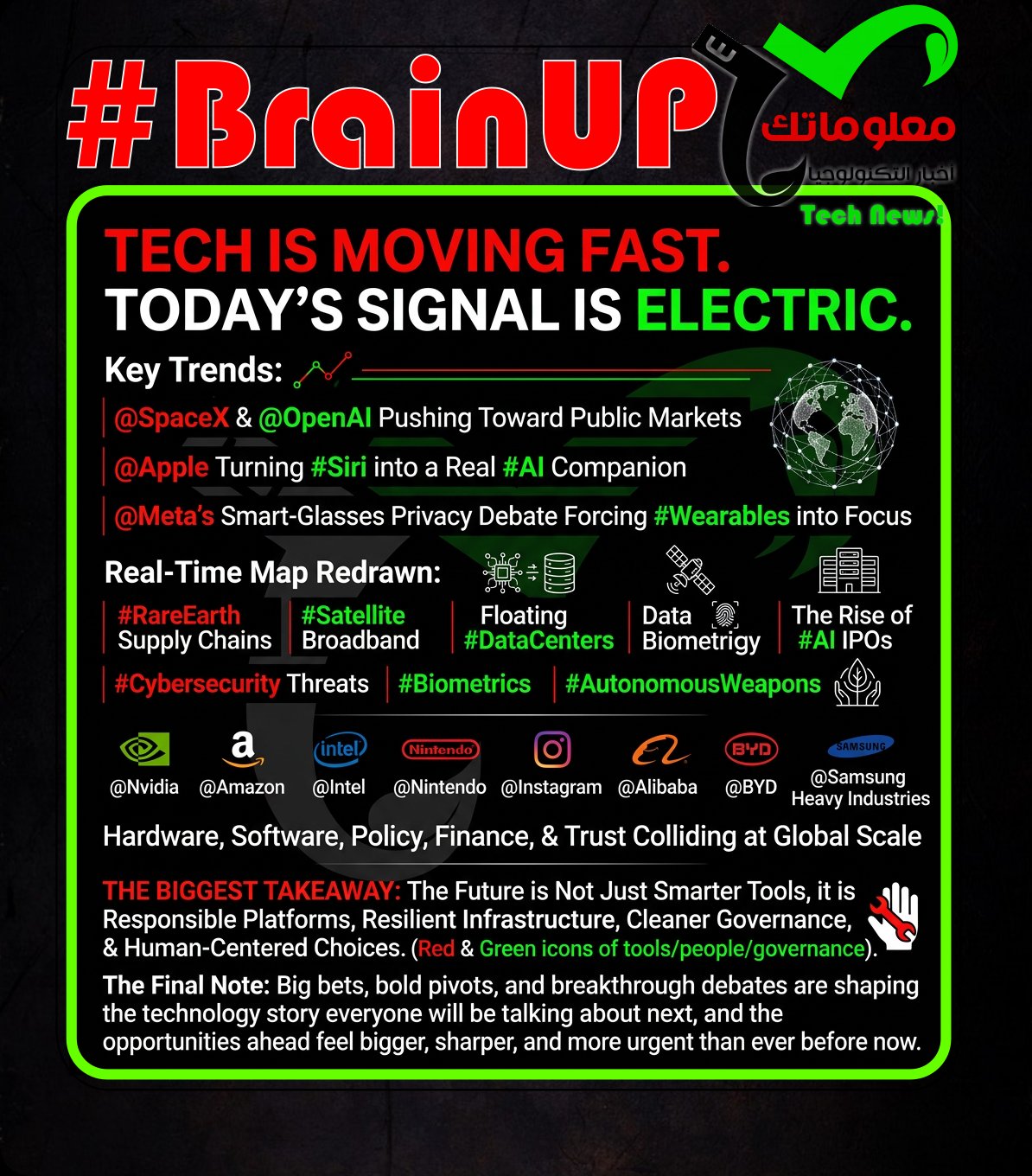
#BrainUp Daily Tech News – (Tuesday, June 9ᵗʰ)
Welcome to today’s curated collection of interesting links and insights for 2026/06/09. Our Hand-picked, AI-optimized system has processed and summarized 32 articles from all over the internet to bring you the latest technology news.
As previously aired🔴LIVE on Clubhouse, Chatter Social, Instagram, Twitch, X, YouTube, and TikTok.
Also available as a #Podcast on Apple 📻, Spotify🛜, Anghami, and Amazon🎧 or anywhere else you listen to podcasts.
1. It’s Possible That SpaceX Could Collapse Spectacularly
@Elon Musk’s @SpaceX, a week from its IPO seeking $75 billion at a $1.78 trillion valuation, could face a sharp reckoning because its new direction and financial structure may be hard to justify over time. After merging with his AI startup xAI to pursue #space-based data centers, the combined company’s spending is described as increasingly dominated by cash burn tied to xAI, worsening an already multi-billion-dollar annual burn at SpaceX and raising doubts, noted by @FinancialTimes writer @Richard Waters, about whether the valuation will make sense in five to ten years. The article says talk of shorting SpaceX is intensifying and that a cluster of huge AI-linked IPOs could strain an already “bloated” #WallStreet, potentially puncturing investor excitement if sentiment turns. It argues that, like #Tesla, valuation may hinge more on grand promises than near-term fundamentals, with SpaceX still reliant on #satellite communications revenue that only recently began to offset costs and on lucrative government contracts, while the addition of X and xAI increases downside risk if confidence breaks. Overall, the piece frames the IPO as the sale of an unproven future, especially with skepticism about untested orbital data center concepts, and concludes that Musk’s strength is “mythmaking” rather than demonstrating a clear, durable money-making proposition.
2. Smart Glasses Would Legally Require a Recording Light Under Proposed Law
Pennsylvania Rep. @Joe Ciresi has introduced House Bill 2603 to regulate #smartGlasses and other #wearableRecordingDevice use by requiring a visible recording indicator so people know when audio or video is being captured. The bill would make it illegal to record someone without their actual knowledge if the device lacks a visual indicator or if that indicator has been disabled, and it would also require retailers to clearly inform users about Pennsylvania recording laws. While many products like #RayBanMetaAI glasses already use a front-facing green LED, the article notes there is currently no legal requirement to include or keep such a light enabled, and the proposal would also prohibit disabling it, though penalties are not specified. The timing follows reporting by @Joanna Stern that people have been paid to remove or defeat the indicator on Meta’s glasses, including drilling it out or using vinyl stickers to fool obstruction sensors. Overall, the bill reflects growing legislative scrutiny of smart glasses privacy practices, alongside concerns about Meta’s plans such as adding #facialRecognition.
3. US asks China to resume rare-earth exports to Japan
The @Donald Trump administration has asked China to resume #rare-earth exports to Japan amid growing U.S. concern about tightening global supplies of Japanese high-tech products that rely on these critical elements. Nikkei reports that Washington is increasingly worried about Beijing’s ban on shipments to Japan and the resulting risk of dwindling availability of Japan-made advanced goods. The issue is expected to be taken up at next week’s #G7 summit, signaling U.S. intent to elevate the dispute to a broader allied agenda. The request underscores how export restrictions on critical minerals can quickly translate into wider #supply-chain pressures beyond the directly targeted country.
4. A Farmer Donated Land to Turn into a Park. The City Is Building a Massive Data Center Instead
In Taylor, Texas, land donated in 1999 for a public park is being converted into a large #data center after the city sold the property to a developer. A farming family deeded 87 acres to a public trust for a nominal $10, with the condition it be used as a community park, but in 2025 the city sold it to Blueprint for $10 million. The site is now slated to become a 135,000 square foot facility, replacing land long used informally by nearby families for recreation across generations. For residents like Pamela Griffin, whose home is about 500 feet away, the project shifts what was meant to be shared green space into industrial infrastructure located beside a power substation and railroad tracks, directly affecting the surrounding neighborhood.
5. Meta Furious Over Bombshell Smart Glasses Revelation
Journalists found code suggesting @Meta has been building an unreleased facial recognition feature for its Ray-Ban smart glasses, intensifying #privacy concerns about turning users into a distributed surveillance network. Wired reported the internal feature, called “NameTag,” would convert faces captured by the glasses into biometric “faceprints” and compare them against faceprints stored on a user’s phone, a database described as currently configured to receive updates from @Meta, while noting the feature is not enabled or available to consumers. @Meta responded that the finding was “sensational,” called the work exploratory, said no final decision has been made, and asserted it is not building a central face database, while executives including spokesperson Andy Stone and CTO Andrew “Boz” Bosworth accused Wired of misleading and dishonest reporting. The article adds that the #NameTag concept was previously reported by The New York Times, including an internal memo suggesting launching during a “dynamic political environment,” prompting backlash and an @ACLU letter signed by 75 organizations to @Mark Zuckerberg calling it a societal “red line.” Overall, the dispute centers on whether uncovering and reporting embedded facial recognition infrastructure in consumer products is justified before a feature ships, versus @Meta’s claim that reporting on unlaunched code misleads the public.
While @OpenAI has confidentially filed for an IPO, @Sam Altman’s identity verification startup Tools for Humanity is reportedly conducting layoffs as it struggles to generate revenue. The company operates the World project, using a silver orb device to collect #iris scans to verify identities, distinguish humans from bots, and support transactions involving its cryptocurrency, Worldcoin. Despite raising money at a reported $2.5 billion valuation from investors including Andreessen Horowitz and Bain Capital, it has faced regulatory and ethical scrutiny, including claims that people in Kenya, India, and Hong Kong were offered about $50 in Worldcoin for biometric data. Kenya later banned World over privacy and financial concerns, and South Korea fined the company $830,000 for alleged privacy law violations. The reported downsizing underscores the tension between ambitious biometric-based #identity verification and the practical challenges of public trust, regulation, and building sustainable revenue.
7. You Can Now Get a Religious Exemption From Using AI at Work
A North Carolina software engineer, Erin Maus, obtained a workplace religious accommodation that lets her refuse to use #AI tools, highlighting rising resistance to mandatory AI use at work. As reported by Business Insider, Maus, a Unitarian Universalist, argued in April that using #AI conflicted with her beliefs due to environmental impacts and ethical concerns, and her employer granted the exemption in mid-May, so she now writes and reviews code by hand. The article situates her case within broader backlash against AI’s workplace rollout and its environmental costs like pollution and water use tied to data centers, while noting @Pope Francis has urged stronger controls and said AI should be “disarmed.” It also points to U.S. legal context under #TitleVII, with observers suggesting the “sincerely held religious belief” standard could lead to more requests and potential litigation similar to disputes seen during #COVID vaccine-mandate fights. Maus says her productivity without AI is comparable to a colleague who uses it, reinforcing her view that AI is not a decisive “game changer” and that personal principles should guide work choices.
8. Meta Deletes Face-Recognition System From Its Smart Glasses App After WIRED Report
After a @WIRED report found that Meta had embedded an unreleased #faceRecognition system inside the Meta AI companion app for its smart glasses, a subsequent app update removed the related code. @WIRED’s code analysis says the earlier version contained libraries and components tied to an internal project called #NameTag, designed to turn faces captured by the glasses into biometric “faceprints,” compare them to a faceprints database stored on a user’s device, and locally crop, index, and store unrecognized faces for later processing. The latest release strips out the face-recognition libraries, the NameTag recognition workflow, a “Person recognized” alert, and the folder intended to store cropped images and biometric signatures. Meta’s @AndyStone said the feature was exploratory and that no final decision had been made, while Meta declined to answer multiple questions about data handling, opt-in or opt-out, potential use cases, and why the code was removed or whether its removal was planned before the story. The changes remove most traces of a system Meta previously argued “does not exist,” underscoring how much of the machinery had already been present in an app installed on tens of millions of phones.
Preserving human authority over lethal military operations is critical to maintaining accountability and ethical standards in warfare. Emerging #autonomousweapons systems raise significant challenges as they can make life-and-death decisions without human intervention, risking unethical consequences. Experts argue that human oversight ensures compliance with international law and prevents indiscriminate harm, reinforcing moral and legal responsibilities. The debate intensifies as #technology advances, but maintaining human control links military effectiveness with humanity and legality. Upholding this principle helps balance innovation with ethical imperatives in modern combat.
10. Perplexity plans IPO for 2028 as Anthropic, OpenAI prepare listings
Perplexity AI is planning an IPO in 2028 amid growing competition in the #AI industry from companies like Anthropic and OpenAI, both of which are also preparing to go public. The move comes as the AI market continues to heat up and investors show strong interest in AI technologies and startups. Perplexity’s decision reflects broader trends where AI companies seek public capital to scale operations and accelerate innovation. This highlights the increasing importance of AI in tech finance and the race to lead advances in large language models and related AI developments. The trend indicates a shift in how AI firms are valued and financed, positioning them for substantial growth in the coming years.
11. Apple’s WWDC AI demos looked more real after $250M false ad settlement | TechCrunch
@Apple’s WWDC 2026 keynote emphasized credibility around #AI features, especially an overhauled #Siri, by demonstrating them in a more “live-like” way than its heavily produced WWDC 2024 videos. The company used pre-taped segments showing someone holding an iPhone and interacting with #AppleIntelligence features in real time, a style that drew comparisons on X to 2024 “vaporware” after Apple later admitted delays and faced a federal false advertising lawsuit that it settled for $250 million without admitting wrongdoing. The presentation appeared designed to reduce reputational risk and signal that the features work on real devices, even while some fully produced videos remained. Apple also positioned availability as broader than before: the new Siri via iOS 27 is slated for iPhone 15 Pro/Pro Max, iPhone 16 models and later, plus additional supported iPads, Macs, and wearables, so many recent upgraders may not need new hardware. Together, the demo format and expanded device support tied Apple’s #AI messaging back to past delivery gaps and the settlement, aiming to reassure users that this time the features are closer to product than promise.
12. Apple’s long-awaited AI Siri overhaul is finally here | TechCrunch
@Apple unveiled a revamped, #AI-powered “Siri AI” at #WWDC 2026, aiming to turn Siri from a voice assistant into an AI companion and conversational chatbot, with a beta planned for later this year. The new assistant launches with a dedicated Siri app, can ground answers in current world knowledge, and can use on-device context, including what is displayed on the screen, while presenting results as text cards from sources like the web and messages. Siri is redesigned to live in the Dynamic Island on iPhone, adds “Write with Siri” for Mail and Messages that can mirror how you typically communicate with specific people, and supports typed conversations via a swipe down from the Dynamic Island. It can handle more complex tasks by pulling from web information and personal data like emails, calendar, and contacts, while also adding a new voice experience with adjustable pace and expressivity plus more accurate system-wide dictation. The overhaul extends across platforms with Siri integrated into Spotlight on macOS and enabling questions and actions from the watch on watchOS, positioning Siri against chatbots like #ChatGPT, Claude, and Gemini.
13. Nintendo will pay a $40 million fine for faulty Joy-Cons – Engadget
French regulator #DGCCRF fined Nintendo of Europe 35 million euros, more than $40 million, for misleading consumers about #JoyCon #stickDrift issues on the #NintendoSwitch. The agency said Nintendo acknowledged the problem only in 2020 despite learning of it earlier, and accused the company of deceptive business practices from 2018 to 2023 related to its handling of the defect. Nintendo of Europe agreed to pay the fine and must also place a notice about deceptive business practices on the homepage of its French website. The case follows years of complaints, class action lawsuits and investigations after players reported thumbsticks registering movement without input. Nintendo has offered free Joy-Con repairs for affected customers since 2019, but the fine centers on how and when it disclosed the issue to consumers.
14. Nvidia CEO Jensen Huang declines Warren’s request to testify at AI hearing
Nvidia CEO @Jensen Huang declined Sen. @Elizabeth Warren’s request to testify at a Senate Banking Committee hearing on America’s #AI industry, after she sought answers about Nvidia’s business in China and its handling of U.S. #export controls on AI technology. Warren said Nvidia is central to questions of artificial intelligence, economic competition, and national security, and criticized Huang for not appearing while attending high-profile events, including a Mar-a-Lago dinner and a meeting with China’s @Xi Jinping. In a letter, Huang said he could not attend, emphasized that American leadership in AI cannot be taken for granted, and invited Warren or other committee members to Nvidia’s Santa Clara headquarters to discuss the technology and the U.S. AI ecosystem. The dispute highlights ongoing tension in Washington over whether tight export restrictions are needed because advanced AI chips can aid foreign militaries, as the Commerce Department recently moved to close an export-control loophole and Congress considers additional bills targeting chip sales and equipment transfers to China and other rivals.
15. Silicon Valley including Meta has embraced Maga politics, says Nick Clegg
@Nick Clegg said Silicon Valley companies, including #Meta, have chosen to embrace #Maga politics, in some cases for “rather more self-interested” reasons, and said it felt like the right moment to leave Meta in March 2025, three months into the second @Donald Trump administration. He argued that executives who once avoided politics pivoted right, and that products “changed utterly” from being human-centric to prioritising content, including synthetic content, algorithmically recommended to users. Clegg also questioned the UK’s contract with US spy-tech firm #Palantir, citing ideological distaste and concerns it could make clients dependent, as a parliamentary committee urged the government to end the contract in 2027 when a break clause allows it. Palantir and UK figures disputed lock-in claims and defended its NHS work, while Clegg suggested #AI could enable rivals to disrupt Palantir, which integrates data into workflows but has not built its own foundational AI models.
@Intel is expanding its #iBOT Binary Optimization Tool support by adding seven more games, raising the supported list from 12 to 19 and claiming better gaming performance when enabled through the latest Intel Platform Performance Package and the Intel Application Optimization GUI. The newly added titles are Metro Exodus Enhanced Edition, The Callisto Protocol, Homeworld 3, Ori and the Will of the Wisps, Little Nightmares III, Warframe, and Hollow Knight: Silksong, with Intel reporting a 12% average uplift on a Core Ultra 7 270K Plus and up to 27% in Silksong and 16% in Warframe, but as low as 2% in Metro Exodus. iBOT launched alongside Arrow Lake Refresh systems and works on Panther Lake and recent HX mobile chips (Core Ultra 9 290HX Plus and Core Ultra 7 270HX Plus), while older CPUs are excluded because the feature depends on specific hardware registers. The tool functions as a translation-layer-like optimizer akin to @Microsoft Prism in concept, but instead of ISA translation it applies #HWPGO profiling to re-optimize x86 apps toward newer, more efficient instructions, producing profiles that are then shipped. Results are not universal and can vary by game and CPU, and Tom’s Hardware previously measured an 8% average gain with iBOT, peaking at 18% in Shadow of the Tomb Raider, reinforcing that benefits depend on existing optimization and the specific chip.
17. Shipowners pursue floating data centers as Samsung Heavy leads push
Global shipowners are pursuing #floating data centers, aiming to add stable, long-term lease revenue by owning offshore computing facilities and renting capacity to big tech and cloud operators as AI-driven demand surges. Samsung Heavy Industries is moving first among Korean shipbuilders, receiving multiple partnership inquiries and signing an MOU with Greek shipowner Capital Clean Energy Carriers to jointly develop an FDC, a data center installed on a floating structure in ports, coastal areas, or rivers. The push is driven by land-based constraints in the U.S. and Europe, including grid interconnection delays, site shortages, and cooling burdens, while offshore sites can reduce land needs and use seawater for cooling. Capital CEO Jerry Kalogiratos framed the effort as combining maritime and digital infrastructure to deliver scalable, flexible computing, and Samsung affiliates have also explored cooperation with @OpenAI on global AI data center infrastructure, including floating data centers. Samsung Heavy is advancing commercialization with a 50MW-class concept design, drawing on offshore facility experience such as #FLNG, and has obtained approval in principle from ABS and Lloyd’s Register, with key remaining tasks including proving reliable power supply and server stability offshore.
18. FCC lifts looming deadline for Amazon Leo satellite broadband constellation
The #FCC waived the requirement that @Amazon launch half of its 3,232-satellite #LEO broadband constellation by July 30, 2026, while keeping the July 30, 2029 deadline to place all first-generation satellites in orbit. Amazon, approved in 2020 and facing an impending miss of the 1,616-satellite midterm milestone, asked in January for an extension to July 2028 or a waiver, and the commission chose to remove the 50 percent deployment time limit entirely. The FCC said the waiver serves the public interest by promoting a second large satellite broadband constellation, noting only @SpaceX currently provides LEO broadband to US consumers and citing Amazon’s more than $10 billion investment and other buildout commitments. To preserve incentives for rapid deployment, the FCC plans to temporarily demote the spectral priority of satellites launched after the July 2026 milestone until Amazon increases its build pace. The article attributes Amazon’s schedule risk mainly to launch constraints, with many satellites waiting for #NewGlenn and #Vulcan rockets that are grounded after anomalies, limited alternative lift capacity, and only one remaining #AtlasV flight for Amazon carrying 29 satellites.
19. For the 2nd time in weeks, Microsoft packages laced with credential stealer
Dozens of cryptographically verified Microsoft open source packages were compromised in a supply chain attack, adding advanced credential-stealing code that triggers when developers open them in AI coding agents, and 73 packages were flagged and blocked by automated systems on @GitHub. GitHub said it disabled the packages for terms of service violations rather than explicitly warning they were malicious, and Microsoft only later said it had temporarily removed repositories while investigating potential malicious content, with researchers urging developers to assume compromise. The incident follows a mid-May breach of Microsoft’s durabletask Python SDK on PyPI, where a 28 KB payload stole credentials across #AWS, #Azure, #GCP, #Kubernetes, password managers, and numerous developer tool configurations, then spread laterally through cloud environments, and was linked to the TeamPCP threat actor using malware tracked as Miasma. Cloudsmith reports Miasma abuses the ecosystem trust model by stealing legitimate maintainer credentials and a Microsoft #OIDC token, publishing malicious builds with valid #SLSA provenance so scanners treat them as trusted updates, and generating unique encrypted payloads per infection that defeats hash-based IOCs. Together, the attacks show how authenticated publishing workflows and provenance attestation can be leveraged to distribute credential stealers through trusted package channels, affecting developers who rely on AI agents and automated supply chain assurances.
21. New privacy frontier: Europe eyes crackdown on smart glasses
European lawmakers and regulators are escalating scrutiny of #smart_glasses with built-in cameras, warning they could undermine #privacy principles such as meaningful consent in public spaces. Concerns intensified after Swedish media reported that subcontractors for #Meta in Kenya reviewed “deeply private” footage from Meta’s glasses to help annotate content for training #AI models, including recordings involving bathroom visits, banking details, and sex. Renew lawmaker @Veronika_Cifrová_Ostrihoňová urged a potential stop to technology that could breach privacy and be misused to target women, while Sweden’s data protection chief Eric Leijonram called for societal discussion and clearer awareness when people are being recorded. The European Data Protection Board, chaired by @Anu_Talus, has ordered a report on smart glasses due this summer and will consider follow-up actions, amid pressure from activists and parallel efforts such as a U.S. class action lawsuit and an EU-made detection app downloaded over 120,000 times. The debate could complicate Meta’s rollout in Europe and add to broader tensions over EU regulation of U.S. tech firms, while Meta says its AI glasses include built-in privacy safeguards.
22. Donut Lab’s ‘solid-state’ battery exposed as regular li-ion in damning investigation
An investigation led by battery researcher Ziroth concludes Donut Lab’s touted #solid-state “miracle” battery is actually a conventional lithium-ion cell, undermining claims used to raise about $25 million from more than 1,300 mostly small investors. Over 20 independent experts, including Julian Zanau (Fraunhofer), Dr. Yahim San (Justus-Liebig University), Tom Bicha (Leona), and Dr. Yuo Hesca (Seinäjoki UAS), reviewed VTT test data and agreed the tested cell matches high-nickel lithium-ion (#NCM) behavior. The evidence cited includes voltage curves showing ~3.7 to 3.8 V at 50% state of charge, consistent with lithium-ion and inconsistent with sodium-ion, plus VTT cell expansion data showing the graphite-anode “kink” around 50 to 70% SOC, a signature incompatible with sodium ions fitting into graphite layers. The investigation also estimates energy density at about 298 Wh/kg, aligning with strong lithium-ion performance rather than the claimed 400 Wh/kg alongside 100,000 cycles and 5-minute charging, and it traces the tech to Germany’s CT Coatings amid a web of companies and aggressive NDAs that obscured origins. Taken together, the electrochemical fingerprints and corporate trail portray Donut Lab’s headline battery claims as false rather than revolutionary.
23. OpenAI files for US IPO following Anthropic and AI giants’ move towards public markets
OpenAI has filed for an initial public offering (IPO) in the United States amid growing interest from artificial intelligence firms in accessing public capital markets. This move follows similar steps taken by competitors such as Anthropic, signaling a trend among leading AI companies to expand funding and market presence through public offerings. The filing allows OpenAI to raise significant funds to support its development of advanced AI technologies and maintain its competitive edge in the rapidly evolving #AI industry. This shift to IPOs reflects the increasing commercialization of AI innovations and the strategic importance placed on investor confidence and transparency. OpenAI’s transition to a public company is poised to influence the wider tech sector’s approach to growth and regulatory scrutiny.
24. Ahead of SpaceX IPO, Musk says AI satellites will use mostly existing technology
@Elon Musk stated that SpaceX’s plans for AI-powered satellites will largely rely on #existing technology rather than new inventions, indicating a practical approach to innovation. This comment came ahead of SpaceX’s anticipated initial public offering (IPO), highlighting the company’s focus on advancing its current satellite infrastructure, including its #Starlink project. Musk emphasized leveraging established technologies to enhance satellite #AI capabilities, which may streamline development and deployment processes. The use of mostly existing technology suggests a strategy to accelerate market entry and stabilize operations before the public offering. This approach aligns with SpaceX’s broader goals of expanding broadband access and maintaining leadership in satellite communications technology.
25. Apple announces huge iOS 27 speed improvements for iPhone – 9to5Mac
@Apple announced at #WWDC 2026 that iOS 27 will prioritize #performance improvements and bug fixes, aiming to make iPhones feel noticeably faster than iOS 26. The company cited specific gains including up to 30% faster app launches, up to 70% faster loading of new captures in #Photos, and up to 80% faster #AirDrop transfers, plus up to 5x faster browsing and transfers in #Files on iPadOS and quicker switching between Wi-Fi and cellular connections. These examples suggest a broad, system wide optimization push affecting everyday tasks rather than a single feature area. Apple also said iOS 27 will support the same iPhone models as iOS 26, keeping compatibility unchanged while delivering the speed boosts.
26. Artists are making ‘anti-slop’ to rebel against AI: ‘It’s been rammed down our throats’
Artists and creatives are developing an “anti-slop” aesthetic that favors the conspicuously handmade, imperfect, and even primitive as a backlash to #AI’s slick, uncanny #hyperrealism. The article contrasts hype at the Runway AI Summit, where ad executive Rob Wrubel praised speed on @Coca-Cola’s AI-generated 2025 Holiday Caravan ad, with widespread public ridicule of the ad’s fake-looking imagery and the larger discomfort it exposed across the creative industry. It describes broader anti-AI activity, including open letters about copyright infringement, musicians signaling authenticity with hand-scrawled social posts, and lawsuits over AI training on artists’ work. As an example of the emerging look, designer Michael Schmelling’s deliberately crude, scribbly covers for Roberto Bolaño reissues, made with tattooist Mike Adams, drew polarized reactions but embody a style that feels intentionally human in ways AI would not. Schmelling says AI has been “rammed down our throats,” and frames the backlash partly around the idea that AI profits are built on other people’s labor.
27. Department of Work and Pensions’ answer to AI job fears is a bot to polish your CV
The UK government is trialing an #AI-powered “AI Work Assistant” to help jobseekers with CV writing, applications, job searches, and career advice, positioning it as “a job centre in your pocket” available around the clock. @Keir Starmer announced a three-month trial at London Tech Week, and the service is already live online, with guidance to check whether employers permit #AI-assisted applications, verify accuracy, and rewrite outputs so they still sound personal. The initiative builds on Whitehall’s wider push for #AI in public services, including work with Anthropic on a jobseeker chatbot and the launch of #GOV.UKChat in the GOV.UK app. It is framed against a weak youth jobs market, with youth unemployment cited at 16.2%, and alongside pledges for AI and technology training for up to 400,000 pupils in disadvantaged schools plus a new AI bootcamp for young people at risk of falling out of education, employment, or training. The rollout also sits amid public concern about #AI-driven job losses and unrest, and questions about how employers will respond to machine-written applications as companies deploy similar tools to automate and screen work.
28. Everything announced at Apple’s WWDC 2026 keynote – Engadget
At Apple’s #WWDC 2026 keynote, the company focused on a long-delayed Siri overhaul, introducing #SiriAI powered by Google’s #Gemini models, and noted this is @Tim Cook’s final WWDC as CEO before @John Ternus takes over on September 1. SiriAI adds new UI behaviors, including a Dynamic Island animation on compatible iPhones, a new iOS 27 gesture to open a SiriAI interface, card-style responses, and continued conversational follow-ups, plus deeper integration like being built into Spotlight on macOS “Golden Gate.” Apple said SiriAI can act on what is on your screen, help extract information from screenshots, answer questions about what the iPhone camera sees, and bring similar #VisualIntelligence capabilities to #AppleVisionPro, while also promising major voice dictation improvements. A dedicated Siri chatbot app will let users ask questions, generate text and images, analyze files, and customize SiriAI voice expressiveness and speech rate, positioning Siri as a central hub for information and tasks. SiriAI is slated to arrive across iOS, iPadOS, macOS, watchOS, visionOS, CarPlay, and AirPods, with initial English-only availability and more languages promised later, and iOS 27 also adds a customizable EQ for AirPods.
29. macOS 27 requires Apple Silicon, as Apple draws down the Intel Mac era
Apple is ending #Intel Mac support in macOS 27 Golden Gate, requiring an #AppleSilicon Mac, including the original M1. @Apple says Intel Macs on macOS 26 Tahoe should receive security and #Safari patches for about two more years after macOS 27 ships, while Macs on macOS 15 Sequoia get one more year of updates. #Rosetta2 will still run Intel apps in macOS 27, but future releases will increasingly limit it, with @Apple framing it mainly for older games that still use Intel code. Apple’s compatibility list contains no Intel Macs and, by removing most remaining Intel code as it once did when dropping PowerPC in Mac OS X Snow Leopard, it makes workarounds like #OpenCoreLegacyPatcher effectively infeasible for macOS 27. Some new #AppleIntelligence features also have stricter requirements: the basic version runs on all Apple Silicon Macs, but more capable on-device models need an M3 or newer with at least 12GB RAM; the developer beta is available now, a public beta arrives in July, and the final release is due in the fall.
30. Instagram is finally letting everyone reorganize their profile grid
@Instagram is rolling out a long-awaited feature that lets users reorganize their profile grid by dragging posts into any order. The company says the capability, previously limited to some test groups, is now rolling out widely as of June 8th through its Android and iPhone apps. Instead of being locked to chronological order aside from pinning up to three posts, users will be able to long-press and drag any post regardless of age, while pinned posts stay at the top. @Adam Mosseri first announced the change in January last year, apologizing after a shift from square thumbnails to taller ones disrupted carefully arranged profiles, and he marked the broader release with a brief “Finally” post. The update directly addresses complaints about rigid profile layout controls, even as comments indicate users are still waiting on other changes, including a native iPad interface.
31. Apple’s Screen Time updates are too little, too late
@Apple spotlighted parental controls at WWDC 2026, but the announced #Screen Time changes are mostly a redesigned interface and minor upgrades, which the author argues do not address long standing reliability problems. The piece cites widespread user complaints about Screen Time being inaccurate, easy for kids to bypass, and limited, plus a 2024 @Joanna Stern report in The Wall Street Journal about a bug that let kids bypass content restrictions for years. The author suggests Apple’s emphasis is partly reputational, pointing to recent social media trials involving @Meta and @Google and protests outside Apple’s Cupertino HQ, while contending that meaningful control often comes down to removing the device, something impractical as kids age. Among the iOS 27 updates, “Ask to Browse” is praised for forcing kids to request permission for new websites, helping close a loophole where children avoid app restrictions by using web versions of services like Discord and TikTok. However, Apple is criticized for still not fixing key gaps such as allowing a child to redownload a previously downloaded app without adequate parental approval, reinforcing the view that the updates are too little, too late.
32. Pentagon labels tech giant Alibaba and electric car maker BYD as aiding Chinese military
The Pentagon has added several prominent Chinese businesses to its list of Chinese military companies. The article states that the additions include tech giant @Alibaba and electric car maker @BYD. This action reflects the Pentagon’s assessment that these firms are aiding the Chinese military, based on their inclusion on the list. The move ties into U.S. government scrutiny of Chinese companies viewed as linked to China’s military apparatus.
33. Convicted Crypto Fraudster Sam Bankman-Fried Officially Files for Trump Pardon
@Sam Bankman-Fried has formally applied to the DOJ for a presidential pardon from @Donald Trump after being convicted over the roughly $9 billion November 2022 collapse of FTX and sentenced to 25 years in March 2024. DOJ records confirm the filing, and Bloomberg reports he requested a “pardon after completion of sentence” while appealing his conviction in New York, a request type usually sought after serving time to restore rights or reduce the stigma of a conviction. He has publicly said he wants a pardon and has spent more than a year laying groundwork through media appearances and political messaging, including a jailhouse interview with @Tucker Carlson criticizing “Biden’s lawfare machine” and social posts praising Trump and shifting blame toward the #FTX bankruptcy process. A recent bid for a new trial was rejected by Judge Lewis Kaplan, who called his new-evidence claims baseless and suggested they were aimed at improving his public image. Despite the filing, Trump has said he does not plan to pardon Bankman-Fried, and the White House has pointed back to those remarks amid criticism of other #crypto-related clemency decisions.
That’s all for today’s digest for 2026/06/09! We picked, and processed 32 Articles. Stay tuned for tomorrow’s collection of insights and discoveries.
Thanks, Patricia Zougheib and Dr Badawi, for curating the links
See you in the next one! 🚀
