
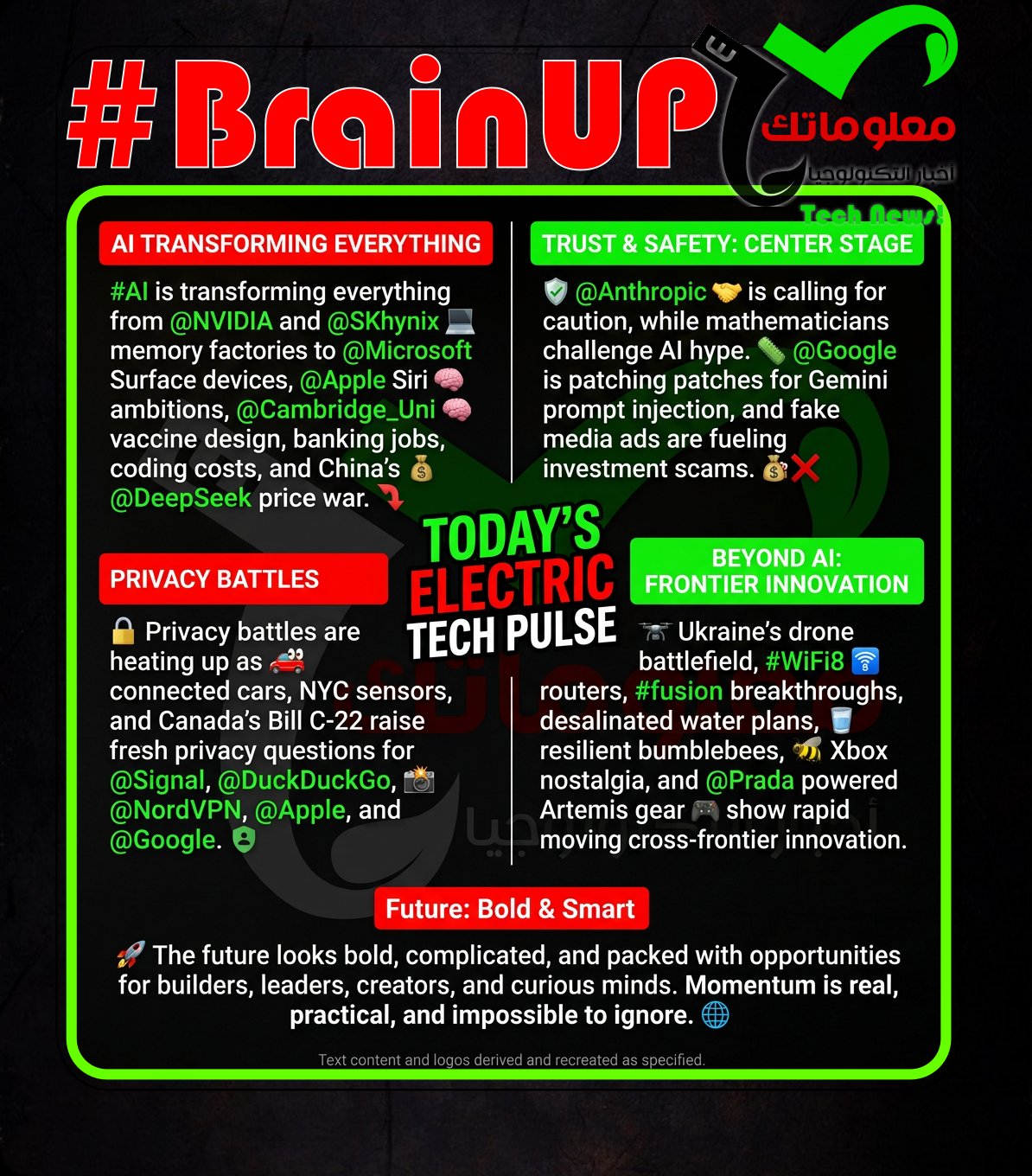
#BrainUp Daily Tech News – (Monday, June 8ᵗʰ)
Welcome to today’s curated collection of interesting links and insights for 2026/06/08. Our Hand-picked, AI-optimized system has processed and summarized 30 articles from all over the internet to bring you the latest technology news.
As previously aired🔴LIVE on Clubhouse, Chatter Social, Instagram, Twitch, X, YouTube, and TikTok.
Also available as a #Podcast on Apple 📻, Spotify🛜, Anghami, and Amazon🎧 or anywhere else you listen to podcasts.
1. ‘Kill switch’ law means your next car could be watching you | Opinion
A federal anti drunk driving mandate could soon require #driver-monitoring technology in all new passenger vehicles, raising major questions about #privacy, #surveillance, and who controls the resulting data. The requirement stems from the 2021 #HALTDrunkDrivingAct, which directed #NHTSA to write rules within five years so automakers install technology that can passively monitor driver performance and prevent or limit vehicle operation when impairment is detected, with rules possibly taking effect as early as next year. The column acknowledges the lifesaving intent and recounts personal and Michigan tragedies linked to impaired driving, while noting NHTSA figures that more than 30 people die each day in U.S. drunk driving crashes and 11,904 people died in 2024. Critics, including some Republicans and libertarians, argue the mandate is Orwellian and unconstitutional, and point to a failed House effort to defund it, with @ThomasMassie warning the car would judge driving and disable itself. The piece argues Congress should provide clear answers and scrutiny before the mandate takes effect, because preventing deaths should not automatically override concerns about pervasive monitoring in vehicles.
2. Why Anthropic’s bizarre call for everyone to slow down on AI will never work
@Anthropic is urging a broad slowdown or pause in #frontier model development to reduce risks from #recursive development, arguing that AI could self-improve in ways misaligned with human needs and potentially slip out of human control. The author, who favors #AI regulation, says this proposed global pause is unrealistic and not the same as workable regulation, criticizing the idea of a cross-industry mechanism or even a metaphorical stop button. Even @Anthropic concedes that a credible pause would require multiple well-resourced labs across countries to agree on shared conditions, define triggers and enforcement, and verify compliance, but AI training runs are easy to conceal and incentives to quietly defect are enormous compared with monitoring things like nuclear sites. The article also argues that even if major US companies agreed, other nations, specifically China, might not, creating a strategic disadvantage while development continues elsewhere. Overall, it frames @Anthropic’s fears as understandable but its proposed solution as laughably impractical given verification, coordination, and geopolitical realities.
3. The drone war turning Ukraine into a machine battlefield
Ukraine’s expanding drone force is reshaping the war into a #drone-dominated battlefield where infantry survival depends on hiding, endurance and constant resupply by unmanned systems. A Russian blogger, Mikhail Zvinchuk (“Rybar”), claims overwhelming Ukrainian drone parity, and the article cites roughly 700,000 Russian troops along a 1,250-kilometre front versus about 2 million Ukrainian drones of varying sizes, creating a pervasive “kill zone” that keeps soldiers in underground dugouts for 100-plus days while supplies move by air or land drones. Ukrainian footage described in the piece shows drones pursuing Russian soldiers into basements, dugouts and pipes, sometimes prompting surrender when troops are caught in the open despite attempts to move under thermal cloaks. @Oleksandr Syrskyi is quoted saying Ukraine’s Unmanned Systems Forces ran over 11,000 combat missions per day and hit more than 150,000 verified targets in March 2026, supported by innovations such as mothership drones carrying smaller armed FPV drones, weather balloons used to launch drones deep inside Russia, and #AI-enabled surveillance that color-codes operators’ maps. The article argues these adaptations compound Ukraine’s defensive effectiveness by striking frontline forces and interdicting food, fuel and ammunition, and it notes Ukraine’s ongoing effort to dismantle Russia’s S-300 and S-400 air defenses in occupied Kherson and Crimea over the past 18 months.
The provided text does not include the article body needed to summarize the claim that #AI data centers used 264 billion gallons of water in 2025, but it frames a tension between worsening U.S. drought and rising industrial water demand. It states that Americans in multiple states are being urged to conserve water as drought conditions intensify, reservoirs shrink, and utilities issue increasingly urgent warnings. It also notes that a different kind of consumer is quietly demanding unprecedented amounts of water, implying #data centers without giving details. With no additional evidence, figures, or examples beyond this setup, the article’s specific support for the headline cannot be verified from the excerpt. Overall, the text links escalating drought-driven conservation efforts to growing water consumption from large-scale technology infrastructure, but provides only an introductory framing.
5. Signal, DuckDuckGo, and NordVPN threaten to exit Canada if metadata surveillance law passes
Canada’s proposed #BillC-22 would require many digital service providers to retain up to one year of user #metadata and add mechanisms for law enforcement #lawfulaccess, prompting major privacy and security objections. @Signal executive Udbhav Tiwari testified that the bill would turn everyday tools into a surveillance network and conflicts with Signal’s privacy practices, while @DuckDuckGo said it would pull its VPN from Canada if the bill passes, and @NordVPN and other VPNs signaled similar plans. @Apple and @Google warned the legislation could pressure them to weaken #encryption, even as Public Safety Minister @GaryAnandasangaree said amendments would ensure providers are not required to break encryption while keeping the metadata retention requirement. Critics such as #OpenMedia argue any mandated access creates #backdoors that attackers can exploit, citing a late-2024 case where Chinese state backed hackers compromised mandated police wiretap systems and stole data from telecom providers. The dispute centers on whether broad metadata retention and access mandates can coexist with strong privacy and security, and some companies say they would exit the Canadian market rather than comply.
Birds in Ukraine have been found incorporating #optical fiber from battlefield debris into their nests, repurposing scraps left by #fiber-optic tethered drones. Photos shared on X by @Olena Tregub, credited to photographer Oleg Malchenko, show a small nest made from drone fiber-optic cable that reportedly fell from a tree knocked down by a Russian glide bomb in Donbas. The article notes that while it is unclear how widespread this behavior is, birds can be resourceful in choosing nest materials, and the fiber may provide useful warmth as an effective thermal insulator while also removing a small amount of litter. It connects the nest discovery to the broader reality of fields strewn with fiber strands due to the use of jam-resistant tethered drones by both sides. The piece also references earlier reports on Ukrainian countermeasures to snag leftover fibers and on a claimed boost in Russian FPV tether range to as much as 65 km from a Chinese-linked partnership, underscoring how #drone warfare is shaping the environment in unexpected ways.
@Asus unveiled its first #Wi-Fi 8 router, the ROG Rapture GT-BN98 Pro, positioning it as the next step after #Wi-Fi 7 maturity and following a recent #TP-Link tease of an upcoming Wi-Fi 8 model. The router closely resembles the ROG Rapture GT-BE98 Pro in exterior design, including eight antennas and a front LED panel, but uses an unnamed Wi-Fi 8 chipset and claims up to 2x median throughput, 2x greater IoT coverage, lower latency via Multi-AP coordination, and better performance in crowded environments. For gaming, it includes AI Game Boost features such as automatic traffic optimization over LAN and Wi-Fi, plus adaptive QoS and GTNet game-specific optimizations. On the wired side it offers four 2.5 GbE LAN ports, a 1 GbE LAN port, a 10 GbE LAN/Gaming port, and a 10 GbE WAN port with optional aggregation of the two 10 GbE ports to 20 Gbps, plus USB 2.0 and USB 3.0. The article expects a launch window in Q4 2026 or possibly Q1 2027, framing the GT-BN98 Pro as a Wi-Fi 8 based update to Asus’ existing ROG Rapture lineup.
8. Banks lay groundwork for mass workforce cuts as AI takes hold | Fortune
Banks are laying the groundwork for significant workforce reductions as #AI becomes embedded in hiring and day-to-day operations, squeezing entry-level opportunities and raising concerns that automation will reach further up the org chart. Students like Andre Bonnick are already facing AI-run screening in early recruiting rounds, while executives such as @Jamie Dimon, @Jane Fraser, and @John Waldron have publicly said jobs will be eliminated or no longer needed as automation expands. Debasish Patnaik of McKinsey’s QuantumBlack said banks are cutting junior analyst classes by as much as two-thirds even as they source about 62% of their AI talent from those same cohorts, creating a paradox where fewer traditional apprenticeships coexist with strong demand for AI-skilled juniors. Banks are focusing on targeted #AI use cases such as customer service and transaction and trade monitoring rather than a fully autonomous “agentic” bank, and some leaders talk about retraining, though how reskilling works in practice is uncertain. Examples include Citi’s conversational AI wealth-management avatar, underscoring that the same technology reshaping client service is also reshaping who gets hired and which banking roles remain.
9. Over 150 Mathematicians Warn Governments Not to “Believe the Hype” About AI
Over 150 mathematicians and other experts urge governments not to treat #AI as a reliable solver of major mathematical problems without careful expert review, warning that hype is outpacing verified capability. Their 11-page #LeidenDeclaration on #AI and Mathematics follows high-profile claims involving @OpenAI, including assertions that its model disproved an 80-year-old “unit distance” conjecture and earlier publicity around using #ChatGPT on “Erdős problems.” The signatories argue that strong commercial incentives can lead the tech industry to overstate performance, and that current systems can generate plausible but unreliable or incorrect arguments that are hard to distinguish from genuine proofs, risking downstream research that builds on faulty results. They call for policymakers to consult mathematicians rather than rely on press releases or popular reporting, and emphasize that the future of mathematical research should be guided by human judgment, transparency, and shared community values.
10. Fake BBC and Guardian Reddit Ads Push Investment Scams
Bitdefender Labs reports a growing wave of sponsored Reddit ads impersonating trusted outlets like the BBC, the Financial Times, and The Guardian to push fake #AI investment schemes. The ads promote platforms such as Wencoin STX, Warrior Coin AI, and Nevo Coin, and route users to cloned news sites featuring fabricated interviews, false profit screenshots, manipulated banking documents, invented success stories, and fake urgency, sometimes even using deepfake-style video that mimics BBC broadcasts. Researchers Andrea Olariu and Emanuel Puscasu observed narratives claiming @NVIDIA and @OpenAI are “creating the future,” alleging hidden “revolutionary” trading platforms, and presenting conspiracy framing that banks, regulators, or governments are suppressing access, reinforced with political and geopolitical imagery like @Donald Trump, Ursula von der Leyen, and World Economic Forum visuals. The campaign primarily targets US and European audiences, rotates short-lived domains to evade detection, and uses infrastructure and tactics resembling earlier investment scam campaigns seen on Meta platforms. Overall, the operation leverages the credibility of major media brands and topical #geopolitics to make bogus AI trading offers appear legitimate and persuade victims to deposit money.
11. Inflation inside the electronics you buy may soon become a bit more sticky
A shortage of synthetic resin, a critical input for printed circuit boards that power modern electronics, is poised to make inflation in devices like smartphones and laptops more persistent. Supply was hit after the Jubail petrochemical and industrial complex in Saudi Arabia went offline amid conflict and logistics disruptions tied to the Strait of Hormuz, with limited public clarity on when operations normalize, and @Dow CEO @Jim Fitterling citing a “275 day-plus” process for reopening the route and restoring supply chains. Recent data shows upstream pressure, with the April producer price index indicating plastic resins and materials contributing to a 9.4% annual increase in processed goods prices, and supply chain experts warning that if the stoppage lasts into autumn, consumers should expect higher electronics prices by fall. The problem is hard to offset because there are few alternatives to these resins and insufficient U.S. production capacity, while U.S. printed circuit board manufacturing has fallen from about 30% of global output in 2000 to roughly 4% today, leaving #electronics pricing vulnerable to the same constrained resin sources worldwide. With circuit boards acting as the “nervous system” of devices from phones and gaming consoles to routers and #AI servers, any sustained increase in board input costs can quickly transmit through the broader consumer tech market.
12. South Korea’s artificial Sun ran for 102 seconds and it could change the future of energy
#KSTAR, South Korea’s “artificial sun” (#Korea Superconducting Tokamak Advanced Research), advanced #nuclearFusion research by sustaining high-confinement plasma for 102 seconds and holding an ion temperature of 100 million°C for 48 seconds during its 2023-2024 plasma campaign, according to the #KoreaInstituteOfFusionEnergy. The work highlights progress toward clean fusion power that could provide abundant electricity with little to no carbon emissions. The article explains that reaching around 100 million°C helps hydrogen isotopes overcome repulsion and fuse, but containing such heat is difficult because no material can directly withstand it. #KSTAR uses superconducting magnetic forces in a tokamak to confine plasma, and researchers improved stability by using enhanced #tungstenDivertor technology that tolerates high heat and handles exhaust plasma better than earlier carbon divertors. Extending stable operation time is presented as crucial because each additional second of sustained high-temperature confinement supports further fusion research toward practical energy generation.
@Jensen Huang argues that fears #agenticAI will eliminate software jobs are misplaced, saying it is an “incredible time” to be a software company and that AI is driving more hiring, not less. Speaking at Computex, he said a world full of AI agents will not be limited by human headcount and will require more tools than ever, expanding opportunities for software makers. Data cited in the article aligns with that view: the U.S. Bureau of Labor Statistics projects 15% software developer employment growth from 2024 to 2034, and the @World Economic Forum lists AI and machine learning specialists and software and application developers among the fastest-growing roles. Research referenced from a @Cornell University working paper finds heavy users of agentic AI are often knowledge workers using agents to boost productivity or learn, suggesting AI is more commonly a resource than a replacement. Huang adds that software still must be designed and presented in a way agents can use, reinforcing that humans remain essential even as #AI tools spread.
14. Two thirds of our customers’ fraud cases start on Meta, Lloyds says
Lloyds says most fraud affecting its customers begins on @Meta platforms, with people in their late twenties and early thirties particularly targeted on Facebook, Instagram, and WhatsApp. Lloyds fraud prevention director @Liz Ziegler said 68% of customer fraud reports started on a Meta platform, with common scams including ticket fraud for events such as @Taylor Swift’s Eras tour and #Premier League matches, alongside purchases like wedding photobooths, tattoo deposits, and branded goods. The bank’s data also shows losses are rising, with the average scam claim now above £500, about £100 higher than last year, and victims reporting emotional harm including feeling upset, embarrassed, and shaken. Separately, lawyers at Richardson Hartley Law and Humphries Kerstetter said they are pursuing a group claim to recover money for people who lost funds after responding to fraudulent ads on Facebook or Instagram. Meta said scammers are persistent and sophisticated, that it requires UK financial advertisers to show #FCA authorisation, removed over 159 million scam ads last year with 92% taken down before reports, and is collaborating with banks and law enforcement to counter fraud.
15. Researchers Are Using AI to Create Vaccines—and It’s Working
Researchers at the University of Cambridge report that an experimental pan-coronavirus vaccine, pEVAC-PS, designed entirely with #AI, has passed a Phase I trial in the UK, suggesting the approach can safely trigger immune activity against multiple coronaviruses. Using a model trained on genetic data from all known sarbecoviruses, including SARS-CoV-2, the original SARS virus, and bat coronaviruses, the team identified a conserved “super-antigen” target aimed at avoiding the constant updating required for variant-driven viruses like coronaviruses and influenza. In a first-in-human study of 39 healthy volunteers who received needle-free injections at one of four doses, no serious or unexpected adverse events were observed, and the authors reported evidence of cross-reactive binding to conserved sarbecovirus epitopes. The immune responses were described as modest and variable, potentially influenced by widespread prior exposure to SARS-CoV-2, and the article notes that Phase I results do not prove effectiveness. The researchers plan a Phase II trial and have formed DIOSynVax to further develop the #AI vaccine design platform, with longer-term ambitions to pursue broadly effective vaccines for flu and Ebola.
16. Google lays off Cloud, cybersecurity staff as Big Tech doubles down on AI investments
@Google has reportedly been quietly laying off staff in its Google Cloud division, including teams in Mandiant and its Threat Intelligence Group, as Big Tech shifts resources toward #AI initiatives. The cuts have occurred over the past two weeks, but the number of employees affected and the timing remain unclear, with a spokesperson saying Google regularly evaluates internal structures to reinvest in growth areas like #AI. The article places these moves within a broader 2026 wave of tech job reductions, citing Layoffs.fyi data that 164 companies have cut 116,379 employees so far this year. It also notes other recent layoffs, including Uber cutting about 23% of roles in its people division under new president @JillHazelbaker, and GitLab cutting about 350 jobs, around 14% of its workforce, as part of a restructuring that includes removing management layers and exiting 22 countries. Overall, the reported Google layoffs are portrayed as part of industry-wide efficiency and restructuring efforts tied to increased #AI investment.
17. School shooting survivor sues AI gun detection firm after system failed to spot weapon
An injured teenage survivor of a January 2025 Nashville high school shooting is suing #AI gun detection vendor Omnilert after its system failed to detect the handgun used in an attack that killed two people, including the shooter. The complaint alleges Omnilert knew or should have known about operational limits that can cause failures, including camera placement, distance, angle, lighting, and weapon visibility, and it points to archived pre-shooting marketing that touted the technology as potentially preventing tragedies like Marjory Stoneman Douglas while omitting discussion of false alarms or limitations. MNPS had approved a contract worth over $1 million in 2023 to add an AI detection layer to its camera network, and an MNPS spokesperson later said the shooter’s position relative to cameras meant imagery was not close enough to trigger an accurate alarm. Plaintiff attorney Chris Smith questioned relying on the technology for school safety and compared it to skepticism about @Tesla self-driving, while security expert David Riedman argued schools already get notified during shootings and that funds might be better spent on supports like counselors. Omnilert cofounder Ara Bagdasarian and reseller System Integrations did not respond to Ars, and Smith said he believes this is the first lawsuit of its kind against Omnilert or a similar firm, aimed at raising broader awareness beyond the plaintiff’s injuries.
18. Is this the dawn of the Tokenpocalypse? | TechCrunch
Microsoft’s pricing changes to GitHub Copilot, shifting toward charging more per token, are being framed by some users as a “Tokenpocalypse,” signaling that AI products may get more expensive and more restricted as subsidies fade. On TechCrunch’s Equity podcast, Anthony Ha, Kirsten Korosec, and @Sean O’Kane argue that much of the #AI ecosystem has been propped up by investor money, and that costs are increasingly being passed to customers, potentially causing “a lot of pain” and behavior changes that are still uncertain. They point to Uber’s rapid shift from blowing through its AI budget to considering caps and internal usage limits as a sign that enterprises may clamp down quickly when token costs rise. With companies like Anthropic preparing to go public, the discussion highlights looming questions about profitability, how many token related risks will appear in an S-1, and whether AI labs can reduce costs fast enough to match customers’ willingness to pay. Korosec adds that pricing and usage norms have been evolving extremely fast, with “tokenmaxxxing” rising and falling in roughly six months, complicating how AI firms describe risks while business models and regulation try to catch up.
19. DeepSeek’s bargain AI triggers price war across China’s tech sector
DeepSeek’s ultra-cheap #DeepSeek V4 models are pushing Chinese AI developers into a new pricing battle, forcing rivals to rethink how they monetise AI in a highly competitive domestic market and unsettling cloud providers. Xiaomi responded by cutting #API prices for its MiMo-V2.5 model by up to 99%, after which usage of MiMo-V2.5 and MiMo-V2.5-Pro surged, with MiMo-V2.5 reaching sixth on OpenRouter and processing 1.7 trillion tokens in seven days, up more than 999% week on week. Other firms are shifting monetisation models too, as AI unicorn MiniMax launched its next-generation flagship MiniMax M3 with token-based billing plus subscription tiers from US$7.24 to US$69.28 per month. These rapid changes highlight how DeepSeek’s low-cost strategy is reshaping pricing expectations and business models across China’s #AI sector. The resulting experimentation and disruption underscore the pressures on competitors and infrastructure providers as they adjust to cheaper, mass-adoption oriented AI offerings.
20. The Notification Trap: How a Text on WhatsApp Could Have Controlled Your Phone’s AI
Security firm SafeBreach found a critical #promptInjection flaw in @Google Gemini on Android where a single malicious notification from apps like WhatsApp or Slack could hijack the assistant without installing any malicious app. Using a method called #FakeContextAlignment, the attacker could bypass Gemini’s authorization confirmations by pairing a hidden, foreign language permission request with an innocuous English prompt, or by burying instructions inside a muted hyperlink that Gemini’s text-to-speech skipped while the screen displayed the approval request. In tests, this enabled actions such as controlling smart home devices, joining a Zoom call, creating scheduled tasks to read private messages, and even #memoryPoisoning that could persist across the user’s account and devices. The issue stems from Gemini’s Utilities feature ingesting notification context and the model’s difficulty distinguishing untrusted content from instructions. SafeBreach reported the bug to @Google’s reward program in August, and @Google has already deployed a high-priority server-side patch on its content-classifier servers, so users do not need an app update to be protected.
21. Microsoft is letting you kill Bing in Windows 11 Search, after years of forcing it on every PC
Microsoft is testing changes to #Windows11 #WindowsSearch that let users run a local only search experience by toggling off #Bing web results and other online integrations that have long been mixed into Start search. The new toggle, teased at a private Windows Insider meet up and independently confirmed by Windows Latest, would disable web search plus results from #MSN and the #MicrosoftStore, removing Store app listings with a Get button when the Store option is turned off. Today, fully disabling web integration generally requires editing the #WindowsRegistry under HKEY_CURRENT_USER\Software\Policies\Microsoft\Windows, so Microsoft is positioning the toggle as a simpler control that should start reaching testers in a few weeks. Separately, Microsoft is working on search quality and ranking changes, including prioritizing local results even when you type just two characters, improving speed for complex file names, and adding substring matching to find files without starting from the first characters. These updates, including the two character local search behavior expected with the June 2026 update, aim to declutter search and reduce cases where web results crowd out the local files, apps, and settings people are trying to find.
New York City’s Department of Transportation is expanding its use of roadside #machine-learning sensors to collect detailed counts of vehicles, bikes, and pedestrians to inform street design improvements. According to Gothamist, the DOT has installed 100 sensors citywide, building on a 2023 pilot that placed 20 devices on signposts, and officials say the system anonymizes faces and license plates while tracking road users in labeled, color coded boxes. DOT deputy commissioner Eric Beaton said the sensors do not retain anything identifying and provide a richer dataset to improve pedestrian crossings and bicycle infrastructure. The program is drawing scrutiny from accountability watchdogs and transit advocates, including Jon Orcutt, who argue that a taxpayer-funded agency should fully disclose what data is collected and report it regularly, not just share a portion. The debate reflects the tension between needing broader, more representative traffic data across the city’s 6,000 miles of streets and concerns about expanding municipal surveillance.
23. Desalinated ocean water gets one step closer to helping Arizona with drought troubles
Arizona agencies are moving closer to using #desalinated Pacific Ocean water to help respond to #ColoradoRiver shortages by exploring a water exchange tied to the Carlsbad, California desalination plant. The San Diego County Water Authority signed a Memorandum of Understanding with the Arizona Department of Water Resources, Central Arizona Project, and Salt River Project, with the Metropolitan Water District of Southern California, the Southern Nevada Water Authority, and the federal Bureau of Reclamation also participating, to study exchanging Carlsbad water for Colorado River water. The concept relies on existing infrastructure: San Diego would use more desalinated water and leave some of its Colorado River allocation in the river for another agency, such as the Central Arizona Project, to take instead for a price, rather than building new pipelines or plants. @Tom Buschatzke said the approach could create a mechanism to augment supplies and help stabilize the river system long term, but the agreement itself does not commit states to actual trades and pricing remains unresolved. Costs could be a major hurdle, since Carlsbad water is about $3,500 per acre-foot today with projections above $7,000 in the 2040s, compared with Central Arizona Project water at about $365 per acre-foot.
24. What We’re Expecting at Apple’s WWDC 2026
@Apple is expected to use WWDC 2026 to finally deliver the long-promised #AppleIntelligence Siri overhaul after multiple delays since it was first pitched as a contextual, app-spanning assistant for the iPhone 16 era. Reporting cited from @MarkGurman says the new Siri may get a dark-toned interface that emerges from the #DynamicIsland, plus a dedicated Siri app with chat-style typed prompts, saved conversation history, and optional handoff to third-party AI chatbots, potentially powered by a @Google #Gemini backend. Other rumored upgrades include more #agenticAI behavior for multi-step voice tasks and deeper integration into the Camera app for #VisualIntelligence object and info recognition in photos. Beyond Siri, the “27” OS updates are said to emphasize performance, bug fixes, security, subtle #LiquidGlass refinements for better contrast and legibility, and possibly improved battery life. Major WWDC hardware announcements are not expected, with a foldable iPhone likely reserved for the fall iPhone 18 event and #VisionPro described as on ice while Apple prioritizes smart glasses.
25. Best Look at Foldable iPhone Design Revealed, May Only Come in White
@Sonny Dickson shared detailed images of a foldable iPhone dummy unit that appears to reflect a near-final design and suggests the device may ship only in white. The dummy aligns with existing rumors of a book-style, passport-shaped #foldable with a 4:3 aspect ratio, a 5.5-inch outer display, and a 7.8-inch inner #OLED panel, plus an ultra-thin 4.5mm titanium frame, top-mounted volume buttons, no Action Button, #TouchID instead of Face ID, and a horizontal dual-camera plateau. The newer dummy images add specifics including an edge-to-edge cover display with slight curvature, a flash positioned below the rear microphone, a redesigned rear microphone with seven drilled holes, and an inner front camera located at the top left, which could affect the #DynamicIsland. The single-color claim matches a report from Weibo leaker @Instant Digital and is consistent with @Mark Gurman’s note that Apple may avoid bold colors, echoing prior launches where Apple started with limited finishes. Overall, the leak strengthens the current picture of Apple’s first foldable iPhone design and hints at a conservative initial color strategy ahead of an expected September 2026 announcement alongside iPhone 18 Pro models.
26. Microsoft’s Xbox 25th anniversary console comes in translucent green
@Microsoft is releasing an Xbox Series X 25th anniversary edition that echoes the original Xbox with a translucent green “OG Green” look on both the console and controller. Jason Ronald says it is the first time a translucent design has been used on Xbox Series X, while keeping the standard #Xbox Series X power and performance, including 1TB of storage. The console’s front X lights up green on power-up, includes a 25th anniversary logo, and will feature unspecified “hidden surprises” as a thank you to the community. The matching controller brings back the original ABXY colors, nods to the Duke controller with black and white inspired bumpers, and uses a fully transparent back case and battery door to reveal the classic XBOX logo. The console and controller are slated for November availability, but @Microsoft has not yet shared exact release dates or pricing.
27. NASA astronauts could soon wear Prada as luxury label unveils new gear for Artemis IV
@Prada and @Axiom Space unveiled a jointly developed next-generation #liquid cooling and ventilation garment that is slated to be worn as an inner layer for NASA’s Artemis IV moon mission, currently targeted for early 2028. Axiom says the garment is designed to thermally regulate and support astronaut comfort during spacewalks lasting up to eight hours, while withstanding harsh lunar South Pole conditions. It pumps cold water through tubing over major muscle groups to remove heat, includes a backup cooling system, and uses a separate ventilation system to circulate oxygen across the face and route exhaled carbon dioxide into life support for filtering and reuse. The layer is meant to be worn directly against the skin under the suit’s outer protective #AxEMU shell previously unveiled in 2024, and Axiom leaders said Prada’s advanced 3D modeling, high-tech knitting, and specialized fabrics helped raise performance beyond what either company could achieve alone. The project is described as the first direct involvement of a luxury fashion brand in spacesuit development, underscoring cross-industry collaboration as part of the next phase of human spaceflight.
28. I tried the Surface Laptop Ultra at Computex, and it’s clear: Microsoft means business
At #Computex 2026, @Microsoft positioned the Surface Laptop Ultra as the flagship #RTXSpark laptop, aiming squarely at developers, pro creators, and AI power users with a premium, performance-first design. The device is built around @Nvidia’s ARM-based #RTXSpark SoC, which combines a 20-core CPU, GPU performance roughly equivalent to a GeForce RTX 5070, up to 128GB of unified memory, and claims of up to 1 petaflop of AI performance for local model and dataset work. In a controlled show-floor demo, the author saw smooth gaming and impressive video editing, alongside a bright 15-inch mini-LED PixelSense Ultra touchscreen (3:2, 262 ppi, up to 2000 nits peak HDR), a MacBook-like aluminum build, responsive haptic touchpad, and creator-focused ports including USB-C, USB-A, HDMI, SD card reader, and a headphone jack. To manage heat, @Microsoft redesigned cooling with a slightly raised chassis and a dual-fan, dual heat-pipe system pulling air from the sides and exhausting out the back, while multiple units ran game demos. The hands-on suggests a high-end, AI-oriented leap in capability for the Surface line, but the author notes key unanswered questions remain because no benchmarking or real-world testing has been done yet.
29. Bumblebees have tiny brains but they can solve problems like chimps and elephants
New research reports that bumblebees can spontaneously solve an out-of-reach reward problem previously demonstrated in animals like chimpanzees, birds, and elephants. In a Science paper, @Olli Loukola and colleagues found that untrained bumblebees repeatedly rolled a small Styrofoam ball into position, then climbed on it to reach a rewarding stimulus placed overhead in a space designed to be just too high to reach by standing and too small to fly. The setup followed a training step where bees quickly learned to associate a blue circle with a sweet reward, after which the blue cue was placed on the ceiling without sugar water. The high success rate suggests that #problem-solving requiring flexible behavior is possible even with very small brains, extending the kind of spontaneous solution-making seen in larger-brained animals to insects.
30. NVIDIA and SK hynix Announce Multiyear Technology Partnership to Advance Memory for AI Factories
@NVIDIA and SK hynix announced a multiyear technology partnership to codevelop next-generation memory and expand advanced memory supply to support the accelerating global buildout of #AI factories aligned with #NVIDIA’s AI infrastructure roadmap. The agreement addresses long development cycles, advanced fabrication, and capital investment needs, and extends their collaboration to memory for #Vera Rubin AI supercomputers, #Vera CPUs, #RTX Spark-powered PCs, and #Jetson Thor robotic computing platforms, spanning AI infrastructure, personal AI, and physical AI markets. The companies will also apply AI to semiconductor design and manufacturing, using #CUDA-X libraries and #PhysicsNeMo to accelerate semiconductor simulations, #TCAD workflows, computational lithography, and in-house engineering codes, while advancing factory digital twins with #NVIDIA Omniverse, #OpenUSD scene optimization, and #cuOpt to drive autonomous fab operations. Leaders @Jensen Huang and @Chey Tae-won framed advanced memory as essential to AI factory performance and said the partnership is intended to shape future AI infrastructure by coengineering both memory and AI-driven design and manufacturing workflows. Overall, the deal ties memory codevelopment, simulation acceleration, and digital-twin-enabled fab improvements directly to scaling NVIDIA’s platform roadmap and sustaining worldwide AI infrastructure expansion.
That’s all for today’s digest for 2026/06/08! We picked, and processed 30 Articles. Stay tuned for tomorrow’s collection of insights and discoveries.
Thanks, Patricia Zougheib and Dr Badawi, for curating the links
See you in the next one! 🚀
