
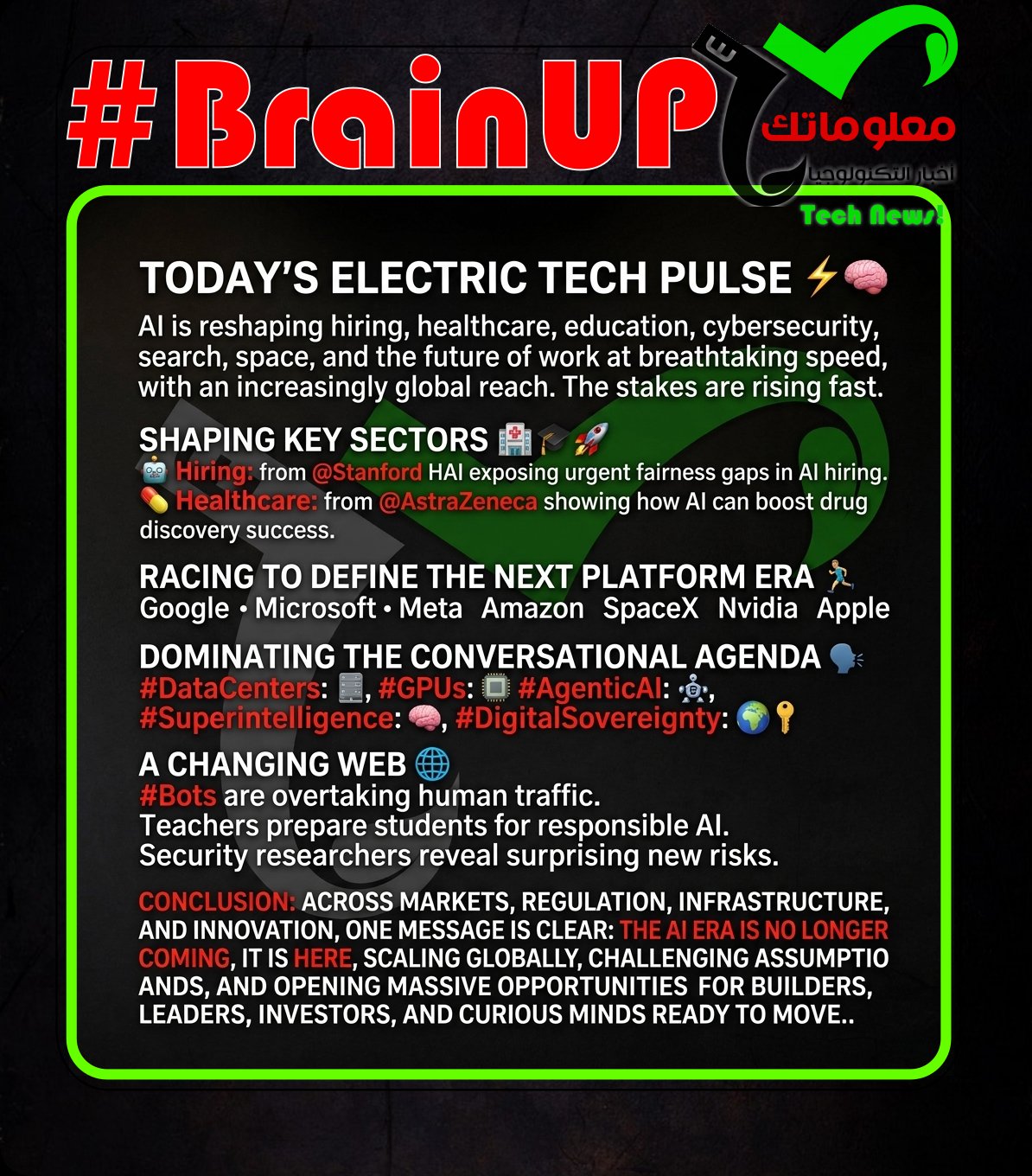
#BrainUp Daily Tech News – (Saturday, June 6ᵗʰ)
Welcome to today’s curated collection of interesting links and insights for 2026/06/06. Our Hand-picked, AI-optimized system has processed and summarized 32 articles from all over the internet to bring you the latest technology news.
As previously aired🔴LIVE on Clubhouse, Chatter Social, Instagram, Twitch, X, YouTube, and TikTok.
Also available as a #Podcast on Apple 📻, Spotify🛜, Anghami, and Amazon🎧 or anywhere else you listen to podcasts.
1. AI Hiring Tools Can Yield Racial Bias and Systemic Rejection | Stanford HAI
A large-scale study of #AI hiring tools used in real hiring finds they can produce racial disparities in screening and create “systemic rejection” when many employers rely on the same vendor. Tracking 3.4 million people submitting 4 million applications to 1,700 job postings across 150 employers in 11 sectors, the authors examine a single third-party vendor’s model that labels applicants “recommend” or “do not recommend,” and they assess adverse impact using the EEOC #four-fifths rule under #TitleVII. They report that 26% of Black applicants and 15% of Asian applicants applied to positions where the system discriminated against their group, and estimate that if Black and Asian candidates were recommended at the same rate as the most-favored group, about 40,000 more applications would have advanced. The results also show that measuring bias by pooling recommendations across all positions can mask discrimination that becomes visible when evaluating each job separately, for example different recommendation rates across job types. Finally, the study tests the idea of “algorithmic monocultures,” finding that applicants who apply to multiple positions screened by the same vendor are more likely to be rejected everywhere than if employer decisions were statistically independent, suggesting shared #hiring algorithms can amplify exclusion across firms.
2. Republicans Claim Anti-Data Center Movement Is a Chinese Psy-Op
Republican lawmakers are asking the FBI to investigate whether growing public opposition to #AI and #dataCenters in the U.S. is being fueled by a Chinese foreign-influence campaign aimed at slowing American AI development. In a letter to FBI Director @KashPatel and members of #Trump’s science advisory leadership, Reps. Brett Guthrie, John Joyce, and Bob Latta cite reports from the #BitcoinPolicyInstitute and Power the Future alleging a coordinated effort by China to hinder AI infrastructure, and one report even insinuates @BernieSanders is involved because he hosted a panel on AI risks that included two professors from China. The article places the claims within a broader U.S. national security framing of an AI “race” with China, an argument promoted by parts of the AI industry, including @JensenHuang of #Nvidia, even as AI’s reputation has worsened over concerns about mental health, jobs, and environmental impacts. That backlash has increasingly focused on local fights over data center projects blamed for higher utility costs, water strain, and pollution, including a massive proposed Utah facility tied to Canadian investor @KevinOLeary, who has similarly alleged Chinese Communist Party influence behind local opposition. Amid the controversy, O’Leary said he would reduce the Utah project’s size by 75%, underscoring how geopolitical accusations are being used to interpret and contest domestic resistance to AI infrastructure.
A former IBM cybersecurity executive alleges in an unsealed lawsuit that IBM and two subsidiaries were breached multiple times in the mid-2010s by foreign state actors, including Chinese hackers, and that IBM covered up the incidents and did not notify government agencies. The complaint, filed by William Barlow, IBM’s former vice president of threat intelligence, says IBM concluded that the Chinese government linked group #APT10 breached IBM’s core network between 2013 and 2016, after a 2017 warning from the Five Eyes alliance prompted an internal investigation. According to the lawsuit, IBM’s investigation found #APT10 may have accessed the network more than 56,000 times, compromising four servers, nearly 400 accounts, and almost 200 systems across business units, countries, and products, while IBM said it could not investigate further because it had not retained basic access logs. The allegations highlight how even large public tech companies and major U.S. federal government cybersecurity vendors can allegedly fail to disclose breaches despite growing #data breach notification laws. IBM declined to address specifics, saying the U.S. Department of Justice declined to intervene and that IBM believes it followed the law.
4. GoPro is in serious financial trouble. Action camera giant is at risk for potential bankruptcy
@GoPro warned in updated SEC filings that there is “substantial doubt” about its ability to continue operating and return to profitability over the next 12 months as sales decline and costs rise. The filing cites a $93.5 million net loss for 2025 following a $432.3 million loss in 2024, plus an 80% to 110% increase in memory hardware costs and reduced supplier supply tied to an #AI data crisis, alongside “further softness in sales” in April and May 2026. It states that without new financing or a strategic transaction, the company may need to significantly reduce or restructure operations, cease operations, or seek protection under U.S. federal bankruptcy laws, while also noting no specific bankruptcy plans have been initiated or considered. GoPro has already cut staff by 23% and is considering a potential sale, but the filing indicates continuing concern about repaying debt. The report does not discuss the recently shipping GoPro Mission 1 series, and GoPro did not respond to a request for comment.
5. China bans 11 online activities under tighter rules to curb rumours, cyberbullies
China’s top internet regulator, the #Cyberspace Administration of China, has introduced tighter rules that ban 11 online activities by multiplatform content creators to curb rumours and content that could inflame social tensions. The measures prohibit tactics such as fabricating topics to confuse the public, spreading fake or speculative information, maliciously collecting and rehashing negative information, and recycling old news to mislead audiences. The CAC said such practices are often used to incite public emotion, stir up social antagonism, or trigger regional discrimination and division, framing the rules as a response to harmful online dynamics. Under the new #Provisions on the Management of Multichannel Distribution Services for Internet Information Content, minors under 16 are barred from hosting live streams, and those aged 16 to 18 must complete age verification and obtain parental or guardian consent. The provisions are scheduled to take effect on September 1.
A software engineer, Erin Maus, obtained a religious accommodation to avoid using #AI at her tech job, and legal experts suggest @Pope Leo XIV’s recent warnings about AI could encourage more workers to seek similar exemptions. Maus, a Unitarian Universalist, said she raised environmental and ethical objections to AI as inconsistent with her religious beliefs, consulted an employment lawyer and her local minister, and received the accommodation in mid-May, allowing her to write and review code by hand. The case comes as more employers mandate and track employees’ AI usage, while Pope Leo’s encyclical warning that AI could undermine human dignity and displace workers has been interpreted by some as support for workplace religious objections. Attorneys say employers must take such requests seriously under Title VII, which sets a relatively low bar for a “sincerely held” belief, and they expect organizations may need to quickly create rules for handling AI-related religious accommodations as more faith groups debate AI ethics.
7. While Google’s CEO Pumps Up AI, Its Actual Employees Are Disgusted by It
Internal messages reported by 404 Media indicate many Google employees are openly frustrated with #AI, mocking both company hype and tools like the internal AI coding system #Jetski. On an internal board called “Memegen,” workers shared large volumes of anti-AI memes, including one during Google I/O that derided new product announcements as “new ways to slop,” and employees estimated the total shared over the past year in the high hundreds or thousands, spiking when models update or Jetski fails. The posts contrast with @Sundar Pichai’s claim that 75 percent of new Google code is now #AI-generated, even if “approved by engineers,” as employees depict the approval work as exhausting code review of low-quality output. One employee argued that #AI speeds code generation but shifts effort downstream, creating bottlenecks in testing, builds, infrastructure, version control, and human review rather than reducing total work. Overall, the internal reaction suggests #AI acceleration pressures are colliding with Google’s engineering culture and systems that were designed to prioritize stability and slow change.
8. Is the data center industry ready to change for the coming of the 1MW rack?
The data center industry has largely adapted to #direct-to-chip liquid cooling, but a bigger shift is approaching as vendors warn that #1MW racks will require fundamental changes to power architecture and operations. At an event in Buffalo, #SchneiderElectric argued that some facilities will need to accommodate #800VDC, with Steven Carlini projecting average rack density could reach about 150kW by 2050, while @Nvidia’s upcoming #Feynman architecture could drive 1MW GPU rack systems as early as 2028. Schneider’s Manish Kumar said designing for 1MW racks will cause “turmoil,” forcing a reimagining of how data centers are built, designed, and operated, because traditional AC approaches and 48 to 54 VDC rack distribution hit practical limits beyond roughly 400kW per rack due to cabling congestion, rack space consumed by power shelves and BBUs, and busbar constraints. Rob Bunger noted today’s ~150kW racks already need multiple power feeds, and scaling to 144-GPU, 1MW racks could require around 32 feeds, becoming unmanageable, while @Nvidia targets a 600kW rack by 2027. As an interim bridge, Schneider expects increased use of power rack sidecars that can be deployed in existing AC data centers, isolate failure domains to a single rack, deploy quickly, and leverage #electric-vehicle supply chains to support small numbers of extreme-density racks.
9. Google To Pay SpaceX $920 Million Per Month For Massive AI Compute Power
@Google will pay @SpaceX $920 million per month under a multiyear agreement for large-scale #AI computing capacity, as demand for its Gemini Enterprise platform outpaces expectations. A regulatory filing says the deal runs from October 2026 through June 2029 and provides access to about 110,000 @NVIDIA GPUs plus CPUs, memory, and other components housed in SpaceX data centers, with a reduced fee during a ramp period through September 2026. The contract gives Google ownership of its content, models, and data, and includes termination options if SpaceX does not deliver the committed GPU capacity by September 30, 2026, plus a 90-day exit clause for either party after December 31, 2026. The arrangement underscores the scarcity and cost of #AI infrastructure, while SpaceX expands compute leasing following its February merger with xAI and alongside a similar May agreement with @Anthropic for Colossus data center access. The Google contract boosts SpaceX revenue ahead of its anticipated Nasdaq IPO, and together with the Anthropic deal implies a compute revenue run rate above $2 billion per month once fully ramped.
A group of @Amazon engineers criticized rapid #data center and #AI infrastructure expansion, arguing it is hypocritical for the company to pour massive capital into compute while cutting jobs. At a Seattle Land Use and Sustainability Committee hearing, @Amazon Web Services engineer Patrick Schloesser cited reports that Amazon plans $200 billion in capital spending this year, mostly for data centers and AI, while company leaders laid off 30,000 corporate employees in the past eight months, and he compared it with @Microsoft spending $190 billion. Seattle’s City Council voted for a one year moratorium on local data center construction after public outcry over five proposed complexes, aiming to create more time for regulation. Amazon said it has no plans to build data centers within Seattle city limits and stated it is working with communities while focusing on water and energy efficiency. The article situates the dispute in a broader #AI spending boom, with hyperscalers including @Alphabet and @Meta contributing to $700 billion in AI infrastructure spending this year, alongside rising public opposition tied to environmental concerns like noise and water use, as a #Gallup poll found 70% of Americans oppose data centers in their local areas.
11. Earthquake-proof prefab Rome data center built in five weeks
Tech firm Sirti Digital Solutions delivered a prefabricated, earthquake-proof data center for Italy’s State Mint in Rome in just five weeks, reportedly the largest prefab data center in Italy. The €28m facility spans about 1,200 sqm, provides space for 200 racks and 1.5MW of IT capacity, uses #2N architecture, and targets a fully loaded PUE of less than or equal to 1.25. Built by a joint venture between HiRef and Smitt, it uses a 44-module modular system assembled on site, and was reported to use 100 percent recyclable materials with no concrete. Earthquake resistance comes from integrated isolators developed with the Polytechnic University of Milan, and the site is also designed to withstand severe weather including winds over 200 kmph. Sirti Digital Solutions also received a five-year operations and maintenance contract, and the Italian government is expected to use the facility to run IO, a public services app for citizens’ official documents and communications.
12. Take This Data Center and Shove It – The American Prospect
A procedural failure in Prince William County, Virginia, helped derail what would have been the world’s largest #data center project, highlighting a broader backlash against rapid data center expansion in Northern Virginia. Landowners and land preservationists won a state appeals court fight after suing the county for not following state rules on posting required public notices for the Digital Gateway project, a planned campus likened in scale to about 12 dozen Walmart superstores. The episode shows how overlooked local #zoning processes can become decisive when residents mobilize, and it reflects collapsing public support for #data centers and the next generation of infrastructure supporting #artificial-intelligence. Residents across party lines object to billions in #tax-breaks for Big Tech in exchange for higher electricity and water rates, few permanent jobs, and environmental and quality-of-life harms like loss of green space and wildlife habitat, plus air and noise pollution, as cancellations and delays mount nationwide with at least 25 projects canceled last year and about half of 2026 openings delayed or scrapped per Bloomberg. Even as tech firms push into rural Virginia with incentives, nondisclosure agreements, and outreach to local officials, the Virginia fight suggests future mega-projects may still face intense resistance in the country’s biggest data center market.
13. An Anthropic employee’s 2-sentence quote crystallizes the state of AI confusion at work
An unnamed @Anthropic employee captured growing workplace confusion as #AI coding tools advance: when systems work, they feel redundant, but when they fail, they do not understand how to fix them. In a company blog post about risks from #AI systems potentially improving themselves autonomously, employees described not writing code for months and expecting AI-generated code to outperform human code within a year. The post said @Anthropic’s frontier #LLM #Claude can handle engineering and research tasks, but still shows large gaps in judgment when choosing goals. The broader workplace impact includes CEOs touting high shares of AI-written code, including @Google citing 75%, alongside increased spending on AI over hiring or bonuses and announcements of AI-linked layoffs. The post, written by The Anthropic Institute, called for a coordinated meaningful slowdown or pause in frontier model development so security, monitoring, societal structures, and #alignment research can keep pace.
14. Bot web traffic has overtaken human web traffic, data shows
#Bot and #AI agent traffic has surpassed human web traffic for the first time, according to data from @Cloudflare. @Matthew Prince said Cloudflare now sees 57.4% of requests to a selection of sites it hosts coming from automated bots versus 42.6% from humans, noting the precise crossover day is unclear but the shift is evident despite messy data. He attributed the change to fast-growing #agentic traffic, where largely autonomous programs can browse at massive scale, such as thousands of websites for tasks that might take humans only a handful. Prince argued the trend does not confirm the #DeadInternetTheory, suggesting AI lowers barriers to creating websites and content, and he said the web has recently flipped from years of shrinkage to exponential growth, alongside concerns that existing ad models may weaken because bots do not click ads. He floated charging bots for access to content as a potential new model that could keep the web free for humans and possibly usher in a new “golden age” of the internet.
15. European Parliament to ditch Google for European alternative | Euractiv
The #EuropeanParliament will replace #Google as the default search engine on MEPs’ computers with France’s Qwant, framing the move as part of its push for #digitalSovereignty and stronger personal data protection. An internal email says that searches from the address bar in Firefox and #Microsoft Edge will be served by Qwant, described as a privacy focused European search engine designed to avoid tracking or collecting personal data, while users can still switch back to Google or other options. The change comes as the #EuropeanCommission is set to present legal proposals aimed at boosting the EU’s tech sovereignty and reducing reliance on US tech giants, in a market where Google holds about 90% share in Europe. Qwant’s selection is notable because it has historically relied on #Bing’s index, though it is developing its own search index, Staan, with Ecosia. The switch answers earlier calls from MEPs to @RobertaMetsola to move services to European providers, but the article notes that other dependencies, including foreign smartphones, email clients, and Microsoft’s Office suite, remain entrenched.
16. Malaysia, Australia emerge as Asia-Pacific’s biggest data center growth hotspots: CBRE
According to CBRE, Asia-Pacific’s #data center boom is shifting toward markets with more available power, with Malaysia and Australia emerging as top growth hotspots as #AI adoption increases. APAC data center investment hit a record $11.6 billion in 2025, and company-level transactions involving platforms and data center operators totaled $8.3 billion, while operators increasingly use capital recycling and new fund strategies to expand and diversify. Johor, Malaysia led the region in 2025 live capacity growth at 53% year over year, followed by Melbourne at 37%, while Singapore and Hong Kong grew only 6% to 8% amid higher construction costs, longer delivery timelines, and power constraints. CBRE says investors are pursuing alternatives such as built-to-suit projects, infrastructure partnerships, and local development alliances as the market reorders, with India and Australia expected to lead broader regional growth. Major US players are also increasing exposure, including Vantage’s $1.6 billion APAC equity investment partly tied to acquiring Sedenak Tech Park in Johor, @Brookfield Asset Management’s plan to invest $10 billion in Japan focused on data centers and battery storage, and @Blackstone’s $3 billion deal with a Saudi AI firm to build data centers in Saudi Arabia.
17. Chip selloff erases over $1 trillion stock market value
The global chip industry experienced a massive selloff that erased over $1 trillion in stock market value. This steep decline was driven by growing concerns over demand and inventory levels in the semiconductor sector. Major chipmakers saw sharp drops in their stock prices amid fears of a slowdown in consumer electronics and automotive industries. The selloff highlights challenges in the #chipmaking supply chain and signals potential shifts in investor sentiment. These developments may impact broader technology markets given the chip industry’s crucial role in innovation and manufacturing.
@Matthew Prince, CEO and co-founder of @Cloudflare, says #bots have surpassed humans in online traffic for the first time, driven by a surge in #agentic traffic that arrived earlier than he expected. Cloudflare’s latest data shows bot vs. human #HTTP requests at 57.5% vs. 42.5%, and Prince notes the exact crossover date is unclear because the data is “a bit messy,” but they are “clearly on the other side now.” The company distinguishes these AI agents from traditional crawlers and abuse bots, describing them as human-like web browsers performing tasks such as reading product pages, checking prices, comparing flights, scraping and indexing content for AI models, ordering food, shopping, and handling customer service. The article cautions that Cloudflare measures requests rather than engagement, so humans still dominate time spent in apps, streaming, and feeds that generate fewer rapid page-load requests. By country, Cloudflare reports especially bot-heavy traffic in Gibraltar (92.1%), Singapore (76.4%), and Iran (76.4%), attributing some of this to dense hosting infrastructure and suggesting Iran’s share may relate to VPN usage and scraping or bypass tools, which Cloudflare has previously linked to malicious bot activity.
19. AstraZeneca CEO says AI is reshaping drug development — and helping boost the odds of success
@Pascal Soriot said #AI is improving productivity at AstraZeneca by helping the company design medicines faster and make smarter choices across drug discovery and development. He cited uses such as identifying new drug targets, optimizing molecules, and reducing potential side effects, alongside partnerships including work with @Tempus AI and Pathos. Soriot said AstraZeneca and Tempus AI built an agent that combines clinical and laboratory data to predict the probability of success for Phase 3 trials. He argued this can materially raise returns because late stage trials can cost $300 million to $500 million, so even modest gains in success probability produce large productivity benefits. His comments address investor skepticism about whether heavy AI spending is generating meaningful outcomes in healthcare, with AstraZeneca pointing to concrete applications in its pipeline.
20. Browser coalition accuses Microsoft of monopolistic abuse and demands change
The Browser Choice Alliance says @Microsoft is abusing its dominant Windows position to steer users toward #Edge and limit real browser choice, and it is demanding policy changes. In a letter to @Satya Nadella, the coalition alleges tactics such as rebate programs that discourage OEMs from preinstalling rival browsers, making Edge impossible to fully uninstall, using system updates to restore Edge integration, and presenting intrusive prompts and ads when users try to download third-party browsers. It also criticizes Edge’s deep ties to Teams, Outlook, Windows Search, and other OS features, plus the absence of a one-click way to fully switch defaults away from Edge across all touchpoints. The group argues these practices distort competition, frustrate users, and are drawing regulatory scrutiny, especially outside the US, at a time when PCs remain a key gateway to the web in the era of generative AI. It calls on @Microsoft to allow third-party browser preinstallation, remove #darkPatterns that deter downloads, and enable full removal of Edge’s deeper Windows integration so browsers compete on merit.
@Goldman Sachs equity research chief @Jim Covello argues that after years of heavy #AI investment, Wall Street is running out of patience for profits and that the debate cannot stay stuck at “it’s early” indefinitely. He says consumer adoption has been “magnificent” and the technology has advanced, but investors are, in his view, further from returns because companies are losing more money implementing AI and the spending hill has grown steeper. Even the more optimistic @George Lee of the Goldman Sachs Global Institute pegs total #AI infrastructure spend at $7 trillion to $8 trillion and says payback requires net new economic activity, not just disruption of existing profit pools. Covello frames the decisive issue as enterprise ROI, whether companies actually make or save money using AI, and he points to thin evidence so far, including MIT findings that 95% of organizations reported zero return on AI pilots and a 2025 EY survey where 99% reported losses tied to AI-related risks averaging $4.4 million. He links these concerns to a broader “activation gap” described by Cognizant research and executive discussions, warning that if the market is still calling it early two years from now, the long term case may face a credibility challenge.
22. How a USB-connected speaker can infect a PC without ever being touched
Security researcher Rasmus Moorats found that the Creative Sound Blaster Katana V2X can be attacked over Bluetooth to gain remote code execution on a PC it is connected to via USB, without pairing or authentication. He discovered the speaker’s proprietary #CreativeTransportProtocol (CTP) accepts commands from any nearby Bluetooth device, including an “upload new firmware” function that lets an attacker flash custom firmware without code signing. By modifying the speaker’s firmware, which runs @FreeRTOS, he altered its USB descriptor to add #HID keyboard capabilities and then used existing firmware code to send keystrokes to the attached computer. In his proof of concept, the over-the-air firmware flash ultimately made the speaker type and execute a command like “echo pwned” on the connected PC, demonstrating how the speaker can act as a proxy for keystroke injection. The behavior shows how insecure firmware update and device identity controls in a USB peripheral can bridge a nearby wireless attacker to a physically connected host system.
23. Most K-12 teachers say AI’s impact on education will eclipse the internet or computers
An NPR/Ipsos poll finds K-12 teachers expect #AI to reshape education even more than the internet or computers, while also raising worries about student learning and relationships. In a nationally representative survey of 545 teachers, nearly three-in-four said AI has bigger implications than past innovations, and a majority said AI is making it harder for students to learn to think for themselves, even as 6-in-10 teachers reported using AI for work tasks. Teachers described using tools like #ChatGPT mainly as a helper for planning and materials, for example @Michele Naber said she teaches students to prompt chatbots and verify outputs with reliable sources, and uses AI to quickly generate multiple-choice questions, though most users said the time saved is two hours or less per week. At the same time, student in-class use appears limited so far, with a little more than half of teachers saying students are not using AI in class at all and about two-in-five saying students use it at least weekly. Despite mixed experiences and concerns, nearly eight-in-ten teachers said schools should teach responsible AI use, reflecting a view that the technology is not going away and educators need to respond.
24. Meta’s stock sinks on report company could raise tens of billions of dollars to fund AI push
Meta shares fell more than 5% after the Financial Times reported the company is considering raising tens of billions of dollars via a stock offering to fund its #AI investments. The report said Meta has not hired banks and may not issue new stock, and a Meta spokesperson called the story “pure speculation” while reiterating the company will pursue flexible ways to raise capital for #AI. The report comes as @Alphabet plans to raise $85 billion from selling equity and as both companies ramp #capex to build #AI infrastructure to meet soaring demand, with Meta lifting 2026 capex guidance to as high as $145 billion and Alphabet raising its top-end capex guidance to $190 billion. Investor concerns about heavy #AI spending have weighed on Alphabet for weeks and Meta has lagged peers over the past year, highlighting how financing and spending plans can pressure valuations even amid expected demand. The market reaction underscores that Meta’s #AI push is increasingly tied to questions about funding strategy, capital intensity, and how investors will price that spending.
25. China launches space computing hub as SpaceX gears up for historic IPO
China has launched a state-backed institute in Beijing to push #space-based #AI computing, highlighting how the tech rivalry with the US is moving into orbit as Earth-based AI data centres hit energy bottlenecks. The Beijing Space Intelligent Computing Research Institute, set up in late May in Beijing’s E-Town, is backed by a consortium led by the National Information Technology Application Innovation Park, a joint initiative created in 2019 by the Ministry of Industry and Information Technology and the Beijing municipal government. According to a notice by the Beijing Association for Science and Technology, the institute will research #space-computing chips, #inter-satellite laser communication, #space energy, and #space safety standards, and it aims to develop and launch a pilot satellite by the end of 2028. The move comes as @Elon Musk’s @SpaceX prepares for a potentially record-setting US$75 billion IPO to fund its own orbital AI ambitions, underscoring that both sides see off-planet computing as a strategic path to scale AI beyond terrestrial constraints.
26. Leak Reveals Microsoft Wants Its AI To Be ‘Addictive’
After @Microsoft publicly announced its new AI personal assistant, Scout, 404 Media published a leaked internal strategy document stating the company’s immediate intention is to “make people addicted.” The document, titled “ClawPilot: Overview and Plan with Project Lobster,” describes a first launch phase focused on driving daily dependence through Scout’s ubiquity across products like Word, Outlook, Teams, and Edge, and it cites internal employee testing showing “Daily Usage with High Retention and intensity of usage.” @Satya Nadella denied the goal in an internal message, saying he did not know the document and calling it “nonsense,” but 404 Media responded that senior staff authored it, including Scout project lead @Omar Shahine, and noted Shahine also wrote Microsoft’s official Scout announcement. The article frames Scout as part of #Copilot and “Project Lobster,” using tools like the #OpenClaw AI agent, and argues the leak undercuts Microsoft’s public posture that the product is meant to “empower and add real value.” It also reports Microsoft did not respond directly to 404 Media and instead criticized the outlet internally while offering a minimal statement through a spokesperson to a more sympathetic publication.
27. China Uses AI to Predict and Suppress Political Dissent
China has deployed advanced #artificialintelligence technologies to anticipate and manage political dissent, utilizing vast data from social media, surveillance, and government records. The AI systems identify potential unrest by analyzing patterns and flagging individuals or groups prone to protest, enabling authorities to intervene preemptively. This approach reflects a broader trend of integrating #AI with state security, raising concerns about privacy and human rights abuses. Experts argue that such surveillance enhances the Chinese Communist Party’s control while stifling freedom of expression and political activism. The use of AI in this way represents a significant shift in how authoritarian regimes maintain order and suppress opposition using digital tools.
28. China bets on AI to promote President Xi Jinping’s thinking
China is increasingly using artificial intelligence (#AI) to disseminate the ideological framework of President @Xi Jinping, embedding his thoughts more deeply into society. The use of AI-covered media, digital platforms, and virtual environments enhances the reach and impact of #XiJinpingThought, which is a central doctrine under the Communist Party’s leadership. By integrating AI technologies, China seeks to modernize propaganda efforts, ensuring more precise targeting and engagement with citizens, thereby reinforcing political loyalty and control. Analysts note this approach exemplifies the government’s broader strategy of merging emerging technologies with governance to consolidate power. This development highlights how AI is not only a technological advancement but a powerful tool in shaping sociopolitical narratives aligned with the Communist Party’s objectives.
29. Microsoft AI chief says company was “set free” from OpenAI to pursue superintelligence
At Microsoft Build 2026, @Mustafa Suleyman said a contractual change with #OpenAI about six months ago “set free” Microsoft AI to formally pursue #superintelligence using Microsoft’s own researchers, data pipelines, and custom silicon, while stressing Microsoft is not abandoning OpenAI. Microsoft backed the shift with the launch of seven in-house “MAI” models covering reasoning, code generation, image creation and editing, transcription, and voice synthesis, delivered via #MicrosoftFoundry with tuning available through platforms like OpenRouter, Fireworks, and Baseten. The flagship MAI-Thinking-1 is a 35-billion-active-parameter reasoning model that Microsoft claims matches leading models in its weight class on software engineering benchmarks and shows strong math reasoning, and Suleyman emphasized the models are trained from scratch on clean, commercially licensed data without distillation from third-party frontier models. He framed the release as proof of concept for building a durable internal lab so that by 2030 and beyond Microsoft can build frontier models rather than only buying them. The move reframes Microsoft’s AI strategy from being inseparable from OpenAI, after more than $13 billion invested, toward a parallel path that could eventually stand on its own.
30. Apple’s WWDC: Tim Cook’s AI legacy at stake in his final developer conference as CEO
Apple enters WWDC with @Tim Cook’s final developer conference as CEO framed as a make or break moment for its #AI strategy, with a major #Siri overhaul expected to headline the event as @John Ternus prepares to succeed Cook. The company is expected to show a more powerful Siri, potentially including a standalone chatbot style app, personal context, on screen awareness, multi step command handling, and deeper routing to outside models such as @Google’s #Gemini. Investors and developers are watching whether #Apple Intelligence can become an iPhone upgrade driver and whether Siri can evolve into a credibly agentic platform, especially given Apple’s rich valuation, cited at about 36 times trailing earnings and a stock price near all time highs. Analysts at MoffettNathanson argue the stock has already priced in the AI story, and that Siri must reliably execute multi step tasks across apps to justify the multiple, but adoption depends on third party support via #AppIntents, creating a chicken and egg problem. The article notes Apple has reportedly lined up early App Intents partners including Uber, Amazon, Temu, YouTube, WhatsApp, Facebook, Threads, and AllTrails, underscoring that WWDC is a key test of whether Apple can turn its large install base into a defensible AI platform narrative.
31. Google accidentally enabled a new Gemini feature, and it could be very useful
@Google appears to have accidentally enabled a new #Gemini “Troubleshooting” mode that some users can see in the model picker. Reports on X say the mode provides step by step troubleshooting guidance using text plus interactive widgets, including prompts that let users select symptoms to narrow down advice, for example when a car will not start. Reddit discussions suggest it uses a lower temperature for more accurate, focused responses, avoids conversational fluff, and aims to provide the most likely diagnosis and next steps. Android Authority could not see the option on its own accounts, and notes it may be a limited rollout or mistake that @Google could revert at any time. If released broadly, the feature could make #Gemini more useful for practical problem solving, and the outlet says it has contacted @Google for comment.
32. The price of Nvidia RTX Spark PCs is going to hurt
@Nvidia’s new RTX Spark-based PCs are shaping up to be premium, expensive machines aimed at an #agentic AI development world, with launches expected in fall 2026. The flagship RTX Spark configuration highlighted at Computex 2026 is described as a single chip with 20 CPU cores and 6,144 #CUDA graphics cores, with partners like Dell, Asus, MSI, HP, Lenovo, and @Microsoft touting thin, light laptops and desktops, including Microsoft’s Surface Laptop Ultra and Surface RTX Spark Dev Box. While Nvidia and Microsoft would not confirm pricing at Build 2026, citing plans to share details closer to launch and uncertainty around memory and storage costs, vendor and analyst chatter points to steep starting prices. Reported estimates put N1X systems around $2,500 to $2,900, and stepped-down N1 systems around $1,800 to $2,000. The likely outcome is sticker shock for mainstream buyers, but the pricing may be more tolerable for developers and early adopters who want local AI power and potentially cheaper development than relying on paid AI tokens, with an open question of whether these costs and capabilities will trickle down to broader PC hardware.
That’s all for today’s digest for 2026/06/06! We picked, and processed 32 Articles. Stay tuned for tomorrow’s collection of insights and discoveries.
Thanks, Patricia Zougheib and Dr Badawi, for curating the links
See you in the next one! 🚀
