
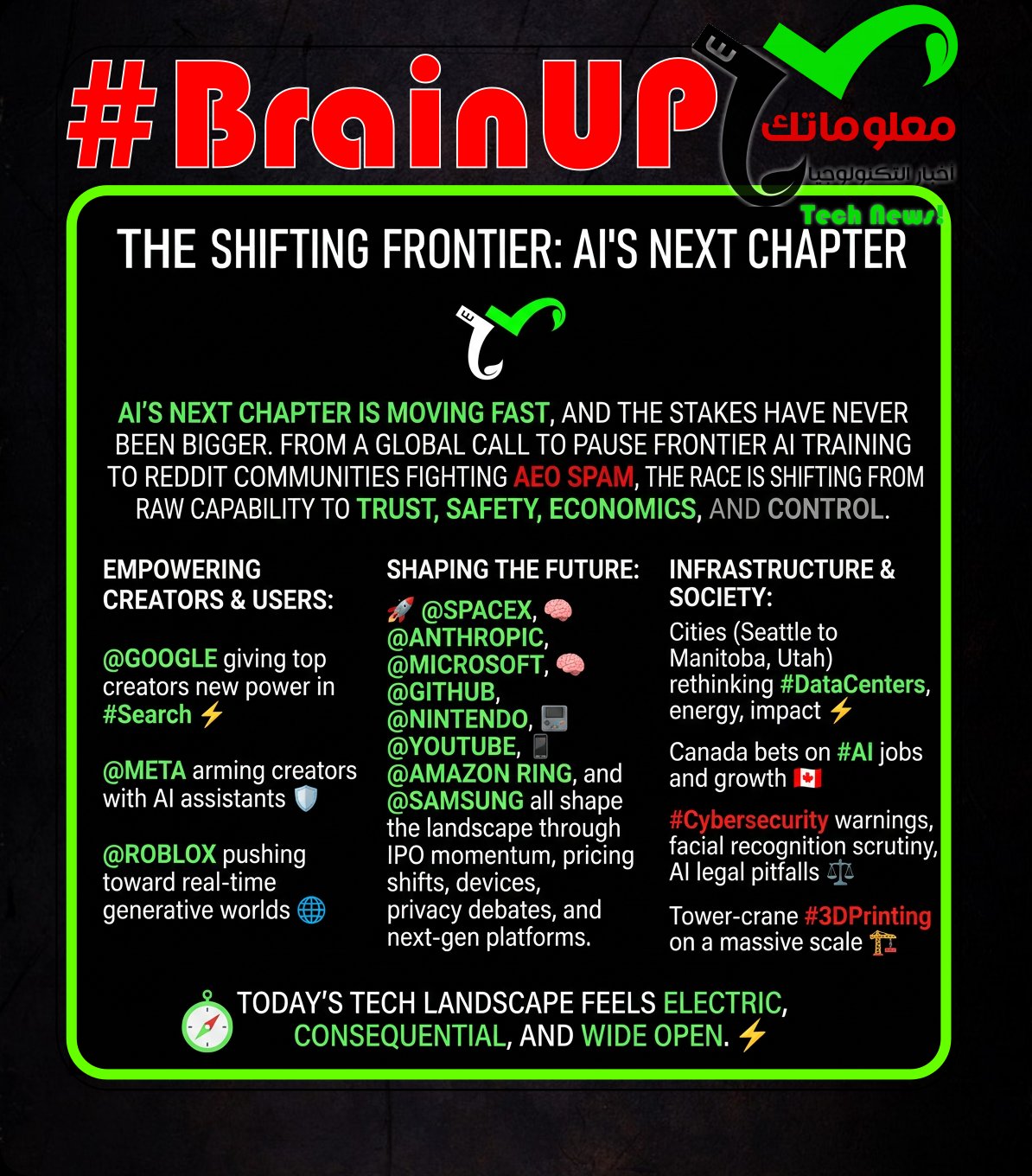
#BrainUp Daily Tech News – (Friday, June 5ᵗʰ)
Welcome to today’s curated collection of interesting links and insights for 2026/06/05. Our Hand-picked, AI-optimized system has processed and summarized 35 articles from all over the internet to bring you the latest technology news.
As previously aired🔴LIVE on Clubhouse, Chatter Social, Instagram, Twitch, X, YouTube, and TikTok.
Also available as a #Podcast on Apple 📻, Spotify🛜, Anghami, and Amazon🎧 or anywhere else you listen to podcasts.
1. World’s most valuable AI start-up calls for global freeze in AI training
The world’s most valuable AI start-up has called for a global freeze on training advanced AI models to address rising concerns about their safety and ethical implications. The company highlights the rapid escalation in AI capabilities, urging governments and organizations to halt development temporarily and establish international regulations to manage risks. Experts warn that unchecked AI advancements could lead to unintended consequences, including misinformation, job displacement, and security issues, making oversight essential. This initiative reflects growing calls for responsible AI development, balancing innovation with societal safety. The proposed pause aims to create a collaborative framework that ensures AI benefits humanity without escalating dangers.
2. Spammers are flooding Reddit with fake posts designed to show up in AI search results
Moderators of Reddit’s /biohackers subreddit say vendors are flooding the community with posts meant not just to sell products, but to shape what #AI systems and #AI search engines cite as answers. They report companies selling peptides and hormone replacement therapy are seeding engagement bait threads and weaving brand mentions into seemingly organic discussion as part of #AEO, because tools like #ChatGPT and #Google AI search often pull from Reddit. Moderators say the spam is harder to detect than traditional promotion because it can involve “warmed up” accounts with normal-looking histories, and sometimes paid participation, plus posts tailored to prompt patterns that #LLMs prioritize. In response, the subreddit announced a policy change banning new standalone posts about peptides and HRT and funneling discussion into weekly megathreads to protect content quality. The moderators warn this creates a difficult balancing act: recognizing coordinated manipulation without over-moderating genuine users in a community focused on self-experimentation and emerging therapies.
3. Google is letting social media stars customize their search result page
@Google is allowing large creators and publishers in the US to claim dedicated #Search profiles that let them customize what appears about them in Google Search. Eligibility is limited to people 18 or older who meet follower thresholds on major platforms, at least 100,000 subscribers on #YouTube, 100,000 followers on #Instagram or X, or 300,000 followers on #TikTok, so most individuals and organizations cannot access it. Demo videos show profiles can include links to websites and other platforms, a short summary, pinned media from services like TikTok and Instagram, and an aggregated feed of posts across platforms, and The Verge says it has already created a profile. Unlike existing knowledge panels, these profiles give notable accounts more control over what is shown and can also function as an alternative to link-in-bio tools like #Linktree by consolidating a creator’s online presence into one Search destination.
4. S&P Global Keeps Fast Entry Proposal Unchanged; SpaceX Listing Looms
S&P Global has maintained its fast entry listing proposal without changes, signaling confidence in an expedited process for new listings. The company aims to streamline capital market access amid a backdrop of evolving regulatory environments and growing investor interest in innovative business models. SpaceX’s potential public listing is anticipated around 2026, reflecting significant market attention on private companies transitioning to public markets. This timing aligns with broader trends in the capital markets favoring quicker, more efficient listing avenues. The approach by S&P Global underscores the emphasis on facilitating faster capital formation while preparing for high-profile entries like SpaceX, indicating a strategic direction in the industry.
5. A CEO told employees they won’t get raises in 2026 because the budget is going to AI
Teradata told employees not to expect annual salary raises in 2026 because it is redirecting that budget to #AI investments. In an internal memo seen by Business Insider, CEO @Steve McMillan said the company’s 2026 focus is to “win in the market with AI” and that it will increase investment in AI talent and expertise, funded by reallocating money from annual salary adjustments. Long-tenured US employees said typical raises had been about 2% to 4% when granted, while the memo noted employees may still receive performance-based bonuses and equity and that the decision applies where regulators do not require market-aligned adjustments. The move reflects a broader push to finance AI transformations by cutting or pausing workforce-related spending, similar to TTEC pausing 401(k) matches to fund AI tools and training, and a workplace strategist said leaders’ explicit framing of #AI as the reason for such cuts marks a notable rhetorical shift.
6. Pioneering AI Founders Join to Accelerate Roblox Reality Vision | Roblox
Roblox says advancing true interactive AI requires overcoming #latency, #consistency, and #quality, and it is accelerating its Roblox Reality vision by acquiring Morpheus AI’s team and technology and bringing in founders from Dynamics Lab and Lucid AI. Researcher @Xun Huang created #Self Forcing to convert slow, offline video models into fast, autoregressive interactive generators, then founded Morpheus AI to pursue real-time responsiveness, and Roblox plans to use these models to advance its Roblox Video Model (#Super Upsampler) with higher-fidelity textures, realistic lighting, and fluid physics, while the #RobloxEngine provides structured logic, long-term state, and multiplayer synchronization. Dynamics Lab founder @Joe Chen built a real-time generative world engine that let users upload any image, enter it as an interactive world, use text prompts to change events, and share a link for friends to play instantly. Lucid AI founder @Alberto Hojel emphasized reliable, consistent worlds by pairing strong visuals with deterministic game logic, inventing a Roblox game cartridge harness that augments video world models with a dedicated engine to turn explorable scenes into high-fidelity multiplayer games. Roblox adds that its Roblox Reality architecture targets 4K at 60 Hz and will rely on optimization and #KVCompression, moving the #SuperUpsampler to edge data centers using H200 and B200 class GPUs, with Morpheus AI’s long-context work helping maintain visual consistency.
7. Seattle poised to ban new datacenters in blow to big tech hub
Seattle is close to approving a one-year moratorium on new #datacenter construction, positioning the city as the largest in the US to consider such a pause amid growing backlash tied to the #AI boom. Four companies proposed five large facilities on areas served by the city’s public utility that, if approved, would have used about a third of Seattle’s current daily electricity demand, prompting lawmakers to cite risks of higher utility costs and environmental hazards. Council committees unanimously advanced the moratorium and a companion resolution, with a full council vote expected Tuesday, and @Mayor Katie Wilson said the city was motivated by strong public support after the proposals became public in April. The pause is intended to give officials time to draft datacenter-specific rules, including pollution and energy-connection standards, labor and contract terms, and new utility pricing for “large load” customers, while still allowing existing datacenters to seek expansions up to 20 megawatts. In the backyard of @Amazon and @Microsoft, activists and tech workers argue the move can spur other jurisdictions to regulate datacenters and push Seattle to decide whether these facilities are a good use of urban land, potentially requiring public benefits like affordable housing and transit investments.
8. AI Spending Frenzy Forces Microsoft Customers to Question the Economics of AI
The Financial Times article examines growing concerns among enterprise customers about the escalating cost of generative AI deployments, particularly those powered by advanced models from companies such as @Anthropic and @OpenAI. While AI adoption continues to accelerate, organizations are discovering that token consumption, agentic workflows, and large-scale inference workloads can generate unexpectedly high operating expenses. The report highlights tensions between AI vendors seeking rapid growth and customers demanding clearer returns on investment. Some enterprises are reassessing deployment strategies, limiting usage, or exploring smaller and open-source alternatives as AI budgets expand faster than anticipated. The article underscores a broader shift in the industry: the challenge is no longer merely accessing powerful AI systems, but sustaining them economically at scale as #GenerativeAI moves from experimentation into daily business operations.
9. Meta rolls out a new AI creator assistant on Facebook | TechCrunch
@Meta is rolling out a new #AI creator assistant on #Facebook that gives creators personalized recommendations based on their content style, performance, community, and goals. The conversational tool answers questions such as when to post and what people are saying in comments, supports follow-up queries like audience shifts over time, and can suggest new content ideas by drawing on trends such as trending audio or cultural moments. It is launching to creators in the U.S., Canada, and India, with plans to add capabilities and expand to more countries. Meta positions the assistant as a way to keep creators active on Facebook amid competition from TikTok and YouTube, encourage more frequent posting to boost engagement, and reduce reliance on third-party tools like #ChatGPT by keeping workflows inside its ecosystem. Meta also added new languages for #AI translations on Facebook, including Arabic, Bahasa Indonesian, French, Thai, and Vietnamese, and says over half a billion users watch AI-translated videos weekly, with options like lip-sync to make translated Reels feel more natural.
10. Hackers are turning up to offices and posing as IT support, FBI warns
The @FBI warns that the Silent Ransom Group is shifting from remote intrusions to in-person #socialEngineering by posing as IT support staff to gain access to company systems. The group, active since 2022, reportedly calls targets with IT-themed pretexts, then sends an impersonator on-site to plug a storage device into a computer, install malware, and exfiltrate sensitive files, later issuing ransom emails threatening to sell or post the data. The alert notes law firms have been the main targets, with medical and insurance organisations also potentially at risk because of the sensitivity of their data. The article links this low-tech approach to a landscape where defenders are deploying #AI at scale, while attackers also use AI tools like voice cloning and deepfakes, underscoring that advanced tooling alone cannot replace layered organisational security. Bitdefender’s Bogdan Botezatu argues the simplicity is intentional: criminals use whatever works, and the tactic suggests basic failures in layered defences at some firms.
@GitHub has moved #Copilot from flat-rate request buckets to #metered billing based on token usage, and developers are discovering that everyday chats, large context windows, and frontier models can drain monthly credits extremely fast. The new system assigns a cent-based credit meter, with Pro at $10 including 1,500 credits, Pro+ at $39 including 7,000 credits, and Copilot Max at $100 including 20,000 credits, but burn rates vary sharply by model choice and prompt and response size. The article contrasts costs such as about $1.25 per million output tokens for a smaller @OpenAI model like GPT-5.4 nano versus roughly $30 for GPT-5.5, and cites user reports including 94 credits for a “build a Minesweeper game” prompt via Claude Haiku 4.5, 171 credits for a complex prompt, “a few prompts” consuming 700 credits, and a couple of Copilot-driven commits consuming 5,000 credits. Developers also report routine usage like 15 credits for a typical query, 100 credits for a small plan, 840 credits spent in one cautious day with Claude Sonnet 4.6, and 21 percent of Pro credits disappearing in a day, prompting some to consider switching tools. Overall, the change ends cross-subsidization of heavy users and forces developers to reevaluate how often they rely on #AI coding assistance and which models and workflows they can afford.
12. Wired found code for an unreleased facial recognition feature in Meta’s AI app – Engadget
A @Wired report says Meta’s Meta AI app contains buried code for an unreleased #facialRecognition feature intended to run on Meta smart glasses, reinforcing earlier reporting that Meta has been exploring face identification on its wearables. The feature is labeled “NameTag” in the code and is described as capturing people’s faces via the glasses and later alerting the wearer when a previously captured face is recognized, although a security researcher said no part of it is currently running or sending biometric data to Meta’s servers. Past versions of the app reportedly included interface elements like a “Connections” menu suggesting users “remember the people you met,” and anonymous sources previously told @TheNewYorkTimes the internal tool was also called “Name Tag,” with a memo indicating interest in launching amid a “dynamic political environment” to reduce expected criticism. Meta spokesperson Ryan Daniels told Engadget the code reflects exploration, nothing has shipped, no final decision has been made, and the company is not building a central face database, while the article notes potential accessibility benefits alongside serious ethical concerns. The discovery adds to recurring signs of experimentation, but there is no evidence NameTag will ship on future Ray-Ban or Oakley smart glasses.
13. Microsoft Says Anthropic Models Are Too Expensive
Microsoft criticizes Anthropic’s AI models for their high computational costs, which limits their practicality. Despite the advanced capabilities of these models, the expense involved in running them is a significant barrier to widespread adoption and integration into Microsoft’s product ecosystem. This cost concern highlights the ongoing challenge in the AI industry to balance model performance with operational efficiency. Microsoft’s stance suggests a preference for models that offer scalability and cost-effectiveness for commercial use. Consequently, this debate underscores the importance of sustainable AI development that meets both technical and economic demands.
14. Premier says no to massive AI data centre proposed for south of Winnipeg | CBC News
@Wab Kinew says Manitoba will reject a proposed hyperscale #AI data centre on 141 hectares of farmland south of Winnipeg, arguing such facilities are not in the province’s best interests. The project, backed by Las Vegas-based Jet.AI and Vancouver-based Consensus Core, was planned near Ile des Chênes in the RM of Ritchot and would be powered by natural gas turbines, while local opposition has grown, including a petition citing noise, light, and air pollution and concerns from Climate Action Team Manitoba about Manitoba’s clean energy future. Kinew said he is concerned about environmental impacts, rural quality of life, and the broader social harms of #AI and “surveillance capitalism,” linking his stance to his government’s intent to ban social media and AI chatbots for kids. He also argued that although construction would bring short-term activity, most economic benefits would leave Manitoba. Consensus Core CEO Wayne Lloyd disputed that, saying the project would create well-paying union jobs, generate its own energy without drawing on Manitoba Hydro, and produce millions in annual local tax revenue, but the premier’s position remains that the data centre will not proceed.
@Nintendo says it will release versions of the Switch 2 that comply with upcoming EU #Batteries Regulation requirements for easily user replaceable batteries, which take effect on February 18, 2027. On its “Compliance with EU Directives and Regulations” page, the company notes the EU #WEEE directive and states it is preparing product versions to meet the regulation, implying an updated Switch 2 will arrive in the EU before the deadline. The compliant products are identified by model numbers starting with “BEE” and will later include an “OSM” code on packaging to denote separate products for regulatory purposes, with the same “BEE” designation also associated with Switch 2 Joy Cons and the Pro Controller, leaving open whether those accessories will get replaceable battery revisions too. The article emphasizes this is EU specific and may not extend to North America or Asia, though importing is possible and current Switch 2 hardware and games outside Japan are not region locked. It also notes that while today’s Switch 2 battery can be replaced, it is difficult, with an iFixit process involving dozens of steps and a 3/10 repairability score.
Google-owned Debug is seeking EPA permission to release 32 million male Aedes aegypti mosquitoes in Florida and California as a #sterile insect release program using #Wolbachia to cause cytoplasmic incompatibility so wild females’ eggs do not hatch, aiming to shrink populations that spread dengue, yellow fever, and Zika. Debug says the plan relies on releasing “sterile males,” and notes males do not bite, while citing a growing research base suggesting the technique can reduce mosquito-borne disease risk. Public comments to the EPA, open until June 5, show strong backlash, with commenters arguing corporations should not alter ecosystems, objecting to being “experimental rats,” and warning of profit-driven manipulation. The article frames the concern as partly grounded in the irreversible, unpredictable nature of releasing live organisms at scale, pointing to a 2019 Brazil release of genetically modified mosquitoes that unintentionally introduced lab DNA into wild populations and to a 2024 review warning that mistakes with the Wolbachia approach could have disastrous consequences. Overall, the proposal is presented as a potentially effective but high-stakes intervention that has triggered public distrust of a for-profit tech company leading an ecological release.
Samsung has effectively confirmed it will launch a “#Ultra” branded foldable called the Galaxy Z Fold 8 Ultra alongside another Galaxy Z Fold 8 model this year. The name appears in the Bluetooth SIG database, where five entries list multiple model numbers that seem to be variants of the same device, lending official-document weight to earlier rumors, though the listing provides no specs. The report says expectations are that Samsung’s shorter, wider foldable will use the standard name, Galaxy Z Fold 8, while the more familiar footprint, similar to the Galaxy Z Fold 7, becomes the Galaxy Z Fold 8 Ultra. Previous leaks cited in the article claim the Ultra model could include a 5,000mAh battery, a #Snapdragon 8 Elite Gen 5 chip, and a roughly 4.1mm unfolded thickness for a thinner, slightly lighter design. Overall, the certification reinforces that Samsung is applying the Ultra label to one Fold 8 variant, potentially leaving the wider form factor as the plain “Galaxy Z Fold 8.”
18. Will the AI economy create a permanent underclass?
The article argues that the #AI economy could entrench a global underclass, with many countries left outside the #AI supply chain facing job losses and weakened public finances. It describes an #AI frenzy in the San Francisco Bay Area where top programmers receive enormous pay packages and startups spend on hyper-targeted advertising, yet even this super-elite fears being displaced as #AI automates white-collar work, especially coding, and some anticipate needing #universal basic income. The author contends that Silicon Valley’s progressive self-image and talk of taxing the rich overlooks that most people harmed by #AI-driven disruption will live outside the US, particularly in regions with few #AI-linked industrial winners. Evidence cited includes South Korea’s success via @Samsung and SK Hynix supplying advanced memory chips for AI, contrasted with Europe’s limited wins aside from ASML’s near-monopoly in high-end lithography equipment, and an even bleaker outlook for Africa and Latin America. The implication is that without securing roles in the #AI supply chain, countries risk mass job displacement alongside declining tax revenue needed to manage AI’s fallout, widening global inequality.
19. Kevin O’Leary says he will shrink his Utah AI data center project after political backlash
@Kevin O’Leary says he will reduce a planned #AI data center campus in Utah after facing political backlash. The project was described as a 40,000-acre development, roughly twice the size of Manhattan, and he indicated in a letter sent Thursday to Utah’s Senate president that he would cut it by about half. The report notes that in recent days he had appeared to dig in his heels despite criticism coming from multiple sides, but he is now willing to scale back. The change frames the downsizing as a response to the pushback while keeping the overall plan alive in a smaller form.
20. AT&T and Verizon lose Supreme Court case over fines for selling location data
The Supreme Court upheld the #FCC process for issuing forfeiture penalties, rejecting AT&T and Verizon’s claim that it violates the Seventh Amendment right to a jury trial in cases involving fines for selling users’ real time location data without consent. In an 8-1 decision written by @John Roberts, the Court reversed the 5th Circuit, noted the carriers had already paid a combined $104 million in 2024 penalties tied to violations revealed in 2018, and held the FCC’s orders are not final, binding obligations because the government must still prove its case to a jury if it seeks to collect from a nonpaying carrier. The ruling emphasizes that carriers had a choice: pay and challenge in circuit court, or refuse to pay and obtain a jury trial through the government’s enforcement action. Advocates like Public Knowledge’s John Bergmayer argued the decision preserves the FCC’s ability to investigate and propose penalties against carriers that enabled misuse of location data by actors including bounty hunters and a rogue sheriff. By confirming that judicial enforcement remains the route to compel payment, the decision sustains the FCC’s enforcement toolkit while undercutting the carriers’ attempt to avoid accountability via a jury trial challenge.
21. YouTube hikes Premium subscription cost again while adding advanced video features – Dexerto
@YouTube is increasing #YouTubePremium pricing by up to $4 while rolling out new playback and discovery tools to make the subscription feel more valuable. The article says individual plans rise from $13.99 to $15.99, family plans from $22.99 to $26.99, and #PremiumLite from $7.99 to $8.99, with new subscribers charged immediately and existing members seeing higher fees in early June, prompting confusion and complaints such as @TheQuartering questioning paying $16 mainly to avoid ads. YouTube defended the change as necessary to improve Premium and support creators, and introduced Premium-only features including Auto Speed on Android, coming to iOS soon, which intelligently adjusts playback speed, plus On-the-go mode that reduces on-screen distractions for audio-focused content, and Ask Music to find podcasts by genre or mood and generate personalized radio or playlists. The piece frames the upgrade push against ongoing expansion of advertising tactics on the platform, including 30-second unskippable ads and ads while browsing subscriptions, leaving open whether the new features justify the higher cost.
23. AI is now so human it can fall victim to social engineering — can we ever truly trust it?
Meta patched a security hole in its Meta AI chatbot after attackers used #promptInjection to get it to reset Instagram passwords, showing that AI systems can be manipulated much like humans through #socialEngineering. The article explains that prompt injection can override a generative system’s rules by instructing it to adopt a new role with forbidden powers, and in this case it allegedly enabled password resets for major accounts like @Obama’s old White House Instagram and the US Space Force account without #twoFactorAuthentication. Cybersecurity expert T.J. Marlin of Guardrail Technologies argues the incident was not a traditional hack but persuasion, because the AI was granted high-consequence authority without a verification step or human judgment. The author links this vulnerability to AI’s push toward human-like behavior, referencing the #TuringTest and the broader aim of #GeneralArtificialIntelligence, and asks whether making AI more human also makes it more susceptible to the same manipulation tactics. The incident is presented as a wake-up call that trust in AI systems must account for social manipulation risks and require safeguards before AI is allowed to execute sensitive actions.
24. Snowflake CIO Says Used Layoffs to Convince Staff to Use AI
Snowflake’s CIO explained that layoffs were partly used to encourage employees to adopt AI tools, illustrating a strategic approach to workforce transformation. The company sees AI as a means to enhance productivity and innovation, fostering a culture where technology complements human efforts. This approach reflects broader industry trends where organizations leverage #AI not just for automation but also for strategic advantage. By linking personnel changes with AI adoption, Snowflake aims to remain competitive while reshaping its internal processes. This strategy underscores AI’s growing role in redefining corporate operations and workforce dynamics.
25. Single 20-Somethings Need AI to Make First Move on Dating Apps, Hinge Boss Says
The head of dating app Hinge argues that many young adults, particularly singles in their 20s, are increasingly struggling with the social confidence required to initiate conversations and build relationships, leading to growing interest in AI-powered dating assistants. The article explores how AI tools are being developed to help users craft opening messages, improve profiles, and navigate online dating interactions, reflecting broader concerns about declining social skills, rising loneliness, and reduced comfort with face-to-face communication among younger generations. Supporters view AI as a coaching tool that lowers barriers to connection, while critics warn that outsourcing emotional and social interactions to algorithms could further weaken relationship-building skills and deepen dependence on technology for basic human engagement. The discussion highlights a growing tension between AI as a social enabler and AI as a potential substitute for developing authentic interpersonal confidence. @Justin McLeod and other industry leaders suggest AI may become a standard layer in digital dating, but questions remain about whether technology is solving loneliness or merely adapting to it.
@Microsoft says its Surface Laptop Ultra is designed around a 110 W #TDP for the #RTXSpark Superchip, offering a concrete power target for a platform where CPU and GPU must share a limited thermal and power envelope. In hands-on sessions at Computex 2026, most partners declined to disclose budgets, but Microsoft provided the 110 W figure, which the article frames as plausible given the compact DGX Spark mini-PC’s 140 W SoC TDP and the laptop’s additional power needs for the display and USB peripherals. The piece cautions against assuming performance scales linearly with power, noting that voltage and frequency scaling can be nonlinear and that sustained behavior depends on boost and clock-down dynamics as the system reaches steady state. It also emphasizes that real performance will vary by workload because some tasks are GPU-heavy while others primarily load the CPU, affecting how the shared power budget is allocated. Overall, the 110 W disclosure helps bracket expectations for thermals and potential performance, but it is not enough on its own to predict battery life or sustained speeds without more data.
27. Ahead of its IPO, Anthropic’s Daniela Amodei shrugs off doubts about AI’s returns | TechCrunch
As #Anthropic moves toward a public listing after filing confidentially for an #IPO, co-founder @Daniela Amodei says the key motivation is securing the capital needed for the large upfront costs of training frontier models and running inference. The company says annualized revenue surpassed $47 billion in May, up from about $9 billion at the end of 2025, and investor demand has been strong after a $65 billion raise at a $965 billion valuation that sources say was oversubscribed. Despite some corporate skepticism about uneven #AI returns, including comments from Uber that not all AI spend has been productive, Amodei argues businesses are still early in learning to deploy AI and expects use cases like coding, finance, legal, and health care to keep driving efficiency and creativity. She also explained why Anthropic is not building its own data centers, preferring not to overextend on compute and instead tolerate demand exceeding supply rather than the reverse. That approach includes a surprise compute partnership with @Elon Musk’s xAI, disclosed in SpaceX’s S-1 as costing Anthropic $1.25 billion per month, underscoring how compute economics are shaping its IPO rationale.
28. Canada says AI strategy will help create 250,000 jobs, boost GDP by 3% by 2026
Canada plans to leverage its AI strategy to generate 250,000 new jobs and increase GDP by 3% by 2026. The government aims to foster innovation and competitiveness through investments and policies supporting artificial intelligence development. This approach includes partnerships with the private sector, educational institutions, and international collaborators to enhance AI integration across industries. By focusing on responsible AI adoption and workforce training, Canada intends to position itself as a leader in the emerging digital economy. The strategy highlights AI’s critical role in economic growth and employment expansion within the country.
29. Meta scales back plan to track workers’ clicks and keystrokes to train AI
@Meta is scaling back its #ModelCapabilityInitiative (MCI) to log employees’ keystrokes and mouse clicks for training #AI models after internal backlash. An internal memo reported by Reuters says new controls will let staff pause data collection for up to 30 minutes at a time and request exemptions, alongside optimizations to reduce laptop battery impact after complaints about heavy data use and surging home internet usage. Employees criticized the plan as intrusive, with a petition gaining more than 1,500 signatures, and some workers describing it as “very dystopian” amid expectations of further layoffs following about 2,000 job cuts this year and a plan to cut 10% of the workforce, roughly 8,000 staff. @Meta previously said it needed real examples of computer use to build agents for everyday tasks and that the data would not be used for other purposes, with safeguards for sensitive content, while the memo said privacy protections had undergone multiple risk reviews and acknowledged concerns about personal data, battery life, and control. The change links the company’s AI training ambitions to employee trust, privacy, and workplace conditions, prompting added opt-outs and pause options to reduce perceived overreach.
30. Watch These Judges Rip Into Lawyers For Citing Cases That Don’t Exist
A New York appellate hearing captured judges sharply criticizing attorneys after a brief cited #case law that appeared not to exist, reflecting a broader pattern of errors linked to #generativeAI use in legal filings. During the May 20 session in the Supreme Court of the State of New York Appellate Division, Justices Valerie Brathwaite Nelson and Hector LaSalle said plaintiff lawyer Michael Sanders cited at least three fictitious cases and quoted language that could not be found, and also cited about ten other cases that seemed to misrepresent the law. Pressed on the source, Sanders said he was not prepared to address the citations, apologized for any incorrect references, and told the court he did not know where the cases came from, prompting Nelson to cite Rule 3.3(A) on lawyers’ duty not to make false statements to a tribunal. Although the judges did not explicitly mention AI, the article argues the episode fits an ongoing “epidemic” of AI-associated fabricated citations and highlights the court’s frustration as LaSalle warned Sanders he was citing non-existent principles and asked why the mistake was not caught before argument. The exchange occurred in an appeal involving plaintiff Judith Landberg’s lawsuit against New York City after she tripped on sidewalk bricks pushed up by tree roots, and the article points readers to the livestream video where the fake-citation discussion begins shortly after the 19-minute mark.
31. Meta steals a tactic from Tesla and builds data centers in tents | TechCrunch
@Meta is building #data centers inside weatherproof tents to cut construction time and potentially reduce costs as it scales #AI infrastructure. Researcher Michael Thomas of Cleanview says Meta erected six “rapid deployment structures” outside New Albany, Ohio, citing local permits showing five 125,000 square foot tents started between April and June and satellite images indicating they are already up. The approach echoes @Tesla’s temporary tented production lines during the Model 3 ramp and borrows from competitor xAI by powering the site with about 200 megawatts of nearby modular gas turbines. The tent buildout comes as Meta reportedly faces delays in developer access to its latest model, Muse Spark, and as it has said it could spend up to $145 billion on data centers and other capital expenditures, a figure that has concerned Wall Street. If confirmed at broader scale, putting expensive AI chips in rapidly built tent structures, coupled with off grid power, signals how aggressively Meta is trying to accelerate and economize its AI expansion.
32. Cable lobby warns of chaos if FCC doesn’t relax ban on foreign routers
The cable industry lobby #NCTA is asking the #FCC for an expedited waiver from its ban on consumer routers made at least partly outside the US, warning that without relief, broadband providers could face disruptions for millions of customers. After the FCC added virtually all consumer-grade routers to its #CoveredList in March, NCTA says suppliers are barred from making certain changes needed to keep producing previously certified models, specifically substituting substrate materials and memory modules without changing device functionality or swapping US components for foreign ones. NCTA argues unavoidable global shortages of semiconductor substrates and both volatile and nonvolatile memory, compounded by long lead times for alternatives, make compliance impossible in the near term even as companies pursue onshoring and conditional approvals. It points to a similar one-year waiver the FCC granted last month to @AT&T suppliers and says cable suppliers are similarly situated. NCTA links the requested waiver to preventing near-term hardware availability problems from cascading into broadband service disruptions while still meeting the rules’ national security and public safety goals.
33. New Bipartisan Legislation Takes a Big Step Forward in Restricting State Regulation of AI
Republican Rep. @Jay Obernolte and Democratic Rep. @Lori Trahan released a discussion draft, the Great American AI Act, that would set a federal framework to oversee advanced #AI, while also preempting some existing state laws. The bill would require large AI developers to keep the government informed about #frontier models, create and follow plans to mitigate severe #cybersecurity harms, and permit auditors to verify compliance. It would also establish the Center for AI Standards and Innovation (#CAISI) within #NIST for three years and provide $300 million in funding, aligning with an earlier AI executive order that sought the office but lacked funding without Congress. Supporters argue the approach balances innovation with accountability, worker protection, and U.S. global leadership in AI, while critics like Public Citizen call it a Big Tech friendly proposal that fails to address issues such as algorithmic discrimination, consumer fraud, youth mental health harms, AI companions, and deepfakes. The draft is presented as a public comment step to gather feedback before formal introduction, and additional members from both parties are expected to join as co-sponsors.
34. TSMC Warns AI-Driven Chip Demand Will Outstrip Supply for Years
@C.C. Wei, CEO of TSMC, warned that demand for AI chips continues to grow faster than the semiconductor industry’s ability to manufacture them. According to Bloomberg, the explosive expansion of AI training clusters, inference systems, cloud infrastructure, and agentic AI services is creating unprecedented demand for advanced semiconductors. Despite massive investments in new fabrication facilities and capacity expansion, TSMC expects supply constraints to persist for years as customers including major cloud providers and AI developers compete for cutting-edge manufacturing capacity. The warning suggests that AI growth may increasingly be constrained not by software innovation but by access to advanced hardware, making #Semiconductors, #ChipManufacturing, and high-end fabrication capacity among the most strategically important resources in the global technology economy.
35. World’s first tower crane 3D printer can build 328-feet structures
Australia has unveiled the world’s first tower crane #3D printer designed to construct concrete structures up to 328 feet tall. The article states that the system is a tower crane-based 3D printing setup and highlights its capability to build high-rise scale concrete structures at that height. This suggests an attempt to extend #construction-scale #3DPrinting beyond low-rise applications by integrating printing functionality into a tower crane form factor. Overall, the announcement positions the technology as a new approach for building tall concrete structures using additive construction methods.
36. Amazon-owned Ring should pay Americans for scanning their faces, lawsuit says
A proposed class action lawsuit claims @Amazon-owned Ring should pay damages to millions of Americans whose biometric data was collected through Ring’s #FamiliarFaces facial recognition feature. Filed by plaintiff Charles Sigwalt in federal court in Washington state, the suit alleges the feature scans guests and passersby, creates an AI-generated “face print” that can re-identify people, and collects, retains, and uses that biometric information without adequate consent, seeking far more than $5 million in statutory and actual damages. The complaint notes Ring has limited the feature in places with stricter biometric privacy rules, such as Texas, Illinois, and Portland, Oregon, but allegedly does not provide similar protections elsewhere. It argues that even where no specific biometric law applies, surreptitious or unexpected biometric collection can violate #FTCAct Section 5 under an #FTC policy statement on unfair or deceptive practices. The lawsuit also alleges violations of Virginia state law and seeks injunctive relief and payouts for affected people.
That’s all for today’s digest for 2026/06/05! We picked, and processed 35 Articles. Stay tuned for tomorrow’s collection of insights and discoveries.
Thanks, Patricia Zougheib and Dr Badawi, for curating the links
See you in the next one! 🚀
