
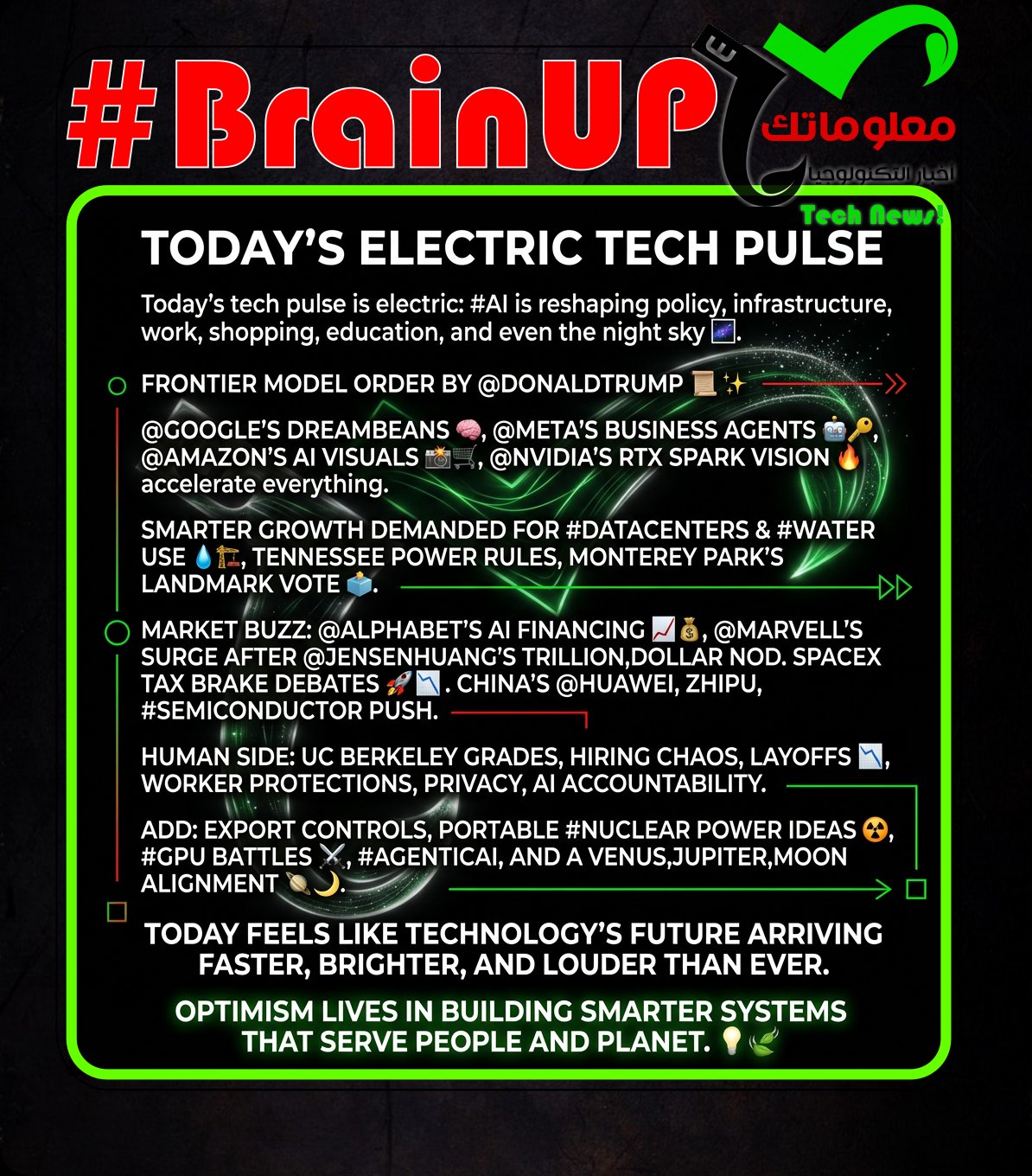
#BrainUp Daily Tech News – (Thursday, June 4ᵗʰ)
Welcome to today’s curated collection of interesting links and insights for 2026/06/04. Our Hand-picked, AI-optimized system has processed and summarized 34 articles from all over the internet to bring you the latest technology news.
As previously aired🔴LIVE on Clubhouse, Chatter Social, Instagram, Twitch, X, YouTube, and TikTok.
Also available as a #Podcast on Apple 📻, Spotify🛜, Anghami, and Amazon🎧 or anywhere else you listen to podcasts.
@Donald Trump signed an executive order asking AI companies to voluntarily provide the U.S. government up to 30 days of early access to their most capable #frontier models before broader release, shortening a previously drafted 90-day window. The order assigns the #NSA, #CISA, and #NIST to create a classified benchmark that determines which systems qualify as a “covered frontier model,” with the 30-day review applying only to models above that classified threshold and with agencies also involved in selecting early “trusted partners” for access. It explicitly says it does not authorize mandatory licensing, pre-clearance, or permitting, but it still expands government influence over pre-release review and partner decisions. The order also directs the Treasury Department to create an “AI cybersecurity clearinghouse” to coordinate vulnerability scanning, validation, and patch distribution with AI firms and critical infrastructure operators, and it steers federal grants and hiring pathways toward AI security work. Critics argue the trusted-partner role could be weaponized against companies in conflict with the administration, citing the unresolved dispute in which the Department of Defense labeled @Anthropic a supply chain risk shortly before its Claude Mythos preview and Anthropic sued to overturn the designation.
2. Americans Have Grown Dramatically Anti-Data Center in Just Months, Survey Finds
A new Heatmap Pro survey finds U.S. public opinion has swung sharply against building #data centers near people’s homes, a shift that is rattling the tech industry amid rapid #AI-driven infrastructure expansion. The poll reports 71% of Americans would oppose a nearby project, including 55% who would strongly oppose, compared with near-even views nine months earlier and 51% opposition three months ago, which Heatmap characterizes as a 49-point swing against data centers in nine months. The article ties this backlash to growing concerns about #AI and its real-world impacts, alongside local complaints in communities hosting projects, such as rising utility bills, water shortages, and increased air and noise pollution, plus research suggesting higher temperatures near large facilities. Opposition is high across regions and especially strong among rural voters, Democrats, and young adults, with 80% of respondents aged 18 to 34 opposed, as worries about #AI’s labor-market effects and entry-level job automation rise. In response, industry leaders such as @Sam Altman and @Jensen Huang have pushed back on job-loss narratives, and Google announced water stewardship commitments aimed at reducing local impacts from its data centers.
3. Feds failing in bid to take a supercomputer from a climate research center
A federal judge has temporarily blocked the #NationalScienceFoundation from transferring stewardship of a Wyoming supercomputing center away from the #NationalCenterforAtmosphericResearch, keeping the facility under current management while the lawsuit proceeds. The @Trump administration had announced plans to shut down NCAR and ordered its manager, the University Consortium for Atmospheric Research, to prepare to hand the supercomputing center to a different operator, prompting UCAR to sue and seek a preliminary injunction. Judge Brooke Jackson found the dispute reviewable under the #AdministrativeProceduresAct, rejecting the government’s claim that no final decision existed, citing officials’ messages indicating the transfer was already decided and being rushed even before public comments closed. He also noted the government had not fully evaluated public feedback and had failed to articulate any rationale for removing UCAR, supporting UCAR’s argument that the action could be arbitrary and capricious. The ruling pauses the supercomputer transfer as the court considers whether the government’s attempt to reassign NCAR resources complies with the APA.
4. AI Billionaires Are Starting to Get Scared
The article argues that prominent tech billionaires are softening their public messaging on #AI-driven automation after recognizing broad public backlash and fears of job loss. It describes a shift from hype to calls for policies meant to help workers cope, framing this as an attempt to prevent unrest as livelihoods are threatened. As examples, @Jeff Bezos endorses exempting the bottom 50 percent of US earners from federal income tax, @Elon Musk promotes a concept he calls “universal high income” akin to #universal basic income, and @Sam Altman suggests “universal basic compute” tied to a share of OpenAI revenue. The piece contends these proposals are self-serving and contrasts them with an option it says they ignore: slowing or stopping #AI deployment if it is truly as disruptive as claimed. It concludes that the billionaires’ new worker-focused appeals appear not to be in good faith, but rather a strategic response to growing resistance.
Failing rates in several UC Berkeley computer science courses rose sharply in spring 2026, departing from EECS grading guidelines, and instructors attribute the shift to heavier #AI use, weaker math preparation, and understaffing. Berkeleytime data show 35.3% of CS 10 students and 10.6% of CS 61A students received F’s, while in spring 2024 and spring 2025 the F rate did not exceed 10% for either class, and both courses averaged C-plus grades, about a 2.3 GPA, below the guideline range of 2.8 to 3.3 and the target 7% D and F rate for lower division courses. Teaching professor @Dan Garcia, who taught both courses, said a “vast increase in academic dishonesty” tied to large language models like Claude, ChatGPT, and Google Gemini was a primary driver, noting nearly 30 CS 10 students were caught cheating on take-home exams and that some students rely on LLMs and then are unprepared for exams. Garcia emphasized using transparent point thresholds rather than curving, arguing curving masks underlying problems and that clear standards should allow unlimited A’s without lowering expectations. He and associate teaching professor @Gireeja Ranade also reported students lacking prerequisite mathematical skills, reinforcing concerns about readiness alongside technology driven misconduct.
6. In first, California city overwhelmingly votes to permanently ban datacenters
Monterey Park, California, became the first US city where residents voted via ballot initiative to permanently ban #datacenters, with early returns showing an overwhelming margin in favor. As of 2am Pacific Time, 86.3% of more than 7,000 counted votes supported the ban, far above the 51% needed, prompting councilmember @Jose Sanchez to call it a landslide and urge other communities to follow the model. The city had already adopted an indefinite moratorium in April after backlash to HMC StratCap’s proposed roughly 250,000 sq ft project, which has since been withdrawn, with residents citing environmental concerns, higher utility prices, and proximity to homes. Supporters said a voter-approved measure would make the prohibition more permanent and stronger in court, amid prior threats of litigation, while the measure itself framed the ban as protecting air quality, drinking water, and public health, and preventing electricity and water rate impacts, lasting until voters end it. The article situates the vote within broader pushback including other ballot efforts in Wisconsin and Michigan and notes a Gallup poll finding seven in 10 Americans oppose #AI datacenters in their local areas.
@Google Labs has launched Dreambeans, an AI app for iOS and Android that turns data from a user’s Google account into a curated set of AI illustrated daily “stories” meant to spark lifestyle ideas. Product lead @Gozde Oznur says the app, with permission, uses #Personal Intelligence to connect information from Gmail, Calendar, Photos, YouTube, and Search History and then suggests things like nearby places to visit, topics to explore, trip and event reminders, pet related guidance, or web news aligned with past interests. It is positioned as an antidote to doomscrolling by limiting output to about 10 to 14 stories per day so users get a small dose of inspiration and move on. Oznur says privacy controls include user only access to stories, the ability to delete data, and the option to choose which services to connect. The name reflects overnight processing while you sleep, and a morning “bean” like coffee, and availability is currently limited to eligible U.S. based Google AI Ultra subscribers, with a waitlist for people using personal Google accounts.
8. Grimes County gives SpaceX Terafab project massive tax break
Grimes County commissioners voted 4-1 to advance @SpaceX’s proposed Terafab #semiconductor chip manufacturing facility by approving a #reinvestment zone designation and a 100% #tax abatement tied to the project. The abatement, which would exempt SpaceX from property taxes related to the development, drew the most debate, with Precinct 2 Commissioner David Tullos casting the lone “no” vote and arguing it went too far and that SpaceX had not been transparent with the county. Tullos questioned why the company had not attended earlier meetings and said unclear maps left commissioners unable to gauge the project’s location and footprint until the county created its own maps, which he said showed the site could cover about 3% to 4% of the county. County leaders described the proposal as a “generational change,” while many residents speaking in public comment opposed the project or criticized the process, though a few expressed support. The court ultimately approved the reinvestment zone on a motion by Commissioner Chad Mallot, seconded by Commissioner Philip Cox, as SpaceX sent an in-person representative for the first time since the project was announced.
9. Colorado Governor Vetoes Surveillance Pricing Ban as Public Backlash Against the Tech Grows
@Jared Polis vetoed Colorado House Bill 26-1210, a measure aimed at restricting #surveillancePricing, saying it was too broad and could discourage acceptable uses of technology and even punish lower, discounted prices. In his veto letter, Polis argued the bill could capture any technology that incidentally influences prices or wages, potentially sweeping in innocuous tools that benefit consumers and workers. George Slover of the Center for Democracy & Technology disputed that reading, saying the bill would have barred algorithmic profiling that uses personal data to target individuals for higher prices or lower wages, while carving out transparent, uniform loyalty programs and discounts. Paul Singer, a former Texas consumer protection official now in private practice, supported the veto, arguing restrictions should focus on harmful conduct rather than underlying #algorithms to avoid harming consumers by limiting price reductions or pricing accuracy. The dispute reflects a broader debate over balancing innovation with consumer protection as lawmakers respond to concerns about opaque, data-driven pricing and wage setting.
Investment in data centers has surpassed U.S. government spending on transportation infrastructure, highlighting a significant shift in capital allocation. Data centers have become critical to supporting the digital economy and cloud services, driving massive demand for new facilities. This growth is fueled by expansions in technologies like AI and streaming platforms, which require substantial computing power. The trend reflects a broader transition in economic priorities toward digital infrastructure, as data centers facilitate connectivity and innovation across industries. As a result, private sector investment in #datacenter construction is now a key component shaping America’s infrastructure landscape.
11. Nvidia GPU crackdown hits China-linked Southeast Asia data centers – Asia Times
Washington has moved to shut a loophole that let Chinese technology firms obtain banned high-end #Nvidia #GPUs by routing purchases through subsidiaries in Singapore and Malaysia. On May 31, the US Commerce Department’s Bureau of Industry and Security clarified that export licenses are required for advanced computing chips going to any entity whose ultimate parent is headquartered in China or Macau, regardless of where the buyer is located, and said the rule has technically applied since November 2023. After the Trump administration said the Biden-drafted #AI_Diffusion_Rule would not take effect, many Chinese firms expanded Southeast Asia data center buildouts and bought large volumes of Nvidia chips, with industry estimates cited by Reuters suggesting hundreds of thousands of banned chips may have reached Chinese-owned subsidiaries. BIS framed the move as a clarification and said existing data centers using the chips will not be forced to stop, but the practical impact is that China-linked overseas entities can no longer freely buy restricted chips, even as Beijing pushes adoption of domestic AI processors like @Huawei’s Ascend 920 over Nvidia’s H200 and H20. Commentators argue enforcement will raise compliance costs and legal risks yet remain difficult because ownership can be obscured across jurisdictions, and firms may respond by using intermediaries, shifting to licensing or cloud services that bundle chip access, or forming partnerships in less regulated locations.
@Alphabet’s planned $80 billion share sale to fund its #AI commitments is pushing markets into what @Goldman Sachs International co-CEO @Anthony Gutman called “unprecedented territory.” The offering, announced Monday, includes a $10 billion allocation to @Greg Abel’s @Berkshire Hathaway to support investments in AI compute infrastructure amid what Alphabet described as unprecedented customer demand, with @Goldman Sachs, @JPMorgan Chase, and @Morgan Stanley serving as joint book-running managers and Goldman also acting as placement agent for the private placement. Gutman said the issuance was a record level of equity issuance and suggested it signals a strong pipeline, noting there is significant demand and that the size looks manageable relative to total equity market capitalization. He tied the deal to a broader surge in capital markets activity, pointing to a flurry of mega-IPOs in the pipeline, including a highly anticipated @SpaceX flotation expected June 12 targeting a $1.75 trillion valuation on the Nasdaq, with @OpenAI and @Anthropic also planning IPOs later this year. Overall, Gutman framed Alphabet’s financing move as both a caution-worthy milestone and a positive indicator for the 2026 equity issuance and IPO environment.
13. AI Could Use as Much Water as 1.3 Billion People by 2030
A new #UNU-INWEH report warns that the environmental costs of #AI are often mismeasured when assessments focus mainly on #carbon emissions instead of also accounting for water and land impacts from powering and cooling data centers and building their supporting infrastructure. It projects that by 2030, AI data centers could use 945 terawatt-hours of electricity, and their #water footprint could match the basic domestic water needs of 1.3 billion people in Sub-Saharan Africa for a year, while their #land footprint could exceed 5,590 square miles. The report argues that footprint tradeoffs can be severe: shifting electricity generation from coal to bioenergy may cut carbon footprint by 70% but raise water footprint more than 30-fold and land footprint 100-fold, illustrating why carbon-only metrics can shift burdens onto water and land. It also cites present-day local strains, including Ireland where data centers used 21% of metered electricity in 2023, and examples in Querétaro, Mexico and Uruguay where water-intensive data center plans amid drought prompted concerns and protests over scarce water being diverted from human needs. The researchers further warn that rapid growth in AI infrastructure could widen a “digital divide,” with wealthier countries better able to invest in data centers while lower-income nations struggle to access and participate in the AI economy.
14. Companies Are Using Reddit to Manipulate ChatGPT and Google AI Search
The moderators of r/biohackers say peptide and hormone replacement therapy companies are covertly spamming the subreddit to influence #AI search and chatbot answers by seeding source material that systems like #ChatGPT and #Google AI Search may scrape. They describe this as #AEO, with firms attempting to systematically manipulate chatbot responses by manipulating Reddit content. In response, moderators announced they will ban new posts about peptides and #HRT, citing increased pressure on content quality from an explosion of peptide interest and AI usage. The subreddit, focused on supplements, experimental pharmacology, and longevity and fitness themes, has seen peptides and HRT become especially popular as companies market them off label or as grey market compounds. The action is meant to curb manipulation and restore content quality as AI systems increasingly treat Reddit discussions as answer fodder.
15. Zhipu’s Chairman Amasses $22.4 Billion Fortune As Chinese AI Model Developer Soars Almost 1,000%
Hong Kong listed Chinese AI model developer Zhipu, formally Knowledge Atlas Technology, has surged nearly 1,000% this year as investors re-rate it from a marginal player to a domestic #AI champion, minting Chairman Liu Debing a $22.4 billion fortune. After a lukewarm January IPO that raised $558 million and skepticism tied to a U.S. blacklist and intense local competition, the company gained momentum by launching higher-performing #LLMs, including GLM-5 in February with reasoning and coding capabilities it says are comparable to @Anthropic’s Claude Opus 4.5, followed by GLM-5.1 in April that improved response speed, per a May note from Macquarie Capital. Analysts argue speed matters more in the era of #AI agents because frequent model calls compound latency, and GLM-5.1 is described as enabling agents to build a sophisticated website within 30 seconds. Forbes estimates Liu is now the richest billionaire produced by China’s recent AI boom and the country’s 15th richest overall, while Zhipu chief scientist Tang Jie, a @Tsinghua University professor, is also a billionaire at about $5 billion. With an accelerating shift toward domestic alternatives such as chips from #Huawei and #Cambricon, Zhipu is seeking at least 15 billion yuan ($2.2 billion) via a share issuance on Shanghai’s #Sci-Tech Innovation Board to fund further research.
16. Amazon’s search bar will invent AI-generated products you can’t buy
Amazon is updating its in-app search bar to generate #AI-created product images from your descriptions, even though the pictured items are not real products you can directly buy. The feature currently focuses on clothing and home goods, lets you tap the generated image that best matches your idea, and then searches for similar real items. Amazon says this can help when you do not know the exact term for a style or texture, such as describing a “shirt with a draped collar” instead of “cowl neck,” though it may add little for basic queries like “blue t-shirt.” The approach echoes @Google’s AI Mode feature that generates fake outfits and decorations to guide users toward real lookalike products, as retailers increasingly integrate tools like #Gemini and #ChatGPT into shopping. Amazon also notes a separate “shop by style” experience that shows #AI-generated collages, but uses real, purchasable items within those outfits, and both features are coming to the Amazon app on Android and iOS.
17. New Tennessee law requires data centers to pay for their own electricity infrastructure
#Tennessee enacted a new law signed by @Gov. Bill Lee requiring large #data centers to cover the cost of their own electricity infrastructure to protect utility #ratepayers. Sponsored by @Sen. Brent Taylor and @Rep. Ed Butler, it applies to facilities with peak demand of at least 50 megawatts within their first three years, amid @Tennessee Valley Authority estimates that data centers account for about 18% of its overall power load. Taylor cited “the xAI way,” saying xAI’s Colossus in Memphis secured a dedicated power source by buying a decommissioned plant in Mississippi to generate and transmit electricity, with the facility estimated to use enough power for 200,000 to 300,000 homes. Some House Democrats opposed the bill over an amendment allowing utilities, in limited cases, to spread some upgrade costs across the broader system when improvements also benefit other customers, raising concerns rates could increase. Taylor argued cost-sharing would occur only when the entire system benefits, and said the law is designed to keep energy prices down and took effect immediately upon the governor’s signature.
@Jensen Huang suggests an #RTX Spark based gaming handheld is not a current priority because Nvidia is focused on a larger effort to “reinvent the PC”. After his Computex keynote, he said Nvidia would work with a partner if someone wanted to build one, but emphasized the company is concentrating on launching its first full PC #SoC and making it succeed in the Windows and x86 ecosystem. He cited the difficulty of ensuring Windows applications run well, and that games work with anti cheat enabled, calling the PC chip launch a “gigantic project”. Huang also highlighted the long development effort, saying it took years of collaboration with #Microsoft and #MediaTek and involved hundreds of people, framing the work as part of reimagining the PC for the age of #AI.
19. Marvell stock soars 32% as Nvidia’s Huang says it could be the next trillion-dollar company
@Nvidia CEO @Jensen Huang called Marvell Technology the “next trillion-dollar company,” triggering a 32.52% surge that marked Marvell’s biggest one-day gain ever. Speaking onstage with Marvell CEO @Matthew Murphy at Computex in Taipei, Huang said Marvell’s networking and connectivity chips are essential as #AI workloads are distributed across massive data-center clusters that require fast data sharing. Marvell designs high-performance chips for global data infrastructure spanning cloud computing, #AI, enterprise networking, 5G carrier networks, and automotive systems, and it reported a fiscal 2027 first-quarter earnings beat with $2.4 billion in revenue and a forecast for continued growth driven by data centers. The enthusiasm also follows Nvidia’s recently committed $2 billion investment in Marvell and broader investments in #photonics, a light-based data transmission approach described as more efficient than electricity. Together, Huang’s endorsement and Marvell’s role in connectivity and emerging #photonics underscore investor expectations that the company can be a key beneficiary of the #AI infrastructure build-out.
20. AI Has Ruined the Job Market
The article argues that #AI has degraded hiring by making it harder for employers to tell who is qualified and by turning applications into interchangeable, high volume noise. A tech hiring manager, Ken Schumacher, says candidates increasingly use #AI to write resumes and even to cheat during interviews via chatbots and teleprompters, creating a market for tools that detect AI assisted cheating. Tools like #ChatGPT and #Claude have commoditized cover letters and resumes, raising their polish but “compressing” and “homogenizing” information, a dynamic described as “signal collapse” that leaves managers struggling to distinguish real expertise from keyword stuffed sameness. Because applications are faster to produce, job seekers submit hundreds of them on platforms like #LinkedIn and #ZipRecruiter, often without fit or feedback, while employers respond by using AI to sift the resulting flood. The result is an AI driven arms race, described by @Kathleen Creel as “AI on AI crime,” in which hopes that technology would make hiring more efficient and fairer have instead been undermined.
21. Sam Altman Eyes Bernie Sanders as His Pope
After @Anthropic drew attention by engaging with Pope Leo XIV on an AI encyclical, the piece says @OpenAI and @Sam Altman appear to be seeking a comparable moral validator by courting @Bernie Sanders. It reports Sanders said on CNN that Altman requested a Wednesday meeting, shortly after Sanders announced a proposal for the federal government to take a 50% ownership stake in #frontierAI labs and to channel profits into a sovereign-style wealth fund. The article argues Altman has reputational incentives to be seen alongside a figure associated with ethical credibility, and notes partial overlap with OpenAI’s past idea of a #publicWealthFund that gives citizens a stake in AI-driven growth, though OpenAI’s version does not include government control. It suggests Altman may also have self-interested motives, such as assuming the legislation will not pass and using government involvement as a pathway to a federal backstop for risky compute investments, while OpenAI pursues regulation that increases scrutiny in appearance but can be shaped to its advantage. Overall, the meeting is framed as part of OpenAI’s broader strategy of aligning with “doing the right thing” narratives while steering the terms of oversight.
22. The ‘angertainment’ trap: Why you can’t stop clicking on things that make you mad
The article argues that #angertainment, manufactured outrage designed to capture attention and wield political power, has become a dominant force online and is increasingly dividing society. It illustrates this with a backlash over Cracker Barrel’s proposed logo refresh, which was framed by influencers and right-wing media as a major #cultureWar threat, amplified by figures like @Tucker Carlson and accounts such as “End Wokeness,” despite the issue being minor. The coordinated outrage reportedly led to real-world consequences: a $153 million drop in market value, a reversal of the logo change, removal of a Pride page, and a conciliatory call thanking President @Trump for “feedback.” The piece says these blowups are not spontaneous but exploit a human instinct to detect threats, with social media making it easy for vested interests to trigger dopamine-rewarding anger even when the “threat” is trivial. It links this pattern back to how a normally useful social response to injustice is being hijacked and weaponised through online systems that constantly serve up new targets for rage.
23. TikTok Billionaire Zhang Yiming Tops Ambani as Asia’s Second-Richest Person
TikTok founder @Zhang Yiming has surpassed billionaire Mukesh Ambani to become Asia’s second-richest person, reflecting the growing wealth generated by the tech and social media sectors. Zhang’s rise is driven by the success of #ByteDance and the global popularity of its app TikTok, which has revolutionized social media engagement and advertising. This milestone illustrates the increasing economic influence of technology entrepreneurs in Asia’s financial landscape. The shift highlights a broader trend of digital innovation creating vast fortunes, reshaping traditional wealth hierarchies on the continent. Zhang’s accomplishment underscores the significance of emerging #digital platforms in shaping Asia’s economic future.
Cloudflare CEO @Matthew Prince detailed the company’s decision to lay off 20% of its staff amid AI advancements, explaining how to determine which employees AI can replace. He emphasized assessing roles based on how routinely tasks are performed, the complexity and creativity involved, and the value added by human insight. Prince noted that jobs heavily focused on repetitive and predictable work are more likely to be automated, while roles requiring empathy, critical thinking, and nuanced judgment remain less replaceable. This approach reflects broader industry challenges in integrating #AI technologies while managing workforce impacts. The explanation provides insight into strategic workforce management as AI reshapes employment landscapes.
25. Uber slashes people division by nearly a quarter. CEO says ‘changes are necessary’
Uber is cutting 23% of its people division, including human resources and recruitment, as it streamlines operations under new president Jill Hazelbaker. @Dara Khosrowshahi told employees in a memo that the changes are necessary to maximize the team’s effectiveness and the company’s potential, while Hazelbaker said the goal is a more connected, modern, operationally excellent organization. Uber did not disclose how many roles are affected, but said the layoffs are well under 1% of its roughly 34,000 employees, and it emphasized the cuts were not driven by #AI. Hazelbaker cited complexity and fragmentation, overlapping responsibilities, and unclear ownership as issues the reorganization is meant to fix. Separately, Uber confirmed it has tiered spending caps for some agentic tools, described as soft limits, after reports that #AI tool spending exceeded its 2026 budget within four months.
26. Nvidia is already planning N2X and N3X chips — the goal is the Star Trek computer
@Nvidia CEO @Jensen Huang says RTX Spark is not a one-off, and the company is already planning at least two more generations, N2X and N3X, to push toward #StarTrek-like voice-driven computers and #StarWars-style “R2-D2” helpers. At #Computex 2026 he described working with @Microsoft CEO @Satya Nadella for about three years on a vision where you can walk up to a Windows PC and say “hello, do something,” and even message your laptop remotely to fix a PowerPoint slide and send back a PDF. Huang argues local #AI on a personal machine matters because running tasks locally can be “free” compared to renting cloud compute, and because your private data and tools already live on your laptop, making cloud agents an awkward fit for controlling it. He also frames the broader future as “everything’s going to be an AI,” from computers to household devices you can talk to. The article notes Nvidia has shown little evidence yet that first-generation RTX Spark laptops will deliver that experience, since the software execution depends on Microsoft and partners, while Nvidia is positioning the hardware as a compact source of local AI capability.
After #Nvidia’s #RTXSpark launch at Computex 2026, AMD executives said they welcome the new competition and argued AMD’s #StrixHalo and upcoming #GorgonHalo notebooks are well positioned against Nvidia’s N1X and N1 devices. AMD’s Rahul Tikoo said large local memory is becoming critical for #agenticAI workloads, and he is excited Nvidia has joined a market where AMD had been “the only game in town” for nearly two years. Tikoo compared specs, noting Nvidia lists 128GB of local memory and a 20-core CPU, while AMD already offers similar memory on Strix Halo and a 16-core, 32-thread CPU, adding that Gorgon Halo, due in Q3, will be a better product. AMD chief software officer @AndrejZdravkovic also claimed developers are “just wrong” if they do not choose a Strix Halo notebook, reinforcing AMD’s message that its platform remains the stronger option as the competitive landscape expands.
28. Trump plan to test AI models has a problem—US security teams were gutted by DOGE
On Tuesday, @Donald Trump signed an executive order expanding voluntary government safety testing of #frontier AI models, but critics argue it is largely performative and changes little about when and how models are deployed. After internal disputes between cybersecurity experts and deregulation-minded officials and a canceled signing event with AI CEOs, the finalized order avoids mandates and emphasizes not burdening innovation, replacing an earlier plan that reportedly sought model access up to 90 days in advance with a shorter 30-day testing window. The EO directs the #NSA to create a classified benchmarking process to define “covered frontier models” and, with the Treasury Department and #CISA, build a “cybersecurity clearinghouse” plus a voluntary framework for developers to submit models for testing. Critics say the government appears unprepared to do meaningful testing on such timelines, citing the need to recruit expertise, a 60-day directive for the Office of Personnel Management to expand cybersecurity hiring pathways, and uncertainty about near-term funding as OMB is told to look for usable grant money. Overall, the order signals an “America First” #cybersecurity push and claims to ensure secure technology is deployed rapidly, but the short window and voluntary structure raise doubts that it will prevent dangerous deployments.
Huawei Rotating Chairman Xu Zhijun said U.S. pressure and export restrictions helped accelerate China’s semiconductor supply chain, claiming Huawei would not have created its LogicFolding chip architecture without being forced to do so. The article recounts U.S. actions such as the 2019 ban affecting Huawei, 2022 #export controls on #AI GPUs limiting access to chips like @Nvidia A100 and H100 and AMD MI250 series, later tightened into broader bans that reportedly caused write offs and lost sales, followed by a partial reversal requiring export licenses and a fee. With access to leading U.S. hardware constrained, many Chinese firms shifted toward domestic chips, giving local vendors more revenue to reinvest in #R&D, resulting in products that can compete on performance but often use more power. This trend is reinforced by Beijing’s push for #semiconductor independence, including directives to buy homegrown chips and reported customs efforts to block certain imported accelerators and even an RTX 5090D V2 variant. The piece also notes @Jensen Huang’s opposition to such bans, arguing that restricting U.S. tech availability would push Chinese companies to innovate alternatives and build their own tech stack.
A Chinese research team says it has built a truck-mounted, 10-megawatt “#nuclear power bank” intended to provide portable, steady electricity for power-hungry uses like AI data centers. Led by @Wu Yican at the Institute of Nuclear Energy Safety Technology in Hefei and developed by the FDS consortium, the unit is described as an integrated engineering-scale test prototype currently in performance and safety evaluation, not a deployable commercial reactor. Reported developer specifications cited by Nuclear Engineering International include a claimed 30 to 60 year design life and a single fuel load lasting 10 to 30 years, with Interesting Engineering noting 10 megawatts could power a medium-sized AI data center. The article emphasizes these figures and “world’s first” framing are the team’s claims rather than independently verified results. In that context, the project is presented as a potential answer to rising #data center electricity demand, but one that remains unproven beyond its early testing stage.
31. Mark Zuckerberg wants Meta agents to “run your whole business” – Engadget
@Mark Zuckerberg says Meta is rolling out AI agents for businesses on WhatsApp, Instagram, and Messenger with the longer-term aim of helping them “run your whole business” as its #AI models improve. At Meta’s Conversations event in London, the company introduced the “Meta Business Agent,” which can handle everyday tasks like customer interactions and booking appointments, plus recommend products and potentially close sales, while letting humans step in at any time. Meta has tested the agents with small businesses in India, Mexico, and Brazil and says over a million have signed up, and it is now making the agents available to any business across those apps. Meta also describes upcoming, more #agentic capabilities for behind-the-scenes work such as market research, product insights, calendar tool connections, and competitive intelligence, with limited access via a waitlist. Although starting is free, Meta plans to put the business agent behind a new subscription in the coming months.
32. Meta scales back plan to track workers’ clicks and keystrokes to train AI
@Meta is scaling back its plan to log employees’ keystrokes and mouse clicks on work computers for training its #AI models after internal backlash. An internal memo reported by Reuters says staff will be able to pause data collection for up to 30 minutes at a time and can request exemptions, while the company also made changes to reduce battery drain and heavy data usage that reportedly spiked home internet consumption. The tool, called the Model Capability Initiative (#MCI), previously drew criticism and a staff petition with more than 1,500 signatures, with employees describing the monitoring as dystopian and tied to fears of further job cuts. Meta has said the data is used only for training computer-using agents and includes safeguards for sensitive content, but the memo acknowledges concerns about personal data on work devices and the need for more control. The adjustment reflects an attempt to balance building #AI capabilities with privacy, performance, and trust issues raised by employees amid ongoing layoffs.
33. Valve’s Steam Machine is suspected to launch soon
@Valve’s Steam Machine may be nearing release, with online sleuths suggesting it could appear as early as June 4, though no official date has been announced. The speculation comes from a Reddit report that a “Welcome to Steam Machine” welcome tour has appeared on GitHub in multiple languages, following an earlier sighting of the same tour in Steam’s backend in May. Supporters argue the added languages look like pre-launch preparation, and point to a similar pattern seen before the Steam Controller launched after comparable leaks. The article notes this is not conclusive and proposes a more likely near-term move could be opening pre-orders rather than immediate shipping, while also acknowledging the Steam Controller shipped soon after going on sale. Pricing remains unknown, but the piece says delays tied to a memory shortage and price increases have forced @Valve to revisit cost expectations, and recent rumors plus the $949 1TB Steam Deck OLED price suggest the Steam Machine could be expensive.
34. See Our Two Brightest Planets Form a Triple Alignment with the Moon After Sunset
A June evening #conjunction will line up Venus and Jupiter, with Mercury near the horizon, and later the Moon joining to create a striking after-sunset alignment. Beginning June 7, Venus and Jupiter appear close together in the west-northwest, with Venus drifting night by night toward Jupiter and nearing an apparent touch by June 10 before passing it. On June 16, Venus, Jupiter, and Mercury form an almost perfect line, and a waxing crescent Moon slips between Jupiter and Mercury about 35 minutes after sunset, followed on June 17 by the Moon appearing just above and left of Venus as the four bodies align even more neatly. The article notes the Southern Hemisphere sees nearly the same timing and details but with the line oriented in reverse, offering an easy, timely introduction to nearby solar system sights. Overall, the event invites observers to step outside on late-spring nights to watch a rare, orderly grouping of bright planets and the Moon in the western sky.
That’s all for today’s digest for 2026/06/04! We picked, and processed 34 Articles. Stay tuned for tomorrow’s collection of insights and discoveries.
Thanks, Patricia Zougheib and Dr Badawi, for curating the links
See you in the next one! 🚀
