
#BrainUp Daily Tech News – (Monday, June 1ˢᵗ)
Welcome to today’s curated collection of interesting links and insights for 2026/06/01. Our Hand-picked, AI-optimized system has processed and summarized 30 articles from all over the internet to bring you the latest technology news.
As previously aired🔴LIVE on Clubhouse, Chatter Social, Instagram, Twitch, X, YouTube, and TikTok.
Also available as a #Podcast on Apple 📻, Spotify🛜, Anghami, and Amazon🎧 or anywhere else you listen to podcasts.
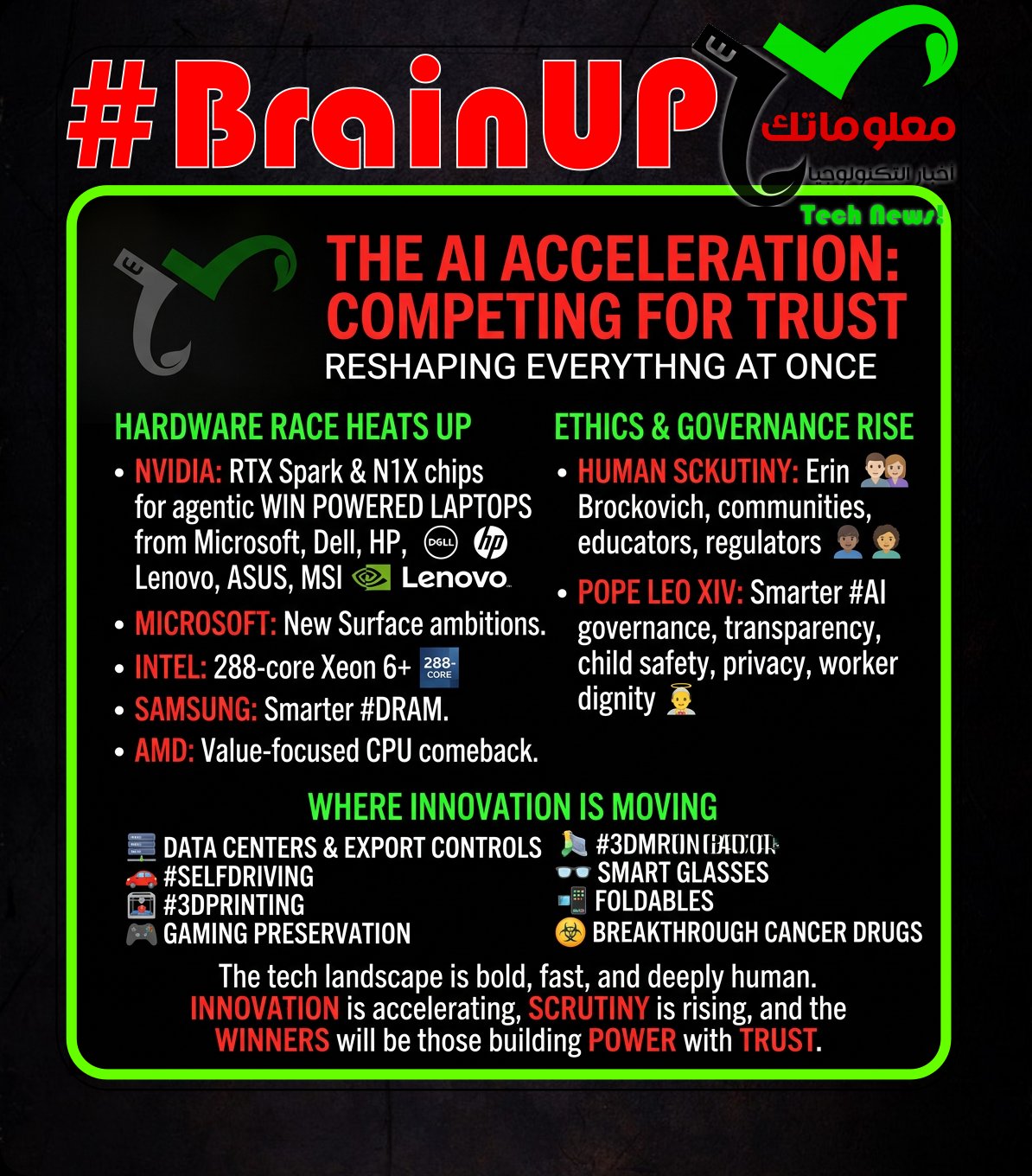
@Erin Brockovich says community anger over new #AI #dataCenters is being driven by secrecy and lack of transparency in how projects are approved. She told “The Jim Acosta Show” that residents often learn about developments only at the proposal stage, then find local officials constrained by #NDAs, and sometimes see projects described as warehouses rather than data centers. The backlash reflects worries about water use, higher electricity costs, and reduced quality of life, with examples including a large Utah project backed by @Kevin O’Leary that helped prompt Gov. @Spencer Cox to release a state framework aimed at protecting resources and community interests. The article also notes @Microsoft said it will stop requesting early-stage NDAs and is promoting its “Community-First AI Infrastructure Plan,” which pledges to cover its own electricity, minimize water use, and create local jobs. Brockovich argues residents can “handle the truth,” but object to being shut out of decisions affecting their own backyards.
At Computex 2026, @Nvidia CEO @Jensen Huang introduced RTX Spark, a Windows on Arm platform built around the RTX Spark Superchip, positioning it as a foundation for an #agentic AI version of Windows where users interact via natural language and AI agents can run long tasks locally and in the cloud. Nvidia says this requires highly efficient hardware and large local memory, and claims the platform is the “most efficient ever built,” aiming to eliminate the usual tradeoff between thin, long battery life laptops and high performance, while also keeping performance consistent on battery or plugged in. The chip is described as offering up to 20 Arm CPU cores, a #Blackwell GPU with 6144 #CUDA cores, 128GB of LPDDR5X memory, up to 300 GB/s bandwidth, and an NVLink C2C connection between CPU and GPU, with enough capacity for 120-billion-parameter models and context lengths up to a million tokens. Nvidia expects the platform to ship in over 30 laptops and about 10 compact desktops, with laptop partners including Dell, HP, Lenovo, Microsoft, Asus, and MSI, and it also pitches RTX Spark as a gaming and creator platform promising 100 FPS 1440p gaming with #DLSS 4.5 and Multi Frame Generation, plus enough memory for large 3D and 12K video workflows. Nvidia also says it is working with @Adobe to rebuild the core of Photoshop, but the article text cuts off before detailing what that entails.
3. Nvidia jumps into PCs with new Arm-based chip debuting in laptops from Microsoft, Dell, HP
@Nvidia is entering the PC processor market with its new Arm-based N1X chip, aiming to reinvent #Windows PCs as #agenticAI workloads expand beyond data centers. @JensenHuang unveiled N1X at Computex, saying it was built with @Microsoft and will ship in fall laptops from @Microsoft, @Dell, @HP, @ASUS, @Lenovo, and @MSI, with Nvidia planning more than 30 laptops and 10 desktops over time. The N1X-based RTX Spark superchip combines an @Nvidia Blackwell #GPU with a custom Arm #CPU designed by @MediaTek, includes 128GB of unified memory, and will be manufactured on @TSMC 3-nanometer technology. Nvidia argues CPUs are becoming a bottleneck for agentic AI workflows, and it is also ramping its Vera CPU for data centers, which Huang said is already seeing early adoption by @OpenAI, @Anthropic, and @SpaceX. The move positions Nvidia against entrenched PC CPU rivals like @Intel, @AMD, @Qualcomm, and @Apple, while betting that Arm-based designs and AI-driven computing shifts will reshape a market Huang sizes at $200 billion.
4. Leak shows Microsoft’s upcoming Surface Laptop Ultra with Nvidia RTX graphics
Microsoft is reportedly preparing to release the Surface Laptop Ultra, a high-end laptop featuring Nvidia RTX discrete graphics, marking a significant upgrade in graphical performance for the Surface line. The leak includes early images showcasing the device’s design, which highlights a sleek, professional look consistent with Microsoft’s Surface branding and aims to appeal to power users. Specification details suggest it targets creators and professionals needing enhanced GPU capabilities for demanding applications. This shift reflects Microsoft’s intent to compete more directly in the premium laptop segment where advanced graphics are increasingly essential. Overall, the Surface Laptop Ultra could represent a new chapter in Microsoft’s hardware strategy, blending productivity with creative performance enhancements.
5. Video on people displaced for Vizag Google data centre blocked by Meta after govt notice
The @Environmental Reporting Collective (ERC) said @Meta blocked an investigative Instagram video in India about alleged forced displacement of Dalits in Visakhapatnam linked to a proposed @Google data centre, and did so without clear explanation. ERC said the two minute video, published May 19 and based on reporting by Shamsheer Yousaf and Monica Jha for ERC’s Dirty Data series on the human costs of #DataCentres, went viral with over 2.6 million views before being restricted in India on May 22. The restriction notice cited action by “The Government of India/Law Enforcement” under Section 79(3)(b) of the #InformationTechnologyAct, 2000, which concerns disabling access to material alleged to be used for an unlawful act after government notification. ERC said it received no detailed reasons for the block and is seeking legal advice while asking Meta to restore access, and Shamsheer told TNM that Meta did not disclose who issued the order unlike #X, which he said provides more transparency. The article links the episode to broader concerns about mechanisms that limit journalism on matters of public interest, noting the Union government’s Sahyog portal enables police to send takedown notices under Section 79(3)(b) and contrasting this with X’s court challenge and disclosure practices.
6. US takes step to halt Nvidia AI chip shipments to Chinese firms outside China
The US has moved to restrict shipments of certain Nvidia AI chips to Chinese firms based outside China starting in 2026, aiming to curb China’s advancement in artificial intelligence. This policy extends export controls to foreign subsidiaries of Chinese companies, preventing them from receiving high-performance AI chips without US licenses. The US government justifies the decision by citing national security concerns and the potential military applications of AI technology in China. This restriction targets firms that use advanced Nvidia chips to develop AI systems and represents a significant escalation in technology export controls. The move highlights ongoing US efforts to maintain technological superiority over China in critical sectors such as AI and semiconductors.
At Harvard’s Class Day, comedian and “The Daily Show” host @Ronny Chieng delivered a profanity-filled critique of #AI, telling students that the mission of their generation is to destroy it, a message that drew loud applause. The article frames his remarks as part of a growing student backlash after other commencement speakers, including former Google CEO @Eric Schmidt and real estate executive @Gloria Caulfield, were jeered or booed for praising AI. Chieng argued that the key danger is not scientific uses like breakthroughs in medicine or physics, but what he called the accumulation of “cognitive debt” and “cognitive surrender” from overreliance on #large_language_models, where people abandon their own reasoning. He joked that the near-term fight is not humans versus AI, but “mastery versus faking it,” and linked the resentment to fears of job displacement and the undermining of human agency and creativity. He ended on a philosophical note that creating is the fun part, asking why anyone would want AI to take that away.
8. California Senate passes first-in-nation ban on AI chatbot toys over safety fears
The California Senate unanimously approved #SenateBill867 to impose a four-year #moratorium on the sale and manufacturing of #AI chatbot enabled toys marketed to minors under 18, aiming to protect children from unregulated #artificial intelligence. Authored by @Steve Padilla, the bill passed 39-0 and targets a growing market of conversational toys powered by #generativeAI models similar to #Grok and #ChatGPT. Supporters cite research and testing that found some early AI toys could produce sexually explicit conversations, suggest ways to find hazardous items like knives and matches, use psychologically addictive engagement tactics, and expose serious #dataPrivacy risks involving children’s recordings and personal information. The pause is intended to give lawmakers, child psychologists, and tech experts time to study long-term impacts and update consumer safety standards, with sponsor Children Now arguing that digital harms require protections as strong as existing rules for physical toy hazards.
@Intel is launching Xeon 6+ (previously Clearwater Forest), an #E-core-only data center CPU family and its first deployment of #Intel18A in the data center, led by the Xeon 6990E+ aimed at maximum compute density. The flagship integrates 288 Darkmont cores and 576 MB of L3 cache, supports dual-socket systems for up to 576 cores, and @Intel claims an average 30% per-thread performance uplift versus AMD’s 192-core Epyc 9965 plus up to 30% better power efficiency. The design uses a disaggregated, multi-tile stack: 12 CPU chiplets on Intel 18A, cache and memory base tiles on Intel 3, I/O chiplets on Intel 7, tied together with #EMIB 2.5D, and it fits existing Xeon 6 platforms on the LGA 4710 socket with up to 12 channels of DDR5 (up to 8000MT/s) and 96 lanes of PCIe 5.0 (including 64 lanes of #CXL) in single-socket configs. It adds multiple hardware accelerators (QAT, DLB, DSA, IAA), expanded crypto and confidential computing features (#IntelSGX, #IntelTDX), and introduces #ApplicationEnergyTelemetry for per-workload to per-thread energy insight, but it does not support #AVX10 or #AVX512, topping out at AVX2. Overall, Xeon 6+ positions @Intel’s new 18A-based, chiplet-heavy approach around dense core counts, platform compatibility, and data center-focused acceleration and telemetry.
#Stop Killing Games scored a legislative win in California as the #Protect Our Games Act, #AB1921, passed the California State Assembly and now moves to the State Senate. In a YouTube video cited by PC Gamer, Assembly Member @Chris Ward said the bill passed 43 to 16 and would require game companies to give 60 days notice before ending support for games that rely on online servers, then either enable continued play, such as offline mode or community server support, or provide a refund. Ward said the idea came from a San Diego constituent frustrated by games being shut down after recent purchases, aligning with the movement’s goal of keeping online games playable after official support ends, a campaign energized by Ubisoft’s delisting of The Crew. The bill faces opposition from the @Entertainment Software Association, which argues it could divert limited developer resources to maintaining old systems, while Stop Killing Games counters that it seeks basic end of life consumer protections against games being sold that can later be rendered useless.
11. United flight forced to turn around because of a Bluetooth speaker name
United flight 236 from Newark to Palma de Mallorca turned back about an hour after takeoff because of a security concern tied to a discoverable Bluetooth signal. Passengers on Reddit said the crew repeatedly asked everyone to turn off Bluetooth, issued a one minute warning that two devices were still active, and suggested a passenger’s “little joke” was causing the disruption. An archived Air Traffic Control recording says a Bluetooth speaker had been named a “certain four-letter word,” prompting a full inspection of the aircraft, including the cargo area, and an evacuation of passengers. The recording does not confirm the exact word, though it notes the situation triggered a security response consistent with fears about a threat term. The incident underscores how #Bluetooth device names can escalate into #aviation security procedures when they suggest danger.
12. Take-No-Prisoners Professor Will Fail Any Student Who Uses AI
Some professors say #AI chatbots like #ChatGPT are driving widespread cheating and hollowing out learning, forcing instructors to rethink teaching or police plagiarism. Theatre professor Neal Hebert at Grambling State University tells students #ChatGPT is banned from their writing process and says he will fail an assignment, and potentially the entire course after an appeals process, if it is used, arguing that outsourcing creativity signals laziness and undermines artistry. Hebert says the volume of AI misuse in introductory courses has made him a “plagiarism cop,” a role he resents, and he cites papers on @August Wilson’s play “Fences” where many students used similar phrasing in a recognizable chatbot style. By contrast, sociology professor Daniel Silver at the University of Toronto, Scarborough says #AI has fundamentally changed his teaching, prompting new assignments that experiment with AI agents representing thinkers like @Adam Smith, while still confronting students who use AI thoughtlessly. Silver reports he has students meet with him, gives zeros with a chance to redo work, and shows how AI outputs look alike, framing the disruption as difficult but potentially improving how teachers and students learn to live with the technology.
13. New drugs show unprecedented results in pancreatic cancer, doctors look to expand uses
New treatments for pancreatic cancer are delivering unprecedented results, offering new hope for patients facing this traditionally deadly disease. Experimental drugs, including those targeting specific genetic mutations and enhancing the immune response, have shown promising outcomes in clinical trials, improving survival rates and quality of life. Oncologists emphasize the importance of personalized medicine and genetic screening to identify patients who may benefit the most from these innovative therapies. These advances could significantly change the treatment landscape for pancreatic cancer, a disease that has long resisted effective therapies. Continued research and expanded clinical trials are critical to validating these early successes and potentially broadening the application of these drugs.
14. The people who trained Tesla’s self-driving AI won’t ride in it
A @Reuters investigation reports that many of the workers who trained @Tesla’s #FullSelfDriving system do not trust it enough to ride in it. Reuters interviewed nine former Tesla data labelers and a former self-driving engineer, and seven labelers said they would not ride in a Tesla using FSD, citing repeated failures they observed while reviewing hours of internal driving footage. At least five said they routinely saw FSD driving above the speed limit, and they described speeding as treated as a low priority compared with edge-case scenarios, even though it could affect every drive. The reporting places this skepticism alongside Musk’s claims of readiness for safe unsupervised rides, Tesla’s current #Level2 classification for FSD (Supervised), a limited robotaxi trial in Austin, and publicized incidents such as vehicles driving into lakes or off bridges, with insiders suggesting internal footage shows many more failures. Tesla did not respond to Reuters’ request for comment, and while the company has said FSD requires active supervision and that its per-mile safety statistics beat human drivers, the former engineer disputed those statistics, underscoring the gap between marketing and the experiences of those closest to the raw performance data.
15. Meta legal action forces Facebook whistleblower to sit in silence at Hay festival
@Meta legal action effectively silenced former @Facebook executive and whistleblower @Sarah Wynn-Williams during a Hay festival appearance, forcing her to sit on stage without speaking. She had been scheduled to talk with investigative journalist @Carole Cadwalladr and academic @Tim Wu about her memoir Careless People, but lawyers advised her not to speak due to ongoing proceedings and the risk of sanctions. Cadwalladr read a letter from Wynn-Williams’ lawyers saying Meta filed a March 2026 sanctions motion claiming she violates an emergency arbitration order whenever she appears publicly where her book is sold and her presence might draw attention to it, and it cited Hay as conduct that should be sanctioned, while Meta disputes the book’s allegations about internal culture, political influence, China, and child wellbeing. The article portrays the episode as #censorship and a display of corporate power, with Wu condemning the restrictions and Hay’s programme director calling it solidarity for the silenced, as Wynn-Williams received a standing ovation and reportedly faces $50,000 fines per breach and financial pressure that could lead to bankruptcy.
16. California passes bill requiring gun-blocking software in 3D printers
California lawmakers advanced Assembly Bill 2047, the #California Firearm Printing Prevention Act, to require consumer #3DPrinters sold in the state to include #firearmBlockingTechnology that scans design files before printing. The bill mandates a firearm blueprint detection algorithm to evaluate STL, CAD, or other geometric code and block files flagged as capable of producing firearms, illegal firearm parts, or conversion devices, with #CaliforniaDepartmentOfJustice standards due by January 1, 2028 and a compliance timeline leading to a sales ban on non-compliant models starting March 1, 2029 and civil penalties up to $25,000 per violation. It would also create a misdemeanor for knowingly bypassing the blocking software with intent to manufacture firearms or distributing modified printers for that purpose. Supporters, including Everytown for Gun Safety, cite a nearly 1,000% rise in recoveries of 3D-printed crime guns across 20 cities over five years, while critics such as the @Electronic Frontier Foundation argue it is “censorware” that could restrict users to approved software, threaten open-source firmware like Marlin and Klipper, and increase privacy risks if inspection shifts to cloud systems, with makers warning about false positives. The proposal contrasts with Colorado’s HB26-1144, which as enacted focuses on knowingly producing potentially functional firearms or components via 3D printing rather than controlling files or printers preemptively.
17. Wix lays off 1,000 workers as the AI jobs apocalypse keeps looking very real
@Avishai Abrahami says Wix is cutting about 20% of its workforce, around 1,000 people, citing financial pressure from the Israeli shekel strengthening against the US dollar and the fast evolution of #AI capabilities. He argues AI represents the biggest change in how companies are built since modern programming languages, pushing Wix to become faster, leaner, and flatter with fewer layers between leadership and teams. The article links Wix’s move to a broader wave of tech layoffs, noting nearly 116,000 cuts in 2026 so far, with many tied to AI through direct replacement or shifting resources toward AI infrastructure, and it compares Abrahami’s message to @Jack Dorsey’s layoff rationale at Block. It also contrasts the layoffs with @Sam Altman’s recent optimism that an AI-driven jobs apocalypse has not happened, while citing a survey of nearly 1,000 executives where 99% expect some headcount reduction in the next 24 months. Despite heavy AI spending, the piece notes surveys reporting limited business payoff so far, including one where more than half of CEOs said AI adoption has not increased revenue or reduced costs.
18. $9 Trillion Collapse Machine
The article argues that the #AI industry is taking economic and ecological risks so large and interdependent that a failure would look less like a simple bubble bursting and more like a systemic collapse, because expansion is straining industrial supply chains, grid electricity capacity, and global capital markets. It contends that AI firms and tech billionaires talk about “existential risk” but lack understanding of #systemic risk, where complex systems fail unpredictably when they collide, and that recent geopolitical shocks, including a U.S.-Israeli attack on Iran, intensify the likelihood of an energy crisis, supply chain disruption, and economic contraction. As evidence, it describes how AI depends on fossil fuel linked inputs such as helium, a natural gas byproduct essential for silicon wafer processing, noting that 30% of global helium came from Qatar’s Ras Laffan Refinery, which has stopped and, after an Iranian drone attack, may take years to repair despite currently high stockpiles and contingency free logistics. It also highlights broader fragility and choke points, citing warnings about global supply chain fragmentation and pointing to Indonesia cutting back mining of copper, nickel, and silver due to shortages of sulfur and oil and gas, while noting AI data centers require about 30,000 tons of copper per gigawatt. The overall link back is that because #AI infrastructure is deeply locked into fossil fuel dependent, precision supply networks and long term commitments, disruptions in energy, minerals, and capital could rapidly unravel the tech ecosystem that current “10x” growth narratives assume.
19. 1. AI Dangers Eclipse Nuclear Weapons at Singapore Defense Forum
At the Shangri-La Dialogue defense forum in Singapore, military leaders, strategists, and security experts argued that the risks posed by #AI are now rivaling or even surpassing those associated with nuclear weapons. The central concern was not AI’s destructive power alone, but its ability to compress military decision-making cycles to such an extent that human leaders may no longer have sufficient time to evaluate information, challenge assumptions, or prevent escalation. Panelists warned that AI-driven systems could accelerate the military “observe, orient, decide, act” (OODA) loop, creating conditions where mistakes, false alarms, or automated responses trigger dangerous reactions before humans can intervene. Military officials from multiple countries acknowledged that AI is already being deployed for intelligence analysis, battlefield prediction, and operational planning, making these risks immediate rather than theoretical. While nuclear weapons remain a cornerstone of strategic deterrence, the discussion reflected growing concern that autonomous and semi-autonomous AI systems could introduce new forms of instability, arms-race dynamics, and escalation risks that existing international security frameworks were never designed to handle.
20. Malaysia enforces ban on social media accounts for children younger than 16
Malaysia has begun enforcing a #ban that prohibits children under 16 from having #social media accounts, framing it as a step to improve online safety for young users. The article says the move is part of a broader global push to enhance protections for minors on the internet. By enforcing age limits on account ownership, Malaysian authorities aim to reduce risks associated with young people’s social media use. The development is presented as Malaysia aligning with international efforts focused on child safety in digital platforms.
21. Dell’s $599 XPS 13 is coming for the MacBook Neo’s lunch money
Dell is positioning a new XPS 13 as a direct value rival to @Apple’s MacBook Neo by matching its $599 entry price for students while promising a full premium experience. The laptop can be configured with Intel “Wildcat Lake” or higher-end “Panther Lake” chips, includes a 13.4-inch 2560 x 1600 OLED touchscreen, and targets up to 17 hours of streaming battery life in a roughly 2.2-pound, CNC-milled aluminum design that is slightly smaller than the Neo. Dell says the student price is a limited back-to-school offer available until Nov. 2 for eligible high school and college students, while non-students start at $699, and executives argue this is not a race-to-the-bottom but a no-compromise #pricing strategy. The article frames the pitch around portability plus long battery life for students moving between classes and places without reliable outlets, making the XPS 13 a compelling alternative in the same lightweight, premium-laptop space. It also notes Dell’s recent return of the XPS line after previously killing the brand in 2025, with the cheaper XPS 13 teased earlier and now unveiled at an aggressive price to challenge the MacBook Neo.
22. As the Pentagon pushes for battlefield AI, some military leaders urge caution
The Trump administration is pushing to expand the use of #artificial intelligence in the U.S. military, but the effort is drawing calls for caution from some companies and military leaders. The article states that the Pentagon is moving toward #battlefield AI even as concerns are raised about how it should be used. It presents a tension between rapid adoption for military advantage and restraint to address risks and responsible deployment. The limited text provided does not include specific examples, detailed arguments, or named officials beyond an incomplete reference to an admiral. Overall, it frames #battlefield AI as a priority for the Pentagon while highlighting that significant cautionary voices remain.
23. Samsung overtakes Micron to become No. 1 in automotive memory chips
Samsung Electronics has regained the top position in the global automotive memory chip market, surpassing @Micron for the first time in several years as demand for AI-enabled vehicles, advanced driver assistance systems, and increasingly software-defined cars drives rapid growth in automotive semiconductors. The company expanded shipments of automotive-grade DRAM and NAND products, benefiting from automakers’ growing need for higher-performance memory to support autonomous driving, in-car AI workloads, and connected vehicle platforms. The development strengthens Samsung’s broader strategy to capitalize on the AI infrastructure boom beyond traditional data centers and smartphones, while highlighting how memory suppliers are increasingly competing for the next generation of intelligent vehicles. The shift also reflects the rising importance of automotive electronics as a growth engine for the semiconductor industry, where reliability, long product lifecycles, and specialized #Memory technologies are becoming as strategically important as performance and capacity.
24. Americans echo Pope Leo’s concerns about AI: ‘It threatens workers, privacy and human life’
In his first major papal text since becoming pope, @Pope Leo XIV warns that #AI is driven by a “culture of power” and calls for the “most rigorous” ethical constraints, arguing it poses one of humanity’s greatest threats and could create “new forms of slavery” in the digital economy. US Guardian readers largely echo those concerns, describing #AI as an unregulated industry used to the detriment of many and linking it to surveillance, labor displacement, war, and environmental harm. Linda Given, a longtime small business owner, says AI is moving too fast without meaningful oversight and fears it could be manipulated for destructive ends, while Stephen Sincoskie calls unregulated AI a threat to workers, privacy, and even human life and worries it could help usher in a “fascistic surveillance state.” Debra, a college professor, says students are losing critical thinking, research, and writing skills, and adds that the church should apply the same human-dignity logic to its stances on gender and sexuality, including women serving as priests. Another reader, Scott Gibb, frames the issue as a need for moral leadership, aligning with the pope’s call to center human dignity in governing AI.
@Microsoft is planning a broad modernization of legacy Windows 11 dialog boxes by rewriting them in #WinUI 3, aiming for more than incremental tweaks like dark mode. The article notes that many Windows dialogs still rely on older interfaces, though Microsoft has recently shipped dark mode updates for file operation dialogs such as file copy, delete, and cut, and is also redesigning the decades old Run dialog as an optional WinUI update. In response to user feedback on X, @March Rogers, Partner Director of Design, said Microsoft is working through a list of older dialogs, that the file copy dialog is already redesigned internally, and that the common file dialog is on the list. The piece also raises performance concerns because modern WinUI experiences have historically been slower than legacy Win32, citing File Explorer as an example, but adds that newer builds like Windows 11 25H2 with the May 2026 update are much faster and that WinUI has made significant progress. Overall, the effort is framed as part of Microsoft’s stated “fundamental improvements” to Windows 11, combining design consistency with performance and reliability work such as Low Latency Profile and a more reliable explorer.exe.
@DuckDuckGo says traffic to its opt-in #NoAI search page has tripled since @Google publicized its latest #AI-focused search overhaul. The company posted on Bluesky that visits to noai.duckduckgo.com are “still rising” and promoted its Chrome and Firefox extensions that set the AI-free search option as the browser address bar default, blocking AI-assisted answers, chat, and AI images. PC Gamer notes this follows a previous report that DuckDuckGo app installs rose by almost a third after Google’s renewed push for AI in search. The article frames DuckDuckGo as emphasizing user privacy and user choice, while still keeping its own options open with AI. The traffic spike is presented as a user response to Google making its AI mode search more prominent on the main search homepage, giving it primacy in the UI over traditional results.
27. AMD’s Plan to Fix RAM Costs: Bring Back Bygone CPUs
With #RAM prices and reseller markups making platform upgrades harder, @AMD is leaning on older CPUs and niche GPUs to keep gaming builds affordable. It is reintroducing the Ryzen 7 5800X3D for #AM4 starting June 25 at $350, which is $100 below its 2022 launch price and far less than reseller listings that can hit $450+, while its current best gaming chip, the Ryzen 7 9850X3D for #AM5, lists at $500. @AMD is also launching the previous gen Ryzen 7 7700X3D for #AM5 on July 15 at $330 as an “entry point” option, arguing that memory costs and the resale market distort pricing. On graphics, it is bringing the $550 Radeon RX 9070 GRE to the U.S. on June 1, a variant of the RX 9070 with 12GB of #VRAM that was previously China only, as a stopgap for buyers who cannot afford bigger upgrades. The result is a market of sidegrades where keeping cheaper #DDR4 and extending 10-year-old #AM4 systems makes more sense, even as @AMD says it will support #AM5 through 2029.
28. Apple’s Smart Glasses Reportedly Delayed Until Late 2027
According to @Mark Gurman, Apple has pushed its rumored #AI smart glasses release to late 2027 after development setbacks. The glasses had previously been expected to be announced later this year and ship in early 2027, and are described as a key part of Apple’s product roadmap, with people close to @Tim Cook saying he strongly supports the project, while @John Ternus is reportedly driving development. Gurman says Apple is aiming for differentiation through design choices like oval-shaped cameras, unique colors, and multiple frame styles, and believes the product could later evolve into a health device and eventually add #augmented reality capabilities. The glasses are expected to include cameras, microphones, and speakers for photos and video, calls, notifications, and music, plus multimodal #AI responding through #Siri. Industry context cited from Counterpoint Research suggests the category is still early, despite 139% year-over-year smart-glasses market growth in the second half of 2025.
At Computex, Alienware unveiled the AW3926QW, which it calls its most ambitious display and says is the world’s first 39-inch 5K OLED monitor using an #RGB stripe panel from LG to improve text clarity while keeping OLED contrast and color. The monitor targets a key weakness of many #QD-OLED and some #WOLED screens, where sub-pixel layouts can cause color fringing around text, making OLED less appealing for productivity despite great gaming and movie performance. The AW3926QW offers up to 1,300 nits peak brightness, a 1500R curve, VESA #DisplayHDR True Black 500 and Dolby Atmos certifications, plus a dual-mode option that runs 5,120 x 2,160 at up to 165Hz or 1080p at 330Hz for competitive play. Connectivity includes a built-in KVM, USB-C with up to 90W charging, DisplayPort 2.1, HDMI 2.1 FRL with eARC, and support for @NVIDIA G-Sync and @AMD FreeSync Premium Pro, alongside a three-year warranty with burn-in detection. Alienware did not announce pricing but expects it to be well above $1,000 with availability in late June, and it also teased a refreshed 34-inch AW3426DW arriving in July plus more affordable QHD options, the AW3226DM ($300) and AW3426DWM ($400), with 240Hz and DisplayHDR 400.
30. Samsung employee spotted using wide Galaxy Z Fold 8 in public
A real-world photo reportedly shows a Samsung employee using the wider upcoming Galaxy Z Fold 8 in public, suggesting the device is in advanced testing ahead of a rumored July 22 Unpacked event. The handset is covered in an “anti-leak protective case” that hides details, but it still appears to be a book-style foldable with a wider, passport-like shape and two rear cameras, and it looks thick likely due to the case. Leaker @Ice Universe also shared a side-by-side of dummy units indicating the lineup may include a tall, narrow model referred to as the Galaxy Z Fold 8 Ultra and a wider Galaxy Z Fold 8 with a 7.6-inch inner display and a 4:3 aspect ratio. The article argues the wide Fold 8 could appeal to users who dislike the narrow outer screen and find an 8-inch inner screen too large, positioning it as a more compact sweet spot that echoes designs associated with competitors like the #Google Pixel Fold. It also notes Samsung is rumored to be considering ending the Flip series due to lineup constraints and weaker sales versus the book-style foldables, with the wide Fold 8 potentially filling a smaller-foldable role for buyers.
That’s all for today’s digest for 2026/06/01! We picked, and processed 30 Articles. Stay tuned for tomorrow’s collection of insights and discoveries.
Thanks, Patricia Zougheib and Dr Badawi, for curating the links
See you in the next one! 🚀
