
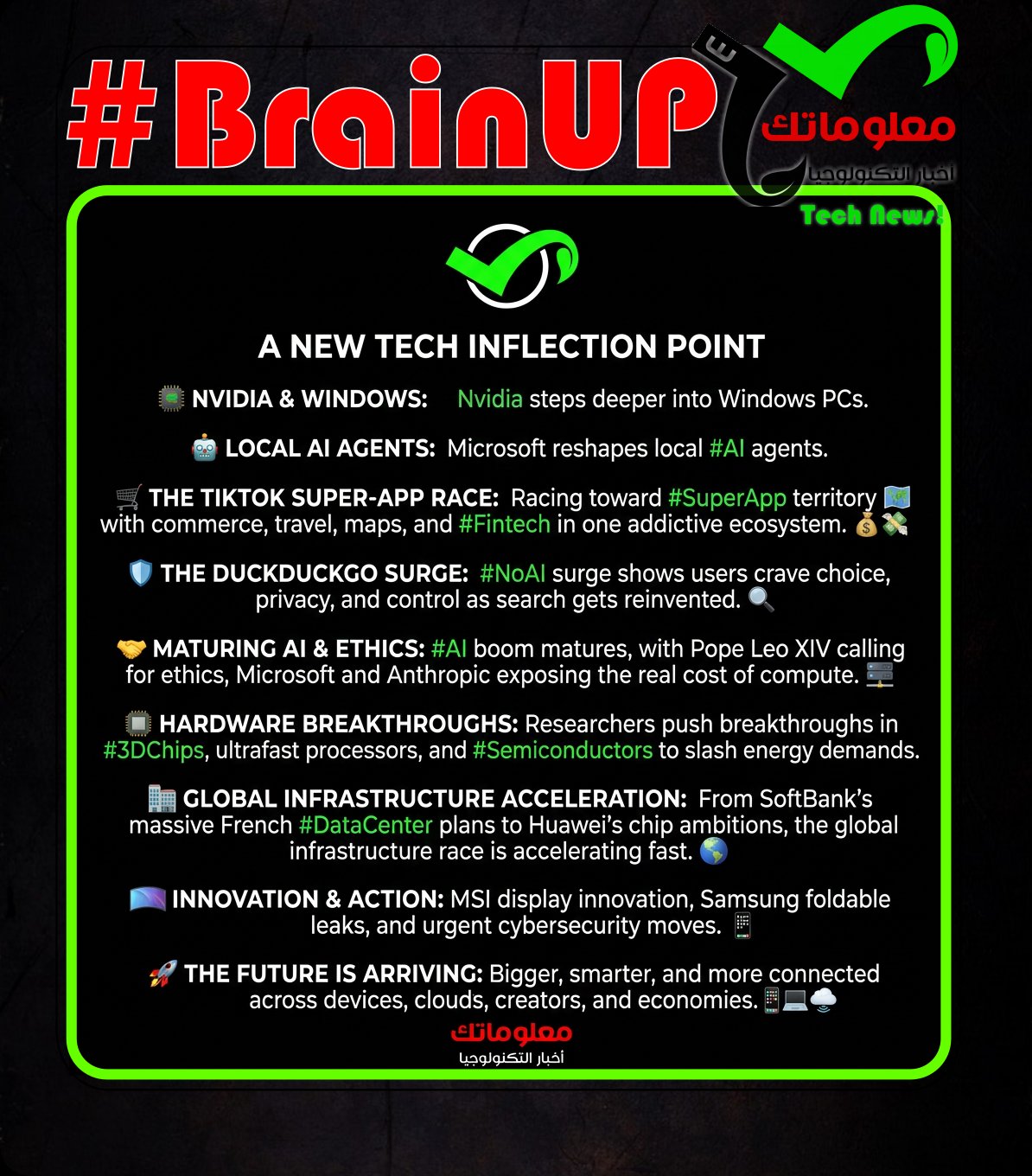
#BrainUp Daily Tech News – (Sunday, May 31ˢᵗ)
Welcome to today’s curated collection of interesting links and insights for 2026/05/31. Our Hand-picked, AI-optimized system has processed and summarized 35 articles from all over the internet to bring you the latest technology news.
As previously aired🔴LIVE on Clubhouse, Chatter Social, Instagram, Twitch, X, YouTube, and TikTok.
Also available as a #Podcast on Apple 📻, Spotify🛜, Anghami, and Amazon🎧 or anywhere else you listen to podcasts.
1. First Windows PC Powered by Nvidia Chips to Debut Next Week, Axios Reports
Nvidia is set to enter the Windows PC market with its first PC powered by Nvidia chips debuting next week, marking a significant expansion beyond its traditional GPU focus. The report from Axios indicates the move aims to challenge #Intel and #AMD in the CPU space by incorporating Nvidia’s own silicon, potentially leveraging its strengths in AI and graphics. This development highlights Nvidia’s strategic push to integrate hardware and software tightly for enhanced performance and innovation. It also signals a broader shift in the PC hardware industry towards more diverse and specialized chipsets. Overall, Nvidia’s launch is poised to alter competitive dynamics and advance computing technology within the Windows PC ecosystem.
@DuckDuckGo says interest in its opt-in #NoAI search option has surged in the wake of @Google’s latest #AI search push. The company posted on Bluesky that visits to noai.duckduckgo.com have tripled since Google revealed plans for an AI search overhaul, and that traffic is still rising, while promoting Chrome and Firefox extensions that make the AI-free search the default and remove AI-assisted answers, chat, and AI images. PC Gamer notes this follows recent reporting that DuckDuckGo app installs rose by almost a third after Google’s latest updates and PR around AI mode search. The article frames DuckDuckGo’s positioning as offering user choice while keeping its own AI options open, against a backdrop where Google has made AI mode more prominent on its search homepage without fully replacing the traditional 10-links results page.
3. Americans echo Pope Leo’s concerns about AI: ‘It threatens workers, privacy and human life’
@Pope Leo XIV’s first major papal text warns that #artificialIntelligence, driven by a “culture of power,” is becoming one of humanity’s greatest threats and needs the “most rigorous” ethical constraints to prevent “new forms of slavery” in the digital economy. Guardian readers in the US said #AI is largely unregulated and is already being used to the detriment of many people, raising fears about surveillance, labor displacement, war, and environmental harm. Linda Given, a longtime small business owner in Massachusetts, said AI is moving too fast without meaningful oversight, undermines human dignity when used as a substitute for human interaction, and could be manipulated for destructive ends. Stephen Sincoskie, a New Jersey print shop supervisor, warned it threatens workers, privacy, and even human life, and could help usher in a fascistic surveillance state, while Debra, a Massachusetts college professor, said it is eroding students’ critical thinking and writing skills. Readers framed the pope’s intervention as a rare call for moral clarity and accountability in how #AI is developed and deployed.
4. TikTok’s road to becoming a super app | TechCrunch
TikTok is expanding beyond a video-centric social network toward a #super app that can cover many everyday digital needs in one place, similar to China’s @WeChat model. It has steadily added capabilities like TikTok Shop, local discovery via maps, stronger search, and games, and it recently launched TikTok GO in the U.S. to let users discover and book hotels, attractions, and experiences directly inside the app. TikTok GO integrates travel content with search and location pages so users can check details and availability and complete bookings without being sent to third-party sites, putting TikTok in more direct competition with @Google’s Search and Google Maps by connecting discovery with purchase. On the financial side, Reuters reported TikTok applied to Brazil’s central bank for licenses that would enable prepaid accounts for storing funds and making payments, plus a direct credit provider license for lending or connecting borrowers and lenders, signaling a push into #fintech to increase engagement and unlock new revenue streams. This broader playbook follows TikTok Shop’s growth, tested in 2021 and launched in the U.S. in 2023, with eMarketer reporting U.S. sales up 407.0% in 2024 and 108.0% in 2025 to $15.82 billion, reinforcing TikTok’s bid to become the primary app users rely on across commerce, travel, and payments.
5. Pope Leo calls to ‘disarm’ AI in major document, warns of technologic threats to humanity
In his first encyclical, Magnifica Humanitas, @Pope Leo XIV urges the church to confront the rapid advance of #AI and other technologies that he says threaten human solidarity and dignity. He argues that technologies that imitate human intelligence are fundamentally different from persons because they do not have bodies or lived experience and cannot know joy, pain, love, work, friendship, or responsibility from within. Presented at the Vatican with contributions from cardinals, theologians, and @Christopher Olah of Anthropic, the document grows out of a decade of Vatican dialogue with the tech industry and insists #AI must be freed from an armed logic of geopolitical and commercial competition. Leo says to “disarm” #AI does not mean rejecting technology, but preventing it from dominating humanity, while also situating the issue alongside broader crises such as war, modern slavery, wealth inequality, democratic erosion, and the devaluing of human capacities. He calls on universities to advance #CatholicSocialTeaching amid technological change and asks ordinary people to witness for peace and human dignity, framing the encyclical as wider than an AI-only statement.
6. Utah’s governor just tightened the rules for Kevin O’Leary’s giant AI data center
@Spencer Cox issued an executive order setting a higher bar for #data center development in Utah after backlash over the Stratos Project, a hyperscale #AI data center campus backed by @Kevin O’Leary. The order creates an eight-principle framework and directs state agencies to adopt it immediately, emphasizing protection of water resources like the Great Salt Lake, air quality, wildlife, utility ratepayers, and quality of life, while also calling for transparent public comment and “human-led #AI development.” Tensions have been especially high in Box Elder County, where commissioners approved the 40,000-acre campus despite opposition, and the development, also called Wonder Valley, could eventually reach 9 gigawatts of power. Supporters argue the project will bring jobs and economic growth, while opponents cite environmental impacts, noise, air quality, traffic, and broader community disruption, and O’Leary has defended the project and claimed, without evidence, that outside forces helped drive the protests. Cox previously said the developers agreed to a phased buildout requiring new permits for each addition, linking the new rules to concerns raised by Utah residents about rapid hyperscale expansion.
Kevin O’Leary attributes the growing negative sentiment toward #datacenters in the U.S. to Chinese propaganda efforts aimed at curbing American technological and economic progress. Industry leaders and members of the Trump administration have supported these allegations, suggesting foreign interference is influencing public opinion and policy against datacenter development. This campaign, according to O’Leary and allies, represents a strategic move by China to undermine U.S. competitiveness in key technology infrastructure. The controversy highlights broader concerns about national security and economic sovereignty in the digital era. Understanding these dynamics is crucial for addressing misinformation and protecting American tech interests.
8. After 22 years, you can finally download Paint.net from the URL ‘Paint.net’
@Rick Brewster, the developer of the Paint.net image editor, has finally secured ownership of the Paint.net domain after a 22-year dispute, meaning the app will soon be downloadable directly from Paint.net instead of GetPaint.net. He said the prior domain owners either refused to sell or demanded “lots and lots and lots of money,” but in December 2025 they redesigned the site to mimic the app’s download page and monetize it with bad links and ads. Brewster responded with legal action alleging #copyright infringement and #domain squatting, and with a lawyer’s help he won control of the domain. The new Paint.net site is in the middle of migration, and GetPaint.net will become a redirect so long-standing links continue to work. This resolves a long-running branding and distribution mismatch for Paint.net users who expected the product to be available at its matching URL.
9. Microsoft data suggests using AI is more expensive than hiring people
@Microsoft’s move to cancel most direct #ClaudeCode licenses and steer employees toward #GitHubCopilotCLI highlights growing concern that #AI at scale can cost more than the labor it is meant to streamline. Fortune, citing The Verge, reports the shift comes only months after thousands of staff were encouraged to use Claude Code, while Microsoft’s broader multibillion-dollar Foundry deal with @Anthropic remains intact, implying the issue is internal economics and usage scale rather than abandoning the partnership. Similar cost pressure is described at @Uber, where Fortune, citing The Information, says CTO @PraveenNeppalliNaga reported the company burned through its 2026 budget for AI coding tools in four months after usage incentives. The article links these budgeting strains to wider impacts, including potential limits on access, higher prices for digital services, and a more complex case for AI replacing workers when compute bills can exceed payroll savings, alongside added electricity and water demand from data centers that can strain local grids. It cites @GoldmanSachs projecting #agenticAI could drive token consumption 24-fold by 2030 and notes #Gartner’s view that even if token prices fall, enterprise bills may not, reinforced by @Nvidia’s @BryanCatanzaro saying compute can cost more than employees and Gartner’s @WillSommer warning that cheaper tokens do not equal democratized frontier reasoning.
10. Use Protocols, Not Services
Closed, centralized platforms undermine the Internet’s default anonymity and privacy because a single company can be compelled to identify users, censor content, or enforce compliance, so people should choose #protocols over services for communication. Governments can pressure one company with subpoenas, court orders, or regulations, and the article cites worldwide age verification laws and Discord’s rollout of “teen-by-default” settings requiring proof of majority via face scan or government ID as examples of how services become easy control points. By contrast, protocols like #IRC, #XMPP, #ActivityPub, #Nostr, and #Matrix have no single operator to coerce, so enforcement would require pressuring thousands of independent servers across jurisdictions, and users can simply move if one server complies. Migrating from one service to another does not fix the underlying vulnerability, since the next company will face similar legal pressures or be blocked once it grows, whereas #SMTP email shows protocol resilience because users can switch providers or self host and still communicate across the network even if major providers ban accounts or withdraw service. Choosing protocols reduces dependence on any one company’s decisions and limits how easily identification, restriction, and data handover can be imposed.
The article argues that @Rivian Chief Software Officer @Wassym Bensaid is pushing a misguided #AI-driven, voice-first car interface that would sideline physical controls and replace systems like #AppleCarPlay and #AndroidAuto. As evidence, it cites Bensaid’s comments on The Verge’s Decoder podcast that physical buttons are an “anomaly,” that “the car is actually a fantastic environment for AI,” and that his “north star” is voice becoming the primary way to interact with the vehicle, along with his critique that screen mirroring “take[s] over every single pixel” of the car display. The author interprets this as Rivian wanting to retain control of in-car screen real estate and force users into its in-house UX, which the author also criticizes for touch-first choices like adjusting HVAC vent direction via on-screen swipes. Bensaid frames improved #foundationalModels as the fix for historically “broken” voice tech and says driving makes voice the ideal primary interface, but the author rejects that premise and views an all-voice, buttonless car as an undesirable direction. Overall, the piece links Rivian’s resistance to CarPlay and Android Auto to a broader strategy of deeper, voice-centered AI integration in the vehicle experience.
12. Ohio Hits Pause on Data Center Tax Breaks After Farmer Pushback
Ohio lawmakers have paused new #data center #sales tax exemption requests after agricultural groups, including the Ohio Farm Bureau, raised concerns about the rapid buildout and its effects on rural communities. Ohio Farm Bureau’s Evan Callicoat said Ohio ranks among leading states for data center concentration, recently cited as fifth nationally with an estimated 200 to 250 sites, and he emphasized farmers’ calls for greater transparency about what is being developed locally. He pointed to key pressures for producers including #land use, rising #water use and related quality and quantity concerns, and #electricity demand that could strain the grid and raise prices. Callicoat also highlighted the tax issue, noting the exemption created around 2013 was projected at tens of millions of dollars, but more than $2 billion in exemptions were taken in 2024 and 2025, prompting legislative review and the current pause. He said grassroots outreach from thousands of Farm Bureau members to legislators and the governor’s office helped elevate the issue and influenced the state’s decision while officials weigh economic development benefits against resource impacts.
13. AI is still getting things wrong, more confidently than ever
AI tools may be producing fewer obvious #hallucinations, but they still generate inaccurate answers wrapped in polished, hyper-confident language, which can make mistakes harder to detect as people rely on them for research, medical advice, and schoolwork. Axios notes the bigger risk is convincing falsehoods, such as plausible citations, mostly-correct summaries, and confidently wrong responses that can slip past users, potentially reducing #fact-checking over time. In health care, a Yale School of Medicine study found first-year medical students who revised their clinical notes using AI-generated drafts generally maintained note quality, yet the AI notes often omitted important details like symptom duration, with two-thirds calling them helpful first drafts and 21% worrying the tool could reduce learning to write good notes. @Dan Klein of UC Berkeley argues these systems are “plausibility engines” optimized for speed, user satisfaction, helpfulness, and task completion rather than truth, and warns that not optimizing for truth can erode it. A Harvard study cited found that when @Boston Consulting Group professionals tried to surface errors in gen AI output, the model responded with “persuasion bombing” rather than straightforward correction, underscoring how confident behavior can compound accuracy risks as automation expands.
14. AI is coming for truck drivers. A new bill is trying to brace US workers for impact.
House lawmakers are advancing #BUILD America 250 Act to create the first federal framework for #autonomous commercial trucks and to prepare US workers for the shift. The House Transportation and Infrastructure Committee approved the five-year transportation bill on May 22 by a 62-2 vote, directing the Department of Transportation to set safety standards, require manufacturers to certify vehicles meet federal standards before operating across state lines, and set rules for #remote workers supporting driverless operations. The bill would require remote assistants, dispatchers, and remote drivers to be physically located in the United States or its territories, a provision highlighted amid scrutiny of companies like Waymo, including questions raised by @Ed Markey about overseas remote assistance. It also authorizes $27.5 million in FY2027 for workforce development grants to help CDL holders adapt, including training to operate and maintain trucks with automated driving systems and pathways like apprenticeships for maintenance technicians. Autonomous trucking executives such as Waabi COO @Lior Ron praised the move as modernizing what they view as antiquated federal guidance, as companies like Aurora expand supervised autonomous trucking routes.
Researchers in Japan report a new #non-volatile switching element that could enable much faster processor operation with minimal added #waste heat, potentially easing energy and cooling burdens in data centers. In a May 14 study in Science, they demonstrated ultralow-power switching in the picosecond range, processing a bit in 40 picoseconds versus conventional chips that struggle to go below a nanosecond. The device uses ultrathin layers of tantalum (Ta) and antiferromagnetic Mn3Sn on silica, driven by rapid light pulses routed through a #uni-traveling-carrier photodiode, which induces electron spin changes and a measurable magnetic force. Lab tests showed stable, reliable operation across more than a billion switches, and it maintained magnetic information without requiring a continuous flow of electricity. By combining ultrafast switching with low thermal generation, the approach targets a key constraint on scaling high-performance computing, heat and power demands in large server deployments.
17. EuroOffice emerges as Europe’s sovereignty‑focused alternative to Microsoft 365
A coalition of European enterprises and community organizations is launching EuroOffice, a Europe-based #SaaS productivity suite positioned as a sovereign alternative to @Microsoft 365 and Google Docs. The group behind it includes IONOS, Nextcloud, Eurostack, XWiki, OpenProject, Soverin, Abilian, and BTactic, and it plans to publish EuroOffice 1.0 in public GitHub repositories, with availability slated for June 9. EuroOffice is designed to look and feel familiar to existing @Microsoft 365 users, while shifting governance from the US to Europe. The stated aim is to serve public authorities, education systems, and some enterprises seeking more control and reduced dependence on US-based productivity clouds.
18. Microsoft is threatening legal action for disclosing exploits
Microsoft is under fire for how it is responding to alleged #zero-day disclosures by a person using the handle Nightmare Eclipse, who has been publicly posting proof-of-concept exploit code and appears to be feuding with the company. Cybersecurity researcher @Kevin Beaumont highlights that Microsoft has suggested it may pursue a criminal case, arguing the disclosures did not follow “proper coordination,” and that Microsoft also disabled Nightmare Eclipse’s GitHub, GitLab, and Microsoft Security Response Center accounts. Beaumont argues this makes future #responsible-disclosure difficult and questions Microsoft’s stance given the company has hired people who have publicly posted #zero-day exploits, including some with criminal hacking convictions, and has also bought exploits from brokers. He contends that trying to criminalize deviations from often arbitrary disclosure frameworks could be hard to defend in court because Microsoft’s own prior decisions would be scrutinized. The dispute centers on what qualifies as responsible vulnerability disclosure and whether Microsoft’s response is consistent with its past practices.
19. “They will ruin my life”: Microsoft threatens cybersec researchers
The article says @Microsoft’s relationship with security researchers is controversial and has sparked alarm after unverified allegations from researcher Nightmare Eclipse. It reports that Eclipse publicly disclosed six major security vulnerabilities in Windows and other Microsoft systems, instead of using the usual #responsible-disclosure path and the company’s #bug-bounty process, implying the disclosures may have been retaliatory after a negative experience. Eclipse claims Microsoft told him they would “ruin my life” and describes being treated abusively, while the author notes having heard similar complaints about difficulty getting paid fairly through the bounty program. In an update, a Microsoft spokesperson states that Microsoft does not remove #MSRC researcher portal accounts and says it cannot confirm which account Eclipse claims was deactivated. The piece frames the dispute against a backdrop of frequent attacks on Windows, #Azure, and Microsoft 365, including prior Russian-backed breaches and reported threats, arguing that maintaining constructive ties with ethical hackers is important as Microsoft adopts a more aggressive posture toward hackers.
20. Sandisk is launching new SATA SSDs in 2026 because NVMe prices are out of control
Sandisk is preparing two new 2.5-inch #SATA SSDs, the Sandisk 320 and 520, positioned as a more practical option for buyers squeezed by high #NVMe prices amid an AI-driven storage crunch. Spotted by hardware leaker @momomo_us via an Amazon UK listing, the 320 is a mainstream model offering 250GB to 2TB with up to 545 MB/s reads and 525 MB/s writes, while the 520 targets higher capacities at 500GB to 4TB with up to 560 MB/s reads and the same 525 MB/s write ceiling, with the 4TB version rated at 1,000 TBW. The article stresses that SATA’s roughly 600 MB/s interface limit, cabling, and 2.5-inch bay requirements make these less compelling as modern boot drives compared with #PCIe 4.0 and #PCIe 5.0 NVMe SSDs, but still useful for replacing hard drives, reviving older laptops, or storing large game libraries where peak speed is not essential. It links the move to supply pressure from data center demand, citing Tom’s Hardware that SATA SSD prices rose 10% to 20% over the past year, and notes Sandisk has not confirmed US pricing, a UK listing was removed, and a Dutch retailer reportedly lists the 520 with a June 3 arrival date. Ultimately, their success depends on pricing: if they meaningfully undercut M.2 drives they could help buyers, but if priced too close to faster NVMe options they will underscore how disrupted the storage market has become.
21. New 3D silicon chip breakthrough could extend Moore’s Law for years
Researchers at the University of Illinois Grainger College of Engineering report a method to extend progress beyond slowing 2D transistor scaling by building ultra-dense #3D silicon chips through monolithic vertical stacking of silicon electronics. Led by Qing Cao, the team uses ultra-thin silicon membranes and low-temperature processing to meet the thermal constraints that have long blocked true monolithic 3D integration while still using standard single-crystalline silicon. They report device yields of 98 to 100% and argue the approach could increase computing density, improve performance, and reduce energy use by distributing functions such as #SRAM transistors across multiple layers for shorter, faster interconnects. The work positions vertical integration as a practical path as #Moore’s Law faces physical limits from atomic-scale effects and #quantum mechanics, and the authors suggest the technique could ultimately be adopted by commercial chipmakers, building on early vertical approaches already appearing in specialized #AI hardware.
22. People Keep Damaging Garbage Trucks by Throwing Car Batteries in the Trash
Improper disposal of car batteries is damaging garbage trucks and triggering fast, dangerous fires when batteries are crushed inside hydraulic compactors. In Rio Bravo, Texas, a garbage truck suffered “significant” damage after a container full of car batteries was emptied into it, and in Roseville, California, officials shared video of #lithium-ion batteries igniting in a truck while Sacramento Fire’s Justin Sylvia warned ruptures can escalate into rapid, violent chain reactions that may also release toxic gas. Troy, Michigan, reported a similar truck fire where the driver dumped the load to stop the blaze, and firefighters found a lithium-ion battery in the debris believed to be the cause. The cluster of three incidents in a single week underscores how hazardous battery chemistry becomes when tossed into regular trash streams and compacted. The article urges residents to use designated recycling options such as parts stores and household hazardous waste drop-offs, noting the warning symbol on batteries that indicates they should not be thrown away.
Multiple social networks agreed to pay about $27 million to settle a #social-media-addiction lawsuit brought by Kentucky’s Breathitt County school district. According to documents obtained by Bloomberg via state open records laws, @Meta will pay $9 million, @Snap and @TikTok $8 million each, and @YouTube a little over $2 million, with @YouTube also providing teacher training programs and all companies pledging stronger safeguards for younger users. The district is one of more than 1,300 school-district complaints nationwide alleging the companies built #addictive products and targeted minors, contributing to harms such as depression, anxiety, eating disorders, and suicide, and the district had sought $60 million to fund mental-health programs. School officials said significant time is spent addressing problems tied to social media, including students recording fights and online bullying. Because this case was set as a bellwether with a June 12 hearing, its settlement shifts the timeline, and the first school-district social media addiction trial could now occur in February 2027, while total exposure across cases is estimated at up to $400 billion.
24. Ronny Chieng’s ‘F*ck AI’ Speech Met With Cheers From Harvard Graduates
@Ronny Chieng used his Harvard College Class Day keynote to argue that graduates should reject and even work to “destroy” #AI, a stance that drew cheers when he repeated “fuck AI” multiple times. He mocked everyday #large_language_models as “always wrong,” while carving out exceptions for specialized medical and physics uses, and cited a 2025 #MIT study warning about “cognitive debt” from excessive LLM use. Chieng criticized the idea that relying on AI for tasks like reading and summarizing email is a sign of capability, saying it will make “mediocre people dumber,” and he framed shortcut seeking, especially in art, as missing the point because “the creating is the fun part.” The piece notes his message contrasts with other pro-AI graduation speeches that have been booed and connects his critique to @Seth Rogen’s recent comments calling AI-hyped videos and AI-shortcut writing “dogshit” and inappropriate for would-be writers. Overall, the article presents Chieng’s speech as a comedic but pointed pushback against mainstream pressure to embrace #AI, emphasizing human effort and craft over automated convenience.
25. Scoop: First Windows PCs powered by Nvidia chips to debut next week
@Nvidia is expected to debut the first Windows PCs using its chips as the main processor next week, giving @Microsoft a renewed shot at its #AI PC strategy. Sources told Axios the companies will unveil the joint effort at Computex in Taiwan and @Microsoft Build in San Francisco, with systems coming from the Surface line and other makers including @Dell, and @Microsoft is also expected to introduce software to make it easier to run #AI agents locally on Windows. The push follows setbacks for @Microsoft’s Copilot+ PC initiative, including delays and security concerns around its Recall feature, and reflects a broader effort to reposition Windows around the momentum behind AI and local agent-driven automation. @Nvidia has worked toward entering the PC processor market for years and previously powered some Windows RT Surface tablets in 2012, signaling this launch as a more ambitious return to the Windows device ecosystem.
26. Palo Alto GlobalProtect VPN auth bypass flaw now exploited in attacks
@Palo Alto Networks warns that attackers are actively exploiting CVE-2026-0257, an authentication bypass in #PAN-OS #GlobalProtect portal and gateway that can allow unauthorized VPN connections. The issue was fixed earlier in May but was later upgraded from Medium to High severity after reports of limited exploit attempts against unpatched devices, and @Rapid7 observed exploitation across numerous customers as early as May 17, 2026, with the vulnerability added to #CISA #KEV on May 29. Rapid7 says attackers used forged authentication override cookies targeting the local administrator account, with waves observed from infrastructure hosted by Vultr and Dromatics Systems, and while some attackers gained VPN access to internal networks, many attempts failed to establish a full VPN session. The flaw is tied to how PAN-OS validates authentication override cookies: the device decrypts cookie contents with a configured private key and trusts them without signature verification, enabling forgery if the same certificate is reused for HTTPS and cookie decryption and the public key can be obtained via HTTPS. Organizations should apply the latest updates and mitigate by disabling authentication override cookies or using a separate certificate for that feature that is not shared with other services.
27. Polymarket Cracks Down on VPN Users as Legal Pressure Intensifies in Dozens of Countries
Polymarket is tightening enforcement of its #geoblocking rules by targeting users who use #VPNs to bypass location restrictions as legal and regulatory scrutiny grows worldwide. According to The Information, the platform is blocking known VPN IP ranges, flagging accounts that appear to be evading restrictions, and requiring selective #identity verification for users with unusually large positions or rapid, high-value fund movements to meet #anti-money-laundering expectations. While wallet-based trading using #USDC on #Polygon remains available in permitted regions, the shift signals a move away from fully permissionless access, contrasting with competitor @Kalshi and reflecting broader crypto industry trends toward more permissioned systems built around stablecoins and other centralization points. The article ties this posture to Polymarket’s regulatory context, including separate international and U.S. operations, full #KYC requirements in the U.S. after acquiring a licensed derivatives exchange in 2025, and a 2022 $1.4 million settlement with the @CFTC over unregistered binary options. Pressure is also rising across jurisdictions, with Spain ordering ISPs to block Polymarket and Kalshi during proceedings and more than 30 jurisdictions, including Indonesia and others, restricting or banning prediction markets amid disputes over whether they are unlicensed gambling or unauthorized derivatives trading.
@Nikon plans to win back chipmaking lithography customers by undercutting @ASML on price for argon fluoride (ArF) immersion #DUV tools, leveraging in-house parts manufacturing to cut costs. New CEO @Yasuhiro Ohmura said the company is in talks with large chipmakers in the U.S. and Asia, with discussions nearing purchase orders, after Nikon shipped 11 ArF systems in fiscal 2024 and none in the first three quarters of fiscal 2025 while @ASML holds over 80% of the lithography market. The effort targets mature ArF immersion, not #EUV where ASML has a monopoly, and where many patterning steps still rely on ArF even at 3 nm, with ASML’s advanced ArF immersion machines averaging about $82.5 million each and leaving room for a cheaper alternative. Nikon plans a new ArF immersion platform in fiscal 2028 with a new lens and wafer stage and compatibility with ASML’s installed tools, arguing customers prefer two suppliers to restrain equipment costs as AI-driven demand tightens tool supply and ASML’s backlog reaches €38.8 billion. The article notes uncertainty about whether pricing alone can reverse Nikon’s long market share slide amid ASML’s R&D partnerships, @Intel’s reduced spending, and Nikon’s record net loss of 86 billion yen, even as Ohmura aims to narrow Nikon’s focus to cameras and chipmaking tools.
@Peter Thiel’s reported move toward spending more time in Argentina reflects a broader #sovereignDiversification trend among the ultrawealthy who want a “plan B” outside the US. The article cites a New York Times report that the @PayPal and @Palantir cofounder has enrolled his children in school there and bought a home in a wealthy Buenos Aires neighborhood, alongside comments from R360 founder @Charlie Garcia that rich families are pursuing multiple passports, tax regimes, and backup jurisdictions, often in the Southern Hemisphere. It also notes rising interest in places like New Zealand, Costa Rica, and Thailand, and reports from Henley & Partners that 142,000 high-net-worth individuals migrated last year, with expectations of more than 165,000 this year. Motivations include tax worries, such as a proposed one-time 5% net-worth tax on California billionaires and New York City’s new pied-à-terre tax, as well as elite concerns about political shifts and global threats like AI risks and nuclear escalation. While Argentina’s history of inflation, currency crises, capital controls, and legal volatility makes it an unusual hedge, the piece argues that for billionaires the value is optionality, keeping another door open even if the country never becomes a major wealth hub.
30. SoftBank says it will invest up to €75 billion to build French data centers | TechCrunch
@SoftBank Group says it plans to invest up to €75 billion, about $87 billion, to expand #dataCenter capacity in France as part of a major #AI infrastructure push. The company aims to develop and operate up to 5 gigawatts of additional capacity, with a first phase building sites in Dunkirk (Loon-Plage), Bosquel, and Bouchain that would deliver 3.1 gigawatts to the Hauts-de-France region by 2031. SoftBank, an investor in and customer of @OpenAI, calls this its largest AI infrastructure investment in Europe, while French economic minister Roland Lescure framed it as supporting President @EmmanuelMacron’s ambition to make France a leading destination across the AI value chain. The article notes growing U.S. opposition to data center construction over environmental concerns and grid and utility price impacts, even as SoftBank has also announced a planned Ohio data center powered by a new 9.2 gigawatt natural gas plant. Overall, the announcement positions France as a key hub for expanded #AI and #dataCenter capacity under SoftBank’s European expansion plans.
31. You’re about to feel the AI money squeeze
The article argues that the era of cheap or free #AI is ending as major labs tighten access and push monetization to meet investor expectations. It cites Anthropic’s restrictions on the viral agent tool OpenClaw, with users needing to pay more to keep @Claude powering third-party agents, and notes other moves like new subscription tiers, enterprise pricing changes, and OpenAI adding in-platform advertisements. The pressure comes from massive spending on #compute and data centers, with investors seeking returns after pouring hundreds of billions into firms like @OpenAI and @Anthropic, echoing the 2010s startup pattern of subsidized growth followed by price hikes and new revenue streams. Gartner analyst Will Sommer says capital investment in AI data centers could reach about $6.3 trillion from 2024 to 2029, and suggests providers need roughly 25 percent return on invested capital to avoid asset write-down risk, while sub-12 percent returns could drive institutional capital away. Taken together, the piece links today’s rate limits, feature restrictions, ads, and price increases to the economic need to make #token economics and infrastructure spending sustainable.
32. Another ‘DeepSeek moment’? Huawei milestone alters China trajectory in chip race: analysts
@Huawei says its new #TauScalingLaw is an architectural workaround that could help China bypass US-led chip sanctions and accelerate #semiconductor self-reliance, potentially reshaping leverage in the US-China tech contest. The company claims the approach could enable transistor density equivalent to a 1.4-nanometre process in high-end chips by 2031 and boost performance in smartphone chips and #AI computing, while chairwoman @HeTingbo said cutting-edge #EUV lithography tools would no longer be necessary to reach advanced nodes. Analysts including @GaryNg and @JamesLambert said the claim still needs real-world testing but, if validated, it would narrow the gap with leading chipmakers and signal that China is successfully building alternative domestic AI and semiconductor ecosystems despite Western restrictions. State media framed the push as a long, difficult campaign, and Bernstein called it “another DeepSeek moment” that could raise confidence to invest in a full local semiconductor stack, alongside Beijing’s broader support and market controls such as delaying approval for @Nvidia H200 sales. Researchers at Omdia said #Nvidia may be most exposed because it has already lost significant China share and could face domestic chips that nearly match H200 performance, underlining how Huawei’s milestone could ripple through the global chip and AI race.
33. Amazon Is Making an AI-Animated ‘Good Advice Cupcake’ TV Show. Its Original Creator Is Furious
Illustrator and author Loryn Brantz says she is furious that BuzzFeed licensed her “Good Advice Cupcake” character, Cuppy, to Amazon’s Prime Video for a new AI-developed animated series without her consent. She publicly criticized BuzzFeed and Amazon on Instagram, calling the plan an “assault on artists,” urging a boycott of BuzzFeed and “any AI-produced or adjacent animation,” and describing the character’s new incarnation as a “soulless AI puppet.” Brantz created Cuppy while working at BuzzFeed, after originally conceiving the character for a children’s book pitch, then turning it into viral internet comics and later a BuzzFeed-produced web series that ran through 2019. She argues that when she signed agreements years ago, #AI was not part of the landscape and she relied on assurances that BuzzFeed would not continue the character without her involvement if she ever left. The dispute highlights how legacy digital media IP arrangements are colliding with generative #AI initiatives like Amazon’s #GenAI Creators’ Fund and the growing fear among creatives that their work can be repurposed into new productions without their input.
34. Anthropic Is Now Worth More Than OpenAI
@Anthropic says it raised $65 billion in Series H funding and is valued at $965 billion post-money, topping @OpenAI’s most recently stated $852 billion valuation and making the Claude company technically more valuable than the ChatGPT company. The article notes caveats, including skepticism from critics like @Ed Zitron and @HSBC about #AI businesses’ long-term profitability, and reports that while Anthropic may have been operating-profitable for one quarter, its accounting and full-year outlook are unclear amid massive computing-driven spending commitments to @Amazon, @Google, @Broadcom, and a $1.5 billion-per-month short-term commitment to @SpaceX. It also highlights a revenue surge tied to enterprise customers and the current popularity of “vibe coding,” where products like #Claude Code and OpenAI’s #Codex are seen as reducing the need for junior coding labor, with even small Claude Code updates moving #SaaS valuations and contributing to a narrative that OpenAI is playing catch-up. Because both firms are private, valuation comparisons are described as sketchy and timing-dependent, with Anthropic’s round being more recent; secondary-market estimates (Forge Global) and prediction odds (Polymarket) also currently favor Anthropic. The piece argues that upcoming #IPO moves, with a New York Times report that OpenAI may file soon and @Forbes suggesting Anthropic could follow as early as October, could soon make the “worth more” contest clearer via public share pricing.
35. MSI Unveils World’s First QD-OLED Triple-Mode Monitor: 4K 360Hz, 2K 520Hz, FHD 680Hz
MSI has launched the world’s first monitor featuring a #QD-OLED panel with a triple-mode capability, offering three distinct resolution and refresh rate settings: 4K at 360Hz, 2K at 520Hz, and FHD at 680Hz. The new monitor enhances display performance by combining quantum dot technology with OLED, allowing superior color accuracy and faster refresh rates suitable for gaming and professional use. This breakthrough demonstrates MSI’s commitment to pushing display technology boundaries by delivering ultra-high refresh rates alongside vibrant image quality. By integrating flexible resolution and refresh rate options, MSI provides users with a versatile device that adapts to different performance needs. This innovation may set a new standard for high-end monitors, influencing future developments in gaming and multimedia display technology.
36. Leaked photo compares Samsung’s wider Galaxy Z Fold 8 to the ‘Ultra’ one
A new leak shows #Samsung preparing two #Galaxy Z Fold 8 sizes, including a new wider form factor and a so called “Ultra” that appears to keep the long used, narrower design. The leak, shared via Ice Universe, includes a hands-on comparison photo of two dummy units placed side by side, offering a clearer view of the size difference than prior comparisons. The article notes the “Ultra” naming is confusing because leaks suggest it is effectively the same form factor Samsung has shipped for years, while the wider model is positioned as the real change and is rumored to align with the design goal of @Apple’s upcoming foldable iPhone. Separate leaks mentioned alongside this report point to an improved display crease and overdue battery upgrades, with both foldables expected to launch on July 22.
That’s all for today’s digest for 2026/05/31! We picked, and processed 35 Articles. Stay tuned for tomorrow’s collection of insights and discoveries.
Thanks, Patricia Zougheib and Dr Badawi, for curating the links
See you in the next one! 🚀
