
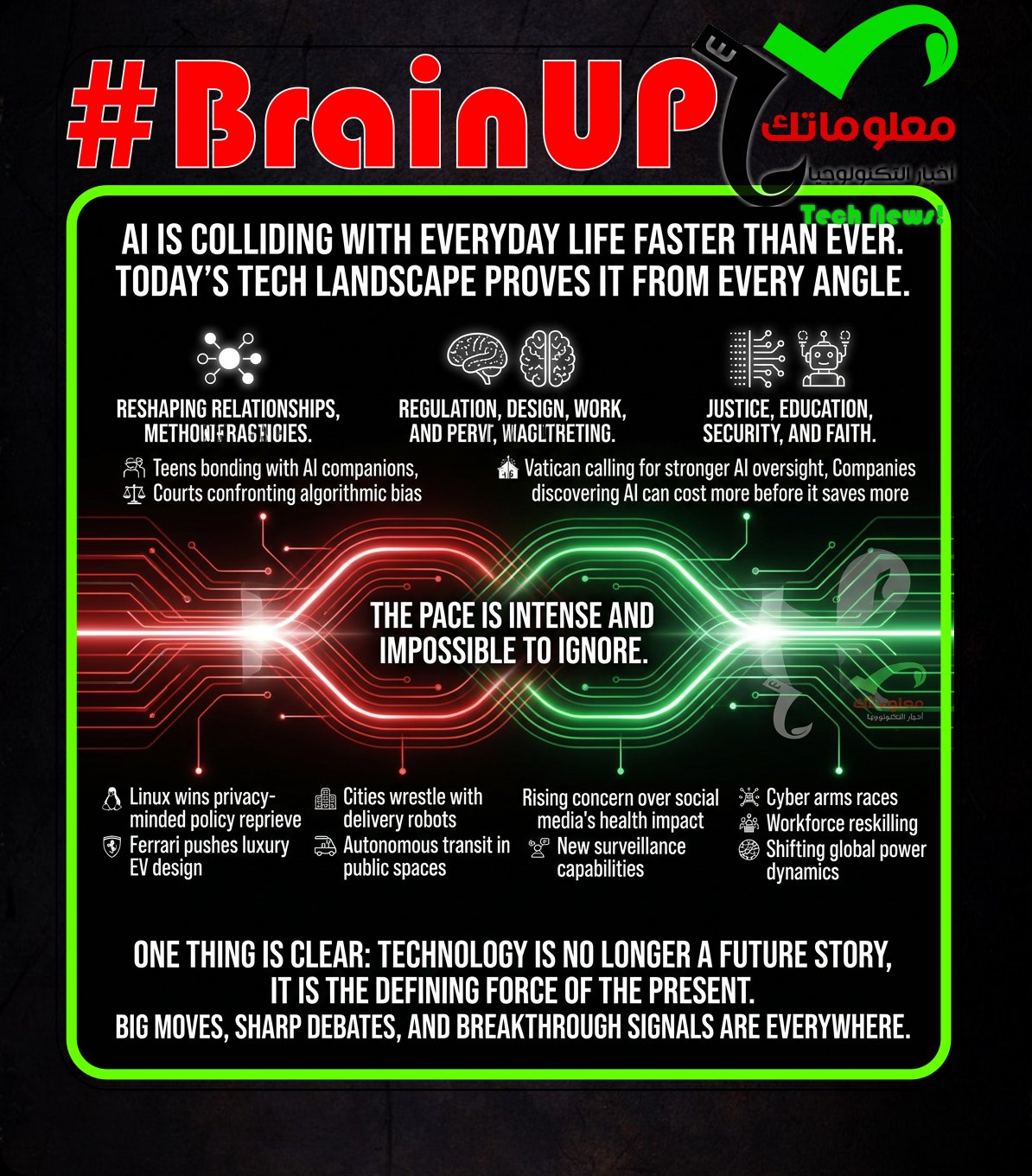
#BrainUp Daily Tech News – (Tuesday, May 26ᵗʰ)
Welcome to today’s curated collection of interesting links and insights for 2026/05/26. Our Hand-picked, AI-optimized system has processed and summarized 26 articles from all over the internet to bring you the latest technology news.
As previously aired🔴LIVE on Clubhouse, Chatter Social, Instagram, Twitch, X, YouTube, and TikTok.
Also available as a #Podcast on Apple 📻, Spotify🛜, Anghami, and Amazon🎧 or anywhere else you listen to podcasts.
1. Schoolboys Turn to AI Girlfriends Amid Changing Social Dynamics
Schoolboys are increasingly forming attachments with AI girlfriends, reflecting shifts in social and emotional behavior among young people. Instances show boys spending significant time interacting with AI companions designed to simulate romantic relationships, highlighting a growing reliance on technology for emotional fulfillment. This trend suggests challenges in traditional peer relationships and dating, driven by factors including social anxiety and digital immersion. Experts warn that while AI can offer companionship, it may also impact social development and expectations of real-life interactions. The phenomenon underscores broader societal changes, linking #AI technology with evolving youth culture and emotional health.
California lawmakers are advancing an amendment, #AB1856, that would exempt most open source operating systems from the state’s upcoming #DigitalAgeAssuranceAct requirements after backlash from Linux and open source communities. The amendment changes the definition of an “operating system provider” to exclude software distributed under licenses that let recipients copy, redistribute, and modify it, which would likely cover mainstream Linux distributions like Debian, Fedora, Ubuntu, Arch, and Mint, ahead of compliance slated for January 1, 2027. The original law, #AB1043, would have pushed age verification to the operating system level by requiring age or birth date collection during device setup and providing apps and app stores an age bracket signal such as under 13, 13 to 15, 16 to 17, and 18 plus, raising feasibility and enforcement concerns for decentralized, volunteer run projects. Privacy advocates including the @ElectronicFrontierFoundation criticized the approach as invasive, and developers questioned how California could enforce it on easily forked open source code, while reporting suggested SteamOS could still be affected because of its proprietary Steam storefront. The amendment does not repeal the act, it narrows who is covered, leaving commercial platforms with proprietary app ecosystems potentially still subject to the age assurance rules.
3. Ferrari Luce unveiled: Here’s the first car from Jony Ive’s design house – Engadget
Ferrari has revealed a full look at the Ferrari Luce, a luxury #EV whose radical interior and even bigger exterior departure are attributed to LoveFrom, the design house founded by @Jony Ive, with @Marc Newson also involved. The Luce is closer to an SUV in size and shape, with four doors and five seats, making it the first Ferrari to seat more than four people, and it uses rear-hinged “suicide” doors with a button that closes them automatically. Inside, the cabin’s knobs and dials feel high quality, but the software in this pre-production viewing was largely non-functional, including items like the on-screen stopwatch, drive modes, and seat ventilation, while second-row headroom was slightly limited. Ferrari positions the Luce as a way to broaden its portfolio and “enlarge” its customer community, even if traditional owners may not immediately embrace the design. Performance aims to stay on-brand with 1,035 horsepower from four motors, one per wheel, plus #fourWheelSteering and per-wheel power modulation for sharper cornering and better traction management.
In his new encyclical “Magnificent Humanity,” @Pope Leo XIV calls for stronger regulation of #AI, warning that “opaque algorithms” controlled by a handful of private companies can lead to “new forms of dehumanization” and should not remain in the hands of “a few.” He argues the technological revolution must not be driven by the “idolatry of profit,” and notes AI has recently been used during the U.S.-Israel War on Iran. In an unusual move, he personally presented the encyclical at the Vatican alongside @Christopher Olah of @Anthropic, amid the company’s outreach to religious communities and following CEO @Dario Amodei’s reported clash with the Pentagon over unrestricted military use of its assistant #Claude. The text frames the moment as a choice between building a new Tower of Babel or a shared “city” for God and humanity, and stresses that technology is not inherently evil but is never neutral because it reflects those who design, finance, regulate, and use it. Linking these concerns to governance, the encyclical urges more active political involvement, “robust legal frameworks,” independent oversight, informed users, and political systems that do not abdicate responsibility, positioning the document as a potential benchmark in the AI debate.
6. THE PEOPLE DO NOT YEARN FOR AUTOMATION
The episode argues that “software brain,” a worldview that reduces problems to algorithms, databases, and loops, has been supercharged by #AI and helps explain the widening gap between tech-industry excitement and growing public backlash. It cites polling that shows unusually negative attitudes toward #AI despite widespread use, including an NBC News poll placing AI favorability below ICE and only slightly above the war in Iran, a Quinnipiac poll finding over half of Americans expect more harm than good, and a Gallup poll showing Gen Z is the heaviest-using yet increasingly angry cohort. The piece connects that distrust to real-world resistance, with politicians across parties opposing data center buildouts, supporters being voted out, and escalating harassment and violence, including attacks mentioned against @Sam Altman. @Satya Nadella is quoted saying the industry must “earn the social permission” to consume energy, and the host argues AI has not earned it yet, warning that violence is unacceptable and urging opposition through markets, attention, and democratic voting and regulation. Overall, it frames “software brain” as a powerful force behind modern tech, but one now running into a legitimacy crisis as automation spreads faster than public consent.
7. Delivery robots are spreading across LA. Residents ‘both pity and hate them’
Delivery robots are rapidly spreading across Los Angeles, adding new obstacles to sidewalks in a city already known for poor walkability. Serve Robotics has deployed 500 more bots across 40 neighborhoods this month, up from two neighborhoods in 2023, while Coco Robotics has about 300 and plans to expand, prompting debates and restrictions elsewhere such as Glendale considering a moratorium and Chicago limiting growth. Workers and residents along Sunset Boulevard describe the robots as disruptive, citing blocked foot traffic, congestion around outdoor dining, kids interfering with them, and reports of robots hitting people, with added concerns about accessibility for wheelchair users and fewer delivery driver jobs. Supporters point to potential benefits like reduced exhaust emissions and less road traffic, and some people find the machines cute despite occasional property damage like smashing bus-shelter glass. The mixed reactions, ranging from hate to pity when bots get stuck and crowds cheer them through, reflect a broader tension over whether #delivery-robot technology is an inevitable shift in food delivery or an unwelcome takeover of public space.
Enterprise #AI coding tools that were expected to reduce costs are instead driving higher spending at @Microsoft and @Uber as usage scales rapidly. @Microsoft reportedly began cancelling most direct Claude Code licences and shifting engineers toward #GitHubCopilot CLI after opening Claude Code to thousands of employees and seeing very fast adoption, while @Uber’s CTO Praveen Neppalli Naga said the company burned through its entire 2026 budget for AI coding tools in just four months despite promoting usage with internal leaderboards. The article argues the cost surge is rooted in #token-based pricing, where higher efficiency and heavier use both increase total token consumption and therefore bills, a dynamic reinforced by internal pushes like Amazon’s “tokenmaxx” and Meta’s “Claudeonomics” tracking. Forecasts suggest #agenticAI could massively expand token demand, with @GoldmanSachs projecting a 24-fold increase by 2030 to 120 quadrillion tokens per month, and although @Gartner expects inference costs for large models to drop sharply by 2030, it warns enterprise bills may not fall because token use per task rises, consumption can outpace price declines, and providers may not pass through savings. Overall, the experiences at Microsoft and Uber illustrate how aggressive AI adoption can make compute spending grow faster than anticipated, even as per-token prices trend down.
9. Artificial Intelligence Is Changing How Courts Handle Cases, Introducing Bias Concerns
Artificial intelligence (#AI) tools are increasingly integrated into courtrooms across the United States, transforming case handling and judicial decision-making. Studies reveal that some algorithms intended to assess risks or sentencing may reinforce existing biases, raising concerns about fairness and transparency in the justice system. Experts including legal scholars and technologists highlight the need for careful regulation and oversight to ensure that AI complements rather than undermines judicial integrity. The debate reflects broader national discussions on ethical AI deployment, underscoring the tension between technological innovation and civil rights protections. This development signals a critical moment in balancing efficiency gains with equity in legal processes.
10. What ClickUp’s mass layoff tells us about the future of work | TechCrunch
ClickUp’s 22% layoff is being framed by CEO @Zeb Evans as a deliberate shift to #AI agents that changes employees’ roles from doing work to directing and reviewing automated output. Evans says the company has deployed about 3,000 internal AI agents and plans to reinvest savings into remaining staff with new million-dollar salary bands and pay outside traditional bands for outsized AI-driven impact, aiming to become a “100x org.” The move reflects a broader trend: a #Gartner survey found roughly 80% of companies using autonomous tech have cut jobs, though those reductions do not always produce meaningful financial returns, raising concerns that some firms use unproven AI as cover for downsizing. ClickUp argues it is seeing real productivity gains and is preparing to bake measured efficiencies into a forthcoming customer product, emphasizing “value created and time saved” rather than tracking #tokenmaxxing. The article suggests this approach rewards workers who automate effectively while steadily reducing headcount needs for those who do not, echoing extreme examples like Polsia, a one-person startup that claims to automate software operations and has raised $30 million.
11. Palantir hits back at Sadiq Khan after £50m contract with Met police blocked
@Palantir accused @Sadiq Khan of putting politics above public safety after his office blocked a proposed £50m, two-year contract for the #MetPolice to use #AI to process intelligence in criminal investigations. Palantir UK and Europe head @Louis Mosley said the mayor was politicising procurement and argued the focus should be preventing serious crime, while the mayor’s office said there had been a clear and serious breach of procurement rules. The dispute has exposed tensions within Labour and between City Hall and the force, with Scotland Yard calling the decision disappointing and warning that without new technology it would have to cut officer numbers, affecting safety. Critics including Labour MP @Stella Creasy condemned Mosley’s remarks, while MPs such as @Rosena Allin-Khan and @Clive Lewis backed Khan, arguing Palantir does not reflect London’s values and that public trust should guide tech partnerships. Mosley said Palantir was being singled out despite other major tech firms working with Israel and the Trump administration, as Khan’s stance contrasts with government contracts involving Palantir, including deals with #NHSEngland and the #MinistryOfDefence.
12. Donald Trump Is Building An Amazon For Guns, And Donald Trump Jr. Stands To Benefit
Donald Trump is launching a new digital platform aimed at creating an e-commerce site for firearms and related products, similar to Amazon but focused on the gun industry. This venture, called TRUTH Social Market, intends to cater to gun owners and supporters of gun rights, leveraging Trump’s large base. Evidence suggests Donald Trump Jr. could financially benefit from this initiative through family ties and potential business involvement. The platform is part of a broader strategy to capitalize on the polarized political climate and support for the Second Amendment. This move ties into the Trump family’s efforts to build a media and tech empire aligned with conservative values.
13. America’s schools face a backlash on digital devices as screens saturate classrooms
Schools across the U.S. are reconsidering the heavy use of digital devices in classrooms amid a growing backlash as screens become ubiquitous in learning. After investing billions of dollars in laptops, tablets, and learning apps, an increasing number of schools say it is time to scale back classroom device use. The shift reflects concerns that the expansion of #digital devices and #learning apps may have gone too far, prompting districts to rethink how much technology should be embedded in daily instruction. This reassessment signals a broader move from rapid adoption toward more limited, intentional use of classroom technology.
14. New Chinese surveillance leaves foreigners nowhere to hide
A Chinese police #surveillance system is evolving into a data-fused, 24/7 mechanism that can build “holographic profiles” of individuals and is increasingly used to monitor foreigners, especially journalists. Cybersecurity researcher NetAskari found an unsecured demonstration dashboard for the Public Security Bureau in Zhangjiakou containing real data, including a near-complete database of foreign journalists in Beijing around 2021 with passport photos, phone numbers, visa details and dates of birth, and he saw his own personal data on a watch list. The platform illustrates how #Xueliang (Bright Eyes) and related efforts extend beyond street CCTV by linking #facialRecognition images from ticket gates, pinpointing train carriage and seat numbers, mapping movements, and logging behaviors such as gasoline consumption, shopping locations, and visits to “petition areas” to create a “holistic personnel archive.” Built-in “smart report” statistics indicate disproportionate attention to citizens from the #FiveEyes countries, and some journalists are labeled “trackable,” enabling automatic alerts when they enter a jurisdiction. The ease of access to such sensitive tools and the system’s real-time tagging suggest a widening, more automated net that poses an existential risk for independent reporting in China.
@Microsoft says the original 2011 #Secure Boot certificates used by Windows PCs since 2011 will expire in June 2026, and it is rolling out new 2023 certificates via a delicate, multi-year update that writes to #UEFI firmware. In a March 2026 “Ask Microsoft Anything” with Arden White, Scott Shell, and Richard Powell, Microsoft explained that if you ignore the June 2026 certificate transition, Windows 11 PCs should still boot and run, but security will permanently degrade because Microsoft will stop delivering boot critical protections such as #DBX revocation list updates and other boot security updates. The AMA also outlined how Secure Boot works through a chain of keys and databases, including PK, KEK, DB (trusted certificates like the 2011 and 2023 Microsoft certs), and DBX (revoked signatures used to block threats like the BlackLotus bootkit). Microsoft noted that the new Secure Boot folder in Windows 11 is expected because it stages cryptographic files before flashing them to the motherboard, and devices that are not Secure Boot capable, such as true Legacy BIOS systems reported as SecureBootCapable = False, will have Windows skip the update attempt.
16. The AI Era Is Creating a Bug Hunting Arms Race
The rise of #agentic AI and #LLMs is accelerating vulnerability discovery and exploit development, reshaping #bug bounty and #vulnerability disclosure economics while also boosting attacker capability. Programs that once marked a shift toward cooperation, exemplified by @Apple raising top payouts from $200,000 in 2016 to $2 million last year, now face a flood of submissions as AI helps researchers find more bugs, with Joseph Thacker predicting major firms like #Google may spend 2 to 10 times more on payouts. Researchers expect a near-term surge in low and medium complexity findings, followed by fewer submissions as AI-assisted hunting exhausts “low-hanging fruit,” potentially pushing some organizations to adjust payouts again. Faster AI-driven discovery also pressures traditional norms like #90-day disclosure windows, and could force quicker patching even as rapid deployment risks outages and other operational harm. Google researchers recently reported observing cybercrime actors using AI tools to develop a #zero-day that bypassed #two-factor authentication on an open source admin platform, a case that underscores the emerging arms race and the need for faster fixes.
17. Self-driving bus in Sweden crashes with tram on first day of passenger service
A self-driving bus in Stockholm, Sweden, collided with a tram on its first day of carrying passengers, marking a setback for autonomous public transport. The incident occurred when the bus, operated by #AutonomousVehicles technology, failed to yield to the tram, demonstrating challenges in integrating such systems into existing urban traffic. Despite no serious injuries, the crash has raised concerns about the safety and reliability of self-driving public transport solutions. This event highlights the complexities of deploying #selfdriving technology in mixed-traffic environments and underscores the need for rigorous testing and regulation. As cities worldwide look to adopt smart mobility solutions, this incident serves as a reminder of the hurdles in achieving seamless coexistence between autonomous and traditional vehicles.
18. Samsung Reportedly Developing 250TB to 1PB Nearline SSDs, Enough for Up to 8000 GTA V Installs
Samsung is reportedly working on extremely high-capacity nearline SSDs ranging from 250TB to 1PB, which could store enough data to install up to 8,000 copies of Grand Theft Auto V. These advances signify a leap in #storage technology, pushing the limits of data density and capacity for enterprise and data center applications. The reported SSDs would dramatically enhance storage efficiency, reduce physical footprint, and transform data handling capabilities. This development reflects @Samsung’s ongoing innovation in solid-state drives, positioning them as a leader in high-capacity storage solutions. Such breakthroughs are likely to influence future data storage infrastructures and meet increasing demands for vast digital content storage.
19. Cox Media fined after bragging it spied on users through their phones
The @Federal Trade Commission says Cox Media and marketing firms MindSift and 1010 Digital Works misled advertisers and consumers by claiming they could spy on people through phones and smart devices to target ads. In 2023 Cox touted a product called #Voice Data, suggesting “every casual conversation” could be used for ad targeting and likening it to #BlackMirror, while internal pitch materials reported by @404 Media echoed similar claims despite widespread skepticism. The FTC alleges the service did not listen to conversations or use voice data, and it also failed to accurately place ads in desired locations, instead reselling email lists from data brokers at a significant markup and falsely claiming consumers had opted in. The companies agreed to pay $930,000 to settle allegations centered on deceptive claims about surveillance based ad targeting. The case underscores that marketing hype about #phone listening and consent can trigger enforcement even when the underlying spying capability is not real.
20. Microsoft said its AI made Google dance in 2023, three years later Gemini is beating Copilot
In 2023, @Microsoft believed integrating a custom @OpenAI model called #Prometheus into #Bing and #Edge would force @Google to react and finally level the search market, but by 2026 the advantage faded as @Google rebuilt #GoogleSearch around an AI first approach and turned #Gemini into a dominant search layer. The article cites @Satya Nadella’s 2023 comments about making @Google “dance,” the author’s own switch to Bing, and the later outcome where #ChatGPT became a ubiquitous utility rather than a gateway to Bing while Google leveraged distribution via #Chrome and #Android to make Bing’s early AI lead irrelevant. It argues Microsoft is now left with a fragmented ecosystem of #Copilot experiences that users push back against, despite Microsoft helping pioneer the modern AI wave. To explain the pattern, it frames Microsoft’s AI history as recurring cycles of strong research foundations followed by uneven consumer execution, beginning with #MicrosoftResearch (1991) and high profile assistant attempts like #Clippy from #ProjectLumiere (1997). Overall, the piece portrays Google’s Gemini led search integration as outpacing Microsoft’s Copilot strategy, raising doubts about Microsoft’s ability to “save the web” through its current approach.
21. Social media as bad for young people as smoking, top doctors say
The UK’s most senior doctors say #social media use poses a health threat to young people on a par with smoking, and they want it treated as a routine clinical issue. In a submission to a government consultation on under-16s’ social media use, the @Academy of Medical Royal Colleges urges doctors to ask younger patients about #screen time and social media, develop guidance to spot unhealthy use, and record potential harms to improve data, citing physical and mental health problems linked to exposure to extreme violence online. The government consultation, which has received around 70,000 submissions, is considering options such as a ban like Australia’s, app curfews, stronger age checks, and disabling features like auto-play and infinite scroll, with @Liz Kendall saying a response will come in summer and action by year end. Consultant child psychiatrist @Dr Emily Sehmer argued excessive social media use can be worse than smoking because children can be exposed to harmful content within seconds, and said clinicians need to ask non-judgementally to understand the scale of harm. Campaigners and groups are divided on an outright ban, while bereaved families and some police leaders back tougher restrictions and higher access ages, as the consultation weighs how best to reduce risks to children online.
22. ‘New form of war’: an insider view of China’s AI strategy in electronic warfare
China is pursuing an “AI Plus” push in #electronicWarfare that aims to reshape how militaries communicate, jam, and control the electromagnetic spectrum by tightly integrating #AI with radio-wave physics. A team led by Li Fukai at the China Academy of Electronics and Information Technology and the National Key Laboratory of Electromagnetic Wave Propagation argues in the journal Command Control and Simulation that fusing AI with #electromagneticWavePropagation could yield radars and communications that are faster, smarter, and more resilient, including methods designed to confuse enemy jammers. The paper frames this as a “new form of war,” suggesting traditional approaches centered on jamming, spoofing, and interception are increasingly strained by chaotic, dynamic signal environments created by drone swarms and hypersonic weapons. The article contrasts this with reported US use of AI in strikes on Iranian targets and claims that even advanced platforms like the #F35 have faced losses when Iranian air defenses exploited weaknesses in US electronic warfare. Overall, the piece presents China’s strategy as using AI not just to process signals, but to adapt to and exploit the underlying physics of the spectrum to gain operational dominance.
23. Not just Samsung: Workers at TSMC also questioning bonus system in wake of record profits
Amid a semiconductor #chip supercycle and record-level results, discontent is emerging among TSMC employees in Taiwan over how profits are shared as the company expands investment, echoing recent bonus-related tensions seen at Samsung. Taiwanese media reported speculation that 2025 annual bonuses, paid in July, could end up about 15% lower than employees previously expected as TSMC ramps up overseas investment spending, despite strong first-quarter performance. TSMC’s board sets investment, dividends, and compensation, and in February approved a 2025 bonus pool of 206.15 billion Taiwan dollars, about 10.6% of operating profit, with local estimates suggesting an average of roughly 2.64 million Taiwan dollars per employee across a workforce of about 78,000, distributed in five installments through the following July. Employees criticize what they view as an opaque bonus calculation and distribution system because individual bonus amounts are not publicly disclosed and payouts can vary by headcount and department performance metrics, raising fears that tighter evaluations could effectively cut bonuses to fund expansion. With no official response from TSMC to the rumors, the episode underscores a growing industry debate over balancing aggressive investment growth with transparent profit sharing.
24. India’s AI Ambitions Hinge on Workforce Re-Skilling, IBM India Head Says
India’s advancement in artificial intelligence depends heavily on the re-skilling of its workforce to meet the evolving demands of #AI technology adoption. @IBM India’s head emphasized that preparing talent through continuous learning and adaptation is crucial to harness AI’s potential effectively. The challenge lies in bridging the skills gap to ensure that employees across industries can work alongside AI tools competently. This approach not only supports individual career growth but also drives national competitiveness in the global AI landscape. Therefore, workforce re-skilling is central to India’s strategy to leverage AI innovations for economic development.
25. China’s AI Boom Is Reshaping Employment Anxiety Across the Economy
China’s aggressive push into #AI and automation is fueling growing fears of unemployment across white-collar and manufacturing sectors as companies race to cut costs and boost productivity. The report describes how firms across finance, customer service, logistics, media, and technology are replacing or reducing human roles with AI-driven systems, while workers increasingly fear becoming obsolete in an economy already struggling with youth unemployment and slower growth. Chinese companies and local governments are heavily investing in generative AI, robotics, and intelligent automation to stay competitive against the United States, but the rapid transition is creating social pressure and uncertainty for employees who feel unprepared for the speed of disruption. Economists and labor experts warn that while AI may create new industries over time, the immediate impact is likely to widen inequality and intensify competition for fewer stable jobs, especially among younger graduates entering the workforce. The article also highlights how #China’s centralized industrial strategy allows rapid AI deployment at national scale, turning the country into one of the largest real-world experiments in AI-driven labor transformation.
A Soviet lunar rover launched in 1971 ceased communication shortly after landing, leading scientists to believe it was lost permanently. However, almost four decades later, researchers detected laser reflections from a retroreflector attached to the rover, proving it still existed on the Moon’s surface. This finding demonstrated the longevity and durability of lunar equipment and enabled precise measurements of the Earth-Moon distance using laser ranging techniques. The rover’s unexpected response highlighted the potential for long-term scientific data collection from lunar missions. This discovery underscores the enduring value of early space exploration technologies in advancing lunar science.
27. Sennheiser’s Momentum 5 headphones are all about the audio and ANC upgrades – Engadget
Sennheiser’s Momentum 5 Wireless keeps the Momentum 4’s look but focuses on internal upgrades to #audio and #ANC, alongside a higher $400 price. It retains the same 42mm transducers inspired by Sennheiser’s HD 600 series, while adding #HiResAudio certification, #SnapdragonSound with up to aptX Lossless, and an updated Smart Control Plus app with an 8-band EQ, presets, and personalization, plus support for the BTD 700 lossless Bluetooth dongle and planned DSP Bluetooth updates. A day-one firmware update adds #DolbyAtmos with head tracking for compatible content, and although it ships with #Bluetooth5.4, it was designed for #Bluetooth6.0 with a future firmware upgrade. For noise cancellation, Sennheiser adds two more microphones per side, four per ear cup, claiming up to three times better cancellation of human voices and improved call quality. Battery life drops from 60 hours to 57 hours with ANC, but it adds 5-minute quick charge for up to three hours and a user-replaceable 700mAh battery, with availability on June 16 in black, white, and blue.
That’s all for today’s digest for 2026/05/26! We picked, and processed 27 Articles. Stay tuned for tomorrow’s collection of insights and discoveries.
Thanks, Patricia Zougheib and Dr Badawi, for curating the links
See you in the next one! 🚀
