
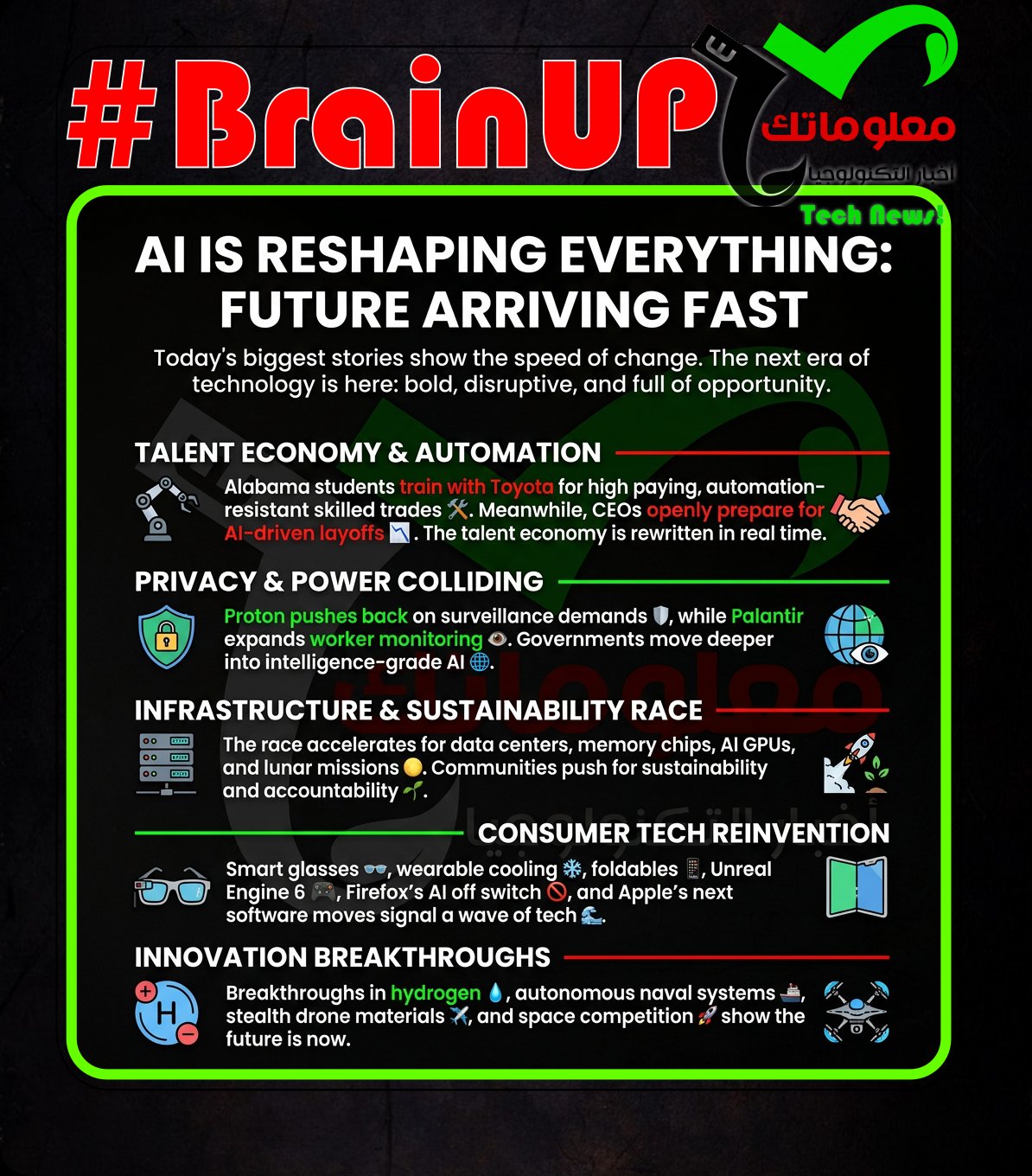
#BrainUp Daily Tech News – (Monday, May 25ᵗʰ)
Welcome to today’s curated collection of interesting links and insights for 2026/05/25. Our Hand-picked, AI-optimized system has processed and summarized 29 articles from all over the internet to bring you the latest technology news.
As previously aired🔴LIVE on Clubhouse, Chatter Social, Instagram, Twitch, X, YouTube, and TikTok.
Also available as a #Podcast on Apple 📻, Spotify🛜, Anghami, and Amazon🎧 or anywhere else you listen to podcasts.
Amid an intensifying #skilled-trades shortage and rising #AI automation pressure on entry-level white-collar work, the Huntsville Center for Technology in Alabama is channeling high school students into industry-ready technical careers through a direct partnership with @Toyota. The new $40 million facility serves about 700 students part time and includes an “Inditech” pathway, backed by $1 million from Toyota’s charitable endowment, created after local employers identified industrial maintenance as a major workforce gap at Toyota’s Huntsville engine plant. The article cites broader labor-market strain: many tradespeople are nearing retirement, some estimates peg the economic risk at $1 trillion annually, and the National Association of Manufacturers projects the U.S. will need about 1.9 million manufacturing workers by 2033, while data center buildouts compete for electricians and construction talent. Instructors emphasize the payoff for students, noting that with a two-year degree plus a couple years of experience, industrial maintenance roles can exceed $40 an hour with little to no student debt. The Huntsville model, alongside efforts from companies like @Lowe’s and @BlackRock and scholarship initiatives from @Mike Rowe, illustrates how education and employers are attempting to rebalance a job market that is short on “essential economy” workers even as automation threatens many traditional corporate paths.
2. Proton VPN vows to resist Canadian surveillance demands under Bill C-22
Proton VPN says it will resist any Canadian surveillance demands tied to Canada’s proposed #lawful access legislation, #Bill C-22, arguing it operates under Swiss jurisdiction and will challenge the law “by every means available,” according to General Manager David Peterson. Peterson said complying with foreign surveillance orders without a Swiss legal process would be a criminal offense, and added that Proton VPN cannot legally act on such demands unless they go through Swiss channels. Addressing whether Swiss courts could force logging, he cited 411 Swiss legal requests seeking logs that Proton could not satisfy because it does not retain activity logs, and said there is no mechanism under Swiss law to require it to start logging, referencing the company’s transparency report. The stance aligns Proton with other critics like @Apple, @Meta, and Signal, who argue Part 2 of #Bill C-22 could require providers to maintain technical capabilities that may effectively weaken #encryption or embed lawful access mechanisms, even as Canadian officials insist the bill is “encryption neutral.” The dispute underscores escalating industry pushback as lawmakers continue debating the proposal, with opponents warning about systemic cybersecurity risks and potential backdoors while officials deny mandating weakened security.
3. ‘AI washing’: firms are scrambling to rebrand themselves as tech-focused
UK companies are increasingly trying to rebrand ordinary #automation as #artificialIntelligence, pushing PR teams to pitch them as AI specialists to capitalize on the hype. PR executives describe “yoga-level” stretches in labeling products and even company leaders as AI-focused, despite weak links to #generativeAI, and warn that journalists are becoming numb or skeptical of “AI-powered” language. Examples cited include AllBirds reportedly pivoting to acquiring AI graphics processing units, genetics firms promoting AI-powered blood tests, and pitches for AI-powered basketball hoops and lasers, alongside a property tool marketed as AI that a PR said was essentially a handheld scanner with some automation. PR workers say they are often compelled to send AI-themed releases they do not believe in, with one estimating about half of his pitches fall into that category, and agencies caution clients against forcing AI commentary that will not be taken seriously. The pattern is framed as #AIwashing, where familiar, sometimes years-old, technologies are repackaged as AI to appear tech-forward and relevant.
4. Memory prices tipped to fall as China starts flooding market
Memory prices are expected to decline due to China’s significant increase in memory chip production. Chinese manufacturers, supported by government subsidies, have boosted output, creating greater supply in the market. This surge in supply is putting downward pressure on prices, challenging dominant players like Samsung and SK Hynix. The trend suggests increased competition in the #memorychip market, potentially benefiting consumers with cheaper prices. It highlights the impact of China’s strategic focus on advancing its semiconductor industry on the global memory market.
Paramount/CBS paused copyright takedown notices against bootleg YouTube uploads of @Stephen Colbert’s “Only in Monroe” episode after online outcry, saying the enforcement was routine rather than an attempt to suppress the show. CBS said the episode was financed and produced by CBS Studios and officially posted on @Colbert’s new YouTube channel in collaboration with Monroe Community Media and “The Late Show” YouTube channels, and that it is waiving further enforcement pending additional review. Unofficial uploads had accumulated large view counts, including one from “The Desk” with 620,621 views versus about 392,486 views on Colbert’s official page, which helped trigger attention to the takedowns. The company argues this is standard #copyright procedure for protecting network and talent content, and notes Monroe Community Media lacks comparable legal resources to pursue takedowns itself. The official video remains readily available via the collaborative uploads, and insiders say CBS funded the episode, including music by Jack White and a guest appearance by Jeff Daniels, which is why “The Late Show” holds the copyright and led enforcement.
Navantia UK unveiled a model of its Large Autonomous Surface Vessel, #LASV75, positioning it as a core element of a future #hybrid navy that combines crewed warships with uncrewed escorts and autonomous systems such as drones. Displayed at the Combined Naval Event in Farnborough, the UK-designed concept is built from the keel up to be uncrewed, emphasizes persistent capability through size, range, and speed, and uses smart modularity and a modular hull to support sensing, operations, or combined configurations while aiming for high availability and lower cost than crewed vessels. The company ties the design to its goal of strengthening UK sovereign naval capability following its purchase of Harland & Wolff’s assets, alongside a £157 million modernization of its four yards, Appledore, Arnish, Belfast, and Methil, including an automated panel line in Belfast and adoption of digital design tools across sites toward its #Shipyard5.0 concept. Navantia UK says these upgrades could reduce standard design and build time for large naval vessels by up to 30%, aligning with the UK Ministry of Defence’s #SDR2025 ambition for faster delivery of major modular platforms. In parallel, it reports progress on the £1.6 billion Fleet Solid Support program, including steel cutting at Appledore for the first ship and the launch of the 85-meter Seahorse barge from Methil to move blocks and components between Appledore and Belfast.
7. Palantir Gets an Initial $3.9 Million to Spy on Federal Workers – The American Prospect
The @Trump administration is building a cross-agency surveillance network to track federal employees, beginning with a $3.9 million contract for @Palantir at the USDA tied to enforcing #returnToOffice requirements. Federal spending disclosures say Palantir will “design, configure, deploy and manage” a tool to track USDA employees’ office returns, with the deal starting May 1 and potentially rising to $13.3 million over the next fiscal year, while the VA has also sought a system to passively gather and report daily occupancy counts across 311 administrative locations and union officials say the SSA is pursuing similar monitoring. Critics argue the effort prioritizes monitoring and intimidation over governance, and note research indicating constant scrutiny harms workers’ physical and mental health. At the SSA, AFGE Council 220 leaders contend occupancy metrics could be used to justify office consolidation or closures despite staffing being at a 59-year low after DOGE pushed out 7,000 workers, and they cite at least three Social Security field offices already closed to in-person service for over a year. The article links the new surveillance tools to broader workforce and service impacts, arguing limited budgets would better address public needs through hiring and improved service rather than #workplaceSurveillance technology.
@Sundar Pichai says graduates skeptical of #AI will both help drive the technology forward and have to live with its effects, and he plans to draw on his own experiences when he delivers Stanford’s commencement speech. He told the “Hard Fork” podcast that recent commencement backlash, including booing of former Google CEO @Eric Schmidt and criticism of @Scott Borchetta after pro-AI remarks, reflects real anxiety among students entering the job market. The article cites broader public unease, including a Pew Research finding that about half of Americans feel more concerned than excited about AI’s growing presence, community resistance to new data centers needed to power AI tools like chatbots, and companies pointing to AI-driven efficiency as a factor in layoffs. With new-grad unemployment at a four-year high and hiring processes lengthened, Pichai said people are rightfully anxious because the scale of change is difficult for humans to process. The piece contrasts that tension with optimism from leaders like @Jensen Huang, who told graduates that AI will be a net positive and that the timing for their careers is ideal.
9. Women Lead Opposition to AI Data Centers
Women are at the forefront of opposing the rapid development of AI data centers in their communities, citing concerns about environmental and social impacts. Activists highlight issues such as high energy consumption, water usage, and increased local pollution connected to data centers. The opposition draws attention to how these facilities often exacerbate existing inequalities, impacting marginalized groups disproportionately. This grassroots resistance underscores a broader debate about sustainable technology growth and community rights. The movement challenges policymakers and corporations to balance technological advancement with environmental stewardship and social equity.
10. Zuckerberg warns ‘success isn’t a given’ after laying off 10% of Meta
@Mark Zuckerberg told employees that “success isn’t a given” as #Meta carried out a reorganization that cut about 10% of its workforce and shifted the company’s focus more heavily toward #AI. In a companywide memo, he thanked departing staff, said there should not be additional cuts in 2026, and emphasized that AI is “the most consequential technology of our lifetimes,” while Meta redirects 7,000 employees into AI roles. The restructuring, first outlined internally in April after a leak about upcoming layoffs, includes cutting about 8,000 employees and not filling roughly 6,000 open positions, with affected workers notified on Wednesday. Meta also said it was raising 2026 capital expenditures to $125 billion to $145 billion due to higher component pricing and additional data center costs to support future capacity. Zuckerberg said Meta is transforming to remain a top place for high impact talent, acknowledged the company has not been as transparent as he would have liked, and noted U.S. laid off employees will receive severance starting with four months’ pay plus additional support such as immigration and healthcare assistance.
A viral Instagram video by Moreiras3D showing a severely melted @Bambu Lab A1 has reignited debate over whether the A1 remains a #fire hazard and whether it should be recalled. The clip shows the A1’s side melted down to the metal chassis and a neighboring A1 with a damaged cord, while the poster says the printer had been used for three months and was plugged into a surge protector, with the fire starting on the machine rather than the outlet. The incident resembles earlier reports tied to the A1’s AC power distribution board running hot, where an NTC thermistor used for inrush-current limiting during warmup could fail, an issue highlighted by @Grant Posner, though @Bambu Lab previously said no fires had been reported, the printers meet safety standards, and the company would fix the issue in future units. Critics on Reddit and @Louis Rossmann argue for a recall, but other Redditors doubt the same thermistor issue is to blame because the unit may be from post-fix stock and the video context is unclear, including an unidentified melted plastic object between the printers. With no footage of the fire itself and limited details, commenters say the available evidence supports speculation rather than a definitive link to the known NTC-related failure.
12. 99% of CEOs Expect AI-Driven Layoffs in the Next Two Years
A Mercer survey reports that nearly all CEOs expect corporate #AI initiatives to cause layoffs within the next two years, reflecting strong executive belief in automation as a profit and ROI driver. In Mercer’s Global Talent Trends report, 99% of CEOs said they are prepared for AI-driven layoffs, and while most see work redesign around automation as the biggest return, only 32% think organizations can optimally combine human and machine capabilities. The article adds that headcount reductions are expected to fall heavily on early-career roles because #AI is seen as best at automating simpler entry-level tasks, and multiple recent studies are cited as showing the impact has already reached young workers, contributing to the grimmest job market for ages 22 to 27 since the worst of the pandemic and growing distrust of AI among #GenZ. Broader public sentiment is also described as negative, with an NBC News poll finding #AI viewed more negatively by voters than @ICE. Regardless of whether productivity gains justify the cuts, the piece links executive rhetoric about AI to worsening worker well-being, citing Mercer data that the share of employees thriving at work fell from 66% in 2024 to 44% in 2026, and notes researchers proposing the term “AI replacement dysfunction” (#AIRD) to describe distress over AI-driven displacement.
13. AI agents are quietly generating chaos engineering failures enterprises don’t track yet
Enterprises are experiencing a new class of production incidents where an #AI agent takes a technically correct action based on incomplete context, triggering cascading infrastructure failures that do not fit existing postmortem templates and get debated as either agent or infrastructure faults. The scale is growing, with 79% of organizations having some form of #AI agent in production and 96% planning expansion, while @Gartner forecasts 33% of enterprise software will include agentic AI by 2028 and warns 40% of those projects may be canceled due to poor risk controls, leaving an untracked middle ground of agent-driven infrastructure events. Drawing on experience building enterprise automation at @Cisco and @Splunk and work on intent-based #chaos engineering, the author argues organizations make a structural mistake by treating autonomous agents and chaos engineering as separate disciplines. In mature chaos programs, humans initiate experiments with judgment checks like dashboards, error budget burn rate, dependency stability, and blast radius controls, but autonomous remediation agents remove that judgment gate and effectively introduce chaos events without SLO or blast radius evaluation. An example is a remediation agent restarting a microservice cluster to address latency, unaware of peak traffic, high shared connection pool utilization, and a database index rebuild, where the restart triggers a thundering herd and turns a manageable spike into a wider cascade, illustrating why agent actions should be governed like chaos experiments.
14. NASA reorganizes to accelerate Moon Base, lunar programs
NASA announced an agency reorganization to streamline decision making and speed progress on its Moon Base initiative and broader lunar exploration, while aiming to avoid layoffs, as the agency faces uncertainty around its $24.4 billion budget amid divisions between Congress and the White House. The agency said it will consolidate key offices and will outline Moon Base program details, mission architecture, and industry partnerships in a May 26 news conference in Washington featuring NASA Administrator @Jared Isaacman, Lori Glaze, and program executive Carlos Garcia-Galan. The Moon Base effort is being advanced under the #Artemis Program with a focus on the Lunar South Pole to build sustained human presence, support long term science, and prepare for future Mars missions, including plans to extract frozen water and operate in challenging terrain. NASA described a phased approach that starts with roughly 4,000 kg of payload delivered across 25 launches and 21 landings in Phase 1, scaling up by Phase 3 to 29 launches and nearly 150,000 kg of capacity, alongside integrating commercial payload services, a move praised by @Elon Musk. Overall, the restructuring is positioned as an organizational and partnership push to accelerate lunar base development and mission delivery.
15. Chinese astronaut to spend a full year in orbit as Beijing ramps up Moon race
China launched the Shenzhou-23 mission to the #Tiangong space station, aiming to complete its first year-long astronaut stay in orbit as a key step toward a crewed Moon landing by 2030. A #LongMarch2F rocket from the Jiuquan launch centre carried three astronauts, including Hong Kong’s first spacefarer, Li Jiaying, alongside Zhu Yangzhu and Zhang Zhiyuan, who will conduct research in life sciences, materials science, fluid physics and medicine. One crew member will remain for a full year to study the effects of long-duration #microgravity, with the final selection to be announced later based on mission progress, according to the CMSA. Expert Richard de Grijs highlighted major risks such as bone and muscle loss, radiation exposure, sleep and psychological strain, and stressed the need for reliable water and air recycling and medical contingency capability. The mission extends China’s operational experience beyond six-month rotations and supports its broader lunar and potential deep-space plans, alongside development of the new #Mengzhou spacecraft for an orbital test flight in 2026 as the United States pursues its Artemis programme.
Turkish researcher @Yunus İnce and a small defense research firm describe a sprayable #radar absorbent material called Kürşat 3.0 intended for drones and other small #UAVs to reduce radar detectability. They claim test footage shows up to 43dB attenuation, higher than the 20 to 30dB reductions cited for typical broadband #RAM in standardized academic testing, but the article notes the performance still needs third-party validation. The formulation is said to use volcanic basalt and pumice, whose microscopic porosity could be engineered to trap electromagnetic energy and convert some radar waves into heat rather than reflecting them. The piece argues that because most UAVs are too small and cost-constrained for specialized radar-deflecting airframe geometry, a “spray-on” coating could be a cost-effective way to further reduce detection and targeting range, even though exposed features like quadcopter blades would still reflect radar. Overall, the coating is presented as a potentially meaningful survivability boost for small drones amid rapidly expanding drone warfare and counter-drone defenses, contingent on independent verification.
@Jensen Huang urged Super Micro Computer to strengthen #export control compliance, saying Nvidia requires partners to follow U.S. trade rules after a major alleged smuggling scheme involving Nvidia-equipped servers. His comments followed U.S. prosecutors charging Supermicro co-founder @Yih-Shyan “Wally” Liaw and two others with conspiring to smuggle about $2.5 billion worth of Nvidia-equipped servers to China via shell companies in Southeast Asia, while Supermicro said it is not a defendant and is cooperating and Liaw pleaded not guilty. Taiwan also announced its first formal crackdown on illicit #AI hardware exports, alleging suspects used fraudulent shipping declarations to export Super Micro servers with Nvidia #AI chips to China, Hong Kong, and Macau. Huang also said China is included in Nvidia’s projected $200 billion market for its upcoming Vera CPU, and noted that while #H200 has been licensed for shipment to China and some firms were cleared to buy it, no H200 units have yet been delivered and recent U.S.-China talks produced no breakthrough. He made the remarks while visiting Taipei ahead of #GTC Taipei and a Computex keynote, where he is expected to discuss the #Vera Rubin platform and its large Taiwanese partner ecosystem.
18. White House Near Deal With Anthropic as Spy Agencies Expand AI Use
The White House is close to securing a significant deal with @Anthropic, an AI startup, to provide advanced artificial intelligence technology to U.S. spy agencies. This development highlights the increasing integration of #AI tools in national security operations to boost intelligence capabilities. The agreement involves stringent oversight and aims to balance technological innovation with privacy and ethical concerns. The expansion of AI use by intelligence agencies underscores a broader government push to leverage AI for enhanced data analysis and operational efficiency. The partnership reflects a strategic effort to maintain competitiveness in global intelligence gathering through cutting-edge AI solutions.
19. Scientists Discover Low-Cost Route To Clean Hydrogen Production
Researchers at the University of Birmingham report a lower-temperature route to #hydrogen production using a #perovskite catalyst for #thermochemical water splitting, aiming to make hydrogen cheaper and cleaner than many current options. The team led by @Yulong Ding found the catalyst can produce substantial hydrogen at about 150 to 500°C and be regenerated at 700 to 1000°C, cutting temperature requirements by roughly 500°C compared with typical systems that need 700 to 1000°C for splitting and up to 1300 to 1500°C for regeneration. They argue the reduced heat demand could let industrial waste heat from steel, cement, glass, and chemicals, or heat near renewable generation sites, power local hydrogen production, easing storage and transport barriers. An initial cost-competitiveness analysis suggests this approach could undercut both #green hydrogen from electrolysis and #blue hydrogen from methane with carbon capture, with the biggest advantage where renewable energy is cheap, such as Australia. The work, published in the International Journal of Hydrogen Energy and done with the University of Science and Technology Beijing, is being commercialized in the UK and Europe, with a patent filed for low-temperature water splitting using BNCF catalysts.
20. Samsung is giving chip workers huge bonuses as AI chip sales soar
Samsung is rewarding its chip workers with substantial bonuses due to the surge in AI chip sales, reflecting the company’s strong profits in this sector. The bonuses are part of Samsung’s strategy to incentivize and retain talent amid the booming demand for chips that power generative AI, a market dominated by companies like Nvidia. This move highlights the growing importance of #AI technology in the semiconductor industry and Samsung’s efforts to capitalize on this trend to boost its competitiveness. By financially recognizing its workforce, Samsung aims to sustain high productivity and innovation in chip manufacturing, directly linking employee incentives with the company’s success in AI chip markets. The bonus payouts underscore the increasing integration of AI advancements with industrial growth strategies in tech companies.
21. Unreal Engine 6 Gets First Look and Logo Reveal as Rocket League Gets a New Coat of Paint
Epic Games developer Psyonix revealed an updated version of Rocket League running in #UnrealEngine6, offering the first public footage of any game on the new engine and unveiling a new purple Unreal Engine 6 logo. The announcement debuted at the Rocket League Championship Series Paris Major alongside a reveal trailer focused on improved visuals, with the studio noting the footage was captured real-time in game. Epic and Psyonix did not detail what #UnrealEngine6 specifically adds over its predecessor, leaving the engine’s advantages and release timing unclear compared with the more technical showcase used for #UnrealEngine5’s announcement. The trailer’s ending also appeared to hint at a future hub app grouping Fortnite, Rocket League, and other experiences, as highlighted by prominent Fortnite creator @ShiinaBR. Overall, the reveal signals a new era for Rocket League’s presentation while keeping key details about #UnrealEngine6 and Epic’s broader platform plans unconfirmed.
22. New iOS 27 Rumors Include Revamped AirPods Settings Menu and More
Apple is expected to preview iOS 27 at #WWDC 2026 ahead of a September release, with rumors pointing to a range of interface and #AppleIntelligence upgrades. According to @Mark Gurman in Bloomberg’s Power On, iOS 27 may add a revamped, better organized AirPods settings menu, improved output quality for #Genmoji and Image Playground creations, and a new #Siri interface featuring a dark color scheme similar to Apple’s WWDC 2026 graphics. Gurman also says users may be able to set an #AirPlay alternative such as Google Cast as the default, possibly limited to the EU. The report adds to earlier expectations of a dedicated Siri app, broader Apple Intelligence features in apps like Wallet, Safari, and Shortcuts, better keyboard autocorrect, and Apple Maps satellite connectivity, with more details likely at the June 8 keynote.
@Chi Xu, CEO of Google partner Xreal, says the long money-losing smart glasses industry may be hitting an inflection point as hardware, operating systems, and user interfaces finally mature. He points to @Meta’s 2023 Ray-Ban partnership as evidence that smaller form factors and better software can drive real unit sales, even if Reality Labs still loses money. Xreal’s latest effort, Project Aura, is a wired #XR smartglasses system with embedded OLED displays that tethers to a phone-like computing “puck,” trading some awkwardness for higher-quality experiences. The company says Aura enables features like immersive #Google Maps, VR #YouTube videos, hand-tracked holographic “painting,” games, and basic web browsing, positioning it for both consumer entertainment and professional work use. Aura is currently developer-only, with a commercial launch planned later in 2026, while Xreal also prepares for an IPO expected before the end of 2026 and works toward profitability by improving gross margin.
Gemini Spark and OpenClaw represent two emerging technologies in the field of artificial intelligence, each offering unique approaches to machine learning model development and deployment. Gemini Spark emphasizes ease of use and integration with existing workflows, enabling developers to accelerate AI projects through flexible, scalable cloud-based resources. In contrast, OpenClaw focuses on optimizing performance and efficiency, utilizing advanced algorithms to reduce computational overhead and improve training speeds. The competition between Gemini Spark and OpenClaw highlights the broader trend of balancing user accessibility with technical sophistication in AI platforms. Understanding the strengths of both can guide organizations in selecting solutions that best fit their specific needs and capabilities.
25. Sony Launches Reon Pocket Pro Plus Wearable Air Conditioner In Time For Summer Heatwaves
@Sony has introduced the Reon Pocket Pro Plus, a #wearable personal air conditioner designed to be worn under clothing to help during summer heatwaves. It uses a stainless-steel cooling panel pressed against the back of the neck via an adaptable neckband, with onboard buttons and a smartphone app for adjusting cooling, plus sensors that monitor skin temperature for safety and comfort. The new model is described as having 20% higher cooling performance, making it about 2 degrees Celsius colder, and it adds a larger-diameter neckband for better stability during movement, while also offering warming for winter. Temperature regulation is supported by a wireless second-generation Pocket Tag that can be clipped to a belt or bag and now measures humidity as well as temperature to better reflect the ambient environment than readings taken under clothing. The device is positioned as an alternative to handheld fans but has practical limits such as being visible under some clothing and being unsuitable for sleeping on your back, and it is listed at £199 in the UK and €229 in Europe.
26. Firefox’s Big Redesign Gives You a Button to Kill All the AI – Decrypt
Mozilla is preparing a major Firefox redesign called #ProjectNova, slated for later this year, that focuses on a cleaner interface and more user control over built-in features. The update is described as adding a more compact mode and a dedicated toggle that can make #AI features disappear entirely. These changes position Firefox as offering a streamlined look while acknowledging that some users want to opt out of AI additions rather than have them embedded by default. By bundling visual simplification with an explicit AI off switch, the redesign emphasizes customization and choice as part of the browser experience. The article centers on how #ProjectNova’s UI refresh and AI-kill toggle are intended to reshape how users interact with Firefox.
Hacknect is a Kickstarter USB cable by Little Gadgets that looks ordinary but hides an #ESP32-S3 microcontroller with #WiFi and microSD storage to enable remote, browser controlled cybersecurity functions. The project advertises ready made capabilities such as remote payload execution, #HID keystroke injection, mouse automation, multiple on device payload slots, Wi Fi triggers, one click deployment, a full speed USB interface, and a self destruct mode to erase stored data. The ESP32-S3, typically used on dev boards for #AIoT, is concealed in the USB connector, with the microSD card shown fitting inside the USB Type A end while the cable still appears usable for USB data and charging. The combination of stealth form factor, wireless control, and open source firmware and documentation is presented as both impressive and concerning, and it is positioned as more affordable than the similar O.MG cable. Backers can pledge for a single red or white cable starting around $82, with initial shipments expected in August if fulfillment proceeds smoothly.
28. Samsung’s Galaxy Z Fold 8 Wide is the first foldable I would actually buy
The article argues that the rumored Samsung Galaxy Z Fold 8 Wide fixes the biggest practical issues with prior Z Fold models by changing the displays to a wider, more conventional set of aspect ratios. Previous Z Folds are described as awkward when folded because of their narrow cover screen, and compromised when unfolded because the square inner display does not match how most apps and media are designed. The Z Fold 8 Wide is rumored to use a wider, shorter cover and main display, including a 4:3 inner screen that should better suit media consumption and still work well for split screen multitasking, making it feel like a real phone when closed and a tablet when open. It also reportedly targets more usable day to day hardware with a 4,800mAh battery and 45W charging, up from the Z Fold 7’s 25W, while the standard Z Fold 8 is said to reach 5,000mAh with faster charging too. Overall, the piece frames the combination of a tablet like wider unfolded experience and more practical battery and charging upgrades as the reason this #foldable design is the first the author would actually consider buying.
29. AI Is Getting Worse as Google and Anthropic Nerf AI Models and Limit Usage
AI performance is declining as major companies like @Google and @Anthropic reduce the capabilities of their models and impose stricter usage limits. This trend is evident in the recent adjustments made to AI systems, which users observe as reduced creativity and responsiveness. The limitations stem from companies prioritizing safety, regulatory compliance, and managing resource consumption. While these actions aim to mitigate risks associated with #ArtificialIntelligence, they also hinder its potential to deliver more advanced and dynamic outputs. Consequently, users experience a noticeable decline in AI quality, highlighting the tension between innovation and caution in AI development.
That’s all for today’s digest for 2026/05/25! We picked, and processed 29 Articles. Stay tuned for tomorrow’s collection of insights and discoveries.
Thanks, Patricia Zougheib and Dr Badawi, for curating the links
See you in the next one! 🚀
