
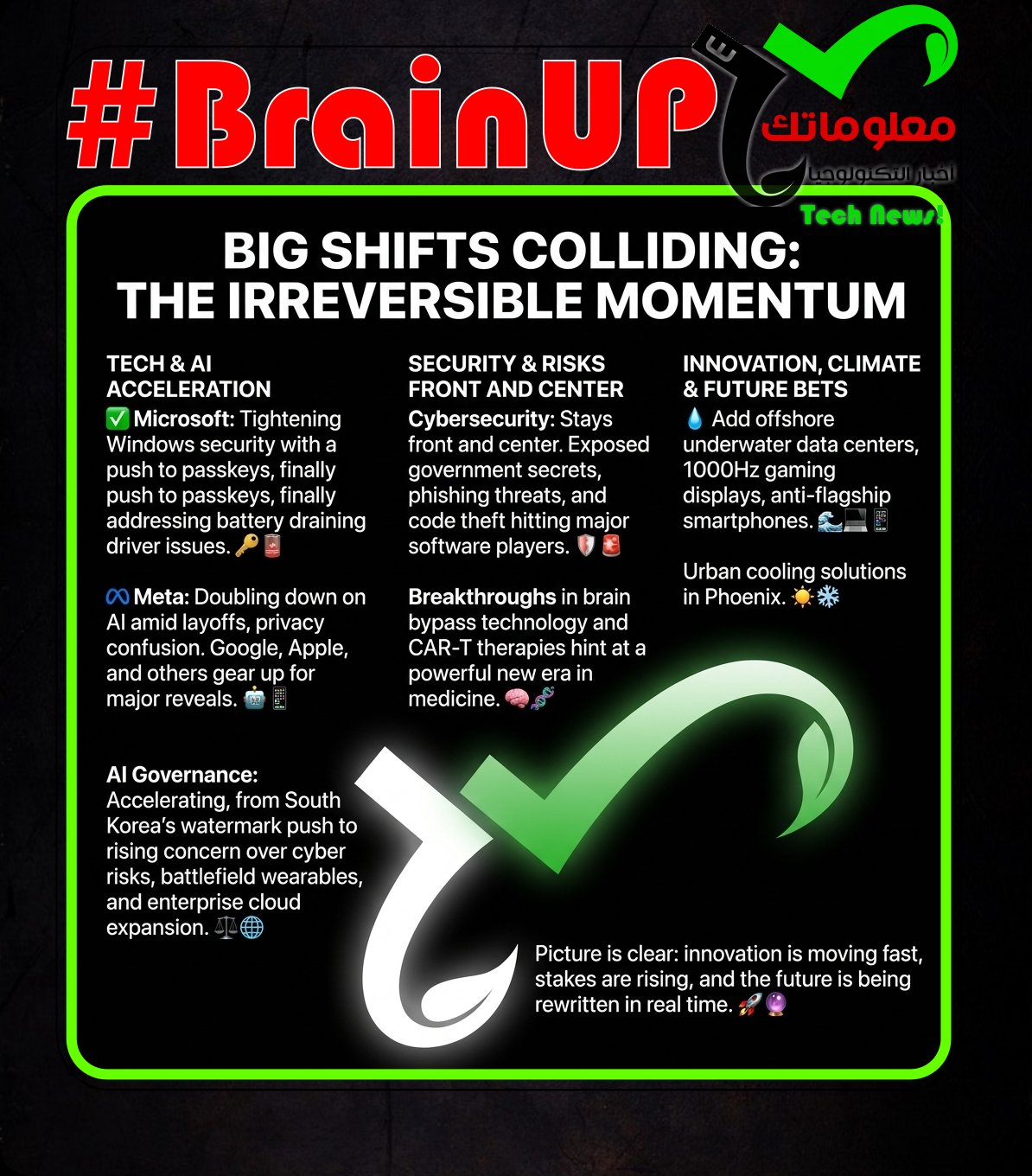
#BrainUp Daily Tech News – (Tuesday, May 19ᵗʰ)
Welcome to today’s curated collection of interesting links and insights for 2026/05/19. Our Hand-picked, AI-optimized system has processed and summarized 26 articles from all over the internet to bring you the latest technology news.
As previously aired🔴LIVE on Clubhouse, Chatter Social, Instagram, Twitch, X, YouTube, and TikTok.
Also available as a #Podcast on Apple 📻, Spotify🛜, Anghami, and Amazon🎧 or anywhere else you listen to podcasts.
1. New study finds community centers can reduce local temperatures by several degrees in Phoenix
Community centers in Phoenix have been found to significantly reduce nearby temperatures by several degrees, helping to alleviate extreme heat. Researchers collected temperature data and observed that shaded areas and green spaces around these centers contributed to cooler local microclimates. The study highlights the importance of strategically placing public facilities with natural cooling features in urban heat islands. This approach presents a practical solution for managing rising temperatures in cities vulnerable to heat waves. It underscores how urban planning integrating #greeninfrastructure and public amenities can improve residents’ thermal comfort and health.
2. Microsoft admits faulty drivers were killing Windows 11 battery life for years
Microsoft says faulty third-party drivers have been quietly hurting battery life and day-to-day performance in #Windows11 and older versions for years because its prior driver checks focused mainly on crashes. At @WinHEC 2026, Microsoft said it will overhaul how it evaluates drivers, adding scrutiny for power use, heat generation, and performance impact, not just system failures reported via #WindowsErrorReporting telemetry. The company notes that a single bad driver could stop a laptop from entering low-power hibernation during standby, leading to unexpected battery drain, alongside issues like high latency, audio glitches, and graphics stutter. Microsoft plans stricter approval and earlier collaboration with driver makers, plus an automatic driver rollback via #WindowsUpdate and blocking of older drivers that fail new quality standards. The goal is to prevent “stable” but problematic drivers from slipping through and degrading everyday Windows experience.
3. Korean bill seeks strict watermark mandate on AI-generated content – The Korea Times
South Korean lawmakers are pushing to tighten the country’s new #AI Basic Law by requiring embedded watermarks on #AI-generated content and criminalizing their removal, aiming to fix what they call a transparency “blind spot.” The bill, introduced by Rep. @Kim Dai-sik and nine other legislators from the opposition People Power Party, would amend the Framework Act on the Development of AI and the Creation of a Foundation for Trust, which currently only requires providers to notify users when highly realistic audio, images, or video are AI-made, without specifying durable placement. Legislators argue that today’s interface-based labels, like small captions or icons, can be lost when content is screenshot, cropped, or repackaged by secondary creators, allowing AI-made material to spread as if human-created or depicting real events. The proposal shifts compliance toward watermarks embedded in the output file itself, described as “codes, letters or symbols,” so the AI-origin notice persists through editing, downloading, and reposting, and is harder to strip. It would also ban anyone from damaging, forging, or altering these marks, with penalties of up to two years in prison or fines up to 20 million won.
4. Ex-Google CEO Eric Schmidt booed after AI remarks at Arizona commencement
@Eric Schmidt, former @Google CEO and now CEO of Relativity Space, was booed by University of Arizona graduates after raising #AI and broader information-technology impacts in a commencement address to as many as 10,000 students. He traced technology’s evolution from laptops to smartphones, the internet and social media, arguing that tools meant to expand knowledge also helped isolate people and degrade the public square through polarization. The jeers intensified when he acknowledged students’ fears that machines are coming, jobs are evaporating, the climate is breaking and politics are fractured, calling those fears rational. Schmidt urged graduates to adapt and to shape how #AI will be used rather than be shaped by it, saying AI will shape the world and the question is whether they will have shaped it. The episode fits a wider pattern of anxious reactions to AI at commencements and aligns with Pew findings that about half of Americans feel more concerned than excited about AI’s growing presence in daily life.
5. Pizza Hut franchisee says delivery drivers gamed its new AI system
A major Pizza Hut franchisee alleges in a Texas Business Court lawsuit that Pizza Hut forced it to adopt the #AI-powered #Dragontail delivery-management platform, which then triggered operational breakdowns, customer dissatisfaction, and more than $100 million in lost business and enterprise value. Chaac Pizza Northeast, which operates about 111 restaurants across several Northeastern states and Washington, DC, says its delivery performance dropped sharply after the 2024 rollout, despite previously delivering over 90% of orders within 30 minutes and posting double-digit sales growth with above-average guest satisfaction. The suit claims that by giving #DoorDash drivers real-time visibility into kitchen workflows and order timing, Dragontail enabled drivers to batch orders, sometimes waiting up to 15 minutes for additional deliveries, increasing the time pizzas sat after leaving the oven before departing the store. It also alleges drivers could see tip amounts and whether an order was cash, affecting which deliveries they accepted. Chaac argues that a system marketed to optimize delivery instead created delays, hurt consumer satisfaction, and cratered sales across more than 100 restaurants.
6. Sony’s Xperia 1 VIII headphone jack honors the ‘Anti-Flagship’ spirit
Sony’s Xperia 1 VIII smartphone retains the 3.5mm headphone jack, supporting high-quality wired audio, which contrasts with many flagship phones dropping this feature. Sony emphasizes this choice to appeal to audiophiles valuing the #AudioJack for superior sound quality and versatility over wireless alternatives. The Xperia 1 VIII integrates advanced audio technology, reinforcing Sony’s commitment to a niche market prioritizing premium audio experiences. By maintaining the headphone jack, Sony aligns with its ‘Anti-Flagship’ approach, focusing on unique value propositions rather than mainstream trends. This strategy highlights Sony’s effort to differentiate its flagship through classic features appreciated by a dedicated user base.
7. CISA Admin Leaked AWS GovCloud Keys on Github – Krebs on Security
A contractor for the Cybersecurity and Infrastructure Security Agency left a public GitHub repository, “Private-CISA,” that exposed highly privileged #AWS GovCloud credentials and numerous internal CISA system secrets, which experts called an unusually severe government leak. @Guillaume Valadon of #GitGuardian reported the repository after the owner did not respond to automated alerts, and said commit history suggested the administrator had disabled GitHub’s default secret blocking and stored items like plaintext passwords, tokens, and backups in the repo. The archive reportedly included files such as “importantAWStokens” with administrative credentials for three AWS GovCloud servers and “AWS-Workspace-Firefox-Passwords.csv” listing plaintext usernames and passwords for dozens of internal systems, including what appeared to be the agency’s “Landing Zone DevSecOps” environment. @Philippe Caturegli of Seralys said he validated the keys still worked at a high privilege level and warned that exposed access to CISA’s internal “artifactory” could enable lateral movement and supply chain-style backdooring of packages used to build and deploy software. CISA acknowledged questions from the publication, but the provided text cuts off before any detailed agency response.
Leaked internal Samsung wage negotiation transcripts described by Reuters show a major bonus gap inside its Device Solutions division, with memory workers offered bonuses of 607% of annual salary, while foundry and System LSI staff were offered 50% to 100%, as the company heads toward what would be its largest strike. In the minutes, negotiator Kim Hyung-ro argued the disparity reflects business performance, saying the loss-making logic chip units would have collapsed without memory profits driven by AI-related #HBM demand, while union chair Choi Seung-ho said paying one group around 500 million won versus 80 million won for others risks a retention crisis. Reuters also cited workers describing shrinking foundry teams at Pyeongtaek and departures to competitors like SK hynix and Micron, aligning with the union’s claim that roughly 200 employees moved to SK hynix over four months. Amid the dispute, Samsung replaced Kim Hyung-ro as chief bargaining representative and @Jay Y. Lee issued a public apology, while the union pushed for a profit-sharing style bonus system similar to SK hynix, including allocating 15% of operating profit to a bonus pool and removing the current 50% cap. The episode underscores how Samsung’s integrated model spanning memory, logic design, and contract manufacturing can create internal compensation strains that complicate its ambition to challenge TSMC in foundry by 2030 alongside planned investment exceeding $116 billion.
9. Poland urges officials to ditch Signal for state-run messaging apps
Poland is urging public sector entities to reduce reliance on #Signal for official communications and move to government managed encrypted platforms after a surge of phishing targeting politicians, government personnel, and military staff. The advisory, signed by Deputy Prime Minister and Minister of Digital Affairs @Krzysztof Gawkowski, warns that #APT groups linked to hostile foreign intelligence services are trying to compromise officials’ Signal accounts, and recommends using nationally operated systems, mSzyfr run by #NASK and SKR-Z for restricted information, both hosted and administered under Polish jurisdiction. Authorities say Signal’s encryption has not been broken, instead attackers exploit account management via social engineering, including fake support messages to steal SMS codes and PINs, and malicious QR codes or links that silently link an attacker device to a victim account. Guidance advises enabling #RegistrationLock, reviewing linked devices, never sharing codes or PINs, avoiding unsolicited QR codes, and hiding phone numbers by using usernames. The government also explicitly warns officials not to use Signal to transmit classified or sensitive information, aligning with a broader European push for #DigitalSovereignty in government communications.
Microsoft is ending SMS codes for personal @Microsoft accounts and phasing out text messages for both #two-factor authentication and account recovery, pushing users toward #passwordless sign-in on #Windows 11. A support document and an official advisory cited by Windows Latest say SMS-based authentication is a leading source of fraud, and Microsoft will mandate alternatives such as #passkeys, authenticator apps, and verified secondary email addresses. The company argues SMS is insecure because messages traverse vulnerable cellular networks and are prone to interception and #SIM-swap attacks that let attackers receive login codes and hijack accounts. It is replacing SMS with phishing-resistant passkeys that rely on device biometrics like #Windows Hello face recognition, fingerprint sensors, or a local device PIN, creating a cryptographic key pair where the private key stays on the hardware and can be device-bound or synced across devices via services like @Apple iCloud Keychain or @Google Password Manager. While presented as a security improvement, the article notes concerns about a forced transition, even as the author describes a smooth experience using @Microsoft Edge, @Microsoft Password Manager, and the @Microsoft Authenticator app.
11. New Brain “Bypass” Technology Could Transform Treatment for Neurological Disorders
Researchers at Duke University School of Medicine led by @Kafui Dzirasa developed #LinCx, a biological “wire” that can create precise, long-lasting electrical connections between selected neurons to route around damaged brain circuitry. Built from fish-derived proteins that form electrical synapses, the proteins were engineered to connect only with matching modified partners, and a fluorescence-based assay helped identify pairs that transmit signals with high specificity while avoiding unintended interactions. In worms and mice, adding these engineered links strengthened communication in targeted circuits, altered brain-wide activity patterns, and produced measurable behavioral changes, including shifts in temperature-seeking in worms and changes related to stress responses and social interaction in mice. The approach aims to edit circuit communication by creating an electrical “bypass” rather than repairing synapses or relying on drugs, external stimulation, or broadly acting tools like optogenetics. The team’s next step is to test whether #LinCx can override synaptic deficits caused by lifelong genetic disruptions, supporting its potential as a strategy for disorders driven by damaged neural circuits.
Chinese media report that China’s claimed “world’s first” offshore wind-powered #underwater data center near Shanghai has entered full commercial operation, aiming to reduce the energy and cooling constraints of modern #AI infrastructure. The $226 million, 24 MW facility in the Lingang Special Area houses nearly 2,000 servers, including GPU clusters from China Telecom and LinkWise, and targets AI processing, big data annotation, and #5G workloads; it was launched in June 2025, completed in October 2025, and followed initial trials in February before reaching full operation last week. Instead of conventional chillers and large HVAC systems, the servers run inside pressure-resistant subsea modules about 35 meters underwater, using surrounding seawater as a passive heat sink, with reported #PUE below 1.15 versus an industry average near 1.5. The site is also connected to nearby offshore wind farms so a substantial portion of electricity demand can be supplied by renewable generation, aligning with China’s push to pair renewables with digital infrastructure. The article notes that subsea designs bring challenges such as saltwater corrosion, pressure sealing, subsea cable reliability, and difficult maintenance, so operators depend on sealed modular hardware, remote monitoring, and redundancy to limit physical intervention.
13. Inside Anduril and Meta’s quest to make smart glasses for warfare
Anduril and #Meta are prototyping augmented-reality smart glasses for the US Army that aim to tightly link soldiers with drones and battlefield data, including a vision of issuing actions like drone strikes through eye tracking, voice, and taps. The company has two efforts: the Army’s #SBMC program, backed by a $159 million prototyping contract for glasses that attach to existing helmets, and a self-funded helmet plus headset called #EagleEye that the military has not requested but Anduril hopes it will ultimately buy. The prototypes would overlay information from simple navigation cues to maps, nearby drone locations, and AI target recognition, while a large language model, tested with @Google’s #Gemini, @Meta’s #Llama, and @Anthropic’s #Claude, translates plain-language requests into executable commands powered by Anduril’s #Lattice software, which the Army has said it plans to integrate broadly in a $20 billion effort. Barnett, an Anduril VP and former Army Special Operations leader, frames the goal as optimizing “the human as a weapons system,” enabling multi-step missions where the system can recommend actions that still require approval through the normal chain of command, though scalable Army testing is not yet ready. With production decisions not expected until 2028 if the Army chooses a system at all, the work faces practical constraints like non-Chinese supply chains and the challenge of avoiding information overload by showing only the right data at the right time.
14. It’s reckoning week for Meta employees in layoff limbo
Meta employees have spent weeks in limbo after an internal memo said the company would cut about 10% of its roughly 78,000-person workforce and about 6,000 open roles, with the reductions expected around May 20. Workers told Business Insider they feel stuck in a “holding pattern,” unsure how decisions are being made, with some even hoping to be laid off so they can take severance while pursuing other job offers, while others are extremely anxious. A former employee, Adel Wu, echoed that mood on X, and another employee noted large empty boxes appearing at Menlo Park offices, which they interpreted as an ominous sign. Meta said the cuts are meant to help it run more efficiently and offset investments, as it ramps spending on #AI, including projecting 2026 capex of $115 billion to $135 billion and paying about $15 billion for a 49% stake in Scale AI, bringing @Alexandr Wang in to lead its Superintelligence Lab. The situation underscores how #layoffs alongside rising #AI investment are reshaping day-to-day morale and expectations inside Meta ahead of the announced cut date.
15. Meta Lays Out Plans for May 20 Layoffs and Restructuring, Internal Document Says
Meta is preparing to implement layoffs and restructuring on May 20 as part of a broader effort to reduce costs and refocus the company amid challenging economic conditions. An internal document revealed plans to cut jobs and reorganize teams to enhance efficiency and align with new priorities. These changes reflect Meta’s response to the evolving digital landscape, where increased competition and shifting user behaviors demand strategic adjustments. The move also highlights ongoing efforts by CEO @MarkZuckerberg to streamline operations and prioritize investments in areas like artificial intelligence and the metaverse. Overall, Meta aims to position itself for sustainable growth while managing financial pressures through this operational restructuring.
16. 16. Meta Reassigns 7,000 Employees Into AI Roles Ahead of Broader Workforce Cuts
@Mark Zuckerberg’s #Meta is reportedly shifting around 7,000 employees into AI-focused positions while simultaneously preparing for another round of layoffs, highlighting how aggressively the company is restructuring around #ArtificialIntelligence. According to the report, Meta is prioritizing internal redeployment into areas such as generative AI products, infrastructure, recommendation systems, and automation while reducing teams considered less critical to its AI-first future. The move reflects a broader Silicon Valley trend where companies are not only cutting jobs, but also redefining employee value around AI fluency and productivity metrics. Workers inside Meta reportedly describe growing uncertainty, morale issues, and pressure to adapt quickly as the company accelerates its transformation into an AI-centric organization. The restructuring also signals that major tech firms increasingly see AI not merely as a product category, but as the operating foundation for future hiring, budgets, and organizational survival.
@Mozilla urges the UK Department for Science, Innovation and Technology not to #age-gate #VPNs as part of measures linked to the UK #OnlineSafetyAct, arguing that restricting privacy tools will not effectively protect young people and will undermine fundamental rights for all users. The article explains that VPNs protect privacy and security by hiding IP addresses, helping protect location, reducing tracking, and avoiding IP based profiling, and are used for remote access to school or work networks, avoiding censorship, and improving personal privacy and security. It stresses that vulnerable groups such as activists, dissidents, and journalists rely on VPN access, and that young people are particularly exposed to tracking, targeted advertising, and harmful data collection without adequate consent or transparency. Mozilla argues that limiting young people’s access to privacy protecting technologies conflicts with the goal of preparing them to navigate the internet safely, and that young people should instead be introduced to best practices and safety and privacy tools. It recommends focusing on root causes by holding platforms accountable, encouraging responsible use of parental controls, and investing in digital skills and a whole of society approach to digital wellbeing, and links to its full submission to the department.
18. Jury Rejects Elon Musk’s Lawsuit Against OpenAI and @Sam Altman
A jury rejected the legal challenge brought by @Elon Musk against OpenAI and CEO Sam Altman, marking a major turning point in the escalating conflict between former allies in the #AI industry. The lawsuit centered on Musk’s claims that OpenAI abandoned its original nonprofit mission and shifted toward a commercially driven strategy that allegedly contradicted its founding principles. OpenAI argued that the company’s evolution, partnerships, and capped-profit structure were necessary to compete in the rapidly accelerating #GenerativeAI race against firms like Google, Anthropic, and Meta. The verdict is seen as a significant legal and symbolic win for OpenAI and Altman, especially as the company expands enterprise adoption, infrastructure investments, and global AI influence. The case also intensified broader debates around AI governance, nonprofit ethics, corporate control, and whether advanced AI labs can realistically remain mission-driven while competing in a trillion-dollar technological arms race.
19. A revolutionary cancer treatment could transform autoimmune disease
Researchers are testing #CAR_T_cell_therapy, originally built for cancer, as a way to “reset” the immune system in autoimmune diseases such as multiple sclerosis, lupus, Graves’ disease, and vasculitis. The article follows Jan Janisch-Hanzlik, a 49-year-old with worsening multiple sclerosis despite standard medications, who enrolled as the first patient in a University of Nebraska Medical Center trial and received the experimental treatment on June 9, 2025, while being monitored for dangerous side effects like inflammation. The approach draws on the cancer success of #CAR_T, first approved by the FDA in 2017 for an aggressive leukemia, by engineering a patient’s own T cells with a chimeric antigen receptor so they can seek and destroy targeted immune cells. In many current applications, the engineered T cells are designed to attack B cells, which can drive certain blood cancers and are implicated in autoimmune activity, with the hope that eliminating these self-reactive components can restore defenses to a pre-disease state. The promise is substantial but the article notes major uncertainties about effectiveness in autoimmunity, how long benefits might last, and potential long-term side effects, underscoring both the urgency felt by patients like Janisch-Hanzlik and the risks inherent in translating a potent cancer technology to chronic immune disorders.
Grafana Labs says it was hacked and refused to pay an extortion demand tied to a threat to publish its codebase. The company said attackers abused a stolen token credential to access its GitHub environment used to store source code, but the token did not provide access to customer records or financial data, and Grafana has since invalidated the token and added security measures. Because Grafana’s software is #open source and publicly available, the company said it is unclear whether any proprietary code or information was taken, even though the attacker attempted to blackmail it. Grafana contrasted its response with Instructure’s recent decision to pay after a separate incident and cited the FBI’s guidance that paying hackers does not ensure data will be returned or withheld, while also funding future attacks. Grafana said its investigation is ongoing and it will share findings when the probe concludes.
21. Meta’s confusing new approach to chat privacy
@Meta is sending mixed signals on chat privacy by adding “truly private” disappearing #MetaAI chats to #WhatsApp while removing optional #end-to-end encryption from #Instagram DMs. WhatsApp is promoting an Incognito Chat mode built on #PrivateProcessing, claiming chats are text-only for now, sandboxed, not saved, and separate from regular E2EE person-to-person messaging, with a planned “Side Chat” feature to invoke AI inside other chats without breaking encryption. In contrast, Instagram ended support for end-to-end encrypted DMs on May 8, 2026, telling prior users to back up conversations and citing low usage and maintenance complexity, which critics say is circular because the feature was hidden and not enabled by default. The result is that “private” and “incognito” are marketing terms, while E2EE is a technical guarantee, so users should not treat all Meta chat products the same. The article concludes that WhatsApp still offers E2EE for user-to-user chats plus AI privacy features, but Instagram DMs should now be assumed readable by Meta and potentially accessible to law enforcement, advertisers, or attackers with access to Meta’s systems.
22. New Windows laptops with Intel’s latest chips take aim at the MacBook Neo
New budget Windows laptops from Honor, ASUS, and HP using #Intel Wildcat Lake are positioned as direct competitors to Apple’s MacBook Neo at roughly similar prices, while offering higher base specs. Listings spotted by VideoCardz at Chinese retailers show the Honor Notebook X14, ASUS Fearless 14SE, and HP OmniBook 350 all powered by Intel Core 5 320 and configured with 16GB RAM and 512GB storage, double the base MacBook Neo, and more RAM than any MacBook Neo option. Intel describes the Core 5 320 as a 6-core, 6-thread chip with two performance cores and four low power efficient cores, and PassMark results cited in the article put it near @Apple’s A18 Pro in single-core performance while ahead in multi-core. The piece argues that while the MacBook Neo brought macOS into a new sub-$600 band, Windows has long dominated budget PCs, and these OEM models suggest Windows laptops can counter a low-cost Mac by matching price while competing on specs. The author notes debate within Windows Central about whether Microsoft should worry, but frames these new OEM devices as evidence that the Windows ecosystem can fill the budget gap even if Microsoft hardware does not.
23. LG UltraGear 24.5″ world’s first native 1000Hz FHD gaming monitor unveiled
LG Electronics unveiled the UltraGear 25G590B, positioned as the industry’s first commercially available gaming monitor with a native 1000Hz refresh rate at #FullHD 1080p, built for competitive gaming and #FPS play. It delivers 1000Hz in FHD by default rather than relying on dual-mode compromises, and includes Motion Blur Reduction Pro to sharpen fast motion for easier target tracking. The 24.5-inch size targets eSports norms, paired with an #IPS panel with low-reflection film, a compact ergonomic stand with calibration indicators, plus a headset hook and customizable UltraGear Emblem ambient lighting. It also adds on-device #AI features such as AI Scene Optimization for automatic picture tuning by genre and AI Sound for spatial audio and clearer voice chat with a compatible headset. Overall, the monitor combines extreme refresh rate performance, tournament-friendly ergonomics, and automated tuning to serve the competitive eSports market.
24. Apple’s officially sets WWDC 2026 schedule
@Apple has officially set the schedule for WWDC 2026, its annual software showcase where it typically previews updates to iOS, macOS, iPadOS, and more. The public keynote livestream is set for June 8 at 10 a.m. PT, with additional developer-focused sessions in the following days, and viewers can watch via the Apple TV app or @YouTube. The media invite graphic features a dove-like logo and the phrase “Coming bright up,” which the article notes could mean many things but invites speculation. Citing prior reporting tied to @Bloomberg’s @Mark Gurman and ongoing expectations, the piece suggests WWDC 2026 may include a long-awaited update on #Siri’s #AI transformation and broader discussion of #AI and #AppleIntelligence. Overall, the announced timing and teaser imagery frame WWDC 2026 as a likely major moment for @Apple’s software roadmap and its AI messaging.
Google I/O returns as Google’s annual developer event and product showcase, focused on updates to #Android, #Search, and its #Gemini AI efforts, plus a preview of #AndroidXR smart glasses. The main keynote, hosted by @Sundar Pichai at Shoreline Amphitheatre in Mountain View, starts Tuesday, May 19 at 10 am Pacific, and can be watched on Google’s website or YouTube, with coverage also embedded on the article page. Google has already previewed Android 17 features and what it calls #GeminiIntelligence, including AI-driven task help, improved voice-to-text, autofill upgrades, digital well-being changes, a refreshed Android Auto, and more 3D-looking emojis, while also announcing an AI-first “Googlebook” laptop platform distinct from Chromebooks with partners like Acer, HP, Lenovo, and Dell. The keynote is expected to leave room for additional software announcements and demos, with rumors pointing to more AI-powered Search updates, possible #GoogleLabs news like the Flow music tool, and a potential video-generation Gemini model called Omni. The event may also revisit last year’s promised Gemini-powered Google Home smart speaker timeline and provide more details on 2026 #AndroidXR smart glasses, and WIRED will follow the keynote via a liveblog.
26. Google and Blackstone to Create New AI Cloud Company
Google Cloud and private-equity giant Blackstone plan to form a new company focused on #AI cloud services. This joint venture will leverage Google’s AI technology and Blackstone’s investment acumen to accelerate the adoption of AI tools across various industries. The collaboration aims to capitalize on the growing demand for scalable, secure AI infrastructure by combining Google’s expertise in cloud computing with Blackstone’s deep capital resources. By creating this new entity, both companies intend to enhance AI accessibility and innovation, ultimately impacting businesses worldwide. This partnership signifies a strategic move to expand the cloud and AI market presence of both firms.
27. Global Finance Leaders Demand Briefing on Anthropic’s Mythos AI Cyber Threats
Global finance leaders have requested a detailed briefing on potential cyber threats posed by Anthropic’s Mythos AI as concerns grow around AI-driven vulnerabilities in financial systems. Discussions highlight the increasing risks associated with advanced AI models, particularly in how Mythos AI could be exploited for sophisticated cyberattacks against critical financial infrastructure. Analysts emphasize the need for enhanced security protocols and collaborative intelligence sharing to counter these emerging threats effectively. The finance sector is urged to adopt proactive measures and regulatory frameworks to mitigate risks while leveraging AI innovations safely. This demand underscores growing awareness and preparedness in safeguarding financial ecosystems amid rapid AI advancements.
That’s all for today’s digest for 2026/05/19! We picked, and processed 27 Articles. Stay tuned for tomorrow’s collection of insights and discoveries.
Thanks, Patricia Zougheib and Dr Badawi, for curating the links
See you in the next one! 🚀
