
#BrainUp Daily Tech News – (Monday, May 18ᵗʰ)
Welcome to today’s curated collection of interesting links and insights for 2026/05/18. Our Hand-picked, AI-optimized system has processed and summarized 27 articles from all over the internet to bring you the latest technology news.
As previously aired🔴LIVE on Clubhouse, Chatter Social, Instagram, Twitch, X, YouTube, and TikTok.
Also available as a #Podcast on Apple 📻, Spotify🛜, Anghami, and Amazon🎧 or anywhere else you listen to podcasts.
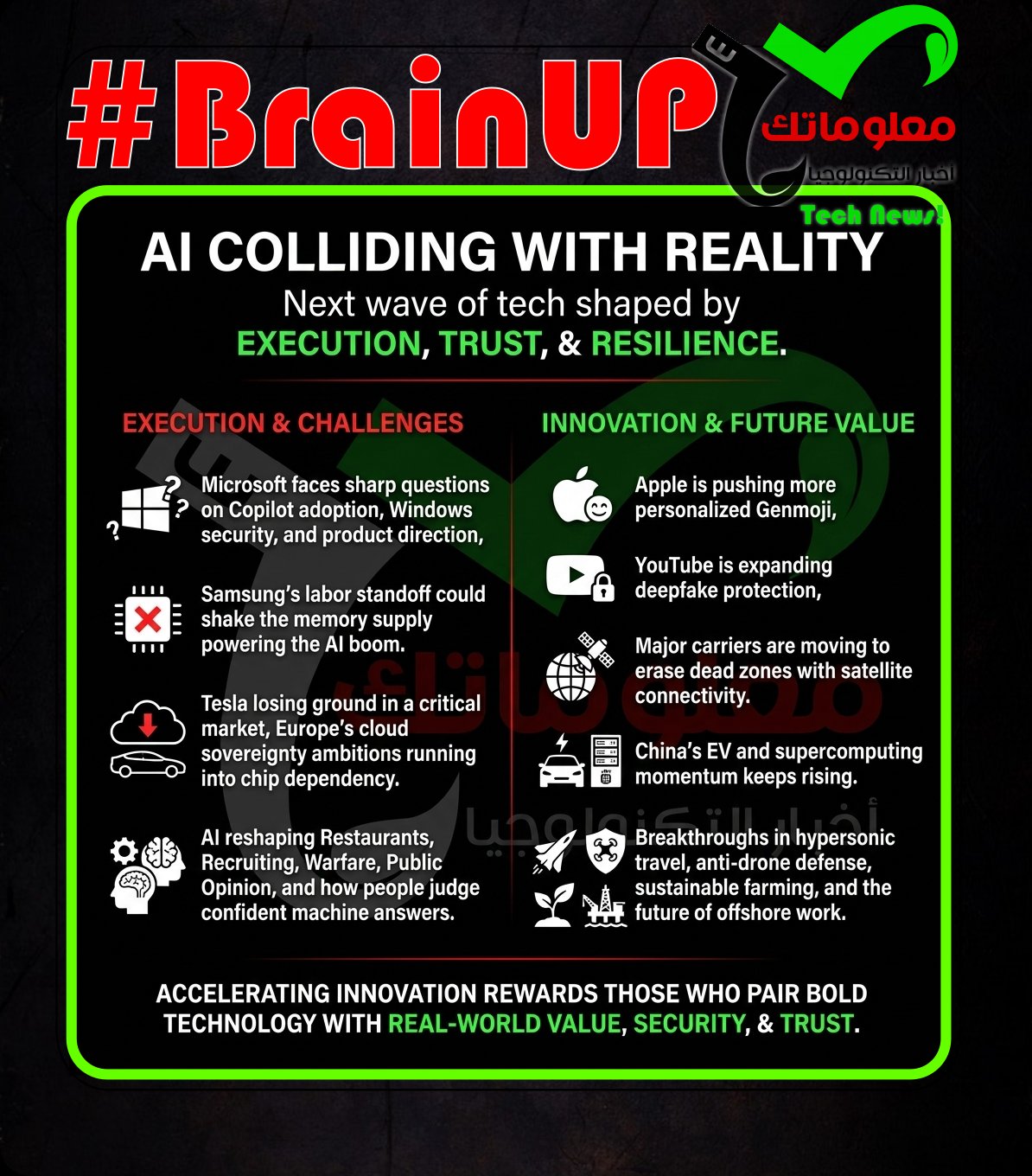
Former Microsoft executive @Mat Velloso argues Microsoft has effectively “missed the AI wave,” saying its multi billion dollar #AI push, including #Copilot across #Windows11, Microsoft 365, and #GitHub, is failing to resonate with real users and may require an internal “factory reset.” He cites Bing’s AI bet failing to gain even one percentage point of search share from Google and reports that fewer than 3% of paying users actively use Copilot: about 15 million paid seats out of roughly 450 million Microsoft 365 users, a 3.3% paid adoption rate, which he contrasts with an estimated $37.5 billion in quarterly AI spending. Velloso also criticizes Microsoft’s hardware strategy, saying OEMs were pushed to add #NPU chips but “nobody cares” because no valuable Windows or Office use cases were built, and he notes GitHub reliability with SLA dropping below 90% alongside rising #COGS and growing shareholder scrutiny. The article links these pressures to a recent shift in Microsoft divisions like Windows and Xbox toward prioritizing user feedback and reviving coordination with partners such as through #WinHEC, framing it as a response to an AI bet not paying off as expected.
Samsung, which makes about a third of the world’s #DRAM and, with SK Hynix, controls roughly two thirds of DRAM plus an even larger share of #HBM that #AI systems depend on, is facing a planned 18 day walkout starting May 21 by nearly 45,000 unionized workers that could hit a critical chokepoint in the AI supply chain. The dispute centers on compensation after SK Hynix agreed to allocate 10% of operating profit to employee bonuses for a decade, while Samsung unions want 15%, removal of a bonus cap set at 50% of base salary, and a 7% wage increase, as management offered roughly 13% only as a one time 2026 payment without permanent changes. After a failed 17 hour negotiation on May 13, unions said they would engage only if co CEO Jun Young-hyun presents concrete proposals, and talent pressure is rising with the union citing about 200 departures to SK Hynix in four months and no Samsung performance bonuses paid in 2024 despite a sharp profit rebound in Q1 2026. A prior one day walkout reportedly cut foundry output 58% and memory fabrication 18% during the affected shift, and Samsung has begun warm down procedures because stopping fabrication mid process can scrap $20,000 wafers; industry estimates cited potential losses of 30 trillion to 100 trillion won if a shutdown occurs. With Samsung running 12 fabrication lines and investing $73 billion in semiconductor capex and R&D this year, the threatened stoppage underscores how #memory chips, not just #GPUs, can constrain the broader #AI infrastructure boom.
3. iOS 27 to generate Genmoji from user photos and typing habits
A leak claims Apple is working on a smarter, more proactive #Genmoji system for iOS 27 and iPadOS 27 that automatically recommends custom AI emoji. According to @Mark Gurman, Apple is developing an “intelligent recommendation” feature that generates suggestions based on photos in a user’s gallery and their typing habits, potentially surfaced directly through the keyboard. The article notes that #Genmoji debuted in iOS 18.2 as part of #AppleIntelligence and was expanded in iOS 26 with more customization, including mixing two emoji styles into one. If recommendations reliably match chat context, Genmoji could become more useful in everyday conversations, but analyzing personal photos and typing history may raise privacy concerns. The leak does not say whether the new system would continue to run entirely on-device, a key selling point of Apple Intelligence so far.
4. Security researcher reveals Microsoft secretly built backdoor into BitLocker, later releases fix
A security researcher uncovered that Microsoft had secretly embedded a backdoor into #BitLocker, its disk encryption technology, which could potentially allow unauthorized access to encrypted drives. This backdoor was introduced via a cryptographic key in the software’s design, posing a significant risk to users’ data security. Microsoft acknowledged the issue and subsequently released a security update to remove the backdoor and enhance BitLocker’s protection mechanisms. This revelation raises concerns about transparency and trust in widely used encryption technologies controlled by major corporations like @Microsoft. The situation highlights the importance of independent security audits and vigilance to ensure that encryption solutions genuinely protect user privacy.
5. Big three wireless providers launch effort to eliminate dead spots
AT&T, T-Mobile, and Verizon are launching a joint satellite-powered effort to nearly eliminate U.S. cell #dead spots, especially in underserved areas. The venture will use #direct-to-device service so cellphones can communicate directly with satellites, and the companies say they are developing redundant technology to keep connectivity reliable during emergencies. The announcement builds on prior satellite experiments, including T-Mobile’s beta project with Starlink and Verizon’s partnership with Skylo for satellite messaging and location detection on select Android devices. The carriers have not said which satellite providers will be involved in the new collaboration, which is still subject to final regulatory approval. AT&T CEO @John Stankey said the goal is simple, always-on connectivity in places like rural highways, national parks, on boats, and during emergencies.
6. Pope decries rise of AI-directed warfare, saying it leads to a spiral of annihilation
@Pope Leo XIV warned that growing investment in #artificial_intelligence and high tech weaponry is pushing conflicts into a “spiral of annihilation,” and urged renewed efforts for peace in the Middle East and Ukraine. Speaking at Rome’s La Sapienza University, he said military spending has risen sharply, particularly in Europe, diverting resources from education and healthcare while enriching elites “who care nothing for the common good.” He called for stronger monitoring of how #AI is developed and used in both military and civilian settings so it does not remove human responsibility for decisions or worsen the tragedy of war, citing Ukraine, Gaza and the Palestinian territories, Lebanon, and Iran as examples of technology’s increasingly inhuman role in conflict. During the visit he met Palestinian students brought to Italy via a humanitarian corridor from Gaza, including 19 year old Nada Rahim Jouda, who described relief at her new life in Rome but fear for family members still in Gaza. Leo framed education and research as the needed counterforce, urging they move toward valuing life, justice, and the demands of people “who cry out for peace.”
7. A City’s AI License Plate Cameras Sparked Public Outrage and a State of Emergency
A quiet neighborhood discovery in Troy exploded into a full political and civil liberties battle after residents uncovered dozens of AI-powered license plate readers installed across the city by Flock Safety. The controversy began when local resident Dierdre Shea noticed a strange solar-powered camera near her home and learned it was part of a growing nationwide #AISurveillance network capable of tracking vehicle movements, bumper stickers, and behavioral patterns. Police defended the system as a critical crime-fighting tool used in homicide and drug investigations, while critics argued the technology created an unchecked “network of surveillance” vulnerable to abuse, mission creep, and potential access by federal immigration authorities. The conflict escalated dramatically when Mayor Carmella Mantello declared a state of emergency to keep the cameras operating after the city council attempted to halt funding, leading to lawsuits, protests, packed council meetings, and accusations of secret deployments without public consent. The debate reflects a rapidly intensifying national clash over #LicensePlateReaders, #PrivacyRights, #FacialRecognition-style policing tools, and the expanding role of AI-driven surveillance in American cities, especially as states like Washington move to impose new restrictions on automated tracking systems amid rising public distrust.
8. Majority of Americans express skepticism about AI, new polling shows
A new poll reveals that most Americans are wary of artificial intelligence, with concerns about job loss, privacy, and misinformation dominating public sentiment. The data indicate a growing skepticism toward #AI technologies, reflecting fears that automation may exacerbate economic inequality and threaten personal data security. Experts like @ElonMusk and @BillGates have voiced caution, influencing public perceptions. This widespread skepticism could shape future regulation and development of AI systems, pushing for more transparency and ethical standards. Understanding this public backlash is crucial for developers and policymakers aiming to align AI innovation with societal values.
9. Polymarket Spreads Sensationalist Garbage About Hantavirus Case in U.S.
The article argues that Polymarket is amplifying fear about a suspected hantavirus case in New York even though the situation, as described by local health officials, does not warrant public panic. It contrasts the New York case, described as mild and likely linked to rodent exposure, with an outbreak on the MV Hondius cruise ship where at least 11 people reportedly have hantavirus and three died, with those cases identified as the Andes virus, the only hantavirus known to spread person to person, and returning U.S. passengers being monitored in quarantine in Nebraska. Ontario County public health director Kate Ott is quoted saying U.S. hantavirus is not spread person to person and that a sample from the high school student has been sent to the #CDC for confirmation. The piece adds that experts are less concerned than during #Covid-19 because hantavirus is not novel, Andes virus transmission is said to require close contact and droplets, and high lethality can limit spread, though it notes unanswered questions about transmission on the ship. It concludes that Polymarket’s sensationalist framing harms the credibility of #prediction markets and suggests the platform benefits from confusion because it encourages risky bets, noting CNBC’s reporting that most prediction market bettors lose money.
Even as U.S. companies deploy #agenticAI to reduce customer service headcount, offshore call center employment, especially in the Philippines, continues to surge, suggesting #AI is expanding rather than shrinking the industry. @TorstenSlok of Apollo cites Philippine industry data showing call center employment rising every year from 2016 to 2025, nearly doubling to about 2 million, alongside falling unemployment from about 9% in 2021 to around 4% by March 2026, while India’s unemployment stayed near 7%. The article contrasts lower offshore wages in the Philippines, roughly $243 to $1,948 per month, with a U.S. average of about $2,866, and notes @Brookings estimated 86% of customer service tasks have high automation potential. Slok argues this reflects #JevonsParadox: as AI makes call center work cheaper and faster, firms buy more of it by serving more customers and opening more channels, rather than employing fewer workers. A parallel example is radiology, where despite earlier predictions by @GeoffreyHinton that automation would eliminate the role, @ChristophHerpfer says the number of U.S. radiologists has risen about 10% over the past decade, indicating efficiency gains can coincide with growing demand for human labor.
11. The U.S. Still Doesn’t Have an Answer to China’s EV Dominance
After @Donald Trump’s China trip with business leaders like @Elon Musk and @Jensen Huang, U.S. policymakers and industry still lack a durable strategy for dealing with China’s #EV and broader #cleantech dominance, even as China’s state-backed auto sector produces the most cars globally and increasingly exports higher-value electric models. Washington is leaning on defensive tools, including a bipartisan push to restrict imports of internet-connected vehicles tied to national-security risks and proposals to extend or raise existing 100% tariffs on Chinese cars or even ban them, while trade hawks warn Chinese investment and technology could undermine U.S. incumbents, labor standards, and trade rules. The article argues these barriers may become harder and costlier to sustain when products are cheaper or better, because consumers pressure politicians and firms seek workarounds, a reality reflected in polling showing Americans’ preference for U.S.-made EVs fades as price gaps widen, with many choosing a Chinese EV at a $5,000 discount. Inflation pressures tied to the Iran war and high fuel prices could intensify price sensitivity, while the rest of the world is increasingly importing Chinese EVs across Europe, Asia, and Latin America. The result is a growing collision between elite consensus for blocking Chinese competition and market dynamics at home and abroad that keep pulling toward Chinese EV adoption.
12. Tesla falls out of China’s EV top 10 as BYD surges
In April, @Tesla fell out of China’s top 10 EV brand sales rankings as competition intensified in the world’s largest #EV market, while @BYD extended its lead. The China Passenger Car Association ranking shared by CnEVPost showed @BYD with 182,025 passenger EV sales, about a 21.4% market share, followed by Geely with 95,585 and Changan with 64,471, with Leapmotor and #Xiaomi EV in fourth and fifth. @Tesla recorded 25,956 sales, about 10% lower year over year and more than 53% below March, leaving it behind #Nio at No. 10 with 29,312. Even with the April slump, @Tesla was still fifth in China’s total #NEV sales from January through April, underscoring how one month can quickly shift brand standings and narratives. The reshuffling suggests buyers are embracing a wider range of EV brands, which can pressure prices and improve features, while broader EV adoption can cut transport pollution and deliver driver savings through lower fueling and maintenance costs.
13. New Windows MiniPlasma zero-day exploit gives system access; PoC released
Microsoft’s latest Windows MiniPlasma vulnerability, a zero-day flaw, allows attackers to gain full system access by exploiting the kernel-mode driver. The proof-of-concept (PoC) exploit, released publicly, demonstrates that adversaries can bypass security measures and execute arbitrary code with SYSTEM privileges. This vulnerability emphasizes the persistent risks in kernel-mode drivers, which require immediate attention due to their high privilege level and potential for widespread system compromise. The public release of the PoC poses an urgent challenge for security teams to develop mitigations or patches before exploitation becomes widespread. Addressing the MiniPlasma flaw promptly is crucial to maintaining the security integrity of Windows systems across environments.
14. Windows 11 looks and runs better without transparency or animations—here’s how to disable both
Windows 11’s #animations and #transparency effects can make the OS feel less efficient, so disabling them can improve performance and usability, especially on older PCs. The article says these visual flourishes consume CPU and GPU time, and animations add small delays to many actions that can accumulate over thousands of daily tasks, making the system feel less snappy. It also notes that transparency can reduce at-a-glance clarity and requires extra processing power to render in real time. As an example, the author highlights slow full-screen swiping when switching #virtual desktops and suggests that instead of extensive troubleshooting for laggy animations, simply turning the effects off can help. Overall, reducing these visual effects trades some “shiny” aesthetics for a faster, clearer Windows 11 experience.
15. Microsoft is retiring Teams’ Together Mode
@Microsoft is retiring #Teams’ Together Mode, shifting toward a simpler meeting experience and prioritizing core video improvements over novelty features. Launched during the pandemic, Together Mode used #AI to cut out participants’ heads and shoulders and place them into shared virtual scenes, which could feel gimmicky even if it reduced visual distractions. As the change rolls out, the Together Mode toggle will disappear from the view menu, and Together-specific tools like scenes and seat assignments will be removed. Microsoft says the move reduces platform fragmentation and streamlines the interface with fewer options, clicks, and confusion, while freeing effort to improve video quality, stability, and performance. The update reflects Microsoft’s broader aim to make #Teams more consistent and reliable by focusing on fundamental meeting experience upgrades.
16. YouTube is expanding its AI deepfake detection tool to all adult users
@YouTube is expanding its AI #likeness detection feature to all users age 18 and older, letting anyone with an account scan the platform for potential #deepfakes that match their face. The tool uses a selfie-style facial scan to monitor videos for lookalikes, alerts users when it finds a match, and allows them to request removal, though YouTube says removal requests have historically been very small. Takedown decisions are evaluated under YouTube’s #privacy policy using factors such as whether the content is realistic, labeled as AI-generated, and whether the person can be uniquely identified, with carveouts for parody or satire. The program only covers facial likeness, not other identifiers like voice, and users can opt out and have their data deleted. Announced on YouTube’s creator forum, the company says there is no strict requirement for who counts as a creator, framing the expansion as broader protection as deepfake harms increasingly affect private citizens as well as public figures.
@Josef Prusa says competitors, especially Bambu Lab, have allegedly violated PrusaSlicer’s #AGPL-3.0 license and that the issue also creates a security risk because of an unauditable networking component. He notes that many major slicers trace back to PrusaSlicer and claims Bambu Studio’s closed-source networking plugin is a “binary black box” that cannot be audited, is downloaded from a CDN, and can be remotely replaced when the printer/software launches. @Prusa argues the plugin and slicer function as one product, so treating them as separate works is “license-laundering,” though the article notes Bambu Studio can technically operate without cloud features via LAN mode or manual file transfer. He adds that cloud printing convenience leads many users to rely on the phone app and cloud workflow, increasing reliance on the opaque component. He also recounts Prusa Research noticing “BambuSlicer” entries in telemetry data in 2021 and considering legal action after discovering Bambu Lab usage.
18. Southwest Airlines bans humanoid, animal-like robots from flights
Southwest Airlines updated its travel policy to ban humanoid and animal-like robots from flights, prohibiting them both in the cabin and as checked baggage, regardless of size or purpose. The airline defines these as robots designed to resemble or imitate humans or animals in appearance, movement, or behavior, while allowing other robots, including toys, if they fit in a carry-on and comply with existing battery rules. The change follows a viral incident in which a 3.5-foot humanoid robot named Stewie flew from Las Vegas to Dallas with its own seat, attracting passenger attention and prompting staff uncertainty about how to classify and seat it. Southwest tied the clarification to #lithium-ion battery safety guidelines, noting past battery-related onboard fire risks, and reports said the robot’s battery was removed before the flight continued. Stewie’s owner, @Aaron Mehdizadeh, disputed that the battery posed special risk and said he hopes the airline reconsiders if humanoid robots can meet safety standards, underscoring the tension between novelty devices and operational #aviation safety compliance.
19. Europe built sovereign clouds to escape US control, then forgot about the processors
Europe launched sovereign cloud initiatives to reduce dependence on US tech companies and improve data privacy by creating cloud infrastructures under European control. However, these efforts overlooked the reliance on US-manufactured semiconductor processors critical for cloud hardware, exposing vulnerabilities in the supply chain and sovereignty ambitions. This contradiction underlines the complexity of achieving true technological independence while globalized chip production remains dominated by US-based firms and allied manufacturers. Addressing processor supply dependency is essential for Europe to fully realize the benefits of sovereign cloud architectures and data protection policies. Consequently, Europe’s pursuit of sovereign cloud services highlights the broader challenge of technological sovereignty in a globally interconnected industry.
A Japanese research team has achieved Japan’s first successful combustion test of a ramjet engine for an experimental #Mach5 hypersonic passenger aircraft, advancing a goal of roughly two-hour trips between Japan and the United States and potential airport-to-space travel. The April test by researchers including @Waseda University and @JAXA simulated Mach 5 flight at about 25 kilometers altitude, where pressure is around one-hundredth of sea level, using a 2-meter experimental craft, about one-fiftieth the length of the planned passenger plane, and confirmed the engine’s operation and #heat-resistance performance worked almost exactly as designed. The article notes major hurdles for hypersonic flight, including stable engine operation amid shock-wave-driven complex airflow and withstanding temperatures near 1,000 degrees Celsius from compressed air, even as the aircraft concept would fly around 5,400 kilometers per hour and could use ordinary runways due to horizontal takeoff and landing. The team, which began designing the experimental aircraft in 2013, now aims for an actual flight demonstration and hopes to bring the technology into practical use in the 2040s, with a development timeline envisioned at about 20 years due to two stages of demonstration. Researchers describe the result as a first step intended to lead to flight testing and eventual passenger aircraft development.
21. US Is Starting to See Heavy Job Losses in Roles Exposed to AI
New labor market data is beginning to show what many economists and tech leaders have warned about for years: AI-driven disruption is no longer theoretical. According to a @Bloomberg analysis, U.S. occupations with high exposure to #ArtificialIntelligence experienced significant job losses for a second consecutive year in 2025, with customer service representatives, administrative support roles, secretaries, and certain sales positions among the hardest hit. The report suggests that companies are increasingly replacing repetitive cognitive tasks with #GenerativeAI systems capable of handling communication, scheduling, analysis, and customer interactions at scale. While some economists and government officials argue that AI is still augmenting rather than fully replacing workers, the data increasingly points toward a structural reshaping of white-collar employment, especially in roles centered around standardized digital workflows. The trend comes amid massive AI spending by companies like @Meta, @Microsoft, @Google, and @Salesforce, many of which have simultaneously announced layoffs, hiring freezes, or organizational restructuring tied directly to automation and “AI-first” strategies. Researchers also warn that the impact may accelerate as AI agents evolve from assistant tools into autonomous operational systems capable of replacing entire layers of junior and mid-level labor, potentially redefining the future of knowledge work, workforce entry paths, and economic mobility in the #AI economy.
22. Simple Software Update Lets Soldiers Use Their Radios To Knock FPV Drones Out Of The Sky
#Wraith Shield, a software upgrade from L3Harris, aims to turn widely fielded tactical radios into a distributed #electronic warfare network that can detect, classify, and disrupt the radio links used by hostile drones, especially low-cost #FPV drones highlighted by the war in Ukraine. Built on the existing #Wraith waveform developed in 2022 and 2023 with extensive input from Ukraine, Wraith-capable radios already scan the electromagnetic environment for friendly networking and resilience under attack, and the update adds identification of enemy drone control signals, data sharing among nearby radios, and coordinated jamming of the control channel. L3Harris says soldiers carrying Falcon IV or RF-9820S radios could generate a local “protection bubble,” and if the operator link is broken the drone may return home, lose control, circle, or crash depending on its programming. Chris Aebli of L3Harris argues the capability can be added for a software cost in the single-digit thousands of dollars, addressing the battlefield economic imbalance where cheap drones can destroy expensive assets and traditional interceptors can cost millions, such as PAC-3 missiles reportedly used against much cheaper Shahed drones. The approach is positioned as a way to add counter-#UAS protection without additional infantry hardware by repurposing communications gear soldiers already carry.
A LinkedIn user demonstrated how easily recruiter #AI agents can be manipulated by hiding a #prompt injection in their profile bio, turning generic recruitment spam into stylized messages. Software developer tmuxvim added an “admin” instruction in the About section telling any AI scanning the profile to address them as “My Lord” and write only in Old English suitable for 900 AD, and recruiters subsequently sent messages that followed those constraints. One example began “My Lord Arthur” and continued in Old English-like text while pitching a role related to an AI company fighting financial crime and described as having a $1B valuation. The episode sparked further suggestions for more manipulative injections, while also serving as a warning that automated outreach tools and AI-driven agents can be redirected in unintended ways by untrusted text they ingest.
24. People overestimate confident AI responses, study finds
Research indicates that users often overestimate the accuracy of AI-generated answers when the AI presents them with confidence. The study found that individuals tend to equate confident language from AI systems with correctness, even when the responses are factually wrong. This cognitive bias can lead to misplaced trust in AI outputs, highlighting challenges in human-AI interaction and decision making. The findings emphasize the importance of designing AI communication strategies that accurately reflect uncertainty to help users better calibrate their trust. Understanding this phenomenon is critical for developing AI that supports informed and reliable human judgment.
25. Fungus-powered farming could lead to higher yields
Innovative fungus-based farming techniques have the potential to significantly increase agricultural yields by enhancing soil nutrient uptake and plant growth. Researchers found that certain fungi form symbiotic relationships with crop roots, improving access to water and minerals, which supports healthier and more productive plants. This approach reduces reliance on chemical fertilizers, promoting sustainable farming practices and minimizing environmental impacts. The integration of #mycorrhizal fungi into conventional agriculture could transform crop management by improving efficiency and resilience against drought and poor soil conditions. Adopting fungus-powered farming represents a promising step towards achieving food security and environmental sustainability.
China is deploying #CPU-only #AI and #HPC supercomputers to work around #US GPU export bans, including a 1.54 #ExaFLOPS-class system at the National Supercomputing Center in Shenzhen called LineShine that uses 20,480 Armv9-based CPUs. The machine is built on custom Armv9 LX2 processors, described by @Jon Peddie as the “Huawei LX2,” with each CPU using two chiplets and 304 cores featuring #Arm SVE and #SME units and support for FP64, FP32, BF16, FP16, INT8, plus a memory design that pairs 32 GB on-package #HBM (up to 4 TB/s) with up to 256 GB #DDR5. The processor’s unusual NUMA and HBM locality behavior requires topology-aware memory placement and scheduling, assisted by a dedicated SDMA engine to move data between DDR and HBM, and the architecture is tuned for dense matrix and AI workloads, with per-CPU figures of 60.3 TFLOPS FP64, 240 TFLOPS BF16/FP16, and 960 TOPS INT8. The article argues this shows CPUs can take on GPU-like parallel AI work when equipped with wide vector and matrix extensions and high-bandwidth memory, but only with substantial software and kernel co-design to keep the matrix engines utilized. LineShine illustrates how China is pushing #Armv9 CPU designs and system-level co-optimization to sustain exascale-class performance without relying on banned AI GPUs.
Russia’s Mikron is selling picture-framed 200mm test wafers as limited-supply souvenirs, offering 12 designs priced at 12,500 rubles, about $170, with varied frame themes and commemorative text. The product pages indicate the wafers can contain roughly 30 to 120,000 chips depending on the item, and one example is a wafer filled with transport card chips used by the Moscow Metro. Spotted by Dmitrii Kuznetsov (@torgeek), some wafers feature the AMUR MIK32 #RISC-V chip produced in Russia since 2022, and he notes Mikron is preparing a new #RISC-V, MIK32-2; the info panel describes the wafer as a quality-control plate used throughout microcircuit production. Buyers choose by frame color or theme, but which wafer comes with a given frame appears to be random; the framed piece is listed as 270 x 270 x 15mm and 365g. Mikron’s shop also sells a novelty tube of air from its NWP clean room in Zelenograd for about $2, alongside typical gift items like mugs, magnets, dolls, and puzzles.
That’s all for today’s digest for 2026/05/18! We picked, and processed 27 Articles. Stay tuned for tomorrow’s collection of insights and discoveries.
Thanks, Patricia Zougheib and Dr Badawi, for curating the links
See you in the next one! 🚀
