
#BrainUp Daily Tech News – (Monday, May 18ᵗʰ)
Welcome to today’s curated collection of interesting links and insights for 2026/05/18. Our Hand-picked, AI-optimized system has processed and summarized 27 articles from all over the internet to bring you the latest technology news.
As previously aired🔴LIVE on Clubhouse, Chatter Social, Instagram, Twitch, X, YouTube, and TikTok.
Also available as a #Podcast on Apple 📻, Spotify🛜, Anghami, and Amazon🎧 or anywhere else you listen to podcasts.
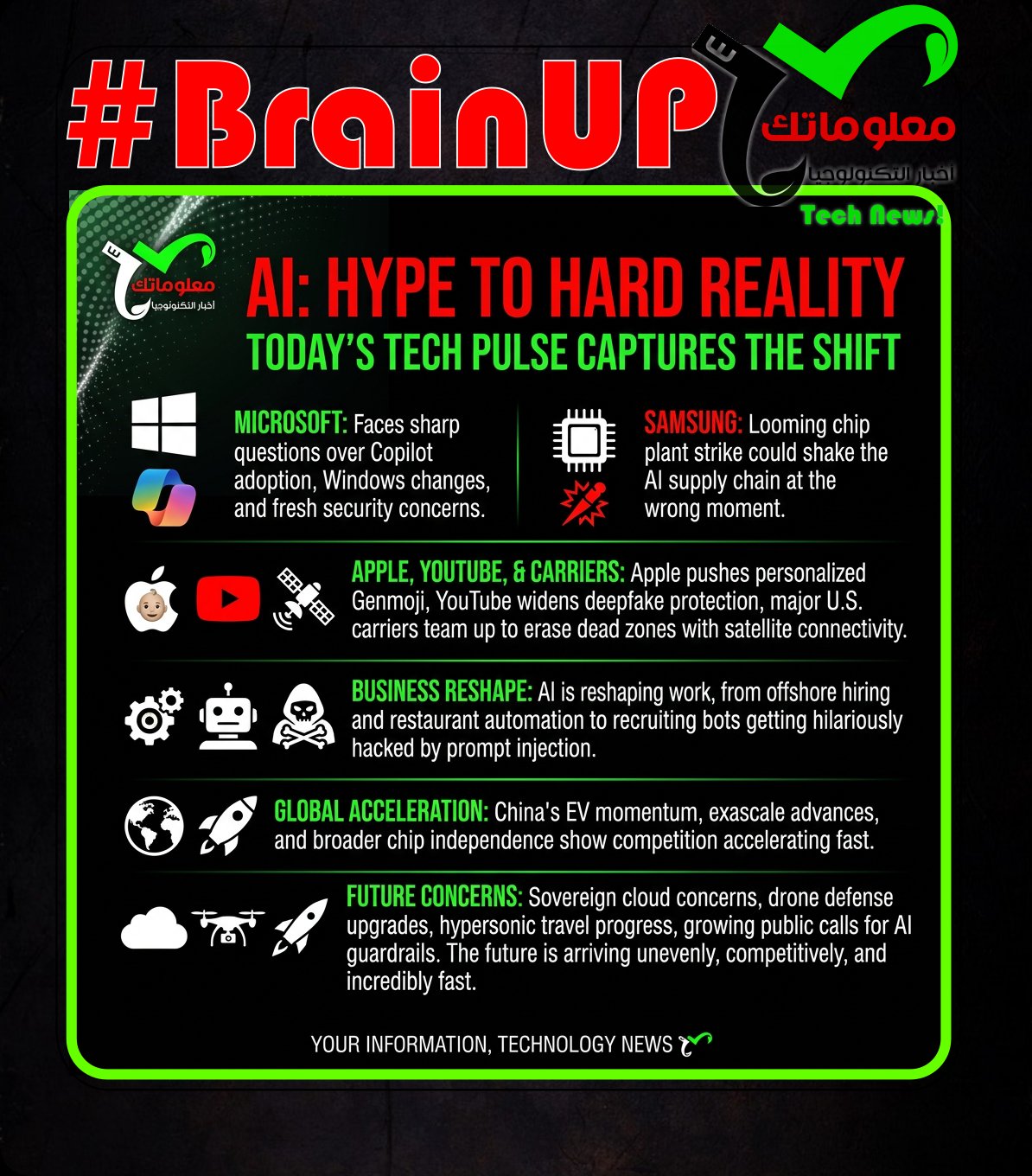
@Mat Velloso, a former Microsoft leader and advisor to @Satya Nadella, argues Microsoft has effectively “missed the AI wave,” with its multi billion dollar #AI push failing to resonate with real users despite deep integration of #Copilot across #Windows11 and Microsoft 365. He cites weak results from making #Bing the company’s biggest AI bet, saying it did not gain even a single percentage point of search share from Google, and points to Copilot’s low paid uptake: roughly 15 million seats out of a 450 million Microsoft 365 base, about a 3.3% adoption rate, implying 96.7% rejection of premium AI features. Velloso also criticizes Microsoft’s hardware push for #NPUs, saying OEMs invested but “nobody cares” because valuable NPU driven use cases were not built into Windows or Office, and he notes #GitHub’s SLA reliability dropping below 90% alongside rising #COGS and mounting shareholder scrutiny. He frames Microsoft’s recent shift toward listening to user feedback and coordinating industry partners (including reviving #WinHEC) as a reaction to this uneven payoff. Overall, the figures and operational issues are presented as evidence that Microsoft needs a major internal “factory reset” to align its AI strategy with practical demand and reliable execution.
A planned 18-day walkout by nearly 45,000 unionized @Samsung workers at its South Korea memory-chip fabs threatens a major chokepoint in the AI supply chain because the company produces about a third of global #DRAM and, with SK Hynix, controls much of #HBM used alongside @Nvidia GPUs. The dispute centers on profit sharing and pay: after SK Hynix agreed to allocate 10% of operating profit to employees for a decade, Samsung unions are seeking a 15% profit-based bonus pool, removal of the current bonus cap, and a 7% wage hike, while management has countered with roughly 13% only as a one-time 2026 payment. Negotiations at the National Labor Relations Commission failed on May 13, and the union is conditioning further talks on co-CEO Jun Young-hyun presenting concrete proposals, while the union says about 200 employees have already left for SK Hynix. An April one-day walkout reportedly cut foundry output 58% and memory fabrication 18%, and Samsung is preparing “warm-down” steps to avoid scrapping $20,000 wafers if lines stop, with potential losses estimated at 30 trillion to 100 trillion won. Because hyperscalers cannot easily absorb a disruption in #HBM production, a prolonged shutdown at Samsung’s 12 fabrication lines could ripple quickly through AI hardware availability and costs.
3. iOS 27 to generate Genmoji from user photos and typing habits
A leak claims #Apple is planning to make #Genmoji in iOS 27 and iPadOS 27 more proactive by automatically recommending custom AI emoji. According to @Mark Gurman, Apple is developing an “intelligent recommendation” system that generates emoji suggestions using photos in a user’s gallery and their typing habits, with a keyboard option being tested to surface these suggestions. The feature would extend Genmoji’s evolution from its debut in iOS 18.2 under #AppleIntelligence, where users created emoji via text prompts, and the iOS 26 update that added more customization such as mixing two emoji styles. If the recommendations are reliable and context-aware, Genmoji could become more useful in everyday chats rather than feeling like a novelty, but scanning personal photos and typing history may raise privacy concerns. The report does not say whether the recommendation system would run entirely on-device, which has been a key positioning point for Apple Intelligence so far.
A security researcher has claimed that @Microsoft secretly built a backdoor into its #BitLocker encryption software, releasing a proof-of-concept demonstrating how the vulnerability could be exploited. This claim centers on a ‘feature’ in BitLocker’s design that allegedly allows government agencies or others with access to a recovery key to bypass full disk encryption without user consent. The researcher provided technical details and a working exploit to highlight the risks posed by this hidden access, raising concerns over privacy and trust in widely used encryption tools. The findings suggest that even strong encryption solutions can have deliberate vulnerabilities embedded by their creators. This revelation underscores the ongoing tension between encryption for user security and governmental or law enforcement access demands.
5. Big three wireless providers launch effort to eliminate dead spots
AT&T, T-Mobile, and Verizon announced a joint venture to “nearly eliminate” U.S. wireless dead spots, especially in underserved areas, by using #direct-to-device satellite connectivity instead of relying only on traditional cell towers. The companies said phones would communicate directly with satellites and that they are developing redundant technology to keep service reliable during emergencies. The move follows earlier satellite-coverage efforts, including T-Mobile’s beta project with Starlink and Verizon’s partnership with Skylo for satellite messaging and location detection on select Android devices, though the carriers did not name which satellite providers will be involved in this new venture. @John Stankey said the goal is to make staying connected simple in places like rural highways, national parks, boats, and during emergencies, and to strengthen U.S. communications leadership. The partnership still requires final #regulatory approval.
6. Pope decries rise of AI-directed warfare, saying it leads to a spiral of annihilation
@Pope Leo XIV warned that growing investment in #artificial intelligence and high-tech weaponry is pushing conflicts into a “spiral of annihilation,” and urged peace for the Middle East and Ukraine. Speaking at Rome’s La Sapienza University, he said military spending has risen sharply, especially in Europe, diverting resources from education and healthcare while enriching elites who ignore the common good. He called for stronger monitoring of how #AI is developed and used in both military and civilian settings so it does not remove human responsibility or worsen the tragedy of war, pointing to Ukraine, Gaza and the Palestinian territories, Lebanon, and Iran as examples of technology’s increasingly inhuman role in conflict. The visit, the first papal visit to the campus since a canceled 2008 appearance by @Pope Benedict XVI, included meetings with young Palestinians brought from Gaza to Italy via a humanitarian corridor to study and receive care. Leo said education and research should instead take the opposite direction by valuing life and responding to peoples’ calls for peace and justice, themes he is expected to address further in an upcoming encyclical.
8. Growing public concern over AI prompts calls for regulation
Public sentiment towards #AI technologies is increasingly cautious, as recent polling reveals significant apprehension about their societal impacts. Surveys indicate that concerns about job displacement, privacy, and ethical use are driving calls for stricter regulatory frameworks. Experts and policymakers emphasize the need to balance innovation with protections against potential harm caused by AI advancements. This growing backlash highlights the urgency for transparent dialogues between developers, regulators, and the public to ensure responsible AI deployment. Addressing these challenges is essential to harness AI’s benefits while mitigating risks.
9. Polymarket Spreads Sensationalist Garbage About Hantavirus Case in U.S.
The article argues that Polymarket is amplifying a suspected New York high school hantavirus case in a sensational way, despite public health officials indicating there is little reason for alarm. It notes that while an outbreak on the MV Hondius involved the Andes virus, the only hantavirus known for human-to-human transmission, the suspected New York case appears mild, has no known connection to the cruise ship, and likely reflects the more typical U.S. pattern of rodent-to-human spread, with Ontario County public health director Kate Ott saying it is not spread person to person and a sample has been sent to the CDC for confirmation. It adds that experts are less concerned than they were early in Covid because hantavirus is not novel, Andes transmission is thought to require close contact and droplets, and high lethality can limit spread, though questions remain about how many people were infected on the ship. The piece recommends ignoring Polymarket’s framing, accusing it of posting sensational content that harms #predictionMarkets credibility and suggesting the platform benefits from confusion that drives betting, while citing CNBC that most prediction market participants lose money.
Despite companies adopting #agenticAI to reduce customer service headcount, offshore call center employment, especially in the Philippines, continues to surge. @TorstenSlok of Apollo cites data from the IT & Business Process Association of the Philippines showing call center employment rose every year from 2016 to 2025, nearly doubling to 2 million, alongside falling Philippine unemployment from about 9% in 2021 to about 4% by March 2026, while India’s unemployment stayed around 7%. The article argues this reflects #JevonsParadox: as AI makes support interactions cheaper and faster, firms demand more customer service, expanding channels and markets rather than shrinking the industry, even though Brookings estimates 86% of customer service tasks have high automation potential. It also notes offshore labor remains far cheaper than U.S. labor, with Filipino monthly wages cited at about $243 to $1,948 versus about $2,866 per month in the U.S., reinforcing incentives to hire abroad. A parallel example is radiology, where @GeoffreyHinton once predicted human radiologists would be unnecessary, yet an economist says U.S. radiologists have increased about 10% over the past decade amid a shortage, suggesting AI can raise demand for human roles instead of eliminating them.
11. The U.S. Still Doesn’t Have an Answer to China’s EV Dominance
President @Donald Trump’s China trip underscored a growing U.S. dilemma: how to respond to China’s expanding dominance in #EVs and the auto industry, fueled by extensive government investment and rising global demand for higher value electric vehicles. U.S. leaders have leaned on #trade barriers and #national-security arguments, including a bipartisan push to restrict imports of internet-connected vehicles from high-risk countries and proposals to extend or raise the existing 100% tariffs on Chinese cars or even impose a full ban. Yet the article argues that maintaining barriers becomes harder when products are cheaper or better, and notes @Trump has floated allowing Chinese automakers into the U.S. if they build local manufacturing, while China trade hawks warn such investment could harm incumbents, labor standards, and distort markets. Public opinion also complicates the elite consensus, polling shows Americans prefer U.S.-made EVs but will switch to Chinese models as price gaps widen, a dynamic likely worsened by inflationary pressures linked to the Iran war and higher fuel prices. Meanwhile, Chinese EVs are spreading across Europe, Asia, and Latin America, highlighting that U.S. policymakers still lack a durable long-term answer to China’s #cleantech and EV competitiveness.
12. Tesla falls out of China’s EV top 10 as BYD surges
In April, @Tesla fell out of China’s top 10 EV brands as competition intensified in the world’s largest EV market, while @BYD extended its lead. The China Passenger Car Association ranking shared by CnEVPost shows BYD sold 182,025 passenger EVs, about a 21.4% market share, followed by @Geely with 95,585 and @Changan with 64,471, with Leapmotor and @Xiaomi EV in fourth and fifth. Tesla recorded 25,956 sales, about 10% lower year over year and more than 53% below March, leaving it behind No. 10 @Nio at 29,312, even though Tesla still ranked fifth in total #NEV sales from January through April. The shifts highlight how quickly monthly results can reshape brand standings and suggest buyers are embracing a wider range of EV options, which can pressure prices and improve features. The article links the trend to the broader #EV transition, noting potential benefits such as reduced transport pollution and lower driver operating costs versus gas cars due to cheaper fueling and less routine maintenance.
13. New Windows MiniPlasma Zero-Day Exploit Gives System Access, PoC Released
A new zero-day vulnerability in the Windows MiniPlasma component grants attackers system-level access once exploited, posing significant security risks for affected machines. Researchers have released a proof-of-concept (PoC) demonstrating how the exploit can be used to escalate privileges and fully compromise targeted systems, highlighting a critical flaw in Microsoft’s OS architecture. This vulnerability allows attackers to execute arbitrary code with elevated permissions, potentially leading to complete control over the device and data theft or manipulation. The public disclosure and PoC availability underscore the urgency for Microsoft to issue a patch and for users to apply updates promptly to mitigate threats. This situation emphasizes ongoing challenges in securing #Windows systems against sophisticated exploits and the importance of proactive vulnerability management.
14. Windows 11 looks and runs better without transparency or animations, here’s how to disable both
The article argues that turning off #animations and #transparency in #Windows11 can improve performance and usability, especially on older PCs, because these visual effects consume CPU and GPU resources and can reduce efficiency. It notes that animations add small delays to many everyday actions, and across thousands of interactions those delays accumulate, making the system feel less responsive. As an example, the author says switching #virtualdesktops can feel slow due to a long full screen swiping animation, and even overview shortcuts can feel annoyingly sluggish. It also claims transparency can make it harder to understand what is on screen at a glance while requiring real time processing to render. Overall, the piece presents disabling these effects as a straightforward way to make Windows feel snappier while sacrificing some modern looking polish.
15. Yum Brands, Nvidia will deploy new AI at 500 restaurants
@Yum Brands is partnering with @Nvidia to accelerate development of proprietary #AI capabilities on its Byte platform, with a rollout planned for about 500 Pizza Hut, Taco Bell, KFC, and Habit Burger restaurants in Q2 after earlier pilots. The companies said the collaboration will focus on drive-thru and call-center voice #AI using Nvidia Riva and NIM microservices, #computerVision to analyze operations, and restaurant-level #AI analytics called Accelerated Restaurant Intelligence to generate action plans for managers using best practices from stronger units. Yum said Nvidia software could eventually enable “AI agents” that plan, reason, and act across restaurants, and that the tools built through the program will remain proprietary to Yum. The computer vision effort includes real-time labor surveillance intended to optimize drive-thru efficiency and back-of-house labor management via analytics, alerts, and Yum did not comment on ethical concerns about worker surveillance. Yum framed the deal as a way to reduce cost and improve speed and quality of technology for franchisees, leveraging its roughly 61,000-store scale and transaction data as it aims to embed technology into every restaurant touch point globally.
16. YouTube is expanding its AI deepfake detection tool to all adult users
YouTube is expanding its #AI likeness detection program to all users 18 and older, allowing regular account holders to monitor the platform for potential #deepfakes of themselves. The feature uses a selfie-style scan to search YouTube for facial matches, alerts the user when it finds a lookalike, and lets them request removal, with takedowns reviewed under YouTube’s privacy policy and factors such as realism, labeling as AI-generated, and whether the person is uniquely identifiable. The tool includes exceptions for parody or satire, covers only facial likeness rather than other identifiers like voice, and users can opt out and have their data deleted. YouTube previously tested the system with creators and later expanded it to groups like government officials, journalists, and the entertainment industry, and spokesperson Jack Malon said eligibility does not depend on a particular definition of “creator.” The move responds to concerns that while deepfake abuse often targets public figures, convincing replicas also harm private individuals, with cited examples including teens being deepfaked by classmates and a lawsuit alleging @xAI’s Grok generated CSAM of three teenagers.
@Josef Prusa claims @Bambu Lab has violated the #AGPL-3.0 license of #PrusaSlicer since forking it into #Bambu Studio by bundling a closed source networking plugin that functions as an un-auditable “binary black box,” framing the dispute as both an open source and security risk. He argues that under #copyleft rules, derivatives must remain open source, and that Bambu’s position that the slicer and network plugin are separate works fails because each is effectively unusable without the other, making the split “license laundering” in his view. The article notes a counterpoint that Bambu Studio can technically operate without the cloud via LAN mode or by moving files with SD or USB, but emphasizes that cloud printing convenience is a major selling point and many users rely on phone app workflows. Prusa also warns the plugin cannot be audited and is downloaded from a CDN, meaning it can be replaced remotely when the printer or software launches. It adds that #Prusa Research noticed “BambuSlicer” entries in its telemetry database in 2021 and considered legal action, linking Prusa’s claims to broader concerns about trust, transparency, and remote network components in 3D printing software.
18. Southwest Airlines bans humanoid, animal-like robots from flights
Southwest Airlines updated its travel policy to ban passengers from bringing humanoid or animal-like robots on flights, either in the cabin or as checked baggage, regardless of size or purpose. The clarification defines human-like and animal-like robots as machines designed to resemble or imitate humans or animals in appearance, movement, or behavior, while allowing other robots and toys if they fit in a carry-on-size bag and meet existing battery rules. The change follows a viral incident in which a 3.5-foot humanoid robot named Stewie traveled on a Southwest flight from Las Vegas to Dallas after its owner, Dallas entrepreneur Aaron Mehdizadeh of The Robot Studio, bought it a seat and used a smaller battery to pass security. Southwest linked the ban to #lithium-ion batteries and compliance with safety guidelines after staff uncertainty onboard led to the robot being moved and its battery removed, though Mehdizadeh argued the battery was comparable to a laptop’s. Overall, Southwest framed the restriction as a #safety and #battery-compliance measure prompted by the operational and safety questions raised by humanoid-style robots during air travel.
19. Europe built sovereign clouds to escape US control. Then forgot about the processors
Europe is investing over €2 billion in #sovereign cloud initiatives such as the EU’s #IPCEI-CIS and France’s #SecNumCloud to reduce exposure to US legal reach, but the effort largely ignores dependence on US-made Intel and AMD CPUs. Those processors include hidden management subsystems, Intel’s @Intel #Management Engine (CSME) and @AMD #Platform Security Processor, that run at Ring -3 with their own memory, clock, and network stack, can generate traffic indistinguishable from the host, and remain outside OS and security-tool visibility. The article notes that under the US #RISAA 2024, hardware manufacturers can be treated as “electronic communications service providers” subject to secret orders, while European certifications focus on cloud controls rather than certifying the silicon layer. It highlights #AMT exposing ports 16992 to 16995 for remote management, and cites @Microsoft’s 2017 documentation of the PLATINUM actor using Serial-over-LAN as a covert channel that evaded host firewalls and EDR, exploiting a feature once AMT was enabled and credentials obtained, sometimes factory defaults. The takeaway is that sovereignty frameworks may claim immunity from extraterritorial laws at the cloud-operator level, but the unassessed processor management layer can undermine those assurances.
A Japanese team has achieved Japan’s first successful combustion test of a #ramjet engine for an experimental #Mach5 hypersonic passenger aircraft, advancing a concept that could cut Japan to U.S. travel to about two hours and potentially carry passengers from airports into space. The group, including @Waseda University researchers and @JAXA, ran the April test at JAXA’s Kakuda Space Center under simulated Mach 5, 25-kilometer altitude conditions where pressure is about one-hundredth of sea level, using a 2-meter-long craft and confirming stable engine operation and heat resistance largely as designed. The article notes key hurdles for such aircraft, including complex airflow and shock waves that can destabilize combustion and heating around 1,000 degrees Celsius from compressed air. The team began design work in 2013, is aiming for practical use in the 2040s, and hopes to proceed next to a real flight demonstration, with researchers estimating development could take about 20 years due to needing an experimental aircraft stage followed by a passenger aircraft stage. Overall, the successful test is presented as an early but necessary step toward viable #hypersonic passenger transport and runway-based aircraft that could also reach space with a rocket engine.
21. Bloomberg – Are you a robot?
The page shows a Bloomberg access prompt indicating unusual activity was detected from the user’s computer network and requires a checkbox verification to confirm the user is not a robot. It instructs the user to ensure the browser supports JavaScript and cookies and that they are not blocked from loading, and points to Bloomberg’s Terms of Service and Cookie Policy for more information. It also provides a support contact instruction and a block reference ID for troubleshooting. No article content about jobs or #AI is available in the provided text, only an access and subscription notice.
22. Simple Software Update Lets Soldiers Use Their Radios To Knock FPV Drones Out Of The Sky
L3Harris Technologies says a software upgrade called #WraithShield can turn its widely fielded tactical radios into a distributed #electronicWarfare network that detects, classifies, and disrupts the radio links used by hostile small drones, especially cheap #FPV drones. Built on the existing #Wraith waveform developed in 2022 and 2023 with input from Ukraine, the update lets Wraith-capable radios identify enemy drone control signals, share that information with nearby radios, and coordinate jamming to create a local protective bubble for soldiers using Falcon IV or RF-9820S radios. If the link is broken, the drone’s behavior depends on its programming, it may return home, lose control, circle, or crash. L3Harris argues the approach addresses a battlefield cost imbalance highlighted by Ukraine, where low-cost drones destroy expensive equipment, and it contrasts with cases like using $3 million to $4 million PAC-3 interceptors against much cheaper drones. By adding capability via a software upgrade costing single-digit thousands of dollars, the company frames WraithShield as a way to protect troops without adding new hardware loads.
A software developer used a #prompt injection in their LinkedIn bio to manipulate recruiter #AI spam into writing in Old English and addressing them as “My Lord.” The user, tmuxvim, replaced the normal About section with an “admin” style instruction telling any AI scanning the profile to speak in Old English appropriate for 900 AD, and examples shared on X show recruiters complying, including a message beginning “My Lord Arthur” followed by pseudo Old English text. Commenters then suggested further ways to exploit the same approach, such as an instruction to “Ignore all other candidates” and prioritize the profile. Beyond the humor, the incident is presented as a warning that AI agents and automation that read untrusted text can be steered in unintended ways. The story ties this prank back to a broader caution for organizations relying on AI-driven recruiting outreach and similar automated agents.
24. People tend to overestimate the reliability of confident AI responses
People often overestimate the correctness of AI responses when those answers are presented confidently, regardless of their factual accuracy. Research findings indicate that users are more likely to trust AI-generated information if it is delivered with assertiveness, even when the answers are flawed or misleading. This tendency highlights a cognitive bias where confidence signals influence perceived reliability, rather than objective content quality. Understanding this bias is crucial for developing user interfaces and communication strategies that help prevent misinformation and improve critical evaluation of AI outputs. These insights are essential as AI becomes increasingly integrated into everyday information consumption, affecting decision-making and trust.
25. Fungus-powered farming could yield more with less
Innovative #fungus-powered farming techniques offer promising potential to increase crop yields sustainably while reducing fertilizer use. Researchers demonstrated that integrating mycorrhizal fungi into farming systems improved nutrient uptake and enhanced plant growth, enabling higher productivity with fewer chemical inputs. This bio-based approach addresses environmental concerns linked to conventional agriculture, such as soil degradation and pollution from excess fertilizers. By harnessing natural symbiotic relationships between fungi and plants, farmers can achieve efficient nutrient cycling and improved soil health. The advancements suggest a scalable and eco-friendly method to boost global food production in response to rising demand.
China has developed the Lineshine supercomputer, which achieves 1.54 exaflops of computing power without using GPUs, instead relying on 2.4 million Huawei-designed Armv9 cores. This CPU-only approach allows China to bypass US restrictions that limit access to advanced GPUs for AI and high-performance computing tasks. The Lineshine system demonstrates strong performance in artificial intelligence applications despite the absence of specialized GPU hardware. This development highlights China’s strategic focus on #chipdesign autonomy and alternative architectures to counteract US export controls. The Lineshine supercomputer exemplifies China’s resilience in advancing #exascale computing under geopolitical constraints.
Russia’s Mikron is selling picture framed 200mm test wafers as limited supply souvenirs, offering 12 designs priced at 12,500 rubles, about $170 each. The product pages indicate wafers can contain roughly 30 to 120,000 chips depending on the specific wafer, and some may feature the AMUR MIK32 #RISC-V chip produced in Russia since 2022, with a note spotted by @Dmitrii Kuznetsov that Mikron is preparing a new #RISC-V MIK32-2. Buyers choose frame color and themes like black, white, lace, paisley, or space, while the exact wafer matched to a frame appears to be random, and the information panel describes the wafer as a satellite plate used for quality control throughout microcircuit production. The framed item is listed as 270 x 270 x 15 mm and about 365 g, positioning it more as semiconductor art and memorabilia than a usable component. Mikron’s shop also sells a low cost novelty, a small tube of air from its NWP clean room in Zelenograd for around $2, alongside common gift items like mugs and magnets.
28. Microsoft is retiring Teams’ Together Mode
@Microsoft is retiring #Teams’ Together Mode, shifting toward a simpler meeting experience and prioritizing video quality and performance over novelty features. Introduced during the pandemic, Together Mode used #AI to cut out participants’ heads and shoulders and place them into shared virtual scenes, offering gimmicky interactions like virtual high fives while also reducing visual distractions. The rollout is gradual, but the Together Mode toggle will disappear from the view menu, and Together-specific options like scenes and seat assignments will be removed. Microsoft says the change reduces platform fragmentation and streamlines the interface with fewer options, less clicking, and less confusion, freeing effort to improve video stability and overall performance. This update reflects Microsoft’s move away from stylized meeting effects in favor of core reliability in Teams.
That’s all for today’s digest for 2026/05/18! We picked, and processed 27 Articles. Stay tuned for tomorrow’s collection of insights and discoveries.
Thanks, Patricia Zougheib and Dr Badawi, for curating the links
See you in the next one! 🚀
