
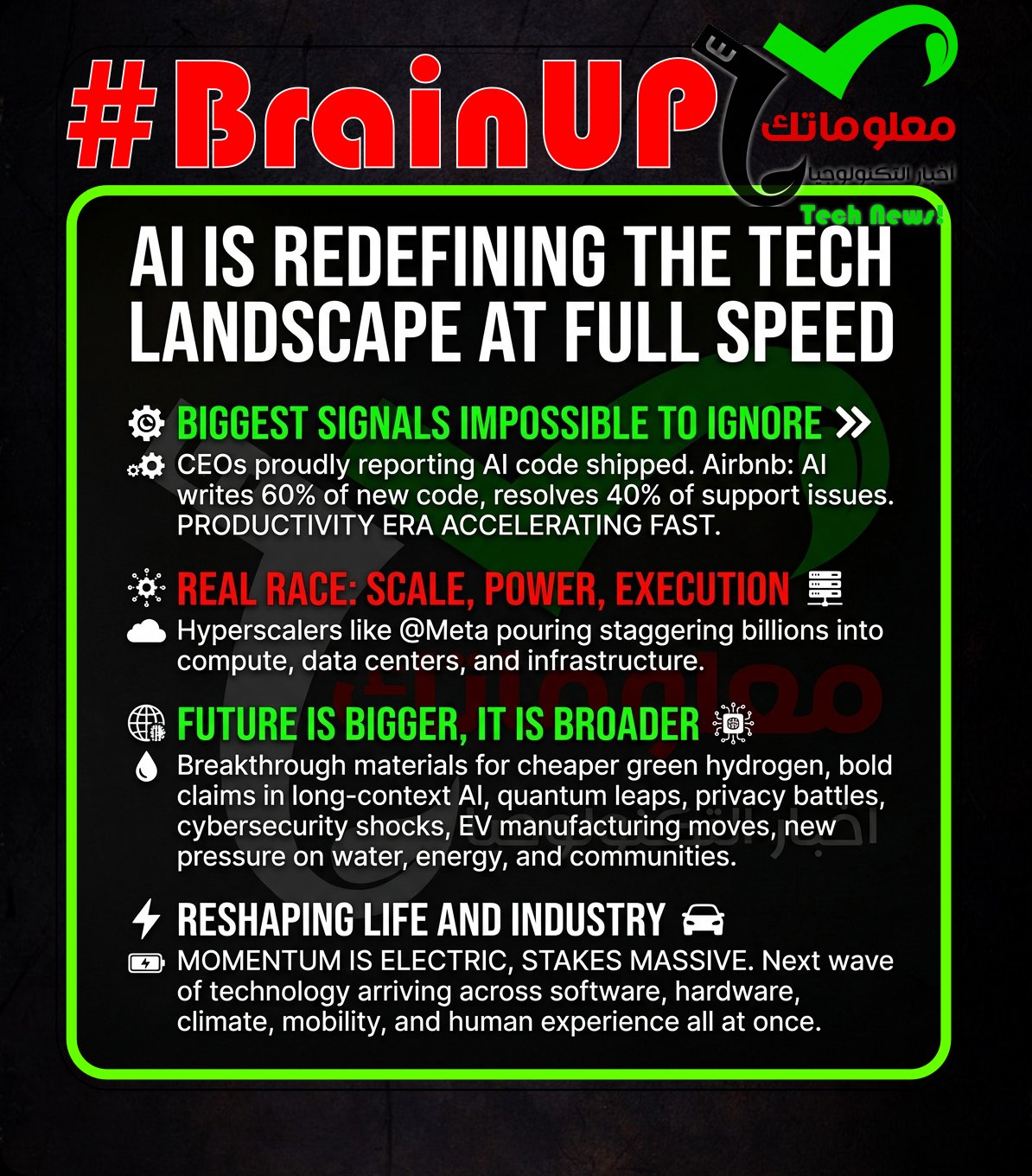
#BrainUp Daily Tech News – (Monday, May 11ᵗʰ)
Welcome to today’s curated collection of interesting links and insights for 2026/05/11. Our Hand-picked, AI-optimized system has processed and summarized 29 articles from all over the internet to bring you the latest technology news.
As previously aired🔴LIVE on Clubhouse, Chatter Social, Instagram, Twitch, X, YouTube, and TikTok.
Also available as a #Podcast on Apple 📻, Spotify🛜, Anghami, and Amazon🎧 or anywhere else you listen to podcasts.
1. The new CEO flex: Bragging about how much AI code your company shipped
CEOs are increasingly treating #AI productivity, especially how much code is produced with #agenticAI, as a headline metric on interviews and earnings calls to signal performance and future direction. The article says this bragging trend started with AI-focused companies such as Anthropic, Meta, and Google and has spread across industries, with executives highlighting AI-generated or AI-coauthored code to appeal to investors and prospective employees. Examples include Airbnb CEO Brian Chesky saying about 60% of engineers’ code is coauthored with AI and that teams are shipping and iterating faster, and Anthropic CEO @DarioAmodei saying @Claude writes about 90% of code generated by most teams while noting engineers are still needed to review and supervise models. AI-forward public metrics are framed as both a status symbol and a recruiting signal, with recruiter Alex King saying visible AI adoption helps attract the talent profile needed to become an AI-centric company. Overall, the piece links executive “AI code” statistics to a broader shift in how companies measure productivity and position themselves competitively in work and hiring.
2. Airbnb says AI now writes 60% of its new code | TechCrunch
Airbnb says it is increasingly using #AI across engineering, customer support, and search, and claimed that in Q1 2026, 60% of new code produced by its engineers was written by AI. CEO @Brian Chesky said AI is especially useful for building tools for #API partners managing properties in different software, allowing one engineer to supervise agents and do work that previously could have required a much larger team. The company also reported its customer support AI bot now resolves 40% of issues without escalation to a human agent, up from about 33% earlier in the year. Airbnb is experimenting with AI in search, but Chesky argued chatbots are not yet well suited to travel or e-commerce because they are text-heavy, lack direct manipulation, make comparisons hard, and do not support “multiplayer” booking well. In the same quarter, Airbnb reported net income up 3.9% to $160 million, revenue up 18% to $2.7 billion, nights booked up 9% to 156.2 million, and said its “Reserve now, pay later” feature accounted for almost 20% of gross booking value.
@Meta signaled it will cut roughly 8,000 jobs in May as part of a push for a leaner operating model meant to move faster and help offset massive #AI and data center spending. On its Q1 2026 call, CFO Susan Li said the workforce reduction would help fund substantially higher investment as @Meta raised 2026 capex guidance to $125 billion to $145 billion, cited higher component pricing and data center costs, and added $107 billion in new contractual commitments for cloud and infrastructure in one quarter. @Mark Zuckerberg argued that #AI is boosting productivity, saying one or two people can now build in a week what used to take dozens of people months, while also claiming people will matter more in the future, but the article notes AI capex is estimated at four to five times total human compensation and even eliminating payroll of about $27 billion would not materially offset a $145 billion infrastructure bill. The piece situates this within a broader hyperscaler shift as @Amazon, @Microsoft, and @Alphabet also ramp capex and reduce headcount, with the four projected to spend up to $725 billion on capex in 2026 and April 2026 job cut announcements totaling 83,387, including 21,490 citing AI. With @Meta posting $56.3 billion revenue, 41% operating margin, and EPS of $10.44 and the market rewarding spend, the article argues shareholders should read the layoffs as a signal that hyperscalers are prioritizing compute share, benefiting suppliers like @NVIDIA, while booking human cost as savings to fund infrastructure.
AI #data-centers are facing growing community resistance over #noise-pollution, including complaints about #infrasound that is inaudible yet reportedly felt. The Environmental and Energy Study Institute says high and low frequency sound from these industrial sites can be heard and felt for hundreds of feet, with levels reported as high as 96 dB around the clock, while Heatmap Plus notes residents describing a constant low frequency hum and alleging health effects such as headaches, insomnia, nausea, and anxiety. Some local governments are citing infrasound concerns while considering moratoriums on data center projects, even as researchers continue to study the phenomenon and its impacts. Conventional noise is also tied to scale and infrastructure, especially off grid facilities that use natural gas turbines for continuous on site power and the extensive cooling and backup generation equipment required by high power AI deployments. Together, continuous turbines, cooling systems that can account for nearly 40% of data center power use, and large backup generators are described as making nearby neighborhoods lose peace for as long as these facilities operate.
5. A major watchdog says data centers are wreaking havoc on North America’s power grid
The #North American Electric Reliability Corporation, which oversees grid reliability in the US, Canada, and parts of Mexico, issued a rare Level 3 alert calling for essential action to address new reliability risks from data centers connecting to the grid. The watchdog said grid operators lack sufficient processes and methods to manage risks from large computational loads, especially #AI workloads that can produce rapid, extreme swings between very high and very low electricity use. According to the alert, these power swings can happen in seconds and leave little or no room for real-time responses, raising the risk that entire electric grids could go offline and increasing the likelihood of outages and blackouts. NERC also said the issue is not limited to AI training, with #crypto mining and traditional data centers also posing threats. It directed operators to take immediate action and submit risk mitigation plans to NERC by August 3 as large power consumers surge.
6. Ukraine ramps up ground robot production to spare soldiers haul ammo and rescue grandma
Ukraine is increasing production of ground robots to reduce the physical burden on soldiers in wartime, using these machines to carry ammunition and assist in rescue operations. These robots enhance soldiers’ effectiveness by handling logistics tasks and performing dangerous missions such as evacuating casualties. The development reflects a strategic move to incorporate #autonomous and #robotics technology on the battlefield, aiming to improve troop safety and operational efficiency. By deploying these ground robots, Ukraine adapts to modern warfare demands while preserving human lives. This effort underlines the growing role of unmanned systems in contemporary conflicts.
The article describes @Louis Rossmann publicly backing a developer targeted by Bambu Lab, framing it as a fight over #RightToRepair and user control of 3D printers. Rossmann pledged $10,000 to cover initial legal fees for developer Pawel Jarczak after Jarczak shut down his “OrcaSlicer-BambuLab” project, a fork intended to restore direct control between Bambu Lab printers and #OrcaSlicer, and Rossmann urged him to repost the code on GitHub while calling for community donations. It notes Bambu Lab previously argued third party integrations threatened its infrastructure, claiming its cloud servers were hit with about 30 million “unauthorized” requests per day and that OrcaSlicer was the main source. The piece also highlights repair and modding complaints about Bambu Lab printers, including glued components, earlier X1 Carbon design issues like non-replaceable carbon rods and a cumbersome nozzle swap, and says later models replaced some parts with more user-friendly ones. Rossmann has not launched a crowdfunding site yet, but the video drew tens of thousands of views and commenters promised contributions, tying the dispute back to whether owners should be free to modify and maintain products they bought.
8. Sorry, iPhone 17 users: You don’t qualify for Apple’s $250 million Siri lawsuit
Apple faces a $250 million class-action lawsuit over Siri’s alleged privacy violations, but iPhone 17 users are excluded from the settlement. The suit addresses how Apple contractors analyzed private Siri recordings without adequate disclosure, raising concerns about user consent and data privacy. Despite the settlement, only owners of devices with Siri before September 2019 qualify for compensation, excluding newer models like the iPhone 17. This limitation highlights challenges in privacy litigation as technology and policies evolve over time. The case underscores ongoing debates around #digitalprivacy and corporate responsibility in the era of AI assistants.
9. “Cannot be explained” – New ultra stainless steel stuns researchers
Researchers at the University of Hong Kong report a new stainless steel for hydrogen production, SS-H2, designed to withstand the corrosive conditions of #seawater electrolysis and other harsh electrolyzer environments. Led by @Mingxin Huang, the team describes a “sequential dual-passivation” or double-protection mechanism that resists corrosion beyond the limits of conventional chromium-based passive films in ordinary stainless steel. In salt-water electrolyzer testing, SS-H2 reportedly performs comparably to titanium-based structural materials commonly used for hydrogen production from desalted seawater or acid, but at far lower expected cost. The article argues this could address a central barrier to #green hydrogen scale-up, since seawater introduces salt, chloride ions, side reactions, and corrosion that degrade components and durability, while current titanium parts often require expensive precious-metal coatings. Using a 10 MW PEM electrolysis tank example where structural components can be up to 53% of an estimated HK$17.8 million cost, the team estimates switching to SS-H2 could cut structural-material costs by about 40 times, potentially making seawater-based hydrogen systems more affordable.
10. Georgia’s tech growth stretches water resources thin
Georgia’s booming data center industry is placing significant strain on local water resources, particularly in rural areas where water supplies are limited. Extensive water usage by tech companies for cooling purposes competes with agricultural, residential, and environmental needs, complicating water management efforts. Local officials and residents express concern about sustainable water access, highlighting the tension between economic growth driven by #technology infrastructure and natural resource conservation. The situation underscores broader challenges in balancing rapidly expanding digital infrastructure with environmental stewardship in communities experiencing rapid industrial development. This case exemplifies the need for integrated policies that address both technological advancement and sustainable resource management.
11. Scientists discover a hydraulic link between the abdomen and the brain
A new study suggests that flexing abdominal muscles can physically move the brain, creating a hydraulic link between the abdomen and the brain. The reported mechanism is a gentle shifting that acts like a hydraulic pump, forcing fluids through brain tissue. This fluid movement is described as helping wash away harmful waste. The study also links this process to promoting cognitive health.
12. Cerebras raises IPO price range to $150-$160 as demand surges, sources say
Cerebras Systems Inc. has increased its initial public offering price range to $150-$160 per share due to strong investor demand, signaling growing enthusiasm for its AI chip technologies. The move follows a surge in interest from institutional buyers attracted to Cerebras’s large-scale AI processors designed to accelerate machine learning workloads. Raising the price range suggests confidence in the market’s appetite for innovative semiconductor solutions amid expanding AI applications. This upward revision positions Cerebras favorably against competitors and may enhance its capital raise potential. The increased price range reflects both the company’s technological strengths and the broader industry’s bullish outlook on AI hardware investment.
13. FCC Attempts to Solve Robocall Problem by Potentially Creating Even Bigger Privacy Problem
@FCC chairman @Brendan Carr is pushing new rules to curb #robocalls, but the proposed approach could create a major #privacy problem by ending much of the semi-anonymity of prepaid “burner” phones. Citing a U.S. PIRG Education Fund report that Americans received about 2.14 billion robocalls per month in 2024, the FCC voted April 30 on proposed #KnowYourCustomer requirements that would force customers to provide government ID, a physical address, a full legal name, and an existing phone number, with additional “red flags” such as virtual offices, suspicious emails or websites, unverifiable locations, and paying with #cryptocurrency. Civil liberties critics argue this would impose an identity-verification regime on one of the last semi-anonymous communication tools, potentially harming people who rely on easy, low-cost phone access like refugees and those fleeing abusive relationships. The FCC says originating providers are best positioned to stop illegal call traffic and faults some telecoms for not taking adequate steps, backing enforcement with fines reportedly set at $2,500 per call against providers rather than callers, effectively deputizing telecom companies to verify identities and monitor customer behavior. The rules are not yet in force, would take effect a year after full approval, and the FCC is seeking public comment specifically on privacy concerns.
14. Nick Bostrom Has a Plan for Humanity’s ‘Big Retirement’
In an interview about his shift toward a more optimistic view of advanced AI, @Nick Bostrom argues that taking some risk with #advancedAI could be justified because it might free humanity from its “universal death sentence” and even extend human life. He contrasts this with his earlier focus on #existentialRisk in Superintelligence, including the paperclip maximizer thought experiment, while saying his newer book Deep Utopia explores a “#solvedWorld” if AI goes right. Bostrom pushes back on “doomer” claims that building AI guarantees catastrophe, noting that without AI “everyone dies” anyway, and frames his paper as narrowly asking what benefits or harms accrue to currently living people under risky development. He also acknowledges that abundance is not automatic, governance matters, and that his optimistic scenario assumes society does a reasonably good job so everyone shares in the gains rather than reproducing inequality. If such governance succeeds, he suggests AI could emancipate people from drudgery and coerced labor, but he treats the question of what constitutes a good life in that world as a deep philosophical problem.
15. Trump Phone Looks Different, Has No Launch Date, Isn’t Made in America
The reported Trump Mobile T1 phone has undergone multiple redesigns and still has no announced launch date, while the company has dropped its earlier claim that it would be made in the US. In mid-April, a revamped Trump Mobile website showed a third new look for the T phone, and @The Verge reported the device appears to have received #PTCRB certification and previously surfaced #FCC documentation suggesting authorization tied to Smart Gadgets Global, whose CEO is listed as Trump Mobile executive Eric Thomas. Trump Mobile, launched in June 2025 with a $47.45 monthly plan, continues taking $100 deposits for a $499 promotional price and lists specs such as a 6.78-inch #AMOLED display, multiple cameras, a 5,000 mAh battery, a #Snapdragon platform, and #Android, but as of May 1 it has not posted a release date. Executives told @The Verge in February the phone was delayed to avoid a rushed entry-level launch, and claimed it would be made in a “favored nation” with final assembly in Florida, though what that means is unclear. CNET notes Trump Mobile has not responded to repeated requests for comment, leaving the phone’s final design, manufacturing details, and timing unresolved.
16. Linux Kernel Killswitch Proposed After Recent Vulnerability Disclosures
Linux kernel developers are reviewing a proposed emergency #killswitch that lets administrators temporarily disable specific vulnerable kernel functions after serious CVEs become public but before fixes are widely deployed. @Sasha Levin, an NVIDIA engineer and Linux stable co-maintainer, submitted a patch that makes selected functions return an error instead of executing, offering runtime mitigation via #securityfs until the switch is disabled or the system reboots. The proposal is motivated by recent disclosures such as Copy Fail and Dirty Frag, and includes a self-test referencing CVE-2026-31431 to show blocking the affected AF_ALG path. Levin suggests targeting less commonly needed code paths like AF_ALG, ksmbd, nf_tables, vsock, and ax25, arguing that disabling these may be less disruptive than running known-vulnerable code, but notes risks because there are no automatic safety checks and the wrong choice or return value could break systems. The patch is explicitly not #live_patching and does not fix the underlying bug, it only blocks access until a full kernel update is applied, and it remains under review and not yet accepted.
17. Canvas Restored After Hack, Breach Traced to ‘Free-For-Teacher’ Accounts
Canvas access has been restored after #Instructure took the learning platform offline as a precaution following an extortion note posted by the cybercriminal gang ShinyHunters, and the company has temporarily shut down its #Free-For-Teacher service. Instructure says the attackers exploited an issue tied to #Free-For-Teacher accounts, first gaining access on April 29, later regaining access on Thursday to post the note, though the company has not detailed the vulnerability. Canvas reports no evidence that user information was stolen this week, but confirms data was taken during the April 29 intrusion, including names, email addresses, student ID numbers, and messages among Canvas users. The incident has disrupted schools and universities, raised concerns about exposure of underage student details and potentially sensitive student teacher messages, and even led some universities to delay final exams. It remains unclear whether a ransom was paid, while the @FBI urged victims not to pay and warned that threat actors often exaggerate claimed access, advising caution about unsolicited contacts purporting to be from schools, Canvas, or law enforcement.
18. GM agrees to pay $12.75M in California driver privacy settlement | TechCrunch
@General Motors reached a California privacy settlement led by @Rob Bonta over alleged sales of driver data collected via #OnStar. The complaint says GM sold names, contact information, geolocation, and driving behavior data of hundreds of thousands of Californians to data brokers Verisk Analytics and LexisNexis Risk Solutions, earning about $20 million, while California said this data likely did not raise in-state insurance rates because insurers are barred from using driving data to set rates under California insurance laws. Under the settlement, GM will pay $12.75 million in civil penalties, stop selling driving data to any consumer reporting agencies for five years, delete retained driver data within 180 days unless it gets customer consent, and ask Lexis and Verisk to delete the data as well. Bonta said GM sold driver data without knowledge or consent despite statements to the contrary, and framed the outcome as reinforcing #dataMinimization in California privacy law. GM said the settlement addresses its Smart Driver product, which it discontinued in 2024, and it follows an earlier #FTC order restricting GM and OnStar data sales.
CAS Cold Atom Technology, a Wuhan firm affiliated with the Chinese Academy of Sciences, says its Hanyuan-2 is the world’s first dual-core #quantum computer, combining two independent #neutral-atom arrays in one cabinet-sized system for a total of 200 qubits made from 100 rubidium-85 and 100 rubidium-87 atoms. The company claims the two cores can either run workloads in parallel or operate with one core executing computations while the other performs real-time error correction, and it also touts a compact integrated design with total power consumption under 7 kW. However, unlike Western neutral-atom efforts such as Atom Computing and QuEra, the announcement provides no published benchmarks like gate fidelity, coherence time, or error rates, and it is not accompanied by a peer-reviewed paper, with reporting tracing back to Chinese state-affiliated outlets. The article notes that “dual-core” branding parallels classical CPUs but resembles modular #quantum-computing approaches already pursued elsewhere, and it remains unclear whether placing both arrays in one machine is advantageous versus scaling a single larger array without comparative metrics. Hanyuan-2 follows the company’s earlier Hanyuan-1 system, for which technical specifications are also described as limited.
@Sam Altman says people use #ChatGPT in sharply different ways by generation: older users treat it like a Google replacement, people in their 20s and 30s use it as a life advisor, and college students use it like an operating system. Speaking at a Sequoia Capital event, he described college users building complex workflows, connecting it to files, saving or memorizing detailed prompts, and often not making life decisions without asking ChatGPT. OpenAI reports that U.S. college-aged adults are the biggest adopters, with more than one-third of 18 to 24 year olds using ChatGPT, enabled in part by features like memory that preserve prior conversation context. The article notes people seek everything from relationship, business, and medical guidance to therapy-like support, while studies and experts disagree on safety and reliability, with some urging caution and others finding common advice potentially harmless or helpful. Altman frames the gap as similar to early smartphone adoption, illustrating how younger users are turning #ChatGPT into a deeply integrated personal tool rather than a simple search substitute.
21. AI isn’t actually ‘taking’ your job. Here’s what’s happening instead
The article argues that #AI is more often reshaping jobs by automating tasks than replacing entire roles. Companies have cited #AI as a leading reason for recent job cuts, and @Microsoft notes workplace anxiety about job loss and keeping up, but experts say most jobs are not fully automatable with current AI and robotics. @Alexis Krivkovich of @McKinsey says AI can automate 57% of work activities, yet those are dispersed across pieces of many roles, and @Nitin Seth of @Incedo claims AI can lift productivity 20% to 25% without staff reductions at the same scale because partial automation does not neatly convert into fewer people. In software work, surveys show widespread use of #AI tools, but sources stress that engineering still requires system design, review, troubleshooting, and judgment, with @Boris Cherny suggesting titles may evolve as coding becomes a smaller share and an engineer describing a shift toward prompting and evaluating code quality. Overall, the workplace impact is a reallocation of responsibilities and skills toward human judgment and problem solving, even as AI-linked layoffs continue.
Miami startup Subquadratic says its SubQ 1M-Preview is the first large language model built on a fully #subquadratic architecture, with attention compute scaling linearly with context length rather than quadratically, enabling up to 12 million tokens and nearly 1,000x lower attention compute at that length versus other frontier models. It is putting three offerings into private beta, an API exposing the full context window, a command-line coding agent called SubQ Code, and a search tool called SubQ Search, and reports $29 million in seed funding from investors including Tinder co-founder Justin Mateen and former SoftBank Vision Fund partner Javier Villamizar, with The New Stack reporting a $500 million valuation. The claims draw mixed reactions from the AI research community, from curiosity to accusations of vaporware, with calls for independent validation. The company frames its approach as a way to remove the #quadratic scaling constraint that forces developers to rely on #RAG, retrieval pipelines, chunking, prompt engineering, and multi-agent orchestration to work around limited and costly long-context processing. If the linear-scaling claim holds, it would materially change how transformer-based systems from @OpenAI, @Anthropic, and Google scale long-context use cases by reducing dependence on brittle external infrastructure.
23. Lithium deposit valued at over $1.5 trillion discovered in the U.S.
The McDermitt Caldera near the Oregon-Nevada border is drawing attention as a potentially massive #lithium resource that could strengthen U.S. battery supply, but it is also triggering conflict over environmental and cultural impacts. Estimates cited in the article value the deposit at about $1.5 trillion, with some geologists suggesting the ancient volcanic sediments may hold 20 to 40 million metric tons of lithium, and a proposal from HiTech Minerals Inc. would add roads and hundreds of test wells in Malheur County. Supporters point to surging lithium demand for electric vehicles and renewable energy storage, and to the economic appeal for one of Oregon’s poorest counties, while critics, including the Oregon Chapter of the #SierraClub, argue that drilling and mining should not sacrifice fragile habitats used by pronghorn antelope, sage-grouse, and other sensitive species. The #BLM is criticized for allowing only a brief public comment period, and concerns raised include dust, vehicle emissions, water use, and potential leakage of industrial byproducts, especially because claystone processing can require complex methods like #acidLeaching that complicate waste disposal and water safety. With the caldera’s mineral-rich clays formed by eruptions roughly 16 million years ago, the article frames the decision as a near-term policy choice with long-term consequences for ecosystems and local communities, even as efficient extraction could elevate the U.S. among top global lithium suppliers.
24. Poland picks Taiwan’s Foxconn as partner for electric vehicle manufacturing hub
Poland has chosen Taiwanese electronics giant Foxconn as a strategic partner for ElectroMobility Poland (EMP) to revive a long-delayed plan to build a domestic #electric-vehicle manufacturing hub. EMP says Foxconn was selected for its willingness to transfer technology, help build Polish EV design and engineering expertise via a local R&D centre, and involve domestic suppliers, with cooperation potentially taking the form of a joint venture to be finalised in the second half of the year. The revised programme envisions a portfolio of initially three locally branded EV models for the European market, a production plant in Jaworzno, and an R&D centre focused on software, data analytics and digital mobility solutions, alongside an investment mechanism supporting the broader mobility ecosystem, including Poland’s #battery sector. Funding is to include about 4.5 billion zloty from EU post-pandemic recovery funds, while the new partner is also expected to contribute capital, as the project tries to overcome prior failures with partners such as Geely and unrealised talks with Chery and follows a Supreme Audit Office finding that progress had reached only 4% despite significant public spending. Industry voices such as @Jan Wiśniewski of the New Mobility Association cite Foxconn’s global scale and growing focus on #AI and electromobility, and the current government argues the Foxconn-backed plan replaces earlier concepts that lacked financial and technological foundations.
25. Amazon’s Chile data center moves ahead after residents lose environmental battle
Amazon’s plan to build a data center in Chile will proceed after residents lost a legal battle challenging the project’s environmental approval. Opponents argued that the center, located in the northern desert region, would adversely impact the local environment, particularly water resources. However, Chile’s courts upheld the approval, emphasizing regulatory compliance and mitigation measures proposed by Amazon. This development highlights tensions between technological advancement and environmental conservation in resource-sensitive areas. Amazon’s project exemplifies how #digitalinfrastructure expansion in Latin America must navigate complex #environmental and community concerns.
26. Alibaba to integrate Qwen AI with Taobao, launch agentic shopping: source
Alibaba is set to integrate its Qwen large language model, an advanced #AI technology, with its e-commerce platform Taobao by the end of 2024, aiming to introduce a new form of agentic shopping that uses AI to interact and assist users. According to sources, this move is intended to enhance customer experience by providing a more interactive and personalized shopping assistant, blending AI with real-time commerce. The integration signifies Alibaba’s commitment to leveraging AI innovations to compete in the digital marketplace, potentially reshaping online retail through smart, conversational agents. This development reflects the broader trend of major tech companies embedding #artificialintelligence into consumer products to drive engagement and streamline purchasing processes. Alibaba’s strategy underscores the growing importance of AI in retail and supports its position as a leading innovator in this space.
A University of Cambridge linked startup is developing #refrigeration that replaces leak prone gaseous refrigerants with solid “plastic crystals” that change temperature under pressure, aiming first at commercial heating and cooling systems. Barocal raised US$10 million in seed funding to advance this approach, saying early prototypes already deliver performance comparable to compressors used in current refrigerators, though the technology remains under development with no public launch date. The system relies on the #barocaloric effect, where certain materials release or absorb heat when mechanically compressed, shifting the cooling cycle from compressing a gas to compressing a solid, as described by founder @Xavier Moya in an interview with TechCrunch. The round included World Fund, Breakthrough Energy Discovery, Cambridge Enterprise Ventures, and IP Group, and Cambridge Enterprise said the money will support hiring, engineering development, and preparing the technology for commercial use. By targeting the core weakness of #vaporCompression systems, namely refrigerant fluids that can leak during use, maintenance, or disposal, Barocal positions solid state pressure driven cooling as a potential alternative to today’s dominant refrigeration method.
28. Parent company of Trump’s Truth Social reports $400M loss
Trump Media & Technology Group, the parent of @Donald Trump’s Truth Social, reported a first quarter net loss of about US$406 million while generating roughly US$900,000 in revenue. The company said the vast bulk of the loss came from declines in its #cryptocurrency holdings, after it raised about US$2.5 billion to invest in digital assets and as #Bitcoin fell from over US$126,000 in early October to below US$70,000 in March, later rebounding above US$80,000. Because TMTG must disclose the value of its investments even without selling them, the drop in crypto prices translated directly into a reported quarterly loss. Despite the results, TMTG said it is focusing on expanding infrastructure and audience in preparation for future monetized features, and noted a planned merger with American company TAE, a #nuclear fusion developer, expected to close in mid-2026.
29. Anthropic Has Added Several More Religions on Its Quest to Inject Perfect Morals into Claude
@Anthropic, alongside @OpenAI, is expanding outreach to religious groups as part of its effort to build #Claude with stronger moral decision-making, akin to gathering many spiritual perspectives rather than adopting a single doctrine. Representatives from groups including Sikh, Hindu, Jewish, LDS, and Greek Orthodox communities attended a New York “Faith-AI Covenant” roundtable, following earlier Anthropic-organized meetings with 15 Christian leaders, though it is unclear whether these were part of one coordinated program. The event is described inconsistently as initiated by the companies yet organized by the Interfaith Alliance for Safer Communities, with plans for similar meetings abroad and support from Baroness Joanna Shields. The reporting offers no unified religious guidance, but connects the outreach to Claude’s #constitution and Anthropic’s stated concern that attempts to instill “good enough ethical values” could fail when rules do not cover high-stakes edge cases. @Rumman Chowdhury argues that Silicon Valley’s hope for universal ethics has proven unrealistic, and that companies may be turning to religion to navigate ethically gray situations, while the article suggests Anthropic is more likely seeking high-level ethical principles and signaling diligence than embedding specific religious teachings.
That’s all for today’s digest for 2026/05/11! We picked, and processed 29 Articles. Stay tuned for tomorrow’s collection of insights and discoveries.
Thanks, Patricia Zougheib and Dr Badawi, for curating the links
See you in the next one! 🚀
