
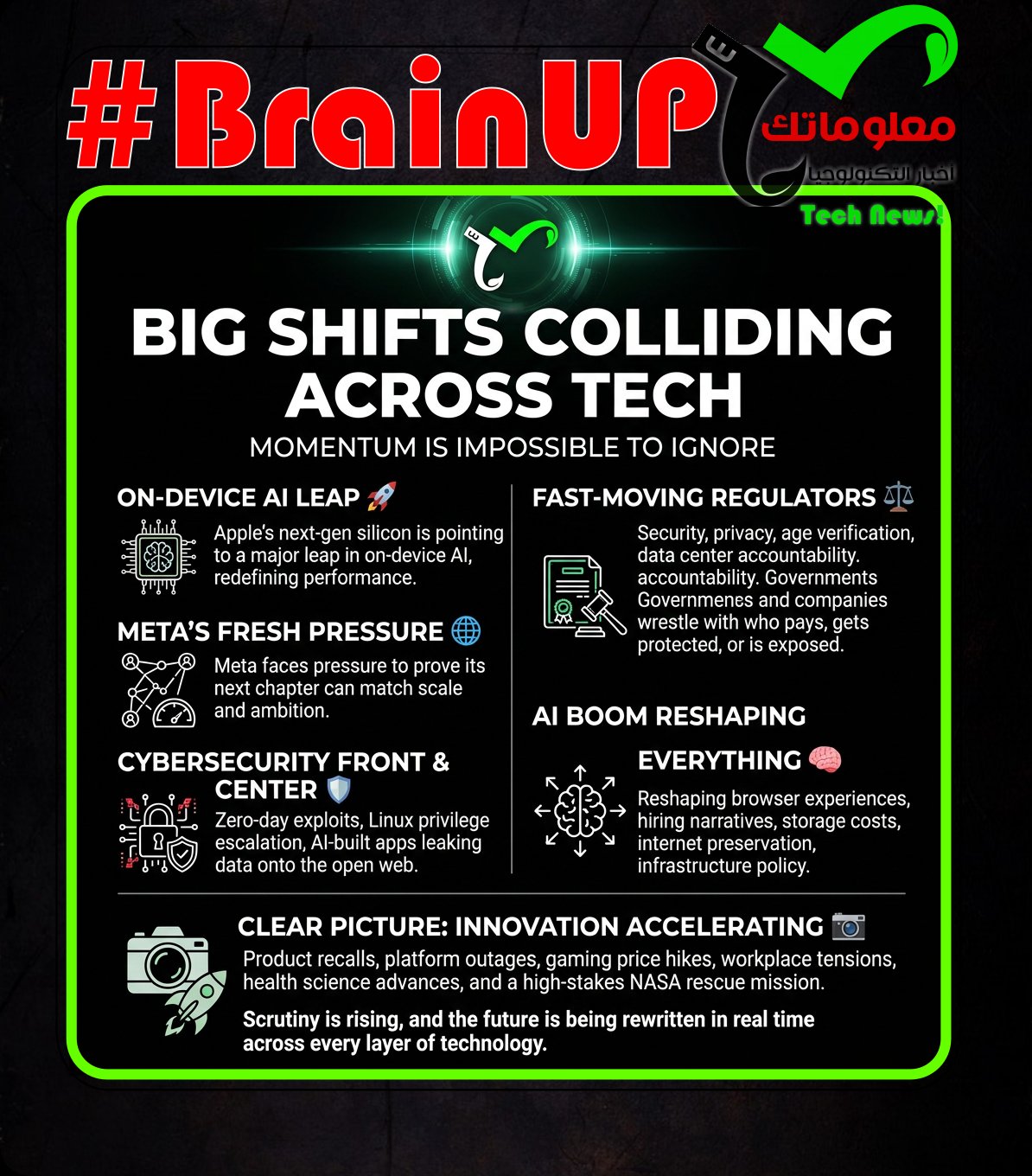
#BrainUp Daily Tech News – (Saturday, May 9ᵗʰ)
Welcome to today’s curated collection of interesting links and insights for 2026/05/09. Our Hand-picked, AI-optimized system has processed and summarized 23 articles from all over the internet to bring you the latest technology news.
As previously aired🔴LIVE on Clubhouse, Chatter Social, Instagram, Twitch, X, YouTube, and TikTok.
Also available as a #Podcast on Apple 📻, Spotify🛜, Anghami, and Amazon🎧 or anywhere else you listen to podcasts.
1. iPhone 18 Pro’s new A20 chip rumored to bring two major upgrades – 9to5Mac
The rumored A20 Pro for this fall’s iPhone 18 Pro and iPhone Ultra is expected to deliver unusually large gains via two major changes in #chipmaking and #packaging. First, it is said to be Apple’s first iPhone chip built on @TSMC’s #2nm process, a move from #3nm that should provide more performance headroom and better efficiency within a similar chip footprint, though specific target improvements are not yet known. Second, Apple is rumored to adopt #WaferLevelMultiChipModule packaging, integrating components such as the SoC and DRAM at the wafer level and connecting dies without an interposer or substrate, which can improve thermals and signal integrity. With memory physically closer, the chip could boost performance and lower power use for workloads like #AI processing and high end gaming, aligning with claims that iOS 27’s headline features may be AI centric. Overall, the combination of #2nm fabrication and #WMCM packaging is presented as the reason A20 Pro could be especially strong, particularly for AI focused tasks, in the next Pro tier iPhones.
2. Mark Zuckerberg’s Meta Faces New Challenges
Mark Zuckerberg’s Meta is confronting significant challenges as it strives to maintain its dominance amid shifting digital landscapes. Despite Meta’s vast resources and investments in the metaverse and artificial intelligence, competition from emerging platforms and regulatory pressures are intensifying. Analysts note that Meta’s ambitious pivot toward immersive virtual environments demands substantial innovation and user adoption to justify its expenditures. This evolving context compels Meta to balance technological advancement with public trust and privacy concerns. The outcome of this balancing act will crucially shape Meta’s future role in social media and digital interaction.
3. FCC Extends Update Deadline for Foreign-Made Routers, Drones Until 2029
The @FCC has extended the deadline for software and firmware updates on already authorized foreign made Wi-Fi routers and drones from 2027 to Jan. 1, 2029, aiming to reduce consumer harm from unpatched security flaws. The agency’s Office of Engineering and Technology granted a waiver allowing updates that patch vulnerabilities, maintain functionality, and support compatibility, covering both #ClassI and certain #ClassII permissive changes that mitigate harm to US consumers. The extension responds to national security driven bans pushed by the White House while addressing the practical risk that millions of widely used devices could become easier to hack without vendor updates. OET also said it will recommend the commission consider codifying the waiver via #rulemaking, which could lead to further extension or removal of the cutoff. The waiver applies only to already authorized devices, while new foreign made routers and drones remain banned unless vendors obtain conditional approval from the Pentagon or the Department of Homeland Security, with exemptions so far including Netgear and @Amazon’s eero but not @DJI or TP-Link.
4. Tesla is recalling its cheaper Cybertruck because the wheels might fall off
@Tesla is recalling its RWD Cybertruck Long Range because a brake rotor defect could lead to wheel separation. An #NHTSA notice says brake rotor stud holes may crack, letting a stud separate from the wheel hub, and the recall covers all 173 of the roughly $70,000 RWD Cybertrucks sold with 18 inch steel wheels. Tesla reports three potentially related warranty claims and says it is not aware of any collisions, fatalities, or injuries. The company attributes the risk to higher severity road impacts and cornering that can strain the stud hole, and it will replace the front and rear brake rotors, hubs, and lug nuts for free. The recall is the 11th for the Cybertruck, and it affects the discontinued RWD model, not the newer $60,000 dual motor AWD variant.
Utah State Senator @Jerry Stevenson was recorded getting physical with an ABC4 reporter amid controversy over a massive #dataCenter project he helped approve. ABC4 says reporter Bayan Wang and a photographer were covering alleged harassment toward Stevenson’s business, J&J Nursery and Garden Center, including reportedly harassed employees and social media calls to boycott, when Stevenson approached and slapped Wang’s phone out of his hand in the parking lot. A witness called authorities and a police report was filed, officers later told Wang the senator was apologizing, and the news crew was also served a one year trespassing notice from the property. The incident sits within broader backlash against #AI and data center expansion, where officials have faced escalating hostility, while Utah residents remain wary of environmental impacts from the 9 GW project, including on site natural gas power generation despite claims it will not connect to the grid. The project is still moving forward and MIDA is said to be planning additional town halls, with construction not expected to start soon.
6. DOGE used ChatGPT in a way that was both dumb and illegal, judge rules
A federal judge ruled that the Department of Government Efficiency’s cancellation of more than $100 million in National Endowment for the Humanities grants was unconstitutional because it used #ChatGPT and keyword screening to disqualify projects based on protected characteristics tied to #DEI. US District Judge @ColleenMcMahon cited evidence from a 2025 lawsuit and testimony that DOGE staffer Justin Fox submitted grant descriptions to ChatGPT with a standardized prompt asking whether each “relate[d] at all to DEI,” without defining the term and without understanding how ChatGPT interpreted it, and also applied “Detection Codes” like “BIPOC,” “Jewish,” “Indigenous,” and “LGBTQ” across grant descriptions. The decision says DOGE treated subjects involving race, national origin, religion, and sexuality as markers of “waste,” sweeping in grants about topics such as the Holocaust, civil rights, and Indigenous knowledge, despite those being expressly germane to NEH’s mission. McMahon rejected the government’s attempt to blame viewpoint-based classifications on ChatGPT, stating there is no meaningful distinction because ChatGPT was the government’s chosen instrument for the process. The ruling restores the federal grants that had been shut down using this approach.
7. Google Chrome May Have Quietly Installed a 4GB AI Model Onto Your Device
@Google Chrome may be installing the roughly 4GB on device AI model #GeminiNano onto some users’ devices without asking or clearly notifying them, according to Swedish computer scientist and lawyer @AlexanderHanff, also known as That Privacy Guy. He says the model is only installed if a device meets hardware requirements, and users typically would not know it is there unless they manually look for the OptGuideOnDeviceModel folder and the weights.bin file. A Google spokesperson told CNET the model can automatically uninstall if the device lacks resources, and since February Chrome has been rolling out a setting to turn off and remove the model so it will not download or update. Hanff argues the move may shift AI inference costs from Google’s servers onto users’ hardware and could raise European legal issues under the EU #GDPR principles of lawfulness, fairness, and transparency, and potentially reporting expectations under the #CorporateSustainabilityReportingDirective. Users who want to remove it can uninstall Chrome or disable the related flag by going to chrome://flags and turning off “Enables optimization guide on device.”
8. Laid-off Oracle workers tried to negotiate better severance. Oracle said no. | TechCrunch
After @Oracle cut an estimated 20,000 to 30,000 employees via email on March 31, some laid-off workers challenged the company’s severance terms and attempted to negotiate for better treatment, but Oracle refused. The severance package required signing a legal release and offered four weeks of pay for the first year plus one additional week per year of service, capped at 26 weeks, along with one month of #COBRA coverage, while providing no acceleration for soon-to-vest #RSUs, meaning unvested stock was forfeited even when tied to retention grants or promotion-related compensation. Workers also reported discovering they were classified as remote, which in many states limited access to #WARNAct protections, and the classification could sidestep WARN’s 50-people-at-one-location trigger even for hybrid employees near offices. Even when WARN applied, employees said Oracle effectively counted the two months of WARN notice pay within its existing severance formula rather than adding to it. A group effort emerged briefly, including a letter and a public petition signed by at least 90 people, but the negotiations did not change Oracle’s stance.
9. EU calls VPNs “a loophole that needs closing” in age verification push
The European Parliamentary Research Service says #VPNs are increasingly being used to bypass online #age-verification systems and calls this a legislative loophole as European governments expand child-safety rules that gate adult or age-restricted content. It notes VPN use surged after mandatory age checks took effect in places like the UK and some US states, with VPN apps reportedly topping UK download charts, and it cites proposals from policymakers and advocates, including England’s Children’s Commissioner, to restrict VPN access to adults or require age checks to use VPNs. The report and related debate highlight a tension between child protection and privacy, since forcing identity verification for VPN access could weaken anonymity and increase surveillance and data-collection risks, an approach opposed by VPN providers and privacy advocates. It also points to broader technical problems with #age-verification, including recent findings of security and privacy flaws in a European Commission age-verification app and the ease with which current methods, self-declaration, age estimation, identity checks, can be bypassed, while mentioning “double-blind” systems in France that confirm age without revealing identity or browsing destinations. The paper suggests regulators may increasingly target VPN use in law, referencing Utah’s SB 73 defining location by physical presence rather than IP even when VPNs or proxies are used, as the EU considers revisions to cybersecurity and online safety legislation.
@Sam Altman says some companies are engaging in “AI washing,” blaming layoffs on #AI that they would have made anyway, even as he expects genuine AI driven job displacement to become more noticeable in the next few years alongside new AI complementary roles. He cited a mix of false attribution and real displacement, while research evidence remains mixed: an #NBER survey found nearly 90% of surveyed C suite executives reported no AI impact on employment in the three years after #ChatGPT’s release, and a Yale Budget Lab analysis of U.S. labor data found no significant AI related shifts in occupation mix or unemployment duration through March 2026 for jobs with high AI exposure. Meanwhile, some leaders warn of major white collar disruption, and examples like @Evan Spiegel’s layoffs at #Snap and the #WorldEconomicForum report show many employers expect future staff cuts due to AI. Commentators argue AI washing can reflect firms deflecting from margin and revenue pressures tied to cautious consumers and geopolitical tensions, and from pressure to justify heavy AI investment, echoing past tech cycles where hype outpaced macro data, as noted by @Torsten Slok referencing @Robert Solow’s observation about limited productivity gains during the PC era. Overall, the article frames a gap between prominent AI layoff narratives and current macro labor indicators, while highlighting Altman’s view that true AI labor impacts are coming but are not yet clearly visible in aggregate data.
Internet preservation is getting harder because the #AI boom is driving a storage crunch and higher prices, while also triggering stricter anti-scraping defenses that interfere with archiving. According to 404 Media, large-capacity HDDs can cost up to 3x more as production capacity is constrained and booked by hyperscalers, and @Internet Archive says it maintains about 210 petabytes while adding roughly 100 terabytes per day, with founder @Brewster Kahle calling the situation a real issue costing time and money. The 28TB to 30TB drives it prefers are often out of stock or only available at inflated prices, forcing reliance on donors and workarounds, while @Wikimedia Foundation cites impacts on memory and drive purchases, server lead times, and future ordering capacity as it supports over 65 million articles. At the same time, sites trying to block #LLM scraping are increasingly blocking archival bots too, and even hobbyists report pausing archiving due to near-impossible MSRP pricing, leaving organizations like End of Term Archive hoping conditions improve before needed upgrades. Together, rising storage costs and broad anti-scraping measures are slowing how quickly and reliably the internet can be captured for long-term access.
12. Rising Fuel Prices Are Making Return-to-Office Mandates Harder to Defend
Rising fuel prices are complicating companies’ efforts to enforce return-to-office mandates as commuting costs increase for employees. Data from the U.S. Energy Information Administration shows gasoline prices reached highs not seen since 2022, putting financial pressure on workers who must drive to physical office locations. This trend challenges the business case for in-person work by increasing commuting expenses and reducing employee willingness to return, potentially impacting productivity and retention. Employers may need to reconsider strict office attendance policies or offer accommodations like remote work or subsidies to offset these costs. As fuel prices fluctuate, the tension between corporate goals and workforce needs highlights the evolving dynamics of post-pandemic workplace strategies.
13. Big data centers in Florida must pay full power and infrastructure costs under new law
@Ron DeSantis signed #Senate Bill 484 to stop large #data centers that power #artificialIntelligence from pushing higher utility costs onto Florida residents and small businesses. The law blocks electric utilities from shifting the cost of serving hyper scale facilities, requiring those companies to pay the full cost of electric service, including infrastructure upgrades tied to their energy demands, and directs the Florida #PublicServiceCommission to set new tariffs and service rules to enforce this. It also addresses water impacts by allowing water management districts to deny permits that would harm water supplies and encouraging use of reclaimed water, while preserving local governments’ authority to approve or reject data center projects. The measure reflects the administration’s view that local customers should not subsidize wealthy technology companies and is described as a first step toward stronger oversight of data centers and AI. At the same time, it permits local governments to sign non disclosure agreements with companies for up to a year, temporarily limiting public access to details about proposed projects.
14. ICE Plans to Develop Own Smart Glasses to ‘Supplement’ Its Facial Recognition App
#ICE is exploring developing smart glasses to supplement its #facial recognition Mobile Fortify app, which lets officers scan a person’s face to verify citizenship, according to a @Department of Homeland Security official and another attendee of a conference where a senior ICE official discussed the plan. The glasses, if built, would expand ICE’s use of #biometrics during enforcement activity. The article says this would represent another technological escalation tied to the @Trump administration’s mass deportation campaign. 404 Media previously reported that ICE and @CBP use Mobile Fortify to scan faces and instantly query multiple government databases to help decide whether to detain someone. Overall, the proposed smart glasses are framed as an add-on that could make Mobile Fortify’s identity checks more integrated into officers’ field operations.
15. Study finds cell phone bans in high schools do not boost grades
A recent study found that banning cell phones in high school classrooms does not significantly improve students’ academic performance. Researchers collected data from numerous schools implementing such bans and analyzed their impact on grades. The findings suggest that while #cellphone bans may reduce distractions, they do not translate into measurable gains in student achievement. The study emphasizes the need for schools to consider alternative strategies beyond outright bans to enhance learning outcomes. This highlights the complexity of addressing classroom distractions and achieving educational improvements.
16. Scientists are working on a hantavirus vaccine — but it’s likely years away
The hantavirus outbreak on the MV Hondius has renewed attention on vaccine development, but experts say an effective, widely available shot is still likely years away because progress has repeatedly stalled. @Sabra Klein says funding is limited since outbreaks are sporadic and often hit poorer countries, reducing incentives for drugmakers despite hantaviruses being dangerous hemorrhagic fever viruses. U.K. biotech EnsiliTech has worked for about 15 years on an #mRNA vaccine targeting the hantaan virus, and has focused on making it transportable at room temperature using “ensilication,” a silica cage that protects the mRNA, with rodent studies completed but no human testing yet. Co-founder @Matt Slade estimates early clinical trials are still 3 to 4 years away, and without an Operation Warp Speed-like push, Phase 2 and 3 trials could add about five more years, with other candidates also stuck in preclinical stages. @Ofer Levy notes China and South Korea have vaccines with mixed reported results that are not available outside those countries, underscoring how limited global options remain even as interest rises after the cruise ship outbreak.
17. Thousands of Vibe-Coded Apps Expose Corporate and Personal Data on the Open Web
Security researcher Dor Zvi and his team at RedAccess found that thousands of AI built, “vibe coded” web apps are being published with little to no #security or #authentication, leaving sensitive corporate and personal information openly accessible online. After analyzing apps made with Lovable, Replit, Base44, and Netlify, they identified more than 5,000 that were effectively public by URL alone or protected only by trivial gates like signing in with any email address, and Zvi estimates about 40 percent exposed data such as medical information, financial records, corporate presentations, strategy documents, and detailed chatbot logs. RedAccess located many of these apps by using simple Google and Bing searches against the platforms’ hosted domains, and shared examples WIRED verified as still exposed, including hospital work assignments with personal details, advertising spend data, go to market materials, customer chat transcripts with names and contact info, shipping cargo records, and other sales and financial records, with some apps potentially enabling administrative access. Zvi also says Lovable hosted phishing pages impersonating major brands like Bank of America, Costco, FedEx, Trader Joe’s, and McDonald’s, suggesting the risk extends beyond accidental exposure to outright abuse. When contacted by WIRED, Netlify did not respond, and the other companies disputed the researchers’ characterization and process but did not deny the exposed apps existed, underscoring how #AI coding platforms that rapidly publish hosted apps can amplify data leakage when users ship without basic access controls.
18. Ivanti warns of new ePMM flaw exploited in zero-day attacks
Ivanti has disclosed a critical zero-day vulnerability in its ePMM (enterprise Patch Management and Monitoring) product, actively exploited by threat actors in the wild. The flaw allows unauthorized remote code execution due to improper validation of user-supplied input, potentially granting attackers system-level access. Ivanti urges customers to apply security patches immediately to prevent further exploitation and recommends monitoring systems for unusual activity. This vulnerability underscores the importance of prompt patching in #enterprise_security to mitigate risks associated with zero-day exploits. Organizations using ePMM must prioritize updates and vigilance to maintain robust defenses against evolving cyber threats.
19. Linux Kernel Dirty Frag LPE Exploit Enables Root Access Across Major Distributions
The article describes Dirty Frag, an exploit chain that enables local privilege escalation to root on Linux systems. It states that Dirty Frag achieves root escalation by chaining multiple kernel flaws and that it impacts major distributions including Ubuntu, RHEL, and Fedora. The piece frames the issue as a significant risk because it can convert an existing foothold into full root access on widely used Linux platforms. It links the topic to broader security themes around how attackers accelerate breaches, but provides no additional technical details in the provided text.
20. Discord is back after an outage that took some users offline – Engadget
Discord experienced a brief outage that left some users unable to use the chat app, and it later reported service recovery. The company said at 3:08PM ET it was investigating an issue with its #API systems, then noted at 3:24PM ET it had identified the problem but users were still affected, including trouble logging in and sending messages. By 4:16PM ET Discord reported significant recovery, though at 4:59PM ET it said the service was not yet in a fully healthy state. At 6:38PM ET Discord stated that all critical functionalities had recovered for all users. The update reflects that the earlier availability problems tied to #API issues were remediated and the platform returned online.
21. New AirPods prove Apple is still the king of design
Apple’s new AirPods demonstrate the company’s continued leadership in design innovation, combining sleek aesthetics with advanced technology. The redesigned earbuds feature a more compact form factor, improved comfort, and enhanced noise cancellation capabilities, showcasing Apple’s dedication to user experience. By integrating the latest chip technology, the AirPods offer better battery life and seamless connectivity, reinforcing Apple’s ecosystem advantage. These improvements highlight Apple’s commitment to pushing the boundaries of wireless audio devices while maintaining its signature style. Overall, the new AirPods solidify Apple’s reputation as a design pioneer in the tech industry.
22. Nintendo Switch 2 price rise takes effect from September
@Nintendo will raise the global price of the Switch 2 from September, citing changing global market conditions and apologising for the impact on customers. The US price will increase from $449.99 to $499.99, and in most European countries from €469.99 to €499.99, while a revised UK price for the current £395.99 console will be confirmed later. In Japan, price changes arrive sooner, with a Japanese-language Switch 2, all versions of the original Switch, and #Nintendo online subscription services set to rise from 25 May. The article links the broader wave of #console price rises to higher costs and shortages of RAM and storage, driven in part by demand from #AI data centres, plus uncertainty from @Donald Trump tariff plans and potential supply chain effects from the war in Iran, noting similar moves by @Sony on #PlayStation 5 and delays by Valve.
NASA’s effort to save the $500 million @Neil Gehrels Swift Observatory from uncontrolled reentry advanced after Katalyst Space Technologies’ Link robotic servicing spacecraft completed key #environmental testing. NASA said Link finished testing at #NASA Goddard’s Space Environment Simulator on May 4, after vibration and thermal vacuum trials in which it fired three #ion thrusters, deployed one of its three arms, and endured space-like hot and cold temperatures, then shipped back to Katalyst in Colorado for additional prelaunch work. Swift, launched in 2004, lacks onboard propulsion and its orbit has decayed faster due to increased solar activity, dropping from about 600 km to 400 km, with reentry expected in late 2026 without intervention, prompting NASA’s September 2025 $30 million contract for a docking-and-boost mission described as fast, high-risk, high-reward. Because Swift’s orbit is inclined 20.6 degrees, Katalyst selected @Northrop Grumman’s #Pegasus XL air-launched rocket to meet the mission’s schedule and orbital requirements, underscoring NASA’s risk-tolerant, cost-conscious push to extend a critical observatory’s life via #satellite servicing rather than replacement.
That’s all for today’s digest for 2026/05/09! We picked, and processed 23 Articles. Stay tuned for tomorrow’s collection of insights and discoveries.
Thanks, Patricia Zougheib and Dr Badawi, for curating the links
See you in the next one! 🚀
