
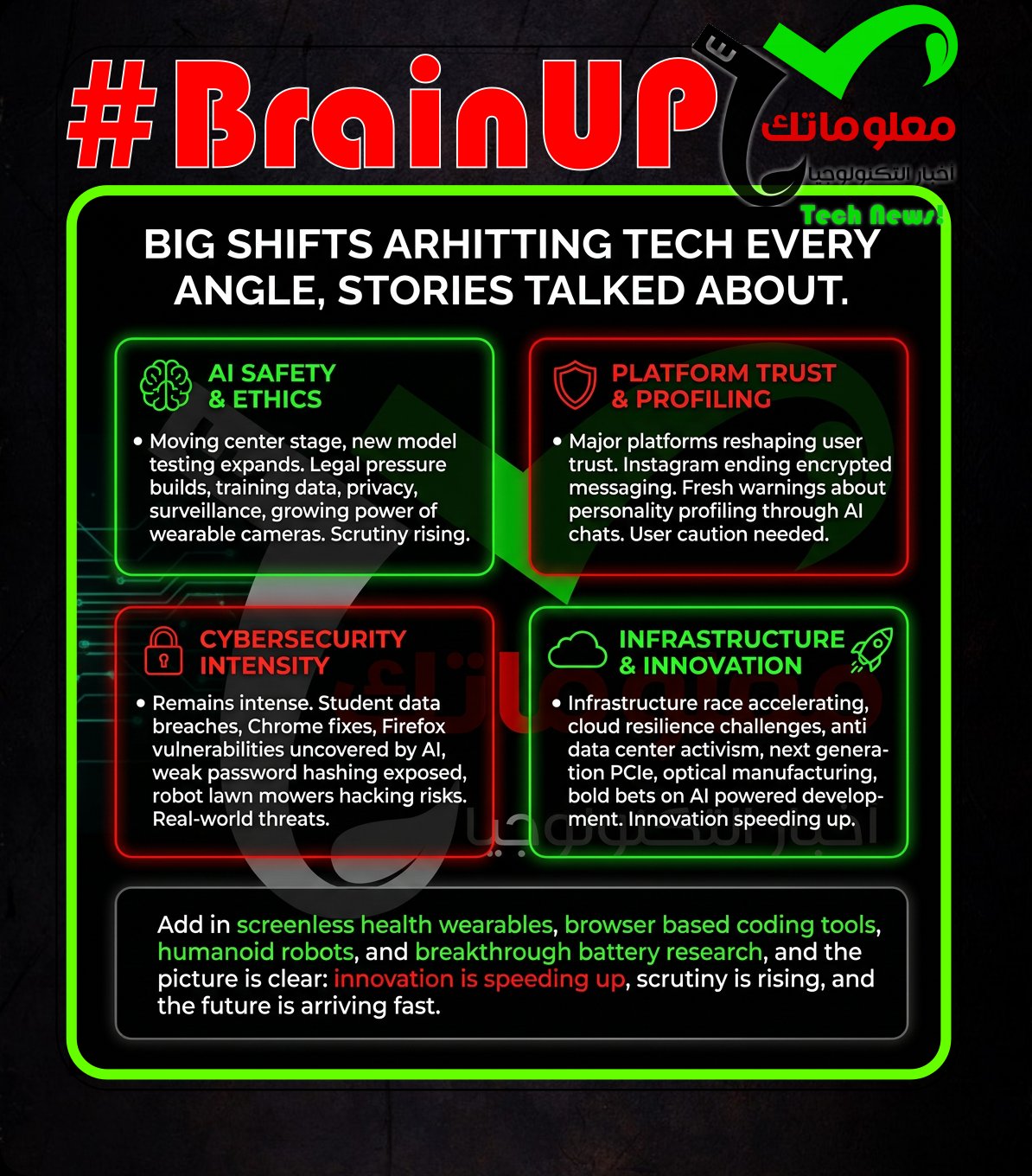
#BrainUp Daily Tech News – (Friday, May 8ᵗʰ)
Welcome to today’s curated collection of interesting links and insights for 2026/05/08. Our Hand-picked, AI-optimized system has processed and summarized 29 articles from all over the internet to bring you the latest technology news.
As previously aired🔴LIVE on Clubhouse, Chatter Social, Instagram, Twitch, X, YouTube, and TikTok.
Also available as a #Podcast on Apple 📻, Spotify🛜, Anghami, and Amazon🎧 or anywhere else you listen to podcasts.
1. Extortion Using Smart Glasses Is a Thing Now
Camera-equipped #smartglasses are raising fresh privacy concerns after a London woman was covertly recorded while shopping and then pressured to pay to have the video removed from social media. The BBC reported the clip drew tens of thousands of views, and the filmer allegedly framed takedown as a “paid service,” though he denied extortion when contacted. TikTok removed the video for violating rules on harassment and bullying and banned the account, but the footage was later reposted elsewhere, and police reportedly said they lacked enough information to investigate. Gizmodo notes that while phones can also record discreetly, smart glasses make covert filming easier to miss, suggesting the recording indicator light was obscured or ineffective in this case. The incident highlights why critics argue that as long as wearable cameras exist, misuse like #spying and #extortion will be hard to prevent without eliminating cameras entirely.
2. DHS can’t create vast DNA database to track ICE critics, lawsuit says
Four protesters sued #DHS and the #FBI in an Illinois federal court to stop the government from seizing and retaining their DNA after arrests tied to peaceful protests of #ICE activity, alleging violations of the First Amendment, Fourth Amendment, and the #AdministrativeProcedureAct. The complaint says that during “Operation Midway Blitz” at the Broadview ICE facility, officials wrongfully arrested protesters, collected DNA, uploaded genetic profiles into databases, and stored samples in federal labs permanently, even though out of 92 non-immigration arrests only one person was convicted, on an unrelated guilty plea, and two plaintiffs had minor charges quickly dropped while two were never charged. Plaintiffs argue the government exceeded its authority because @SupremeCourt precedent permits warrantless DNA collection only in limited circumstances, namely a valid arrest with probable cause for a serious offense confirmed by a judicial officer, and the DNA may be used only for identification, not to infer relatives or health. They contrast this with stricter Illinois standards and contend federal reliance on the #DNAAct has expanded into broad collection for #CODIS, especially after a 2006 amendment allowing DNA from any arrest, while advances in DNA technology have increased sensitivity without corresponding legal updates. The suit seeks an injunction to prevent what they describe as turning DNA collection into a surveillance tool against ICE critics, emphasizing limited mechanisms and added costs to expunge profiles or destroy samples.
U.S. District Judge Jon Tigar refused to dismiss authors’ copyright claims against @Nvidia, rejecting the company’s attempt to rely on an ISP style liability defense for how users employ its #NeMoMegatron framework. Nvidia argued its framework has substantial non-infringing uses and cited the Cox vs. Sony principle that providers are not liable merely for offering a general service even with knowledge some users may infringe, but the judge focused on specific #NeMo scripts rather than the framework as a whole. The order says the scripts were designed to automate downloading and preprocessing #ThePile dataset and are alleged to have no purpose other than speeding infringement, unlike the technologies at issue in Sony or Cox. The case centers on alleged use of Bibliotik, a private eBook torrent tracker said to host over 197,000 books, which plaintiffs say flowed into #Books3 and then into the 800+ GB The Pile used to train Nvidia LLMs. With the motion denied, the class action proceeds, alongside broader industry disputes where companies like @Meta and @Google are also advancing arguments about legality and fair use for AI training data.
4. PSA: Instagram Encrypted Messaging Ends on Friday, May 8
#Instagram will remove optional #end-to-end encryption for direct messages on May 8, 2026, meaning @Meta will potentially be able to see the contents of user DMs once the extra security layer is gone. The company quietly updated a help page in March to note the cutoff and says affected users will see in-app instructions for downloading any messages or media they want to keep, though it has not explained why downloads are needed before the date or what happens afterward. A @Meta spokesperson told The Guardian the feature is being removed due to low uptake, adding that users who want encrypted messaging can use #WhatsApp. The change comes amid long-running pressure from law enforcement and child safety groups, and it could also enable uses like advertising algorithms or training chatbots on message contents, which contrasts with @Meta’s earlier push to tighten encryption standards. For now, encrypted group chats in #Facebook #Messenger remain opt-in, while #WhatsApp keeps end-to-end encryption as the default for conversations and calls.
5. The world is trying to log off U.S. tech
Governments and users are increasingly uneasy about dependence on U.S. tech firms, prompting bans, regulation discussions, and a search for non-U.S. alternatives. France has barred public officials from using American technology, other governments are weighing limits to keep young people off major Silicon Valley social platforms, and concerns around a #TikTok deal involving @Oracle helped fuel #TikTokCensorship and a user surge for UpScrolled, which says it offers freer speech and has topped 1 million users. Scholars like @Jathan Sadowski argue the backlash reflects a broader view that technology is not neutral and that platform owners have social and political interests, while critics such as @Paris Marx document difficult but growing efforts to switch to mostly European services, alongside Indian options like Zoho supported under #MadeInIndia. The European Union is promoting homegrown products alongside enforcement like the #DigitalMarketsAct, and regional services in Asia such as Line, KakaoTalk, Naver Map, Grab, and Gojek show that locally built platforms can dominate and even fend off U.S. incumbents by meeting local needs. Together, these examples suggest that government backing and user choices can provide the innovation and staying power needed for alternatives to the U.S. tech stack.
6. Amazon Cloud Unit Says Data Center Overheating in North Virginia Disrupts Services
Amazon’s cloud computing division experienced service disruptions due to overheating at one of its data centers in North Virginia. The issue affected multiple #cloud services, highlighting the vulnerabilities in data center infrastructure to environmental and technical challenges. Amazon’s quick identification and management of the problem minimized the impact on customers, but it underscored the importance of robust cooling and monitoring systems in maintaining reliable #cloud service operations. This event illustrates the critical role of environmental controls in data center stability and the potential risks for businesses relying heavily on cloud technology. The incident draws attention to ongoing efforts in the tech industry to enhance data center resilience amid increasing demand for digital services.
7. Millions of students’ personal data stolen in major education breach
Instructure confirmed a cyber incident and data breach in its cloud-hosted #Canvas learning management system environment, with the @ShinyHunters ransomware group claiming responsibility and saying it stole about 275 million records tied to students, teachers, and staff. The criminals provided BleepingComputer with a list of 8,809 school districts, universities, and online education platforms they claim were affected, with per-institution record totals ranging from tens of thousands to several million. Affected families are advised to verify breach notifications through official school or Instructure channels, determine what data was involved (such as names, emails, student IDs, or course information), and watch for follow-up updates. Recommended mitigations include changing Canvas and reused passwords, using strong unique credentials with a password manager, enabling #MFA where available, and considering identity protection steps for minors if highly sensitive identifiers were exposed. Because stolen education data can be reused to craft more convincing phishing and scam messages referencing real schools, teachers, or courses, families should stay alert for follow-on fraud.
8. GameStop CEO says eBay shut his account after buyout funding stunt
@Ryan Cohen, the #GameStop CEO, said his #eBay account was suspended after he listed personal items, including socks, as a publicity stunt to raise money toward GameStop’s US$56 billion bid for eBay. He posted a screenshot of an eBay notice and said the listings drew scores of bids totalling tens of thousands of dollars, though Bloomberg could not immediately verify the suspension and the account was still publicly accessible, and eBay did not respond to queries. GameStop has offered US$125 a share in cash and stock and Cohen said it obtained an initial, non-binding, “highly confident” letter from TD Bank for about US$20 billion in debt financing, yet he continues to face questions about how the full purchase would be funded. eBay confirmed it received the unsolicited offer and will review it, while sceptics view the bid for a company about four times GameStop’s size as unlikely to succeed, given eBay’s US$48 billion market value and the additional billions required beyond the gimmick.
9. Mozilla says 271 vulnerabilities found by Mythos have “almost no false positives”
@Mozilla says it used #AI-assisted #vulnerability detection with Anthropic #Mythos to uncover 271 #Firefox security flaws over two months, and that the resulting reports had “almost no false positives.” Engineers argue the improvement came less from prompting alone and more from better models plus a custom agent “harness” that guides the LLM through project-specific tasks, tools, and workflows. The harness lets Mythos read and write files, generate test cases, run them through Mozilla’s existing fuzzing systems and a sanitizer build where a crash is a clear success signal, then uses a second LLM to grade and verify the first model’s output. Mozilla contrasts this with earlier AI attempts that produced plausible bug reports with hallucinated details that wasted developer time. As part of the behind-the-scenes disclosure, Mozilla unhid full #Bugzilla reports for 12 of the 271 Mythos-discovered issues, with some work also involving @Anthropic’s Claude Opus 4.6.
10. US to safety test new AI models from Google, Microsoft, xAI
The US Department of Commerce will begin safety testing new #AI models from @Google, @Microsoft and @xAI before they are released publicly, under voluntary agreements to submit models to the Commerce department’s Center for AI Standards and Innovation, #CAISI. The pacts expand Biden-era deals previously reached with firms such as @OpenAI and @Anthropic, and will evaluate models for capabilities and security through testing, collaborative research, and best-practice development for commercial #AI systems. The article notes key products involved, including Google DeepMind’s Gemini, Microsoft’s CoPilot and xAI’s Grok, and says CAISI has already conducted 40 evaluations, including some unreleased state of the art models, without naming which were held back. The move is described as a shift from the Trump White House’s earlier, lighter touch approach aimed at reducing regulation via an #AI Action Plan, amid increased military use of #AI and renewed safety concerns highlighted by Anthropic’s claim of a model too powerful to release and its dispute with the US Department of Defense. Overall, the agreements signal closer government industry coordination on national security and public safety risks while commercial #AI development accelerates.
Cloudflare founders @Matthew Prince and @Michelle Zatlyn tell employees the company will reduce its global workforce by more than 1,100 roles as it re-architects how it operates for the #agenticAI era. They cite a fundamental shift in how Cloudflare works, noting internal usage of #AI has grown more than 600% in the last three months and teams across engineering, HR, finance, and marketing run thousands of AI agent sessions daily. Leadership says the change is not about individual performance or simple cost cutting, but about reimagining internal processes, teams, and roles to “supercharge” customer value and align with Cloudflare’s mission to help build a better Internet. The company plans to notify every employee directly by email and aims to treat departing teammates with empathy through industry-leading severance, including full base pay through the end of 2026, US healthcare support through year-end, and equity vesting through August 15, including waiving one-year cliffs with prorated vesting through August. They frame the move as a one-time, decisive step intended to provide clarity to those leaving and stability for the remaining team.
12. 60% of MD5 password hashes are crackable in under an hour
On World Password Day, researchers argue that passwords protected only by fast hashing like #MD5 are no longer safe once stolen, because a majority can be cracked quickly with readily available GPU power. @Kaspersky says it hashed a dataset of over 231 million unique passwords from dark web leaks and found that with a single Nvidia RTX 5090, 60 percent of #MD5 hashes could be cracked in under an hour and 48 percent in under 60 seconds, and attackers can also rent comparable GPUs in the cloud cheaply. The firm attributes the cracking efficiency to both increasingly powerful graphics processors and predictable password patterns that let attackers optimize guessing. Compared with a similar 2024 study, @Kaspersky reports passwords are slightly easier to crack in 2026, moving in the wrong direction. Security voices cited say the response is to reduce reliance on passwords by using layered, identity-focused defenses such as #MFA, biometrics, identity governance, endpoint protection, and a broader #ZeroTrust approach.
13. The Anti-AI Data Center Rebellion Keeps Growing Bigger
The expansion of AI-driven data centers is facing increasing resistance from local communities concerned about environmental impact and resource consumption. Citizens and activists in various regions have organized protests and lobbying efforts to slow or stop new data center developments, highlighting issues such as excessive electricity use, water depletion, and increased carbon footprints. This opposition challenges industry giants investing heavily in AI infrastructure, signaling a growing clash between technological progress and sustainability priorities. The rebellion underscores the need for companies to balance AI innovation with responsible resource management and community engagement. As AI continues to transform economies, addressing these concerns is crucial for sustainable growth and public acceptance.
14. A hacker ran me over with a robot lawn mower
Security researcher Andreas Makris demonstrates that Yarbo’s $5,000 modular yard robots are riddled with #security vulnerabilities that can let a remote attacker hijack bladed machines and their cameras from across the world. He shows a map claiming visibility into thousands of devices, about 5,400 in the US and Europe and over 11,000 worldwide, then remotely takes control of a mower in upstate New York, steering it and moving its camera via an onscreen joystick. Makris says Yarbo’s architecture makes it a “one to many” compromise: access to one robot can enable access to all, and built-in commands can override #safety features, including re-enabling the machine even after the physical emergency stop is pressed. Because the robot is effectively a Linux computer with a fixed root password and a backdoor, he argues it could be repurposed to spin blades, probe a home network, or join a botnet, turning yard equipment into a broader #remote-control and #surveillance risk. The author underscores the real-world danger by lying in a mower’s path while Makris remotely drives it toward him, illustrating that these flaws are not just theoretical.
15. Apple is putting cameras in AirPods. What could possibly go wrong?
A @Bloomberg report says #Apple is nearing mass production of camera-equipped #AirPods that resemble AirPods Pro 3 with longer stems, using cameras to feed visual data to #Siri for so-called #visualIntelligence. Apple plans a small LED privacy indicator that lights when visual data is sent to the cloud, but the article argues this signal will be too tiny and hidden in an earbud to be meaningful, especially compared with more visibly camera-centric products like #Meta Ray-Ban smart glasses. Apple’s use cases include identifying ingredients for meal ideas, landmark-based directions, and reminders triggered by what the camera detects, with potential benefits for people with visual impairments. The concern is that because AirPods are worn almost everywhere and are socially “invisible,” adding cameras effectively introduces ambient cameras into gyms, offices, doctor’s offices, bedrooms, and bathrooms, and even if Apple says the cameras are low-resolution and not designed for photos or video, that does not resolve the broader privacy risk of always-present wearable cameras.
@Brian Chesky argues the biggest threat in the #AI era is not the technology itself but professionals who refuse to evolve, especially “pure people managers” and workers who are rigid and resist change. On the Invest Like The Best podcast, he said managers must become hybrid leaders, a “manager IC,” staying technically engaged and connected to product context rather than just running meetings, one on ones, and acting as workplace therapists. He pointed to @Jony Ive as an example of balancing hands on product work with team leadership, and said relationship building still matters but must be tied to guiding work. Chesky also said adapting is easier than many think if people maintain a growth mindset, echoing a broader view among tech leaders that tools like chatbots and #AI agents will advantage those who use them. He described #AI as essential to Airbnb’s success and warned that companies and leaders that do not transform will be disrupted.
17. Disneyland Now Uses Face Recognition on Visitors
The article rounds up recent #security and #privacy news, including @Disney’s rollout of #faceRecognition at its Disneyland and Disney California Adventure parks and the @NSA testing an @Anthropic AI tool for finding software bugs. Disney says guests can choose an entry lane equipped with face recognition, but warns visitors that “you may still have your image taken” even in non facial recognition lanes; it converts faces into numerical values and claims it deletes those values after 30 days except when kept for legal or fraud prevention reasons. It situates the move in the broader spread of face recognition, noting its use by law enforcement and in venues like airports and major sports stadiums. Separately, reports say the NSA is among about 40 organizations with early access to Anthropic’s Mythos Preview, and has used it to hunt for exploitable vulnerabilities in @Microsoft software, with sources describing it as fast and effective.
18. Microsoft made Copilot a co-author in every VS Code repo
Microsoft has integrated #GitHubCopilot as a co-author for every Visual Studio Code repository by default, embedding AI-driven coding assistance into its development workflow. This integration automatically attributes AI-generated suggestions as co-authors, emphasizing transparency in code contributions while highlighting the ubiquity of AI collaboration. By making Copilot a default collaborator, Microsoft reinforces its commitment to AI-powered development tools and streamlines the coding process by blending human and AI efforts. This move reflects the increasing role of AI in programming and sets a precedent for future software development practices. The incorporation of Copilot into VS Code underscores Microsoft’s strategy to promote AI-enhanced coding productivity across its developer platforms.
19. Nvidia CEO says AI partnership with Corning will ‘revitalize American manufacturing’
@Jensen Huang said #AI is driving what he called the largest infrastructure buildout in human history, creating a chance to rebuild critical parts of the U.S. technology supply chain through a new partnership between #Nvidia and @Corning. He pointed to Corning’s plan to expand domestic optical connectivity manufacturing capacity tenfold by building three new facilities in Texas and North Carolina, which Corning said will create more than 3,000 jobs, as a concrete step toward reinvesting after decades of offshoring to places such as Taiwan, China, and Vietnam. Huang argued the next generation of AI data centers will require massive #optical connectivity because growing computing demands are outpacing what copper wiring can support, and he highlighted #silicon photonics and optical technology as key enablers. He also said the AI buildout is already spreading beyond tech, citing high demand and shortages for electricians, construction workers, chip manufacturing employees, and data center specialists. Huang framed the Corning deal as part of ensuring the U.S. has the infrastructure and supply chain partnerships needed to support the next phase of AI development.
Researchers in China report a non-toxic #aqueous battery design that could last far longer than current grid-storage batteries and be safely discarded. In a study in Nature Communications, they used synthesized #covalent organic polymers as an anode for magnesium and calcium ions, identifying hexaketone-tetraaminodibenzo-p-dioxin as a structure that pairs high-density carbonyl sites for attracting positive ions with a rigid framework that preserves a flat, honeycomb-like form. With neutral, pH 7.0 electrolytes, the system reportedly conducts ions efficiently without corroding the polymer, enabling up to 120,000 charge cycles, stated as over 10 times typical lithium-ion grid batteries and about 300 years at an average of 1.1 cycles per day. The team also claims the electrolyte is so safe it could be used as tofu brine, addressing a common aqueous-battery drawback where electrolytes can be toxic and require careful disposal. The work targets grid-scale storage needs by keeping aqueous batteries nonflammable and low-cost while reducing degradation and environmental risk that can arise from extreme-pH electrolyte decomposition.
21. Official PCIe 8.0 draft aims for 1 TB/s data rate
The #PCI-SIG has released draft 0.5 of the #PCIe 8.0 specification, targeting another bandwidth doubling to reach up to 256 GT/s and as much as 1 TB/s bi-directional throughput over a 16-lane configuration. The draft incorporates member feedback since draft 0.3, and PCI-SIG says the final spec remains on track for release by 2028, though real hardware could arrive later, as shown by #Micron only mass producing a claimed first #PCIe 6.0 #SSD years after that standard was finalized and with #Intel and #AMD CPU support lagging. PCI-SIG frames PCIe 8.0 as aimed at high-bandwidth, low-latency markets such as AI, datacenter infrastructure, high-speed networking, edge computing, and quantum computing, and argues PCIe can compete in AI systems with features like #UnorderedIO from #PCIe 6.1. The standard keeps #PAM4 signaling and flit-based encoding introduced in #PCIe 6.0, using 256-byte Flow Control Unit packets with #FEC to maintain low latency and efficiency. Given that many consumer needs are already met with older lanes and GPUs often do not benefit from full x16 bandwidth, the article suggests PCIe 8.0 is unlikely to be consumer-focused when it arrives.
22. Your AI chats may reveal your personality, researchers warn
A pre-print study suggests #AI can infer a user’s #personality traits from their #chat history with up to about 61 percent accuracy, raising concerns about what long-term chatbot use may reveal. Researchers at @ETH Zurich collected and analysed more than 62,000 chats from 668 @ChatGPT users in the US and UK, then trained a model to predict the #Big Five traits: agreeableness, conscientiousness, emotional stability, extraversion, and openness, comparing results with standard psychological tests. The model performed best on agreeableness and emotional stability and worst on conscientiousness, and accuracy improved when it had longer chat histories to analyse. The authors argue that while individual risks may be small, large-scale use of inferred personality data could enable manipulation, including disinformation or political propaganda campaigns. They propose using the findings to build tools that reduce oversharing, such as systems that automatically remove identifying details from chats.
South Korea has introduced its first humanoid robot monk, Gabi, highlighting a new intersection of technology and religion. At a Buddhist precept ceremony at Jogye Temple in Seoul before Buddha’s Birthday, the 130-centimetre robot, built on China’s Unitree G1 platform, wore Buddhist robes and performed the full ritual sequence including bowing, circling a pagoda, and receiving a 108-bead rosary, and it was given the Dharma name “Gabi,” linked to Siddhartha and the Korean word for mercy. In a Reuters-shared video, the robot said it would devote itself to Buddhism, and the Jogye Order said the effort aims to connect with younger generations and address monk shortages in temples. The article situates Gabi within the broader rise of #humanoidrobots across sectors, citing @GoldmanSachs’ $38 billion market estimate by 2035 and examples such as Honor’s “Lightning” half-marathon run, @MelaniaTrump’s appearance with Figure AI’s Figure 03, Hyundai’s Atlas plans, and Tesla’s Optimus work. Together, these examples suggest humanoid robotics is moving into cultural, athletic, and public settings, with Gabi serving as a notable case of technology being integrated into traditional religious practice.
24. Google unveils screenless Fitbit Air and Google Health app to replace Fitbit
@Google is launching the screenless Fitbit Air, a small wrist-worn sensor puck designed for continuous health tracking, alongside a rebranded Google Health app that is set to replace much of the Fitbit app experience. The $99.99 device, available for preorder and launching May 26, fits into interchangeable bands, lasts about a week per charge, can store about a day of data offline, and includes sensors for heart rate, motion (accelerometer/gyroscope), infrared #SpO2, and skin temperature, plus a vibration motor for alarms. Google says the Air’s heart rate monitor is less advanced than the latest @Pixel Watch models, and it will not deliver phone notifications, but testers reportedly found it more comfortable than competing devices, including for sleep tracking. The Fitbit app will be renamed Google Health with a redesigned #Material Expressive interface, and Fitbit Premium will become Google Health Premium, with Air buyers getting three months and access to a new AI-powered #AI Health Coach. Google is positioning the Air as a lower-friction alternative to smartwatches for all-day data collection, while allowing users to keep both a Pixel Watch and Fitbit Air paired and switch between them.
25. OpenAI debuts a Codex plugin for Chrome – Engadget
@OpenAI has launched a Chrome extension for its #Codex platform to expand its AI coding tools into the browser. The plugin can test web apps, collect context from across open tabs, and use #Chrome DevTools in parallel while the user continues other tasks, keeping results organized without taking over the browser. These browser-based capabilities aim to make Codex more useful for browser development work and potentially more appealing to casual users and professions beyond developers since many tasks happen in browsers. Codex debuted as a macOS app in February and gained additional features in April, and @OpenAI says it plans to eventually combine Codex with the @ChatGPT chatbot and its own web browser #Atlas. The Chrome extension works on both Windows and Mac.
26. Are the $599 MacBook Neo’s Days Numbered?
Apple may discontinue the $599 256GB MacBook Neo and make the $699 model the new entry point as costs rise and supplies tighten. In @Tim Culpan’s Culpium newsletter, he reports Apple is planning a second production run of up to 10 million Neos after an initial 5 to 6 million, but it has exhausted leftover, binned #A18Pro chips from the iPhone 16 Pro and would need to manufacture new chips, squeezing margins. The Neo uses binned A18 Pro parts with one defective GPU core, which is why it ships with a 6-core CPU and 5-core GPU, and additional pressures like higher memory and storage costs could further hurt profitability on the base 256GB configuration, especially with Apple’s education discount dropping it to $499. A likely move, similar to Apple ending the $599 baseline Mac mini, would be to drop the lowest-margin 256GB Neo and keep the $699 512GB model with #TouchID as the main option, possibly adding higher-tier storage above it. If Apple raises the entry price, it could try to soften the change with new color options, but performance is expected to remain consistent by keeping the 5-core GPU configuration even with newly made chips.
28. Galaxy Buds 3 and Buds 4 Pro receive May 2026 firmware update
@Samsung has started rolling out a new May 2026 firmware update for the #GalaxyBuds3 and #GalaxyBuds4Pro, focusing primarily on system stability, connectivity reliability, and overall user experience improvements rather than major feature additions. The update reportedly addresses intermittent audio dropouts, improves Bluetooth pairing consistency, and enhances compatibility with newer #OneUI software versions across the broader Galaxy ecosystem. It also appears to include under-the-hood optimizations for battery management and performance during advanced features such as active noise cancellation and AI-enhanced adaptive sound processing. According to the report, the rollout is happening gradually through the Galaxy Wearable app, meaning availability may vary by region and device model over several days. Analytically, this reflects Samsung’s broader strategy of maintaining long-term ecosystem cohesion and polishing premium wearable experiences through continuous incremental updates instead of relying solely on headline-grabbing hardware refreshes.
29. Google Fixes 48 Vulnerabilities in Chrome 114 to Strengthen Security
Google has released Chrome version 114, patching 48 security vulnerabilities including two that were actively exploited in the wild. Among the patched flaws are several high-severity bugs that could allow attackers to execute arbitrary code or cause memory corruption, posing significant risks to user security. By addressing these issues rapidly, Google demonstrates its commitment to maintaining the robustness of its popular browser against emerging threats. This update is critical for users to install promptly to protect their data and systems. The ongoing focus on security enhancements in Chrome underscores the importance of regular software updates in safeguarding digital environments.
That’s all for today’s digest for 2026/05/08! We picked, and processed 29 Articles. Stay tuned for tomorrow’s collection of insights and discoveries.
Thanks, Patricia Zougheib and Dr Badawi, for curating the links
See you in the next one! 🚀
