
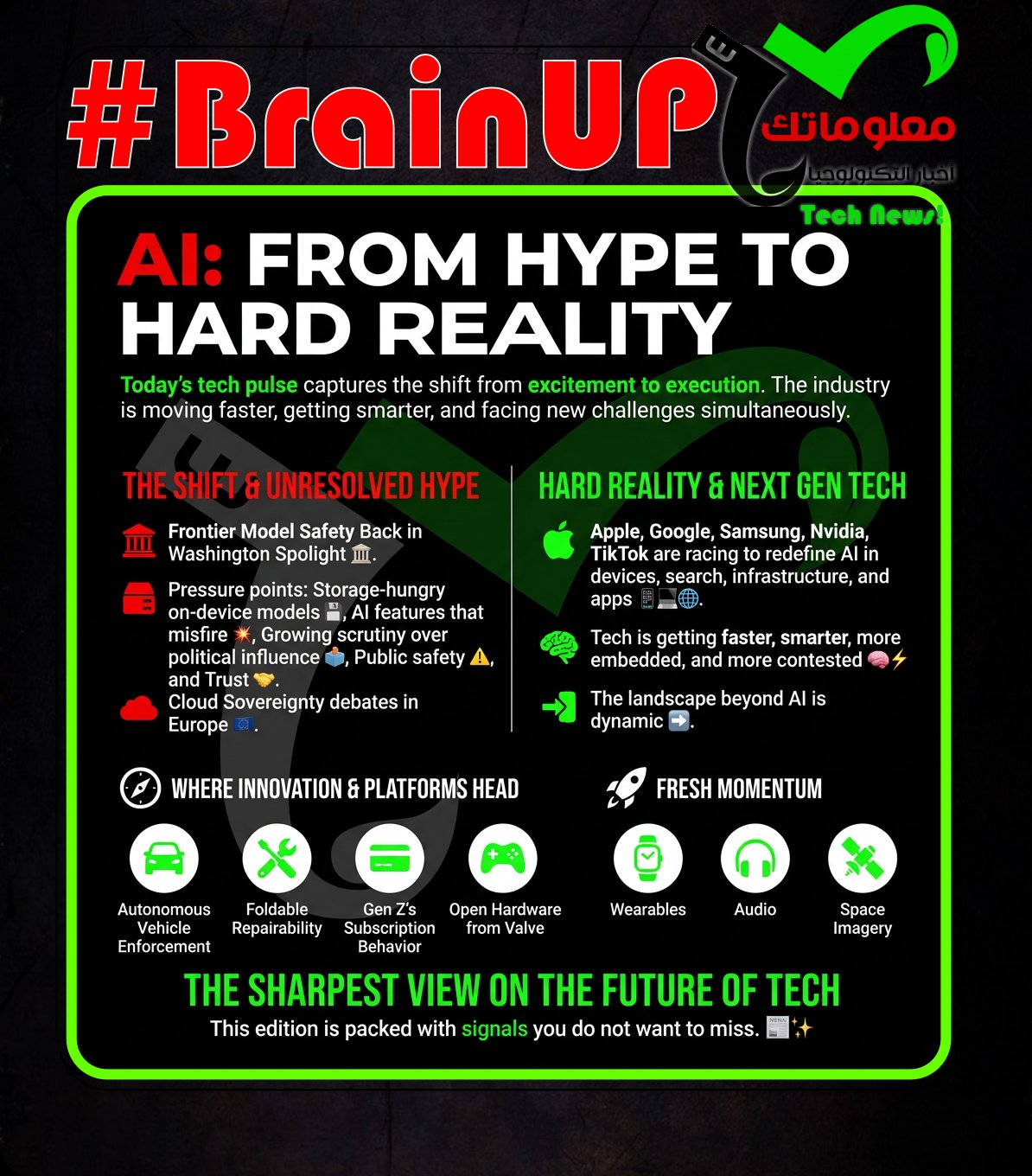
#BrainUp Daily Tech News – (Thursday, May 7ᵗʰ)
Welcome to today’s curated collection of interesting links and insights for 2026/05/07. Our Hand-picked, AI-optimized system has processed and summarized 25 articles from all over the internet to bring you the latest technology news.
As previously aired🔴LIVE on Clubhouse, Chatter Social, Instagram, Twitch, X, YouTube, and TikTok.
Also available as a #Podcast on Apple 📻, Spotify🛜, Anghami, and Amazon🎧 or anywhere else you listen to podcasts.
1. Spooked by Mythos, Trump suddenly realized AI safety testing might be good
The @Trump administration reversed course and entered voluntary agreements with #GoogleDeepMind, #Microsoft, and #xAI to let the renamed US AI Safety Institute, now the #CenterForAIStandardsAndInnovation (CAISI), run government #AI safety checks on frontier models before and after release, after previously rejecting #Biden-era voluntary testing as overregulation and even removing “safety” from the institute’s name. The shift followed @Anthropic’s decision not to release its Claude Mythos model due to fears that bad actors could exploit its advanced cybersecurity capabilities, and a report that an executive order could mandate government testing of advanced AI systems prior to release. CAISI says the new deals “build on” Biden’s policy, that it has completed about 40 evaluations including of unreleased models, and that it sometimes tests versions with reduced safeguards to better assess national security risks, supported by an interagency task force focused on AI national security concerns. Industry statements from Google DeepMind and Microsoft praise CAISI’s role, while xAI did not respond to comment. Critics warn CAISI may lack funding or expertise, that voluntary commitments may not deliver sustained transparency given secretive model designs, and that politicized evaluations could erode trust and discourage companies from participating, especially amid unresolved disagreements about what “safe” even means for frontier AI.
2. Christian content creators are outsourcing AI slop to gig workers on Fiverr
Generative #AI has reshaped Fiverr from a marketplace for specialized creative labor into a hub where gig workers rapidly produce cheap, dramatic Bible story animations for Christian social media creators. The article describes how AI generated Bible clips are common on TikTok, YouTube, Instagram, and Facebook, often featuring inconsistent visuals, mechanical narration, and simplified, emotion heavy storytelling that prioritizes fear and anger over scriptural detail, with styles ranging from Pixar like kids content to more photorealistic videos for older viewers. While audiences appear to watch them in large numbers, the creators behind these accounts rarely disclose that they outsource production, whereas Fiverr freelancers openly advertise past work and report steady demand. The story notes Fiverr’s move to become “AI-first” after laying off 250 employees, and observes that many top rated freelancers are based in Africa and South Asia, a pattern the article compares to how AI firms have outsourced training and data labeling abroad, though freelancers say this video work feels less extractive. One Nigerian freelancer, Dave, says tools like @ChatGPT, @Grok, and Leonardo AI lowered the barrier to storytelling and let him earn money without the long, resource heavy path of traditional animation, illustrating how outsourced AI production underpins the Bible video trend.
3. Taiwan cops say student’s radio kit brought bullet trains to a standstill
A university student in Taiwan was accused of disrupting Taiwan High Speed Rail by triggering an emergency signal that forced trains to stop, and he was later released on bail. Taiwan High Speed Rail said a 48-minute disruption affecting three trains on April 5 was caused by a rogue General Alarm sent from Taichung Station via a #TETRA handset, prompting staff to follow emergency protocols and instruct trains to manually halt. Investigators initially suspected an insider because the specialized radios are typically used by station staff, but rail police and telecom investigators later focused on a 23-year-old radio enthusiast identified as Lin, after the Major Criminal Cases Unit joined the probe on April 13. Authorities alleged Lin exploited a vulnerability in the #TETRA network and used rudimentary signal cloning with equipment bought online, including a setup that captured THSR radio signals through an apparent #SDR filter and retransmitted them to mimic a station employee. Police seized multiple radio devices and computing equipment, arrested Lin on April 28, and set bail at NT$100,000, framing the case as a transportation safety threat tied to misuse of specialized radio communications.
Apple has reduced the maximum #UnifiedMemory configurations for the Mac Studio and Mac mini as chip and memory supply constraints collide with rising demand from local #AI use. At launch, the Mac Studio could be configured with up to 512GB, but it is now capped at 96GB, and the Mac mini is capped at 48GB, down from 64GB; Apple previously discontinued the 512GB SKU and raised the 256GB upgrade price to $2,000. Demand surged as Unified Memory became popular for running local AI models and agentic AI apps like OpenClaw, stretching delivery times from about six days to as long as six weeks and beyond. Lead times remain long despite the cuts and price increases, with some Mac Studio configurations taking six to 10 weeks and Mac mini memory upgrades pushing delivery to 10 to 12 weeks, while higher-memory MacBooks are also seeing multiweek waits. @Tim Cook said Apple is chasing memory supply and expects constraints to persist for months, affecting earnings, even as more standard configurations like entry-level MacBook Airs and iMacs remain easier to buy.
5. FDA’s Delayed Review of Covid Vaccine Studies Sparks Criticism
The FDA faced criticism for delays in reviewing Covid vaccine studies, raising concerns about transparency and regulatory rigor. Reports indicate the agency postponed releasing critical data on vaccine efficacy and safety, prompting lawmakers and public health experts to question the timing and motives behind these decisions. The agency defended its actions, citing the need for thorough analysis to ensure public trust and vaccine effectiveness. This controversy highlights challenges in balancing rapid vaccine approval during a pandemic with maintaining stringent scientific standards. As trust in public health institutions is vital for successful immunization campaigns, the FDA’s delayed review could have broader implications for future public health crises.
6. Europe’s AI translation industry told it risks reputation by partnering with US firms
European leaders in #machine translation risk damaging their reputation and world-leading position after @DeepL decided to use @Amazon Web Services for infrastructure, amid fears this strengthens Silicon Valley’s control over digital infrastructure. The Cologne-based company, widely used by governments, courts and many Fortune 500 firms and reported to have made $185.2m in revenue, told paying subscribers it would no longer process data exclusively on its own servers and framed the AWS deal as necessary to scale internationally. Some customers reacted by cancelling, with Malogica’s CEO @Jörg Weishaupt citing discomfort uploading confidential documents and pointing to US laws such as the 2001 #Patriot Act and the 2018 #Cloud Act that can compel cloud providers to disclose data, alongside a past statement from a Microsoft legal director that data sovereignty in the EU cannot be guaranteed if US authorities demand access. DeepL said it remains the data processor, AWS is only a sub-processor, and that AWS will not control or access paid customer data in usable form because data is encrypted in transit and at rest and is not used to train DeepL’s models. The dispute links Europe’s competitive niche in professional translation to broader worries about trust, sovereignty, and dependence on US-based cloud infrastructure.
7. Big Tech Cut By 80,000 Jobs — Here’s What The Massive Layoffs Are Revealing
Big tech companies have collectively cut about 80,000 jobs in recent months, reflecting widespread efforts to control costs amid economic uncertainty and slowing growth. Companies such as Amazon, Meta, and Twitter led the layoffs, revealing a shift from aggressive hiring during previous tech booms to strategic downsizing. This reduction indicates the industry’s adaptation to current market conditions, including the post-pandemic slowdown and tightening monetary policies. The layoffs highlight an increased focus on efficiency and sustainable growth rather than expansion at all costs, influencing the broader tech labor market and investor expectations. Understanding these cuts provides insights into how the tech sector is recalibrating to balance innovation with financial stability.
8. Kash Patel claims AI has stopped school shootings: ‘I’m using it everywhere’
@Kash Patel says the #FBI has begun using #ArtificialIntelligence widely in the second @Trump administration and claims it has helped prevent school shootings by rapidly triaging incoming tips. He told @Sean Hannity the bureau stopped a potential school massacre in North Carolina after a tip was processed with AI, and said a separate planned shooting in New York was thwarted after a tip from private-sector partners involved in the FBI’s AI infrastructure. Patel argued that AI is necessary to handle the volume of weekly tips and said he has embedded major tech companies in the FBI to rebuild internet and classified systems and integrate AI into counterterrorism for faster results. He also said AI is being implemented at the National Threat Operations Center and is enabling quicker fingerprint checks and actions on fugitives and arrest warrants. Patel criticized prior FBI leadership for not adopting AI, saying their focus was “weaponization, not modernization,” and the article notes he has faced public criticism and was recently mocked in an @SNL sketch.
@Nvidia is investing $300 million in @Corning to expand U.S. optical fiber manufacturing and reduce a key #AI data center infrastructure bottleneck. The long-term deal funds three new facilities in North Carolina and Texas to supply optical fiber for hyperscale data centers deploying Nvidia AI hardware, with Corning projecting a 10x increase in its U.S. optical connectivity manufacturing output and over 50% growth in domestic fiber production capacity, plus about 3,000 jobs. The article argues that modern #AI workloads require massive clusters of accelerators and that meeting bandwidth and latency needs depends on optical fiber and #photonics, making high-speed data movement a major constraint. It also notes Corning’s position as the world’s largest optical cable maker with a 10.4% market share and that the plants are intended to support Nvidia-accelerated deployments rather than the broader industry. By securing supply and effectively gaining influence over a significant portion of U.S. fiber capacity, Nvidia aims to smooth deployment of its hardware and reinforce its dominance in American AI infrastructure.
10. TikTok’s algorithm favored Republican content in 2024 US elections, study finds
A study in Nature reports that TikTok’s #algorithm systematically prioritized pro-Republican content on the For You page in the run-up to the 2024 US election, based on experiments in New York, Texas, and Georgia. Researchers at New York University’s Abu Dhabi campus, including @Talal Rahwan and @Yasir Zaki, ran 323 dummy accounts conditioned to watch either pro-Democratic or pro-Republican videos, then analyzed more than 280,000 recommended videos over 27 weeks using human and AI review. Pro-Republican-trained bots saw about 11.5% more agreeable content than pro-Democrat-trained bots, while pro-Democratic-trained bots were about 7.5% more likely to see pro-Republican content, and the authors said Democratic accounts were shown significantly more anti-Democratic content than Republican accounts were shown anti-Republican content. The study also found issue-level differences in cross-partisan exposure, with immigration and crime surfacing more for pro-Democrat accounts and abortion more for pro-Republican accounts, which the researchers argued could indicate targeted amplification of attacks on the opposing side. TikTok disputed the findings, saying the experiment used fake accounts and did not reflect real user behavior, and that users shape what they see with many tools.
A new report finds #GenZ audiences frequently cycle entertainment subscriptions and purchases based on specific must-watch or must-play content, signaling weak #platformLoyalty. In the “Generations In Play: 2026 Audience Insights Report” from Dentsu and IGN Entertainment, 59% of Gen Z respondents said they actively subscribe and unsubscribe to streaming services to chase a single title, and the report argues this makes platform loyalty “effectively dead.” The same data says 62% of Gen Z will not pay full price for video games and prefer sampling through a gaming platform subscription, while 71% have stopped buying physical music and about 70% no longer buy hard copies of TV shows and movies. Despite the shift away from ownership and toward selective access, the study calls Gen Z the most theatrical generation, citing that they are 13% more likely than older moviegoers to attend opening weekend, described as a social, communal experience. The findings are based on research conducted by Kantar and @UCBerkeley with a survey of 6,250 highly engaged entertainment consumers in the U.S., U.K., and Australia, then synthesized using IGN Entertainment’s IMAGINE platform.
12. Valve releases Steam Controller CAD files under Creative Commons license
@Valve has released a full set of CAD files for the Steam Controller and its Puck so modders can design and build add-ons such as skins, charging stands, grip extenders, or smartphone mounts. The download includes external shell surface topology files in .STP and .STL formats plus engineering diagrams, with the diagrams highlighting areas that must remain uncovered to preserve signal strength and proper device function. This continues a pattern of #hardware openness, following earlier CAD releases for the Steam Deck, @Valve Index, and the original Steam Controller. The files are offered under a restrictive #CreativeCommons license permitting non-commercial use with attribution and a requirement to share designs back with the community, while suggesting commercial accessory makers contact @Valve to negotiate separate terms. Overall, the release aims to broaden the accessory ecosystem while keeping functional constraints and licensing boundaries clear.
13. Canadian Sues U.S. Homeland Security Over Alleged Google Data Demand After Anti-ICE Posts
A Canadian citizen identified only as “John Doe” filed a lawsuit against the U.S. Department of Homeland Security after the agency allegedly demanded extensive personal data from Google following his online criticism of U.S. immigration enforcement and the Trump administration. According to the lawsuit backed by the @ACLU, DHS used an administrative customs summons, not a court-approved warrant, to request highly sensitive information including identity details, location history, browsing activity, and communications tied to the user’s Google account. The plaintiff reportedly has not entered the United States in more than a decade, making the case especially controversial because it raises questions about whether U.S. authorities are attempting cross-border surveillance against foreign citizens for protected political speech. Civil liberties advocates argue the move represents a dangerous expansion of government power using broad #Surveillance and #DataCollection authorities originally intended for customs or trade investigations rather than monitoring dissent. The case is also part of a growing pattern of legal challenges accusing DHS of using administrative subpoenas and digital platform cooperation to unmask anonymous critics online without judicial oversight, intensifying fears around #Privacy, #FreeSpeech, and state monitoring in the age of cloud-based platforms and global tech infrastructure.
14. Cops Will Start Giving Tickets to Driverless Cars That Break the Law Starting with This State
California State Assembly Bill 1777 creates a formal process for law enforcement to cite #autonomous vehicles for traffic violations, with the law taking effect July 1, 2026. Under the bill, officers can issue a “notice of autonomous vehicle noncompliance” that records the date, time, location, and license plate number, and the California #DMV will review the report and decide whether a penalty is warranted, rather than officers handing a physical ticket roadside. In at-fault crashes involving a driverless vehicle, officers will issue the noncompliance citation to the operator’s representative, who must come to the scene. The bill also adds rules for operation around emergency responses and closed areas, including a dedicated emergency call line, a two-way communication device for first responders to reach a remote human operator, and required compliance within two minutes with emergency #geo-fencing messages that keep vehicles out of restricted zones. Additional provisions increase scrutiny through up to 500,000 miles of required testing depending on vehicle size and weight, annual first responder interaction plans, and new data reporting standards.
15. Google Search AI Mode Gets ‘Expert Advice’ From Reddit and Social Media
#Google is updating #GoogleSearch #AIMode and #AIOverviews to add a “preview of perspectives” drawn from public online discussions and social media. Results from sources like Reddit and forums may appear under labels such as “Expert Advice” or “Community Perspectives,” and include the creator name, handle, or community name for context. Google is also adding a “Further Exploration” section with suggested next topics, plus a “Subscribed” label so links from news sites a user subscribes to surface first. To make sources clearer, links will appear next to relevant text, and desktop users can hover to preview the destination with the site name or page title, addressing hesitation about where inline links lead. These changes are positioned as a way to improve link visibility and help users connect directly with original sources and creators.
16. Apple agrees to pay iPhone owners $250 million for not delivering AI Siri
@Apple agreed to pay $250 million to settle a class action lawsuit claiming it misled customers about the availability of #AppleIntelligence features, including an upgraded, more personalized #Siri. The proposed settlement covers US buyers of all iPhone 16 models and the iPhone 15 Pro purchased between June 10, 2024 and March 29, 2025, with qualifying claimants eligible for about $25 per device that may range up to $95 depending on claim volume and other factors. The suit alleged Apple’s marketing created a reasonable expectation that Apple Intelligence would be available at the iPhone 16 launch, but buyers received a limited or absent version of the promised capabilities, while Apple rolled out features like Image Playground, Genmoji, and a #ChatGPT integration later and delayed the more personalized Siri until later this year. The article also notes the National Advertising Division recommended Apple discontinue or modify an “available now” claim and that Apple pulled an iPhone 16 ad featuring @BellaRamsey, while Apple denied wrongdoing and said it settled to stay focused on product innovation. The agreement closes claims tied to feature availability while Apple continues expanding Apple Intelligence features across its platforms, according to its statement.
17. TikTok is pulling back on an AI feature that went haywire
TikTok is pulling back a test of an #AI feature that added on-screen text “AI overviews” to videos after it produced wildly inaccurate summaries. The tool, meant to add context, recommend similar products, and explain what was happening, sometimes hallucinated, for example describing @Charli D’Amelio as a “collection of various blueberries,” a dog training clip as origami art, and posts featuring @Shakira and @OliviaRodrigo with nonsensical descriptions. After user feedback, a TikTok spokesperson told Business Insider the feature has been updated to focus on identifying products in a video rather than describing full video contents. The experiment had been running for a few months and was available to a limited set of users in the US and a few other markets, and TikTok did not disclose which models powered it, saying in-app text referenced either TikTok AI or third-party tools. The change narrows the feature to a more constrained task in response to errors that undermined its goal of providing useful video context.
18. Samsung’s stable One UI 8.5 update officially lands on older Galaxy phones
@Samsung has begun rolling out the stable #OneUI 8.5 update to eligible Galaxy devices after four months of beta testing, with the release starting May 6, 2026 and arriving in stages. The #GalaxyS25 lineup and S25 Edge get it first, followed by the Galaxy S24 series, Z Fold 7, Z Flip 7, and Galaxy Tab S11 and Tab S10 lineups, and the rollout starts in South Korea before expanding to North America, Europe, and parts of Asia. The update includes interface and performance improvements and puts #GalaxyAI at the center with new communication and creative tools, but feature availability varies by device model and region. Full AI features are limited to Galaxy S, Tab S, and Z series devices, while recent Galaxy A, F, and M phones receive a reduced set branded as “Awesome Intelligence.” Overall, Samsung says more devices and regions will be added soon, and users who do not see the update immediately should receive it within the next week or two.
19. Xiaomi releases new affordable smartwatch internationally with 2,000-nit AMOLED display and NFC
Xiaomi has launched a new affordable smartwatch globally, featuring a 2,000-nit AMOLED display and NFC support, aimed at enhancing user experience with vivid visuals and contactless payment capabilities. The device boasts a high-brightness screen that ensures visibility even in direct sunlight, making it practical for outdoor use. It also includes health and fitness tracking features, aligning with Xiaomi’s emphasis on accessible health technology. This combination of high-end display technology and versatile features presents a competitive option in the budget smartwatch market, reinforcing Xiaomi’s commitment to providing quality wearable tech at affordable prices. The release expands Xiaomi’s presence internationally, addressing demand for cost-effective yet feature-rich smartwatches.
20. ‘iPhone Ultra’ Could Be Industry’s Most Repairable Foldable
Leaker @Instant Digital claims Apple’s rumored foldable, often referred to as the “iPhone Ultra,” will be the industry’s easiest #foldable phone to disassemble and repair thanks to its internal engineering and modularity. The leaker says the component stacking is “logical yet elegant,” avoids the complex ribbon cable routing common in rival foldables, and uses a stacked internal design that devotes space largely to the display and battery, including what is claimed to be the biggest iPhone battery yet. They link this to earlier reported design choices such as relocating volume buttons to the top edge to avoid running cables across the fold, plus features like #TouchID and Camera Control on the right side, an iPhone Air-style camera plateau, and limited color options. Additional claims include a roughly $2,000 launch price, eSIM-only operation, three storage tiers, and that teardown videos will validate the repairability approach once the device ships. The foldable is expected to launch in the fall alongside iPhone 18 Pro models, with rumored specs including a 7.8-inch inner display, 5.5-inch cover screen, A20 chip, C2 modem, #TouchID, and two rear cameras.
21. Bose’s New Wired Speaker Sounds Like Sonos on Steroids
@Bose is responding to @Sonos with a new wired “Lifestyle” lineup led by the $299 Lifestyle Ultra Speaker, a Bluetooth and Wi-Fi model positioned like the Sonos Era 100 SL but without a built-in battery, so it must stay plugged in. It uses a revamped version of Bose’s Direct/Reflecting tech with three drivers, including an up-firing driver meant to bounce sound off ceilings and walls for a bigger sense of space, plus #TrueSpatial processing that can make non-#DolbyAtmos audio sound more Atmos-like with multiple channels. In listening, the speaker reportedly fills a room easily and delivers unexpectedly strong bass aided by #CleanBass, combining a woofer, a proprietary QuietPort opening, and processing to boost low end without distortion. Bose is also leaning into multi-room and stereo pairing, and is revamping its app for unified control, while locking voice control to @Amazon’s Alexa+ only, which the author views skeptically. Preorders start at Bose.com now, with a May 15 release and color options including black and “White Smoke.”
22. Chrome’s AI features may be hogging 4GB of your computer storage
#Google #Chrome may be consuming unexpectedly large amounts of disk space because it can automatically download a roughly 4GB weights.bin file for the on-device #GeminiNano model when certain #AI features are enabled. Users reporting unexplained storage drops have found the file in the browser’s data folders, specifically under the OptGuideOnDeviceModel directory, and it supports tools like scam detection, writing assistance, autofill, and suggestions that run locally for privacy. Deleting the file alone may not work because Chrome can re-download it, so freeing the space requires turning off the On-Device AI option in Settings, System to disable those features and prevent reinstalls. The article notes Google mentions model size variability in a long guide rather than at the point of enabling features, and argues clearer storage warnings or a cloud-based option could have reduced confusion. A Google spokesperson says #GeminiNano has been offered since 2024, can auto-uninstall on low resources, and since February users have been able to turn off and remove the model in Chrome settings so it will no longer download or update.
23. Apple to let users choose rival AI models across iOS 17 features: Bloomberg News
Apple plans to allow users to select from competing AI models within iOS 17, which is expected to launch later in 2026. According to Bloomberg News, this shift represents a notable change in Apple’s traditionally closed AI ecosystem by integrating third-party AI services alongside its own. The move is anticipated to enhance user experience by offering a broader range of AI capabilities, fostering competition and innovation in AI functionalities in Apple devices. This strategy reflects Apple’s response to growing user demand for more customizable and flexible AI implementations. Overall, this change aligns with Apple’s broader efforts to evolve iOS and remain competitive in the rapidly advancing field of #ArtificialIntelligence.
24. Google teases Fitbit Air launch on Thursday, May 7
Google is teasing a launch of the screen-less Fitbit Air for May 7, following initial hints that began in late March. The official Fitbit Instagram account cleared its images, directed users to @madebygoogle, and posted a teaser captioned “Buckle up. 5.7.26.” alongside images showing a shiny metal buckle and light blue strap reminiscent of the Pixel Watch Woven Band. Reporting also points to a broader branding shift, with “Fitbit” remaining the hardware name while a “Google Health” app and a “Premium” subscription handle software, accompanied by a new heart-shaped icon in Google colors with a gradient. The timing suggests @Google wants the Fitbit Air to have its own news cycle ahead of Google I/O, rather than being folded into the developer conference. Altogether, the teaser and related branding notes position the Fitbit Air as a near-term product release tied to #GoogleHealth and subscription software plans.
25. The animated version of the iconic “Hello, world” image reveals striking new details
@NASA’s newly released archive of more than 12,000 #Artemis II photos enabled an enhanced, animated look at the famous “Hello, world” Earth image captured by Commander @Reid Wiseman from the Orion spacecraft. Using 17 consecutive frames from the sequence, Andy Saunders processed the images with color and contrast adjustments and animated them at 30x speed to cover about 1 minute and 20 seconds of real time, then zoomed in to highlight details the original still did not show. The animation reveals lightning storms, aurorae, and multiple satellites, with features that appear to include visible solar arrays. That apparent satellite detail is puzzling because the implied scale would require kilometer wide arrays, so the effect may be optical and related to Orion’s window. Even with that uncertainty, the sequence provides a more dynamic view of Earth as an active planet both on the surface and in the atmosphere above.
That’s all for today’s digest for 2026/05/07! We picked, and processed 25 Articles. Stay tuned for tomorrow’s collection of insights and discoveries.
Thanks, Patricia Zougheib and Dr Badawi, for curating the links
See you in the next one! 🚀
