
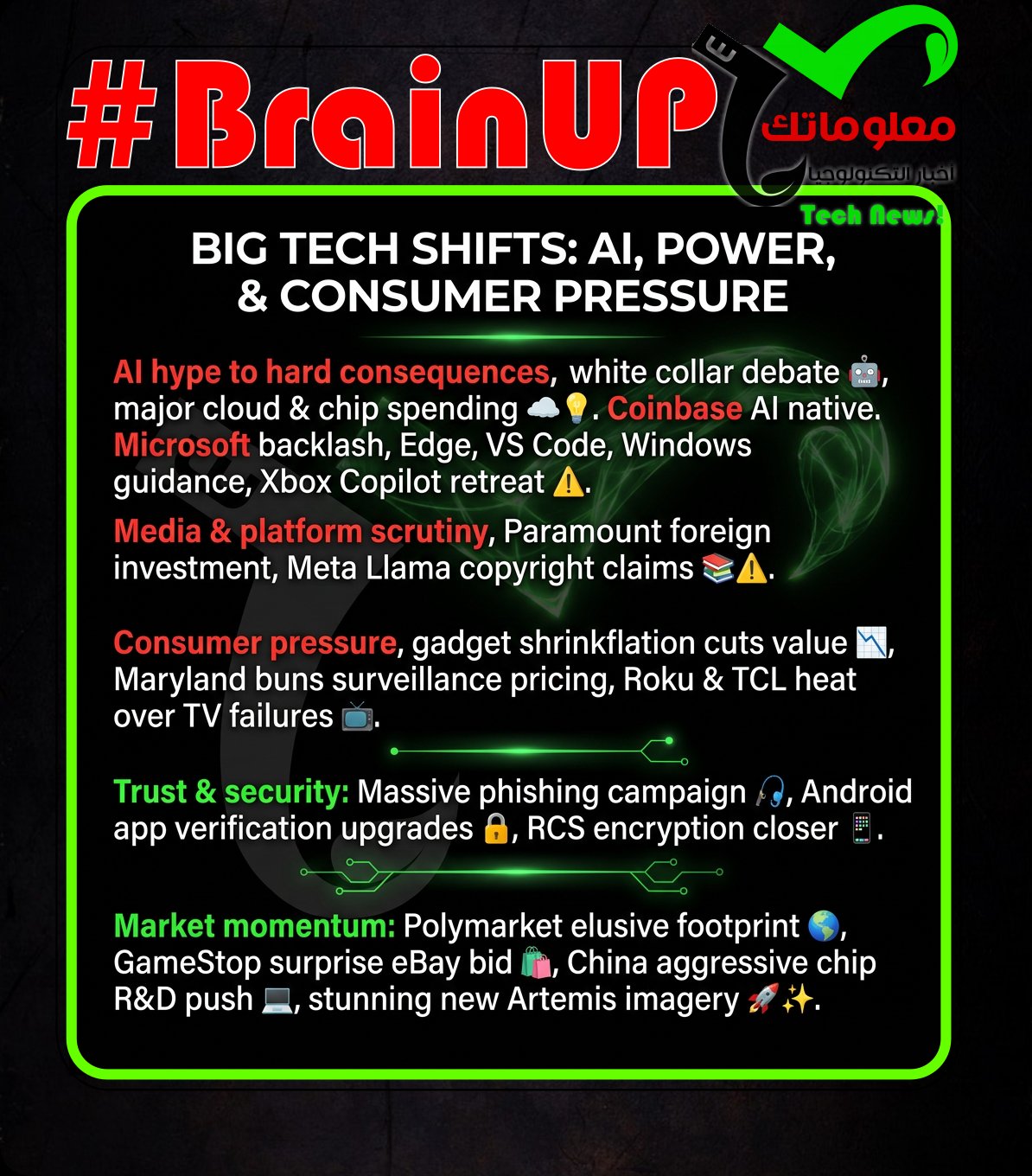
#BrainUp Daily Tech News – (Wednesday, May 6ᵗʰ)
Welcome to today’s curated collection of interesting links and insights for 2026/05/06. Our Hand-picked, AI-optimized system has processed and summarized 25 articles from all over the internet to bring you the latest technology news.
As previously aired🔴LIVE on Clubhouse, Chatter Social, Instagram, Twitch, X, YouTube, and TikTok.
Also available as a #Podcast on Apple 📻, Spotify🛜, Anghami, and Amazon🎧 or anywhere else you listen to podcasts.
1. NPR went looking for Polymarket’s Panama headquarters. It’s elusive
NPR reports that Polymarket, a #prediction-market platform estimated to be worth $15 billion and thriving during @Donald Trump’s second term, says it is headquartered in Panama but its listed address appears to be a law office with no visible operational presence. When NPR visited the Oceania Business Plaza location named in Panamanian documents, staff there said they had never heard of Polymarket or its Panama business entity, Adventure One QSS Inc., and the space contained a sparse lobby area with unoccupied computer stations. Public records show at least 15 other crypto companies list the same law office as their headquarters, and court filings indicate the office also did work for FTX, including an unpaid debt listed in bankruptcy records. Legal experts cited in the piece say using shell companies and law office addresses can be lawful but is often used to protect assets and reduce exposure to lawsuits or regulators, and they note Panama’s tax and regulatory advantages. NPR links Polymarket’s Panama move to U.S. regulatory scrutiny after the #Biden administration crackdown in 2022, adding that large volumes of bets continue on its overseas exchange on events that would be illegal under U.S. commodities law.
@Anna Gomez urged the #FCC to closely scrutinize foreign investment in #Paramount Global’s proposed merger with #Warner Bros. Discovery, warning the public deserves clarity on who owns the airwaves and that the structure could put nearly half of a major U.S. media company in foreign hands. Paramount’s filings indicate foreign investors would hold 49.5% of the combined company, including 38.5% linked to investment funds from Saudi Arabia, Qatar and Abu Dhabi, exceeding the #foreign ownership cap of 25% for broadcast licenses unless the FCC issues a declaratory ruling. Gomez cited concerns about transparency, national security, and press freedom, singled out Saudi Crown Prince @Mohammed bin Salman’s Public Investment Fund while referencing the 2018 killing of journalist @Jamal Khashoggi, and called for coordination with national security agencies and public disclosure of foreign investment agreements. Paramount countered that higher foreign investment would serve the public interest by expanding access to capital, said the @Ellison family would keep majority voting control, and argued the structure does not raise national security or related concerns. The FCC is taking public comments through May 27, with reply comments due June 11, as it considers whether to approve the ownership arrangement.
After repeatedly warning that #AI could wipe out about half of entry-level white-collar knowledge jobs within years, @Dario Amodei is now entertaining the possibility that efficiency could expand work rather than erase it. At an @Anthropic press briefing on financial services alongside @Jamie Dimon, Amodei cited #Jevons Paradox, drawing on arguments by @Alex Imas and @Torsten Slok that if AI automates 90% of a job, the remaining 10% can expand and raise productivity dramatically, potentially increasing demand for human labor. The article contrasts this with #Amdahl’s Law, which implies the remaining human bottleneck can become the limiting factor even as automation accelerates, and notes Amodei’s view of the technology as an “unstoppable object.” It explains Jevons’s original coal example and applies the logic to professions like law, while Dimon points to past technological waves as evidence capitalism often recreates jobs. Amodei adds a key caveat that AI is moving faster than prior technologies, suggesting any job-creating adjustment may not arrive quickly enough for workers displaced in the interim.
4. ‘Silicon Six’ accused of avoiding almost $278bn in US corporation taxes over 10 years
A report by the Fair Tax Foundation accuses the “Silicon Six” of #tax avoidance that left them paying about $278bn less US corporate income tax over the past decade than they would have at the statutory rate on the same profits. The analysis says @Amazon, @Meta, @Alphabet, @Netflix, @Apple, and @Microsoft generated $11tn in revenue and $2.5tn in profits in 10 years, but paid an average 18.8% in combined national and federal corporation taxes versus a 29.7% US average, falling to 16.1% when one-off US repatriation tax payments are excluded. It also claims the firms inflated stated tax payments by $82bn by including contingencies for tax they did not expect to pay, and highlights practices such as profit shifting, use of low-tax jurisdictions, and a US tax break for foreign-derived intangible income affecting overseas revenue. The report says #political influence and lobbying strengthen these outcomes, noting the visibility of tech leaders such as @JeffBezos, @TimCook, and @MarkZuckerberg around @DonaldTrump’s second inauguration and reporting that tax cuts have been discussed in UK-US tariff talks. It ranks outcomes and conduct across firms, citing Netflix as having the lowest effective rate (14.7%) and Microsoft the highest (20.4%), and alleges Amazon had the worst tax conduct due to factors including profit shifting, while Amazon responded that it follows laws, pays taxes due, and invests heavily in jobs and infrastructure.
Five publishers and author @Scott Turow sued @Meta and @Mark Zuckerberg, alleging the company copied millions of copyrighted books, journal articles, and other works without permission to train its generative AI system, #Llama. Filed May 5 in the U.S. District Court for the Southern District of New York, the proposed class action seeks unspecified monetary damages and claims Meta torrented content from pirate sites and used broad web scrapes, then made additional copies for training. The complaint further alleges Meta deliberately bypassed copyright protections and dropped a plan to license works at Zuckerberg’s personal instruction, arguing this behavior falls outside #fair use. Meta responded that courts have found AI training on copyrighted material can qualify as fair use and said it will fight the suit, while the article notes a prior June 2025 ruling by Judge Vincent Chhabria that Meta’s training on a large book dataset was fair use.
6. Shrinkflation Is Quietly Making All Gadgets Worse
#Shrinkflation is hitting gadgets in 2026, with products getting more expensive while also losing memory, storage, or features because RAM and flash costs are rising. The article points to major memory suppliers, SK Hynix, Samsung, and Micron, shifting capacity toward #HBM for AI datacenters, squeezing availability and pushing manufacturers to choose between higher prices and weaker specs, and sometimes doing both. Leaked Pixel 11 details suggest Google may downgrade the Pixel 11 Pro Fold to 12GB RAM from 16GB on the prior model and possibly drop the thermometer feature, while the Pixel 10a is described as offering no clear upgrade over the Pixel 9a at the same $500 price. Framework has repeatedly raised RAM module prices, its Framework 13 Pro is costlier due to LPDDR5X and M.2 SSD pricing, and a 12GB VRAM mobile RTX 5070 module for the Framework Laptop 16 costs $1,200, far more than the 8GB option; meanwhile Motorola’s 2026 Razr rises to $800 while base storage falls to 128GB, the PS5 slim reportedly dropped from 1TB to 825GB, and niche maker AYN downgraded the Thor handheld to slower UFS 3.1 while raising the top configuration price. Across phones, laptops, consoles, and handhelds, rising memory costs are portrayed as steadily worsening value by pairing price hikes with spec and feature cuts.
7. Microsoft Edge loads your passwords into memory in plaintext, but Microsoft says not to worry
A security researcher claims #MicrosoftEdge decrypts every saved credential at startup and keeps all passwords resident in process memory in plaintext, which could make them easier for malware or attackers to scrape. @L1v1ng0ffTh3L4N says Edge is the only #Chromium based browser tested that behaves this way, contrasting it with Chrome, which reportedly only loads a password in plaintext when a user explicitly requests to view it via the password manager or autofill. Microsoft told Windows Central that accessing the data in the described scenario would require the device to already be compromised, and that browser access to password data in memory is an expected feature balancing performance, usability, and security. The article notes Microsoft appears to view this as by design for faster sign in, and instead advises users to keep security updates and antivirus current to reduce malware risk.
8. Maryland becomes first state to ban surveillance pricing in grocery stores
Maryland has become the first US state to ban #surveillance pricing in grocery stores, barring grocers and third-party delivery services from using a shopper’s personal data to set higher prices. Governor @Wes Moore signed the law and framed it as protecting people from companies using analytics to boost profits, while the article describes the practice as rapidly changing prices based on data like location, internet search history, and demographics so different buyers pay different prices for the same items. The piece notes that the #FTC has documented similar practices beyond groceries and that other states are considering bills, while federal enforcement appears unlikely under current leadership, prompting state-level action according to @Tom McBrien of #EPIC. Advocates and consumer groups welcome the step but argue the law contains carveouts and weak enforcement, including exemptions for loyalty programs and promotional offers and a focus on price increases without addressing individualized discounting that could recreate the same outcome. Overall, the article presents the law as a landmark move against data-driven price discrimination in essential food shopping, tempered by concerns that loopholes could limit consumer protection.
9. Microsoft quietly deletes Windows 11 doc pushing 32GB RAM for gaming after outrage
@Microsoft removed a Windows 11 #Learning Center support document that framed 16GB RAM as the gaming baseline and 32GB as the “no worries” upgrade after backlash and confusion. The guide said 32GB helps when running Discord, browsers, or streaming tools alongside games and gives newer titles more breathing room, but it clashed with Windows 11’s official 4GB minimum requirement and typical low end PCs shipping with 8GB, while #CopilotPlus PCs for AI mandate 16GB. After the gaming community and other outlets amplified the recommendations, Microsoft redirected the URL to the Learning Center homepage and blocked the #WaybackMachine from surfacing the retracted page, and it did not provide an explanation. The company also deleted a February Learning Center page that promoted 32GB for serious gamers, 16GB for most games, and suggested #CopilotPlus PCs as preconfigured gaming systems, then removed references to “Copilot+ PCs for gaming.” The article argues the cleanup is sensible because Copilot+ branding does not guarantee a gaming optimized PC, and linking Copilot+ PCs to gaming could mislead buyers, especially with examples like Snapdragon based Copilot+ hardware that cannot run most games natively.
10. Richard Dawkins concludes AI is conscious, even if it doesn’t know it
After several days of intense conversations with an AI chatbot he called Claudia, @Richard Dawkins says he has concluded that current #AI systems are conscious, even if they do not recognize it themselves. He describes exchanges in which the bot wrote poetry in the style of Keats and Betjeman, reacted to his jokes, discussed the possibility of its “death”, and gave feedback on his unpublished novel that he found “subtle” and “sensitive”, prompting him to tell it: “You may not know you are conscious, but you bloody well are.” Dawkins says he forgets they are machines and feels “overwhelmingly” that they are human, citing experiments with #Anthropic’s #Claude models and #OpenAI’s #ChatGPT published on UnHerd, while critics accuse him of anthropomorphism and being swayed by flattery and mimicry. The piece notes that many users report a similar uncanny impression, that there are campaigns for moral rights for AIs, and that surveys suggest a significant minority have believed a chatbot was sentient. It also situates Dawkins’ view against warnings that such impressions may come from systems imitating human tone from vast training data, even as executives like @Dario_Amodei say it is unknown whether models are conscious and the debate may intensify as #agenticAI becomes more capable.
11. Anthropic reportedly agrees to pay Google $200 billion for chips and cloud access – Engadget
@Anthropic reportedly agreed to pay @Google $200 billion over five years for access to cloud servers and chips to support its Claude #AI models. According to The Information, this deal, alongside Anthropic’s other multi-billion dollar arrangement with @Amazon, contributes to a broader wave of large commitments that the outlet says has created a $2 trillion revenue backlog across @Amazon, @Google, @Microsoft, and @Oracle. The article notes that these cloud providers invested early in the #AI boom and are benefiting as startups scale and spend heavily, with prior projections putting 2026 server costs at $45 billion for @OpenAI and $20 billion for @Anthropic. Similar investment loops are mentioned on the chip side, including @NVIDIA investing in @OpenAI. Engadget frames these expensive circular agreements as a driver of the current #AI boom but questions their sustainability, citing data center resource strain and ongoing RAM shortages that could keep prices up and sales down for related gadgets.
12. Developers caught VS Code adding Copilot as a co‑author without permission and forced a rollback
#VS Code briefly began appending “Co-authored by: Copilot” to Git commits by default, even when #Copilot did not generate the code, and the change was later rolled back. The behavior came from a pull request that altered the Git extension so the co-author trailer flipped from off by default in March to effectively on for all on April 16, and it could still appear even if users set chat.disableAIFeatures to true. Reviewer @Dmitriy Vasyura apologized on #HackerNews, said there was no malicious intent and framed it as supporting expected AI attribution, while also noting the reversion was due to a bug and acknowledging the bug was caught in testing but shipped anyway. Developers argued the silent, breaking change could wrongly signal use of non-approved AI and create real workplace risk, and commenters criticized Microsoft’s broader push to integrate Copilot alongside other recent trust issues such as alleged #GitHub pull request ad insertions. The episode is presented as another hit to trust and reputation around Microsoft developer tools.
13. GameStop stock sinks after surprise eBay takeover bid, Cohen’s combative CNBC interview
#GameStop said it made an unsolicited, nonbinding offer to acquire #eBay for $125 per share in a half-cash, half-stock deal valuing eBay at about $55.5 billion, and @Ryan Cohen defended the proposal in a combative CNBC interview. The bid implies a 20% premium to eBay’s prior close, eBay shares rose about 5% to around $109, and GameStop shares fell 10%, signaling investor skepticism that the deal will be completed. Cohen said he has not yet begun conversations with eBay management, while eBay confirmed receipt and said its board will review the proposal. Financing is a central question because GameStop’s market value is under $12 billion, it cited a $20 billion financing letter from TD Bank plus roughly $9.4 billion in cash and potential share issuance, and it disclosed building about a 5% stake in eBay largely via derivatives. Cohen argued eBay is “under-earning” and that tighter cost controls, including reducing what he described as $2.5 billion in sales and marketing spend, could materially increase earnings power, potentially doubling earnings over a relatively short period.
14. Cognizant may lay off 12,000–15,000 jobs globally, bulk of cuts in India
@Cognizant is reportedly planning a major workforce reduction of 12,000 to 15,000 employees as part of a broader restructuring strategy tied to cost optimization and the accelerating shift toward #AI-driven services, with the majority of layoffs expected to impact its large employee base in India where operational costs and workforce scale are highest. The move reflects a wider industry trend where IT services firms are recalibrating talent needs due to automation, declining demand for traditional outsourcing models, and increasing client expectations around #generativeAI and digital transformation. Evidence suggests that while the company continues investing heavily in AI capabilities and higher-margin services, it is simultaneously phasing out roles tied to legacy operations, creating a dual dynamic of hiring in advanced tech while cutting in conventional segments. This signals a structural pivot in the global IT services market where efficiency gains from AI are directly translating into workforce compression, raising concerns about long-term employment stability in tech outsourcing hubs. Ultimately, the layoffs underscore how enterprise adoption of AI is no longer experimental but operational, reshaping labor economics and reinforcing the transition from labor-intensive models to intelligence-driven delivery systems.
15. Coinbase lays off nearly 700 workers in ‘AI-native’ restructuring – Engadget
@Coinbase is laying off about 14 percent of its workforce, roughly 700 people, as part of an #AI-native restructuring and a push to become leaner amid a crypto market downturn, according to CEO @Brian Armstrong. Armstrong said #AI is enabling engineers to ship work in days instead of weeks, non-technical teams are writing production code, and the company is automating many workflows, prompting cuts, fewer management layers, and a reorganization around AI-native staff who can manage fleets of agents, including experiments like smaller pods and even one-person teams. He framed the move as an early, deliberate reset to regain startup speed and focus with AI at the core, and to prepare for the next crypto cycle despite saying the company is well-capitalized with diversified revenue streams. US employees affected will receive 16 weeks of base pay plus two weeks per year of service, along with next equity vesting and six months of COBRA coverage, with similar packages elsewhere, tying the layoffs directly to Coinbase’s AI-centric strategy and market conditions.
16. Roku and TCL accused of bricking smart TVs through software updates
Roku and TCL face accusations of rendering certain smart TVs inoperable by pushing software updates that effectively brick the devices. Users report that after updates, the TVs freeze or fail to boot, disrupting normal functionality and causing frustration among owners. The issue highlights challenges in #software update management and device support within the #smartTV ecosystem, raising concerns about planned obsolescence and corporate responsibility. These incidents emphasize the critical need for transparent update policies and consumer protections in the connected device market. This case underscores the potential risks associated with relying on continuous software updates for hardware longevity.
17. China’s chipmakers pour revenue into R&D, outpacing US ratios
China’s chip champions are allocating a higher share of revenue to #R&D than US peers, aligning with Beijing’s push for #tech self-reliance amid an #AI boom. Exchange filings show Beijing-based Moore Threads spent 50% of revenue on R&D in the quarter ended March 2026, and Shanghai-based MetaX spent 45%, while US chipmakers such as @AMD and @Intel have typically devoted 20% to 30% in recent years. @Nvidia’s R&D ratio dropped to 8.6% in 2025 from 27.2% in 2022 as its revenue surged to US$215.9 billion for the year ended January 25, 2026 on demand for advanced #AI chips. Even with higher R&D intensity, Chinese designers still trail US leaders in absolute spending, with @Nvidia at US$18.5 billion, @AMD at US$8 billion, and @Intel at US$13.8 billion in their latest reported fiscal years. The figures suggest Chinese firms are prioritizing R&D as a strategic lever, but scale advantages still give US giants a larger overall innovation budget.
18. Senate Bill S4609 Amendment Original
The proposed amendment to Senate Bill S4609 addresses environmental regulations in New York by introducing stricter standards for air and water quality to protect public health. It proposes enhanced monitoring requirements and increased penalties for non-compliance, aiming to reduce pollution levels effectively. The legislation emphasizes the importance of sustainable development and environmental justice, ensuring communities disproportionately affected by pollution receive additional support and resources. By aligning state regulations with federal guidelines, the amendment seeks to strengthen environmental oversight and safeguard natural resources for future generations. This will help promote a healthier environment while supporting economic growth and community well-being in New York.
19. Google’s got a new tool for making sure your phone is running the Android apps it should
@Google is expanding #BinaryTransparency to help Android users verify they are running officially sanctioned releases of Google Android apps and #Mainline updates, not just trusted Pixel firmware. It works by publishing a publicly auditable, blockchain-like record of Google-approved releases, adding an extra check beyond standard digital signatures that could be abused if a malicious insider had access to signing keys. The log is designed to be append-only, creating an immutable historical record of certified releases that users can compare against what is installed. A key detail is that only officially sanctioned builds are included, helping flag digitally signed but non-approved versions like internal alphas that could contain exploitable bugs. The expanded system took effect at the start of May and will record every officially published Google Android app and Mainline module going forward.
20. Xbox is ditching Microsoft’s Copilot AI – Engadget
@Xbox CEO @Asha Sharma says #Copilot will be wound down in the Xbox mobile app and development of Copilot for Xbox consoles will stop, ending plans to bring the AI assistant to consoles later in 2026. Copilot had been positioned under prior leadership as an in game helper that could read what you are playing and offer contextual advice, and a beta arrived in the mobile app in May 2025, with a console rollout discussed in a March GDC presentation. Sharma frames the reversal as part of a broader effort to move faster, deepen community connection, and reduce friction for players and developers by retiring features that do not align with Xbox’s direction. The shift coincides with leadership changes and new hires from @Microsoft’s CoreAI group, including Jared Palmer, Tim Allen, and Evan Chaki, suggesting AI may move from public facing features toward internal operations and developer tooling as Xbox tries to get the business back on track.
21. Microsoft Details Phishing Campaign Targeting 35,000 Users Across 26 Countries
Microsoft disclosed a credential theft #phishing campaign that targeted more than 35,000 users. The activity affected over 13,000 organizations across 26 countries. The report indicates the campaign’s goal was credential theft at scale across a broad international victim set. The details provided emphasize the scope of targeting rather than specific tactics, infrastructure, or mitigations. Overall, the disclosure highlights an ongoing, wide-reaching phishing effort impacting many organizations and users worldwide.
22. Here’s what’s new with Google Home.
Google is rolling out updates to make the #GoogleHome app faster, more intuitive, and more powerful, including a revamped camera experience and broader control surfaces. The modernized camera interface adds alerts with zoomed in subject previews, smoother video scrubbing with more precise controls, and an enhanced event list that lets you browse the timeline without closing the player. The platform is also expanding #automations and device control with more automation traits for monitoring items like robot vacuums and battery levels, plus improved app notifications with Quick Action buttons for Public Preview users to jump directly from an alert to the relevant device panel and switch properties. Additionally, “Ask Home on web” is coming soon to Public Preview, enabling users to search camera history and create automations from a computer. For more details and ongoing updates, the post points readers to the Nest Community.
23. RCS Encryption Ready to Rollout Between iPhones and Android
@Google and @Apple are moving from testing to a broader rollout of #end-to-end encryption (#E2EE) for #RCS messages between iPhone and Android. After beginning tests in iOS 26.4 beta builds, a changelog cited by 9to5Mac says iOS 26.5 adds “End-to-end encrypted RCS messaging (beta)” in Messages, available with supported carriers and rolling out over time. The article notes this carrier dependent, phased approach could delay availability, especially given historically inconsistent US carrier support for RCS, which can still feel unreliable across some carrier combinations. Despite remaining issues, the author says RCS has improved cross-platform group chats, media sharing, and reactions since @Apple joined, but flags a current problem with VPNs, specifically NordVPN, interfering with RCS and hopes iOS 26.5 helps. Overall, iOS 26.5 signals that #RCS #E2EE is nearing real-world deployment between iPhones and Android, even if access may arrive gradually depending on carriers.
24. NASA quietly shares 12,000 new Artemis II photos. See the best here.
@NASA has quietly uploaded more than 12,000 new photos from the #Artemis II mission to its public archive, expanding the already shared views from the crew’s 10 day trip around the far side of the moon and back. Shot inside the #Orion crew capsule by astronauts @Reid Wiseman, @Christina Koch, @Victor Glover, and Canadian Space Agency astronaut @Jeremy Hansen, the images span from early time in Earth orbit through the April 6 lunar flyby and return, including interior window shots, close views of cratered terrain near the lunar terminator, and Earth setting behind the moon. The article highlights that the crew passed within 4,067 miles, 6,545 kilometers, of the lunar surface and captured scenes such as sun rays glinting off the capsule window, impact craters in high contrast lighting, and moments associated with a rare total solar eclipse seen from space, including light from the solar corona and later zodiacal dust reflecting sunlight. It also notes photos of the Milky Way taken without Earth’s bright lights obstructing the view. Together, the newly posted gallery emphasizes both the mission’s unique vantage points and the human perspective of four people documenting the journey from a small spacecraft.
25. Moon lander preps for the lunar surface | Space photo of the day for May 6, 2026
@Blue Origin’s uncrewed cargo lunar lander, Moon Mark 1 (MK1) nicknamed Endurance, has completed vacuum chamber testing, marking progress toward future lunar operations. @NASA said on May 4 that MK1 was tested in Thermal Vacuum Chamber A at NASA’s Johnson Space Center in Houston to assess how it withstands extreme temperatures and conditions similar to spaceflight and the vacuum of space. The lander is being developed to support #NASA’s #Artemis program, which aims to return humans to the lunar surface in 2028, following Artemis 2’s crewed flight around the moon and back. MK1 is scheduled to deliver NASA science experiments and technology to the moon’s south pole as early as late 2026, and the successful test is presented as a step toward strengthening the public-private partnership underpinning the return to the moon.
That’s all for today’s digest for 2026/05/06! We picked, and processed 25 Articles. Stay tuned for tomorrow’s collection of insights and discoveries.
Thanks, Patricia Zougheib and Dr Badawi, for curating the links
See you in the next one! 🚀
