
#BrainUp Daily Tech News – (Sunday, April 26ᵗʰ)
Welcome to today’s curated collection of interesting links and insights for 2026/04/26. Our Hand-picked, AI-optimized system has processed and summarized 20 articles from all over the internet to bring you the latest technology news.
As previously aired🔴LIVE on Clubhouse, Chatter Social, Instagram, Twitch, X, YouTube, and TikTok.
Also available as a #Podcast on Apple 📻, Spotify🛜, Anghami, and Amazon🎧 or anywhere else you listen to podcasts.
1. Trump fires the entire National Science Board
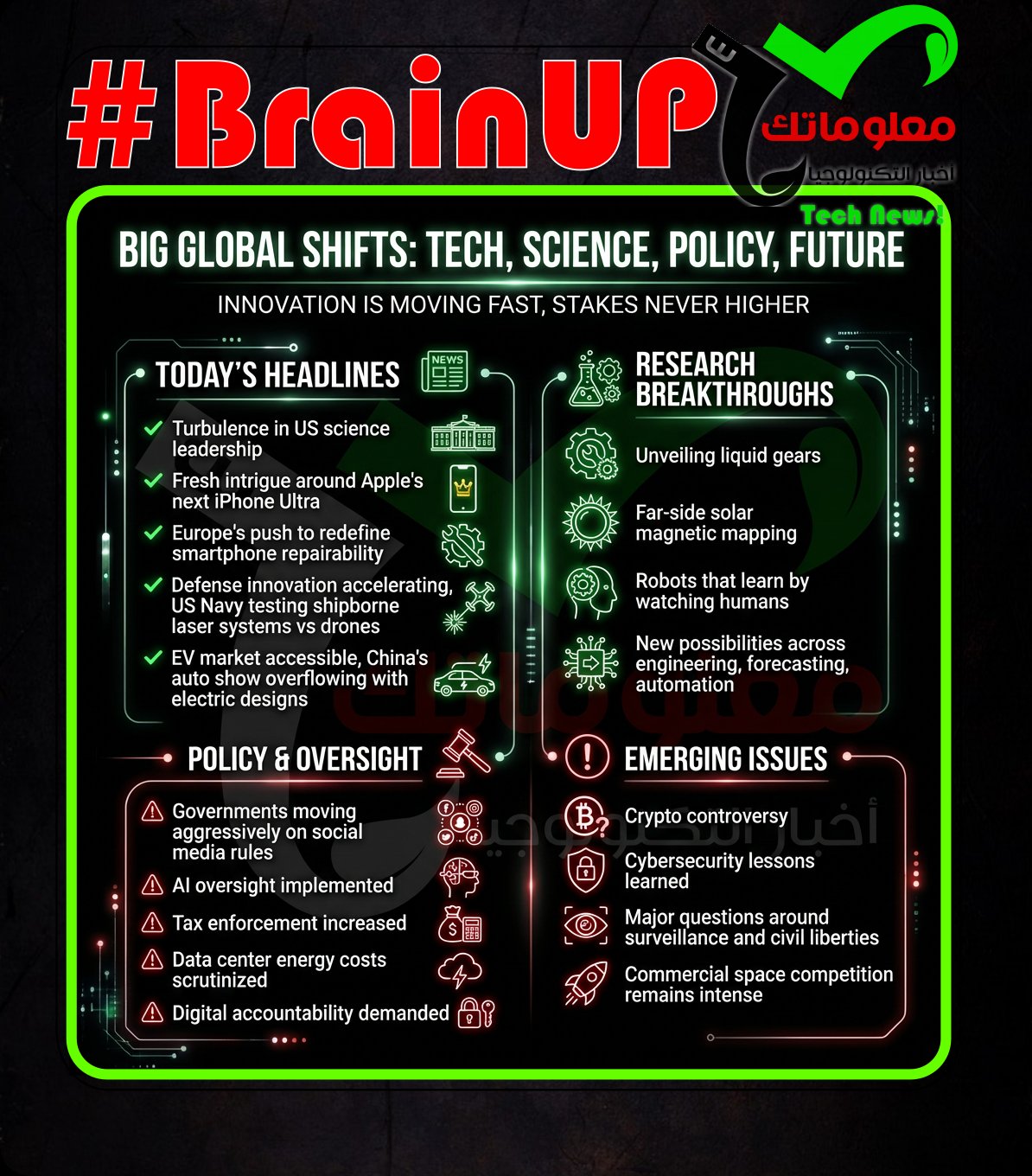
Multiple sources report that the @Trump administration dismissed the entire National Science Board, an apolitical body that advises the president and Congress on the #NationalScienceFoundation and its future. The article notes that federal research funding was already in turmoil because the #NSF has been funding research at historically low levels and has faced significant delays in distributing grants. It also highlights the NSF’s long role in enabling technologies such as #MRI, #cellphones, and helping support early efforts behind #Duolingo. Rep. @ZoeLofgren, the ranking Democrat on the House Science, Space, and Technology Committee, condemned the move as damaging to science and innovation and questioned whether the administration would replace the board with “MAGA loyalists.” The firing intensifies uncertainty around NSF guidance and comes amid broader concerns about weakened US scientific leadership.
2. New iPhone Ultra schematics leak, prior reports didn’t do it justice
The leaked schematics for the new #iPhoneUltra reveal detailed internal and external design features that exceed prior rumors. The evidence shows a distinct dual-camera system setup along with notable internal component placements that suggest enhanced functionality and performance improvements. These schematics provide clearer insight into the engineering efforts behind Apple’s latest flagship device, highlighting its sophisticated construction. This information complements earlier reports by offering precise visuals and a better understanding of the device’s capabilities. The leaked schematics solidify expectations for the iPhone Ultra as a significant advancement in Apple’s smartphone lineup.
3. EU is mandating ‘readily removable’ batteries for phones — but iPhones may be exempt
The EU is set to enforce new #repairability rules requiring phones sold in the region to be designed with more easily replaceable batteries starting in February 2027, but some devices may not have to comply. Support documents for the legislation note an exemption for devices whose batteries retain 80% capacity after 1,000 recharge cycles, a threshold @Apple has met since the iPhone 15. All smartphones sold in the EU must have their batteries tested and the results made public, with examples cited including the iPhone 17 Pro Max and Google Pixel 10 Pro at 1,000 cycles, and the Samsung Galaxy S26 Ultra and Nothing Phone 4a Pro at 1,200 and 1,400 cycles. This effectively shifts the policy from a universal requirement toward performance based compliance, allowing long cycle life phones to avoid redesigns for user replaceability. The development continues the EU trend of regulating device standards, following earlier moves like pushing common charging cables and prompting @Apple to open parts of its ecosystem in the region.
The US Navy tested AeroVironment’s LOCUST #Laser Weapon System on the USS George H.W. Bush, demonstrating shipboard #high-energy laser defense against drones. According to a company blog post, the system was put aboard the carrier in October 2025 and in a live-fire event it “tracked, engaged, and neutralized multiple target drones,” with AV’s directed energy VP @John Garrity calling it a “game-changer” and emphasizing rapid roll-on deployment without major ship modifications. AV says the system can run fully off a ship’s power, giving vessels an “unlimited DE magazine” with an essentially unlimited power source, and the article notes a prior report that LOCUST was upgraded with a larger-aperture beam director to improve lethality. The piece situates the demo in a broader context of expanding drone threats, citing extensive drone use in the Russia-Ukraine war and Iranian Shahed attacks, and notes the carrier is among three US carriers operating in the Middle East at once. Overall, the test is presented as a step toward scalable, quickly deployable #directed energy defenses across the Fleet to counter proliferating drone attacks.
5. Scientists Create “Liquid Gears” That Spin Without Touching
Researchers at New York University created “fluid gears” that transmit rotation through controlled liquid flow instead of interlocking teeth, aiming for mechanical systems that are more adaptable and resilient than traditional rigid gears. Reporting in #PhysicalReviewLetters, @JunZhang and colleagues @LeifRistroph and Jesse Etan Smith tested cylindrical rotors submerged in a glycerol water mixture, with one rotor driven and the other left passive, and used tiny bubbles to visualize the currents that carried motion between them. By varying fluid properties like viscosity and density, along with rotor spacing and rotation speed, they showed the passive rotor could be made to spin either in the same direction like belt driven pulleys or in the opposite direction like conventional gears. The experiments demonstrate that carefully shaped #fluidFlows can replace mechanical contact to control not only rotation transfer but also speed and direction. This “liquid gears” approach directly addresses alignment and damage limitations of toothed gears while retaining gear like functionality through the surrounding fluid.
6. You don’t need extra antivirus on Windows 11, Microsoft officially says
@Microsoft says Windows 11’s built-in #MicrosoftDefender is sufficient protection for most users, so additional antivirus software is usually unnecessary. In its blog post, the company cites Windows 11 being “the most secure Windows yet,” with Defender active by default, deeply integrated into the OS, and continuously updated, plus #SmartScreen to help block malicious files and phishing sites, as long as users keep protections enabled, stay updated, and download carefully. It also notes that third-party tools can still make sense for power users or situations involving multiple or shared devices, or for extra services like identity monitoring and parental controls, and in corporate environments needing centralized management and enhanced threat monitoring. The article adds that extra security suites can consume more RAM and CPU, conflict with Defender, and that running multiple real-time scanners can cause unpredictable behavior, so it is best to use only one real-time antivirus. Overall, for typical home use with defaults on and regular updates, Defender is positioned as the practical baseline, with third-party options reserved for specialized needs.
7. Norway set to become the next country to ban under-16s from social media
Norway is preparing to introduce legislation that would ban children under 16 from using social media platforms, aiming to protect young users from potential harms such as addiction and exposure to inappropriate content. The government proposes restricting access to major platforms, requiring age verification mechanisms to ensure compliance. This move follows similar regulatory actions in other countries, highlighting increasing global concern over children’s online safety and digital well-being. The proposal reflects a growing trend to prioritize children’s mental health and privacy in the digital age, balancing technology use with protective measures. Norway’s approach may influence international policies on children’s social media usage and online protection.
8. Most Australian Teens Admit Social Media Is Bad for Them
Most Australian teenagers recognize that social media negatively impacts their mental health, with many admitting to feeling worse after use. A survey by the eSafety Commissioner found that a significant portion of teens believe their time on platforms like Instagram and Snapchat is harmful, even though they continue engaging daily. This awareness highlights the tension between the desire to connect and the adverse effects of social media on well-being. The findings suggest a need for better support and education to help adolescents manage social media’s risks. Understanding this duality is essential for developing more effective policies and resources to protect youth mental health.
9. ‘Self-aware’ robots can learn complex tasks by watching humans. Is that a good thing?
A team of scientists in Switzerland reports progress toward robots that can learn complex, adaptable tasks by watching humans, which could expand what robots can do at home and in workplaces but also raises safety concerns about robots directing their own learning. Robotics researcher Sthithpragya Gupta at @École Polytechnique Fédérale de Lausanne describes the long-standing limitation that robots perform well only under the exact conditions they were programmed for, unlike humans who adjust when conditions change. In a paper in #ScienceRobotics, the group demonstrates a #machineLearning method based on #kinematicIntelligence, where single-arm robots observe a human toss a ball into a container, then replicate the task while adjusting for their own position and different body mechanics, and can pass the learned skill to other robots. The work suggests a potential turning point for teaching robots to generalize from human demonstrations rather than rigid programming, enabling more sophisticated assistance like making coffee or doing household chores. At the same time, the article notes that increasing autonomy in robot learning prompts questions about how much risk is acceptable if such systems can learn behaviors that might be harmful.
11. Palantir employees are talking about company’s “descent into fascism”
During @Donald Trump’s second term, some current and former Palantir employees began questioning whether the company is abandoning its stated commitment to civil liberties as it deepens work tied to #immigration enforcement. Employees describe Palantir software as a powerful #data aggregation and analysis tool that has supported the US government, including the Department of Homeland Security, with capabilities they say identify, track, and help deport immigrants, prompting internal alarm and a sense that the work now “feels wrong.” The article traces this tension to Palantir’s post-9/11 origins and early framing that security efforts should not erode civil liberties, with workers saying the perceived threat has shifted “from within” and that the company is enabling, rather than preventing, abuses. While Palantir’s spokesperson says the company values “fierce internal dialogue” and is “no monolith of belief,” employees portray a more constrained environment, citing secrecy, press restrictions, non-disparagement agreements, and leadership responses they view as philosophical deflection rather than engagement. The strain reportedly intensified after the killing of Alex Pretti during protests against #ICE in Minneapolis, becoming a flashpoint for broader unrest discussed inside the company.
12. Wisconsin data centers to pay full energy costs under new rate, regulators say
Wisconsin’s #PublicServiceCommission approved a new #energyRate for data centers that requires them to pay 100% of their energy costs so existing customers are not hit with higher bills as #WeEnergies expands its grid. Regulators said the demand from new data centers planned in places like Port Washington and Mount Pleasant could be enormous, potentially comparable to a midsize metro area and, in the Mount Pleasant case, as much energy as all current We Energies customers combined. After about 13 months of review, the oversight board made changes it said will ensure data center companies cover the full costs, with the stated goal that Wisconsin residents “should not pay a single cent” to subsidize these large customers. @SummerStrand, the PSC chair, called it a significant and consequential tariff case unlike others the commission has seen. The decision ties the rapid growth of #dataCenters to a pricing approach intended to protect household and other existing ratepayers from cost spikes tied to new infrastructure.
A 26-year-old man in Singapore was arrested in connection with the online leak of Paramount+’s unreleased animated film “The Legend of Aang: The Last Airbender,” after police said they seized devices containing a digital copy of the movie. Authorities allege he gained unauthorized remote access to a media server, downloaded the film, and distributed it online, with the full movie later appearing on X, an offense that can carry up to seven years in prison and/or a fine of up to $50,000 under local law. Sources said Paramount+ had been investigating the leak and believed it did not originate from within the studio, and a spokesperson for Flying Bark Productions also stated the leak did not come from the animation studio. The incident drew backlash from artists, including animator Julia Schoel, who lamented years of work being circulated online, while director @Lauren Montgomery separately criticized the earlier move from a planned Oct. 9 theatrical release to a Paramount+ exclusive, arguing the film deserved a big-screen launch. The film is based on “Avatar: The Last Airbender,” animated by Flying Bark Productions, and features a voice cast led by @Dave Bautista, @Steven Yeun, and @Eric Nam.
14.“Age limits on social media are a dead end” – Research News
Researcher Sebastian Watzl argues that #age limits on #social media are a dead end, and that public authorities should instead regulate #algorithms and impose stricter controls on #data collection so digital communities can function as safe, democratic meeting places. Drawing a comparison with libraries that are restricted and serve a public purpose, he says the digital world lacks democratic institutions deciding how digital infrastructure should be developed for the common good, while companies like Meta, Google and X invest heavily in attention capturing design and algorithmic steering in the #attention economy. In a policy brief linked to the GoodAttention and Salient Solutions projects, Watzl and colleagues contend that focusing on screen time and age limits misses the broader problem of a few Silicon Valley firms controlling attention and effectively operating as advertising agencies, and that even defining “social media” is imprecise since search engines, digital marketplaces, and now #AI also steer attention. He highlights three problems with age limits: young people should be able to participate in public debate and cannot simply be removed without new safe spaces, age verification can create new privacy harms such as face scanning requirements like those introduced in Australia, and youths will seek other unsupervised social spaces, prompting companies to create services outside the “social media” category that may be no better. He concludes that the age limit debate can serve as a distraction that places few real restrictions on the companies while delaying the deeper governance needed for safer digital participation.
15. IRS Eyes AI to Improve Audit Efficiency Amid Budget Challenges
The IRS is exploring the use of #ArtificialIntelligence to enhance audit efficiency due to budget constraints limiting traditional staffing. Officials indicate AI algorithms could help identify discrepancies in tax filings more quickly and accurately, potentially increasing audit rates without requiring a proportional increase in human examiners. This approach may address concerns over declining audit coverage, especially for wealthy taxpayers, by enabling data-driven targeting of high-risk returns. The integration of AI underscores a shift towards modernizing tax enforcement while navigating limited resources. As the IRS evolves, technology adoption aims to bolster compliance and revenue collection in a cost-effective manner.
16. Manitoba to restrict youth access to social media
The article explains that Manitoba is moving toward one of the most aggressive regulatory approaches in North America by proposing legislation that would restrict or ban access to social media platforms for youth, aligning with a growing global trend led by countries like Australia; the initiative, announced by Premier @Wab Kinew, is driven by mounting concerns over #mental_health impacts, #addictive_design patterns such as infinite scroll, and exposure to harmful or inappropriate content for minors, with the government framing the policy as a child-protection measure rather than censorship; critically, enforcement responsibility would fall on tech companies through mechanisms like #age_verification, potentially backed by significant penalties for non-compliance, signaling a shift toward platform accountability rather than parental enforcement; the move also reflects broader national momentum in Canada where policymakers and public opinion increasingly support restrictions for users under 16, though implementation challenges remain around privacy, technical feasibility, and circumvention risks; analytically, this marks a pivotal escalation in the governance of #social_media, indicating a transition from soft guidelines to hard regulatory intervention, and raises deeper questions about digital rights, surveillance trade-offs, and whether structural platform redesign or outright restriction is the more sustainable long-term solution.
17. Steam Controller Price Leaked By Early Review – and It’s Expensive
18. Blue Origin to launch New Glenn rocket in 2023 after delays
Blue Origin is preparing to launch its New Glenn rocket in 2023 following several delays, marking a significant step for the company founded by Jeff Bezos in the growing commercial space race. The New Glenn rocket, named after astronaut John Glenn, aims to compete with SpaceX’s Falcon rocket family by providing heavy-lift capabilities and reusability. Technical challenges and supply chain issues contributed to the launch postponements, but the company remains confident in overcoming these hurdles to reach operational status. This launch is crucial for Blue Origin to establish itself as a serious competitor in #spaceflight and capitalize on the expanding market for satellite deployment and space exploration. Successful deployment of New Glenn could reshape the commercial space industry and increase competition with other private aerospace firms.
Scientists have developed a method to map #magnetic fields on the Sun’s far side, including their #magnetic polarity, using #helioseismology rather than direct imaging. Using observations from the NSF-NOAA #Global Oscillation Network Group (#GONG) and results reported in Scientific Reports, the team analyzed subtle shifts in solar sound wave signals to infer whether far-side fields point outward or inward, interpreting the measurements with rules such as the #Hale polarity law. @Dr. Amr Hamada said helioseismology previously revealed where far-side active regions existed but could not determine polarity, and the new approach extracts that missing property from tiny wave-signal changes. Because magnetic structure influences how powerful solar eruptions can become, adding far-side polarity maps to models could improve space-weather forecasting before active regions rotate into Earth view. Earlier knowledge of far-side magnetic conditions could extend warning time for impacts on satellites, communications, navigation systems, and power infrastructure.
20. Trump hosts crypto contest winners at Mar-a-Lago as his coin languishes
@Donald Trump hosted winners of his second annual #meme-coin contest at Mar-a-Lago, rewarding top buyers of the $TRUMP #cryptocurrency with access to him even as the token has fallen more than 95% from its peak. Reuters reports 297 of the largest registered $TRUMP holders attended an event Trump promoted as an exclusive crypto and business conference, with the top 29 also receiving a VIP reception and champagne toast, and contest rankings were based on both token holdings and purchases of Trump-branded merchandise. The gala comes amid intensified scrutiny and Democratic calls for investigations into the Trump family’s broader crypto ventures, while ethics experts cited by Reuters said the blending of presidential stature with speculative crypto activities has little modern precedent. Trump said he felt an obligation to support the crypto industry, and a White House spokesperson said his assets are held in a trust managed by his children and that there are no conflicts of interest, even as Reuters found the family has taken in more than $1 billion from crypto asset sales, including at least $336 million tied to #meme-coin sales in the first half of 2025. The $TRUMP token was near all-time lows, trading around $3 late Friday and slipping to about $2.53 as Trump spoke, far below its $75 high shortly after its January 2025 launch.
21. You Can Buy A Used EV Cheap
Hundreds of thousands of #EVs coming off three-year leases are expected to hit the used market at low prices. The piece links this supply surge to a moment when gas prices are spiking, with gas over $4 a gallon cited alongside rising interest in EVs and hybrids among car buyers. The timing suggests cheaper used EV availability could make switching away from gasoline more attractive for shoppers reacting to higher fuel costs. Overall, it frames the lease-turn-in wave as a near-term affordability opportunity that coincides with renewed consumer attention to electrified vehicles.
22. Check Out These Crazy Cars that Were Revealed at the 2026 Beijing Auto Show
The 2026 Beijing auto show featured a huge number of debuts and highlighted China’s surge of dramatic, high-performance luxury EVs alongside increasingly affordable options. Peugeot previewed China-focused large sedan and SUV design directions with its Concept 6 wagon and taller Concept 8 SUV, emphasizing an aggressive new look with triple horizontal LED “claw mark” lighting and sharp body surfacing, while offering virtually no technical details. @BYD’s premium subsidiary Denza moved from concept to production readiness with the Denza Z electric supercar offered as a hardtop coupe, softtop convertible, and track-focused version, claiming over 1000 hp, sub-2.0-second 0-to-62 mph performance, #steer-by-wire, magnetorheological dampers, and #flash-charging up to 1500 kW on BYD chargers. BYD’s Fangchengbao brand expanded beyond SUVs with the carbon-fiber Formula X convertible (tri-motor EV with about 1000 hp and 737 lb-ft, launching next year) and a Formula family of sleek sedans and a wagon using a 1000-hp tri-motor setup and #800-volt architecture, aimed at rivals like the Porsche Panamera and due on sale in China later this year. Showing the other end of the market, Stellantis-backed Leapmotor’s B05 Ultra highlighted low-cost EV performance with a Mazda 3-sized hatch using a 241-hp rear motor, five-second-range 0-to-62 mph acceleration, and over 300 miles of range.
That’s all for today’s digest for 2026/04/26! We picked, and processed 20 Articles. Stay tuned for tomorrow’s collection of insights and discoveries.
Thanks, Patricia Zougheib and Dr Badawi, for curating the links
See you in the next one! 🚀
