
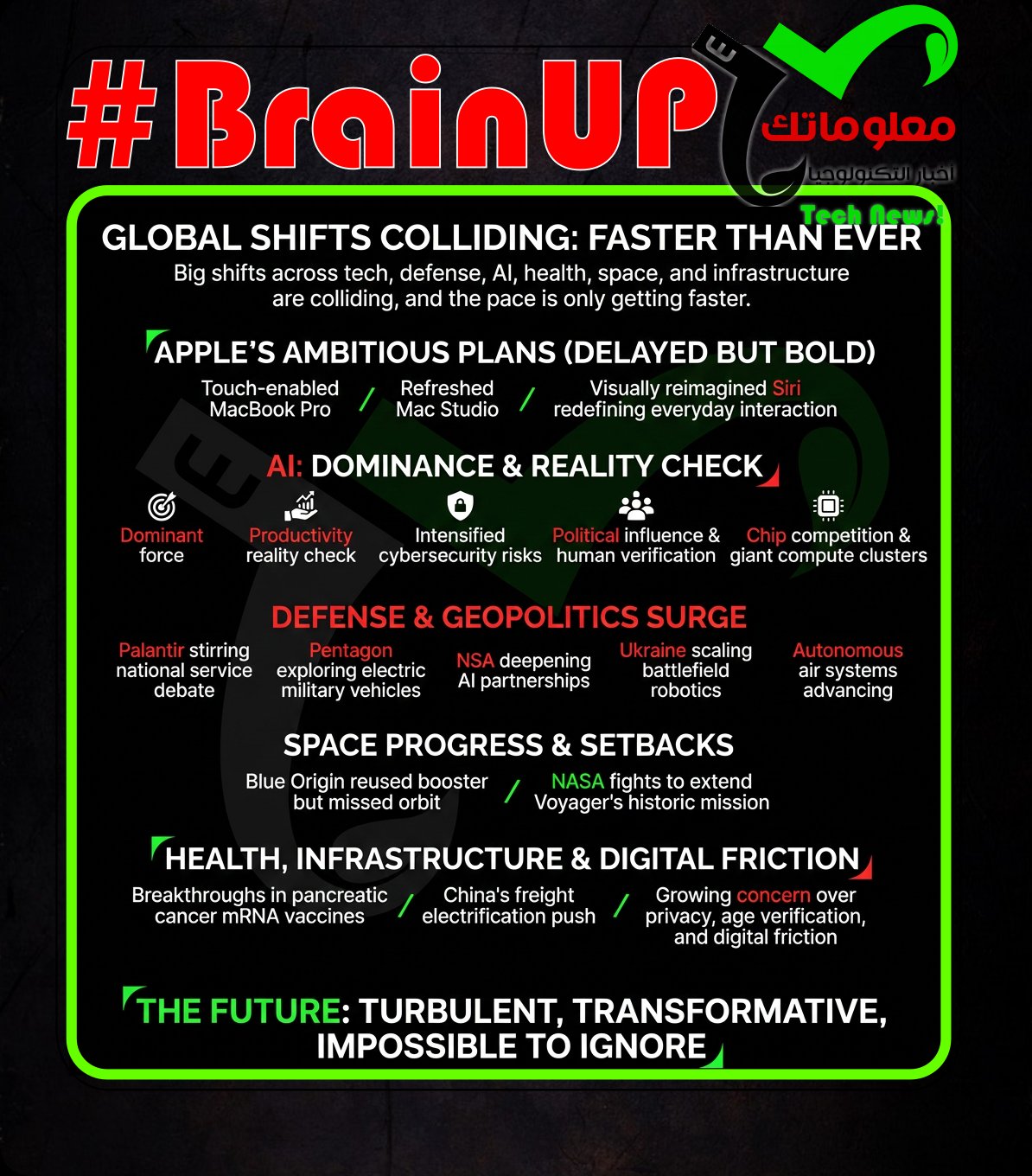
#BrainUp Daily Tech News – (Monday, April 20ᵗʰ)
Welcome to today’s curated collection of interesting links and insights for 2026/04/20. Our Hand-picked, AI-optimized system has processed and summarized 25 articles from all over the internet to bring you the latest technology news.
As previously aired🔴LIVE on Clubhouse, Chatter Social, Instagram, Twitch, X, YouTube, and TikTok.
Also available as a #Podcast on Apple 📻, Spotify🛜, Anghami, and Amazon🎧 or anywhere else you listen to podcasts.
1. US draft update: Major tech company urges universal national service
Defense tech firm @Palantir urged the U.S. government to adopt #universal national service, arguing society should move away from an all-volunteer force and only fight the next war if everyone shares the risk and cost, a stance critics say edges toward endorsing a #military draft. The company posted the proposal on X, and it drew widespread attention and debate about private defense contractors influencing national policy, alongside ongoing criticism over Palantir software used by #ICE and its Pentagon work including #Project Maven. The article situates the controversy amid an escalating Iran conflict that has strained commitments and raised questions about manpower needs, while noting that the #Selective Service System is moving toward automatically registering most draft-eligible men ages 18 to 25 by the end of the year under authority in the fiscal 2026 #NDAA. It also explains Palantir’s role as a data analytics firm with platforms like Palantir Gotham, Foundry, and Apollo used for intelligence, logistics, and targeting support. A #universal national service model is described as typically requiring or strongly encouraging one to two years of service by young adults, sometimes military as in South Korea and Israel, but potentially including civilian options.
2. MacBook Pro With Touch Screen and New Mac Studio Likely ‘Postponed’
A global memory chip shortage could delay Apple’s next high-end MacBook Pro and Mac Studio updates, pushing them later than previously expected. @Mark Gurman reports that 14-inch and 16-inch MacBook Pro models adding #touchscreen support were targeted for late 2026 to early 2027, but may now land closer to the end of that window, making early 2027 more likely. He also says a Mac Studio refresh once expected around mid-2026, potentially near #WWDC 2026, is now believed by sources within Apple to ship around October 2026 due to the shortage. The touch-screen MacBook Pro refresh is rumored to include #M6 Pro and #M6 Max chips, #OLED, a #Dynamic Island, a thinner design, possible MacBook Ultra branding, and #macOS 27 with a touch-friendly interface, while the Mac Studio update is expected to focus on #M5 Max and #M5 Ultra chips with no major design changes. Overall, the rumor points to a Mac Studio update around October 2026, followed by touch-screen MacBook Pro models by the end of January 2027.
3. The Harsh Glare in the Apple WWDC 26 Logo Is Teasing the Look of New Siri, Report Says
A report suggests @Apple is testing a visual redesign for #Siri that could change or add to its familiar orb-like look. In @Mark Gurman’s Bloomberg column, anonymous sources describe a revamp that would show a “Search or Ask” prompt inside the #DynamicIsland pill, paired with a glowing cursor matching the harsh, overexposed “26” glow used in the WWDC 2026 teaser graphic. The same glow also appears in Apple Developer imagery for a WWDC kickoff event at #ApplePark, reinforcing the idea that the aesthetic is intentional. The effect is compared to #halation, a photography-style overexposed glow that can produce color bleed, and is sometimes used deliberately rather than as a flaw. If accurate, the WWDC branding may be hinting at the visual language Apple plans to use for the next Siri experience.
4. Students are speeding through their online degrees in weeks, alarming educators
A growing phenomenon known as “degree hacking” is reshaping higher education, as students leverage #OnlineEducation platforms and competency-based programs to complete full degrees in a matter of weeks instead of years, by focusing solely on passing assessments rather than attending structured courses; institutions like Western Governors University and similar programs allow unlimited course completion within fixed tuition periods, enabling highly motivated learners to compress entire curricula at dramatically lower costs, sometimes under $5,000, while gaining legitimate accredited credentials; proponents argue this model increases accessibility and aligns education with real-world skills validation, especially for working professionals seeking rapid advancement, but critics warn that such extreme acceleration risks undermining academic rigor, encourages superficial learning or gaming the system, and may devalue degrees over time; the rise of online communities and influencers teaching “speedrunning” strategies further amplifies the trend, signaling a deeper structural shift where higher education is transitioning from time-based learning to outcome-based certification, raising unresolved questions about long-term credibility, quality assurance, and the future role of traditional universities.
Executives’ early experiences with #AI are echoing @Robert Solow’s 1987 #productivity paradox, with widespread enthusiasm but little measurable impact in aggregate data so far. An NBER study of 6,000 CEOs, CFOs, and other executives across the U.S., U.K., Germany, and Australia found that about two-thirds report using AI, but only around 1.5 hours per week, and 25% do not use it at work at all, while nearly 90% of firms said AI has had no impact on employment or productivity over the last three years. At the same time, 374 S&P 500 companies mentioned AI on earnings calls and largely described implementations as positive, yet broader productivity gains have not materialized, even as corporate AI investment exceeded $250 billion in 2024. Executives still forecast AI will raise productivity by 1.4% and output by 0.8% over the next three years, with a 0.7% employment cut expected by firms versus a 0.5% employment increase anticipated by individual employees, highlighting a gap between current results and future expectations. Economists such as Apollo’s @Torsten Slok argue that AI is not showing up in employment, productivity, inflation, or most firms’ margins outside the “Magnificent Seven,” while studies offer mixed signals, including an MIT claim of nearly 40% worker performance gains and a St. Louis Fed report estimating a 1.9% increase in excess cumulative productivity growth since late 2022.
6. Palantir posts mini-manifesto denouncing inclusivity and ‘regressive’ cultures | TechCrunch
Palantir published a “brief” 22-point summary of @Alex Karp’s book “The Technological Republic,” presenting it as an outline of the theory behind the company’s work amid heightened scrutiny of its ideology and government ties. The post says #SiliconValley “owes a moral debt” to the U.S., argues that “free email is not enough,” and claims a civilization’s “decadence” is forgiven only if it delivers economic growth and security, while also taking aim at cultural attitudes and referencing @Elon Musk’s interest in “grand narrative.” It asserts that #AI weapons are inevitable and frames the key issue as who builds them and why, warning that adversaries will not stop for debates and suggesting a shift from the atomic age to AI-based deterrence. The manifesto also criticizes the postwar “neutering” of Germany and Japan as an overcorrection that has strategic consequences, and it closes by attacking what it calls “vacant and hollow pluralism,” including a devotion to pluralism and inclusivity.
A Reddit user alleged that #Toshiba refused to honor a warranty replacement for a 20+ TB enterprise hard drive and instead offered only a refund at the original purchase price, leaving the buyer to repurchase at today’s higher prices. Documents reviewed by Tom’s Hardware indicate Toshiba cited lack of replacement stock and suggested a possible one year wait for a 24TB replacement model. The article argues this is especially problematic for corporate buyers who weigh reliability and vendor support, and says a like for like or comparable replacement is the minimum expectation even if market prices have risen. A commenter speculated Toshiba may have sold off safety stock due to the #AI driven supply crunch or could be seeing unusually high failure rates, and urged others to avoid the drives. The piece connects this incident to broader #AI related shortages affecting memory and storage, noting a separate example where #SiliconPower charged a 15% depreciation fee on defective RAM returns, which can leave customers unable to replace hardware when prices have jumped.
8. US may force operating systems to have mandatory age verification, share info with third parties
A proposed US House bill called the #ParentsDecideAct would require operating systems like #Windows, #Linux, and #macOS to verify a user’s age during setup and seemingly for ongoing use. The text says any OS user must enter a date of birth to create an account and use the OS, and OS providers must also build a way for app developers to access whatever information is necessary, collected by the OS, to verify an app user’s date of birth. Key implementation details are deferred until after passage, with the House Committee on Energy and Commerce tasked within 180 days to define how to verify a parent or guardian’s date of birth, set data protection standards, and ensure app developers can access the needed OS collected information. The article argues this creates a vague, high risk privacy and security situation by requiring OSes to store sensitive personal data and potentially share it broadly with third parties. It frames the bill as an alarming approach to age verification that could expand data collection and exposure across everyday PC software use.
Video shared by Wild Hornets and credited to Ukraine’s 23rd NGU Brigade shows Ukrainian Sting interceptor drones engaging Russian-made versions of the Iranian-designed #Shahed-136, which commentators deride as “flying garbage.” Defense-Blog says the footage captures drones that appear to be “literally disintegrating in the air before reaching their targets,” with visible defects such as missing body panels, exposed wiring, deformed wingtips, and in one case a detached nose fairing. The outlet argues these issues likely reflect broader personnel, manufacturing, and supply constraints at the Alabuga Special Economic Zone in Tatarstan, where drones are produced around the clock by minimally trained workers, including very young imported labor, and assembled under pressure with “inferior” Chinese parts. It also notes Ukraine is targeting drone production and storage sites with long-range strikes, further stressing the system. Defense-Blog links the apparent quality collapse to a sustained decline in Shahed-type UAV strike effectiveness starting in October 2025, framing the drones increasingly as an unreliable attrition tool rather than precise weapons.
10. Pentagon seeks GM, Ford to build new electric vehicles for military use
The Pentagon has requested that major auto manufacturers GM and Ford produce new electric vehicles tailored for military applications, aiming to modernize its fleet with more sustainable and advanced technology. The defense department’s plan involves developing electric vehicles that meet specific military standards for durability, safety, and performance, reflecting a shift towards #electricmobility in national defense. This initiative underscores the government’s commitment to integrating green technologies and reducing carbon emissions while enhancing operational capabilities. By leveraging the expertise of established auto companies, the military hopes to accelerate the deployment of #electricvehicles suited for diverse terrains and combat scenarios. The collaboration highlights the intersection of innovation in both the civilian automotive industry and defense sectors, aligning with broader goals of technological advancement and environmental responsibility.
11. NSA partners with AI companies Anthropic and Mythos amid Pentagon interest
The NSA has formed partnerships with AI firms Anthropic and Mythos to enhance its artificial intelligence capabilities. This collaboration reflects a growing Pentagon interest in leveraging advanced AI technologies for national security purposes. Evidence from official statements indicates that these partnerships aim to integrate cutting-edge AI models into defense operations, enabling better data analysis and decision-making. The NSA’s move underscores the strategic importance of AI in modern defense infrastructure and its focus on maintaining technological superiority. This development aligns with broader efforts to incorporate innovative AI solutions within government agencies to address emerging security challenges.
12. eSIM was supposed to replace SIM cards, but carriers turned it into a trap
The article argues that #eSIM was meant to eliminate physical #SIM cards and make switching cellular service as easy as joining Wi-Fi, but carriers have preserved or increased friction, turning the convenience into a kind of trap. It notes that #eSIM can improve travel, letting users add service in other countries and avoid high roaming fees, for example by using an MVNO like #Saily for data plans across many countries. However, the ease of setup and switching depends on the provider, and many carriers still require extra hoops for activation and management, while carrier-locked phones can still block eSIMs from other networks. The author also says moving a phone number between devices can become more complicated with eSIMs, especially if the old phone is broken or stolen, sometimes requiring multi-step processes and even contacting support. Overall, eSIM delivers some real benefits, but carrier policies and lock-ins undermine the promised frictionless freedom.
@Jeff Bezos’ Blue Origin achieved its first re-use of a #New Glenn booster on the rocket’s third launch, but failed its primary objective by placing AST SpaceMobile’s BlueBird 7 communications satellite into a lower than planned orbit. AST SpaceMobile said the satellite separated and powered on, yet the orbit is too low to sustain operations, so it will be de-orbited to burn up in Earth’s atmosphere, with the loss covered by insurance and replacement satellites expected to be ready in about a month. The incident is described as the first major failure for the New Glenn program, which first flew in January 2025 and previously carried customer payloads including NASA twin spacecraft bound for Mars last November. The apparent #second-stage issue could ripple beyond near-term commercial launches, as Blue Origin is positioning New Glenn to support NASA’s #Artemis plans and the Trump administration’s push to land on the Moon by the end of @Donald Trump’s second term, alongside work on Blue Origin’s own lunar lander. Blue Origin had considered flying that lander on this third mission but instead launched the AST SpaceMobile satellite, and the outcome now raises questions about timelines for its broader lunar ambitions.
14. Pancreatic cancer mRNA vaccine shows lasting results in early trial
Researchers have developed an #mRNA vaccine targeting pancreatic cancer that demonstrated promising and lasting effects in an early clinical trial. The vaccine stimulated the immune system to attack cancer cells, resulting in some patients showing durable responses or extended survival. Unlike traditional treatments, this approach harnesses the body’s own defenses for more precise and potentially less toxic outcomes. Experts in cancer immunotherapy see this as a significant step toward effective vaccine-based treatments for hard-to-treat tumors like pancreatic cancer. Ongoing studies aim to confirm these initial findings and explore broader applications.
15. Ukraine Moves to Replace Frontline Soldiers With 25,000 Ground Robots
Ukraine’s Ministry of Defense plans to contract 25,000 #unmanned ground systems in the first half of 2026, aiming for 100% of frontline logistics to be handled by #ground robots, according to Defense Minister @Mykhailo Fedorov. The Defense Procurement Agency has signed 19 contracts worth 11 billion UAH, and Ukrainian forces reportedly conducted more than 9,000 logistics and evacuation robot missions in March and about 21,500 missions in the first quarter of 2026. To speed delivery and stabilize production, the ministry is shifting to longer-term contracting, allowing contract adjustments amid price changes, synchronizing funding flows, increasing annual procurement volumes, and creating a competence center to coordinate deployment with the Armed Forces and serve as a hub for manufacturers. Fedorov said ground robotics is one of the fastest-growing parts of Ukraine’s defense tech ecosystem, now spanning 280+ companies and 550+ active solutions, supported by 175 grants from the state-backed #Brave1 cluster, alongside work on mining and demining systems, combat platforms, loitering ground systems, and automated turrets against aerial threats. The push is linked to scaling low-cost strike ground systems quickly, and follows claims that a Russian position was captured using drones and ground robotic platforms without Ukrainian infantry losses, forcing Russian troops to surrender, as stated by @Volodymyr Zelenskyy.
16. The Cost of the Annoyance Economy
The ‘annoyance economy’ significantly impacts productivity and well-being by bombarding individuals with constant notifications, ads, and unwanted digital interactions. Research highlights that distractions from devices and apps lead to reduced focus and increased stress, costing businesses billions in lost efficiency. Experts argue that the ubiquity of interruptions reshapes work and personal habits, creating a cycle where people are compelled to respond immediately. Solutions such as digital detoxes, better notification management, and mindfulness practices are proposed to mitigate these effects. Understanding and addressing the annoyance economy is crucial for improving mental health and maintaining effective work environments.
17. Artificial Intelligence Transforms the Landscape of Social Media for Political Figures
Artificial intelligence (#AI) is reshaping how political figures, including @DonaldTrump, engage with social media platforms by enabling the creation and dissemination of content faster and more broadly. The technology harnesses machine learning and natural language processing to generate posts, respond to users instantly, and even simulate voices or images, thus amplifying messaging impact and reach. This evolution raises concerns about authenticity, misinformation, and the potential manipulation of public opinion, as AI-generated content can be difficult to distinguish from human-created material. The use of AI tools emphasizes the blending of technology with political communication strategies, transforming traditional campaigning and information dissemination. As social media dynamics shift with AI integration, regulatory and ethical discussions intensify around accountability and transparency in political discourse.
18. China eyes near-total electrification of freight trucks to cut emissions
China is aiming for near-total electrification of freight trucks to cut emissions and reduce oil use. The article says this push could slash road oil demand by about half. It attributes the momentum to cost advantages, large-scale deployment potential, and #energy security considerations. Electrifying heavy trucks is framed as a major lever for reducing emissions from road freight while lowering dependence on oil. Overall, the plan links #electric trucks to both climate and energy-strategy goals.
19. US Air Force tests semiautonomous jet drone with no pilot control
The U.S. Air Force tested a jet-powered YFQ-44A drone designed to fly missions semiautonomously, without a pilot controlling it in real time. The article describes the test as demonstrating the drone’s ability to operate on its own rather than being directly flown by a human during the mission. This indicates progress toward #semiautonomous aircraft that can execute tasks with reduced real-time human input. The focus is on the lack of pilot control during flight as the key capability being evaluated, linking the test to the Air Force’s broader interest in autonomous mission performance.
20. Nvidia rival Cerebras reveals US IPO filing as AI boom drives listings
Cerebras Systems, a prominent competitor to Nvidia in the AI chip sector, has filed for a US initial public offering to capitalize on the growing demand for #artificialintelligence hardware. The company’s IPO filing highlights the increasing investor interest in AI-driven technologies and specialized semiconductor manufacturing. Cerebras is known for creating waferscale chips designed to enhance AI processing speed and efficiency, positioning itself strategically against major players like Nvidia. This move reflects the broader market trend where AI startups are leveraging public markets to fund expansion and innovation. The IPO signals a significant milestone in the AI hardware market, underlining growing confidence in the field’s commercial and technological potential.
21. Intel eases reliance on TSMC with Core Series 3 CPUs
@Intel is shifting more of its budget client silicon back to US manufacturing with new Core Series 3 processors built on its #Intel18A 2nm class node, reducing reliance on #TSMC after outsourcing much of its client portfolio in 2024. The chips are cut-down versions of Core Ultra Series 3, typically offering up to six cores, two Cougar Cove performance cores plus four Darkmont efficiency cores, 2 Xe3 GPU cores, and an NPU rated around 15 to 17 INT8 TOPS, which keeps them below @Microsoft Copilot+ requirements, even as Intel cites up to 40 platform TOPS across CPU, GPU, and NPU. They support up to 48 GB LPDDR5-7467 or 64 GB user-serviceable DDR5-6400 but only single-channel memory, with SKU differences mostly in clocks, including CPU boosts from 4.3 to 4.8 GHz and GPU clocks from 2.3 to 2.6 GHz, plus a Core 3 304 variant with one performance core and one GPU core fused off. Intel pitches the lineup as an upgrade over 11th-gen Tiger Lake, claiming its 15 W Core 7 360 scores 47 percent higher single-thread and 41 percent higher multi-core in Cinebench 2024, while noting competitive pressure such as @Apple’s MacBook Neo. With integrated I/O like up to two Thunderbolt 4 ports, USB 3.2, WiFi 7, and Bluetooth 6, Intel says the parts will land in 70-plus partner designs starting Thursday and later this quarter in low-power #edge computing systems positioned against @Nvidia Jetson Orin Nano for vision and analytics workloads.
22. NASA working on ‘Big Bang’ upgrade for Voyager probes
@NASA is developing an upgrade plan called #TheBigBang to reduce power use and extend operations for the aging #Voyager probes after a February 27 roll maneuver caused Voyager 1 power levels to drop unexpectedly, risking an automatic undervoltage shutdown. To avoid triggering fault protection, the team shut down the Low-energy Charged Particles experiment (#LECP) to gain about a year of “breathing room,” leaving a small 0.5 watt motor on to preserve the chance of restarting the instrument later. #TheBigBang aims to swap out a group of powered devices at once by turning some components off and replacing them with lower-power alternatives while keeping the spacecraft warm enough to keep gathering science data. NASA plans to test the approach on Voyager 2 in May and June, and if successful, attempt it on Voyager 1 no sooner than July, with the possibility that LECP could be turned back on. The effort addresses the probes’ steadily declining power from their radioisotope generators, far beyond their originally expected four-year mission, with each spacecraft now operating three instruments instead of the original ten.
23. Zoom teams up with World to verify humans in meetings | TechCrunch
Zoom is partnering with @Sam Altman’s World to add #human-verification in Zoom meetings so participants can be confirmed as real people rather than AI-generated deepfakes. The move follows high-profile video-call fraud, including Arup’s $25 million loss in 2024 via a deepfake call, plus a similar 2025 incident in Singapore, with estimates putting deepfake-enabled fraud above $200 million in one recent quarter and average corporate losses over $500,000. World argues that frame-by-frame deepfake detection is becoming unreliable as video models improve, so Zoom will integrate World’s World ID Deep Face, which cross-checks a signed registration image captured by World’s Orb device, a real-time face scan from the user’s device, and a live video frame in the meeting. When all three match, a “Verified Human” badge appears on the participant tile, hosts can require verification via a Deep Face waiting room, and participants can request on-the-spot verification mid-call. Zoom frames the integration as part of its open ecosystem to help customers build trust in workflows, while World continues expanding similar verification partnerships with consumer platforms like Tinder and Visa.
24. Claude Opus wrote a Chrome exploit for $2,283
@Anthropic held back its Mythos bug-finding model over fears it could accelerate real-world exploitation, but @Claude Opus 4.6 was still used to produce a functional exploit chain against #Chrome’s #V8 in Chrome 138, a version bundled into Discord. Hacktron CTO Mohan Pedhapati said the effort took about a week of iteration, 2.3 billion tokens, $2,283 in API costs, and roughly 20 hours of manual steering to reach a proof-of-concept that “popped calc,” indicating code execution. He argued that even with operator time added, the cost compares favorably to the time a human would need and is below the approximate $15,000 he cites for Google and Discord bug bounty payouts, while criminal markets could pay more. Opus 4.7 is described as similar in cyber capability to 4.6 and includes safeguards to block high-risk requests, but Pedhapati’s broader point is that improving code generation will compress patch windows and make it increasingly feasible for low-skill attackers with an API key to exploit unpatched software. He highlighted #Electron apps like Discord and Slack as especially exposed because they may lag multiple Chrome versions, noting Discord was nine major versions behind current, and warning that patches can serve as “exploit hints,” a dynamic he says will be particularly hard for open source projects.
25. As AI race with US intensifies, Alibaba launches 10,000-card computing cluster
China is accelerating its push for #home-grown AI infrastructure as the AI race with the US intensifies, with @Alibaba and @Huawei deploying massive computing clusters. @Alibaba announced a 10,000-card #intelligent computing cluster powered by domestically developed #Zhenwu AI chips from its T-Head arm, built with @China Telecom at a data centre in Shaoguan, Guangdong, and described as a “fully domestic” project and the first of this scale in the Greater Bay Area. The move is framed as a response to rising AI demand and competition with US rivals including @Meta, @Microsoft and @Elon Musk’s xAI. It follows the late-March activation in Shenzhen of China’s first 10,000-card intelligent computing cluster using @Huawei’s #Ascend 910C chips. @Alibaba Cloud said the new cluster indicates China’s advanced computing is shifting from high-end performance breakthroughs to large-scale industrial implementation, reinforcing the country’s broader effort to scale domestic AI capability.
26. In its third flight, a Blue Origin New Glenn rocket puts satellite payload into wrong orbit
On its third New Glenn flight, #BlueOrigin successfully re-flew and recovered a previously used first stage, but a problem with the upper stage left the payload in an unusable orbit. The rocket lifted off from Cape Canaveral Space Force Station at 7:25 a.m. ET after an unexplained hold, the first stage performed as planned and landed on a company barge about nine minutes after launch. #ASTSpaceMobile said its BlueBird 7 direct-to-cellphone communications satellite separated and powered on, but was placed into a lower-than-planned orbit that its onboard thruster technology could not correct, and it will de-orbit. Blue Origin said it confirmed payload separation and that the satellite powered on, but reported the payload was in an off-nominal orbit and did not say whether a planned second upper-stage engine firing occurred or ran for its full duration. The satellite’s cost was not disclosed, but AST SpaceMobile said it was fully insured, and @JeffBezos posted video of the booster’s on-target touchdown.
That’s all for today’s digest for 2026/04/20! We picked, and processed 25 Articles. Stay tuned for tomorrow’s collection of insights and discoveries.
Thanks, Patricia Zougheib and Dr Badawi, for curating the links
See you in the next one! 🚀
