
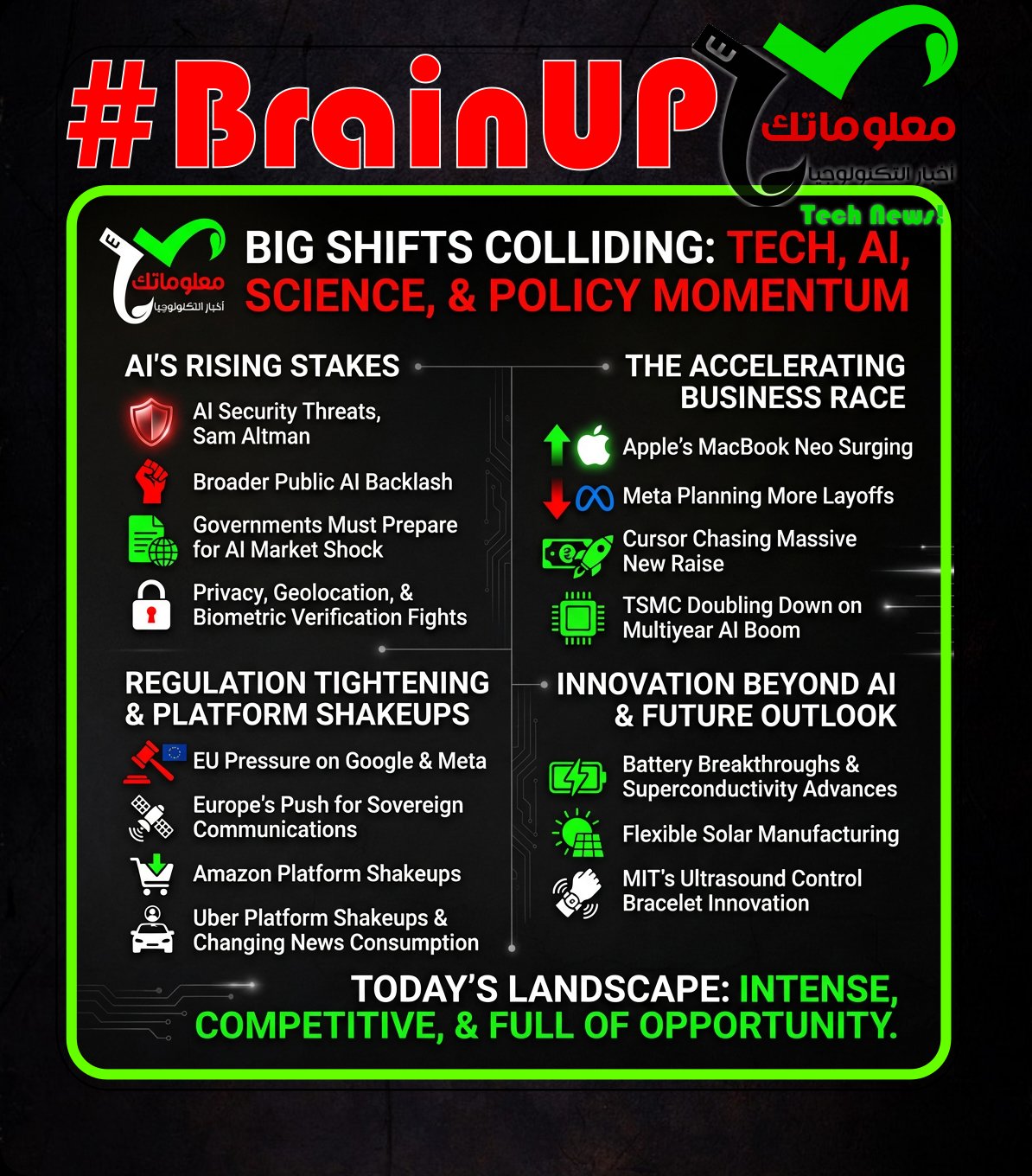
#BrainUp Daily Tech News – (Saturday, April 18ᵗʰ)
Welcome to today’s curated collection of interesting links and insights for 2026/04/18. Our Hand-picked, AI-optimized system has processed and summarized 32 articles from all over the internet to bring you the latest technology news.
As previously aired🔴LIVE on Clubhouse, Chatter Social, Instagram, Twitch, X, YouTube, and TikTok.
Also available as a #Podcast on Apple 📻, Spotify🛜, Anghami, and Amazon🎧 or anywhere else you listen to podcasts.
1. OpenAI CEO Sam Altman says AI attack on his house was meant to kill him
OpenAI CEO @Sam Altman revealed that an attempted attack on his house was intended to kill him, highlighting escalating tensions and risks surrounding the advancement of #AI technology. The incident underscores increasing hostility faced by leaders pushing forward AI development amid growing concerns about its implications. Altman’s disclosure calls attention to the personal dangers tech pioneers encounter while driving innovation in a rapidly evolving field. This event illustrates the intense stakes involved in guiding responsible AI progress. It emphasizes the need for continued dialogue and safeguards as AI’s influence expands in society.
2. Attacks on Sam Altman’s home are extreme. But the AI backlash is going mainstream | Fortune
After a Molotov cocktail attack at @Sam Altman’s home and related arrests, the article argues these incidents sit at the extreme end of a broader, increasingly mainstream #antiAI backlash that has been building for years. It cites concerns ranging from AI’s environmental footprint, #jobAutomation and entry level job losses, and AI use in warfare, to alleged psychological harms that have already sparked lawsuits blaming the technology for multiple deaths, including teenagers. The piece also points to a messaging dynamic in which AI labs and executives have repeatedly warned that #AI could enable cyberattacks, bioweapons, mass unemployment, and even human extinction, and notes @Anthropic’s release of a “Mythos” model described as too dangerous for public hands, framing fear as effective marketing. Polling is presented as evidence of souring public opinion: an NBC News survey found 26% positive views versus 46% negative, and a Gallup poll found Gen Z excitement dropped from 36% to 22% while anger rose from 22% to 31%, attributed to fears about lost entry-level jobs. Local opposition to #dataCenters is cited as another manifestation, with 20 proposed projects worth $98 billion reportedly blocked or delayed in April to June 2025 due to worries about grid strain, higher electricity bills, heavy water use for cooling, and construction dust and light pollution.
3. Century-old Cleaning Chemical Linked to 500% Increased Risk of Parkinson’s Disease
A century-old disinfectant chemical, commonly used in industries and households worldwide, has been linked to a 500% increased risk of developing Parkinson’s disease. Researchers found that exposure to this chemical, which remains prevalent despite bans in some regions, may disrupt neurological function and increase vulnerability to neurodegenerative disorders. The study analyzed epidemiological data, revealing significantly higher incidence rates among individuals with prolonged contact with the chemical compared to those without exposure. These findings highlight the urgent need to reassess regulatory policies on this chemical to protect public health. Understanding this connection could drive preventive measures and inform future research on environmental factors contributing to Parkinson’s disease.
4. Apple’s $599 MacBook Neo Sold Out Through April Amid Surging Demand
@Apple’s $599 MacBook Neo is seeing surging demand more than a month after launch, with online orders effectively sold out through April. The online @Apple Store shows all colors and both 256GB and 512GB configurations delivering May 1 to May 8 at the earliest, while some retail stores have limited in-store stock and others do not expect more until May 11, and third-party sellers like Best Buy and Target list deliveries at least a week out. The appeal is boosted by its low price as PC makers raise prices amid global #RAM shortages, and @Apple is ramping production, increasing its 2026 shipment plan to 10 million units from an original estimate of five to six million. @Tim Cook said the launch was the company’s best ever for first-time Mac customers, but supply could be constrained by the limited availability of the binned #A18Pro chips used in the device, potentially forcing @Apple to restart A18 Pro production or switch to an #A19Pro. More detail on the MacBook Neo’s performance is expected during @Apple’s April 30 earnings call for fiscal Q2 2026.
5. The creative software industry has declared war on Adobe
Rivals across the creative software market are targeting @Adobe by undercutting #Creative Cloud subscriptions, often by making comparable tools free as dissatisfaction grows over pricey plans, dropped licenses, and a full embrace of #GenerativeAI. Maxon has relaunched Autograph, positioned as an After Effects style motion design app, with free access for individuals after previously selling a $1,795 perpetual license or $59 per month, while @Canva made the full version of Cavalry free and previously folded the acquired Affinity apps into a single free app. Blackmagic’s free DaVinci Resolve 21, already seen as a Premiere Pro competitor, added photo editing features such as color correction, masking, Apple Photos and Lightroom Catalog import, plus support for Affinity .af files to ease cross tool workflows. Even paid alternatives are pressuring Adobe on price, with @Apple’s Creator Studio bundle at $12.99 per month versus Adobe’s $69.99 Creative Cloud Pro, while still allowing one time purchases for individual apps. Taken together, the article argues these releases signal an industry wide shift toward free or subscription free options that could meaningfully erode Adobe’s dominance.
6. Congress Should Start Planning for a Potential AI Crash Now
A new report argues that Congress should plan now for a potential #AI market crash because trillions in AI infrastructure investment are propping up the U.S. economy while AI revenues lag, and opaque financial engineering could make a correction resemble the systemic fallout of 2008. @Asad Ramzanali recommends curbing crash drivers such as circular equity among chipmakers, hyperscalers, and model makers, plus undisclosed and complex leverage via private credit-backed #SPVs, asset-backed securities, highly leveraged “neocloud” firms, and state tax loopholes, alongside prosecuting fraud and ending state and local races to offer ever larger data center tax breaks. He also proposes converting stranded data center assets into a government-supported “public cloud” and sustaining AI #R&D for public purposes like drug discovery, disaster planning, and energy sustainability that companies might cut during a crisis. To mitigate labor harms that could both cause and follow a crash, the report calls for expanded unemployment insurance, relaxed safety net work requirements, a digital Works Progress Administration-style mass employment program, and limits on AI-enabled worker surveillance. Overall, the proposals aim to reduce hidden risk in AI finance, preserve public-benefit computing and research capacity, and protect workers so Congress is not improvising policy in the middle of a crash.
7. It Is Time to Ban the Sale of Precise Geolocation
A @Citizen Lab deep dive into the American #adtech surveillance product Webloc argues that the U.S. should clamp down on, and effectively ban, the collection and sale of precise #geolocation data because it is pervasive, easily obtainable, and risky for privacy and national security. Leaked technical materials say Webloc, developed by Cobweb Technologies and now sold by Penlink after a 2023 merger, offers access to records from up to 500 million mobile devices, including device identifiers, location coordinates, and profile data drawn from mobile apps and digital advertising, and can track devices in highly granular ways such as repeated daily location pings. The report also lists current and former U.S. government customers, including the Department of Homeland Security and Immigration and Customs Enforcement, U.S. military units, the Bureau of Indian Affairs Police, and various state and local agencies, and it cites a Tucson Police example where Webloc helped identify a suspect by finding a device present at every robbery and repeatedly returning to the same address. Webloc is an add-on to Penlink’s main platform Tangles, a web and social media investigations tool that can build profiles and link identifiers, and its integration with Webloc raises concerns that ostensibly anonymous mobile identifiers could be connected to social media accounts without a warrant. While these capabilities can aid investigations, the article contends they are intrusive and should not be available for purchase without strong authorization and oversight, reinforcing the case for tighter legal guardrails on geolocation data sales.
8. FAA Scraps Civil and Criminal Penalties for Flying Drones Near ICE Vehicles
The @Federal Aviation Administration rescinded and replaced a temporary #TemporaryFlightRestriction that had effectively barred drones within 3,000 feet of #DepartmentOfHomelandSecurity facilities and mobile assets, including #ICE and #CBP vehicles, removing explicit civil and criminal penalty language but expanding which agencies are covered. The earlier rule, added in January after ICE operations began in Minneapolis, created 3,000-foot no-fly bubbles around any ICE vehicle, and violators could be fined or jailed, a setup that local journalists said was unworkable because agents often use unmarked cars. Minnesota journalist Rob Levine sued the FAA, arguing the restriction chilled #FirstAmendment protected drone photojournalism by creating what court documents described as a “flotilla of invisible, moving bubbles.” The FAA’s new advisory drops the 3,000-foot and criminal-penalty language but advises #UAS operators to avoid flying near covered mobile assets of the Department of War, Department of Energy, Department of Justice, and DHS, warning those agencies may interfere with, seize, damage, or destroy unmanned aircraft deemed a credible threat. Levine and his lawyers called the change a win that allows him to resume journalism, while his counsel said the FAA’s arbitrary back-and-forth remains a problem and the restriction should not have been implemented.
9. EU Age Verification App Hacked With Little to No Effort in Public Demo
The European Commission’s EU age verification app, promoted by @Ursula von der Leyen as #open-source, privacy preserving, non-trackable, and deployment ready, was publicly bypassed in a simple one-day demo that required minimal effort. The walkthrough showed local protections could be defeated: the PIN guarding the stored credential could be circumvented, the lockout could be reset, and the biometric verification layer could be disabled, after which the app still generated the original verified credential. Additional reported findings raised #privacy risks in how biometric source material was handled, including extracting a document chip facial image during #NFC scans and writing it to the device as a lossless PNG that might remain after failed or interrupted scans, and selfie images reportedly being written to external storage as lossless PNGs and not reliably deleted. The gap between the Commission’s assurances and the ease of bypass suggests weak security fundamentals and highlights that encrypting output tokens does not prevent exposure when source biometrics are mishandled. Framing the tool as a child safety measure does not mitigate these technical failures, and rushing sensitive identity and biometric systems without adequate hardening can create serious consequences for users.
10. Amazon won’t release Fire Sticks that support sideloading anymore
Amazon says newly released and future Fire TV Sticks will not support consumer #sideloading of apps outside the Amazon Appstore because they will run #VegaOS. Amazon’s developer documentation states that starting with the Fire TV Stick 4K Select, all future sticks will run Vega, and Vega requires apps to already be published in the Amazon Appstore, with product-page messaging for the new Fire TV Stick HD also warning that installs from unknown sources are blocked. While registered developers can still sideload on enrolled devices, Amazon has not made the change as explicit to consumers, and it reportedly plans for all future sticks to launch with Vega; Amazon also indicated it does not plan to update existing #FireOS devices to Vega. The shift from Android-based #FireOS to Linux-based Vega gives Amazon more control and enables newer software and features like @Alexa+ while limiting apps that reduce Amazon revenue or host illegal content. The move also aligns with increasing anti-piracy pressure and prior steps like blocking apps blacklisted by the Alliance for Creative and Entertainment, leaving affected users to consider rival streamers or possible workarounds.
11. Online Personalities and Comedians Overtake TV and Newspapers as Primary News Sources
A new Ipsos poll for the University of Mississippi’s Jordan Center for Journalism Innovation and Advocacy finds Americans are shifting away from institution centered news, turning instead to online opinion personalities, comedians, and especially right leaning voices. Nearly 70 percent of respondents said they get news online in a given week, versus 55 percent from TV and 25 percent from newspapers, and when politicians are included, @DonaldTrump and other conservative politicians and cabinet members rank as top #news influencers. Excluding politicians, @JoeRogan leads, followed by Fox News figures @GregGutfeld and @SeanHannity, then @TuckerCarlson and @BenShapiro, with only @Trump, @Rogan, and @JDVance exceeding 10 percent. Among voters for @KamalaHarris, late night hosts top the list, led by @JimmyKimmel, followed by @StephenColbert and @JonStewart, while #Facebook, #YouTube, and #Instagram are the most popular online news sources and Fox News, broadcast networks, and CNN lead among traditional outlets. The results point to a fractured media environment where audiences choose sources aligned with their views, and growing distrust in traditional media pushes consumers toward direct, personality driven commentary.
12. Meta targets May 20 for first wave of layoffs, additional cuts later
Meta plans to start its initial round of layoffs by May 20, reflecting its cautious approach to reducing workforce amid economic uncertainty. The company aims to execute the first wave of job cuts gradually, with more reductions expected to follow later in 2026. This strategy indicates Meta’s response to ongoing financial pressures and the broader tech sector downturn, emphasizing measured restructuring rather than abrupt cuts. The phased approach allows Meta to adjust to market conditions while aiming to streamline operations over the coming year. Overall, the planned layoffs align with Meta’s efforts to balance cost management with maintaining its strategic initiatives.
13. Memory card and flash drive prices surge up to 123% amid ongoing shortage
A dramatic spike in #FlashMemory pricing is reshaping the consumer storage market, with memory cards and USB drives seeing average price increases of around 123% year-over-year and extreme cases exceeding 260%, driven primarily by a global shortage of NAND chips as manufacturers prioritize high-margin components for #AI data centers over consumer-grade products; the same production lines supply both enterprise SSDs and everyday storage devices, but with hyperscalers willing to pay a premium, suppliers are reallocating capacity toward higher-quality chips, leaving lower-tier supply constrained and more expensive ; this shift has also pushed brands to focus on premium offerings rather than budget options, effectively reversing the long-standing trend of declining storage costs and creating a market where even basic flash products are becoming significantly less accessible; while the surge is expected to normalize eventually, forecasts suggest elevated prices could persist into 2027 as #AI infrastructure demand continues to dominate global semiconductor supply chains, marking a structural, not cyclical, transformation in how memory resources are allocated.
14. Microsoft warns of reboot loops affecting some Domain Controllers
Microsoft has alerted users about an issue causing reboot loops on some #DomainControllers following January 2024 security updates. The problem has been observed primarily after applying the January 9, 2024 #SecurityUpdates, affecting on-premises domain controllers with certain update rollups installed. The company identified that specific configurations lead to system crashes and continuous reboots, disrupting domain controller functionality. Microsoft is actively investigating and working on a resolution, advising affected users to review their update history and consider recovery actions if impacted. This warning underscores the challenges of balancing security improvements with system stability in critical network infrastructure components.
@Google is reportedly negotiating with the U.S. Department of Defense to deploy #Gemini in classified settings, including adding GPU racks to #GoogleDistributedCloud and, for the first time, running Google’s #TPU accelerators inside accredited classified environments. Sources cited by The Information say Google Distributed Cloud has DoD #ImpactLevel6 authorization for Secret data and an existing Top Secret authorization, but lacks enough in-boundary infrastructure to run classified workloads at scale, which the talks aim to address. The proposed contract would allow the Pentagon to use Gemini for “all lawful purposes,” while Google seeks language barring domestic mass surveillance and fully autonomous weapons without appropriate human oversight, terms similar to those in @OpenAI’s Pentagon agreement that @SamAltman urged be applied across vendors. The article links these policy constraints to recent Pentagon friction with @Anthropic, where refusal to change restrictions contributed to a supply chain risk designation and a phase-out of Claude that a federal judge called “Orwellian” while not staying related litigation. It also situates the talks in #cloud competition, noting Google’s smaller overall and classified-market footprint versus #AWS and #Microsoft, alongside internal goals for public sector bookings that include defense.
16. Google should allow third-party search engines access to data, EU says
The European Union has proposed that Google should permit third-party search engines to access its search data to foster competition and innovation. The EU’s Digital Markets Act aims to reduce Google’s dominance by enabling rivals to provide competitive search experiences using Google’s data. This move is intended to address concerns about market fairness and consumer choice, as Google currently controls a vast majority of European search traffic. By requiring data sharing, the EU seeks to level the playing field and promote diversity in the search engine market. This approach reflects the EU’s broader regulatory efforts to curb the power of major tech platforms and enhance digital market competition.
17. Donut Lab’s ‘miracle’ solid-state battery is fraud, says insider, Donut Lab denies
A former executive at Donut Lab’s manufacturing partner alleges Donut Lab’s touted #solid-state battery does not match its public claims, while Donut Lab and Nordic Nano deny any wrongdoing. Donut Lab had claimed a 400Wh/kg battery with 100,000-cycle life and 5-minute charging that was ready for production in Q1 2026, but independent testing cited by the company reportedly validated only some claims and omitted key promised metrics like energy density and durability, and mass manufacturing has not begun by Q2. According to Helsingin Sanomat, @Lauri Peltola, former Chief Commercial Officer of Nordic Nano, filed a criminal complaint in Finland accusing Donut Lab of misleading statements about energy density, durability, and production capacity, and the paper reports it saw communications suggesting the unit sent for testing was an older, abandoned generation while the newer version remains early-stage. In a joint statement, Donut Lab and Nordic Nano say they have not seen the full complaint, claim Peltola lacked the necessary knowledge and was not part of the battery development working group, and assert the complaint reflects one individual’s views. They say they take the allegations seriously, deny misleading investors or committing any crime, and reiterate that both companies stand behind previously announced information about their battery development.
18. Donut Lab’s battery claims reportedly subject of whistleblower complaint
Startup Donut Lab is reportedly facing a criminal whistleblower complaint in Finland over its high-profile #solid-state battery claims. Finnish newspaper Helsingin Sanomat says former Nordic Nano Chief Commercial Officer Lauri Peltola alleges Donut Lab overstated promised #energyDensity and longevity and lacked the production capacity it had implied. The report cites internal communications involving Donut Lab, CT-Coating, and Nordic Nano indicating the advertised first-generation cell, also provided to Finnish national lab VTT for testing, had been abandoned by CT-Coating in favor of a newer cell still in early development, despite Donut Lab’s earlier claim it was ready for mass production. Donut Lab CEO @Marko Lehtimäki said he was unaware of the complaint, while Nordic Nano CEO @Esa Parjanen disputed Peltola’s allegations and said Peltola was not involved in Nordic’s battery project. In a joint statement, Donut Lab and Nordic Nano said they did not know the exact nature of the complaint, denied wrongdoing or misleading investors, and questioned the complainant’s technical understanding.
The Verge TS-Pro Gen2 introduces advancements in solid state cooling and battery pack configuration that significantly enhance electric vehicle (#EV) battery performance. This new system features innovations that improve thermal management, leading to better efficiency and longevity of EV batteries. By adopting solid state cooling technology, the Verge TS-Pro Gen2 manages heat more effectively than traditional liquid cooling systems. These improvements help maintain optimal battery temperatures under varying conditions, thereby extending battery life and supporting faster charging capabilities. The Verge TS-Pro Gen2’s optimized pack design and cooling integration reflect a notable step forward in EV battery technology, benefiting manufacturers and consumers alike.
20. European civil servants are being forced off WhatsApp
European governments and institutions are pushing officials off #WhatsApp and #Signal and onto government-controlled messaging services to better protect sensitive communications and reduce reliance on U.S. technology. France, Germany, Poland, the Netherlands, Luxembourg and Belgium are rolling out in-house tools, #NATO has its own messenger, and the European Commission plans to switch by year’s end, citing concerns about “platforms over which we have no control,” according to Dutch digital minister @Willemijn Aerdts. Recent warnings from cybersecurity agencies about Russian phishing campaigns targeting officials on WhatsApp and Signal, plus Commission guidance to senior staff to shut down a Signal group amid broader EU cybersecurity breaches, have added urgency. The shift is not presented as proof that end-to-end encrypted consumer apps are inherently less secure, but as a response to organizational needs such as access controls, limiting chats to specific users, and tighter control over #metadata, which executives like Wire CEO Benjamin Schilz argue mainstream apps are “not built for.” Officials such as Belgian Secure Communications director Brandon De Waele link the move to #dataSovereignty, framing closed, government-only environments as a way to reduce exposure to targeted campaigns while aligning with Europe’s drive for strategic autonomy in communications.
21. China turns Taiwan’s own voices against it in information war
China is employing sophisticated techniques to use recordings of Taiwanese officials saying controversial remarks against Taiwan itself, amplifying them on Chinese social media to undermine Taiwan’s credibility and sow discord. Beijing crafts these messages to exploit Taiwan’s democratic openness, mixing real clips with manipulated context to mislead audiences. This strategy represents a newer dimension of #disinformation warfare that leverages Taiwan’s own politically sensitive statements, complicating Taipei’s efforts to manage propaganda and protect its international reputation. Analysts suggest this approach demonstrates China’s increasing focus on psychological operations targeting Taiwan’s internal cohesion and global standing. The use of Taiwan’s own voices in these campaigns shows how information technology can be weaponized in cross-strait tensions.
22. Oxygen anchoring enables air-stable solid-state lithium metal batteries
The development of air-stable solid-state lithium metal batteries has been achieved through the use of oxygen anchoring on solid electrolytes. Researchers demonstrated that oxygen anchoring can stabilize the electrolyte interface with lithium metal, preventing degradation and enhancing battery performance and longevity. This approach addresses a major challenge in producing solid-state batteries that can operate safely and reliably in ambient conditions. The team validated their findings by testing battery cells in air, showing improved stability and reduced dendrite formation compared to conventional methods. This innovation could accelerate the commercialization of solid-state lithium metal batteries, linking material science breakthroughs with practical energy storage solutions.
23. EU warns Meta WhatsApp AI fee breaches antitrust rules, orders rollback
The European Union has ordered @Meta to stop charging for the use of artificial intelligence features on WhatsApp, ruling that the fee breaches antitrust rules. The EU’s decision is based on concerns that the fee restricts competition and harms consumers by limiting access to AI functions on the messaging platform. Evidence from the investigation highlighted the potential for Meta to leverage its dominant position to suppress competitors. The EU’s order aims to restore a level playing field in the digital market and ensure fair access to AI-enabled services. This action reflects the EU’s broader aim to regulate tech giants and promote competitive innovation within its jurisdiction.
@TSMC raised its 2026 revenue guidance and capital expenditures toward the high end of its original expectations, citing a multiyear #AI-driven surge that has left capacity tight and utilization higher than expected. In Q1 2026, its HPC segment, which it uses broadly for products including AI accelerators, delivered 61% of revenue, about $21.9 billion, up from 46% or about $8.68 billion in Q1 2024, while smartphones contributed 26% and IoT and automotive 6% and 4%. The company said demand is pushing it to expand advanced-node output, including building another 3nm-capable fab and adding three N3-capable fabs over the next couple of years as platforms like @Nvidia shift from 5nm-class to 3nm-class nodes; advanced nodes at 7nm and below made up 74% of Q1 2026 earnings, led by 5nm-class at 36% and 3nm-class at 25%. It also noted @Nvidia became its largest customer in 2025 at 19% of revenue, ahead of @Apple at 17%, underscoring how aggressive AI capacity booking is reshaping its demand profile. Even with confidence in long-term growth from the #AI megatrend, TSMC cautioned that the war in the Middle East could pressure profitability as costs rise.
25. Bank of Canada’s Tiff Macklem warns of risks from ‘mythos’ created by AI hallucinations
Bank of Canada Governor @TiffMacklem expressed concern about the potential risks that #ArtificialIntelligence, especially the hallucinations produced by AI models like Anthropic’s Claude, could pose to financial stability and public trust. He highlighted that while AI offers transformative opportunities, the creation of misleading or false information by these systems can distort perceptions and decision-making processes. Macklem emphasized the need for vigilant regulatory oversight and improved AI literacy to mitigate dangers associated with the technology’s misinformation. The warnings underline the broader challenge of balancing innovation with risk management in the digital age. This perspective aligns with global regulatory trends aiming to address the dual-edged nature of AI advancements.
Researchers at @MIT report a #ultrasound bracelet that tracks hand movements in real time and turns them into digital commands to control robots and virtual systems more naturally and precisely. Published March 25, 2026 in Nature Electronics, the device places small ultrasound sensors on the wrist to continuously image muscles and tendons, then uses #artificial intelligence to infer finger and palm positions from subtle tendon and muscle changes. The system aims to overcome limitations of traditional gesture control by recognizing detailed and intermediate movements, likening tendons to “strings” that drive finger motion. In tests with eight volunteers, it identified gestures ranging from simple motions to the 26 letters of American Sign Language and supported object manipulation tasks involving items like scissors, pencils, and tennis balls, reinforcing its goal of bringing machine control closer to the complexity of the human hand.
27. Scientists capture superconductivity pairs, revealing hidden mechanisms
Scientists have directly observed electron pairs responsible for #superconductivity, providing new insight into how these pairs form and lead to zero resistance. Using advanced imaging and spectroscopy techniques, researchers captured the behavior of Cooper pairs in a high-temperature superconductor, uncovering key interactions that enable superconductivity at elevated temperatures. This discovery challenges previous theories that lacked direct observation and illustrates the complex quantum interactions driving superconductivity. The findings could accelerate development of new materials for energy-efficient technologies by illuminating the fundamental mechanisms involved. Understanding these electron pairs bridges gaps in condensed matter physics and propels innovation in applied superconducting devices.
AI coding startup Cursor is in talks to raise at least $2 billion in new funding at a $50 billion pre-money valuation, driven by rapidly growing #enterprise revenue, according to sources. The round is expected to be led by returning backers Thrive and @Andreessen Horowitz, with Battery Ventures possibly joining, and strategic investor @Nvidia also expected to participate, though terms are not final and the round is oversubscribed. If completed, the financing would nearly double Cursor’s prior $29.3 billion post-money valuation from six months ago, even as it faces competition from Anthropic’s Claude Code and @OpenAI’s revamped Codex. Sources say Cursor forecasts ending 2026 with annualized revenue run rate above $6 billion, up from an estimated $2 billion annualized revenue in February, and it recently reached slight gross margin profitability after launching its proprietary #Composer model and using cheaper third-party models such as China’s Kimi. The company is aiming to reduce dependence on outside model providers to avoid being displaced by suppliers like Anthropic, while noting it has positive gross margins in large enterprise sales but still loses money on individual developer accounts.
29. Recent advances push Big Tech closer to the Q-Day danger zone
The article argues that Big Tech is nearing a cryptography risk “danger zone” and needs to accelerate migration to #post-quantum cryptography because widely used public key systems are vulnerable once #cryptographically-relevant quantum computing arrives. It cites the Flame malware incident as a cautionary example of what happens when known-broken crypto like #MD5 remains in production, enabling a collision-based certificate forgery that let attackers impersonate an update server. Against that backdrop, @Google and @Cloudflare moved their internal #PQC readiness deadline up to 2029, reportedly about five years earlier than before, after research suggested quantum capability may arrive sooner than expected, while @Amazon and @Microsoft have longer timelines. The shift also tracks US government targets, including a Defense Department requirement for quantum-safe algorithms in national security systems by 2031 and #NIST guidance to deprecate vulnerable algorithms by 2035, and experts like @Dan Boneh warn that missing later targets could leave the Internet too close to a failure point given the massive scope of replacing #RSA and #elliptic-curve systems.
30. Uber will now pick up your returns from your doorstep | TechCrunch
@Uber has launched a new Uber Eats feature that lets customers return eligible retail items from their doorstep, part of its push to make the app more #sticky beyond ride hailing and food delivery. The option appears in order history as “Return an item” and “Return with a courier,” with a courier fee calculated by time and distance, and customers must follow each retailer’s return policy. The service is currently limited to returns of Uber Eats retail purchases priced above $20, with participating retailers including At Home, Best Buy, Dick’s Sporting Goods, GNC, Michael’s, Pet Food Express, Pacsun, Petco, and Target, and @Uber says more will be added. The feature aims to remove the hassle of in store returns and may appeal to users seeking an instant refund, while extending @Uber’s courier based offerings after prior products like #UberConnect and #UberDirect, including Uber Connect’s 2023 “Return a Package” option to drop off up to five packages at USPS, UPS, or FedEx. Overall, the returns pickup expands @Uber’s commerce capabilities inside Uber Eats with clear eligibility and price constraints and a pay per use delivery model.
31. Dutch startup plans roll-to-roll factory for perovskite solar cells
TNO has created Perovion Technologies to industrialize lightweight, flexible #perovskite solar cells and move the technology from lab scale to large-scale manufacturing for applications where conventional glass modules are impractical. CTO Sjoerd Veenstra says nearly a decade of research with initiatives such as SolarNL and Solliance has matured the technology enough to start preparing for industrial production, using thin flexible sheets suited to lightweight roofs, curved structures, and industrial products. Perovion’s plan centers on building what it calls the first #roll-to-roll perovskite solar cell factory in the Netherlands around 2030, leveraging continuous production similar to newspaper printing to support high-volume output and potentially lower costs. CEO Stefan van de Beek says the initial commercialization focus will be niche markets with existing demand for flexible PV, developed with industrial partners, while scaling will require collaborations with investors and specialized companies across materials, equipment, and product integration to strengthen the European PV value chain. TNO highlights parallel demonstrations such as a Solarge and TNO prototype 32 cm × 34 cm lightweight perovskite module made with roll-to-roll processes using a polymer cover and composite backing, prioritizing integration readiness over efficiency, alongside ongoing work on advanced manufacturing methods including #SALD.
32. OpenAI starts offering a biology-tuned LLM
@OpenAI announced GPT-Rosalind, a biology-specific #LLM trained for common biology workflows rather than general scientific use. According to Life Sciences Product Lead @Yunyun Wang, it targets two research bottlenecks: absorbing massive genomics and protein biochemistry datasets, and navigating highly specialized subfields with distinct jargon and methods. The model was trained on 50 common biological workflows and on accessing major public biology databases, with additional training to suggest likely biological pathways and prioritize potential drug targets by linking genotype to phenotype through known mechanisms, and it is tuned to be more skeptical to reduce sycophantic, overenthusiastic recommendations. OpenAI describes the system as having multi-step “reasoning” and “expert-level” performance on some benchmarks, but the article notes it is unclear whether hallucinations have been addressed and expects real-world use to reveal both useful connections and obvious errors. Access is currently restricted due to biosecurity concerns, limited to US-based applicants in a trusted deployment program, while a more limited Life Sciences Research Plugin will be broadly available, and the model’s utility remains hard to judge until effectiveness reports emerge.
That’s all for today’s digest for 2026/04/18! We picked, and processed 32 Articles. Stay tuned for tomorrow’s collection of insights and discoveries.
Thanks, Patricia Zougheib and Dr Badawi, for curating the links
See you in the next one! 🚀
