
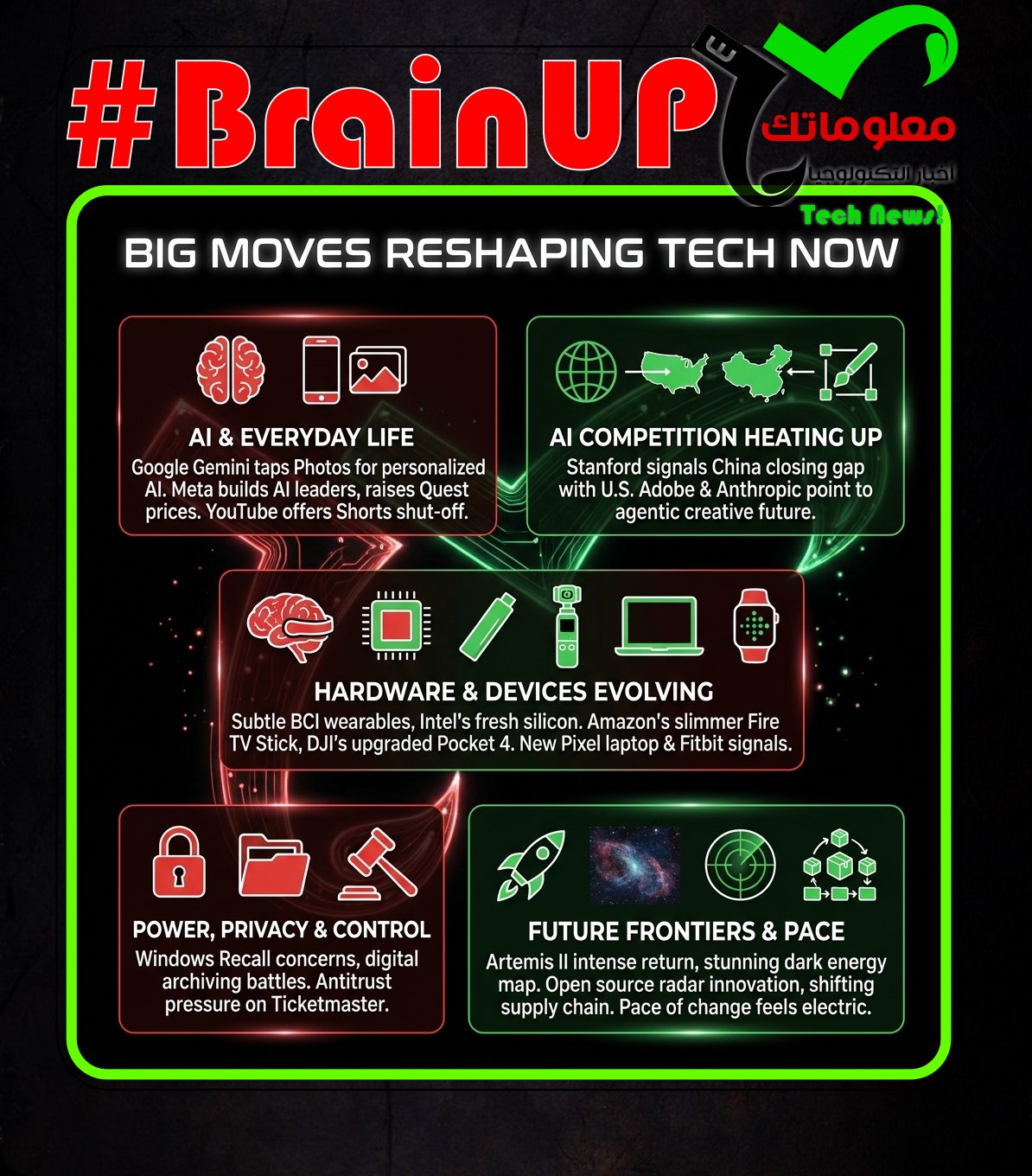
#BrainUp Daily Tech News – (Friday, April 17ᵗʰ)
Welcome to today’s curated collection of interesting links and insights for 2026/04/17. Our Hand-picked, AI-optimized system has processed and summarized 28 articles from all over the internet to bring you the latest technology news.
As previously aired🔴LIVE on Clubhouse, Chatter Social, Instagram, Twitch, X, YouTube, and TikTok.
Also available as a #Podcast on Apple 📻, Spotify🛜, Anghami, and Amazon🎧 or anywhere else you listen to podcasts.
1. Gemini can now create personalized AI images by digging around in Google Photos
#Gemini is expanding its opt-in #personal intelligence feature by linking its image generation model, #NanoBanana2, to #GooglePhotos so it can use your photos and labels to generate more personalized images with simpler prompts. Google says you can refer to concepts like “my family” or “my dog,” and Gemini will use Google Photos labels and image content to pick relevant photos, such as for a prompt like creating a claymation scene of you and your family doing a favorite activity. Google cautions the feature is still evolving and may choose the wrong images, but users can review a sources list, ask follow-up questions about what was selected, or manually add photos in Gemini. Google says Photos data accessed for a prompt is not retained for training, though it does use inputs and outputs to improve its AI products, which may still involve personal information. The feature is off by default and currently limited to paid Google AI plans, with Google noting that such AI features often start on paid tiers and may later expand, and users can control which Google services like Gmail or YouTube are connected.
2. Philippines and U.S. to build industrial hub for supply chain security by 2026
The Philippines and the United States plan to develop an industrial hub aimed at enhancing supply chain security by 2026, focusing on boosting manufacturing capabilities and diversifying sources of strategic materials. This initiative is part of a broader effort to reduce dependence on China amid rising geopolitical tensions and global supply chain disruptions, supported by U.S. government funding and private sector partnerships. The hub will help strengthen economic ties, promote technological innovation, and secure the supply of critical resources, including semiconductors and batteries. The project reflects the growing strategic alignment between @Manila and @Washington to address regional security and economic challenges. This development is expected to reinforce #supplychainresilience and contribute to a more balanced and robust Indo-Pacific economic framework.
Silicon Valley startup Sabi is developing a beanie-style #brain-computer interface that uses non-invasive #EEG to convert a user’s “internal speech” into text, aiming to make thought-based typing feel like everyday clothing instead of bulky lab hardware. The prototype reportedly uses tens of thousands of miniature sensors to capture higher-density brain signals, targets about 30 words per minute, and is intended to work out of the box without daily calibration, positioning it as a more comfortable and accessible alternative to implant approaches like @Neuralink. Sabi is also building a large-scale #AI model trained on thousands of hours of volunteer brain data to handle variation across people and across repeated thoughts, while experts note that true continuous “mind-reading” is often overstated and remains technically difficult. The article highlights major #privacy and ethical risks because neural data can be deeply personal, and Sabi says it plans to encrypt data and consult neurosecurity experts, but broader debates about brain-data rights are expected to intensify. Sabi is aiming for a consumer beanie and cap release by late 2026, suggesting a potential shift toward subtler, wearable BCIs if the technical and societal challenges can be addressed.
4. Ticketmaster is an illegal monopoly, jury finds
A Manhattan jury found Live Nation-Ticketmaster to be an illegal monopolist, finding it liable for illegally monopolizing live event ticketing and amphitheaters, and for tying its concert promotions business to the use of its venues, a verdict that could set up a potential breakup. After a six week trial and several days of deliberation, the case continued even after the Trump administration’s @DOJ settled early in the trial, with 34 state attorneys general pursuing broader #antitrust remedies than the federal settlement that included offloading exclusive booking arrangements at 13 amphitheaters and capping certain Ticketmaster fees. The jury also found Ticketmaster overcharged consumers by $1.72 per ticket, and Judge Arun Subramanian will decide total damages and could choose remedies short of a breakup, with appeals expected. States argued the company used implicit threats to pull concerts unless venues used its ticketing services and that its control of outdoor amphitheaters made major US touring difficult without Live Nation, while the company said it provides superior service and competes for business. State leaders including @LetitiaJames and acting @DOJ antitrust chief @OmeedAssefi praised the outcome as a landmark win that moves the case into a remedies phase focused on how to address the company’s #monopoly power.
5. 23 Major News Sites Have Blocked the Wayback Machine – Digital History In Danger
Major news organizations are blocking the Internet Archive’s Wayback Machine, weakening public and journalistic ability to verify past reporting and track editorial changes in #digital journalism. An Originality AI analysis cited in the article says 23 major news sites block the Wayback Machine’s crawler (ia_archiverbot), including @The New York Times, USA Today’s 200+ outlets, and Reddit, while The Guardian reportedly allows crawling but restricts public access to archives. Publishers argue the blocks are needed to prevent #AI training on archived content and for general anti-scraping, with the Times saying its content is being used “to directly compete with us,” and USA Today describing the move as routine bot prevention. The article argues this creates an accountability gap, noting the Wayback Machine helped expose quiet revisions such as a 2016 @The New York Times change to a @Bernie Sanders article, and @Mark Graham of the Wayback Machine calls it contradictory that outlets benefit from the archive while limiting preservation of their own work. With no comparable public alternative and a coalition letter signed by over 100 journalists including @Rachel Maddow, the article warns that expanding #blocking could push access to digital history into a corporate-controlled void.
6. SpaceX Bought 18% of Tesla Cybertrucks Sold in US During Q4 2025, Data Shows | EV
@Elon Musk’s @SpaceX was the largest identifiable buyer of the #Tesla #Cybertruck in the US during Q4 2025, highlighting concerns that internal demand is propping up sales as broader buyer interest weakens. Registration data from S&P Global Mobility, reported by Bloomberg, shows SpaceX acquired 1,279 Cybertrucks in Q4 2025, more than 18% of Tesla’s 7,071 US Cybertruck registrations, and other Musk-controlled ventures bought another 60, totaling 1,339 units or about 19%. The pattern preceded a deeper slump in Q1 2026, when US Cybertruck deliveries fell to 3,519, down 45.1% year over year and 15% from Q4 2025, even as Tesla launched a cheaper Dual-Motor AWD trim in February that initially started at $59,990, later rose to $69,990, and now shows delivery estimates extending to 2027 for new orders. The article notes Tesla sold just over 20,300 Cybertrucks in the US in 2025, a 48.1% drop from the prior year and only 8.1% of the 250,000 annual production run Musk forecast in 2019, reinforcing the view that the model has struggled to achieve mass-market traction.
7. Mark Zuckerberg is reportedly building an AI clone to replace him in meetings
@Meta is reportedly developing an #AI clone of @Mark Zuckerberg designed to interact with employees and provide feedback, potentially standing in for him in meetings. According to the Financial Times, the avatar is being trained on his image and voice plus his mannerisms, tone, and public statements, with the goal that employees feel more connected to the founder through the interactions. The report says @Zuckerberg is involved in training the avatar and is also spending five to 10 hours a week coding on other #AI projects and doing technical reviews. If the experiment succeeds, Meta may let creators make #AI avatars of themselves, building on prior demos and existing tools like creator AI replies on Instagram and custom AI chatbots, while also noting the company recently blocked teens from the chatbot experience. The effort fits Meta’s broader push to deploy personalized #AI personas, alongside a separate project reported by The Wall Street Journal about an AI agent version of Zuckerberg to help him complete tasks.
8. Hacker Uses Claude and ChatGPT to Breach Multiple Government Agencies
The article documents a landmark cyberattack where a single threat actor leveraged generative AI tools like @Anthropic’s Claude and @OpenAI’s ChatGPT (#GPT4) to compromise multiple government systems, signaling a major shift in how cyberattacks are executed at scale. The campaign targeted several Mexican government agencies between late 2025 and early 2026, resulting in the theft of massive volumes of sensitive citizen data, with the attacker using over 1,000 AI prompts and thousands of automated commands to accelerate reconnaissance, exploitation, and data processing. Evidence shows that Claude was responsible for executing the majority of remote commands, while ChatGPT was used to analyze and structure stolen data via custom pipelines, effectively allowing a single individual to perform work that traditionally required an entire team of skilled operators. The analysis reveals that the attacker generated hundreds of custom scripts and even tailored exploits for known vulnerabilities (#CVE), drastically compressing the attack timeline and reducing detection windows, highlighting how #GenerativeAI is transforming offensive cybersecurity capabilities. Importantly, the breach did not rely on novel zero-days but rather exploited existing security gaps, suggesting that AI acts as a force multiplier rather than a root cause, amplifying the consequences of poor security hygiene. Ultimately, the article frames this incident as a “democratization of cyberpower,” where advanced attack capabilities are no longer limited to nation-states or large groups, raising urgent concerns about how organizations must rethink defense strategies in an era where AI can industrialize hacking workflows.
9. YouTube now lets you turn off Shorts
@YouTube has added a zero-minute option to its #Shorts feed time limit, effectively letting users turn off Shorts in the Android and iOS app. The update builds on the Shorts timer announced in October, which previously had a minimum limit of 15 minutes, and it follows a January expansion aimed at giving parents more control, with a zero-minute setting promised as “coming soon.” YouTube spokesperson @Makenzie Spiller says the zero-minute option is now live for all parents and is rolling out to everyone, including adult accounts. After a user hits the limit, the Shorts tab stops showing videos and instead displays a “reached your Shorts feed limit” notice, and testing also found Shorts disappear from the Home screen, so setting the limit to zero can remove them entirely. Users can enable it by going to the app’s settings, selecting time management, toggling on the Shorts feed limit, and choosing a time.
A 2026 #AI Index report from Stanford’s Institute for Human-Centered #AI says China has nearly erased the U.S. lead in AI performance and is outpacing in several research and deployment measures, even as U.S. funding remains much larger. The report cites a sharp narrowing in #Arena scores between top U.S. and Chinese large language models, from GPT-4 leading by more than 1,300 points versus under 1,000 in May 2023 to only a 39-point gap in March 2026, with Anthropic’s Claude Opus 4.6 ahead of China’s Dola-Seed 2.0 by 2.7%. It also notes China’s higher share of AI citation volume in 2024 (20.6% vs. 12.6% for the U.S.) and far more industrial robot installations (over 295,000 vs. 34,200), while the U.S. still has more top models (50 vs. 30) and vastly higher private AI investment in 2025 ($285.9 billion vs. $12.4 billion) plus 1,953 new AI companies funded. The article links China’s momentum to increased startup funding and IPO activity after a 2025 “DeepSeek moment,” ample power capacity for #AI compute, and investor views that China benefits from valuation, adoption, and power generation advantages, contrasted with U.S. grid constraints from underinvestment. It adds that the U.S. #brain-gain in AI is slowing, with AI scholars moving to the U.S. down 89% since 2017, though more researchers still enter than leave, reinforcing the report’s warning that America’s edge is shrinking even with superior capital flows.
11. Clicking “Reject Cookies” Might Not Actually Do Anything
The article reveals a systemic failure in how cookie consent is implemented across the web, based on an audit by webXray showing that user choice is often ignored despite regulatory frameworks like #GDPR and #CCPA; specifically, around 55% of tested websites still placed tracking cookies even after users explicitly clicked “reject,” while 78% of consent banners failed to enforce the decision at all, exposing a widespread gap between legal compliance and technical reality. Evidence points to major ad-tech ecosystems dominated by companies like @Google, @Microsoft, and @Meta continuing to deploy tracking mechanisms regardless of opt-out signals, sometimes through backend systems that override or reinterpret consent strings, effectively nullifying user intent. The analysis suggests this is not accidental but economically rational, as firms may prefer risking billions in fines rather than restructuring profitable data pipelines, turning privacy compliance into a calculated cost-benefit tradeoff rather than a strict obligation. The piece also highlights how modern tracking increasingly bypasses traditional cookies altogether using techniques like fingerprinting and first-party tracking, meaning even a properly functioning “reject” button may not fully protect users. Ultimately, the article frames cookie banners as a largely performative layer of UX theater, where the illusion of control masks a deeper infrastructure designed to preserve surveillance-based advertising, reinforcing the need for stronger enforcement and more privacy-centric architectural changes.
12. How Silicon Valley Is Turning Scientists Into Exploited Gig Workers
The article argues that #SiliconValley, built on decades of #governmentFundedResearch, is now backing an assault on public science funding while positioning private industry to benefit. It recounts how core technologies like semiconductors, the Internet, touchscreens, lithium-ion batteries, and #generativeAI emerged from Cold War military programs, #NSF-supported university work, and #DOD-backed research, including funding ecosystems that helped train talent later recruited by companies like OpenAI, Google, and Meta, and notes @GeoffreyHinton avoided Pentagon contracts while relying on Canadian government support. It then describes conservative venture capitalists @PeterThiel and @MarcAndreessen as influential in the Trump administration’s push against universities and institutional science, citing leaked messages in which Andreessen called universities “Ground Zero,” labeled Stanford and MIT political operations, and urged the #NationalScienceFoundation receive a “bureaucratic death penalty.” The piece portrays Thiel as seeking to shift federal research dollars from universities to private industry, using contested claims that science PhDs are far less productive than in the past and framing #DARPA’s early success as a one-time acceleration that later “corrupted” institutions. Overall, it links tech elites’ anti-university rhetoric and funding cuts to a strategy of extracting value from publicly built research systems while leaving researchers and institutions with diminished support.
13. DJI Osmo Pocket 4 Is a Great Vlogging Camera, but Not for the US
@DJI’s Osmo Pocket 4 builds on an already strong vlogging design with meaningful image and usability upgrades, but it is not slated for official US availability at launch due to pending FCC authorization. The camera looks much like the Pocket 3 with its 2-inch rotating screen and gimbal-mounted module, yet adds a new 1-inch sensor promising up to 14 stops of dynamic range, 4K capture up to 240fps, new filmic color profiles, and 10-bit #D-Log for more serious color grading. It also introduces two buttons under the display, a 2x digital zoom crop and a programmable custom function button, plus a Creator Combo that includes an attachable fill light, wireless mic, and battery handle, with UK pricing starting at £445 or £549 for the bundle. While @DJI claims better low-light performance via improved image processing and adds a slow-shutter video mode for creative night shooting, the reviewer has only used it for a few days and has not yet tested it extensively in darkness. The launch limitation, tied to a murky regulatory backdrop affecting @DJI products, could make the Pocket 4 hard to buy in the US and may complicate service and support even if consumers import one.
14. iPhone brand loyalty at record high level, with Android users switching
A SellCell survey of over 5,000 US smartphone users reports record-high iPhone #brand-loyalty in 2026, while Android users are far more likely to switch to iPhone than the reverse. It found 96.4% of iPhone users expect their next phone to be another iPhone, versus 3.6% planning to move to Android, while 13.6% of Android users say they intend to switch to iPhone, about 3.7 times the iPhone-to-Android switching rate. iPhone loyalty rose from 90.5% in 2019 to 96.4% in 2026, with most of the increase occurring since 2021. Among iPhone users who stay, the most common reason is preference for #iOS (60.8%), followed by investment in the #Apple-ecosystem (17.4%), with reliability, ease of use, and trust in privacy and security also cited, while those considering Android mostly point to price. Overall, the results depict strengthening retention for Apple and a notable pull of iPhone for would-be switchers, especially from Android.
15. Artemis II astronauts detail ‘intense’ reentry in interview with ABC News’ David Muir
The @NASA #Artemis II crew told @David Muir that reentry in the #Orion capsule was far more intense than launch, describing it as the “grand finale” of their historic 10 day trip to the moon and back. Mission specialist @Christina Koch said the capsule’s plunge through Earth’s atmosphere created a plasma bubble that caused a roughly six minute communications blackout and brought temperatures up to about 5,000 degrees Fahrenheit, with a fireball so bright it was hard to look at. She also described an unpracticed rumbling during descent, and recalled commander @Reid Wiseman calming the crew by saying “Everything’s nominal.” Wiseman praised pilot @Victor Glover for maintaining a steady cadence of altitudes and speeds while they experienced about four Gs for roughly 13 minutes, and Glover said that cadence mattered because during the blackout Mission Control cannot communicate with or command the vehicle, so the crew must confirm events are happening on time.
16. 3D dark energy map is mind-blowing | Space photo of the day for April 16, 2026
A new 3D visualization from the #Dark Energy Spectroscopic Instrument (#DESI) presents the largest three-dimensional map of the universe yet, created to help researchers study #dark_energy, the still-unknown explanation for the universe’s accelerating expansion. Completed on April 14, the map places Earth at the center, with every tiny point of light representing a galaxy, offering a striking view of the cosmos in three dimensions. By charting galaxies at vast scales, the dataset is intended to give scientists a powerful way to investigate what might be driving cosmic acceleration, even as #dark_energy and #dark_matter remain major mysteries. The image underscores both how much remains unknown about the expanding universe and how new technologies are enabling more detailed, data-rich approaches to probing those unknowns.
17. Samsung Is Promoting a Galaxy S26 Feature Without Confirming It for S25, S24
The article highlights a strategic inconsistency in how @Samsung is rolling out its #GalaxyAI capabilities, focusing on an upgraded “Audio Eraser” feature that is being actively promoted as part of the #GalaxyS26 experience while remaining unconfirmed for earlier flagship devices like the S25 and S24, despite their hardware capability to potentially support it. Originally introduced in a limited form with the S25, the Audio Eraser allowed users to reduce background noise in videos and recordings, but the S26 version significantly advances this with real-time sound separation and adjustable intensity controls, effectively transforming it into a more dynamic and intelligent audio processing tool. Evidence suggests that while Samsung is expanding its AI ecosystem through updates like #OneUI 8.5, it has not clearly committed to bringing this enhanced feature to previous generations, leaving users in a state of uncertainty and fueling frustration within the Galaxy community. This selective rollout reflects a broader industry pattern where software-based innovations are used as upgrade incentives rather than universally distributed improvements, even when older devices are technically capable. Ultimately, the piece frames Samsung’s approach as a calculated balance between innovation and product segmentation, where AI features become not just technological enhancements but also strategic levers to drive hardware upgrades and maintain flagship differentiation.
18. Amazon launches its slimmest ever streaming device, the Fire TV Stick HD
Amazon is launching the Fire TV Stick HD, its slimmest and most portable streaming stick, designed to upgrade a TV at home or deliver a full entertainment experience while traveling with a new Fire TV interface and #AlexaPlus built in. The device is about 30% slimmer and narrower than prior HD models, supports #DirectPower via a TV’s USB port to avoid a wall adapter, and adds performance and connectivity upgrades including over 30% faster average speed than the last generation, #WiFi6, and #Bluetooth5.3. It also highlights new features such as using #AlexaPlus to describe a movie scene and have Fire TV jump to that moment on Prime Video, plus more natural conversational recommendations and smart home control in the U.S., Canada, and the UK. Amazon says the redesigned Fire TV experience is cleaner, faster, and better organized with content categories like movies, TV shows, live content, sports, and news, and notes Japan will get an anime hub. Priced at $34.99 in the U.S., preorders start now and it is scheduled to ship starting April 29, with availability rolling out across more than a dozen countries.
19. Intel refreshes non-Ultra Core CPUs with new silicon for the first time
Intel is updating its non-Ultra Core Series 3 laptop CPUs with genuinely new silicon for the first time in a while, replacing prior non-Ultra parts that reused #RaptorLake-era designs. The new chips, code-named #WildcatLake, share some lineage with Core Ultra Series 3 (#PantherLake) but use a simpler two-tile design with up to two #CougarCove P-cores, four #Darkmont E-cores, one or two #Xe3 GPU cores, and usually an NPU rated up to 17 TOPS, plus a separate controller tile that adds up to two #Thunderbolt4 ports, #WiFi7, #Bluetooth6.0, and six #PCIe4.0 lanes. They support up to 48GB LPDDR5X-7467 or 64GB DDR5-6400 at 15W base and 35W max boost, and the compute tile is built on #Intel18A, which Intel says should materially improve battery life versus older 12th-gen and 13th-gen derived parts, citing up to 12.5 hours of office use, 18 hours of 1080p Netflix, and 9.6 hours of Zoom on a 59Wh pre-production system. Performance is not expected to be cutting edge, but the shift to new architecture and process brings modern platform features and efficiency to midrange systems that previously lagged Intel’s flagship @CoreUltra line. A downside for some buyers is that the 17 TOPS NPU falls short of @Microsoft’s 40 TOPS requirement for the #CopilotPlusPC label and its associated on-device AI features.
20. Google working on Pixel ‘laptop’ and ‘Pixel Glow’ lights that are also coming to phones
Code references in #Android Canary 2604 and #Android 17 Beta 4 suggest @Google is developing a Pixel “laptop” and a branded hardware feature called #PixelGlow, previously referenced as “orbit” and shown in Settings as “light_animations.” Pixel Glow is described as using subtle light and color on the back of a device to surface important activity when it is face down, including lights for calls from favorite contacts and visual feedback when speaking or interacting with #Gemini, with per-feature toggles and a warning for light sensitive users. The implementation notes that existing flash notifications can override Pixel Glow. The inclusion in Android 17 points to Pixel Glow arriving on the next Pixel phone, though leaked Pixel 11 renders reportedly do not show a dedicated light cutout, leaving possible placements like the Camera Bar or the ‘G’ logo. The same settings logic checks for desktop devices and an “ic_laptop_light” icon appears, indicating Pixel Glow support on laptops as part of @Google’s broader push toward desktop Android, echoing earlier Pixel hardware like Pixelbook and Chromebook Pixel with its light bar.
21. Meta to raise Quest VR headset prices in US due to rising component costs
Meta announced increases in the prices of its Quest virtual reality headsets in the U.S., citing rising costs of components and logistics as the primary reasons. The price hike applies to all variations of the Quest Pro and Quest 2 devices and is the first such increase since their launch. This decision reflects broader supply chain challenges faced by the tech industry, where inflation and component shortages have driven up production costs. Meta’s adjustment aims to maintain profitability while continuing its investment in virtual reality and the metaverse ecosystem. The price change highlights the impact of global economic pressures on consumer technology markets and Meta’s strategic response to sustaining its VR development.
22. Adobe Is Working With Anthropic to Bring a Creative AI Agent to Claude
@Adobe is expanding its push into #agenticAI by partnering with @Anthropic to bring a conversational, agentic #Firefly assistant into @Claude as its first major creative AI tool. The #Firefly assistant, positioned as the hub for Adobe AI across apps like Photoshop, Acrobat, and Premiere Pro, can complete non generative editing tasks with minimal oversight, such as batch photo adjustments for lighting and cropping. Adobe says the goal is to let creators access Adobe capabilities across the tools they use daily by connecting Firefly to third party models, and @Anthropic says creators will be able to conceptualize work in Claude and execute it through Firefly. More details on the Adobe connector to Claude are expected in the coming weeks, and the Firefly assistant is slated for a public beta later this month. Adobe also announced current Firefly updates including improved video editor audio, advanced coloring, deeper Adobe Stock integrations, image suite upgrades, and the addition of #Kling models 3.0 and 3.0 Omni to its set of 30 plus external AI models.
23. Second Public Windows Defender Exploit Released
The article details a rapidly escalating security situation involving @Microsoft’s built-in #WindowsDefender, where a disgruntled researcher publicly released a second zero-day exploit, dubbed “RedSun,” shortly after the company patched the first vulnerability, exposing a deeper systemic weakness in the platform’s security architecture. According to the report, the exploit enables #privilege_escalation by abusing Defender’s handling of flagged malicious files, allowing attackers to overwrite system files and gain full SYSTEM-level access, effectively taking complete control of a machine even from a low-privilege account. Evidence suggests this is part of an ongoing campaign by the same researcher, operating under aliases like “Nightmare Eclipse,” who is intentionally releasing proof-of-concept exploits in retaliation for perceived mistreatment by Microsoft’s security response process, signaling a breakdown in responsible disclosure norms. The analysis highlights that while one vulnerability (tracked as CVE-2026-33825) was patched during #PatchTuesday, new variants are emerging faster than fixes, with multiple exploits like “BlueHammer” and “RedSun” now circulating publicly and even being observed in real-world attacks. Ultimately, the article frames this as more than a single bug, pointing instead to a dangerous feedback loop between frustrated researchers and slow remediation cycles, where public exploit releases increase the risk surface for millions of users and expose how modern cybersecurity increasingly depends not just on code quality but on trust and coordination between vendors and the research community.
24. Blackmagic Camera app gets Apple Watch companion – 9to5Mac
@Blackmagic Design updated its Blackmagic Camera app for iOS to version 3.3 ahead of NAB 2026, led by a new #AppleWatch companion that adds wrist-based camera control. The watch app shows a live viewfinder plus timecode, focus, resolution, battery, audio levels, and recording controls, lets users hide or show overlays, and uses the Digital Crown to switch iPhone lenses, with settings toggles for options like autofocus, exposure, stabilization, LUT behavior, and live streaming. Version 3.3 also adds full-screen portrait-mode #HDMI output for vertical video, #ATEM camera control when using the Blackmagic Camera #ProDock, support for #ProResRAW stabilization in iOS 26.1+, and support for Blackmagic Focus and Zoom demands, alongside several fixes for ProRes RAW recording, preview lag, and incorrect H.264/H.265 bit rates. The article notes the watch companion does not fully replace an external monitor but can supplement one or work in a pinch, and it improves on prior start/stop control done via the Shortcuts app. Blackmagic Camera 3.3 and its Apple Watch companion are available as a free download on the App Store for new and existing users.
25. Google’s new Fitbit band has continued hiding in plain sight, software too [Gallery]
@Google is developing a screen-less #Fitbit tracking band, similar in concept to a #Whoop-style band, and it has been repeatedly spotted in public. @Steph Curry, described as Google’s “Performance Advisor” for Fitbit, has been wearing the device since January, with a grey and orange version appearing in social videos and press settings, suggesting a thin design and materials resembling other Fitbit products and #Pixel Watch bands. A separate glimpse shows an apparent Fitbit app “Live data” screen on a Pixel phone displaying Cardio Load, heart rate, calories burned, and elapsed workout time, a page that does not currently exist in the app. These sightings imply both the hardware and supporting software experience are already in use or being tested. Google has not indicated when the new band will launch.
26. Starlink outage hit drone tests, exposing Pentagon’s growing reliance on SpaceX
A recent #Starlink outage disrupted Pentagon drone tests, highlighting the U.S. military’s increasing dependence on @SpaceX’s satellite internet service. The outage, reportedly lasting several hours, led to delays and raised concerns about the vulnerability of critical defense operations relying on commercial #satellite networks. The event underscores the risks in the Department of Defense’s strategy to integrate third-party technology, emphasizing the need for backup systems and diversified providers to ensure mission continuity. Despite the benefits of high-speed, low-latency communication offered by Starlink, the outage reveals potential systemic weaknesses in national security infrastructure. This incident illustrates the complex balance between leveraging innovative commercial technologies and maintaining operational resilience for defense purposes.
27. Google Just Patented The End Of Your Website
Google has patented a technology that could fundamentally change the way websites operate by potentially rendering traditional websites obsolete. The patent describes a system where Google could display interactive, app-like experiences directly in search results, bypassing the need to visit a website. This development reflects Google’s ongoing efforts to enhance user experience by streamlining access to content and services within its own ecosystem. By transforming search results into fully functional interfaces, Google may shift control away from individual site owners toward its own platform. This innovation underscores the evolving digital landscape and raises questions about the future role of websites amid Google’s expanding influence.
Moroccan electronics engineer @Nawfal Motii has open-sourced the Aeris-10 #radar system, claiming performance comparable to commercial offerings priced around $250,000 while targeting a much lower build cost. Aeris-10 has two variants: the 10N Nexus with a 3 km range and an 8×16 patch antenna array, and the 10E Extended with up to 20 km range using a 32×16 slotted waveguide array, with full schematics, PCB layouts, components, firmware, and GUI software published on GitHub. The design centers on an XCA7A50T #FPGA for FFT processing, MTI, Doppler speed estimation, and CFAR false-alarm control, plus an STM32F746xx microcontroller managing synthesizers, ADC/DACs, GPS, barometer, motors, and cooling, and it is described as a true #phasedArray system with ±45° elevation and azimuth adjustment. Motii estimates a bill of materials around $5,000 for the 10N and $7,200 for the 10E, contrasting this with cited commercial phased-array prices of roughly $120k to $200k and higher for longer-range units, while noting that surplus radars ($10k to $50k) are older with limited parts and that test equipment alone can cost $50k. To broaden access beyond skilled DIY builders, he says he has reached an agreement with Crowd Supply targeting a Q3 2026 release, and he also switched licensing from MIT to the #CERN-OHL-PT after being advised MIT does not protect physical hardware.
29. “TotalRecall Reloaded” tool finds a side entrance to Windows 11’s Recall database
#Recall on #CopilotPlus Windows PCs was overhauled after early versions stored screenshots and activity data unencrypted, but a new “TotalRecall Reloaded” tool by security researcher Alexander Hagenah claims it can still siphon Recall data after a user authenticates. Hagenah says the Recall database protections are “rock solid,” yet once a user unlocks Recall with #WindowsHello, data is passed to AIXHost.exe, a process that lacks the same protections, creating a “delivery truck” weak point. The tool injects a DLL into AIXHost.exe without administrator privileges, waits for the user to open Recall and authenticate, then intercepts screenshots, OCR text, and metadata, including continuing after the user closes their Recall session. It can also perform some actions without Windows Hello, including grabbing the most recent screenshot, capturing select metadata about the database, and deleting the entire Recall database. Microsoft classified the report as “not a vulnerability” and said it does not plan to fix it, underscoring that even the improved, encrypted Recall remains a privacy and security risk because it records most PC usage.
That’s all for today’s digest for 2026/04/17! We picked, and processed 28 Articles. Stay tuned for tomorrow’s collection of insights and discoveries.
Thanks, Patricia Zougheib and Dr Badawi, for curating the links
See you in the next one! 🚀
