
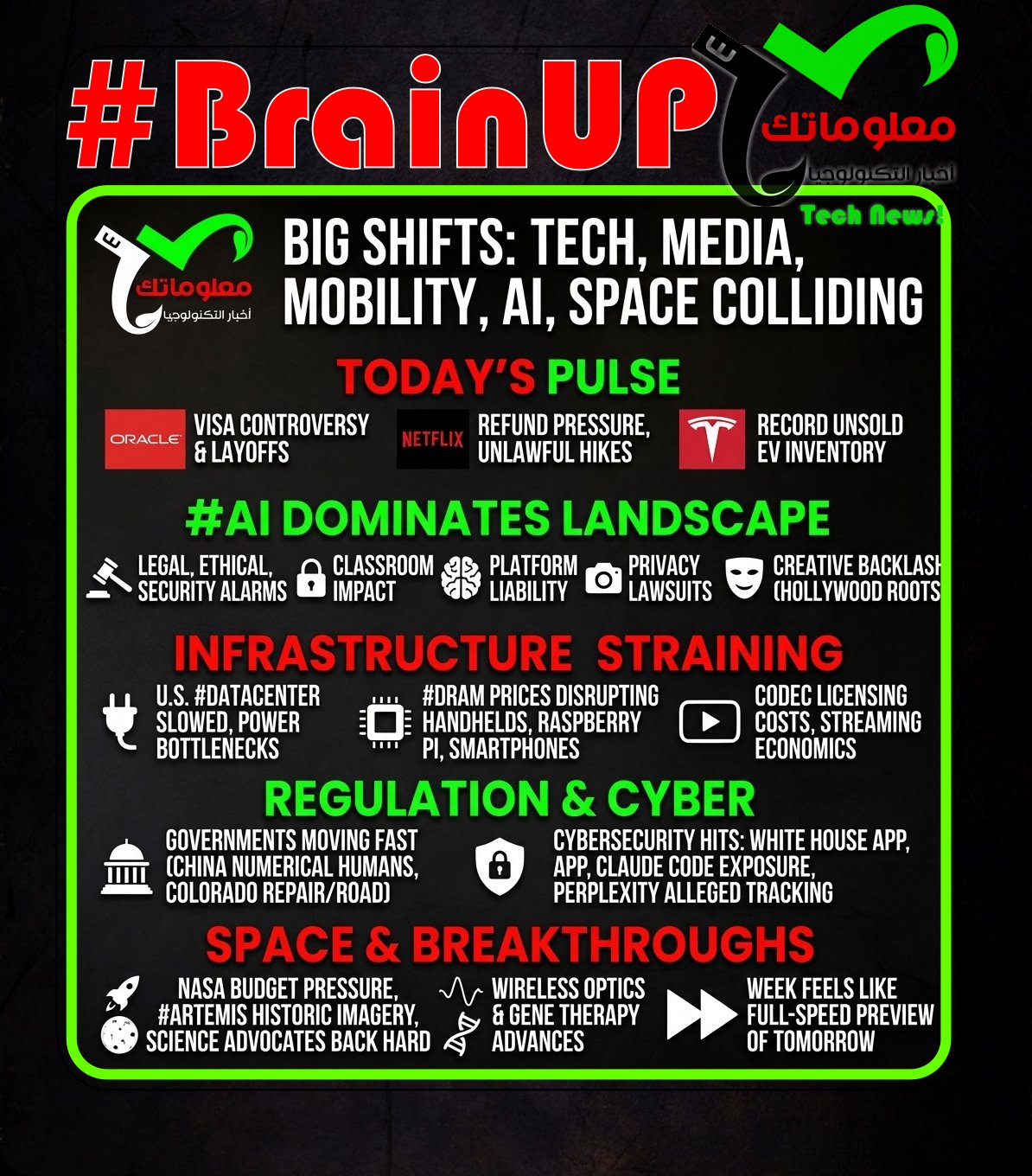
#BrainUp Daily Tech News – (Saturday, April 4ᵗʰ)
Welcome to today’s curated collection of interesting links and insights for 2026/04/04. Our Hand-picked, AI-optimized system has processed and summarized 33 articles from all over the internet to bring you the latest technology news.
As previously aired🔴LIVE on Clubhouse, Chatter Social, Instagram, Twitch, X, YouTube, and TikTok.
Also available as a #Podcast on Apple 📻, Spotify🛜, Anghami, and Amazon🎧 or anywhere else you listen to podcasts.
1. Oracle Files Thousands of H-1B Visa Petitions Amid Mass Layoffs – Austin Today
@Oracle, headquartered in Austin, Texas, filed thousands of #H-1B visa petitions over the past two fiscal years while reportedly laying off thousands of American employees as part of a major organizational shift. U.S. Citizenship and Immigration Services data cited in the article shows Oracle America Inc. filed 2,690 petitions in fiscal year 2025 and 436 so far in fiscal year 2026, totaling more than 3,100 requests, as workers reportedly received letters saying, “today is your last working day.” The article notes that the #H-1B program is intended to let companies temporarily employ foreign workers with specialized skills, but it is contested, with critics arguing it can be used to replace U.S. workers with cheaper labor and supporters saying it fills talent gaps. Oracle has not publicly commented on either the layoffs or the visa filings, leaving its motivations and hiring plans unclear. The situation is presented as a fresh example in the broader debate over how #H-1B use affects the American workforce during corporate restructuring.
The Court of Rome upheld an action by Movimento Consumatori against Netflix Italia, declaring null the contractual clauses that allowed unilateral subscription price and condition changes from 2017 to January 2024 because they lacked justified reasons stated upfront, in violation of the #ConsumerCode. The court held that advance notice and a right to withdraw were insufficient, consumers must know from the outset the specific grounds that could justify future increases, and it deemed the resulting increases in 2017, 2019, 2021 and November 2024 on contracts signed between 2017 and January 2024 unlawful and refundable. The decision focuses on #iusVariandi, finding the earlier framework deficient and also considering clause 6.5 (in force from January 2024 to April 2025) unlawful for the same lack of predetermined reasons. By contrast, the court found Netflix’s April 2025 revised terms compliant because changes are tied to specific causes such as service changes, regulatory obligations, clause clarity, and technological or security requirements. The ruling states affected consumers must be informed and can seek recovery of undue sums and possible damages, orders publication of the decision on Netflix’s website for at least six months and in Corriere della Sera and Il Sole 24 Ore, while Netflix says it will appeal and claims its conditions aligned with Italian law and practice.
3. Tesla Has Record Unsold Inventory As Q1 2026 Delivery Report Surprises Market
Tesla ended Q1 2026 with an unprecedented level of unsold inventory, which surprised market analysts expecting tighter supply. The company delivered 439,883 vehicles this quarter but left 112,000 vehicles unsold on lots and in transit, a significant rise from previous levels. This surplus is partly due to increased production outpacing demand, as Tesla ramped up output of its Model 3 and Model Y to meet future demand projections. The buildup of inventory poses challenges for Tesla’s inventory management and cash flow, while also signaling potential market saturation or demand softening in key regions. How Tesla addresses this imbalance will be critical for sustaining growth and maintaining its leadership in the #EV market.
4. Take-Two Interactive Fires Head Of AI Weeks After CEO Says AI Can’t Make Games Like GTA 6
Take-Two Interactive has laid off its head of #AI, Luke Dicken, alongside wider cuts to the company’s AI department, shortly after CEO @Strauss Zelnick argued that #AI cannot create major hits like #GTA6. According to Insider Gaming, Dicken disclosed the layoffs in a now-deleted #LinkedIn post saying his time at Take-Two and his team’s had ended, and asking for help finding new roles for team members. Dicken said the group had spent seven years developing cutting-edge technology to support game development workflows and build systems that empower developers. Take-Two has not issued a statement, and the number of affected employees and reasons for the cuts are unclear, but Zelnick has consistently maintained that #AI is data-driven and lacks creativity, calling the idea of using it to generate a hit “laughable,” even while expressing interest in tools that make development easier. The layoffs highlight a tension between Take-Two’s stated skepticism about replacing human creativity with #AI and its investment in AI development tools.
5. White House seeks $5.6 billion cut to NASA budget in 2027
The @White House proposed a major reduction to NASA’s 2027 budget, even as the agency plans new missions tied to the #Artemis moon program. The proposal would cut NASA funding by $5.6 billion overall, including a $3.4 billion reduction to the agency’s science unit, described as a 23% cut. The scale of the science reduction suggests significant pressure on NASA’s research portfolio while leadership pursues an expanded set of missions. The proposal frames a tension between sustaining #science capabilities and advancing flagship lunar efforts. The request underscores how future NASA priorities, including #Artemis, could be reshaped by budget constraints if enacted.
6. The Planetary Society urges Congress to reject historic cuts to NASA,…
The #PlanetarySociety urges Congress to reject the FY 2027 White House top-line budget request for #NASA, saying it would revive an existential threat to U.S. leadership in space science and exploration. The proposal would cut NASA by 23% and slash the #ScienceMissionDirectorate by 47%, from $7.25 billion to $3.9 billion, and the Society argues it would add uncertainty and disruption to NASA’s workforce as major efforts proceed, including #ArtemisII, the @NancyGraceRomanSpaceTelescope nearing final integration, and the #Dragonfly and #NEOSurveyor projects moving toward launch. It notes the same cuts were rejected by overwhelming bipartisan majorities last year, that the public responded in record numbers, and that more than 100 House members recently co-signed a bipartisan letter calling for a $1.75 billion increase to NASA Science. The Society says the #OMB proposal is out of step with a broad bipartisan consensus and with the President’s stated desire that NASA remain the world’s premier space agency. It plans to mobilize public advocacy again and calls for swift action by the Appropriations Committees to pursue an ambitious, balanced, science-driven agenda, warning that adjusted for inflation the proposal would yield NASA’s smallest budget since 1961.
7. AI Is a Threat to Everything the American People Hold Dear
Artificial Intelligence (#AI) poses serious risks to American values and national security, challenging privacy, employment, and democratic institutions. The article cites concerns from experts and policymakers about AI’s potential to disrupt economic structures by automating jobs and increasing inequality. It highlights the threat AI-generated misinformation and surveillance pose to democracy and civil liberties. This technology requires urgent regulatory frameworks and public awareness to protect individual rights and societal stability. Addressing these issues proactively will determine whether AI becomes a tool for progress or a catalyst for harm in America.
Via Licensing Alliance (Via LA), the patent pool administrator for #H.264/#AVC, quietly replaced its flat $100,000 annual streaming license cap with a tiered structure that can reach $4.5 million per year for the largest platforms, according to a March 17 Streaming Media report. The change applies only to previously unlicensed implementers seeking a new license in 2026 or later, while existing licensees active by the end of 2025 are grandfathered under prior terms, after Via LA says it contacted unlicensed media companies in 2025 without a public announcement. Although many H.264 patents have expired, licensing attorney Jim Harlan said expirations do not automatically remove obligations because #FRAND evaluations consider the strength and remaining life of active patents. The new schedule sets Tier 1 thresholds such as 100M+ OTT subscribers, 100M+ daily FAST users, 1B+ monthly social users, or 15M+ monthly cloud gaming users at $4.5M annually, with Tier 2 at $3.375M and Tier 3 at $2.25M, while only small or nascent platforms keep the $100K cap. The restructuring comes amid broader codec royalty escalation as Avanci and Access Advance pursue streaming content royalties for #HEVC/#H.265, #VVC, #VP9, and #AV1, potentially driving major platforms toward nine-figure annual costs, alongside examples of downstream impacts from patent disputes including halted PC and laptop sales in Germany following Nokia-linked rulings.
9. Wisconsin Governor Vetoes Age-Verification Bill — Free Speech Coalition
@Tony Evers vetoed Wisconsin’s #age-verification bill, AB 105, citing privacy and constitutional access concerns even after it passed the legislature in early March amid opposition from Free Speech Coalition and other civil liberties groups. In his veto letter, he called the measure “an intrusion into the privacy of Wisconsin residents,” highlighting #data-privacy risks and potential interference with access to constitutionally protected content. He urged lawmakers to pursue #device-based age verification implemented on a user’s phone or computer, arguing it could be more secure and effective while better limiting risks to Wisconsinites. Free Speech Coalition said it had engaged legislators since early last year, including meetings by @Mike Stabile to raise legal and technical issues such as a proposed #VPN ban that was ultimately removed while the rest of the bill advanced. FSC also coordinated with groups including @ACLU, @Electronic Frontier Foundation, Woodhull Freedom Foundation, and Fight for the Future to educate legislators and pressed the governor with a letter outlining concerns before the veto.
10. Colorado To Use Automated Cameras To Catch Speeders Starting Soon
Colorado is set to deploy automated #speedlimit cameras statewide beginning July 1, despite ongoing legislative challenges and a vetoed bill that sought to ban such devices. The state initially implemented these cameras in Adams County, employing #radar and #laser technology to monitor driver speed and trigger automated fines for violators. Supporters argue the cameras will enhance road safety and reduce accidents, while opponents raise concerns about privacy, accuracy, and the motive of generating revenue. As implementation expands, Colorado joins other states using advanced enforcement tools to supplement traditional speed-control measures. This move signals a growing trend in transportation policy leveraging technology to improve compliance and safety on highways.
11. The White House App Is Riddled With Cybersecurity Vulnerabilities
Cybersecurity researchers say the White House’s newly released app exposes users and even some White House staffers to avoidable #cybersecurity and #dataPrivacy risks by sharing sensitive metadata with third parties without clear disclosure. Reviews of the app’s code found it regularly shares users’ IP addresses, time zones, and other data with third-party services, and a researcher provided NOTUS screenshots indicating that embedded widgets from #Elfsight, a Russia-founded software kit company, made some staffers’ personal information publicly visible via the app. Experts, including Philip Fields, argued the app reflects a “slipshod” security approach that is especially concerning amid heightened attacks on U.S. government infrastructure, and contrasted it with typical federal reliance on certified cloud programs like #FedRAMP and #GovCloud to mitigate such risks. Elfsight did not directly respond, instead sending an AI-generated message emphasizing that app owners are responsible for how third-party code is integrated and secured as part of a broader supply chain. A White House official said Elfsight underwent a full security review by White House IT, was approved for use, and that the identified issue was an Elfsight-side vulnerability that the company had been notified about, even as @Donald Trump promoted the app as “front-row access” to Trump administration news and it rose to a top download rank.
12. Claude AI source code leak raises privacy and security concerns
The recent leak of the Claude AI source code has sparked significant privacy and security concerns across the tech community. The leak exposed internal workings and proprietary algorithms of Anthropic’s AI model, raising fears about potential misuse and vulnerabilities. Experts warn that such exposure could enable bad actors to replicate or manipulate #AI systems, threatening user privacy and intellectual property security. The incident underscores the critical importance of robust cybersecurity measures in managing sensitive AI code. This scenario highlights the need for continuous vigilance and improved ethical frameworks in the development and deployment of AI technologies.
13. Microsoft Says Copilot Is For Entertainment Purposes Only, Not Serious Use
Microsoft has positioned its #Copilot AI as primarily for entertainment rather than serious or critical use, cautioning users not to rely on it for important advice. Despite aggressively promoting AI to consumers, the firm emphasizes that the technology is prone to inaccuracies and should not be trusted for crucial decisions. This stance reflects ongoing concerns about AI reliability and the risks of overdependence on machine-generated recommendations. Microsoft’s approach underscores the tension between marketing AI as transformative while acknowledging its current limitations. The company’s messaging aims to balance enthusiasm with a measured warning to users.
Nearly half of planned U.S. data center builds are projected to be delayed or canceled because #power infrastructure components are in short supply, leaving the #AI build-out constrained by the electrical supply chain even after server makers shifted production out of China. Bloomberg reports that @Alphabet, @Amazon, @Meta, and @Microsoft are expected to spend over $650 billion in 2026 on AI capacity, yet only about one-third of the roughly 12 GW of U.S. data center capacity expected online in 2026 is under active construction. Key bottlenecks include transformers, switchgear, and batteries, which are needed both inside facilities and for grid upgrades as demand also rises from electric vehicles and electrified heating. Lead times for high-power transformers have stretched from 24 to 30 months before 2020 to as long as five years now, which clashes with sub-18-month AI deployment cycles, and pushes firms to source globally, including surging imports from China alongside Canada, Mexico, and South Korea. The result is that despite onshoring trends, U.S. data center expansion remains tightly linked to constrained #electrical equipment supply chains, including significant reliance on China for batteries and portions of transformer and switchgear categories.
15. Hannah Einbinder Slams AI Creators As “Losers”
@Hannah Einbinder criticized #generativeAI and the people who build it, calling them “losers” who are “trying to rob real creatives” during a press conference for HBO Max’s @Hacks. She said AI makers are “not artists” and argued they want to be special while undermining genuine creative work and ethical standards, adding that they cannot take away real creatives’ gifts. Co-creator @Jen Statsky echoed the concern, warning that using AI to make the creative process “easier” could harm creatives while executives keep profiting, and said the situation will remain bad until “guardrails” and a “stoppage mechanism” protect humanity in art and people’s livelihoods. The comments arrive as the fifth and final season of #Hacks returns to Hollywood, premiering April 9 on HBO Max, with Einbinder’s Ava Daniels reuniting with Deborah Vance (@Jean Smart) as Deborah aims for a Madison Square Garden stand-up show after being legally barred from performing for breaking a late-night contract.
16. Dodge CEO Asks ‘Do You Need a Radio’ in ‘Back-to-Basics’ Quest for Entry-Level Cars
@Dodge CEO @Matt McAlear says the brand should challenge what buyers expect from an entry-level car by pursuing a #back-to-basics approach that questions features like infotainment and even whether a radio is necessary. Speaking to The Drive at the 2026 New York Auto Show, he floated ideas such as analog gauges and simple audio via speakers paired to Bluetooth, arguing Dodge can make people “uncomfortable” and still deliver something they did not realize they wanted, as it has with past surprises like the first @Viper. The article notes this minimal-feature rethink is already appearing elsewhere, citing the upcoming #Slate electric truck’s base model lacking a radio and power windows, while also emphasizing that regulations like backup-camera requirements and a new #NHTSA rule mandating #automaticEmergencyBraking constrain how bare-bones cars can be. It adds that cost-cutting is not always aligned with low-tech parts, since screens can be cheaper than physical gauges and buttons, and at least one screen is effectively required for mandatory backup cameras. The piece situates the comments within Dodge’s long history of flirting with affordable, unexpected performance, from the #Neon SRT-4 to concepts like the Copperhead “baby Viper,” and suggests a stripped-down, fun-focused entry model is an idea Dodge has often discussed but not delivered.
17. Meta, Google under attack as court cases bypass 30-year-old legal shield
Court cases are increasingly being shaped to bypass #Section230, the 1996 legal shield that has long protected internet platforms from liability for user-posted content, putting @Meta and @Google under growing legal pressure. Recent jury verdicts found @Meta liable in a New Mexico child safety case and found @Meta and @Google’s #YouTube negligent in a Los Angeles personal injury trial, and additional suits are being filed to argue that newer products are not neutral intermediaries, including a class action by victims of @JeffreyEpstein alleging wrongful disclosure of personal information and targeting Google’s #AIMode summaries and links. Legal experts say this systematic litigation is creating “divots and chinks” in Section 230’s protections, challenging the long-held distinction between platforms and publishers. While damages so far are relatively small, under $400 million across the two recent verdicts, the precedents raise stakes as the industry shifts from traditional search and social networking toward #AI systems that generate conversational text, images, and videos that can be controversial or illegal. The emerging legal theory is that as platforms increasingly curate and generate outputs, they may face more responsibility for harms tied to what appears on their services, especially involving children’s safety.
18. NHS staff resist using Palantir software
Some @NHS England staff are reportedly resisting use of @Palantir’s #FederatedDataPlatform, citing ethical objections, privacy and trust concerns, and skepticism about its practical value. The platform is part of a £330 million 2023 contract intended to link NHS systems into a single searchable database to help reduce care backlogs, but staff told the Financial Times that coworkers are boycotting it, working around it, or even slowing down when required to use it. Reported objections include discomfort with @Palantir’s ties to the US government and its work with ICE deportation efforts under the Trump administration, with the #BritishMedicalAssociation calling for doctors to stop using the system. The article also says some care boards have delayed implementation, while UK officials are pushing to end the deal via a break clause, with transparency around the original award and patient data handling presented as key issues rather than ideology. Despite the pushback, the piece notes @Palantir’s UK government presence is expanding through additional engagements such as a trial with the #FinancialConductAuthority and a follow-on agreement with the Ministry of Defence.
19. RAM Prices Are Killing Small Gaming Devices
Rising #RAM and #NAND prices are making small gaming handhelds and tablets harder to sell at reasonable prices, hitting big brands like @Lenovo as well as boutique makers. Lenovo’s Legion Go 2 launched at $1,350, is now listed for $2,000 on Best Buy with open-box units around $1,800+, and its Legion Tab (Gen 3) disappeared from Lenovo’s store and is now labeled “Available Soon” after being sold for about $380 as recently as February. The article ties the squeeze to demand from #AI data centers for high-bandwidth memory, with semiconductor suppliers prioritizing the AI industry, even as TrendForce notes some recent consumer memory price dips of nearly 20% amid multiple factors, including reports about @Google’s TurboQuant reducing memory needs for training and weakening consumer demand from gouging and scalping. TrendForce also warns prices may surge again in the second half of the year, by up to 60% for #DRAM and 75% for NAND flash, suggesting the pressure is not over. Smaller handheld makers are already reacting: Ayaneo suspended sales of its high-end Next II and warned of price increases for devices like Pocket DS and Konkr Fit, while Retroid temporarily discontinued the Retroid Pocket G2 and raised the Pocket Classic price to $150 from $114, underscoring how memory costs are reshaping availability and pricing across the segment.
20. Colorado landmark right to repair law faces pushback from tech company
Colorado passed a landmark #RightToRepair law aiming to make device repairs more accessible and affordable by requiring manufacturers to provide parts and information to consumers and independent repair shops. Despite this, tech company @Apple is pushing back, claiming the law could compromise user privacy and product security. This opposition reveals tension between consumer rights advocates seeking repair freedom and manufacturers emphasizing safety and protection of proprietary technology. The dispute highlights the ongoing debate over balancing consumer empowerment with technological control. The Colorado law’s advancement marks a significant step in the broader #RightToRepair movement challenging industry resistance.
21. China moves to regulate digital humans, bans addictive services for children
China is advancing regulations on #digital humans, virtual influencers generated by AI and CGI, to curb risks and prevent addiction, especially among minors. The Cyberspace Administration of China issued draft rules aiming to prevent misleading content and protect minors from overly addictive services. The rules prohibit digital humans from creating content with violent, pornographic, superstitious, or politically sensitive material, while also banning addictive gaming and live-stream shopping targeting children. This initiative reflects the government’s broader efforts to manage the influence of emerging tech and content platforms on youth behavior and societal norms. By regulating digital humans, China seeks to balance innovation with social responsibility in its rapidly evolving digital landscape.
22. Perplexity’s “Incognito Mode” is a “sham,” lawsuit says
A proposed class action lawsuit alleges that #Perplexity shares users’ chat prompts and conversation transcripts with @Google and @Meta via ad trackers, often without users’ knowledge or consent, including for people who never created an account. The complaint says developer tools showed opening prompts are always shared, plus follow-up questions users click, and that non-subscribed users’ prompts can be linked to a URL that lets third parties access the entire conversation. It also claims #IncognitoMode is a “sham” because chats were allegedly still shared along with personally identifiable information like email addresses, even for paid users who enabled the feature. The anonymous plaintiff, John Doe, says chats involving his family’s financial information, and use of the service for taxes, legal advice, and investment decisions, were shared, and he seeks an injunction to stop the alleged ongoing privacy harms. The suit argues the companies prioritized profit by using surreptitious trackers to exploit sensitive topics, including health research where users may overshare or be prompted to upload records, potentially enabling targeted ads or further data sharing.
23. Pupils in England are losing their thinking skills because of AI, survey suggests
A survey of secondary school teachers in England suggests pupils’ reliance on #AI is eroding core learning abilities such as critical thinking, creativity, writing, conversation, and problem-solving. In a poll of 9,000 state school teachers by the National Education Union, two-thirds said they had observed a decline in these skills, with some attributing reduced spelling effort to #voice-to-text technology and warning that #AI encourages cheating. Teachers are split against the government’s proposed #AI tutor rollout, with 49% opposed and 14% supportive, citing concerns it could be used to cut costs, undervalue teaching, and fail to provide the human support disadvantaged pupils need, even as the government promotes a digital revolution and plans AI tutoring for up to 450,000 disadvantaged pupils, backed by @Bridget Phillipson. Meanwhile, many teachers are using #AI themselves, 76% for daily tasks like creating resources, lesson planning, and admin, but nearly half of schools lack any AI policy and most have no student-specific guidance, prompting calls for training, regulation, and clearer policies before wider implementation.
Reports from DigiTimes claim #TSMC is considering another U.S. expansion that could raise its Arizona presence to 12 fabs, four advanced packaging facilities, and at least one R&D center, described as part of a U.S. and Taiwan intergovernmental deal in which Taiwanese entities would invest $500 billion in American high-tech sectors. The rumors build on earlier reports of 10 advanced fabs and cite a possible additional Gigafab complex next to Fab 21, plus #TSMC’s acquisition of about 900 acres adjacent to its existing 1,100-acre campus, alongside talk of another $100 billion in Arizona investment. The article notes inconsistencies and stresses the company has not confirmed the figures, adding that the land purchase could simply align with an already stated plan for six Fab 21 modules, two advanced packaging facilities, and one R&D facility. It also argues the proposed scale would likely cost well over $100 billion given estimated $25 billion to $35 billion costs per leading-edge 2nm-class fab module. Overall, the piece concludes that the expansion talk remains unverified and may reflect not-yet-finalized planning rather than confirmed commitments.
25. Fewer people posting on social media, Ofcom finds
Fewer UK adults are actively posting, commenting on, or sharing on social media, while #AI tool use is rising and many people worry they spend too long on screens, according to Ofcom. In its Adults’ Media Use and Attitudes survey of 7,533 UK adults (29 September to 28 November), 49% said they actively post on platforms like Instagram, Facebook and X, down from 61% the previous year, which Ofcom links to more #passive social media use and less permanent content. Social media expert @Matt Navarra said people may be practicing “digital self-preservation” by shifting to smaller, private spaces like group chats and DMs, and that posting can feel like a future liability. AI use rose from 31% in 2024 to 54% in 2025, driven by younger adults (four in five 16 to 24 year olds and three quarters of 25 to 34 year olds), and 67% said they sometimes spend too long on their devices, with Ofcom citing average daily internet use of four hours and 30 minutes in 2025. Sentiment about being online also fell, with 59% saying benefits outweigh risks in 2025 versus 72% last year, suggesting shifting habits and attitudes as the social media landscape changes.
@Super Micro Computer co-founder Yih-Shyan “Wally” Liaw pleaded not guilty in Manhattan federal court to allegations that he helped illegally divert billions of dollars of #Nvidia-powered servers with export-controlled #AI chips to China, and co-defendant Ting-Wei “Willy” Sun also entered a not-guilty plea. Prosecutors allege Liaw, Ruei-Tsang “Steven” Chang, and Sun used a Southeast Asian pass-through company and tactics like swapping serial number stickers onto dummy units, supported by CCTV footage showing heat guns used in a warehouse, to ship genuine hardware to China with fabricated paperwork. The government estimates about $2.5 billion in sales since 2024, including more than $500 million in shipments between April and May 2025, and Judge Edgardo Ramos set a November 2 trial date, releasing Liaw on a $5 million bond while Chang is not in U.S. custody. The unsealed March 19 charges reportedly drove Super Micro shares down about 33% in one session and wiped out over $6 billion in market cap, and Liaw resigned from the board; the company is not charged but said the accused were associated with it and that the alleged conduct violated internal policies under its export compliance program, while @Nvidia said it prioritizes compliance and does not support unlawfully diverted systems. The case is described as the highest-profile prosecution in the U.S. crackdown on suspected smuggling of restricted AI chips to China, alongside calls from Senators @Jim Banks and @Elizabeth Warren to pause relevant export licenses and a shareholder securities fraud lawsuit alleging concealed reliance on illicit sales.
A continuing #DRAM shortage is pushing up prices across several Raspberry Pi products, prompting Raspberry Pi to add a new 3GB Raspberry Pi 4 option to broaden memory choices. @Eben Upton said Raspberry Pi 4 and 5 boards rose by $25 for 4GB versions and $50 for 8GB versions, while the Raspberry Pi 5 16GB jumped $100, and the Raspberry Pi 500 increased $50. The largest increase hit the Raspberry Pi 500+ unit and kit, up $150, bringing the 500+ to $410, nearly the price of an @Apple M3 Mac Mini at about $430, and the article notes the 500+ 16GB was $280 in February, implying close to a 50% rise for some models. Compute Module 4, 4S, and 5 pricing also climbed by $11.25 to $50, with the 16GB Compute Module 5 up $100, although lower memory variants under 4GB and older LPDDR2 based models are said to be holding price due to inventory. With memory costs still trending upward and reports that #NAND flash contract prices may rise even faster, the piece warns further Raspberry Pi price hikes could occur soon.
28. Laser-powered wireless hits 360 Gbps and uses half the energy of Wi-Fi
Researchers report an #optical wireless communication transmitter that replaces radio waves with infrared light to deliver much higher indoor wireless capacity while reducing energy use compared with #WiFi. In Advanced Photonics Nexus, they describe a chip-scale transmitter built around a custom 5 × 5 #VCSEL array plus beam-shaping optics that create a structured grid of uniform spots, with each laser independently carrying its own data stream in parallel. The laser array is smaller than a millimeter, is fabricated with standard semiconductor methods, and showed consistent, stable output in early tests after being mounted on a custom circuit board. Using a two-meter free-space optical link, the system reached speeds over 360 Gbps, addressing crowded radio spectrum, interference in busy indoor environments, and rising network energy demands as device counts grow. The work positions compact, scalable light-based access points for high-density indoor settings such as offices, homes, hospitals, data centers, and public venues where many users need fast, reliable connections.
29. Deafness reversed: One injection restores hearing in just weeks
A single-injection #gene therapy restored meaningful hearing in people with congenital deafness caused by #OTOF mutations, with gains sometimes appearing within weeks. In a trial of 10 patients aged 1 to 24 treated at five hospitals in China, researchers used a synthetic #AAV to deliver a working OTOF gene into the inner ear via the round window, and every participant’s hearing improved. Most began regaining hearing within one month, and by six months average sound detection improved from 106 decibels to 52, with the strongest responses in children, including a seven-year-old who regained nearly full hearing within four months. The treatment was well-tolerated, with decreased neutrophils as the most common side effect and no serious adverse reactions during 6 to 12 months of follow-up. The results, published in Nature Medicine, suggest targeted gene replacement can reverse certain forms of inherited deafness, and the team is now extending this approach beyond OTOF to other hearing-loss genes such as #GJB2.
30. Microsoft Now Force Upgrades Unmanaged Windows 11 24H2 PCs
Microsoft has started forcibly upgrading unmanaged Windows 11 devices to the 24H2 update to ensure security and consistency across its ecosystem. This push includes updating machines that are not managed through enterprise tools, emphasizing the company’s commitment to reducing fragmentation and security risks posed by outdated systems. The forced upgrades help maintain a uniform platform for developers and users, improving feature availability and support. However, this approach raises concerns among some users about loss of control over update timing. The policy aligns with Microsoft’s broader strategy to streamline Windows maintenance and enhance security by prioritizing the latest updated versions.
31. Lenovo Legion Go 2 suddenly costs $650 more as RAMageddon lays waste to gaming hardware
Lenovo’s Legion Go 2 has jumped sharply in price, as broader #RAM price hikes and memory-related supply pressures push gaming hardware costs up. Best Buy now lists the handheld at $1,499 with an AMD Ryzen Z2 and $1,999 with a Z2 Extreme, up from an original $1,349 for the Z2 Extreme model, a $650 increase in six months. That makes it roughly twice the price of the $999 Microsoft/@Asus Xbox Ally X with the same AMD chip, even though the Legion Go 2 offers extras like detachable controllers, a standout screen, and a unique mouse mode. The article ties the increase to “#RAMageddon” affecting the industry: @Sony has raised PS5 prices by $100 to $150, Ayaneo canceled its Next 2 as “unsustainable” due to storage prices, Retroid discontinued a 12GB model because of RAM costs, and @Valve delayed Steam Machine and Steam Frame while rethinking pricing. With Lenovo not commenting, the piece questions whether a planned SteamOS Legion Go 2 can realistically hit its suggested $1,199 price as costs continue to rise.
33. Xiaomi reveals how much smartphone costs have actually risen due to the DRAM crisis
Xiaomi has disclosed the actual impact of the global DRAM crisis on smartphone prices, revealing that the cost increase has been less severe than anticipated. The DRAM shortage, caused by supply chain disruptions and high demand during the COVID-19 pandemic, raised component prices significantly, but Xiaomi managed to mitigate the effect through supply chain optimization and strategic procurement. This resulted in an average smartphone price increase of only a few percentage points rather than a sharp surge, highlighting the company’s effective crisis management. The analysis underscores the importance of adaptive strategies in the tech industry when facing global supply chain challenges, demonstrating that even with significant component price hikes, overall product cost inflation can be controlled. Xiaomi’s experience provides insight into how technology companies can navigate shortages and protect consumers from steep price increases.
34. NASA releases stunning first photos of Earth from Artemis II moon mission
@NASA has released the first images from inside the #ArtemisII #Orion spacecraft as its four astronauts travel on a 10 day mission around the moon. Commander @ReidWiseman photographed Earth through the capsule window, with one image showing cloud covered Earth appearing to rise beyond the spacecraft and another showing the full globe and oceans with a green aurora. By midmorning Friday the crew was about 100,000 miles from Earth and closing in on the moon, with arrival expected Monday, and they will conduct a lunar flyby without landing, reaching a closest approach of about 4,000 to 6,000 miles above the lunar surface on the sixth day. The astronauts are rehearsing scientific observations for the flyby and will travel around the far side of the moon, the first humans to go that far into deep space in more than 50 years, before using lunar gravity to head home. Splashdown is expected in the Pacific off San Diego on April 11 at about 00:06 GMT, as crew members described the Earth views as both breathtaking and a reminder of shared human identity.
That’s all for today’s digest for 2026/04/04! We picked, and processed 33 Articles. Stay tuned for tomorrow’s collection of insights and discoveries.
Thanks, Patricia Zougheib and Dr Badawi, for curating the links
See you in the next one! 🚀
