
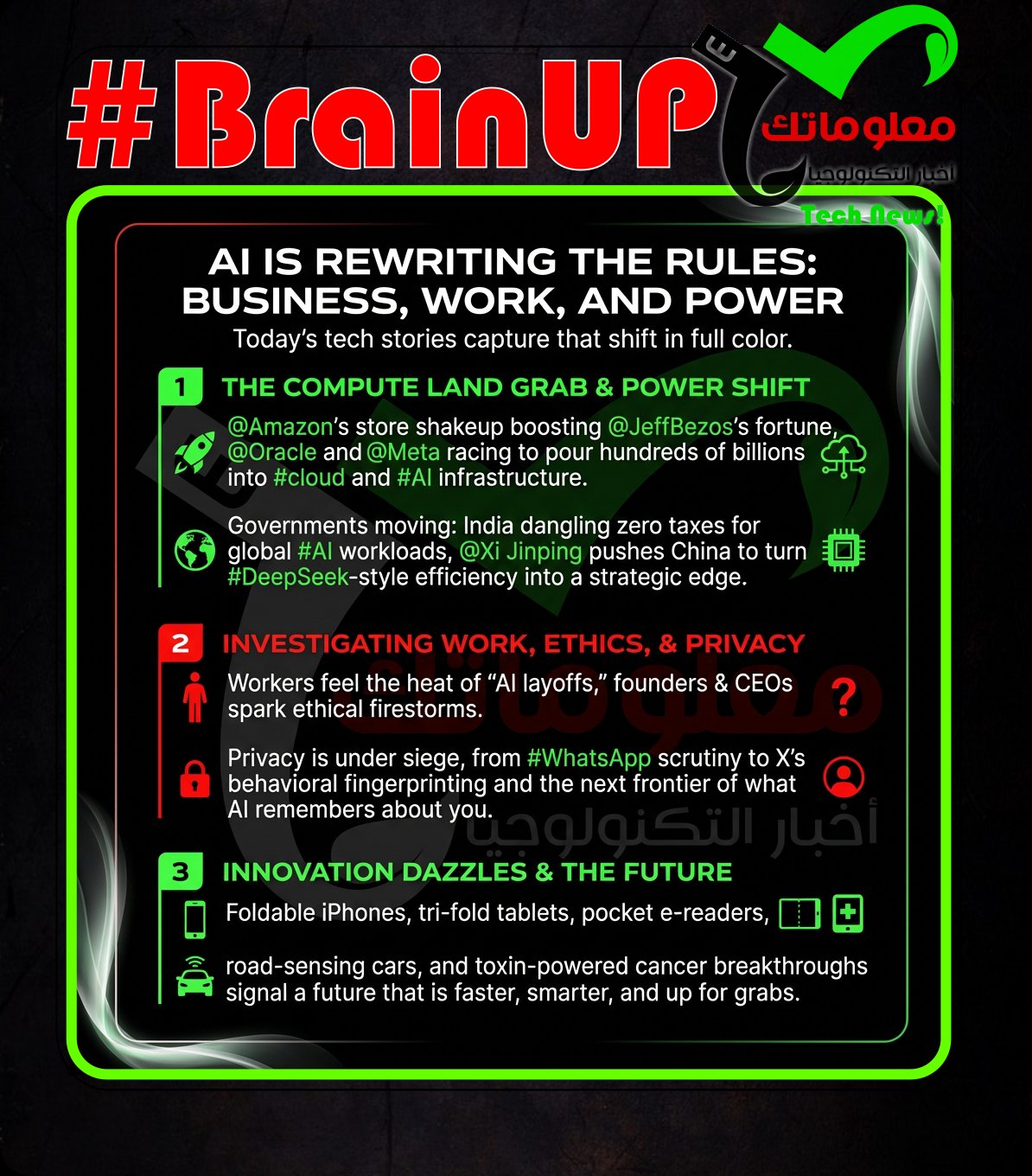
#BrainUp Daily Tech News – (Monday, February 2ⁿᵈ)
Welcome to today’s curated collection of interesting links and insights for 2026/02/02. Our Hand-picked, AI-optimized system has processed and summarized 25 articles from all over the internet to bring you the latest technology news.
As previously aired🔴LIVE on Clubhouse, Chatter Social, Instagram, Twitch, X, YouTube, and TikTok.
Also available as a #Podcast on Apple 📻, Spotify🛜, Anghami, and Amazon🎧 or anywhere else you listen to podcasts.
1. AI layoffs or ‘AI-washing’? | TechCrunch
The article questions whether recent layoffs tied to AI reflect genuine workforce transformation or simply a case of #AI-washing, asking whether companies are truly adapting to AI or using it as an excuse to mask other problems, drawing on a @New York Times piece. It notes that AI was the stated reason for more than 50,000 layoffs in 2025, with @Amazon and @Pinterest among the tech firms blaming the technology for recent cuts. A @Forrester report published in January argues that many companies announcing AI-related layoffs do not have mature, vetted AI applications ready to fill those roles, highlighting a trend of #AI-washing, attributing financially motivated cuts to future AI implementation. Molly Kinder of @Brookings Institute says that claiming layoffs were caused by AI is a very investor-friendly message, especially when the alternative would be admitting the business is ailing. The piece frames the debate as a test of whether AI will truly boost efficiency or simply serve as a scapegoat for broader business challenges.
2. Jeff Bezos’s Net Worth Jumps $5.7 Billion As Amazon Shares Rise On Plans To Shutter Stores
Bezos’s net worth jumped by $5.7 billion to $266 billion as Amazon’s shares rose on plans to shutter physical stores. According to the Bloomberg Billionaires Index, the gain leaves him the world’s third-richest person, just behind Google co-founder @Larry Page, while @Elon Musk remains the richest at $677 billion. Amazon is closing its Amazon Go and Amazon Fresh stores and shifting toward online same-day delivery, and it plans to open more than 100 new Whole Foods locations in coming years #AmazonGo #AmazonFresh #WholeFoods #groceryDelivery #sameDayDelivery. The company is expanding its fulfillment and delivery network and intends to open more physical stores to compete with Walmart, Target, and Costco, illustrating how wealth tied to tech and retail can hinge on delivery capabilities.
3. Report: Apple is testing an iPhone Flip with a square foldable design
Apple is reportedly developing a foldable iPhone that features a square, clamshell design similar to the Samsung Galaxy Z Flip. The concept involves a vertical folding screen that allows the device to compactly close, resembling a flip phone. This design aims to combine portability with display size, enhancing user convenience and pocketability. The development reflects Apple’s exploration into the #foldable smartphone market to innovate beyond traditional designs. Such a product could diversify Apple’s iPhone lineup and update its hardware strategy to compete in this emerging category.
4. Oracle to Raise Up to $50 Billion This Year for Cloud Investment
Oracle plans to raise up to $50 billion in 2026 to expand its cloud infrastructure and accelerate growth in its cloud computing business. The company’s strategy involves significant capital expenditure to compete with leading cloud providers like @Amazon and @Microsoft. This large-scale investment aims to enhance Oracle’s #cloudplatform capabilities, focusing on technology advancements and global data center expansion to attract enterprises. Oracle’s aggressive funding approach underscores the competitive nature of the cloud market and its commitment to capturing a larger market share. The move aligns with Oracle’s broader goal to diversify and strengthen its offerings in the increasingly vital cloud industry.
A 32-year-old programmer in China tragically died allegedly due to overwork after being added to his company’s work group chat while ill and hospitalized, according to a post on the Chinese social media platform Xiaohongshu. The incident sparked widespread discussion on the excessive work culture prevalent in China’s tech industry, where employees face intense pressure and long hours. This case highlights the urgent need for better labor protections and mental health support for workers in high-stress environments. It also reflects growing public concern over ‘996’ work culture, where employees work from 9 a.m. to 9 p.m., six days a week. The story serves as a stark reminder of the human cost of unchecked corporate demands and the importance of enforcing labor laws to protect employee welfare.
6. AI security startup CEO posts controversial statements online
An AI security startup’s CEO generated significant controversy after posting contentious comments on social media, sparking debate about corporate leadership and ethics in the AI industry. The CEO’s remarks, which questioned mainstream approaches to AI regulation and security protocols, drew criticism from industry experts and regulators concerned about the implications for public trust and safety. Analysts suggest that such public statements from influential figures can impact investor confidence and provoke calls for stricter governance measures within emerging AI firms. This incident highlights the growing scrutiny on #AI leadership behavior and the importance of responsible communication as AI technologies become more integrated into critical infrastructures.
7. India offers zero taxes through 2047 to lure global AI workloads | TechCrunch
India’s budget proposal offers foreign cloud providers zero taxes through 2047 on revenues from cloud services sold outside the country if those workloads run from Indian data centers, a move by @NirmalaSitharaman to attract global #AI workloads. Domestic sales to Indian customers would be taxed domestically via locally incorporated resellers, and there is a 15% #safeHarbour for Indian data-center operators providing services to related foreign entities. Global players such as @Google, @Microsoft, and @Amazon have stepped up data-center investments in India, with Google pledging $15B, Microsoft about $17.5B by 2029, and Amazon planning an additional $35B by 2030, bringing total commitments to roughly $75B. Domestic developers like Digital Connexion and Adani-Google projects illustrate rising capacity, but patchy power, high electricity costs, and water scarcity could slow buildout. The policy seeks to position India as a regional #dataHub for AI compute, though execution risks around power, land access, and state clearances remain.
9. Motorola is getting away with zero OS updates thanks to regulatory loophole
@Motorola may be exploiting an EU regulation that allows devices to skip Android OS updates as long as any security or functionality updates are provided, a loophole that could let phones ship with zero OS upgrades. In Europe, models like the Moto G17 reportedly receive five years of security updates but no Android OS upgrades. The regulation’s key word is ‘if’, meaning updates must be offered and provided free only if such updates exist, and Finnish authorities told AfterDawn that the ecodesign requirements do not mandate new updates but require existing security, corrective, and functionality updates for five years from the date the final unit hits the market. This interpretation could set a precedent for other brands in the #EU market and reshape consumer expectations about #OSupdates and #securityupdates. Motorola and the European Commission have been asked for comment, and the article notes that clarification is forthcoming, leaving the outcome uncertain but highlighting a potential industry-wide impact.
10. Unredacted files reveal Anthropic’s secret plan to destructively scan all the books in the world
Anthropic, an AI safety and research company led by former OpenAI and DeepMind executives, planned to destructively scan every book in the world as part of its data collection efforts. Unredacted internal documents reveal that the company intended to build a comprehensive dataset by physically scanning books, possibly damaging them in the process, to train its large language models. This approach raises significant ethical and legal concerns about copyright infringement and preservation of cultural heritage. The plan highlights the tension between the rapid advancement of AI technologies and the safeguarding of intellectual property rights. Anthropic’s strategy reflects broader industry challenges in balancing data acquisition needs with responsible AI development.
11. Gear News of the Week: Samsung’s TriFold Sells Out in Minutes, and a Leak Teases Google’s New OS
Samsung’s first Galaxy Z TriFold sold out in minutes, a folding device that expands to 10 inches and behaves like a tablet, priced at $2,899. It’s the first of its kind in the West, with limited units at select Samsung Experience Stores and invites to sign up for notifications about the next batch. A separate leak hints at Google’s Aluminium_OS, an internal plan to merge #Android and #ChromeOS, with a desktop-like taskbar and split-screen Chrome interface glimpsed in images and a video. The leakage suggests Aluminium_OS may not be a dramatic departure but a stitched-together experience that could take years to supplant ChromeOS, with an official launch anticipated later this year. In other updates, @Vivaldi released an AI-free update focused on enhancements like #Tab_Tiling and improved access to its mail client, signaling a stance against AI integration in favor of human-focused tools.
12. Toxin Stops Colon Cancer Growth Without Harming Healthy Tissue
A bacterial toxin called cytotoxic necrotizing factor 1 (CNF1) has been found to halt colon cancer growth while sparing healthy tissue, offering a promising new therapeutic avenue. Researchers from the University of Padova demonstrated that CNF1 selectively targets tumor cells by inducing senescence and stimulating the immune response, without damaging normal cells. This approach contrasts with conventional treatments that often cause collateral damage to healthy tissue. The selective action of CNF1 suggests potential for safer, more effective colon cancer therapies. These findings highlight the innovative use of bacterial toxins as tools in cancer treatment research.
13. X Down for Thousands of U.S. Users, Downdetector Data Finds
Thousands of U.S. users experienced outages on the social media platform X on February 1, according to Downdetector data. The disruptions mainly affected posting and feed access functionalities, causing significant inconvenience. The issue appears to be widespread, impacting users across various states and devices. This outage highlights the challenges digital platforms face in maintaining continuous service amid growing demand and complexity. Understanding and addressing such interruptions is crucial to ensure user trust and platform reliability.
14. What If the Sensors on Your Car Were Inspecting Potholes for the Government? Honda Found Out
Vehicle sensors designed for safety and driving can also support proactive roadway maintenance, as a two-year Ohio pilot shows by reporting potholes, damaged signs and deficient lane markings. #ProactiveRoadwayMaintenance @Honda @ODOT In the study, Honda teamed with @ODOT, the University of Cincinnati, Parsons and @iProbeInc to drive about 3,000 miles with cameras and Lidar, with human validation and i-Robot verification, achieving 99% detection of damaged or hidden signs, 93% for damaged guardrails and 89% for potholes. #Lidar #Cameras #iProbeInc The project demonstrates that real-time vehicle data, when paired with analytics, can complement existing inspections, support smarter asset management, improve safety and reduce maintenance costs. #Analytics #AssetManagement Looking ahead, Honda aims to anonymize data sharing with the correct agencies to report current and future road issues. #DataPrivacy #PublicSafety
15. WhatsApp’s Privacy Promise Under Federal Scrutiny After Whistleblower Allegations Surface
WhatsApp is facing federal investigation following whistleblower allegations that question the platform’s privacy practices. The allegations claim that WhatsApp may not fully protect user data as promised, raising concerns about compliance with privacy regulations. This scrutiny highlights ongoing challenges in the tech industry regarding user data protection and transparency, especially for platforms like WhatsApp that serve billions globally. The case underscores the importance of regulatory oversight to ensure companies adhere to their privacy commitments. It also provokes discussions on enhancing user trust and accountability in digital communication services.
16. Match, Hinge, OkCupid, and Panera Bread breached by ransomware group
ShinyHunters claims to have stolen data belonging to @MatchGroup’s dating apps (@Tinder, @Match, @Meetic, @OkCupid, @Hinge) and to @PaneraBread, totaling about 10 million records for Match Group and 14 million for Panera. Match Group confirms a cyber incident and says there is no evidence that logins, financial data, or private chats were stolen, but #PII and tracking data for some users are in scope. Panera Bread confirms an incident and says hackers did not access user login credentials, financial information, or private communications. The breaches illustrate varying consequences for users: dating-app data can raise privacy concerns, potential doxxing, and stigma, while Panera’s data could facilitate targeted phishing given contact information. The article notes access via #SSO and voice-cloning and provides protective steps such as changing passwords, enabling #2FA (preferably with a #FIDO2 device), avoiding reuse of passwords, and using identity monitoring.
17. Why TikTok’s first week of American ownership was a disaster
TikTok’s first week under US ownership proved chaotic, with a major outage and a backlash over perceived censorship that has drawn scrutiny from state authorities and competitors. The immediate cause was a privacy policy update permitting more extensive data collection, including precise location tracking, stirring suspicion about the new owners @Larry_Ellison and others #data_privacy. Winter Storm Fern knocked out Oracle datacenters, triggering outages as users struggled to upload videos or saw zero views, while prominent figures and media outlets alleged censorship of content critical of federal immigration agents, including @Billie_Eilish, @Meg_Stalter, and @ScottWeiner #censorship. After days of outcry, TikTok attributed the problems to snow and cold weather and a weather-related power outage at an Oracle datacenter, as critics demanded clarifications and lawmakers pressed for answers #techregulation. The piece frames the episode as revealing new forms of censorship and governance dynamics that could shape TikTok’s prospects in the US going forward #platformgovernance.
18. What AI remembers about you is privacy’s next frontier
AI systems increasingly retain detailed data about individuals, raising new privacy concerns as this memory capacity extends beyond conventional data storage. Researchers highlight that unlike traditional databases, AI models internalize patterns and information, making personal data harder to erase or control, which complicates compliance with regulations like #GDPR. This embedded memory challenges users’ ability to maintain privacy, as AI can recall sensitive or personal details from past interactions, potentially leading to misuse or unauthorized exposures. Experts suggest that addressing this issue requires new policies and technologies focused on limiting AI’s internal retention of user data and enhancing user control over what AI remembers. Understanding and managing AI’s evolving memory capabilities is crucial to safeguarding privacy in an era of increasingly personalized and persistent artificial intelligence.
19. Anthropic CEO Warns Of AI Brainwashing Society Or Psychotically Crushing Human Mental Well Being
Anthropic CEO @DarioAmodei has issued a caution about the risks AI poses to society, highlighting potential scenarios where AI could brainwash people or severely damage human mental health. He points to the escalating influence of AI systems in shaping public opinion and personal beliefs, creating concerns about manipulation and psychological harm. This warning serves as a call for more responsible AI development and deployment practices, emphasizing the importance of safeguarding mental well-being in the age of AI. The discussion aligns with ongoing debates around #AIethics and #mentalhealth, stressing the need for stricter oversight. As the AI field rapidly evolves, the CEO urges stakeholders to balance innovation with protective measures for society’s psychological resilience.
20. Meta estimates 2026 Capex to be between $115-$135bn
Meta projects its 2026 capital expenditures (Capex) to fall between $115 billion and $135 billion, reflecting a significant planned investment in its infrastructure and operations. This forecast indicates a continued aggressive expansion despite recent economic uncertainties and market fluctuations. The planned Capex covers data centers, servers, networking equipment, and other technological assets to support Meta’s growing digital ecosystem. This strategic investment aligns with Meta’s goal to enhance its services and maintain competitiveness in the evolving tech landscape. Consequently, these figures underscore Meta’s commitment to long-term growth and innovation in the social media and technology sectors.
21. Xi Jinping pushes China’s AI ambition but warns against idle capacity
@Xi Jinping frames #AI as an epoch-making technological transformation, comparable to the Industrial Revolution and the early Internet era, and calls for a whole-of-nation push to build indigenous capabilities and sustain global competitiveness. He urges officials to break development bottlenecks and avoid unrestrained provincial spending, integrating AI into existing sectors rather than replacing current infrastructure. Beijing points to software-level gains, citing #DeepSeek’s language model that needs far less compute to deliver competitive results, to justify domestic deployment despite foreign restrictions. Policy emphasis on #semiconductors and coordinated domestic growth reflects a measured approach ahead of the 15th #FiveYearPlan (2026-2030), positioning AI as both a tool for industrial modernization and a lever in U.S.-China tech competition. The cautious stance acknowledges inefficiencies and overcapacity in current infrastructure, signaling a focus on resource management alongside technological ambition.
22. This tiny pocket-friendly e-reader is packed with frustration and potential
The Xteink X4 is a pocketable 4.3-inch e-reader that replaces a touchscreen with physical buttons, delivering extreme portability but a frustratingly unintuitive out of the box experience. It costs $69 and is smaller than the @Kobo Libra 2 and the @Kobo Mini, with a 220ppi #EInk screen, no screen lighting, and jagged edges on fine text. The unlabeled right-edge and bottom buttons have functions that vary, and a growing community is developing fixes and workarounds, including magnetic adhesive rings to help alignment with devices like the @iPhone. Magnetic alignment on newer MagSafe-compatible iPhones is imperfect, so many users use the X4 as a standalone reader with the included magnetic folio case. The device’s potential depends on community-driven improvements to usability and the reading experience, given its tiny form factor and budget price.
23. Security Bite: X going open-source is bad news for anonymous alt accounts – 9to5Mac
X’s decision to open-source its recommendation algorithm creates a privacy risk by enabling de-anonymization of anonymous alt accounts through detailed behavioral data. OSINT researcher @Harrris0n highlighted a “User Action Sequence” in X’s repo, a transformer context that records precise milliseconds of scrolling, block triggers, content preferences, and interaction moments to form a high-fidelity behavioral fingerprint used to predict engagement, a case study in #OSINT and #privacy. When this encoding is applied to a known account and compared against thousands of anonymous accounts via “Candidate Isolation,” it yields abnormally high matches and outlines a de-anonymization tool requiring the action sequence encoder, an embedding similarity search, and training data from threat actor tracking. Theoretically, this could map a public X user to anonymous accounts or cross-platform to Reddit and Discord, making burner accounts less anonymous and underscoring that algorithms may know more about you than you realize #open-source #privacy #X #OSINT.
24. The Asus ROG Xbox Ally isn’t even four months old, and it’s already $110 off
The Asus ROG Xbox Ally, Microsoft’s first foray into portable gaming devices, is on Amazon for $489, down from $599. It packs an AMD Ryzen Z2 A processor, 16GB LPDDR5 RAM, and 512GB SSD, and includes three months of #XboxGamePass Premium, plus a 7-inch touchscreen and cloud streaming for on-the-go play. The experience centers on the Xbox Fullscreen Experience and works best with the #XboxGamePass libraries rather than external launchers, making it a solid transition device for newcomers to PC gaming. It’s cheaper than Valve’s #SteamDeckOLED models, offering an affordable way to try portable gaming while saving money. A review gives it a 7/10, noting it’s a capable entry point for those who want to dip their toes into portable gaming on the go.
25. Capgemini to sell US subsidiary providing services to ICE
Capgemini will sell its US subsidiary Capgemini Government Solutions after saying that legal constraints prevented the group from fully controlling operations linked to @ICE. The subsidiary held a contract with @ICE to identify foreign nationals on US soil and track their movements, a relationship that has sparked international controversy. The subsidiary accounts for 0.4% of Capgemini’s worldwide 2025 sales and under 2% of US sales. Capgemini said the sale process will be initiated immediately. The move comes amid protests in Europe and questions from lawmakers about the collaboration, illustrating increasing public scrutiny of tech firms’ involvement in government immigration enforcement #anti-ICE.
The author recounts growing weary of spam invitations to submit manuscripts and fake conferences, and decides to test journal editorial processes by submitting a deliberately nonsensical AI-generated manuscript to observe how those behind supposed journals operate, including responses from @Henry Jackson. In October 2025, they propose a jokey title Obstetric Paradoxes and Didactic Equations: The Impact of Mathematical Teaching on Childbirth and Beyond, and an abstract introducing #GOAD and the #OFT with a Cervix-Dilation Equation, claiming that explaining non-Euclidean spaces through pelvic retroversion would boost calculus test scores and cut birth anxiety by 13.7%. A case study of pregnant mathematicians and aspiring gynecologists is cited to suggest that integrating #Fibonacci into labor charts could induce appreciation for abstract algebra, while referencing that the article would be published under a pseudonym @Pascual Chiago after @Pascual D. Diago and used non-existent journals and authors like Sneakydez, Trickón, Sneakarez, Hoodvez, Cheatillo. On October 29, there is a response from @Amelia Sandra at the journal asking to submit the full-length article for evaluation, highlighting the journal’s editorial process but also exposing the lack of verification for the author and submission details. Ultimately the piece argues that AI tools like @ChatGPT and broader #AI can be used to test the boundaries of scholarly publication, urging readers to consider the ethical and practical implications of editorial screening while noting that the work deliberately included graphs that explained nothing and implausible results, with conclusions that were patently unbelievable.
That’s all for today’s digest for 2026/02/02! We picked, and processed 25 Articles. Stay tuned for tomorrow’s collection of insights and discoveries.
Thanks, Patricia Zougheib and Dr Badawi, for curating the links
See you in the next one! 🚀
