
#BrainUp Daily Tech News – (Thursday, January 1ˢᵗ)
Welcome to today’s curated collection of interesting links and insights for 2026/01/01. Our Hand-picked, AI-optimized system has processed and summarized 30 articles from all over the internet to bring you the latest technology news.
As previously aired🔴LIVE on Clubhouse, Chatter Social, Instagram, Twitch, X, YouTube, and TikTok.
Also available as a #Podcast on Apple 📻, Spotify🛜, Anghami, and Amazon🎧 or anywhere else you listen to podcasts.
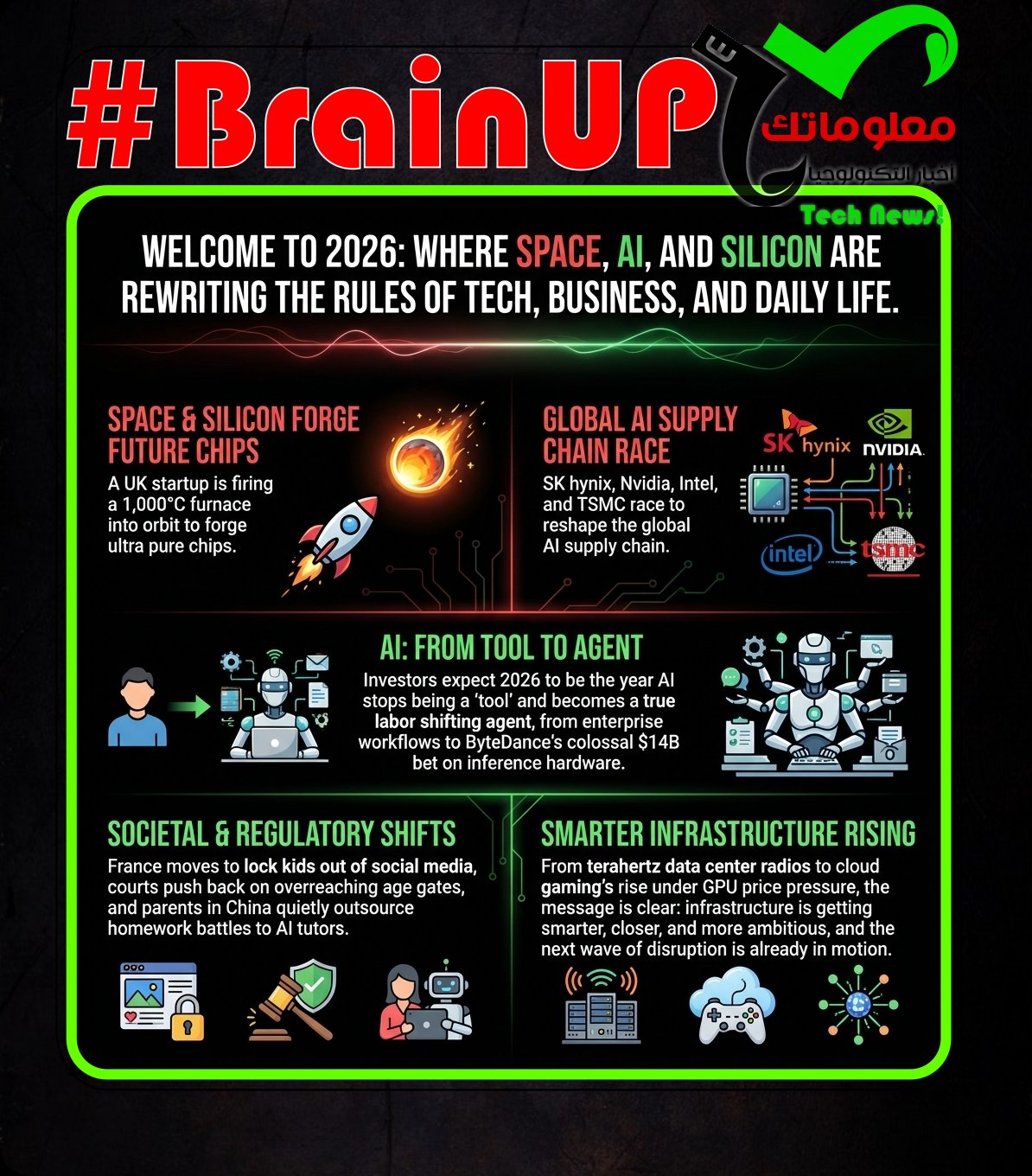
A UK-based company is testing a 1000-degree furnace in space to explore off-world manufacturing of semiconductors, which have the potential to be up to 4,000 times purer than those made on Earth due to the unique microgravity environment. Conducting chip production in space could drastically reduce defects and impurities, enhancing semiconductor performance and lifespan, critical factors as demand for advanced chips increases globally. This experiment aligns with growing industry interest in leveraging #spaceManufacturing to overcome terrestrial limitations such as gravity and contamination. By capitalizing on space’s extreme conditions, the company aims to revolutionize chip production methods and support future technologies requiring high-purity semiconductors. The initiative reflects broader trends in space-based industrial innovation with possible significant impacts on electronics and computing sectors on Earth.
Amazon has allowed a limited set of employees stranded in India due to visa delays to work remotely (#remote-work) through March 2, 2026, a rare exception to its five-day-a-week office policy. An internal memo notes that as of December 13, 2025, those awaiting rescheduled visa appointments can work remotely, but are prohibited from coding of any kind (#coding), including troubleshooting, testing, and documentation, and cannot make strategic decisions, negotiate or sign contracts, or interact with customers; they also cannot work from or visit Amazon offices or sites in India; all reviews and final sign-offs must occur outside India. The plan comes amid broader visa-processing slowdowns tied to changes to the #H-1B program and social media screening, which has led embassies to postpone appointments for months, affecting tech giants like @Google, @Apple, and @Microsoft. For technical roles, the restrictions raise questions about how much work can be done remotely, since a large share of duties involve coding, testing, deploying, and documenting; the policy may not extend to those with appointments rescheduled beyond March 2, 2026 or to workers in other countries. This move illustrates how visa bottlenecks are forcing firms to craft interim, highly restricted #remote-work arrangements to maintain operations while workers await eligibility, reflecting ongoing volatility in international mobility for tech staff.
3. Investors predict AI is coming for labor in 2026 | TechCrunch
AI is poised to reshape the enterprise labor market in 2026 as investors warn that automation could alter many roles. A MIT study cited in the piece finds about 11.7% of jobs could already be automated with AI, while surveys note that employers are eliminating entry-level positions and citing AI in layoffs. In a TechCrunch survey of enterprise VCs, experts like @Eric Bahn foresee a big 2026 impact on labor, though the exact form remains uncertain, ranging from higher productivity to outright layoffs. Industry observers such as @Marell Evans and @Rajeev Dham say budgets will shift from labor to AI, with #agents as software expanding to automate work itself rather than just making humans more productive; @Jason Mendel, a venture investor at Battery Ventures, adds that 2026 could be the year AI moves from tool to agent. Even when budgets don’t move toward AI, leaders may attribute layoffs to AI, underscoring a paradox of rising AI investments alongside reductions in labor. All of this suggests a likely reallocation of resources and significant changes in hiring practices in 2026.
4. AI-Powered Dating Is All Hype. IRL Cruising Is the Future
Despite the widespread hype around #AI-powered dating, the piece argues that authentic connection is more likely to emerge from real-life encounters than from bot-assisted conversations. Big dating firms have rolled out AI tools to speed up connections, with @Three Day Rule launching Tai for real-time coaching, @Grindr using tools from Anthropic and Amazon for wingman features and chat summaries, and Iris, Rizz, and Elate adding AI aids. The #AI push also serves as a reputational repair for an industry built on scale and profit, and the AI companion market has grown more than 96% since 2024. Yet younger users crave alternatives to apps and more opportunities for online-to-IRL interactions, a shift @Tinder is trying to capitalize on with its brand refresh and the emergence of offline-focused spaces like Beyond. Taken together, the piece suggests the future of dating may blend online signaling with human, in-person chemistry rather than rely on AI matchmaking alone, pointing to IRL cruising as the plausible path forward.
5. AI is changing after-school parenting for many Chinese families
AI is becoming a regular presence in after-school parenting in China, with families using an AI chatbot to monitor homework and guide study routines. The Dola chatbot from @ByteDance, linked to @TikTok, can watch a child at the desk, remind them to sit up, check answers, explain mistakes, and generate similar questions, and it is used by about 172 million monthly users. Parents upload trusted materials so Dola tailors guidance to their child, helping them answer while parents answer messages, and some use it to avoid daily conflict with kids. With private tutoring costs rising or hard to justify as economic growth slows, AI reshapes after-school learning and parental roles in #China, reflecting a shift in the #education landscape.
6. ‘I wish I was with them’: Apollo astronaut on Nasa’s 2026 moon mission
Artemis II will be the first crewed Moon mission in more than five decades, a ten-day loop between February and April 2026 that sends @Reid Wiseman, @Victor Glover, @Christina Koch and @Jeremy Hansen in the #Orion capsule on a flight up to 4,700 miles beyond the Moon to test life support, navigation and communications for future crewed landings. From deep space, the crew could view as much as 60% of the Moon’s far side while Earth rides about 250,000 miles behind, offering a dramatic, single-frame perspective on the Earth and Moon system. The mission is a crucial, practical step to validate systems before any lunar landings, laying the groundwork for a sustained NASA presence on the Moon as a stepping-stone to #Mars and a more ambitious #Artemis program. @Charlie Duke, one of the Apollo veterans quoted in the article, says he wishes he could be aboard and describes the ride and the view as breathtaking, underscoring how #Artemis blends Apollo heritage with a new era of space competition.
7. ChatGPT Pushes Leftist Media, Soros-Funded Sites When You Ask It About Climate
The article discusses how ChatGPT reportedly prioritizes leftist and George Soros-funded media sites in its responses related to climate topics. It highlights concerns over potential biases in the AI’s training data, which could influence public opinion by amplifying particular political agendas. The author argues this reflects a broader problem of AI systems inheriting the biases of their sources and stresses the need for transparency and balanced information. The article links this issue to ongoing debates about free speech and the influence of progressive funding on media narratives. This case exemplifies challenges in ensuring AI neutrality and the importance of scrutinizing the origins of digital content.
8. Finnish Authorities Seize Ship and Crew After Undersea Cable Cut, Pursuing Criminal Charges
Finnish authorities detained a ship and its 14 crew members after cutting an undersea internet cable, initiating criminal charges against the crew. Finnish special forces boarded the ship, seizing it amid investigations into the cable’s damage, which disrupted major internet connections. The incident raises concerns about the vulnerability of global #underseacables, vital for internet infrastructure and communications. This case highlights the importance of securing these critical assets against intentional damage. The authorities’ decisive response underscores efforts to protect national and international digital connectivity.
Alphabet closed 2025 up 65%, its strongest year since 2009, as investor excitement around #AI and Google’s new products revived the stock. After an 18% Q1 plunge, the worst since mid-2022, the stock regained momentum as Gemini features, including Nano Banana, drew user interest. Google boosted its AI talent by hiring Windsurf’s top engineers and paying $2.4 billion in licensing fees and compensation, underscoring its push to outpace @OpenAI. A September antitrust ruling limited the most punitive remedies, allowing Google to keep Chrome and continue preloading agreements while still sharing some data with competitors. Among eight tech firms valued at over $1 trillion, Alphabet was the biggest gainer, and Gemini’s momentum has become the centerpiece of the AI-driven narrative driving investor optimism.
10. China’s H200 chip challenges Nvidia in AI market
China has developed the H200 AI chip to rival Nvidia’s dominance in the artificial intelligence hardware market. The H200 is designed to power large-scale AI applications with enhanced performance and efficiency, leveraging advances in #semiconductor technology and tailored for China’s expanding AI ecosystem. Analysts highlight that the H200 could reduce China’s dependence on foreign #AIchips, potentially reshaping the competitive landscape by offering a domestically produced alternative to Nvidia’s GPUs. The move aligns with China’s strategic goals to achieve technological self-reliance in critical sectors amid ongoing geopolitical tensions. This development illustrates the accelerating innovation race in AI hardware and China’s commitment to establishing leadership in next-generation computing platforms.
ByteDance plans a major hardware push to power TikTok’s AI workloads, aiming to spend about $14 billion on #Nvidia chips in 2026 to run its AI inference engine. Reuters reports a 100 billion yuan budget for #Nvidia AI chips in 2026, up from 85 billion yuan in 2025, with ByteDance targeting Nvidia’s #H200 GPUs and noting US approval for selling these chips to China. The plan is complemented by ByteDance’s co-development of two custom AI GPUs with Broadcom and TSMC, expected to debut in 2026 and designed to handle inference for the #ForYouAlgorithm and content moderation, per @Tom’s Guide. Analysts view this as a bid to diversify suppliers and push toward homegrown acceleration amid China’s broader #WholeNation approach and export controls, including a mandate that domestic chipmakers source at least 50% of equipment locally with a goal of 100% eventual local sourcing. ByteDance has previously circumvented supply constraints by renting cloud compute from overseas data centers, illustrating resilience in sustaining its global operations and AI workloads.
12. NASA Goddard Library Closing After Decades of Service
NASA’s Goddard Space Flight Center is closing its historic library, which has served researchers and staff for decades, as part of a digital transformation strategy. The decision follows a shift towards online resources and centralized data access, making physical collections less essential. Some staff express concern about losing access to rare print materials and the communal value the library offered. However, NASA officials emphasize enhanced digital archives and remote accessibility as improvements for future research. This transition reflects broader trends in scientific institutions adapting to evolving technology and information management.
13. Judge to Texas: You Can’t Age Gate The Entire Internet Without Evidence
A Texas state judge ruled against a law that attempted to mandate age verification for accessing all online content, stating that the state provided no evidence supporting the necessity of such a blanket restriction. The ruling highlights the challenges of enforcing #agegating laws on the internet where content and users are highly diverse and interconnected. The judge emphasized the need for evidence to justify broad government regulations that could impact fundamental rights like free speech and internet access. This decision aligns with ongoing legal and societal debates regarding balancing #childprotection with preserving open online access. The case illustrates how courts demand concrete proof before endorsing expansive digital controls, which could set precedent for future internet regulation attempts.
14. How to pick between ChatGPT, Gemini, Claude, and more – what’s the right AI chatbot for you?
Choosing among @ChatGPT, @Gemini, @Claude and other chatbots hinges on understanding what you need from an AI helper, and this guide offers a beginner-friendly starting point to compare how today’s main #LLMs differ. It explains essential terms: #chatbots are interfaces you talk to, while the #LLMs power them behind the scenes; many tools offer a strong #free tier, with #paid plans typically delivering faster responses, access to newer models, bigger memory, and higher usage limits. It highlights potential #hallucinations—when outputs are invented—and the importance of double-checking information, especially for time-sensitive work, and it warns about privacy and data-sharing settings, including the risk of data being used to train models. It covers #prompts as the way you steer outputs and notes that chatbots are not a direct replacement for live #search, since accuracy can vary. Overall, the piece aims to help beginners decide which tool is most suitable for their first steps into AI, focusing on practicality, safety, and good prompts.
15. U.S. grants annual approval for TSMC chipmaking tool exports to China until 2025
The United States has granted its annual authorization allowing Taiwan Semiconductor Manufacturing Co (TSMC) to export chipmaking tools to China until the end of 2025. This approval supports TSMC’s supply chain operations despite ongoing U.S. restrictions aimed at limiting China’s access to advanced semiconductor technology. The license facilitates China’s semiconductor manufacturing capabilities while balancing U.S. national security concerns. The decision reflects the complex dynamics in global tech supply chains and geopolitical tensions between the U.S., China, and Taiwan. Continued regulatory oversight will shape how semiconductor technology exports influence the broader tech competition landscape.
16. Instacart to halt ‘item price tests’ amid scrutiny of its AI tool for retailers
Instacart announced it will immediately end its ‘item price tests’ for retailers and halt the use of #Eversight AI to run price experiments after criticism over why the same item could have different prices at the same store. The tests produced price differences for the same item at the same location, with some customers charged as much as 23% more and an average 7% variation across 437 shoppers in four cities, and Instacart acknowledged that the tests ‘missed the mark for some customers’. The move comes amid scrutiny from @FTC, which issued a civil investigative demand for information about Eversight, and just days earlier the agency agreed to a $60 million settlement over separate allegations of deceptive practices such as enrolling customers in auto subscriptions without consent, advertising ‘free delivery’ while charging a service fee, and hiding refund options. Retailers will still set their own prices on the platform, and Instacart said it would continue to work with retailers to align online and in-store pricing where possible, signaling a shift toward addressing consumer concerns while retaining pricing autonomy.
17. Intel and Nvidia cut strategic stockpile plans amid improved supply conditions
Intel and Nvidia are adjusting their strategic stockpile plans as supply chain conditions improve. Intel has been transitioning from building large chip inventories to a more balanced approach due to stabilized demand and better manufacturing outputs. Meanwhile, Nvidia has reduced its cautious stockpiling as semiconductor shortages ease, allowing for more normal inventory management. These changes reflect a broader industry trend where manufacturers are moving away from hoarding chips toward optimizing supply chains in a less constrained market. This shift helps both companies better align production with actual market demand and reduces carrying costs associated with excess inventory.
18. Lawsuit over Trump rejecting medical research grants is settled
A settlement in a lawsuit over @Trump-era grant blocks requires the NIH to restart reviews of previously rejected applications. The agreement, which still must be approved by the judge, would put blocked grants through the standard #peer-review process. The policy blocked topics like #DEI, #climate, pandemic preparedness, and gender ideology, and a court found it arbitrary and in violation of the Administrative Procedure Act. The settlement does not guarantee funding, and outcomes will hinge on judge approval and the grants’ ultimate review under standard procedures.
19. ASUS officially announces price hikes from January 5 right before CES 2026
ASUS has announced that it will increase prices on its products starting January 5, 2026, just before the CES event. The price hikes affect multiple product lines, including graphics cards and motherboards, reflecting broader market trends and increased production costs. This adjustment aims to ensure ASUS can maintain quality and innovation despite economic pressures and supply chain challenges. Customers planning purchases around the CES timeframe are advised to expect higher costs. ASUS’s decision showcases industry-wide shifts as companies prepare for future technological advancements while managing financial sustainability.
20. Trump family business delays launch of $499 gold smartphone
The Trump family business has delayed the launch of the $499 T1 gold smartphone after a government shutdown disrupted shipments. The project, run by @Donald Jr and @Eric Trump via the Trump Organization, licensed to launch a mobile service, was promoted as a #US-made rival to #Apple and #Samsung and described as “proudly American.” A spokesperson cited the shutdown as causing shipment disruptions and said there is a strong possibility the handset will not be delivered this month. The effort faces uncertainty over domestic manufacturing in a sector where most devices are made abroad, raising questions about feasibility and potential conflicts of interest given regulatory oversight. The phone venture sits alongside other Trump-branded items and follows a broader push into digital media and telecommunications by the family business, signaling a strategy to monetize political branding through licensing and products like watches, footwear, and Bibles.
21. The Digitalization of Tourism: They Promise Experiences and Gave Us the Worst Possible One
The digitalization of tourism promised enhanced, personalized travel experiences but often resulted in frustration and disappointment due to impersonal and inefficient services. Despite advancements in #digital technology and online platforms, tourists frequently encounter technical glitches, lack of human interaction, and poorly designed interfaces that hinder rather than help. This disconnect between expectation and reality has sparked criticism of the tourism industry’s reliance on technology without adequate user-focused design. The article highlights how over-automation and neglect of customer service compromise the quality of travel experiences. Ultimately, the commercialization of digital tools in tourism underscores the need for a balanced integration of technology and human engagement to fulfill travelers’ desires effectively.
23. Researchers make neuromorphic artificial skin for robots
Researchers have developed a neuromorphic artificial skin that mimics human tactile perception, allowing robots to sense touch more effectively. The technology integrates #neuromorphic engineering with flexible sensors to create a synthetic skin capable of detecting pressure, vibration, and texture changes. This advancement exemplifies a significant step towards more sensitive and adaptive robotic systems, which could improve interaction with complex environments. The artificial skin’s design enhances robotic responsiveness and opens pathways for applications in prosthetics and autonomous machines. Such innovation directly addresses the challenge of endowing robots with human-like sensory capabilities, advancing the field of robotics and AI.
24. France aims to ban under-15s from social media by September 2026, Le Monde reports
France plans to prohibit children under 15 from using social media platforms starting September 2026 to protect minors from potential harm associated with online content. The proposed legislation aims to address growing concerns over cyberbullying, addiction, and exposure to inappropriate material. Authorities intend to enforce strict age verification systems to ensure compliance, reflecting a broader European debate on regulating digital spaces for youth safety. This initiative aligns with France’s commitment to balancing technological advancement with social responsibility, emphasizing the government’s proactive stance on child welfare in the digital era.
The article reports that @Point2 and @AttoTude are pursuing radio-based interconnections for scale-up connectivity, using millimeter-wave and terahertz frequencies over waveguides to link servers with standard pluggable connectors, delivering 1.6 Tb/s in a form factor about half the volume of copper cables. Point2’s active radio cable uses eight e-Tube waveguides carrying data on 90 GHz and 225 GHz, with plug-in modules converts signals to modulated millimeter-wave and back; a full cable measures 8.1 mm thick and can run up to seven meters. The design is said to consume roughly one-third the power of optical links, cost about one-third as much, and add as little as one-thousandth the latency of optical connections. AttoTude pursues a higher-frequency approach (300–3,000 GHz) using a digital interface, a terahertz generator, and a dielectric waveguide, with early versions using hollow copper tubes and later 200 μm fibers showing losses as low as 0.3 dB/m; 224 Gb/s has been demonstrated over four meters at 970 GHz with viable ranges near ~20 meters. The companies rely on waveguides rather than cables because high-frequency copper cables struggle with losses and jitter, while waveguides are a mature option for terabit-scale bandwidth; fabrication remains grounded in standard semiconductor processes and exists alongside partnerships showing cables can be produced on existing lines, suggesting potential for future rack-scale AI connectivity but requiring real-world validation.
26. Meta Created Playbook to Fend Off Pressure to Crack Down on Scammers, Documents Show
Meta developed an internal strategy aimed at deflecting calls to more aggressively combat scammers on its platforms, demonstrating the company’s efforts to manage regulatory and public scrutiny. Documents reveal that Meta prioritized protecting user engagement and revenue over intensifying anti-scam measures, despite clear awareness of the growing scam issue. This playbook included tactics to downplay the prevalence and impact of scams, highlighting a tension between corporate interests and user safety. The approach illustrates how large tech companies like Meta balance pressure from regulators and advocacy groups with business goals. The revelations underscore the challenges in holding powerful digital platforms accountable for harmful content while navigating the complexities of platform governance.
27. New York’s incoming mayor bans Raspberry Pi at inauguration
The incoming New York mayor @Zohran Mamdani bans #RaspberryPi from his inauguration, placing it on the prohibited items list alongside #Explosives, #Weapons, #Drones, #LaserPointers and the #FlipperZero. The piece notes that the #FlipperZero can clone access cards and interfere with wireless systems, illustrating security concerns at large events. A #RaspberryPi could potentially enable similar misuses but is less neatly packaged and more conspicuous than the Flipper Zero. Adafruit criticizes the ban as harming education and artistry, arguing miscreants could instead program a smartphone to perform the same deeds at the inauguration. The article frames the move as part of a broader debate about maker devices and security at public events, raising questions about practicality versus risk.
SK hynix is pursuing a turnkey HBM strategy by building its first U.S. packaging plant in West Lafayette, Indiana, a $3.9B project that aims to produce 2.5D HBM modules for AI accelerators by 2028, in partnership with @Purdue University. The facility will package HBM stacks with silicon interposers and integrate them with host dies to create ready-to-mount modules, and will operate a full mass production line supported by a Purdue-tied talent pipeline, funded in part by $458 million in CHIPS Act grants and loans, with a new R&D outpost near Seattle to deepen ties with @Nvidia and other domestic hyperscalers. By owning memory and interconnects, SK hynix seeks to bypass external packaging bottlenecks and challenge @TSMC’s CoWoS dominance as demand for AI silicon grows and CoWoS capacity is effectively sold out through 2027. The move positions SK hynix as a full-stack supplier rather than a memory vendor, potentially reshaping AI supply chains by giving customers a turnkey alternative to outsourcing final assembly. While the scale and timing are ambitious, the strategy fears execution risks in complex 2.5D packaging, thermal management, and competition with established players, even as U.S. policy aims to reshore critical semiconductor capabilities.
Russia is set to intensify its crackdown on illegal cryptomining, introducing prison terms of up to five years starting in 2027 to prosecute offenders. This new approach reflects @Kremlin’s growing concern over unauthorized use of electricity and resources for unauthorized #cryptomining activities. Officials argue that illegal cryptomining poses significant risks to energy infrastructure and regulatory compliance within the country. The policy shift underscores a broader effort by Russian authorities to regulate the digital asset sector more strictly and protect the national power grid. Consequently, the enforcement of these legal measures aims to deter illicit mining operations and encourage adherence to established regulations.
30. Leaks Predict $5000 RTX 5090 GPUs in 2026 Thanks to AI Industry Demand
Leaks suggest @NVIDIA’s RTX 5090, launched at $1,999, could reach $5,000 by year-end 2026 due to growing #AI demand. The report, citing Newsis, indicates both #AMD and @NVIDIA will gradually raise GPU prices starting January 2026 (AMD) and February (NVIDIA), while memory costs could account for up to 80% of a GPU’s #BOM and DRAM prices may rise as much as 40% by Q2 2026. The trend is echoed by ASUS planning price increases in January 2026, as DRAM market instability could affect launch windows for upcoming hardware. This pricing pressure compounds ongoing affordability challenges in gaming and underscores how #AI-driven demand is reshaping GPU pricing, though the article does not provide a firm price for AMD’s RX 9000.
31. Like it or not, cloud gaming might take over in 2026
Cloud gaming could overtake traditional PC gaming in 2026 as RAM prices surge, making high end desktop builds less affordable. It lets players stream from the cloud to devices with minimal hardware, including a Samsung TV app, so you can play on a phone, a smart TV, or an existing laptop. NVIDIA’s GeForce Now can deliver #RTX 5080-level graphics, and @Xbox Game Pass cloud streaming now offers 720p, 1080p, and 1440p ‘max quality’ options. The RAM crisis is already affecting hardware makers, with Maingear advising customers to bring their own RAM and Framework updating pricing as RAM costs rise. Ultimately, keeping existing hardware and leaning on cloud looks like the most sensible path, with GeForce Now offering a native Steam Deck app and the RAM crunch potentially pushing 2026 toward a cloud-first gaming landscape.
That’s all for today’s digest for 2026/01/01! We picked, and processed 30 Articles. Stay tuned for tomorrow’s collection of insights and discoveries.
Thanks, Patricia Zougheib and Dr Badawi, for curating the links
See you in the next one! 🚀
