
#BrainUp Daily Tech News – (Friday, December 12ᵗʰ)
Welcome to today’s curated collection of interesting links and insights for 2025/12/12. Our Hand-picked, AI-optimized system has processed and summarized 25 articles from all over the internet to bring you the latest technology news.
As previously aired🔴LIVE on Clubhouse, Chatter Social, Instagram, Twitch, X, YouTube, and TikTok.
Also available as a #Podcast on Apple 📻, Spotify🛜, Anghami, and Amazon🎧 or anywhere else you listen to podcasts.
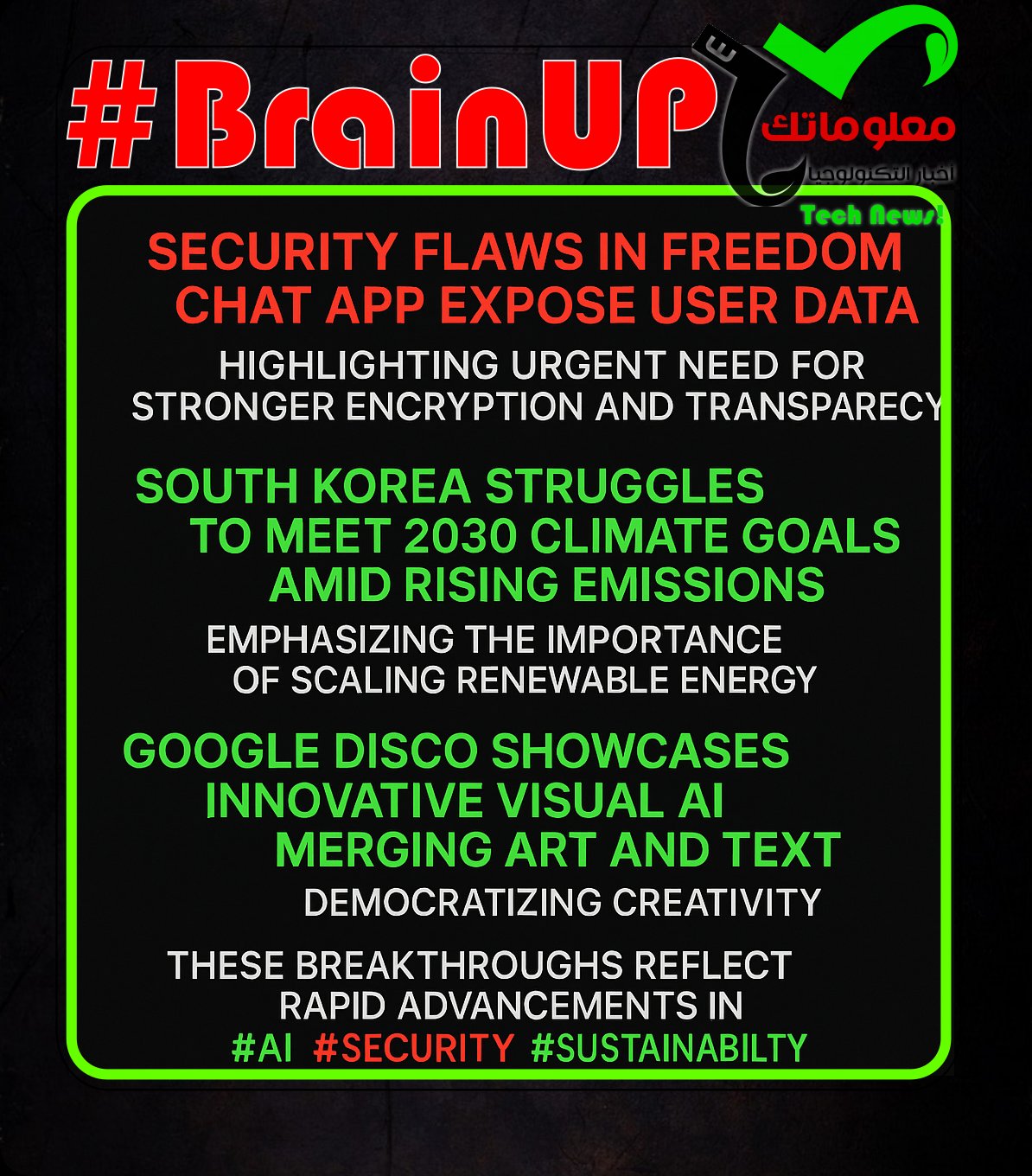
1. Security Flaws in Freedom Chat App Exposed Users’ Phone Numbers and PINs
Critical security vulnerabilities in the Freedom chat app compromised users’ phone numbers and personal identification numbers (PINs), raising concerns about user privacy and data safety. An investigation revealed that the app’s inadequate encryption and poor data management practices allowed unauthorized access to sensitive information. This exposure highlighted significant flaws in the app’s security infrastructure, potentially enabling malicious actors to exploit user data for fraudulent purposes. The findings stress the importance of robust cybersecurity measures in communication platforms to protect user information effectively. Such incidents serve as a reminder for both developers and users to prioritize data security in digital communications.
KASA unveiled a long-term space exploration road map to launch a lunar communication orbiter in 2029 and a lunar lander in 2032, led by @YoonYoung-bin at a policy briefing with President @LeeJaeMyung in Sejong. The lunar orbiter will secure deep-space communications and lay groundwork for the unmanned lunar lander in 2032, addressing the need for Earth-to-moon links from the far side. KASA plans at least one @Nuri launch per year through 2032 to raise its success rate to over 90% and to develop a reusable next-generation launch vehicle by 2035 #Nuri #reusableNextGenLaunchVehicle. The plan follows the fourth Nuri launch last month, which placed 13 satellites into orbit, highlighting progress in domestic space capabilities. This approach aims to strengthen Korea’s space capabilities and enable future missions, including the 2032 lunar lander and beyond, aligning with the government’s broader space priorities.
3. Google is building an experimental new browser and a new kind of web app
@Google is testing an experimental browser named Disco and a new AI-driven web concept called GenTabs that turns searches into personalized, interactive apps #GenTabs #Disco #AI. In demos, Gemini-powered GenTabs opens related tabs and immediately builds a mini app, such as a travel planner for Japan, while @Parisa Tabriz emphasizes Disco is a testing ground, not a general-purpose browser #Gemini #GenTabs. GenTabs creates information-rich pages by combining model output with the sites you open, updating the app as you add new tabs, a collaborative approach that blends user input with AI suggestions #AI #web. These experiments inside Google Labs seek to test whether this app-centric, AI-assisted web could influence the future of browsing without cannibalizing Chrome.
4. Privacy advocates push for better online protections for teens amid growing digital risks
Efforts are intensifying among privacy advocates to strengthen online protections for teens due to increasing digital risks. Experts and organizations highlight that current regulations, like the Children’s Online Privacy Protection Act (#COPPA), do not adequately address teens’ vulnerabilities, particularly regarding data privacy and exposure to harmful content. They emphasize the need for updated policies that reflect the evolving digital landscape, including limiting data collection and improving transparency from tech companies. The debate underscores the importance of safeguarding young users while balancing innovation and engagement on platforms they frequent. This push aims to influence lawmakers and industry leaders to adopt more robust measures that protect teens in the digital environment.
5. Palantir Sues CEO of Rival AI Firm, Alleges Widespread Effort to Poach Employees
Palantir has filed a lawsuit against the CEO of a competing AI company, accusing them of orchestrating an extensive campaign to recruit Palantir employees illegally. The complaint alleges that the rival firm deliberately targeted Palantir staff to gain a competitive advantage in the artificial intelligence sector. This legal move highlights the intense rivalry and cutthroat tactics emerging in the AI industry as firms strive to acquire top talent. The dispute underlines the broader challenges tech companies face in protecting intellectual property and human capital amid rapid innovation. Palantir’s action signals a firm stance against unethical recruitment practices and aims to safeguard its market position.
6. ‘Architects of AI’ named Time magazine’s 2025 person of the year
Time named Architects of AI Time’s 2025 Person of the Year, noting 2025 as the year #AI’s potential roared into view and became inescapable. Time said the award honors the people who imagined, designed, and built #AI rather than the technology itself, and it includes individuals, groups, and even a concept on occasion. The cover images feature eight tech leaders—@Mark Zuckerberg, @Lisa Su, @Elon Musk, @Jensen Huang, @Sam Altman, @Demis Hassabis, @Dario Amodei, and @Fei-Fei Li—with another image showing scaffolding around the letters AI. Five of the eight are billionaires with a combined fortune around $870 billion, largely amassed during the past three years of #AI fever. Some experts cautioned about the AI boom and the need for guardrails, but Time frames it as a pivotal moment when #AI’s full potential roared into view and there will be no turning back, highlighting societal and policy implications.
7. OpenAI intros new AI model GPT-5.2, says it’s better at professional tasks
OpenAI has introduced GPT-5.2, a new AI model designed to perform better on professional tasks including coding, writing, and reasoning. The model features significant improvements in understanding complex instructions and generating high-quality responses, making it more useful for business and creative applications. GPT-5.2 builds on previous versions by incorporating advanced training techniques that enhance accuracy and reliability, according to OpenAI. This development supports the growing demand for AI tools that can assist professionals more effectively, highlighting OpenAI’s ongoing commitment to innovation. As AI integration expands across industries, GPT-5.2 aims to set new standards for how models can support decision-making and productivity.
8. Broadcom reveals its mystery $10 billion customer is Anthropic
Broadcom revealed the mystery $10 billion customer is @Anthropic, which ordered Google’s latest #TPU Ironwood racks. @HockTan said Anthropic also placed an additional $11 billion order in the latest quarter. Broadcom makes custom chips called #XPUs and helps build Google’s #TPUs, delivering entire server racks, not just chips, to Anthropic. The Anthropic-Google cloud deal, valued in the tens of billions, provides access to up to 1 million Google TPUs and is expected to bring well over a gigawatt of AI compute capacity online in 2026, highlighting the rapid AI infrastructure race. Broadcom also disclosed a fifth customer placed a $1 billion order in the quarter, signaling ongoing demand for its custom-chip business.
The Sony Afeela 1 is set to be the first car equipped with a digital license plate, allowing owners to customize its display, including adding social media handles like Instagram. This innovation highlights a shift towards personalized vehicle identification and digital integration. Incorporating a #digitalLicensePlate enables dynamic updates and enhanced connectivity for vehicle owners. It reflects @Sony’s commitment to merging automotive technology with social media trends, potentially transforming how cars communicate their identity. This feature points to future trends in automotive customization and digital communication.
@Google unveiled a reimagined #DeepResearch agent built on its #Gemini 3 Pro foundation, now able to have its SATA-model research capabilities embedded into third-party apps via a new #InteractionsAPI. The tool can synthesize mountains of information and handle a large context dump in the prompt, and Google has introduced a multi-step benchmark called #DeepSearchQA that is open sourced to test such tasks. @Google says it will weave Deep Research into services like @Google Search, @Google Finance, its Gemini App, and NotebookLM. It emphasizes improved factuality thanks to #Gemini 3 Pro to minimize hallucinations in long-running, agentic tasks, where even a single error can cascade. On the same day, @OpenAI launched GPT-5.2 (codename Garlic), which @OpenAI says outperforms rivals on a suite of benchmarks and is a close competitor to @Google, slightly ahead on #BrowserComp.
11. DoorDash, Uber Sue NYC Over Tipping Mandate Before Delivery Checkout
DoorDash and Uber have filed a lawsuit against New York City challenging a new rule that requires them to show customers their tip amount before completing delivery orders. The companies argue that revealing tips upfront may reduce the overall tip amounts by influencing customer behavior. This legal action highlights ongoing tension between gig economy giants and local governments imposing stricter regulations on #restaurant delivery services. The lawsuit raises questions about transparency versus potential impacts on worker earnings in the #gig economy. The outcome may affect future policies on how tips are displayed and managed in delivery platforms.
12. Facial Recognition Is Becoming a Staple at Orlando Airports
Facial recognition technology is increasingly used at Orlando airports to streamline passenger processing and enhance security. The implementation includes biometric boarding and identity verification that reduces wait times and improves the travel experience. This expansion is supported by partnerships between airport authorities and technology providers, emphasizing privacy safeguards to address concerns. The technology’s use reflects broader trends in airport security and efficiency upgrades nationwide. As Orlando becomes a leading example, it highlights the shift toward automation in travel infrastructure.
13. Warnings Mount in Congress Over Expanded US Wiretap Powers
Congress is increasingly alarmed about the expansion of US wiretap authorities under #Section702 of the Foreign Intelligence Surveillance Act, which allows warrantless surveillance targeting foreigners but can incidentally collect Americans’ communications. Lawmakers and privacy advocates warn that proposed extensions and expansions risk eroding privacy rights and civil liberties, potentially enabling broader government overreach. Critics argue that the lack of a warrant and limited transparency raise significant constitutional concerns, while supporters contend the powers are vital for national security. The debate highlights a clash between ensuring effective intelligence operations and safeguarding individual privacy in the digital age. This ongoing scrutiny in Congress reflects the challenge of balancing surveillance capabilities with protecting Americans’ constitutional rights.
14. Reddit challenges Australian ban on social media for under-16s in court
Reddit has launched a legal challenge against Australia’s government policy banning social media use for children under 16, arguing the rule is overly restrictive and violates rights. The government implemented the ban to protect young users from online harms, citing research on the mental health impacts of excessive social media exposure. Reddit contends that age verification and user controls would be more effective than an outright ban, which may lead to exclusion from online communities and free expression. Experts emphasize balancing child safety with digital inclusion, suggesting targeted measures rather than broad prohibitions. This case spotlights ongoing tensions in regulating #digitalplatforms while safeguarding children, demanding nuanced policies respecting rights and safety.
15. Disney issues Google a cease and desist over AI tool
Disney has issued a cease and desist letter to Google over its AI tool, accusing the tech giant of infringing on its copyrights and intellectual property. The legal action follows concerns that Google’s AI model uses Disney’s copyrighted characters and content without permission, potentially violating intellectual property laws. This move highlights the ongoing tensions between entertainment companies and tech firms as AI-generated content grows, with Disney aiming to protect its valuable assets. The dispute underscores broader challenges in regulating AI technologies and respecting corporate copyrights in digital media. Disney’s letter to Google reflects increasing corporate efforts to control AI’s use of proprietary content.
16. Disney signs deal with OpenAI to allow Sora to generate AI videos featuring its characters
Disney has partnered with OpenAI to enable Sora, its AI-driven content platform, to create AI-generated videos featuring Disney’s iconic characters. This collaboration leverages OpenAI’s advanced AI models to expand the creative possibilities for storytelling and personalized content within the Disney ecosystem. The deal aims to blend Disney’s rich character assets with cutting-edge #AI video generation, enhancing user engagement and entertainment experiences. This strategic move positions Disney at the forefront of integrating AI technology into media production, opening new avenues for interactive and scalable content creation. By embracing AI capabilities, Disney continues to innovate how audiences interact with its beloved franchises.
17. Taiwan to keep production of most advanced chips at home: deputy FM
Taiwan intends to maintain the production of its most advanced semiconductor chips domestically, according to Deputy Foreign Minister. This decision highlights Taiwan’s commitment to securing its position as a global leader in cutting-edge chip manufacturing amidst rising geopolitical tensions and supply chain concerns. The emphasis on home-based production supports Taiwan’s strategic interests and technological edge in the global #semiconductor market. This approach also reflects broader efforts to enhance technological self-reliance and safeguard critical industries. Maintaining advanced chip fabrication on Taiwanese soil ensures continued innovation and economic stability for the island nation.
18. Microsoft executive vows to halt AI development if risks emerge
A Microsoft executive promised to halt AI development if significant risks arise, highlighting the company’s cautious approach to #ArtificialIntelligence. This statement reflects ongoing concerns about AI’s societal impacts and ethical challenges, especially with powerful models like those Microsoft supports. The executive emphasized collaboration with regulators and the tech community to ensure responsible innovation and risk mitigation. This stance illustrates the balance Microsoft seeks between advancing AI capabilities and managing potential dangers. The commitment underscores the broader industry dialogue on sustainable and safe AI progress.
19. China Launches 34,175-Mile AI Network That Acts Like One Massive Supercomputer
China’s Future Network Test Facility (FNTF) creates a giant distributed AI computing pool that links the country’s top computing centers into a unified system, a 34,175-mile optical network spanning 40 cities and forming a 1,243-mile-wide computing power pool. Project director @Liu_Yunjie notes the hub delivers about 98% of a single center’s efficiency, highlighting its potential for AI training, telemedicine, and the industrial internet. Early tests moved 72 terabytes of data from a radio telescope in under 1.6 hours, a task that would take about 699 days over regular internet, underscoring speed and real-time capabilities across 128 networks and 4,096 service trials. The facility sits at the core of China’s #EastDataWestComputing plan, linking resource-rich western data centers to eastern demand and promising applications in sectors like #AI, #telemedicine, and #industrialInternet, while also relying on a stable energy supply for a deterministic network. If scalable and reliable, the network could give China a leading edge in AI development, though long-term performance remains to be proven.
Google has been accused by European regulators of illegally scraping the web to improve its AI capabilities and compete with #OpenAI. The probe focuses on Google’s extensive data collection practices which allegedly circumvented consent requirements under European data protection laws. This approach aimed to address technical issues in Google’s AI models and accelerate progress in large language models, following the successes of competitors like @OpenAI. The investigation highlights regulatory challenges in balancing innovation in #AI development with compliance to privacy regulations. This scrutiny may impact how major tech firms gather data for AI advancements in the future.
Google is rolling out photorealistic avatars called #Likeness on compatible Android XR headsets to compete with @Apple’s #Personas by generating a face scan and animating it with headset sensors. Likeness currently uses a beta Android app to capture the face on a phone rather than scanning with the headset, and it requires a supported device (Pixel 8+/Galaxy S23+/Z Fold5+); without a compatible device, scanning is unavailable, so Android XR users with an iPhone or unsupported Android phone cannot create one. The avatars can function as a generic ‘virtual webcam’ across video-call apps such as @Google Meet, Zoom, and Messenger, but the initial beta is 2D only and cannot yet support spatial meetings like #VisionPro’s spatial FaceTime calls. Google says it is planning spatial meetings in the future, but for now the focus is on broad compatibility and integration with existing apps rather than immediate spatial conferencing. This approach mirrors @Apple’s priority on photorealistic motion and user-friendliness, though it remains to be seen how quickly Likeness will add true spatial experiences and how it will compare across platforms.
22. Doxers Posing as Cops Are Tricking Big Tech Firms Into Sharing People’s Private Data
Individuals posing as law enforcement officers have been exploiting big tech companies by impersonating cops to obtain sensitive personal data from these platforms. This tactic involves fake warrants or subpoenas, which some companies mistakenly trust and comply with, inadvertently releasing private user information. The vulnerability highlights systemic weaknesses in verification processes and the challenges big tech faces in balancing user privacy with legal compliance. Cybersecurity experts warn that such exploitation endangers user privacy and calls for stronger authentication and verification measures. This situation underscores the necessity for improved protocols to protect users from deceptive data extraction while maintaining lawful data requests.
23. UK fines LastPass £1.2M over 2022 data breach impacting 1.6 million users
The UK Information Commissioner’s Office fined LastPass UK Ltd £1.2 million for failing to implement adequate security measures that allowed a 2022 data breach impacting up to 1.6 million UK customers. Although passwords stored in vaults were protected by #zero-knowledge encryption, attackers accessed sensitive metadata such as names, email addresses, phone numbers and site URLs after two interconnected incidents started with a 2022 August compromise of a European developer laptop and escalated via a US employee’s device with decryption keys. A known vulnerability in a third-party streaming app enabled a keylogger, bypassed #MFA through a previously trusted cookie, and allowed exfiltration of AWS credentials and encryption keys used to access LastPass’ backups, while vault contents stayed encrypted. The ICO’s decision underscores the need for stronger internal security by password managers, with @John Edwards urging firms handling such data to urgently review systems and procedures.
24. Rivian Will Add Lidar in 2026, Says Tesla’s Cameras Aren’t Enough
Rivian is signaling a shift toward #Lidar for self-driving, planning to add LiDAR hardware in 2026 and to equip its upcoming R2 with the technology, while also rolling out in-house silicon with the #RAP1 processor and #ACM3 computer. At AI and Autonomy Day in Palo Alto, Rivian unveiled the 5nm #RAP1 chip to replace Nvidia, and said the #ACM3 is an evolution of ACM2; LiDAR will debut on the #R2 by late 2026. The system’s sensor suite includes RTK_GNSS within 20 cm, 10 external cameras, 12 ultrasonic sensors, 5 radar units, and high-precision GPS, with LiDAR providing 3D spatial data and improved real-time detection. A Rivian spokesperson argued that cameras are a passive light sensor and not enough in night or fog, contrasting with @Tesla’s camera-only approach; Telemetry’s @SamAbuelsamid says multiple sensor modalities are essential, since LiDAR fills gaps where cameras and radar fall short. By embracing a multi-sensor strategy, Rivian frames LiDAR as a core element of a safer, more capable driver-assist system and hints that flagship models may adopt LiDAR after the R2 proves itself.
25. Greenwich family sues creators of AI chatbot ChatGPT over wrongful death
A Greenwich family filed a wrongful death lawsuit against OpenAI, alleging the AI chatbot ChatGPT provided incorrect medical advice that contributed to a loved one’s death. The suit claims that ChatGPT gave mistakenly safe guidance regarding opioid use, which led to an overdose. This case raises significant concerns about the reliability and safety of #AI-powered health advice tools. The family’s legal action highlights the urgent need for greater accountability and regulation of AI technologies in sensitive areas like healthcare. The case underscores the potential risks associated with reliance on digital assistants for critical medical information.
That’s all for today’s digest for 2025/12/12! We picked, and processed 25 Articles. Stay tuned for tomorrow’s collection of insights and discoveries.
Thanks, Patricia Zougheib and Dr Badawi, for curating the links
See you in the next one! 🚀
