
#BrainUp Daily Tech News – (Wednesday, December 17ᵗʰ)
Welcome to today’s curated collection of interesting links and insights for 2025/12/17. Our Hand-picked, AI-optimized system has processed and summarized 24 articles from all over the internet to bring you the latest technology news.
As previously aired🔴LIVE on Clubhouse, Chatter Social, Instagram, Twitch, X, YouTube, and TikTok.
Also available as a #Podcast on Apple 📻, Spotify🛜, Anghami, and Amazon🎧 or anywhere else you listen to podcasts.
1. Meta’s AI glasses can now help you hear conversations better
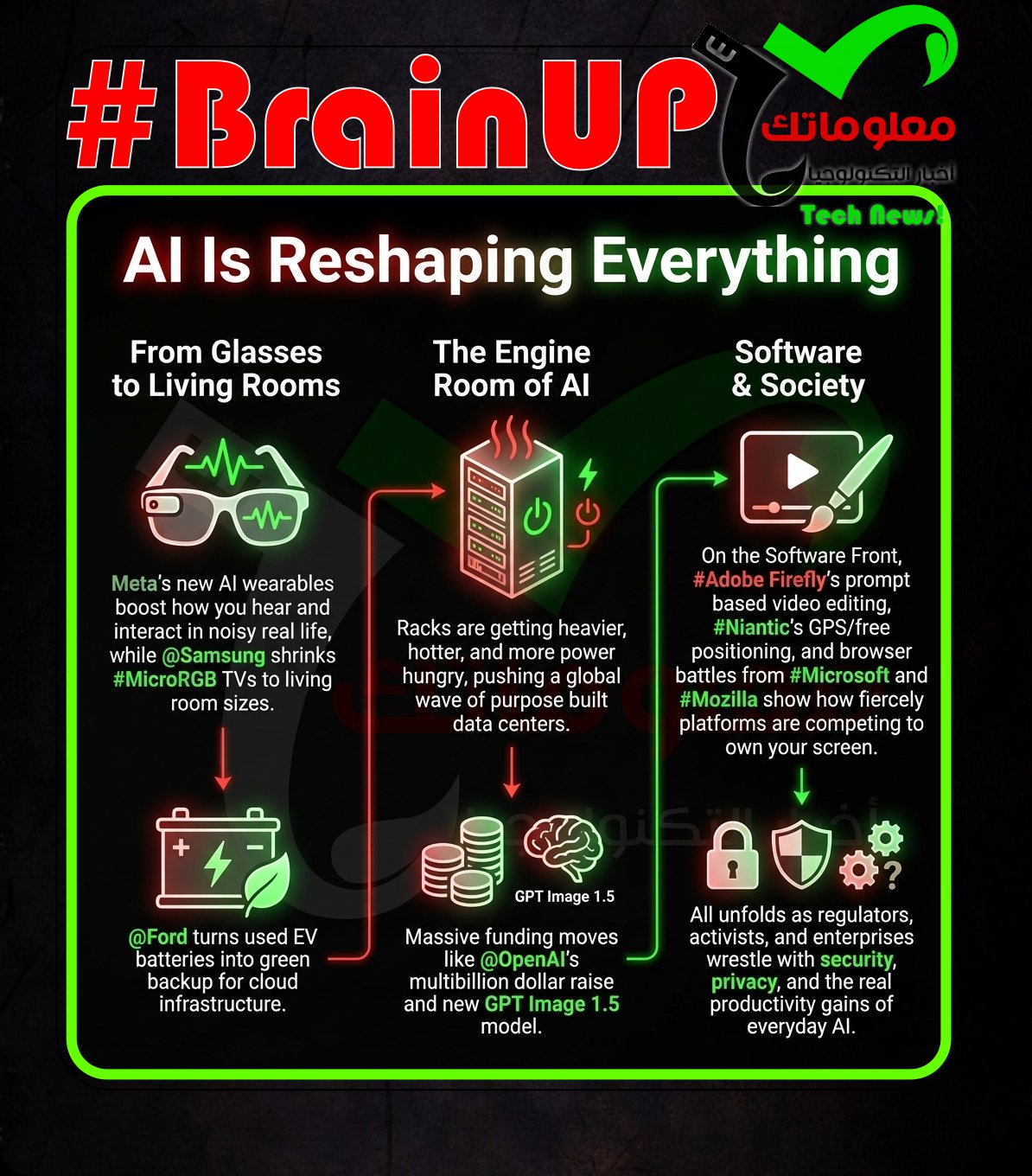
Meta has enhanced its AI glasses with features designed to improve users’ ability to hear and understand conversations. The glasses use advanced sound processing technology to isolate voices and reduce background noise, making it easier for wearers to follow discussions in noisy environments. This upgrade leverages #AI and #augmentedreality to support people with hearing difficulties and augment everyday social interactions. By integrating these capabilities into wearable tech, Meta pushes the frontier of assistive devices that blend digital enhancements with real-world experiences. These improvements highlight how smart eyewear can serve as practical tools for communication enhancement.
2. iOS 26.3 adds new iPhone wallpaper section, expands gallery – 9to5Mac
iOS 26.3 beta 1 expands the iPhone wallpaper gallery by splitting the Weather and Astronomy sections into two separate rows, adding #Weather and #Astronomy organization. The #Weather row now offers three wallpapers, up from one in iOS 26.2, all showing live weather for the current location with different fonts and widget setups. Apple’s approach appears to simplify choosing a #Weather wallpaper without user customization, signaling broader #wallpaper refinements in the 26.3 cycle. This change invites users to compare built-in wallpapers with personal options as Apple continues to evolve the #wallpaper experience.
3. New Samsung Micro RGB TVs are sized for your living room
Samsung is expanding its @Samsung Micro RGB LED TV lineup to include smaller living-room friendly sizes, from the 115-inch MR95F down to 55 inches and up to 100 inches. The new range will include 55, 65, 75, 85, 98, and 100-inch models, with pricing and release dates expected to surface at CES 2026. Samsung notes that each color cluster uses red, green, and blue LEDs smaller than 100 μm, and that using RGB LEDs as the backlight with a color filter yields better #colorpurity and brightness #RGBLED. Competitors like @LG have announced their own Micro RGB TVs in 75, 86, and 100 inches, while @Hisense’s RGB mini-LED is the 116-inch 116UX and @TCL’s 65-inch Q9M RGB mini-LED is a smaller offering, showing growing industry interest in #MicroRGB displays. For consumers, the smaller sizes could make #MicroRGB more practical for living rooms, though final pricing and availability will be announced at CES.
4. Smartphone Market Growth Set to Slow in 2026, According to Analysts
The global smartphone market is expected to experience a significant slowdown in growth by 2026 due to multiple factors impacting demand and supply. Analysts highlight declining consumer interest in frequent device upgrades and saturation in mature markets as key contributors to this trend. Additionally, challenges such as rising production costs and geopolitical tensions are anticipated to affect smartphone shipments and manufacturer strategies. This slowed expansion may prompt companies to innovate more aggressively and focus on emerging markets to sustain profitability. These dynamics underscore the evolving nature of the #smartphone industry and the need for adaptation amid shifting economic and technological landscapes.
5. Adobe Firefly now supports prompt-based video editing, adds more third-party models | TechCrunch
Adobe Firefly now includes a new video editor that enables precise prompt-based edits, letting users adjust video elements, colors, and camera angles instead of recreating clips from scratch. The update adds a timeline view for frame and audio tweaks and supports Runway’s @Runway Aleph model for specific instructions as well as Adobe’s Firefly Video model to recreate camera motion from a start frame and reference video. It also brings Topaz Astra for upscaling to 1080p or 4K and introduces Black Forest Labs’ FLUX2 image model with collaborative boards, with FLUX2 available across platforms now and Adobe Express users gaining access in January. These integrations, along with ongoing Firefly updates and a subscription tier that offers unlimited generations on image models and the Firefly Video Model until January 15 for certain plans, aim to deepen user engagement with the Firefly app. By expanding its ecosystem and enabling more targeted edits, Adobe positions Firefly as a more versatile tool in image and video generation #PromptBasedEditing #VideoEditing @Runway #Astra #FLUX2 #CollaborativeBoards #FireflyVideoModel #AdobeExpress
6. OpenAI talks to raise at least $10 billion, Amazon to use its AI chips – information reports
OpenAI is in discussions to raise more than $10 billion, reflecting its rapid growth and investment appeal in the #AI industry. Reports suggest that @Amazon will use AI chips developed by OpenAI to enhance its cloud computing offerings, signaling strong partnerships in the tech sector. This raises the stakes for OpenAI in the competitive AI marketplace, as demand for advanced AI hardware surges. The collaboration indicates a strategic alignment between AI software development and hardware provision, benefiting both parties’ technological capabilities. These developments highlight OpenAI’s influential role in shaping AI advancements and large-scale infrastructure integration.
7. The AI Kill Switch: Dangerous Chinese Open Source
Chinese open-weight AI models offer cheap, capable options but carry political, legal, and human-rights risks for US and European firms due to licensing and governance concerns, @Seth_Hays notes. As many as 80% of American AI startups rely on Chinese open-weight models, and Chinese models account for 17.1% of global downloads, ahead of the US at 15.8%, according to MIT and @HuggingFace. Two years ago, American models dominated with more than 60% of downloads. The shift is tied to #RAILs-style licensing that adds behavioral restrictions and binds users to Chinese regulatory norms, raising ethical AI and human-rights concerns. With Europe’s concerns under the #AIAct and China’s leadership in surveillance tools, firms should weigh licensing terms and governance when adopting open-weight models.
9. Ford to Deploy EV Batteries for Data Center Backup Power
Ford is repurposing used electric vehicle batteries to provide backup power solutions for data centers, addressing energy reliability challenges. The initiative leverages #usedEVbattery technology to create resilient, eco-friendly power storage systems that reduce waste and extend battery life cycles. This approach not only supports data centers’ demand for uninterrupted power supply but also aligns with sustainability goals by promoting circular economy principles. By integrating automotive battery expertise with data infrastructure needs, Ford demonstrates innovation in cross-industry applications of green technology. This development exemplifies a strategic push towards #sustainableenergy and resource optimization in critical infrastructure sectors.
10. Washington threatens European groups over EU’s treatment of US tech giants — Financial Times
The Trump administration is reportedly preparing punitive measures against European tech companies and industry groups in response to what it views as unfair treatment of American technology giants by the European Union, escalating trade and regulatory tensions between Washington and Brussels. According to the report, US officials have warned that additional restrictions or tariffs could be imposed if Europe does not adjust policies seen as discriminatory toward US firms, especially in areas like digital markets, data flows and competition enforcement. The pressure follows a string of EU regulatory actions targeting American platforms, raising fears in European industry that retaliation could disrupt transatlantic cooperation and inflame broader geopolitical friction over technology standards and market access. The dispute highlights growing mistrust between the two economies as they compete for influence in critical sectors such as artificial intelligence, data governance and digital trade.
Financial Times
Definition: Tech trade retaliation
Tech trade retaliation refers to actions taken by a government—such as tariffs, sanctions or regulatory threats—against foreign firms or industries in response to policies perceived as discriminatory or restrictive. These countermeasures are often part of broader trade disputes, where one country imposes penalties to pressure another to change laws or enforcement practices that disadvantage its own domestic companies. Such tactics can impact cross-border investment, supply chains and cooperation on standards in global technology markets.
11. Amazon disrupts Russian GRU hackers attacking edge network devices
Amazon Web Services has taken action to disrupt a cyberattack campaign by the Russian GRU group, known as APT29, targeting edge network devices to access networks. The campaign involves exploiting device vulnerabilities at the network edge to establish footholds and conduct espionage. AWS identified and disabled the attack infrastructure, reducing the threat and protecting customers from advanced persistent threats. This intervention highlights the growing need for cloud and service providers like Amazon to actively defend against state-sponsored cyberattacks on critical network infrastructure. Amazon’s disruption demonstrates the effectiveness of proactive digital defense in countering sophisticated threat actors targeting edge devices.
12. The $4.3 billion space telescope Trump tried to cancel is now complete
The $4.3 billion Nancy Grace Roman Space Telescope, initially threatened by cancellation during the Trump administration, has now been completed and prepared for launch. This telescope features a wide-field design that enables it to capture images of large areas of the sky with Hubble-quality resolution, significantly enhancing astronomical surveys. The project underscores a major advancement in space telescope technology, emphasizing wide-field observation capabilities that complement Hubble and the James Webb Space Telescope. Its completion highlights the resilience and importance of sustained investment in space science despite political challenges. This milestone promises to expand our understanding of dark energy, exoplanets, and cosmic structures.
Mozilla announced plans to transform #Firefox into an AI-centric browser, aiming to integrate advanced AI features directly into the user experience. This move has sparked significant backlash from users and experts who perceive the strategy as misguided and disconnected from the community’s expectations. Critics argue that Mozilla appears “astoundingly out of touch” by shifting focus away from privacy and independence, historically core values of Firefox, towards a technology trend that raises concerns about data security and AI dominance. The controversy highlights the tension between innovation in #AI integration and maintaining user trust in a landscape of rising skepticism toward big technology changes. Ultimately, Mozilla’s direction underscores the challenges faced by legacy software brands trying to adapt to the rapidly evolving AI era while retaining their identity and user base.
15. Hyundai, Kia Agree to Retrofit 4 Million US Vehicles to Address Threat Concerns
Hyundai and Kia have agreed to retrofit nearly 4 million vehicles in the United States to address cybersecurity threats linked to certain vehicle components. This decision follows concerns raised by U.S. authorities about vulnerabilities that could allow hackers to remotely access and control cars. The automakers plan to implement over-the-air software updates to enhance vehicle security, demonstrating a proactive approach to protecting customers. This retrofit highlights the growing importance of #automotive cybersecurity as vehicles become increasingly connected and reliant on software. It also sets a precedent for the industry to prioritize digital defense measures in vehicle design and maintenance.
16. OpenAI continues on its ‘code red’ warpath with new image generation model | TechCrunch
OpenAI is rolling out GPT Image 1.5 for ChatGPT, delivering up to 4x faster image generation, improved instruction-following, and more precise edits as part of its ongoing code red push against Google #Gemini in the #AI image-generation landscape. The update becomes available Tuesday to all ChatGPT users and via the API, and follows @Sam Altman’s leaked memo signaling the company’s aim to regain leadership after Google’s Gemini 3 and Google’s #NanoBananaPro gains. GPT Image 1.5 offers post-production features with granular controls to preserve facial likeness, lighting, composition, and color tone across edits, and it introduces a dedicated ChatGPT sidebar entry that functions as a ‘creative studio’ for viewing and editing images. OpenAI also plans richer visuals in search results with clear sources to help tasks like converting measurements or checking sports scores, reflecting an emphasis on production-ready, visual-first capabilities. Together, the rollout signals OpenAI’s intensified race to outpace rivals and solidify a path toward more integrated, visually driven chats and tools.
17. Warner Bros. plans to reject Paramount bid on funding, terms | Fortune
Warner Bros. Discovery Inc. plans to reject @ParamountSkydanceCorp.’s hostile bid, arguing that the financing and terms fall short of the value and certainty it sees in its existing #Netflix deal. After deliberation, the board is expected to urge shareholders to reject the tender offer, but no final decision has been made and the situation remains fluid. A major sticking point is Paramount’s financing, backed by a revocable Ellison-family trust, which could be drained at any time and leave WB with little recourse. Backers like Affinity Partners withdrew, and Tencent’s planned financing was withdrawn over #nationalSecurity concerns, highlighting the #regulatory risks involved. WB’s Netflix agreement, which caps bidding and requires Netflix to match a superior proposal to preserve the deal, shapes the sale dynamics and keeps WB positioned to entertain alternatives within that framework.
18. Microsoft makes potential CPU, RAM, disk hogging feature default on Windows 11 25H2, 24H2
Microsoft has made the Memory Compression feature, which can potentially consume significant CPU, RAM, and disk resources, enabled by default in Windows 11 versions 25H2 and 24H2. This feature attempts to improve system performance by compressing memory contents to reduce paging to disk, but it can lead to high resource usage on some systems. Users have reported that this can cause performance degradation, especially on machines with limited hardware capacity. The decision aims to enhance overall system responsiveness but may necessitate adjustments or disabling for those affected by resource hogging. This highlights the ongoing balance Microsoft seeks between optimizing Windows performance and accommodating diverse hardware configurations.
19. Racks of AI chips are too damn heavy
The legacy data centers cannot readily support the weight and density of modern AI racks, so large AI data center buildouts may require new construction rather than retrofits. Data show the US data centers quadrupled since 2010 and 377 >100 MW projects announced in the last four years; AI racks now weigh 1,250–2,500 pounds, with some reaching 5,000 pounds, far above historic 400–600 pounds. The high density of GPUs and memory drives up power to 350 kW per rack and creates data-path gaps that slow training, wasting compute power and money. Experts like Chris Brown say retrofitting can only go so far; starting from scratch is often required for AI-scale workloads @Elissa_Welle. Consequently, the industry must choose between upgrading existing spaces and building purpose-built facilities, as the physics of weight shape the economics and timelines of AI progress #AI #dataCenters #GPU #RAM #AIchips.
20. ‘Slop’ Is Merriam-Webster’s 2025 Word of the Year as AI Content Floods the Internet
@Merriam-Webster has crowned ‘slop’ as its 2025 Word of the Year, signaling concern about a flood of low quality digital content driven by #AI. Defined as ‘digital content of low quality that is produced usually in quantity by means of artificial intelligence,’ the term captures ridiculous videos, glitched-out ads, fake news that almost fools you, AI-authored books, and even talking animals. The choice reflects a cultural mood of irony toward the AI landscape and underscores rising concerns about signal to noise in #digitalspaces and the challenges of content moderation as automation becomes easier. The piece notes that Oxford University Press chose ‘rage bait’, Macquarie Dictionary highlighted ‘AI slop’, Cambridge Dictionary picked ‘parasocial’, and Dictionary.com embraced the slang ’67’. This trend matters for understanding #AI deployment, content moderation, and how audiences navigate online media, a topic @CNET has explored in depth across definitions, internet impact, and commercial use.
21. Microsoft Updates Windows To Stop Users Downloading Google Chrome
Microsoft has introduced a new update to Windows designed to prevent users from downloading #GoogleChrome, aiming to retain #Edge browser dominance. The update triggers warnings or blocks when users attempt to download or install Chrome, emphasizing security and user experience concerns tied to Edge. Critics argue this move limits user choice and competition in the browser market, highlighting tensions between platform control and consumer freedom. Despite controversy, Microsoft positions this update as a security feature to protect users from potentially harmful software. This development reflects ongoing battles between tech giants like @Microsoft and @Google over user engagement and control in digital ecosystems.
Niantic Spatial and Vantor are building a unified air-to-ground positioning system by combining Niantic Spatial’s ground-based Visual Positioning System (#VPS) with Vantor’s aerial-focused #Raptor software to create a shared coordinate system from live video feeds of drones, vehicles, AR glasses, and other field assets in GPS-denied environments. The solution addresses GPS unavailability, spoofing, interference, and jamming, enabling autonomous and mixed reality operations to maintain real-time location and coordination when satellite signals fail (#GPS-denied). Spatial foundation models tie ground and air localization, with Niantic Spatial providing ground localization and Vantor delivering aerial localization, forming an integrated system that supports a common frame of reference (#air-to-ground). Field testing is planned for early 2026, and @Brian McClendon notes the network operates anywhere using the Large Geospatial Model, while @Peter Wilczynski says Raptor enables GPS-independent autonomy and a unified view of the terrain. This partnership signals a path toward resilient, GPS-denied operations across air and ground assets.
23. Meta CTO Responds To The Speculation: “VR Is Not Dead”
Meta’s @Andrew Bosworth publicly rejects the idea that VR is dead, stating that Meta continues to invest in VR while pursuing #AI and #Wearables. Meta confirmed it is shifting some investment from the #Metaverse toward AI glasses and Wearables, and said it is not planning broader changes beyond that. In an Instagram AMA, Bosworth argued the narrative is not zero-sum and that VR, glasses, and AI can be funded simultaneously. A leaked memo described 2025 as a critical year for Reality Labs, underscoring the high stakes for its hardware and metaverse efforts. This approach shows that Meta will pursue VR alongside #AI and #Wearables, not abandon VR.
24. Most enterprise AI users save just an hour of work per day
Enterprise users of AI tools typically save about an hour of work daily, according to a survey. While #AI adoption is growing across industries, the efficiency gains remain moderate rather than transformative. Many users still rely on AI for repetitive or routine tasks, enhancing productivity incrementally rather than replacing significant work hours. This suggests that despite high expectations around #AI’s potential, real-world applications currently yield limited time savings. The findings highlight a gradual integration of AI into workflows, emphasizing steady improvement over radical change.
25. Microsoft to block Exchange Online access for outdated mobile devices
Microsoft plans to block access to Exchange Online from outdated mobile devices and apps beginning October 31, 2023, affecting users of older Android and iOS devices that cannot support modern authentication. This move aims to enhance security by enforcing modern authentication protocols and removing legacy authentication support. Devices running Android 9 and earlier or iOS 12 and earlier, along with some Windows 10 Mobile versions, will no longer be able to connect via Outlook or other email apps without modern authentication support. Users are encouraged to update their apps and devices or switch to supported platforms to maintain uninterrupted access. The policy change emphasizes Microsoft’s ongoing commitment to secure cloud services and protect user data against evolving cybersecurity threats.
26. The Age-Gated Internet Is Sweeping the US. Activists Are Fighting Back
Age verification is sweeping the US, with about half the states requiring ID checks to view adult content and similar mandates spreading worldwide. Digital rights groups, led by @Fight_for_the_Future, have launched a week of actions across Reddit, LinkedIn, and livestreams to warn that these bills would normalize ID checks, increase surveillance, and curb safety through censorship. The House Energy and Commerce Committee considered 19 bills including #KidsOnlineSafetyAct and the #Reducing_Exploitative_Social_Media_Exposure_for_Teens_Act, raising debates over #parental_controls, #AI, and #data_privacy. Missouri’s age-gate law took effect, about 25 states have some form of age verification, and the UK Online Safety Act and Australia’s teen social media ban are moving forward with platform compliance from giants like @Instagram, @YouTube, @Snap, and @TikTok. Critics including @Sarah_Philips warn these are censorship laws that threaten democratic freedom, backed by a coalition of over 90 human rights groups opposing online ID checks, while the hearing itself did not advance legislation and testimonies urged that the government and platforms not be the sole arbiters of children’s online access.
That’s all for today’s digest for 2025/12/17! We picked, and processed 24 Articles. Stay tuned for tomorrow’s collection of insights and discoveries.
Thanks, Patricia Zougheib and Dr Badawi, for curating the links
See you in the next one! 🚀
