
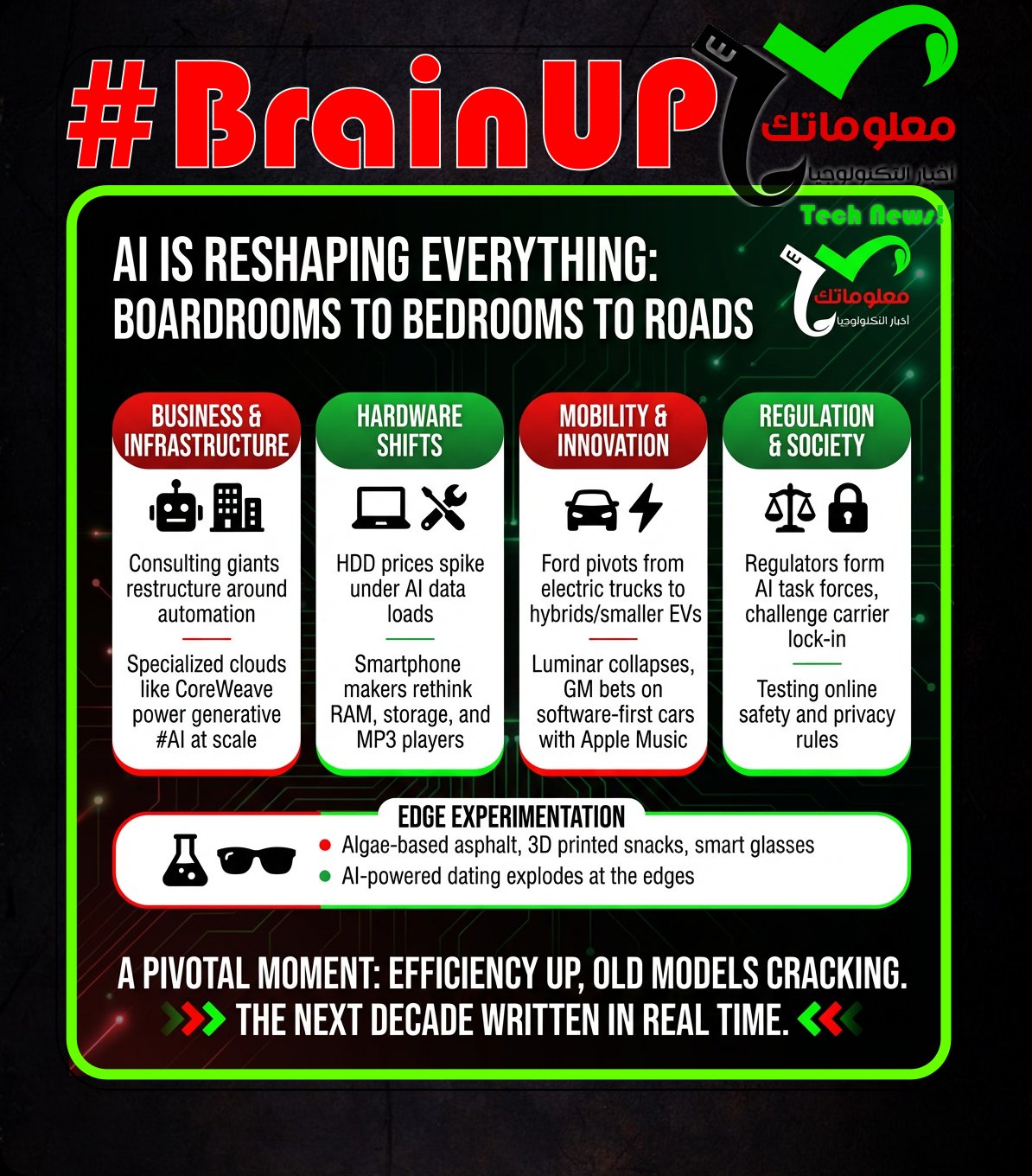
#BrainUp Daily Tech News – (Tuesday, December 16ᵗʰ)
Welcome to today’s curated collection of interesting links and insights for 2025/12/16. Our Hand-picked, AI-optimized system has processed and summarized 28 articles from all over the internet to bring you the latest technology news.
As previously aired🔴LIVE on Clubhouse, Chatter Social, Instagram, Twitch, X, YouTube, and TikTok.
Also available as a #Podcast on Apple 📻, Spotify🛜, Anghami, and Amazon🎧 or anywhere else you listen to podcasts.
1. McKinsey to make thousands of layoffs as AI advances
McKinsey plans to cut thousands of roles in some teams as rapid advances in #AI reshape its operations. Senior partners have discussed shrinking non-client-facing departments by as much as 10%, with Bloomberg estimating a few thousand layoffs over 18 to 24 months. The firm’s spokesman said the move is about improving the effectiveness and efficiency of its support functions while continuing to expand client deployment, a stance echoed by @Bob_Sternfels in September about fewer staff in non-client-deployed areas. McKinsey employs about 40,000 people, with roughly half in back-office roles. The moves reflect a broader trend of AI-enabled cost-cutting as seen in @Marc_Benioff’s Salesforce and at Klarna, which reduced or replaced a large portion of the workforce with AI.
2. Microsoft 365 Price Increase: What You Need to Know
Microsoft has announced a price increase for its Microsoft 365 subscription plans, affecting both business and consumer products. The adjustment reflects the added value from continuous feature updates, security enhancements, and better productivity tools integrated within the platform. This move aligns with industry trends where software-as-a-service providers update pricing to match evolving services and technological advancements. Users should anticipate changes in their billing statements and consider how the new pricing impacts their overall budget for digital tools. Staying informed about these updates helps businesses and individuals make strategic decisions regarding their cloud-based software investments.
3. Google To Retire ‘Dark Web Report’ Tool That Scanned for Leaked User Data
Google is retiring its free dark web monitoring tool after finding it less helpful than hoped. The feature scanned email addresses to check if they appeared in data breaches and alerted users to exposure details such as dates of birth, addresses, and phone numbers, but feedback showed it didn’t provide meaningful next steps #darkWebMonitoring #dataBreach. Google says it will focus on tools that give clearer, actionable steps to protect information online and will continue to defend users from online threats, including the dark web, while building better protections @Google. Scans will stop on January 15, and the dark web report will be gone by February 15, with paid Google One subscribers losing access as well. Users can turn to alternatives like HaveIBeenPwned for breach alerts @HaveIBeenPwned.
4. Payments Firm PayPal Files for Bank Charter in Lending Push
PayPal has filed for a bank charter with the Office of the Comptroller of the Currency as part of its strategy to expand into lending. This move aims to give PayPal greater control over its lending business, allowing it to offer credit products directly to consumers and merchants, reducing reliance on third-party banks. The bank charter would enable PayPal to handle deposits and broaden its financial services beyond payments, supporting its ambitions in the fintech sector. This regulatory step aligns with PayPal’s goal to compete with traditional banks and enhance its digital financial offerings by 2025. The company’s expansion into banking signifies a deeper integration of payments and lending under a unified platform.
The prices of hard disk drives (HDDs) have surged significantly, marking the largest increase in eight quarters due to rising demand from artificial intelligence (#AI) infrastructure and a push for PCs in China. Suppliers report that this price pressure is unlikely to ease soon, driven by the rapid expansion of data centers and heightened PC sales that strain the supply chain. The convergence of AI technology demands and China’s market dynamics creates a tight supply environment, impacting various sectors reliant on HDD storage. This trend highlights the ongoing challenges in balancing production capacity with escalating #tech industry requirements. As demand continues to rise, stakeholders should anticipate sustained price volatility in the HDD market.
6. UK to “encourage” Apple and Google to put nudity-blocking systems on phones
The UK government plans to encourage @Apple and @Google to embed #nudity-detection algorithms in their iOS and Android systems to block nude images unless users verify they are adults, aiming to extend device-level controls to protect children. The push, per a Financial Times report, is not a formal legal requirement for now but could become mandatory if talks stall, with adults needing age verification through biometric checks or official ID to access such content. The Home Office would start with mobile devices and may extend to desktops, while officials acknowledge concerns about user rights and the accuracy of the detectors and the privacy implications. Coming after the #OnlineSafetyAct, the move reflects wider #age-verification debates across countries and shows how tech firms’ privacy objections and regulatory pressure intersect.
7. Luminar files for Chapter 11 bankruptcy
Luminar, a company specializing in #LIDAR technology for autonomous vehicles, has filed for Chapter 11 bankruptcy protection. Despite being a key player in the industry with partnerships involving automakers like @Volvo, Luminar struggled financially amid intense competition and high costs. The bankruptcy filing allows Luminar to restructure its debts while continuing operations, aiming to stabilize and eventually grow. This development highlights the challenges facing the #autonomousvehicle sector where technology advancement and capital demands converge. Luminar’s move underscores the volatility in emerging tech markets and the necessity for strategic adjustments to survive.
8. In 2025, tech giants decided smart glasses are the next big thing
Smart glasses are being positioned as the next big thing in tech as 2025 nears, amid a sense that gadgets have grown boring and #smartwatches have not disrupted daily life. The piece contrasts #VR headsets with smart glasses, noting headsets are larger and more isolating, while smart glasses aim for a #mixedreality, mobile-first heads-up display. Smart glasses overlay helpful information while you stay aware of your surroundings, can be paired with a phone for data or notifications, and are not typically tethered to a PC full-time. The goal for smart glasses is to provide a mobile-first heads-up display that augments what you see with your eyes rather than replacing the real world. @Google plans to support both smart glasses and headsets with Android XR, and the Galaxy XR suggests that heavier devices may not suit all-day use yet, underscoring #AndroidXR as a platform that shapes adoption.
9. Verizon refused to unlock man’s iPhone, so he sued the carrier and won
Patrick Roach, a Kansas resident, bought a discounted iPhone 16e from Verizon’s Straight Talk brand with the plan to unlock it after activation and then switch it to his preferred network. Under the FCC rules and the unlocking policy in place when he bought the phone, Roach could expect it to unlock after activation. Verizon later changed its policy to require 60 days of paid active service before unlocking, a change implemented for TracFone brands and Verizon prepaid phones on April 1, 2025. Roach sued Verizon in small claims court and won; a Kansas magistrate judge ruled that the post-purchase policy change altered the device’s intended use and cited the Kansas Consumer Protection Act. The case highlights tensions between FCC unlock requirements and carrier policy changes, and raises questions about retroactive unlocking obligations for devices purchased under earlier terms @FCC #unlock #60days #KCPA
10. It’s Time to Give MP3 Players a Second Chance
The piece argues for giving MP3 players a second chance, noting that while streaming services like @Spotify transformed music discovery, they also face criticism over artist pay and AI-driven content. It spotlights modern #DAPs such as Snowsky’s Disc, which can store up to 2TB via microSD, features a circular touchscreen, multiple ports (3.5mm, 4.4mm, USB-C), and Bluetooth, all priced around 499 CNY (~$70). It emphasizes that dedicated DACs in these players can deliver cleaner sound than a phone’s DAC, with brands like #FiiO and #HiBy leading the way. Philosophically, separating hardware from the phone lets listeners focus on music without notifications, echoing a nostalgic appeal for a device that can be used anywhere without heavy internet requirements. In short, MP3 players are presented as a practical, high-fidelity alternative that blends nostalgia with modern capability and may complement or even replace certain streaming experiences for some listeners.
11. CoreWeave’s stock plunge highlights AI bubble concerns — Wall Street Journal
Shares of #CoreWeave, a major AI-infrastructure provider backed by #Nvidia GPUs and servicing customers like OpenAI and Meta, have fallen sharply in recent weeks, wiping out roughly $33 billion in market value as investors question the sustainability of its business model and broader AI spending patterns. The plunge reflects multiple pressures including a failed acquisition of Core Scientific, construction delays at a key Texas data center, rising costs to insure the company’s debt, and public criticism from short-seller Jim Chanos that framed CoreWeave as emblematic of an overheated #AI bubble. Analysts warn that the company’s thin profit margins and heavy reliance on debt financing raise doubts about whether its aggressive expansion will translate into long-term profitability. The selloff at CoreWeave has also fed wider market anxiety about the AI sector’s valuation and the risk that overinvestment in data centers and chips may not deliver the financial returns markets expected.
Definition: AI bubble
An AI bubble refers to a situation where investor enthusiasm and capital inflows into artificial intelligence companies, technologies, or related stocks drive valuations far above underlying economic fundamentals, creating a risk of sharp price corrections if growth expectations are not met. In such a scenario, high valuations are sustained more by hype and speculative sentiment than by sustainable profits, raising concerns that the market could experience a rapid downturn similar to the dot-com bubble of the early 2000s.
UK Prime Minister Sir Keir Starmer has expressed serious concern over Rockstar Games firing 31 developers allegedly involved in union activities related to the development of GTA 6. The alleged dismissals have sparked claims of union busting and workplace rights violations. In response, Sir Keir pledged that government ministers will investigate the matter to ensure fair treatment and uphold workers’ rights. This situation highlights ongoing tensions in the video game industry regarding labor organization and corporate responses. The government’s involvement underscores the importance of protecting employees’ rights in the evolving digital labor market.
13. Judge blocks Louisiana’s social media age verification law
A judge blocked Louisiana’s 2023 Secure Online Child Interaction and Age Limitation law, preventing enforcement of age verification and parental-control features on platforms such as Meta, Reddit, Snap, YouTube and Discord. Judge John W. deGravelles ruled that the law’s age-verification and parental-consent requirements are both over- and under-inclusive, and that its definition of ‘social media platform’ is nebulous. NetChoice argued the law would pose safety and privacy risks, with @Paul Taske calling it a massive privacy risk for Louisianans. The ruling signals limits to state-age-verification efforts and underscores ongoing debates about #privacy and #ageverification in online spaces.
14. SoundCloud Confirms Breach After Member Data Stolen, VPN Access Disrupted
@SoundCloud experienced a data breach that compromised member information and disrupted access to its VPN service. The company confirmed unauthorized access to its systems, leading to the theft of user data and temporary operational impacts. This breach highlights ongoing challenges in securing digital platforms amid evolving cyber threats. It underscores the importance of robust cybersecurity measures to protect user privacy and maintain service availability during incidents. The event serves as a reminder for companies to continuously improve defense mechanisms and response strategies.
15. OpenAI’s communications chief Hannah Wong exits after just seven months
Hannah Wong, OpenAI’s communications chief, has left the company after a brief tenure of seven months. Wong joined OpenAI to lead its communications strategy during a pivotal period of AI development and regulatory scrutiny. Her departure highlights ongoing shifts and challenges within prominent AI firms as they navigate rapid growth and public relations demands. This change may impact OpenAI’s engagement with media and policymakers as it continues to advance its #artificialintelligence initiatives. Wong’s exit underscores the dynamic and often volatile nature of leadership roles in fast-evolving tech sectors.
16. Denmark announces ban on VPNs to combat online crime
Denmark has introduced legislation to ban the use of #VPNs within its borders as part of a broader strategy to fight #onlinecrime and enhance cybersecurity. The government argues that banning VPNs will reduce anonymity for criminals engaging in illegal activities such as fraud and trafficking, making it easier for law enforcement to track and prosecute offenders. Critics warn that the ban could undermine online privacy rights and limit legitimate uses of VPNs by businesses and individuals seeking digital security. The move reflects a growing trend among governments to prioritize security over privacy in the digital realm, raising debates about the balance between surveillance and civil liberties. This policy aligns with Denmark’s commitment to protecting its citizens while navigating the complex challenges of digital governance.
17. Algae-based asphalt binder for roads developed
Researchers have developed a novel #asphalt binder derived from algae oils as a sustainable alternative for road construction. This bio-based binder addresses environmental concerns associated with traditional petroleum-based asphalt, which is energy-intensive and non-renewable. Tests indicate the algae-based binder performs comparably to conventional materials, showing promise in durability and flexibility. The innovation aligns with global efforts to reduce carbon emissions and enhance sustainability in infrastructure projects. Utilizing algae, a fast-growing and renewable resource, could transform the paving industry and contribute to eco-friendly road development.
18. A startup betting that AI can find your ‘soulmate’ has raised $4 million. Read its pitch deck.
Keeper, a dating startup founded in 2022, uses layered #AI models to claim it can pair people with their #soulmate and will tell users when someone could not be their soulmate rather than wasting time. It disclosed a $4 million pre-seed raised in October 2024 led by #Lightbank and Lakehouse Ventures, with Goodwater Capital and Champion Hill Ventures among participants, and says more than 1.5 million people signed up with about 300,000 accounts created, while 10% of beta dates reportedly led to marriage. Investors see #AI as an inflection point in the #dating app landscape and expect it to disrupt incumbents like Tinder and Bumble, while Keeper emphasizes its values and a #pronatalism alignment, noting current focus on heterosexual relationships with plans to support other genders later; this stance mirrors public discussions around @ElonMusk’s fertility remarks. As Keeper continues building its matchmaking tech toward product-market fit, its approach rests on a signal about potential life partners and may accelerate connections in #AI-assisted dating while remaining limited to heterosexual users for now.
19. Ford pulls the plug on the all-electric F-150 Lightning pickup truck
Ford is ending production of the all-electric F-150 Lightning and shifting its strategy toward hybrids and smaller, cheaper EVs. @Andrew Frick, president of Ford Blue and Ford model e, says the move follows customer demand and is grounded in the fact that the Lightning was a money-loser, even as a 2025 model started around $55,000 after a $40,000 launch. Ford will keep the Lightning name for a plug-in hybrid with a gasoline generator, and battery plants once intended for trucks will support the electric grid instead. The truck earned awards like 2023 MotorTrend Truck of the Year and was cited as the best-selling electric truck last quarter, and it offered outlets to power tools, appliances, and homes, but reliability issues and limited towing range eroded interest while Ford lost money on every vehicle. This shift signals the industry-wide pivot away from large, costly EV pickups toward #hybrids and #smaller-cheaper-EVs, with policy and cost dynamics shaping the path forward.
20. Creative Commons Announces Tentative Support for AI Pay-to-Crawl Systems
Creative Commons has expressed tentative support for AI pay-to-crawl systems, recognizing the growing need for regulated access to digital content by AI developers. These systems require AI companies to pay for crawling copyrighted materials, ensuring fair compensation for content creators while facilitating AI training. The discussion includes the potential for balancing intellectual property rights with technological innovation, as pay-to-crawl frameworks could prevent unrestricted scraping that harms creators’ interests. This approach aims to create a sustainable ecosystem where AI advancements do not come at the expense of original content producers. Creative Commons’ stance highlights an ongoing effort to align #copyright policies with the evolving demands of #AI development and digital content usage.
21. Microsoft will finally kill obsolete cipher that has wreaked decades of havoc
Microsoft will deprecate RC4 by mid-2026 and disable it by default in Windows Server domain authentication, ending RC4 as the default for Kerberos and reducing exposure to its long-standing weaknesses. RC4 has been supported since the 2000 rollout of Active Directory and remained a default in Kerberos-based authentication, a vulnerability that contributed to the Ascension breach and drew criticism from @RonWyden. By mid-2026, domain controller defaults for the Kerberos Key Distribution Center (#KDC) will be updated to only allow #AES-SHA1, and RC4 will be disabled by default unless explicitly configured by an administrator, reducing risk from #Kerberoasting. Microsoft is also releasing tools, including updates to #KDC logs that track RC4 requests and responses in Kerberos, to help identify any remaining systems relying on the cipher.
22. Scientists say printed food could change the way we eat
Nutri3D in Italy aims to reshape eating by 3D printing pastries from lab-grown plant cells and fruit residues, producing items like snack bars and ‘honey pearls’ while honoring Italy’s UNESCO-recognized gastronomic heritage. @SilviaMassa, who heads ENEA’s Agriculture 4.0 lab, says the goal is to keep making foods people are used to by using plant cells rather than growing the plant itself, a strategy driven by shrinking arable land and climate change. At @EltHub in Abruzzo, ENEA’s plant-based ‘inks’ are printed into shapes, with the team stressing the use of recovered by-products such as jam residues to enhance nutrition and flavor. The concept could extend beyond the kitchen, with @ErmannoPetricca describing snacks as ‘fruit for astronauts’ for space or conflict zones, and 59% of ENEA survey respondents were willing to try such foods, while some venues like @ImpactFood in Rome are already offering 3D-printed sliced meat. On Earth, 3D printing could enable tailored nutrition for dietary restrictions, illustrating how this #3DPrinting approach may gradually integrate into mainstream cuisine.
23. Microsoft recent Windows updates cause WSL networking issues
Recent Windows updates released by @Microsoft have caused networking issues affecting #WindowsSubsystemforLinux (WSL) users. The updates, including KB5021233 for Windows 11 and KB5021235 for Windows 10, have resulted in network adapter problems, loss of Wi-Fi connectivity, and broken proxy functionality within WSL environments. Users have reported inability to access the internet or connect to network shares through WSL after installing these updates. Microsoft is aware of the issue and suggests workarounds such as uninstalling the problematic updates or disabling IPv6 in WSL to restore network functionality temporarily. This situation highlights how critical Windows updates can inadvertently impact dependent technologies like WSL, emphasizing the need for thorough compatibility testing before rollout.
24. GM Bets You’ll Miss CarPlay Less With Built-In Apple Music Support
GM’s rollout of a native Apple Music app in models that don’t offer CarPlay signals a shift in its in-car ecosystem toward built-in streaming, not external CarPlay links. The feature will be included in the free @OnStarBasics package for 2025 and newer vehicles, with eight years of support and an over-the-air update to cover eligible ICE and EV models across brands, including Cadillacs that will gain #SpatialAudio with #DolbyAtmos where hardware supports it. This means drivers won’t need to poke at their phones to stream music, reducing distraction and eliminating extra costs, while #AppleMusic remains available without CarPlay. The rollout is phased, and GM says it will reach all eligible vehicles over time, signaling a gradual shift rather than an immediate replacement for CarPlay in its lineup. By embedding music apps and immersive audio, GM aligns with a broader industry move toward built-in media apps and could shape consumer expectations about what “free” vehicle software should include, while reinforcing the connection to @Apple for music streaming.
25. Return of 4GB RAM in Smartphones by 2026, Amidst DRAM Crisis; microSD Slots Make a Comeback
Smartphone manufacturers are expected to reintroduce 4GB RAM models by 2026 due to a continuing DRAM supply crisis impacting higher-capacity memory availability. This trend is driven by tight #DRAM market conditions leading to increased prices and scarcity, compelling brands to optimize costs and adjust their product strategies accordingly. Additionally, the microSD card slot, once phased out by many devices, is anticipated to make a comeback to offer expandable storage as internal options remain constrained. This shift reflects manufacturers’ adaptations to current component shortages while balancing performance and affordability for consumers. The evolving hardware landscape highlights the industry’s response to global supply chain disruptions affecting smartphone design choices.
26. Government Forms New Tech Force to Tackle AI Challenges
The government has established a specialized tech force aimed at addressing the rapid development and deployment of #ArtificialIntelligence technologies. This move comes in response to growing concerns about AI’s impact on security, privacy, and economic sectors, underlining the urgency to create robust frameworks. The team consists of leading experts and aims to collaborate across federal agencies to develop and enforce responsible AI policies. This effort reflects a strategic approach to balance innovation with ethical considerations and risk management. By forming this task force, the government signals its commitment to overseeing AI advancements while safeguarding public interest.
27. Elon Musk’s net worth hits estimated $600bn as SpaceX prepares for IPO
@Elon Musk became the first person to reach an estimated net worth of $600bn, driven in part by expectations that @SpaceX could go public at a valuation around $800bn. That valuation would lift his wealth by about $168bn to roughly $677bn as of 12pm ET. Musk’s roughly 12% stake in @Tesla has also contributed, with shares up 13% this year and up nearly 4% on Monday after Musk said robotaxis were being tested. His AI startup @xAI is in advanced talks to raise $15bn at a $230bn valuation. Requests for comment from Musk, @Tesla, @SpaceX, and @xAI were not immediately returned, and this snapshot illustrates how his tech- and space-focused holdings collectively shape his extraordinary wealth trajectory.
28. Payments firm PayPal files for bank charter in lending push
PayPal has filed for a bank charter with the Office of the Comptroller of the Currency (OCC) to expand its lending capabilities and reduce reliance on third-party banks. This move aims to enhance PayPal’s control over consumer deposits and loan issuance, aligning with its strategy to compete in financial services more directly. The filing reflects the growing trend of tech and payments firms seeking to integrate banking services to streamline operations and improve customer offerings. By obtaining a bank charter, PayPal could increase efficiency in underwriting personal loans and other financial products, potentially lowering costs and enhancing user experience. This step signals PayPal’s commitment to broadening its financial service footprint as digital payments and lending markets evolve.
29. 12 days of disaster loom for Earth in orbit around 2025
In late February to early March 2025, Earth will face a 12-day period posing an increased risk of disasters linked to space hazards, according to recent analyses. This window coincides with the planet’s orbit intersecting debris fields from past satellite collisions and fragments from defunct spacecraft, raising concerns about possible impacts on operational satellites and space missions. Researchers emphasize the importance of tracking space debris using advanced #space situational awareness technologies to mitigate potential disruptions. The event highlights the growing challenge of managing #space debris in Earth’s orbit, underscoring the need for international cooperation to ensure the safety and sustainability of space activity. Understanding and preparing for these temporal risk peaks is vital to protect both satellites essential for communication and earth observation and the astronauts aboard orbiting stations.
That’s all for today’s digest for 2025/12/16! We picked, and processed 28 Articles. Stay tuned for tomorrow’s collection of insights and discoveries.
Thanks, Patricia Zougheib and Dr Badawi, for curating the links
See you in the next one! 🚀
