
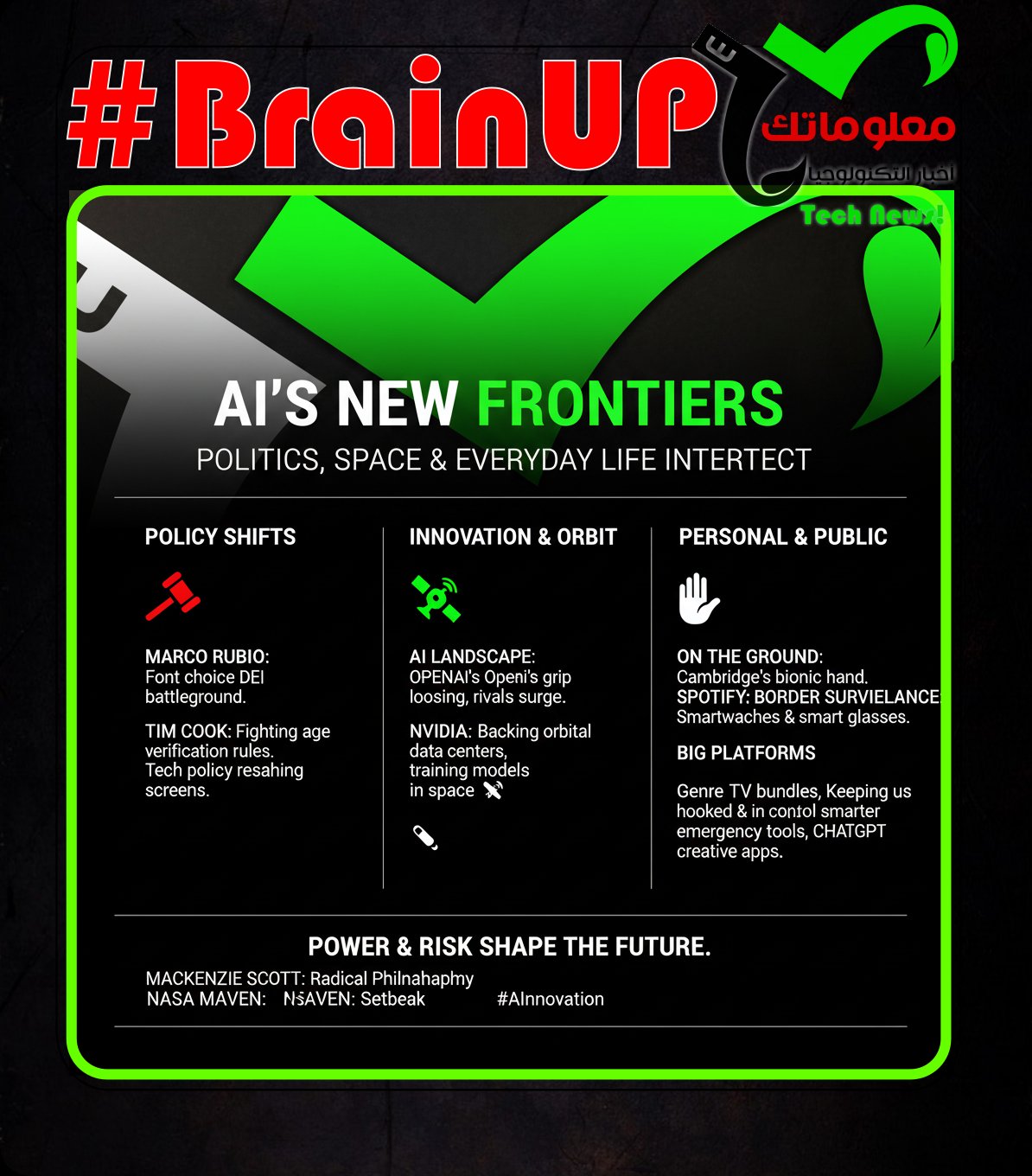
#BrainUp Daily Tech News – (Thursday, December 11ᵗʰ)
Welcome to today’s curated collection of interesting links and insights for 2025/12/11. Our Hand-picked, AI-optimized system has processed and summarized 23 articles from all over the internet to bring you the latest technology news.
As previously aired🔴LIVE on Clubhouse, Chatter Social, Instagram, Twitch, X, YouTube, and TikTok.
Also available as a #Podcast on Apple 📻, Spotify🛜, Anghami, and Amazon🎧 or anywhere else you listen to podcasts.
1. Marco Rubio bans Calibri font at State Department for being too DEI | TechCrunch
In a move tied to the administration’s stance on #DEI, @Marco Rubio bans Calibri as the State Department’s official font and orders Times New Roman for official documents to restore decorum and professionalism. Calibri was adopted in 2023 by the department’s then-DEI office, which has since been disbanded under Rubio’s directives, and the font was chosen to make documents easier to read for the vision-impaired. The memo frames the change as part of a broader push against #DEI initiatives, noting that there is debate about how much sans-serif fonts aid readability and that research on this is inconclusive. This move illustrates how #fontpolicy and #DEI dynamics influence government communications, turning typography into a signal of policy priorities rather than a mere stylistic choice.
2. Tim Cook Goes to Washington to Fight App Store Age Verification Legislation
@Tim Cook traveled to Washington to press against the #AppStoreAccountabilityAct, arguing it would require age verification and parental consent for apps and could compel disclosure of sensitive data. Cook told lawmakers that device-level age checks should not require birth certificates or government IDs and that parents should provide a child’s age when creating accounts, with data not kept by app stores or developers. Apple also cited @Hilary Ware’s letter warning the bill could threaten user privacy and urged privacy-forward approaches, including the #DeclaredAgeRangeAPI that lets parents share only an age range with developers and relying on existing #ScreenTime controls. Texas SB2420, which passed, requires age confirmation for new Apple Accounts starting Jan 1, 2026, illustrating the practical implications of age verification rules. The case highlights Apple’s effort to balance child safety with privacy rights as lawmakers weigh the tradeoffs.
3. OpenAI’s house of cards seems primed to collapse
OpenAI is in a far less commanding position than during the ChatGPT boom, with its lead in the #AI market steadily eroding as rivals surge ahead. By 2025, DeepSeek released its #R1_chain_of_thought model and its chatbot became the top free app on the US App Store, prompting OpenAI to respond with #o3-mini and Deep Research, even as #GPT-5 failed to meet expectations and seemed less capable than #GPT-4o. Anthropic leveraged the moment by signing a deal with Microsoft to bring #Claude to #Copilot365, signaling a shift in where Microsoft depends for Copilot, while Google released #Gemini3Pro, leapfrogging #GPT-5 and ranking at the top of #LM Arena, with #GPT-5 falling to sixth behind #Anthropic and #xAI. A December 2 WSJ report about @Sam Altman adds to the sense of heightened scrutiny over OpenAI’s trajectory, as leaders and investors reassess the company’s positioning. Taken together, the pattern of stronger rivals, a high-profile misstep with GPT-5, and ongoing industry shifts suggest OpenAI’s dominance is more fragile than it appeared a few years ago.
4. AI bionic hand grips like a human
Researchers at the University of Cambridge have developed an advanced AI-powered bionic hand capable of gripping objects with human-like precision and strength. The prosthetic uses machine learning algorithms to interpret nerve signals, allowing for intuitive and adaptive movements that closely mimic natural hand functions. This innovation enhances the user’s ability to perform complex tasks, addressing limitations of previous prosthetic technologies that lacked fine motor control. The development represents a significant step forward in #AI integration with robotics and prosthetics, improving the quality of life for amputees. Such technology demonstrates the potential of combining #machinelearning and #neuralinterfaces to create more responsive and functional prosthetic devices.
5. Spotify tests more personalized, AI-powered ‘Prompted Playlists’ | TechCrunch
Spotify is testing Promoted Playlists that give Premium users in New Zealand more control over its algorithm, using longer prompts and world knowledge to guide recommendations. The feature can consider your listening history from day one and lets you choose how often it refreshes, daily or weekly. It builds on the existing AI playlist option, offering descriptions and context for each recommendation and enabling prompts like music from top artists over the last five years plus deep cuts, or songs for a 30-minute 5K run with a cool-down. This approach aims to let users tailor a Discover Weekly-like playlist to a chosen genre, time period, or activity, reflecting @Spotify’s push into more explainable, user-driven AI curation #AI #PromptedPlaylists.
6. Nvidia-backed StarCloud trains first AI model in space with orbital data centers
StarCloud, supported by @Nvidia, has achieved a pioneering milestone by training the first AI model in space using orbital data centers. This innovation leverages the unique advantages of space environments, such as reduced latency and enhanced data security, to optimize AI processing capabilities. The project demonstrates how satellite-based infrastructure can complement terrestrial data centers, promising to transform global AI deployment and accessibility. By integrating advanced #AI training with space technology, StarCloud exemplifies the future potential of decentralized, resilient computing frameworks. This advancement not only pushes the boundaries of AI hardware deployment but also aligns with broader trends in space tech and cloud computing.
7. Oracle plummets 11% on weak revenue, pushing down AI stocks like Nvidia and CoreWeave
Oracle’s quarterly results beat on earnings but fell short on revenue, triggering an 11% drop in after-hours trading and weighing on AI stocks such as @Nvidia and @Meta. The company posted adjusted EPS of $2.26, ahead of the $1.64 consensus, but revenue of $16.06 billion missed the $16.21 billion estimate. Cloud revenue rose to $7.98 billion, with cloud infrastructure up 68% to $4.1 billion, while software revenue fell 3% to $5.88 billion. Remaining performance obligations surged 438% to $523 billion, driven by new commitments from @Meta and @Nvidia and others, signaling a large backlog of contracted but unrecognized revenue #RPO. Oracle guided for $1.70-$1.74 in adjusted EPS and 19%-21% revenue growth for the fiscal third quarter, while @OpenAI has committed to spending more than $300 billion on Oracle’s infrastructure over five years, underscoring the high-stakes race for #AI #infrastructure.
8. Man Charged for Wiping Phone Before CBP Could Search It
The Atlanta man @SamuelTunick has been arrested and charged for allegedly deleting data from a Google Pixel before a member of #CBP’s Tactical Terrorism Response Team could search it. Court records and social media posts reviewed by 404 Media identify him as Samuel Tunick, an Atlanta activist, with the charge centering on wiping the phone rather than the search itself. The exact circumstances around the search, such as why #CBP wanted to examine the device, are not known, and it is unusual to see someone charged specifically for wiping a phone that offers privacy features. The case highlights tensions between border agency data access and individual digital privacy, raising questions about when data deletion constitutes a crime and how security units handle mobile devices #privacy #digitalprivacy. It remains to be seen how prosecutors will frame the charges and how this case might influence future questions about data deletion and border searches #civilliberties.
ICE’s use of @BI_Inc’s #VeriWatch under the #AlternativeToDetention program extends surveillance to pregnant immigrants and fuels fear of detention during labor. In Colorado, a nine-month pregnant patient wore the device, which beeped on hospital entry and led her to worry that a dying battery would signal she was trying to disappear. She had recently been put on a deportation flight to Mexico, but the pilot refused to let her fly because she was so close to giving birth. During delivery, hospital staff faced uncertainty about whether the device could be removed safely and how to contact ICE, a situation that can jeopardize care when a C-section is needed. The report notes that she was one of three pregnant patients under such monitoring, illustrating how ATD protocols and wearable surveillance can deter seeking medical care and raise questions about patient safety and civil rights.
10. Border Patrol Agent Recorded Raid with Meta’s Ray-Ban Smart Glasses
A Border Patrol agent wore @Meta @Ray-Ban smart glasses during a recent immigration raid, with the recording light clearly on, despite a DHS ban on officers recording with personal devices. The new material from Charlotte, North Carolina shows the light illuminated, and CBP says it has no arrangement with Meta, indicating the glasses were personally sourced. This case underscores tensions between #privacy and #recording policies within #CBP and the broader #DHS, suggesting some officers may bypass rules when documenting operations with personal gear. It also invites scrutiny of how tech used by agents is documented and overseen, tying into the ongoing debate about transparency in immigration enforcement and the role of personal devices in accountability.
11. South Korea’s Hanwha, US defense startup Vatn to build underwater drones by 2026
South Korea’s Hanwha Systems has partnered with US defense startup Vatn to develop underwater drones by 2026, aiming to enhance maritime security and underwater surveillance. The collaboration leverages Hanwha’s experience in defense technology and Vatn’s innovative autonomous underwater vehicle expertise. This partnership reflects growing global demand for advanced marine robotics to address security challenges in maritime domains. The joint effort is expected to strengthen both companies’ market presence and contribute to broader defense modernization. This initiative highlights the strategic importance of autonomous underwater vehicles in future naval operations.
12. Android’s new emergency feature lets you live stream incidents to 911 dispatchers
Android is introducing a new emergency feature that allows users to live stream video directly to 911 dispatchers during critical situations, enhancing the communication between callers and emergency services. This feature integrates with Android’s existing Emergency Location Service, automatically sending precise location and sensor data alongside the video feed. By enabling dispatchers to see the scene in real time, it can improve response accuracy and speed, potentially saving lives during emergencies such as accidents, crimes, or medical crises. The integration reflects ongoing efforts by #Google and public safety organizations to leverage mobile technology for more effective emergency response. This update underscores the growing role of smartphones in public safety and the importance of improving #911 systems with innovative digital tools.
13. YouTube TV to launch genre-based subscription plans in 2026 | TechCrunch
More than 10 genre-specific channel packages are coming to YouTube TV in early 2026, marking the first break-up of its traditional bundle and giving viewers greater control over what they pay for on #YouTubeTV. A dedicated sports package will include major broadcasters and networks (FS1, NBC Sports Network, all #ESPN networks, ESPN Unlimited) with optional add-ons like NFL Sunday Ticket and RedZone, while packages for #news, #family, and #entertainment will also be offered; the core features—unlimited DVR, multiview, key plays, and fantasy view—will remain, and the base price stays at $82.99/month, though pricing for the new bundles hasn’t been announced. This move mirrors competitors’ shifts toward cheaper, genre-focused options from providers like #DirecTV, #Fubo, and #SlingTV, appealing to viewers who want lower costs or to avoid price hikes. As @Christian Oestlien, YouTube VP, head of subscriptions, notes, the goal is to tailor subscriptions with more options, allowing users to choose plans that best fit their interests.
14. SK hynix ponders US stock market listing through ADR as AI chip demand soars
SK hynix is considering listing its shares on the US stock market through American Depository Receipts (ADRs) to capitalize on the surging demand for AI chips. CEO Lee Seok-hee highlighted the company’s strategic focus on expanding its presence in the global market while meeting growing needs driven by artificial intelligence advancements. The move aims to attract more international investors and enhance liquidity, aligning with the company’s ambition to strengthen its competitiveness in the semiconductor industry. This potential listing reflects SK hynix’s proactive approach to leveraging market opportunities presented by the increasing reliance on AI technologies. The decision underscores the broader trend of semiconductor firms seeking global market access amid rising demand for specialized chips.
15. Adobe introduces ChatGPT-powered features in Photoshop and Acrobat Express apps
Adobe has integrated #OpenAI’s ChatGPT technology into its Photoshop on desktop and Acrobat Express apps to enhance user creativity and productivity. Photoshop’s version 26.0 introduces a new Photoshop Beta with generative AI tools powered by Adobe Firefly, allowing users to create, modify, and expand images using natural language prompts. Similarly, Acrobat Express now supports a ChatGPT-powered assistant that helps users summarize, simplify, and generate text based on documents. These features demonstrate Adobe’s commitment to embedding AI capabilities directly within its software ecosystem to streamline workflows and empower users. By combining powerful generative AI with established creative tools, Adobe is advancing how users interact with and produce digital content.
16. Google announces PC Connect for Android XR, enabling virtual desktop experiences
Google has introduced PC Connect for Android XR, a feature that allows users to connect their Android XR devices to a PC for virtual desktop experiences. This capability enables users to stream their PC content, like games and apps, directly to the Android XR headset, enhancing productivity and entertainment options. Google highlights integration with existing Android features and XR platforms, aiming to expand use cases for XR devices beyond gaming to include work and media consumption. The feature promises seamless connectivity and high performance, making XR devices more versatile as personal computing tools. This move aligns with Google’s broader strategy to foster a more connected and immersive digital ecosystem across multiple device types.
17. Amazon’s Color Kindle Scribe Leaves Me Sending Love Letters to Other Ereaders
The Kindle Scribe Colorsoft adds a large color #colorEInk screen and solid note-taking that suits reading comics, but its high price and limited non-Amazon content keep it from matching traditional tablets. At $629.99 (plus separate stylus options) with a slim 14.1 oz frame and a mostly symmetrical Graphite or Fig design, it includes a Premium Pen that attaches magnetically and offers writing feel close to pencil on paper. However, the color screen lacks the vibrancy and brightness of LCD/OLED, and the device is not waterproof like smaller Kindles, limiting its everyday versatility. When stacked against the @OnyxBoox Note Air 4C, which costs less and runs an Android-based system for broader flexibility, the Colorsoft loses much of its appeal, though it remains our Editors’ Choice for large color ereaders. For readers who want color and handwriting with quality stylus input, it can work, but for value and flexibility, there are better options.
18. Don’t Wait for the iPhone 18. It’s Fine to Buy the iPhone 17
If you want a new iPhone within the next year, it’s fine to buy the #iPhone17 now rather than waiting for the rumored #iPhone18, which Apple hasn’t announced and whose release date remains uncertain. The #iPhone17 is a strong upgrade with a 6.3-inch display, a variable 1 to 120Hz ProMotion, an always-on display, dual 48-megapixel rear cameras, an 18-megapixel selfie camera with Center Stage, solid battery life, and a Pro model with a beefier #A19 Pro chip that earned a @CNET Editor’s Choice award. Rumors about #iPhone18 include features like variable aperture cameras, under-display Face ID, a smaller Dynamic Island, an #A20 chip, and new colors, but these are speculative and the release could slip to early 2027. Thus, for most users upgrading from an iPhone 14 or earlier, choosing the proven #iPhone17 now makes more sense than waiting for a model that may not materialize on a predictable timetable.
19. Galaxy Z TriFold’s fingerprint reader is something special
21. Instagram gives users control of their algorithms in new feature
Instagram launched a new AI-powered feature called “Your Algorithm” that lets users see and edit the topics shaping their #algorithmic content recommendations in the Reels feed. The tool shows an AI-derived list of a user’s inferred interests based on engagement and allows adding, removing, or highlighting topics to tailor what videos are recommended going forward, giving people more influence over their personalized feed. This change arrives amid industry and regulatory pressure for greater transparency and control over how #AI drives social media curation, signaling a shift toward more user-centric algorithmic design.
22. Fed lowers interest rates but future cuts remain uncertain
The US Federal Reserve reduced its benchmark rate by 0.25 percentage points to a range of 3.50 to 3.75 percent, marking its third cut this year, but internal disagreement among policymakers has created uncertainty over whether more reductions will follow. @JeromePowell emphasized the need to observe how previous cuts filter through the economy as officials weigh a weakening job market against persistent inflation above the Fed’s 2 percent target. Three officials dissented, with Stephen Miran pushing for a larger cut while @AustanGoolsbee and Jeffrey Schmid preferred no cut at all. The unemployment rate has inched upward to 4.4 percent and tariffs are contributing to certain price pressures, yet recent softer inflation readings allowed the Fed to prioritize labor market support. Political pressure from @DonaldTrump, who called for deeper cuts and is searching for Powell’s successor, adds further volatility as candidates like @KevinHassett face questions about independence. With fresh labor and inflation data expected soon, the Fed’s outlook for 2026 could shift depending on whether economic indicators signal continued slowdown or stabilization.
23. Mackenzie Scott makes a pledge to give away her fortune by 2025
@Mackenzie Scott has committed to giving away the majority of her fortune by 2025 as part of her philanthropic mission to promote social equity and support underserved communities. She has already donated billions to various charities focused on racial justice, economic mobility, and public health, demonstrating a strategic approach to targeted, impactful giving. Scott’s approach challenges traditional philanthropy by emphasizing speed, flexibility, and trust in grantees’ expertise, fostering innovation and systemic change. This commitment underscores a growing movement among wealthy individuals to rethink charitable giving for more immediate and equitable impact. Her pledge highlights a shift in #philanthropy toward addressing social disparities proactively and inclusively.
24. NASA Confirms It Has Lost Contact With Mars Orbiter MAVEN
NASA has lost contact with the MAVEN orbiter, which has been studying Mars since 2014 and is part of a fleet of seven orbiters observing the planet, a reminder of the ongoing effort to understand #Mars and its environment @NASA. The signal was lost on 6 December 2025 as MAVEN passed behind Mars, and when it re-emerged NASA ground control could not reestablish a connection, with officials saying they are investigating the anomaly and will share more information @MAVEN. Launched in 2013 and arriving at Mars in September 2014, MAVEN studied the upper atmosphere and ionosphere and their interaction with the solar wind, helping explain how atmospheric loss occurred and how Mars evolved from a once wet world to the cold, dry planet we see today #MarsAtmosphere #Ionosphere #SolarWind. Its data revealed atmospheric loss as the escape route for water, mapped Martian winds, exposed Mars’ invisible magnetic tail, discovered the sputtering mechanism and even revealed a new proton aurora, contributing to understanding planetary evolution and habitability #PlanetaryEvolution #Habitability. The orbiter also carries a UHF radio to serve as part of the data relay network between @NASA’s surface rovers #Curiosity and #Perseverance and Earth, so resolving this anomaly could help protect other missions and support ongoing Mars operations; NASA said more information would be shared as it becomes available @NASA.
25. Google Photos launches new video editing tools
Google Photos has introduced new video editing tools to enhance user creativity and content management. These tools include features like video cropping, filters, and the ability to adjust playback speed, expanding beyond traditional photo editing capabilities. The update leverages Google’s expertise in AI and machine learning to provide intuitive and accessible video edits for everyday users. This development aligns with the growing demand for easy-to-use multimedia editing on mobile and cloud platforms. By integrating these functionalities, Google Photos strengthens its position in digital content creation and sharing.
That’s all for today’s digest for 2025/12/11! We picked, and processed 23 Articles. Stay tuned for tomorrow’s collection of insights and discoveries.
Thanks, Patricia Zougheib and Dr Badawi, for curating the links
See you in the next one! 🚀
